Category Archives: Officer Corps

Pavel Baev on Politics and the Military

Last week BFM.ru interviewed Pavel Baev of Peace Research Institute Oslo about Russia’s military reforms.  Baev’s view of the reality of ongoing reforms is captured in one word — catastrophic. 

Now Baev doesn’t get everything exactly.  Some military policy changes — like the one-year draft and a new, higher military pay system — were made some time ago, not necessarily for the 2012 presidential election. 

But he’s right about lots of other things.  Some decisions made in Defense Minister Serdyukov’s reforms haven’t meshed, or even been antithetical.  Decisions like higher pay have become, like it or not, part of the electoral picture, and the leadership has to follow through.

Baev believes the army might not be combat capable due to personnel cuts.  He allows for the possibility that Serdyukov might be sacrificed by his political masters.  The Kremlin and White House are using pay and apartments to keep serving officers politically quiescent.  But Baev thinks these aren’t enough; at some point, the army will insist on having its combat capability restored.  He hints later that the state and inclinations of the army were factors in the recent Arab revolutions that overturned long-time rulers.

The interviewer asks Baev to reconcile Prime Minister Putin’s Duma session last week in which he emphasized using the defense budget at home to create good, high technology jobs in Russia with President Medvedev’s [and Putin’s] statements about the failure of the state defense order:

“It seems to me that on the whole in the realm of military reform, and the Gosoboronzakaz in particular, there are very many concealed problems which Putin generally didn’t talk about.  The speech [Putin’s Duma speech], in large measure, on the whole was very unproblematic.  Somehow everything was more about achievements, future developments, very little about problems.  In the military arena, many problems have accumulated, and in the course of military reform not a few new ones were created.  The situation is very complicated, and attempts to correct the situation somehow largely lead to problems becoming even more acute, particularly problems with personnel.”

Baev went on to say that the Gosoboronzakaz and the problems of buying new military equipment have reached a critical point because of the aging of current weapons systems.  There is, he says, an undercover battle over what to buy and, especially, what should be bought abroad.  The situation around Mistral has become so complicated and political that it’s now more a “special operation” than an export contract.

Baev says the Russian Navy didn’t really want such ships, but went with the idea when it was foisted on them.  The real struggle and lobbying over Mistral concerns which shipyard in Russia will build units 3 and 4, according to Baev.  He suggests the whole deal might have been French President Sarkozy’s way of placing a bet on President Medvedev to be Russia’s future leader, and organizing the “political climate” in Europe toward this end.  But right now, of course, the Mistral deal looks very uncertain.

BFM.ru asked Baev for his interim assessment of the military reforms begun in late 2008:

“Purely catastrophic.  In every reform, there’s such a moment when the old thing is no longer working, and the new one isn’t working yet.  At this critical moment for any reform, we have a situation when nothing is working; where to move — either forward along the path of reforms or to try to work back, — is in large measure a political question.  Just in the area of Armed Forces personnel policy, an unknown number of things have been botched.  The initiatives advanced, — cutting the officer corps, contract service, sergeant training, cutting the conscription term — each of them has its own basis, but they’re absolutely mismatched.  That is, we now have a situation with military personnel when the army is in fact not combat capable.”

Asked about military pay raises planned for next year, Baev says:

“I think the main sense of this initiative is still to lift the officer corps’ very obvious dissatisfaction with all these reforms.  Great potential dissatisfaction has built up in the army, it is focused more or less on the minister, which, they most likely will sacrifice.  But this isn’t enough to lift this dissatisfaction, but the promised money plus the long ago promised apartments, and they are still gradually giving them out, — this is somewhat capable of  damping down this dissatisfaction.  And the fact that they are promising lieutenants, — for young officers it sounds completely improbable, and, most likely, they are prepared to wait for such money.”

“It’s perfectly obvious that very many political initiatives are aimed at this critical electoral sector — to lift the tension now, to make so that the army sits quietly in its barracks, not speaking out, waiting for its money and apartments, — and everything.  These are purely short-term things, which can help get through a complex electoral period.  It seems no one particularly looks after this [military] sector, inasmuch as, generally, for officers money is money, but they are people of service.  If even in addition they pay the money, service doesn’t go because they aren’t succeeding in reforming the Armed Forces so that they become combat capable, then this is a more serious source of dissatisfaction than simply a lack of money.”

“. . . the Armed Forces are the only area where genuinely serious and deep reforms are going on.  But with reforms, problems always take on a new character, change.  Here some kind of forward dynamic is occurring, it isn’t going in circles.  But the lack of resolution of these problems in the absence of political will is very evident, and all political will is going now to electoral projects which aren’t clear how they will be implemented because it’s not clear to anyone who in the end will be Supreme CINC, that is also a question of no small importance for the Armed Forces.”

Baev sees a lesson for Russia and the Russian Army in the Arab revolutions:

“But it’s clear that several conclusion flow from the Arab revolutions, and not just in relation to missile systems, but in the fact that the army is a serious political force.  This is more the conclusion of events not in Libya, but of the situation in Egypt.  And attempts somehow to neutralize the politicization of the army grow more from here [Egypt], than from Libya, where the army was in a pitiful condition, from here [Libya] also, in large measure, there is a civil war.  If there were a powerful army there, such a thing [civil war] wouldn’t have occurred.”

He finishes by talking about obsession with ultra-modern weapons when existing systems are perfect for today’s armed warfare.  His discussion leads to an open question about the fit between Russia’s military doctrine and its future armament plans:

“Therefore, the conversation about how we realistically need to outfit the Russian Armed Forces depends largely on whom we intend to fight, where we intend to employ these Armed Forces, against what kind of potential enemies, — answers to all these questions don’t exist, the doctrine doesn’t provide these answers.  It’s essential to replace weapons systems which have already outlived their time, but whether it’s necessary to replace them with the most super modern systems, — this is still a question.”

The Price of Military Labor

Today Voyenno-promyshlennyy kuryer published what it says is the nearly complete version of new military pay and pension rates that will be reviewed by the Defense Ministry and other power ministries by 20 May, and passed on to the Duma not later than 22 June for approval.  There might, says VPK, be some changes and amendments as parliaments are want to make.  But expect the package to become law by early July at the latest.  The new pay rates will be implemented for the Defense Ministry, as long promised, on 1 January 2012, and a year later for other power ministries.

In the following graphic, VPK shows duty and rank pay for some military men.

Duty and Rank Pay

This is just a foretaste of the data presented.  Of course, duty pay is the more significant component.  It’s why some officers outside the TO&E, i.e. without duties, are hurting so badly — they don’t get this big chunk of pay.

But what it says is a sergeant who’s the upper grade of two for section commander gets 6,500 rubles for his rank and 15,000 rubles for his duty or position pay, or 21,500 rubles per month.  But let’s call this “base” pay onto which other supplements are added.  A general-colonel serving as a deputy defense minister would get 64,000 rubles in “base” pay per month.

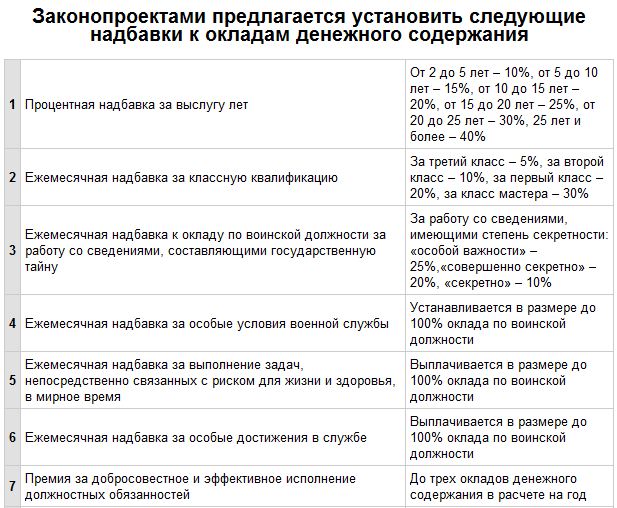
Supplements and coefficients are calculated for years served, class qualifications, work with state secrets, service under special [usually climatological] conditions, etc.  The following graphic shows part of the list.  It actually runs up to nine different supplements and coefficients.

Supplementary Pay

Supplements are sometimes calculated on duty pay; other times on combined duty and rank pay.  Let’s say our section commander sergeant has served 10 years, has a second class qualification, works with secret information, and serves with Russian troops in Tajikistan — he would add 4,300 and 2,150 and 1,500 and perhaps 15,000 to that “base” of 21,500.  His supplemented pay becomes 44,450 rubles per month — not bad, but this would likely be an exceptional case we’ve made just for illustration purposes.

Note that items 6 and 7 on the supplement chart are Defense Minister Serdyukov’s “premium” pay supplements for outstanding performance.  They allow officers to double their duty pay or even triple their combined duty and rank pay.  “Premium” pay was a stopgap to raise military salaries until a new, higher pay system could be devised.  But VPK makes it look like this will become a permanent feature of the new system.

The draft law sets out lots of other special payments and benefits to servicemen for this and that, relocation, death, injury, dismissal, etc.

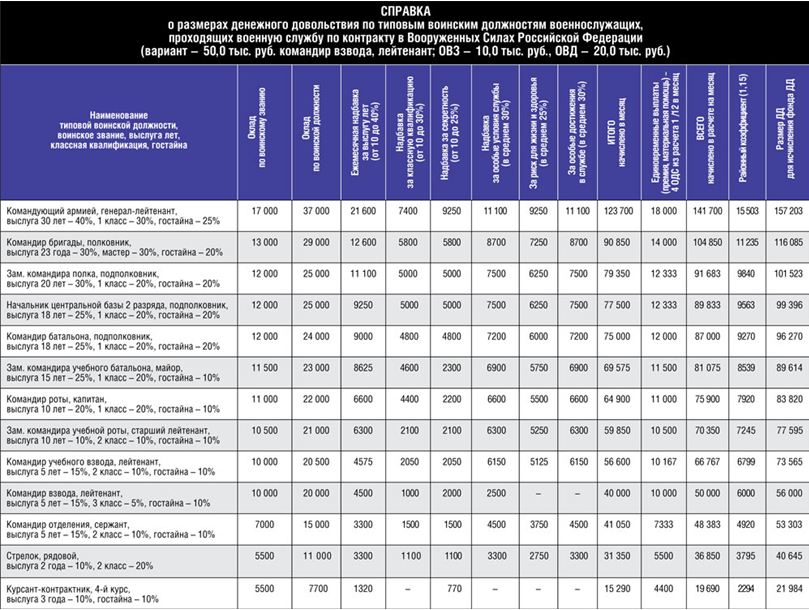
The following graphic provides some examples of what officers and soldiers will make.

Some Pay Examples

This shows the kind of lieutenant platoon commander that Medvedev, Putin, and Serdyukov have described earning over 50,000 rubles per month.  And our putative section commander sergeant . . . it lists him at about what we estimated 41,000 rubles or so, plus other supplements that take him over 50,000 too.

There’s an exemplar pension chart for those that are interested, and below is a snip of the 50-grade schedule the military uses.  If you view the entire chart, grade 50 is for a first deputy minister, there are two grades for MD commanders, and seven different ones for deputy army commanders, so on and so forth.

Grade Schedule

 What’s it all mean?  Again, this pay reform is a thing both necessary and long in coming.  It’s also going to be very expensive at a time when there’ll be lots of other outlays for the GPV, for contract enlisted, for military housing, for better military infrastructure, etc.  It won’t be easy.  But it seems to be a priority.  The difficulty is that it’s very hard to move forward on all military reform fronts at once.  We’ll have to watch to see which areas are treated with preference or, alternatively, neglected.

Another Trouble Brigade

Today’s Presidential ukaz on military personnel changes is attracting attention because it relieved and dismissed General-Lieutenant Vadim Volkovitsky from the service.  Of late Volkovitskiy was First Deputy CINC of the Air Forces (VVS), and Chief of the Main Staff. 

General-Lieutenant Volkovitskiy

He’s a career air defender who’s been a two-star for the last ten years.  He’ll be 55, statutory retirement age next Friday.  He commanded air and air defense troops in the Urals in 2006, and came to Moscow and the VVS headquarters in 2007.

We don’t really know why Volkovitskiy’s going out right on time, but it does seem President Medvedev and Defense Minister Serdyukov have made an effort to keep senior officers from serving forever.

God-Forsaken Pechenga

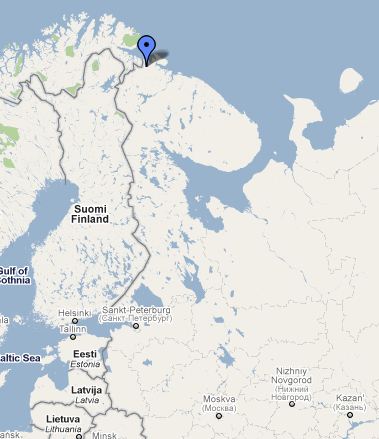
Far more interesting is the President relieving Colonel Vitaliy Leonidovich Razgonov, Commander of the 200th Independent Motorized Rifle Brigade based at god-forsaken Pechenga.  He’s only been commander there for 18 months. 

The 200th Brigade remains in its Cold War deployment along the Russian border with Norway.  It’s probably not what the Defense Ministry has in mind for its future Arctic brigade. 

This brigade has more than its share of trouble, and Colonel Razgonov’s apparent inability to control his men might — repeat might — have something to do with the change of command.  The ukaz, of course, gives no reason.

Just on Monday, Komsomolskaya pravda published on all of v / ch 08275’s problems.  The paper’s reporters say this command is unable to maintain elementary order.  The brigade’s officers complain that today’s young men are already so corrupted that the army can’t fix them, and that they don’t have any tools to deal with disorder among their men.  But KP says the soldiers don’t look disorderly during the day, but become that way at night when they’re unsupervised in the barracks.  The paper suggests the officers themselves are corrupt and disorderly at Pechenga.

Several weeks ago a conscript from Dagestan got three and a half years for killing an ethnic Russian junior sergeant in June 2010.  The command initially tried to make it look like an accident rather than murder.  Svpressa.ru suggests 4 or 5 men from Dagestan beat the victim.  The Soldiers’ Mothers Committee helped his family get the military prosecutors on the case.

Another conscript was beaten severely right on the brigade’s parade ground in early March.  According to IA Regnum, the young man — a graduate of the Murmansk School of Music — had two operations and his spleen was removed.

Last September a conscript shot and killed another conscript before shooting himself to death.  The parents of the shooter don’t believe this version of what happened, and have turned to the Soldiers’ Mothers Committee for help.

Last May, the chief of the brigade’s missile-artillery service stabbed his wife and six-year-old son to death.  He was subsequently diagnosed as a paranoid-schizophrenic.  This can happen anywhere, but it’s interesting it happened in a place already so afflicted with misfortune.  One wonders if there isn’t more to the story.

Where does this leave us?

It’s hard to say.  All the evidence of trouble is, so to say, circumstantial when it comes to Colonel Razgonov and whether he’s up to the job or has been derelict.  We don’t have enough information.  Maybe Razgonov himself asked to be relieved.  Who knows?  But it may be that someone in the chain, in the Defense Ministry or elsewhere, recognized a situation that needs to change.  The question now is will it?

Mukhin on the Army’s Protest Mood

According to Nezavisimaya gazeta’s Vladimir Mukhin, Defense Minister Serdyukov has lost the confidence of his bosses, as well as his carte blanche to reform the Armed Forces.  NG’s Kremlin source claims Serdyukov’s initiatives will be vetted at higher levels (i.e. the Sovbez and President) in the future.  But can there really be any initiatives left at this point?  Isn’t it all either implementation or reversal at this point?

President Medvedev’s press-secretary quickly denied that responsibility for military reform is being transferred elsewhere, and insisted it remains with the Supreme Commander-in-Chief and his Defense Minister (but what about Putin?).  She called Mukhin’s report a “lie,” and said only Medvedev and Serdyukov answer for Armed Forces reform, while others just “contribute to it.”

Mukhin covers Putin’s trip to Kaliningrad about military housing where he was told about discontent among military retirees and he promised a 50-70 percent increase in their pensions.  General-Lieutenant Netkachev blames Putin for letting military pensions slip from three times to barely equal to a normal labor pension.

Mukhin’s final interlocutor cites Finance Minister Kudrin on the cost of these political promises to the military increasing Russia’s defense burden from 3 to 4.5 percent of its GDP.

It’s worth including all of Mukhin’s article:

“Election Candy for the Military Electorate.  The Party of Power Struggles for the Votes of Veterans and Servicemen.”

“The fundamental steps connected with reforming the army will now be implemented not by the military department itself, but by the Security Council (SB), where the main director of this work will be the Deputy Secretary of the SB, ex-Chief of the General Staff Yuriy Baluyevskiy.  A Kremlin source has told ‘NG’ such information.  It notes that in its responsibilities, the Sovbez is charged with supervising the general work of the government and power structures in creating a positive image of the main activities of military organizational development, especially in the social sphere for officers and retirees and their family members.”
 
“So it is that the carte blanche given to Anatoliy Serdyukov several years ago by Vladimir Putin for a radical reorganization of the country’s Armed Forces is now canceled.  Further reforms will be agreed at a higher level and, of course, with the participation of Dmitriy Medvedev’s team.  As an SB source notes, Prime Minister and United Russia leader Vladimir Putin agreed to such steps for two reasons.  First, the image of the country’s military-political leadership was recently severely shaken, and the protest mood among a large number of serving military personnel and retirees is growing.  Taking into account the experience of the Arab revolutions, the tandem, apparently, decided to secure itself.  Secondly, the electoral battle has pushed the party of power to correct steps in the army’s reform and especially in social issues.”

“Vladimir Putin’s 23 February trip to Kaliningrad, where he, along with General Staff Chief Nikolay Makarov, Deputy Defense Minister Grigoriy Naginskiy, and other government officials met about the housing problems of servicemen and where he met with residents as UR leader, was evidently connected to these factors.  These meetings happened at the same moment when on Poklonnaya Gora in the capital, the Union of Airborne of Russia (SDR) demanded the Defense Minister’s resignation, when on the Arbat [location of the Defense Ministry’s buildings] under the flags of [the political party] ‘Yabloko,’ military retirees demonstrated demanding doubled pensions, when on Pushkin Square in Moscow and Lenin Square in St. Petersburg communist-veterans demanded a solution to the housing problems of servicemen.  Television didn’t show these and other protest actions, occurring in many regions, at all.  On the other hand, all central television channels broadcast Putin’s visit to Kaliningrad.”

“Against this background, ‘Finans’ magazine published its latest list of [ruble] billionaires in Russia, where under number 163 current Deputy Defense Minister and United Russia activist Gregoriy Naginskiy was noted.  On the list, he is noted as founder of the engineering firm ‘Titan-2’ which is involved in construction.  His personal wealth is estimated at 20.7 billion rubles.  We note that in the Defense Ministry Naginskiy is also in charge of construction issues.”

“At a meeting with Putin, one of the leaders of the Kaliningrad veterans movement, former chief of the 11th Army’s political department, General-Major Boris Kosenkov handed the Premier a ‘little extremist manifesto’ being disseminated among veterans in Kaliningrad.  At the same time, talking about low pensions for retirees, the general stressed that ‘a very tense situation is being created in our veterans’ organization structures and political parties are even using this problem in the election campaign.’  As is well-known, there’s no such thing as a former political worker, and the veteran precisely seized the moment to enlighten the Premier about the mood among military pensioners.  Vladimir Putin had no choice but to agree with the fact that ‘really the situation with pension support for servicemen doesn’t correspond to the principles on which it was formed in previous years.  And according to recent data, for about 40% of military pensioners (or, maybe, even a little more), the pension is already either equal, or even a little less than a labor pension.’  Putin immediately promised that the ‘increase in military pensions will be substantial.  It will be an increase of about 1.5 times, about in the range of 70%.’”

“‘Let them, of course, raise pensions.  But now this looks like pure PR,’ believes General-Lieutenant Yuriy Netkachev, advisor to the Association of Social Defense for Veterans of ‘Rus’ Special Sub-Units.  ‘In 2000, when Vladimir Putin became President, military pensions were on average three times more than civilian ones.  Now they are much lower.  Who stopped the current authorities from keeping our pensions at the previous level?'”

“Academy of Military Sciences Correspondent-Member Colonel Eduard Rodyukov draws attention to another fact.  ‘In Kaliningrad, Putin promised to allocate another 150 billion rubles to solve all the housing problems of servicemen and military pensioners.  President Dmitriy Medvedev has once again pledged that from 2012 the salaries of officers will increase several times. In Finance Minister Aleksey Kudrin’s opinion, all these transformations, as well as realization of rearmament programs, which the President and Prime Minister proudly proclaim, will require increased defense spending of at least 1.5% of the country’s gross domestic product.  That is the total expenditures in the military budget next year will be 4.5% of GDP.  For comparison:  in the U.S. about 3.5% of GDP is spent on defense.’  Rodyukov draws attention to the fact that in Russia wars are not foreseen in the near future.  But spending on defense will be very great.  ‘This will lead to increased problems in the economy.  Or is there a possibility that militarization simply won’t occur, and this means the military’s negative attitude in society will exacerbate further.’ Rodyukov supposes.”

Golts on the Sudden Increase in Officers

Yezhednevnyy zhurnal’s Aleksandr Golts says Defense Minister Anatoliy Serdyukov’s explanation that 70,000 more officers are needed because of VKO doesn’t hold water since it will be created on the basis of existing formations and units.

Golts concludes that Russian military reform has reached its next turning point.  He recalls that cutting officers to 150,000 and eliminating a large number of cadre formations and units represented the rejection of the old mass mobilization army concept.

But the reduction of so many officers could not but bring bitter opposition.  Nevertheless, Serdyukov stubbornly implemented the cuts, ignoring cries about the destruction of the country’s glorious officer corps (which Golts says hasn’t existed in a very long time).

Then suddenly the chief of the military department reversed himself.  Suddenly, it appears there are not too many officers, but a shortage.  The Armed Forces agonizingly cut 200,000 officer positions just to reintroduce 70,000!

Golts thinks there are several possible reasons.

The most obvious is the state’s inability to meet its obligations (primarily permanent apartments) to dismissed officers.  In mid-2010, there was information about 70,000 officers outside the shtat (штат or TO&E).  Later in the year, the number given was 40,000.  But says Golts:

“. . . to find out how many officers are really outside the shtat is impossible:  whatever figure Defense Ministry officials want to name, they name.  It’s possible to suppose that, having realized their inability to settle up with future retirees, the military department simply decided to put them back in the shtat.”

The second possible cause, according to Golts, is that the Defense Ministry failed to fill the officer posts it cut with well-trained sergeants and civilian personnel because the wages it offered were too low.  On the issue of more sergeants, Golts concludes:

“Sergeant training programs are failing.  Training centers simply can’t put out as many junior commanders as the Armed Forces need – they require not less than 100 thousand.  There’s no where to get them from.  And so they decided again to use officers to perform sergeant functions in combat sub-units, as rear service guys, service personnel.  If so, then this is a serious blow to reform.  Because the officer will cease being the elite of the Armed Forces, again turning into a low-level functionary.”

And Golts provides his third, worst case possibility:

“The generals convinced the president, but most of all, the premier [Putin] that it’s possible to achieve combat readiness by returning to the old mobilization model.  This is an ultimate end to reforms.  If so, then after presidential elections in 2012 the term of conscript service will inevitably be raised.  And everything will be back to normal.”

Golts concludes this concession by Serdyukov – heretofore supported by President Medvedev and Prime Minister Putin – will make those who hate him conclude he’s lost support, and they will triple their attacks on reforms.  In the worst case, this will be the first step toward overturning them.

More on the Military Personnel Zigzag

Wednesday’s Argumenty nedeli looked briefly at the reversal of Defense Minister Serdyukov’s cuts in the Russian officer corps, as well as plans to increase officer pay.

AN said Serdyukov said 70 thousand officers were needed to establish Air-Space (Aerospace) Defense (VKO), but noted he didn’t say where he would find so many officers for such a complex and specialized military field.

Those thrown out of the service in the course of implementing the “new profile” can’t be brought back, and training new officers will take 10-12 years following the reform of the military education system and the liquidation of the Mozhayskiy Military-Space Academy.

And, says AN, radically increasing pay won’t be so simple.  The budgets for 2011 and 2012 have been approved, so pay raises will have to wait until 2013 and 2014, after a new Duma and president have been elected.  And increasing the number of contractees [also with higher pay] will be another factor in army financing problems.

A General Staff source told AN:

“The approximate manning of VKO in all duty positions, including conscripts, contractees, and officers, will be 20-22 thousand.  This means the majority of duty positions will transfer there from Space Troops (KV), air defense troops and missile defense.  But after the mass cuts there aren’t enough commanders on the level of company, regiment and even brigade commanders.  And in all services and branches of the Armed Forces at that.  Therefore, it’s incorrect to think that all 70 thousand are going into VKO.”

According to him, the establishment of any new service [if it is a service rather than a branch], especially one as high-tech as VKO, requires “decades of work by all staffs.”

AN also cites Aleksandr Khramchikhin:

“It seems to me that constant casting about on the size of the officer corps just says that military reform issues haven’t been worked out in a strategic plan.”

A short item that says a lot . . . just a couple comments:

  • This piece is saying that VKO officers and specialists will be taken from the ranks of those currently serving in KV, PVO, and PRO.
  • The 70,000 additional officers will plug holes in command positions throughout the Armed Forces.
  • It would be difficult to bring back dismissed officers.  But there are lots of serving officers living in limbo outside the shtat (штат), outside the TO&E at the disposition (распоряжение) of their commanders, who could be called back to their units.
  • Military education’s been hammered, but it looks like Mozhayskiy’s still operating.
  • Delivering the promised new higher pay system in 2012 will be difficult under current and projected budgetary constraints.  So it’s another opportunity for the regime to fail.  But the Kremlin and White House don’t really need to worry about military votes anyway.
  • Kramchikhin’s right on.  Serdyukov’s idea to cut the officer corps in half – from more than 30 to 15 percent of Armed Forces personnel – was right.  But he failed to plan properly for it, and he tried to do it too fast.  Without accounting, or compensating, for the myriad historical, economic, and cultural reasons Russia had so many officers in the first place – reliance on conscripts and the lack of a strong NCO corps being first and foremost.  So another correct step is discredited by hubris, lack of foresight, and poor execution.  Serdyukov didn’t need to measure seven times before cutting, but twice would have been nice.
  • Taking “decades” to put VKO in place would certainly be the old-fashioned speed of Russian military reform.  But if it’s to be done quickly and successfully, it has to be done with more care than Serdyukov’s demonstrated over the last four years.

Military Men Refuse Apartments

The military housing story is interesting, but, regrettably, also neglected of late.  And lots has happened on this front in recent weeks and months.  At every turn, the Kremlin, White House, and Defense Ministry have tried to convince Russians that they honored former President Putin’s pledge to provide permanent apartments not later than 2010 to all servicemen entitled to them. 

Putin and the government may say they delivered 50,000 apartments in 2010, but they didn’t necessarily reduce the line for military housing or satisfy the government’s obligation to retired, or retiring, servicemen.

Newsru.com provided a good story on this last Friday.  And it’s not the first time it’s been told.  

A Defense Ministry source told Interfaks more than 20,000 apartments acquired for servicemen are unoccupied.  They and their families have refused to move in because these apartments lack access to essential services and infrastructure.  He says:

“On 1 January 2011, according to preliminary data, 20 to 25 thousand apartments built for servicemen in various regions of Russia were unoccupied.  But officer families are refusing to receive such housing built, as it’s called, in an empty field, where there are no schools, no clinics, no stores.”

United Russia member, Deputy Chairman of the Duma Defense Committee, and frequent critic of the government’s military policy, Mikhail Babich told Interfaks the “process of building and receiving housing, organized by the Defense Ministry’s State Order Directorate, generally contradicted common sense and the interests of servicemen, who weren’t even asked where they want to settle after dismissal into the reserve.”  Babich continued:

“It goes without saying now the Defense Ministry has a large quantity of unoccupied apartments which officers have refused because of their lack of social infrastructure, opportunities to find daycare for their children, schools, and also even to find work for themselves.”

The Audit Chamber told lawmakers last year that the “absence of necessary coordination in the activity of the Defense Ministry’s State Order Directorate and FGU ‘Rosvoyenzhile’ in a number of  the country’s regions led to buying apartments in volumes significantly exceeding real demand for them.”

The Audit Chamber said in the Central MD alone more than 50 percent of apartments in the cities of Kinel, Balakov, Almetyevsk, Salavat, Kopeysk, and others are unwanted.  A check showed that local authorities permitted 9 apartment blocks in Serpukhov, Chekhov, and Khimki, which lacked essential infrastructure (heating mains, water supply, sewer), to be accepted for use, and this led to improper expenditures in the amount of 1.6 billion rubles.

Walking Back Serdyukov’s Personnel Policies (Part II)

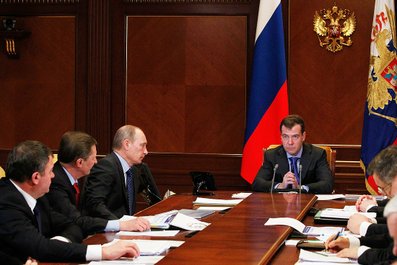
Medvedev in Meeting on Military Pay (photo: Kremlin.ru)

So officers were cut too drastically, and their numbers are going to be increased.

One recalls Ilya Kramnik saying officer cuts were causing serious tension in the ranks.  As if to prove the point, on Wednesday, near Novosibirsk, a drunken major living outside the “shtat” threatened to blow up his room in the unit’s dormitory.  This summer Aleksey Nikolskiy said halving officers caused trouble for brigades in the Vostok-2010 exercise.

But it’s not just an officer shortage that’s led to this policy reversal.  Difficulties with conscription and sergeants have forced the Defense Ministry to plug holes with more officers. 

Aleksandr Sharavin talked to BFM.ru about the situation:

“I think this is connected with the fact that now the situation in the army is very tense.  They cut officers from 450 thousand [sic] to 150.  They cut warrant officers completely, and professional sergeants aren’t appearing, we didn’t train them, and still can’t do this.  What we’ve got is a lot of conscript soldiers, few contractees, generally no professional sergeants, and a triple load laid on the remaining officers.  Now we have to compensate by increasing the number of officers.”  

Increasing the officer ranks wasn’t the only personnel policy reversal announced on 2 February.  A preliminary decision to increase contractees in the Armed Forces was also discussed.  Serdyukov said:

“This issue isn’t finally decided, but we have a proposal for an increase.  The Security Council was ordered to review this issue, in the course of the month a concrete figure – how much the number of contractees will be increased from 2012 – will be determined.”     

Utro.ru entitled it’s coverage of this story “Army Reform Reversed,” and reminded readers that army contract service was curtailed last winter because the military couldn’t afford it.  And now apparently it can?

We don’t know how many contract sergeants might be added starting next year.  In fact, no one seems to know how many there are now.  Newsru.com claims the army currently has 180,000 contract soldiers, sergeants, and warrants.  If that’s true, the Armed Forces are about 900,000.  But if there are fewer contractees, and conscripts are less than 560,000, then the Armed Forces are that much below 900,000.

Can an about-face on the elimination of warrant officers be far behind?

As early as 27 January, Rossiyskaya gazeta reported Deputy Defense Minister Pankov said some cadets might be inducted into VVUZy in 2011.  It was just back in the fall that the Defense Ministry put a two-year moratorium on them.  As it is, VVUZy now have about 45,000 cadets in the classes of 2011, 2012, and 2013.

But the Defense Ministry is looking at having these would-be officers join 5,000 other former cadets as sergeants.  The Defense Ministry is talking about salaries as high as 40,000 rubles a month for professional NCOs.  But current NCO training efforts in VVUZy are going very slowly, and the army wants 250,000 of them, according to Nezavisimaya gazeta.

Let’s return for a bit to Medvedev’s Tuesday session on raising pay for servicemen and law enforcement.  We’re talking Defense Ministry, MVD, MChS, FSB, FSO, and SVR here.  Men with ranks, badges, and guns.  Medvedev called higher pay for them:

“. . . an issue of state importance.  In the last analysis, our efforts to reform the Armed Forces, create a new profile of the Armed Forces and, of course, reform the system of law enforcement organs, including reforming the Internal Affairs Ministry and creating police depend on it.”

The Defense Ministry is talking median pay of 50,000 rubles a month for lieutenants starting in 2012.  Just a sampling . . . a cadet would get 18,200, a contract soldier 24,800, a squad sergeant 34,600, and a brigade commander 93,800 rubles per month.

NG’s Vladimir Mukhin reports the Finance Ministry believes the new military pay plan will cost another 1 percent of Russia’s GDP, taking the defense budget from nearly 3 to nearly 4 percent of GDP.  All this while the government wonders whether outyear budgets will be in deficit or not.

The last couple days represent the first major defeat for Serdyukov.  His military personnel policies are a complete and utter shambles.  Political analyst Aleksey Mukhin commented to BFM.ru on Defense Minister Serdyukov’s prospects: 

“ It’s fully possible that soon they’ll call him enemy No. 1 for the reform which is being conducted.”

If they don’t already.  One guesses he’ll keep his post though.

So after flirting briefly with paying relatively few officers more money, the Defense Ministry’s going to pay more officers more money instead.  And this is more officers at the same time President Medvedev’s ordered a 20 percent cut in government bureaucracy.

The fact is military reform’s gone beyond the military now and become more of a factor in domestic politics.  Vlasti are just a bit nervous about social stability in the runup to elections this year and next, and are also a little worried about the guys with the guns.  For the regime, the extra money is worth keeping 70,000 potential ex-officer opponents out of the streets.  It may feel this provides some insurance that the guys with guns will do as they’re told.

As BFM.ru concludes, the Tunisian [or Egyptian] “virus” could spread.  And the terrorist threat is high.  So Russia’s leadership has to think about an effective and combat capable army.

Commentator Sergey Markov told BFM.ru that the regime wants to increase the number of officers who can fight, but it will continue cutting those in support functions and replacing them with civilians:

“But everyone understands perfectly that you can’t do without a real combat force.”

Walking Back Serdyukov’s Personnel Policies (Part I)

And so it’s begun. 

The first of Defense Minister Serdyukov’s major reform planks – cutting the officer corps from 355,000 to 150,000, or no more than 15 percent of the million-man army – has been reversed.

The Armed Forces’ officer manning level was apparently one topic in yesterday’s meeting between President Medvedev and his “power” ministers about plans to raise pay for servicemen in 2012.

Serdyukov told the media about the decision to increase officers in the Armed Forces by 70,000:

“A decision’s been taken to increase officer personnel by 70 thousand.  This is connected with the fact that we’re deploying additional military units, establishing military-space defense, that is, an entire service (of troops), and the increase is happening in connection with this.”

First, this raised some interesting questions about VKO.  Is it really going to become a service (vid or вид).  After all, the Space Troops are only a service branch (род войск) right now.  That’s quite a promotion.  And are we really supposed to believe the expansion of VKO or the Space Troops will require 70,000 additional officers? 

Of course not, it’s a convenient excuse to walk back a large part of the 50 percent cut in army officers Serdyukov announced when he launched his reforms in October 2008.

Most media outlets were pretty confused on what this means for officer numbers.  They assumed the Russian Army’s at 150,000 officers right now, just add 70,000 for a total of 220,000.  But it’s not so simple.

When Serdyukov started cutting officers, there were 305,000 occupied officer billets.  Krasnaya zvezda said the Armed Forces had 181,000 officers at the end of last year.  So a grand total of 124,000 officers were either discharged, placed outside the “org-shtat” at their commander’s “disposition,” or forced to accept an NCO billet between late 2008 and the end of 2010.  Returning 70,000 to the ranks might leave us wondering only about what happened to the other 54,000.  And 181,000 plus 70,000 takes the officer corps basically back to 250,000, or fully one-quarter of the million-man army.

The army officer corps has endured considerable sturm und drang in a little over two years all for the sake of shedding just 55,000 officers.

More on this tomorrow.

Fox News on the Russian Military

We laughed, we cried, two thumbs way down to Fox News for yesterday’s story on the Russian military.  It makes us wonder what kind of crap they say and write on topics we don’t know anything about.  Well, actually, we already know how bad that drek is too.

Now, no one who frequents this blog will accuse your present author of giving Moscow credit for much.  No, of course not.  But Fox News has succeeded in taking the absurd in Russian defense policy and making it ridiculous.  Fox’s article couldn’t garner a C in a high school journalism class.

At the risk of getting some of the stink on us, let’s examine the piece a little:

  1. Ahem, if you didn’t notice, the Russian military’s been falling apart for a long time.  And, actually, in the most objective sense, experts who’ve watched the process would say Defense Minister Serdyukov and his cronies may have arrested the process some over the last 4 years.
  2. Yes, CAST did put out a new monograph, but it’s a slender volume, and certainly neither comprehensive nor groundbreaking in any sense.  CAST is valuable, but hardly well-known.  And its leadership is probably not fully independent of the current regime.
  3. Fox’s claim that Russia only has 8-10 thousand deployable troops is a ridiculous misreading of intentionally hyperbolic statements in the CAST report.  No serious analyst believes that Russian forces aren’t more ready today than they were 5, 10, or 15 years ago.  But this is a relative comparison.  It doesn’t mean they’re sufficiently ready, in sufficient quantity, to execute the missions they’ve set for themselves.
  4. The Russians have already beat the furniture salesman stuff to death, but one supposes it’s still funny to a nonspecialist audience in the U.S., a country where actors become governors and presidents (and good ones at that).  But even the most basic journalistic accounts normally note that Serdyukov married well, gaining a father-in-law with a strong connection to Vladimir Putin.  And Serdyukov’s no dummy; he probably engineered most of the tax case against Khodorkovskiy.  Not sure Fox knows who Khodorkovskiy is though.  The bottom line is, most people accept Serdyukov as a savvy and tough bureaucrat with talent, who was specifically selected to do a job he’s well-suited for.  Doesn’t mean he hasn’t pissed off Russian military men.  That’s exactly what he was supposed to do.
  5. Fox missed the point that Serdyukov was sent in to stop the stealing, not to cut the military’s budget.  Does Fox realize the $78 billion that DoD’s going to trim over five years isn’t much less than what Russia’s military budget will be over that period?  Duh.
  6. Fox saves itself a little by referring to Felgengauer, but it can’t spell his name.
  7. Russian defense industry has problems, yes, but buying abroad is more complex than Fox’s passing mention.  Fox didn’t bother to Google Mistral either.
  8. Fox’s military expert is wrong; Russia still has a military.  But the U.S. needs to worry about whether and what kind it will have in the future.  We don’t need a “sick man of Eurasia,” and a military vacuum there wouldn’t be good for Americans.  And we also need to worry if there will be a country there, by the way.  Fox’s retired general is right, however, when he reminds that Russia is still a nuclear weapons superpower, and it is relying on nukes heavily for its security.  And its conventional weaknesses increase the risks of miscalculation.  But this has been the case for much of the past 20 years. 

But none of this is a news story.  The news story is that even skeptics have to admit the Russian military is doing a little better, and it’ll be interesting to find out how much better the next time it goes into action.  It’ll be interesting to see if it’s somewhere on the former Soviet imperial periphery, or against another internal threat in the North Caucasus.

The Russian media reactions to the Fox article are just starting, we’ll see if they get interesting.

But thanks Fox for providing something to write about this morning.