Category Archives: Serdyukov’s Reforms

New Mil.ru

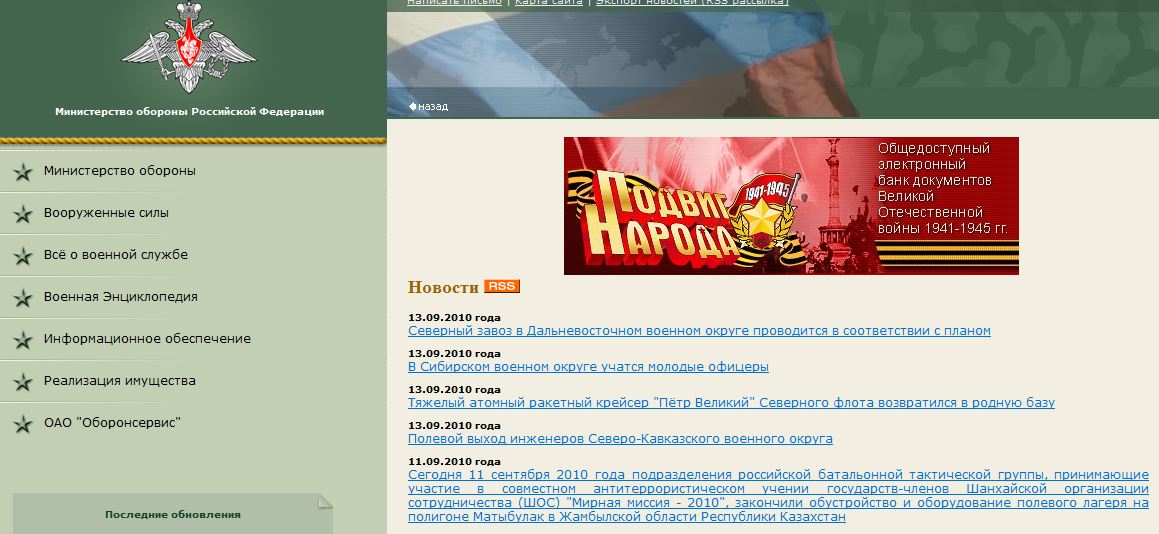
The New Mil.ru

A new look for the RF Defense Ministry website’s been unveiled (in testing mode, so far).

The first treat we’re supposed to get is video from tonight’s Red Square rehearsal of Monday’s Victory Day parade.  There’s a place to click for it, but it’s obviously not loaded yet.

So, say farewell to the old Mil.ru.

Farewell Old Mil.ru

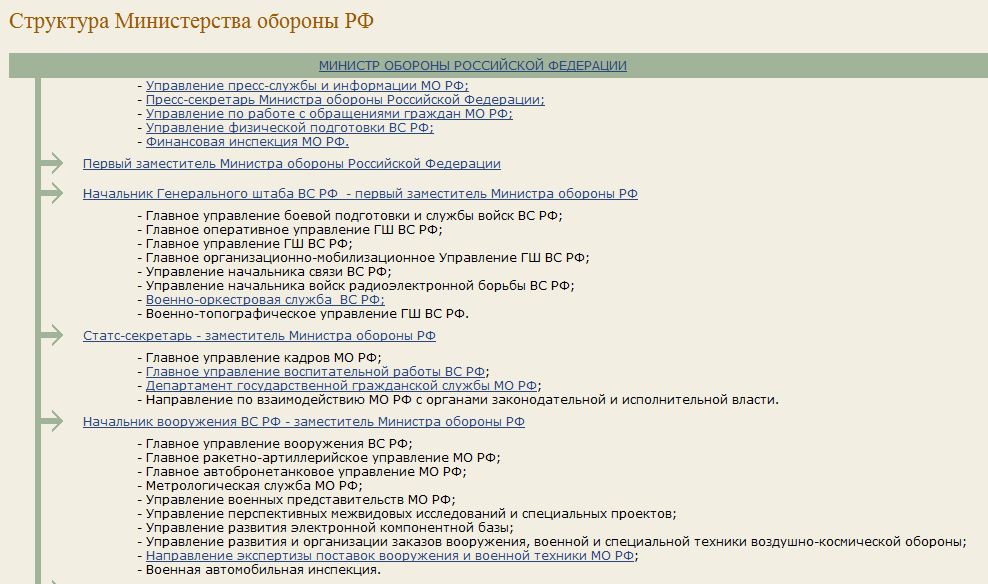
Old Mil.ru had a nice rundown of the Defense Ministry’s organizational structure that was once well maintained, but became an untended mess after Anatoliy Serdyukov arrived in 2007 and changed the Russian military bureaucracy in myriad ways.

RF Defense Ministry Structure on the Old Mil.ru

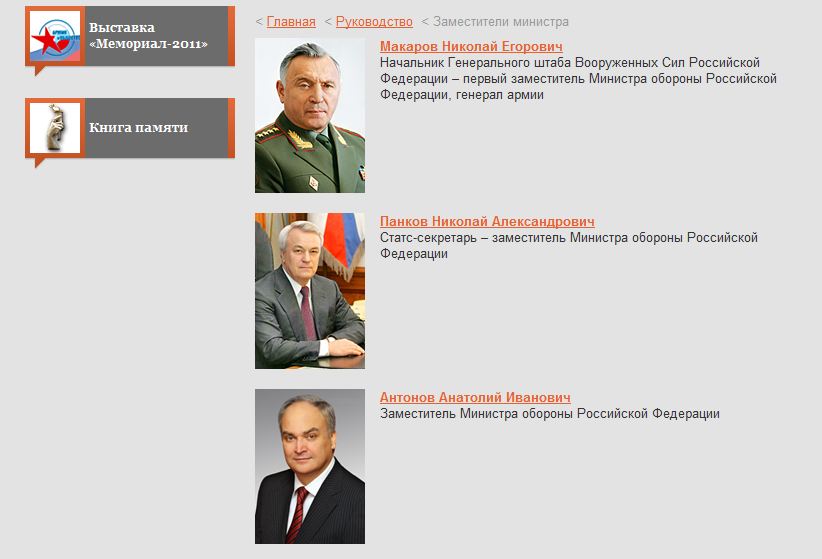
New Mil.ru is pared down, so far, in this respect, showing only a slicker (but up-to-date) rundown of Serdyukov’s deputies.

New Defense Ministry Leadership Page

Civilians Now Top Military Diplomats

There’s great interest in the new civilian chief of the Defense Ministry’s Main Directorate for International Military Cooperation (GU MVS).  With yesterday’s decree, President Medvedev appointed career diplomat Sergey Mikhaylovich Koshelev to this post.  Koshelev had been Deputy Director of the Foreign Ministry’s Department of Security and Disarmament Issues (DVBR or ДВБР).

Koshelev’s appointment followed that of former DVBR Director Anatoliy Antonov to be Deputy Defense Minister for International Military Cooperation.  So presumably close colleagues Koshelev and Antonov will collaborate again to promote Russia’s military interaction with foreign armies, with the former acting as the latter’s right hand.  The burgeoning “reload” or “reset” with the U.S. Defense Department and with NATO will be a principal preoccupation. 

According to ITAR-TASS, Koshelev has concentrated on strategic negotiations — including START, INF, missile defense, and military space issues — during his diplomatic career.  Today’s Rossiyskaya gazeta notes Koshelev had an active hand in negotiating the new START Treaty with the U.S.  The paper forecasts  he will be active on the issue of European missile defense.

Kommersant writes that Koshelev was born in Moscow on 26 June 1957.  In 1983, he graduated from the Institute of the Countries of Asia and Africa, proceeding to work in the diplomatic service in India.  From 1995, he worked on export control in the DVBR.  In 1998-2003, Koshelev was a counsellor in Moscow’s permanent mission to the U.N. Disarmament Conference in Geneva.  In addition to serving as DVBR Deputy Director, he was also chief of its multilateral disarmament section.  He was promoted to Russia’s third highest diplomatic rank — Envoy Extraordinary and Plenipotentiary Second Class — in 2008.

Gazeta.ru and Gzt.ru postulate, not without some basis, that Antonov and Koshelev will be part of a new negotiating team for the Mistral purchase.

It’ll be interesting to see what Koshelev and Antonov do with GU MVS, a storied organization somewhat adrift in recent years.  Koshelev relieves acting chief, Colonel Yelena Knyazeva, an interesting character in her own right.  The press notes that General-Major Aleksey Sukhov was dismissed in 2010.  His predecessor was General-Lieutenant Vladimir Fedorov, who had headed the UVS — External Relations Directorate, charged with supervising foreign military attaches in Russia and Russian ones abroad.  We’ve noted on these pages that General-Colonel Anatoliy Mazurkevich left in a hurry when Defense Minister Serdyukov arrived, and General-Colonel Leonid Ivashov discovered the Defense Ministry wasn’t big enough for him and Sergey Ivanov.

So GU MVS once got its leadership from the ranks of Russia’s military diplomats, its military attaches, i.e. from its military intelligence officers and the GRU.  In Gzt.ru, Ivashov described the old GU MVS as an “instrument for warning of military dangers and threats to the USSR and Russia” [i.e. the GRU’s strategic military intelligence mission], but he acknowledged those days are gone and this main directorate has been “reformed” in recent years.

Naginskiy at Spetsstroy

The dust’s settled a bit on this story . . . in a 22 April decree, President Medvedev replaced Nikolay Abroskin as Director of the Federal Agency for Special Construction (Spetsstroy), putting Deputy Defense Minister Grigoriy Naginskiy in Abroskin’s place.

Grigoriy Naginskiy

What does the change at the top of this large, government-financed construction firm — nominally under Defense Ministry control — indicate?

Ending Abroskin’s 13-year tenure in the Spetsstroy empire took four years. According to Kompromat.ru, Defense Minister Serdyukov’s wanted Abroskin out from beginning, but, unlike in other personnel situations, it took him a while to win out.

The media says the anti-Abroskin operation was methodical.  On his 60th birthday, four-star Army General Abroskin was dismissed from the Armed Forces, but left in his civilianized post.  This created the convenient precedent to have another civilian succeed him.  Then Medvedev dismissed Abroskin’s long-time deputies and allies. 

According to Kommersant, Spetsstroy’s annual collegium in late March was a solemn affair, devoted mainly to talk about order, discipline, and anticorruption efforts.  But the Main Military Prosecutor wouldn’t tell Kommersant whether it was investigating Abroskin or anyone else at Spetsstroy.  Then the final stroke on Abroskin came three weeks later.

Spetsstroy’s a semi-militarized agency with ranks and, until this spring, conscripts, under formal Defense Ministry control, but traditionally and generally acting as an independent federal agency.  As its name suggests, Spetsstroy is responsible for special government construction projects – in the Soviet and Russian past, it built secret industrial, defense, and specialized facilities, but has also built more mundane military housing, bases, garrisons, road, and electrical power projects.  It also builds major state infrastructure like hydroelectric stations, dams, and bridges. 

Most of Spetsstroy’s work is no longer for the Defense Ministry.  Kommersant says only 26 percent of its 2010 work was for the Defense Ministry.  A Defense Ministry official told Vedomosti the territorial divisions of Spetsstroy, in particular, work essentially like private construction firms and contractors.  Kompromat put its 2009 revenue at 67.7 billion rubles, making it a large company, even a market leader, by Russian standards.

Its most recent controversy revolves around the alleged “Putin palace” on the Black Sea.  According to Newsru.com and other media outlets, Spetsstroy is building a billion-dollar residence for Prime Minister Putin’s personal use.  The money for the elaborate Italianate mansion allegedly came from Putin’s rich business cronies.

Now about Naginskiy . . . you remember his arrival at the Defense Ministry in early 2010 to be Serdyukov’s deputy for housing and construction.  The 52-year-old Piter native’s a construction magnate who got rich renovating nuclear power plants, and then entered politics.  He joined United Russia in 2002, and served in the Leningrad Oblast assembly before representing his region in the Federation Council.

According to Forbes, he’s the richest official in the Defense Ministry, but he’s only 45th on the list of millionaires in government service.  His family income was over 100 million rubles in 2009.  Finans places him as the 163rd richest Russian. 

But Argumenty nedeli makes the point Naginskiy didn’t exactly cover himself with glory while directing military housing acquisition.  An unnamed Defense Ministry official tells Argumenty:

“The state program to provide housing to all officers and retirees is 15-20 percent complete.  Billions have been absorbed, but more and more are needed.  Deputy Minister Naginskiy, who directed it [military housing] last year, during construction site visits by the president and prime minister vowed and swore that everything would be done on time.  Now instead of the planned 2011 when they promised to provide housing, the authorities are forced to talk about the end of 2013.”

Recall also that Naginskiy went without portfolio starting in mid-2010, and his colleague Deputy Minister Shevtsova found housing in her lap.

All the good journalistic coverage of the Spetsstroy story agrees on one, well two, things.  Getting rid of Abroskin was all about controlling an agency that was too independent and, more importantly, controlling its money.  As Kompromat concludes, it’s natural for Serdyukov to want his man to have his hands on these large “financial flows.”  Kompromat suggested Serdyukov may have also had his eye on selling some of Spetsstroy’s expensive Moscow real estate. 

But this isn’t all there is to the story . . .

  • Argumenty makes the point that Serdyukov has holes in his top management team.  Six months without a main finance officer has left the Defense Ministry behind on placing armaments contracts (again threatening a bad year for GOZ fulfillment).  And now Serdyukov’s lost First Deputy Defense Minister Popovkin to Roskosmos.  Popovkin’s replacement will be a huge story.  Even if Shevtsova has the housing issue, Serdyukov absolutely has to replace Chistova and Popovkin.  And Nezavisimaya gazeta suggests Serdyukov will soon appoint a new deputy primarily responsible for establishing aerospace defense (VKO).
  • Ruslan Pukhov tells Vedomosti the whole situation proves Serdyukov still has carte blanche from the country’s leadership, and NG claims Serdyukov’s political position has never been stronger.
  • Kommersant makes a point of saying that Abroskin doesn’t appear on the list of Russia’s richest bureaucrats, suggesting of course that this career serviceman might have amassed a fortune, but can’t report it because it was obtained through graft.  Perhaps the paper’s larger point is that appointing a wealthy executive from a private firm is the only chance for avoiding corruption in a high-level post.

The Good, the Bad, Etc.

PR firm Р. И. М. Porter Novelli has just completed the first-ever rating of government ministers using comments from Russian-language blogs, social networking sites, and discussion forums.  Gazeta.ru and Argumenty i fakty covered this electronic beauty contest.  However, the firm’s press-release on its work wasn’t posted for first-hand examination.

The rating puts Finance Minister Kudrin, Emergency Situations Minister Shoygu, and Transport Minister Levitin at 1-2-3 in “popularity,” while Kudrin, Foreign Minister Lavrov, and Interior Minister Nurgaliyev are said to be tops in sheer mentions.

The firm also generated a rating of “good” and “bad” ministers.  Defense Minister Anatoliy Serdyukov, Economic Development Minister Nabiullina, and Nurgaliyev head the so-called “white” list.

However, Nurgaliyev, Serdyukov, and Kudrin are also 1-2-3 on the “black” list of those most vilified on Ru.net.  Health and Social Development Minister Golikova and Education Minister Fursenko are No. 6 and 7 on the “black” list.

For a traditional monthly opinion poll on what Russians think about top members of the government, check out VTsIOM’s monthly poll.  You get a different picture here.  For example, routinely about a quarter of the people are up on Serdyukov, a quarter are down, and half are unchanged.  You can compare Nurgaliyev’s one-third, one-third, and one-third, or look at unpopular Fursenko’s generally negative rating.

Of course, the polling is very different from the PR firm’s rating.  Internet penetration in Russia continues to grow; maybe 50 percent of Russians under 35 use the Internet every day or almost every day. 

All this is just more data in the mix on how Russians (in this case, ones connected to and savvy about the Internet) regard Serdyukov and his military reforms.

Pavel Baev on Politics and the Military

Last week BFM.ru interviewed Pavel Baev of Peace Research Institute Oslo about Russia’s military reforms.  Baev’s view of the reality of ongoing reforms is captured in one word — catastrophic. 

Now Baev doesn’t get everything exactly.  Some military policy changes — like the one-year draft and a new, higher military pay system — were made some time ago, not necessarily for the 2012 presidential election. 

But he’s right about lots of other things.  Some decisions made in Defense Minister Serdyukov’s reforms haven’t meshed, or even been antithetical.  Decisions like higher pay have become, like it or not, part of the electoral picture, and the leadership has to follow through.

Baev believes the army might not be combat capable due to personnel cuts.  He allows for the possibility that Serdyukov might be sacrificed by his political masters.  The Kremlin and White House are using pay and apartments to keep serving officers politically quiescent.  But Baev thinks these aren’t enough; at some point, the army will insist on having its combat capability restored.  He hints later that the state and inclinations of the army were factors in the recent Arab revolutions that overturned long-time rulers.

The interviewer asks Baev to reconcile Prime Minister Putin’s Duma session last week in which he emphasized using the defense budget at home to create good, high technology jobs in Russia with President Medvedev’s [and Putin’s] statements about the failure of the state defense order:

“It seems to me that on the whole in the realm of military reform, and the Gosoboronzakaz in particular, there are very many concealed problems which Putin generally didn’t talk about.  The speech [Putin’s Duma speech], in large measure, on the whole was very unproblematic.  Somehow everything was more about achievements, future developments, very little about problems.  In the military arena, many problems have accumulated, and in the course of military reform not a few new ones were created.  The situation is very complicated, and attempts to correct the situation somehow largely lead to problems becoming even more acute, particularly problems with personnel.”

Baev went on to say that the Gosoboronzakaz and the problems of buying new military equipment have reached a critical point because of the aging of current weapons systems.  There is, he says, an undercover battle over what to buy and, especially, what should be bought abroad.  The situation around Mistral has become so complicated and political that it’s now more a “special operation” than an export contract.

Baev says the Russian Navy didn’t really want such ships, but went with the idea when it was foisted on them.  The real struggle and lobbying over Mistral concerns which shipyard in Russia will build units 3 and 4, according to Baev.  He suggests the whole deal might have been French President Sarkozy’s way of placing a bet on President Medvedev to be Russia’s future leader, and organizing the “political climate” in Europe toward this end.  But right now, of course, the Mistral deal looks very uncertain.

BFM.ru asked Baev for his interim assessment of the military reforms begun in late 2008:

“Purely catastrophic.  In every reform, there’s such a moment when the old thing is no longer working, and the new one isn’t working yet.  At this critical moment for any reform, we have a situation when nothing is working; where to move — either forward along the path of reforms or to try to work back, — is in large measure a political question.  Just in the area of Armed Forces personnel policy, an unknown number of things have been botched.  The initiatives advanced, — cutting the officer corps, contract service, sergeant training, cutting the conscription term — each of them has its own basis, but they’re absolutely mismatched.  That is, we now have a situation with military personnel when the army is in fact not combat capable.”

Asked about military pay raises planned for next year, Baev says:

“I think the main sense of this initiative is still to lift the officer corps’ very obvious dissatisfaction with all these reforms.  Great potential dissatisfaction has built up in the army, it is focused more or less on the minister, which, they most likely will sacrifice.  But this isn’t enough to lift this dissatisfaction, but the promised money plus the long ago promised apartments, and they are still gradually giving them out, — this is somewhat capable of  damping down this dissatisfaction.  And the fact that they are promising lieutenants, — for young officers it sounds completely improbable, and, most likely, they are prepared to wait for such money.”

“It’s perfectly obvious that very many political initiatives are aimed at this critical electoral sector — to lift the tension now, to make so that the army sits quietly in its barracks, not speaking out, waiting for its money and apartments, — and everything.  These are purely short-term things, which can help get through a complex electoral period.  It seems no one particularly looks after this [military] sector, inasmuch as, generally, for officers money is money, but they are people of service.  If even in addition they pay the money, service doesn’t go because they aren’t succeeding in reforming the Armed Forces so that they become combat capable, then this is a more serious source of dissatisfaction than simply a lack of money.”

“. . . the Armed Forces are the only area where genuinely serious and deep reforms are going on.  But with reforms, problems always take on a new character, change.  Here some kind of forward dynamic is occurring, it isn’t going in circles.  But the lack of resolution of these problems in the absence of political will is very evident, and all political will is going now to electoral projects which aren’t clear how they will be implemented because it’s not clear to anyone who in the end will be Supreme CINC, that is also a question of no small importance for the Armed Forces.”

Baev sees a lesson for Russia and the Russian Army in the Arab revolutions:

“But it’s clear that several conclusion flow from the Arab revolutions, and not just in relation to missile systems, but in the fact that the army is a serious political force.  This is more the conclusion of events not in Libya, but of the situation in Egypt.  And attempts somehow to neutralize the politicization of the army grow more from here [Egypt], than from Libya, where the army was in a pitiful condition, from here [Libya] also, in large measure, there is a civil war.  If there were a powerful army there, such a thing [civil war] wouldn’t have occurred.”

He finishes by talking about obsession with ultra-modern weapons when existing systems are perfect for today’s armed warfare.  His discussion leads to an open question about the fit between Russia’s military doctrine and its future armament plans:

“Therefore, the conversation about how we realistically need to outfit the Russian Armed Forces depends largely on whom we intend to fight, where we intend to employ these Armed Forces, against what kind of potential enemies, — answers to all these questions don’t exist, the doctrine doesn’t provide these answers.  It’s essential to replace weapons systems which have already outlived their time, but whether it’s necessary to replace them with the most super modern systems, — this is still a question.”

Could Serdyukov Go?

Svpressa.ru asked yesterday if it’s possible Defense Minister Anatoliy Serdyukov might be dismissed in the runup to the presidential election.

It asked political analyst Aleksey Makarkin if any ministers might be dismissed to appease angry voters.  Svpressa noted the Kremlin has something of a tradition of firing some high-ranking officials to garner the electorate’s good will.  The media outlet asked him which current ministers might be sacrificed.

Makarkin answered:

“Society is pretty calmly inclined toward the current ministers.  But the people and the elite have different irritants.  If, let’s say, in the elite, great attention is given the role of Deputy Prime Minister Igor Sechin, then the populace is poorly informed about what he’s doing.  It happens that there’s what they write in the business press, and there’s what they show on television.  And the public, on the whole, watches television.”

“I think if ministerial dismissals happen, they will be connected not with an allegeric reaction among the people.  There are ministers that have complicated relations with the bureaucratic structures they direct.  These relations have formed in the course not of decades, but of centuries.  Now problems are notable in two such bureaucracies.”

“The first is the Defense Ministry which from the very beginning was very critical of Anatoliy Serdyukov — a strictly civilian person without a general’s rank.  The second is the Ministry of Health and Social Development.  It’s true the situation there is somewhat different.  It wasn’t initially negative for Tatyana Golikova.  But she isn’t a doctor, and she’s running up against a sufficiently cohesive medical community.”

“The difference [between Serdyukov’s and Golikova’s situations] is that Serdyukov has military men as his subordinates.  They aren’t inclined toward opposition demonstrations, and military retirees don’t have real influence on army processes.  There was the situation when Serdyukov had a conflict with the VDV Academy in Ryazan.  But General-Lieutenant Vladimir Shamanov, a well-known army figure, thought it best not to exacerbate the affair — the brakes were quickly put on the conflict.”

“Of course, internal dissatisfaction with Serdyukov is strong in the military.  Whereas at first this was dissatisfaction with the minister’s persona itself, the details of his biography (Serdyukov was once in the furniture business), but later with his activity in seriously reforming the army (that is the work to which they assigned Serdyukov).”

“Yes, it’s possible to recall the army reform under Aleksandr II — one of the greatest reforms of that time, together with freeing the serfs.  Then Milyutin’s military reform was also met very critically by a significant part of the military corporation.  They accused him of being a professor who didn’t have sufficient military experience.  And his accusers were famous combat generals . . .”

“Serdyukov’s situation is more complex, because he’s an outsider.  Naturally, the reforms he’s conducting — cutting the army as a whole, cutting generals, restructuring the military district system, taking the shoulderboards off some representatives of the military corporation, whose duties civilians can fulfill — are causing serious disapproval.”

It’s interesting to hear a purely political perspective on where Serdyukov and the Defense Ministry stand.  But it seems unlikely the Defense Minister would be cut loose when this would be a more public admission of failure than the recent reversal of several of his policies.  Serdyukov is more likely to be moved aside under cover of an ostensible elevation.

Makarkin’s right when he points out that army problems almost exclusively concern and affect the military caste.  They are routinely low on the list of worries of average Russians.   

But Makarkin shouldn’t dismiss the significance of unhappiness among military veterans and retirees.  True, they don’t necessarily have influence.  Their attitudes toward defense policymaking roughly mirror the moods of active duty military men who can’t attend political demonstrations or speak out in public.  Most Moscow commentators, like Makarkin, have probably gotten used to not pausing long to ponder what Russian military men think about politics.

Russia’s Fading Army Fights Losing Battle to Reform Itself

A very good article by the Wall Street Journal’s Richard Boudreaux . . . though missing a few of the most up-to-date pieces of the story, his report captures important aspects of the Russian contract service experiment that even so-called specialists overlook.

“VOLGOGRAD, Russia—Sergei Fetisov, a 23-year-old welder, signed on for one of the most ambitious projects in Vladimir Putin’s Russia: rebuilding the remains of the once-mighty Soviet Red Army.”

“A cornerstone of that effort was the creation of special combat-ready units staffed entirely by professional soldiers, not conscripts.  Mr. Fetisov volunteered to be one of them.  He enlisted for a renewable three-year stint, enticed by higher pay and the chance to learn new skills.”

“One of his first tasks, he recalls, was toiling past midnight shoveling snow and ice from a football-field-size parade ground.  The work that followed was menial, humiliating and of little practical use, he says.  Combat training consisted of two firing exercises a year, he says, and a chunk of his paycheck was routinely withheld by corrupt officers.”

“‘When I realized that being a professional soldier was just the same as serving as a conscript, I wanted to tear up my contract and get out of there,’ he says.  He quit when his commitment ended in July, he says, ‘but we had guys who simply ran away.’”

“With volunteers like Mr. Fetisov leaving in droves, the Defense Ministry has abandoned the initiative altogether.  The program’s failure shows the limits of Mr. Putin’s grand plan to transform the army from a cumbersome machine designed for European land war into a lithe force capable of fighting regional wars and terrorism.”

“Russia’s struggle to rebuild its armed forces comes as the world’s military balance is in flux.”

“Two decades after the Cold War ended, China is engaged in a military buildup that has many of its neighbors, including Russia, scrambling to bolster their defenses.  The U.S., still the world’s dominant military power, is trying to rein in defense spending—while simultaneously keeping a wary eye on China, projecting power in the volatile Middle East and dealing with the North Atlantic Treaty Organization’s persistent concerns about Moscow.”

“Currently, Russia is at odds with NATO’s air assault in Libya. Moscow has stayed out of the military conflict, despite its stakes in weapons deals and oil-exploration ventures with Col. Moammar Gadhafi’s regime.  But Mr. Putin said last month that the bombing in Libya is part of a ‘steady trend’ of U.S. military intervention around the world and ‘a timely indicator that our efforts to strengthen [Russia’s] defense are justified.’”

“In February, Russia outlined a $650 billion plan to acquire new warplanes, ships, missiles and other arms over the next decade, the Kremlin’s biggest spending spree since the Cold War.”

“Mr. Fetisov’s account of poor morale in the army’s ranks, however, raises questions about Russia’s long-term ability to assert power abroad.”

“The Defense Ministry declined to comment on Mr. Fetisov’s complaints, but has acknowledged that widespread discontent among volunteers undermined its enlistment campaign.  Defense Minister Anatoly Serdyukov has said that the program had been poorly managed and would cost too much to fix.”

“‘We cannot afford to create a fully professional army,’ he said in October.  ‘If we save funds elsewhere, we will certainly go back to this idea, but well prepared.’”

“The setback has the Kremlin in a bind.  Counting on volunteers to make up nearly half of all soldiers, Mr. Putin had bowed to public sentiment and shortened the draft from two years to one.  Now, the dearth of volunteers and a drop in Russia’s draft-age population have prompted the Defense Ministry to cancel some deferments and step up conscription of men 18 and older, risking discontent over a twice-yearly ritual that began anew on April 1 and is widely evaded.”

“Russia relies mainly on its nuclear arsenal to project power and protect its territory.  Tensions with the West have eased, but Mr. Putin sought a revival of conventional forces, which had been weakened by budget cuts, to put muscle behind his push for influence in former Soviet republics that are now independent.”

“The army’s decline became evident in the mid-1990s with its battering by separatist rebels in Chechnya.  The land, air and naval forces Mr. Putin inherited when he became president in 2000 were a pale shadow of the Red Army, five million strong at the time of the Soviet Union’s breakup in 1991.  They stand at one-fifth that size today.”

“Under the enlistment program, launched in 2004, officers were to train volunteers as career specialists and make the new combat-ready units fully operational by 2010.  The shift to professional soldiers was supposed to better enable the army to operate the high-tech weaponry Russia plans to acquire.”

“The U.S. abolished the draft in 1973, attracting volunteers through advertising, pay increases, educational benefits and re-enlistment bonuses.  By the time of the Persian Gulf War of 1991, the move was widely viewed as a success.”

“Russia’s campaign to attract volunteers, by contrast, was not as well funded or advertised.  By 2008, the army said it had signed up 99,000 volunteers for the new units, about 40,000 short of the goal.”

“Then the number began a sharp decline as most of them chose not to re-enlist or went AWOL.  That trend was evident during Russia’s clumsy but ultimately successful invasion that year of neighboring Georgia.  Conscripts were sent to fight and die there, despite Mr. Putin’s promise that only professionals would serve in hot spots.”

“Despite the shortage of volunteers, Mr. Serdyukov, the defense minister, announced at the end of 2009 that Russia’s ground forces had been reorganized into 85 brigades of ‘permanent combat readiness,’ doing away with bulkier divisions and making the army more mobile.  Only later did officials acknowledge that the brigades were made up mostly of one-year conscripts, men with few combat skills.”

“The enlistment drive’s failure puts constraints on Russia’s reach.  When ethnic rioting in June threatened to tear Kyrgyzstan apart, its president appealed for Russian peacekeepers, the kind of force Moscow once deployed routinely as a political tool.  This time the Kremlin demurred—in part, defense analysts say, because the army couldn’t spare a full brigade of professional soldiers.”

“Democratic reformers have lobbied for years to end the draft, arguing that a smaller, professionalized force could better defend the nation’s interests.  Opinion polls show majority support for the idea, and Mr. Putin endorsed it early in his presidency.”

“But tradition-bound generals favored keeping a large conscript army. Mr. Putin opted in 2003 for a compromise:  The Defense Ministry would continue to draft, but also would start recruiting for the combat units.  The government budgeted $3.3 billion for higher pay and better housing for volunteers.”

“By the time Mr. Fetisov received a draft notice four years later, the plan was faltering.  Recruiting stations, unaccustomed to any task other than rounding up draft-age men, were given no blueprint for luring volunteers.”

“The army was a tough sell, too.  Salaries for contract soldiers averaged $270 per month at the end of 2007, about half the average salary for civilians.  Housing construction at bases fell behind schedule.  Residential buildings paid for by the military were turned over without running water, plumbing or electrical wiring, government auditors reported.”

“Mr. Fetisov, who has dyed-blond hair and a passion for video games, had no interest in leaving his $370-a-month welding job.  He lived with his mother and two brothers in Volgograd, a ‘hero city’ once named Stalingrad and famed for resisting the Nazis in World War II, but he wasn’t attracted to military life.”

“Once he was drafted, however, an army contract seemed to offer advantages.  Draftees at the time served 18 months, earning next to nothing.  But they had the option to go professional six months after induction.  Mr. Fetisov, who says he was offered $400 a month, thought a contract would raise his status in the army and enable him to master new skills.”

“He reported to the 99th Artillery Regiment’s base near Nizhny Novgorod in November 2007.”

“His disillusionment began with midnight snow-shoveling duty.  ‘We worked in cleaning, construction, regular things, not serving as soldiers,’ he says.  ‘We didn’t do anything that would help us in a combat situation.’”

“Mr. Fetisov and others who served in recent years say the army’s search for contract servicemen centered exclusively on draftees already under its control.”

“The 99th Artillery, for example, had 600 volunteers on three-year contracts, including Mr. Fetisov, and 300 draftees.  Officers were under instruction to recruit as many new volunteers as possible.”

“Mr. Fetisov says they resorted to an unusual recruiting technique:  Nearly every night at 11 that first winter, conscripts were mustered on the parade ground and made to stand in formation for hours, facing superiors who sometimes were drunk.”

“‘Finally an officer would say, ‘Those willing to sign contracts, you’re dismissed.  The rest of you, stay at attention,’‘ Mr. Fetisov recalls.  ‘A personnel officer would tell stories about the great treatment contract soldiers get.’”

“‘They had to stand there in the cold until at least two or three men agreed to sign,’ Mr. Fetisov says.  ‘This went on for weeks, but they never got 100%’ of the regiment on contract.”

“Volunteers under contract lived three to a room in new barracks with televisions and DVD players.  Conscripts slept in bunk beds, 20 to a room.”

“Beyond that, the distinction seemed to blur.  Volunteers and conscripts alike were treated harshly, Mr. Fetisov says.  Sometimes a soldier who broke disciplinary rules was ordered to dig a deep pit and stay inside for days, he says.”

“His accounts were corroborated by two other contract soldiers, Artyom Pugach and Denis Pushkin, who served at the base and were interviewed separately.”

“The three soldiers say they experienced arbitrary deductions from their paychecks of $20 to $135 a month for what they say an officer described as ‘needs of the regiment.’  Some contract soldiers had to forfeit their final month’s pay in exchange for discharge papers, says Mr. Pushkin.”

“A 2008 study by Citizen and Army, a Russian human-rights group, said such deductions were widespread, amounting to large-scale misappropriation.  Mr. Fetisov says his commander had leeway with payroll money because his contract, like many others, didn’t state the salary he was promised.  He says the commander threatened to punish anyone who challenged the cuts.”

“‘We were told there were some financial difficulties with the military reform,’ he says.  ‘But we could see that the commanders got new cars.…We saw what they were driving, and it was clear what was being spent on what.’”

“Crime and coercion plagued other volunteer units.  Police in Russia’s Far East broke up gangs that extorted cash from soldiers on paydays at three bases.”

“In Kaliningrad, a military prosecutor’s inquiry led to the annulment in 2006 of 83 contracts signed under pressure, according to that city’s chapter of the Soldiers’ Mothers Committee, an advocacy group.  Elsewhere, commanders of soldiers who went AWOL kept them on the roster, pocketing their salaries, says Alexander Golts, a military specialist and deputy editor of Yezhedevny Zhurnal, an online Russian publication.”

“In 2009, Mr. Fetisov was among 160 soldiers sent to form the all-volunteer artillery battalion of the new 6th Specialized Tank Brigade.  There, he says, he injured his hand badly while cleaning the artillery barrel of a tank, and army doctors neglected it.  When his three-year contract came up for renewal, Mr. Fetisov bailed out.  At the time, he says, only 10 volunteers remained of the 160.  The rest had been replaced by draftees.”

“‘The army ran out of fools,’ his mother, Tatyana Fetisova, said recently as she listened to her son tell his story.”

“And so it went at bases across Russia.  The exodus left a handful of all-volunteer units, staffed by a few thousand contract soldiers, in an army made up overwhelmingly of conscripts, say defense officials and independent observers.”

“‘It’s no secret how the contract service was implemented,’ Mr. Serdyukov, the defense minister, told news magazine Odnako.  ‘Active duty soldiers were induced to sign contracts by all means.  Their [low] monthly salary and standard barracks life made them quit the armed forces as early as possible.  There was no systematic preparation of military specialists.’”

“Mr. Serdyukov, a former business executive close to Mr. Putin, was appointed during the enlistment effort and felt cheated by officers who resisted or mismanaged it, says Vitaly Shlykov, a retired colonel who advises him.  The minister, he says, concluded that Russia must change the culture of its officer corps before trying to switch to a professional army.”

“Backed by Mr. Putin and the current president, Dmitry Medvedev, Mr. Serdyukov is slashing the number of officers and changing the way new ones are educated.  He is training Russia’s first corps of career sergeants since the czarist era, starting with a class of 300.”

“But those leaders will take a generation to develop, Mr. Shlykov says, and meanwhile ‘Russia will have a conscription army for years to come.’”

“That is bad news for Russia, says Mr. Fetisov, the former enlistee, but at least those who serve will do so with fewer illusions.”

“‘Now everybody knows you just put up with a year of hell,’ he says, ‘and then you’re free.’”

The Price of Military Labor

Today Voyenno-promyshlennyy kuryer published what it says is the nearly complete version of new military pay and pension rates that will be reviewed by the Defense Ministry and other power ministries by 20 May, and passed on to the Duma not later than 22 June for approval.  There might, says VPK, be some changes and amendments as parliaments are want to make.  But expect the package to become law by early July at the latest.  The new pay rates will be implemented for the Defense Ministry, as long promised, on 1 January 2012, and a year later for other power ministries.

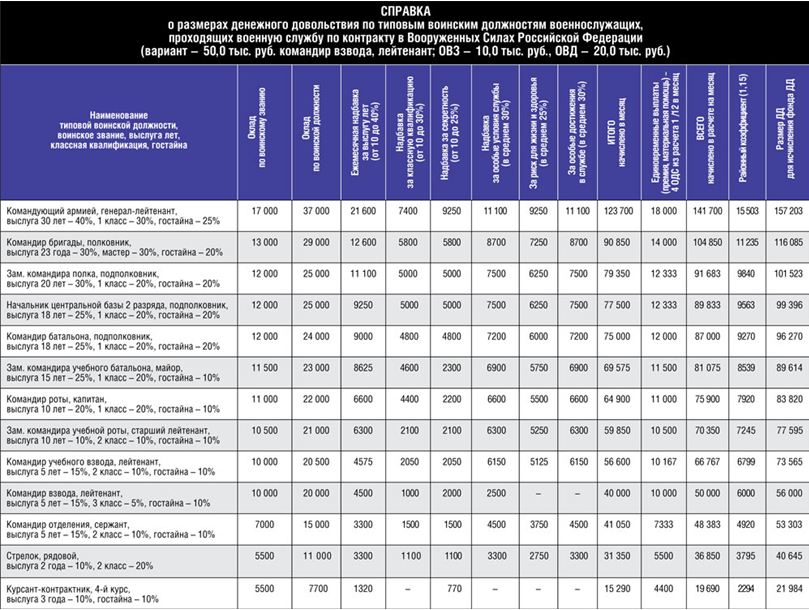
In the following graphic, VPK shows duty and rank pay for some military men.

Duty and Rank Pay

This is just a foretaste of the data presented.  Of course, duty pay is the more significant component.  It’s why some officers outside the TO&E, i.e. without duties, are hurting so badly — they don’t get this big chunk of pay.

But what it says is a sergeant who’s the upper grade of two for section commander gets 6,500 rubles for his rank and 15,000 rubles for his duty or position pay, or 21,500 rubles per month.  But let’s call this “base” pay onto which other supplements are added.  A general-colonel serving as a deputy defense minister would get 64,000 rubles in “base” pay per month.

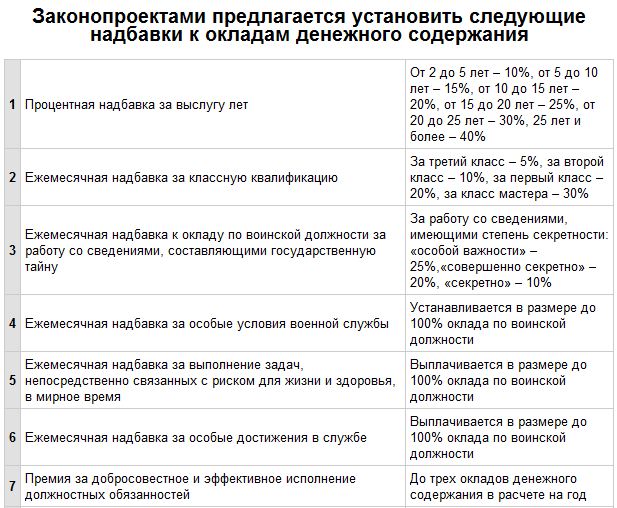
Supplements and coefficients are calculated for years served, class qualifications, work with state secrets, service under special [usually climatological] conditions, etc.  The following graphic shows part of the list.  It actually runs up to nine different supplements and coefficients.

Supplementary Pay

Supplements are sometimes calculated on duty pay; other times on combined duty and rank pay.  Let’s say our section commander sergeant has served 10 years, has a second class qualification, works with secret information, and serves with Russian troops in Tajikistan — he would add 4,300 and 2,150 and 1,500 and perhaps 15,000 to that “base” of 21,500.  His supplemented pay becomes 44,450 rubles per month — not bad, but this would likely be an exceptional case we’ve made just for illustration purposes.

Note that items 6 and 7 on the supplement chart are Defense Minister Serdyukov’s “premium” pay supplements for outstanding performance.  They allow officers to double their duty pay or even triple their combined duty and rank pay.  “Premium” pay was a stopgap to raise military salaries until a new, higher pay system could be devised.  But VPK makes it look like this will become a permanent feature of the new system.

The draft law sets out lots of other special payments and benefits to servicemen for this and that, relocation, death, injury, dismissal, etc.

The following graphic provides some examples of what officers and soldiers will make.

Some Pay Examples

This shows the kind of lieutenant platoon commander that Medvedev, Putin, and Serdyukov have described earning over 50,000 rubles per month.  And our putative section commander sergeant . . . it lists him at about what we estimated 41,000 rubles or so, plus other supplements that take him over 50,000 too.

There’s an exemplar pension chart for those that are interested, and below is a snip of the 50-grade schedule the military uses.  If you view the entire chart, grade 50 is for a first deputy minister, there are two grades for MD commanders, and seven different ones for deputy army commanders, so on and so forth.

Grade Schedule

 What’s it all mean?  Again, this pay reform is a thing both necessary and long in coming.  It’s also going to be very expensive at a time when there’ll be lots of other outlays for the GPV, for contract enlisted, for military housing, for better military infrastructure, etc.  It won’t be easy.  But it seems to be a priority.  The difficulty is that it’s very hard to move forward on all military reform fronts at once.  We’ll have to watch to see which areas are treated with preference or, alternatively, neglected.

Another Trouble Brigade

Today’s Presidential ukaz on military personnel changes is attracting attention because it relieved and dismissed General-Lieutenant Vadim Volkovitsky from the service.  Of late Volkovitskiy was First Deputy CINC of the Air Forces (VVS), and Chief of the Main Staff. 

General-Lieutenant Volkovitskiy

He’s a career air defender who’s been a two-star for the last ten years.  He’ll be 55, statutory retirement age next Friday.  He commanded air and air defense troops in the Urals in 2006, and came to Moscow and the VVS headquarters in 2007.

We don’t really know why Volkovitskiy’s going out right on time, but it does seem President Medvedev and Defense Minister Serdyukov have made an effort to keep senior officers from serving forever.

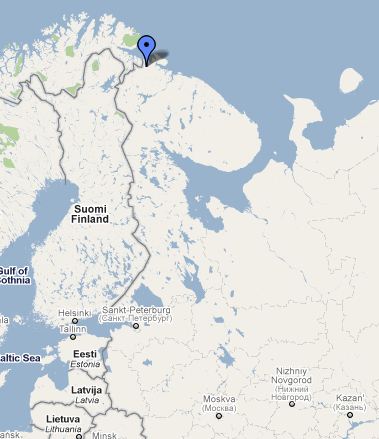
God-Forsaken Pechenga

Far more interesting is the President relieving Colonel Vitaliy Leonidovich Razgonov, Commander of the 200th Independent Motorized Rifle Brigade based at god-forsaken Pechenga.  He’s only been commander there for 18 months. 

The 200th Brigade remains in its Cold War deployment along the Russian border with Norway.  It’s probably not what the Defense Ministry has in mind for its future Arctic brigade. 

This brigade has more than its share of trouble, and Colonel Razgonov’s apparent inability to control his men might — repeat might — have something to do with the change of command.  The ukaz, of course, gives no reason.

Just on Monday, Komsomolskaya pravda published on all of v / ch 08275’s problems.  The paper’s reporters say this command is unable to maintain elementary order.  The brigade’s officers complain that today’s young men are already so corrupted that the army can’t fix them, and that they don’t have any tools to deal with disorder among their men.  But KP says the soldiers don’t look disorderly during the day, but become that way at night when they’re unsupervised in the barracks.  The paper suggests the officers themselves are corrupt and disorderly at Pechenga.

Several weeks ago a conscript from Dagestan got three and a half years for killing an ethnic Russian junior sergeant in June 2010.  The command initially tried to make it look like an accident rather than murder.  Svpressa.ru suggests 4 or 5 men from Dagestan beat the victim.  The Soldiers’ Mothers Committee helped his family get the military prosecutors on the case.

Another conscript was beaten severely right on the brigade’s parade ground in early March.  According to IA Regnum, the young man — a graduate of the Murmansk School of Music — had two operations and his spleen was removed.

Last September a conscript shot and killed another conscript before shooting himself to death.  The parents of the shooter don’t believe this version of what happened, and have turned to the Soldiers’ Mothers Committee for help.

Last May, the chief of the brigade’s missile-artillery service stabbed his wife and six-year-old son to death.  He was subsequently diagnosed as a paranoid-schizophrenic.  This can happen anywhere, but it’s interesting it happened in a place already so afflicted with misfortune.  One wonders if there isn’t more to the story.

Where does this leave us?

It’s hard to say.  All the evidence of trouble is, so to say, circumstantial when it comes to Colonel Razgonov and whether he’s up to the job or has been derelict.  We don’t have enough information.  Maybe Razgonov himself asked to be relieved.  Who knows?  But it may be that someone in the chain, in the Defense Ministry or elsewhere, recognized a situation that needs to change.  The question now is will it?

Walking Back the Draft

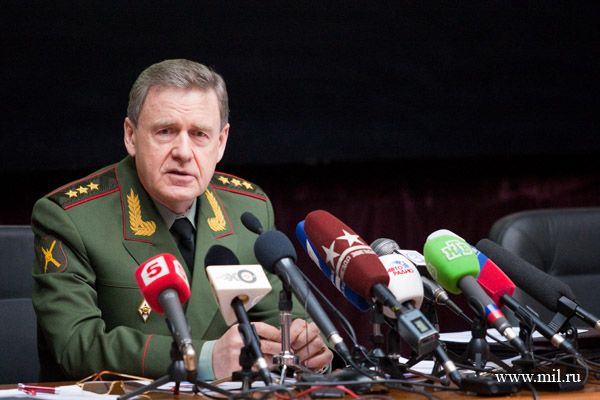
General-Colonel Vasiliy Smirnov

Reversing decisions made in the context of Defense Minister Anatoliy Serdyukov’s military reforms is apparently necessary, no matter how painful.  In early 2010, Serdyukov and General Staff Chief Nikolay Makarov announced their intention to curtail professional contract service and rely on the one-year draft to man the Armed Forces.  Scarcely more than a year later, they’ve been forced to retreat from this plan.

Yesterday Deputy General Staff Chief, General-Colonel Vasiliy Smirnov said Moscow will draft only about 200,000 young men in this spring’s callup.  See Mil.ru’s transcript of the press-conference.

The Russian military has tried to conscript in excess of 270,000 men in every draft campaign since one-year service started.  But General-Colonel Smirnov said the military will now induct only 203,720 men this spring, and (not mentioning problems with numbers) he attributed the reduction to a Defense Ministry and General Staff decision to raise the quality of the callup contingent.  He added that coming drafts would also aim for about 200,000 new soldiers, plus or minus 3-5 percent.

The Russians are also refraining from measures to round up more men.  Newsru.com noted the spring callup will run only until July 15, not August 31 which would have allowed for drafting more men before they enter higher educational institutions (VUZy).  President Medvedev decided not to make technicum (post-secondary trade school) graduates liable to the draft so they can attend VUZy if they choose.  Other ideas, such as extending the upper age limit for the draft from 27 to 30, or raising the service term back to 18 months or 2 years, remain off the table.

So Moscow is facing its manpower limitations head-on.

The simple fact is a million-man Russian Army was never going to have 600,000 or 700,000 conscripts, perhaps not even 540,000 at any given moment.  Vladimir Mukhin already reported in January on the fall callup’s failure, and approximately 20 percent undermanning in the ranks.  That would put draftees at about 430,000, or at what Smirnov says they now plan to conscript each year.  Mikhail Lukanin wrote last June that the military’s conscription targets were unrealistic when the number of 18-year-olds alone won’t reach 600,000 during the next couple years.  Army General Makarov said it himself back in September when he noted that only about 13 percent of draft-liable manpower serves in the army.  His 13 percent of 3 million 18- to 27-year-olds is 390,000.

Where does all this leave Russian Army manpower?

Taking recent pronouncements on the intention to have 220,000 officers and 425,000 contractees in the future, conscripts might number 355,000 at some point in a million-man army.  Smirnov’s statement yesterday indicates they intend to have somewhat more than 400,000 at any given time for now.  Where they are today is harder.  If there are 181,000 officers and 174,000 contractees (as Smirnov said yesterday), and there are no more than 540,000 conscripts presently serving, the Armed Forces are comprised of less than 900,000 men.  How much less depends on the actual number of conscripts.  That’s at least ten percent below their authorized level.  If there are only 500,000 conscripts, that’s about 850,000, or 15 percent under one million, and so on.