Monthly Archives: March 2010

GOMU Chief Smirnov Denies Plans to Increase Draft Term

Reacting to spreading rumors that the Defense Ministry intends to increase the current one-year draft term to 18 months, 2 years, or more, GOMU Chief Vasiliy Smirnov said Monday, “There’s no plan to increase the term of conscripted military service in the Russian Army.”

His denial came hard on the heels of General Staff Chief Makarov’s sudden public declaration that professional contract service has failed, at least for enlisted soldiers if not future sergeants, and the army will redouble its emphasis on drafted manpower.

Commenting in today’s Novaya gazeta, the chairwoman of Mother’s Right Veronika Marchenko says:

“If the Genshtab Chief is acknowledging the fact that the Genshtab is not capable of transferring the army to contract service, even though a corresponding [Federal] goal program was adopted, this is not cause to return to the draft system and increase the number of conscripts.  This is a reason to dismiss all the inept generals.”

That is a quaint sentiment, but it doesn’t work that way.  The generals always muttered that contractees wouldn’t work, and men inclined to evade simply had to be herded in.  They’ll say they were right all along.  The chiefs won’t suffer, only the indians.

More interesting, however, Marchenko thinks the rumors could be a trial balloon to gauge society’s reaction–if there’s no reaction, they might try to increase the service term again.

Another human rights organizer claims every 10th conscript is abused in some dehumanizing fashion.  She compares army service to life in a leper colony:

“It’s possible to live [there] ten years and not contract leprosy, or it’s possible for the irreparable to happen in one day.  The army today is potentially dangerous for the human system.”

Komsomolskaya pravda’s Viktor Baranets writes today that he’s amazed that it’s taken 20 years for generals like Makarov, Postnikov, and Chirkin to acknowledge that contract service is doomed.  He goes on:

“And how here can’t you believe that in the same manner in a year or two the Defense Ministry and Genshtab again will publicly ‘scratch their noodles’ and with a funereal sigh announce to us that the transfer of troops to the brigade system, and the transfer of the Navy Main Staff to Piter, and getting rid of warrant officers, and the reduction of almost 200 thousand officers were also mistakes?  But the strategists who reformed the army for no reason will by that time will be wearing pensioners’ slippers and courageously scribbling out their memoirs.”

This Russian (maybe even universal, bureaucratic) penchant for back-to-forth reform, reforms where process is everything and results are nothing is truly amazing and very evident in the armed forces.  But it’s everywhere even on the very same day.  Witness please Putin’s solemn announcement that he’s slashing the rolls of strategically important enterprises after many years of just as solemnly building up their ranks . . . what was the point?  What did they gain, what was accomplished?  Nothing.  It was a political drill to fend off clients desperate for money and bureaucratic attention, and their strategic status was, by and large, a sop.  End of digression.

What else on the topic of the moment?

Baranets.  He speculates the ‘death notice’ for contract service could be a first step backward on Serdyukov’s reforms.  He says there are now 70,000 contractees and contract-sergeants.  He believes in a year the Genshtab will increase conscription to 700-750 thousand guys annually, and they won’t become specialists in anything with demob always just around the corner.  So, he concludes, the rumors about a return to longer conscript service ain’t a coincidence.

Versiya has interesting coverage of the issue.  So Makarov says contract has failed, all sorts of other innovations in army service similarly haven’t brought the desired results.  Dedovshchina didn’t decrease, collecting the requisite quantity of servicemen will now be more complicated, the quality of soldier training has sharply declined.  And the number of conscripts in the ranks will grow.  Versiya asks:

“Can it be we’ll return to the Soviet model of an army which has been publicly declared ineffective in modern conditions?”

One-year service was supposed to eliminate dedovshchina, but General-Lieutenant Chirkin admits it didn’t.

Versiya’s versions:

  • First Version:  Return to Soviet-style manning.  Probability:  50 percent.
  • Second Version:  No alternative but contractees, this is just a pause.  Probability:  30 percent.
  • Third Version:  Course will be unchanged despite Makarov’s announcement.  Probability:  20 percent.

It sounds like Versiya really puts the odds of largely diverting from contract service at 50:50.
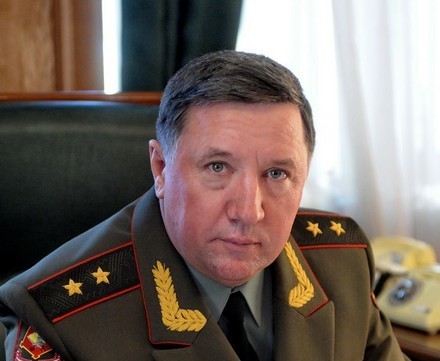
One-Year Conscription Hasn’t Stopped Dedovshchina

General-Lieutenant Chirkin (photo: IA Regnum)

On Thursday, SibVO Commander, General-Lieutenant Vladimir Chirkin told reporters:

“The military expected a dramatic decrease in this type of offenses, but, regrettably, hazing remains an acute problem. The conscripts, who now have to serve 12 months, regard themselves as ‘old timers’ after serving 6 months, and the same thing continues.  Apparently, this virus is transmissible.”

“We now know that we should search for the causes of bullying not in the duration of service but, it seems, deeper.  We now have to work harder with detachment commanders.  This year issues of discipline will be even more important for us than those of combat readiness.”

Chirkin said several high-profile abuse cases are currently under investigation in the SibVO.

Introduced in 2008, the one-year draft was intended to reduce conflict between conscripts from different draft campaigns.  The ‘dedy’ or ‘grandfathers’ about to demobilize would often abuse, haze, or otherwise mistreat brand-new inductees.  But as Veronika Marchenko from Mother’s Right says, it hasn’t been enough to stop dedovshchina:

“In the army then and now they beat people on the third day of service, in two weeks, and in the first months.”

Marchenko believes ending conscription completely is the only way to curb dedovshchina, but that’s not likely now with the virtually complete failure of professionalization through contract service.

The Contractees Are Dead, Long Live the Contractees!

Asked about professional soldiers and contract service last week, General Staff Chief Nikolay Makarov said: 

“We are not switching to a contract basis.  Many mistakes were allowed, and that task which was given—construction of a professional army—was not completed.  Therefore a decision was made that conscript service needed to remain in the army.  Moreover, we are increasing the draft , and decreasing the contract part.  We’ve come to understand that a contractee has to be trained by altogether different methods than there were earlier.  Therefore now we’re taking on contract only sergeants who are studying for 2 and a half years.  We plan to reach a contract army through this.  Many people talked even in the Soviet Army about the need to train sergeants, but now we’ve thought everything through well and we’re promptly moving forward, so that in 2.5 years in our army there will be a sergeant, an assistant commander who’s capable of independently resolving an entire complex of tasks that are now resolved by officers.”

The effort to build a professional NCO corps will continue, but the experiment in recruiting career enlisted personnel—a main line of the army’s development since 2003—has failed.  The tenor of Makarov’s statement almost makes it sound as if he didn’t think or know a mixed manning system with conscripts predominating was the plan all along.  The Russian Army was always going to remain mixed, but now it will be much more one-sided in favor of conscripts.  A Vedomosti editorial pointed out that Russia’s generalitet (what remains of it) never supported contract service anyway.  The training of professional NCOs begun on a very small scale last fall will continue, but how long will it be before that effort too is abandoned?

Makarov’s announcement will only add to pressure on Russia’s dwindling manpower resources.  The start of one-year service basically doubled the semi-annual requirement for draftees from 133,000 to 270,000 or so.  Now it’s clear that conscripts are needed to fill spots contract enlisted were supposed to occupy.

Rossiyskaya gazeta and Krasnaya zvezda covered similar comments last week from new Ground Troops CINC Postnikov.  Both papers concluded that, while the effort with professional NCOs will continue, the army’s priority will be on meeting its manpower requirements through conscription.

Vremya novostey quoted Postnikov:

“The federal program to transfer permanent readiness units to manning with contractees did not achieve its intended goals.”

It didn’t succeed in making contract service prestigious, they didn’t select those who could be true professionals, they fully manned units with contractees to the detriment of quality.  Now corrections have been made in the troop manning plans.  Only those positions that determine the combat capability of units and formation will be contract.  There both pay and social conditions will be fitting – just like officers.  They will train contractees for the positions of professional sergeants, just as in the U.S.

And Izvestiya:

“. . . we can’t say that we have precisely those contractees which we wanted to have ideally.  We understood that we had to change the system of training contractees.  It’s planned to do this through the institution of sergeants – an assistant commander capable of independently resolving a whole block of tasks which officers now resolve.  For this reason they have to occupy positions directly answering for the combat readiness of army units and sub-units.  We have to increase their pay, create social conditions for living at the level of officers.”

But one basic problem has always been the jealousy of officers (who rarely get all their pay and benefits) toward contractees or NCOs who might possibly get almost as much as them. 

Novyye izvestiya quoted Sergey Krivenko, a member of the RF President’s Human Rights Council:

“Contractees were not provided housing or normal pay, or even timely indexing of their wages . . . .  Instead huge sums were invested in construction of housing, reequipping ranges and other facilities where the money could easily be hidden and stolen.”

Krivenko adds that contractees didn’t experience a change in their status, were often forced to sign contracts, and were not allowed to leave the garrison or live a normal life with their families outside the garrison.  So there was nothing to distinguish them from conscripts.

To sum Krivenko up, the army failed to find the right candidates and deliver the benefits it promised them.  So one has to be skeptical that the selections and Defense Ministry follow through on the professional NCO effort will be any better.

Krivenko believes that the army has virtually no choice but to increase the conscription term from one year to cover the lack of contract soldiers.  But simply allowing undermanning of units would have the same effect, but that might impinge on Makarov’s claims that most units are now fully manned and permanently ready.