
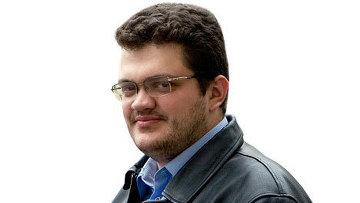
Ilya Kramnik (photo: RIA Novosti)
On 22 April, RIA Novosti military commentator Ilya Kramnik provided an essay on the army, the VPK [OPK], and post-Soviet realities. He gives a convincing negative answer to the question posed above. Like more money and budget, foreign imports won’t be enough by themselves to fix the Russian OPK’s structural problems which have to be addressed more directly at their roots.
He has praise for Defense Minister Serdyukov for being willing to admit that the ‘emperor had no clothes’ to some degree. Serdyukov’s management has recognized that the world has changed and changed the army’s missions accordingly.
A recognition of one’s problems, however, is not the same thing as fixing them. Serdyukov, the army, and the OPK face the same kind of modernization dilemmas that face Russian politicians, business, and society. But thanks to Serdyukov, the armed forces are operating under a more realistic vision of what they are, or should be, building toward.
Kramnik believes imports are fine, but the OPK needs the capability to build the entire line of military equipment needed, if it has to. To do that, it will have to remedy its capital problems, including human capital. He concludes there’s still a way to go to get to a mobile, well-armed, and trained army, appropriate for the real threats facing the country.
Kramnik writes:
“In the past few days Defense Minister Anatoliy Serdyukov and his deputy Vladimir Popovkin again raised questions about the quality of the work of the country’s VPK [military-industrial complex]. These questions are not being mouthed for the first time, and are taking on a particular acuteness against the backdrop of announcements of planned purchases of military products abroad–both separate components and complete systems.”
“It’s difficult to say when the theme of the Russian VPK and armed forces’ dependence on foreign supplies first began to resound. In a large sense, it was always acute–even the USSR didn’t have full independence from foreign supplies, in its heyday, trainer aircraft from Czechoslovakia, light helicopters (Soviet-designed) from Poland, large assault ships from the very same Poland, various types of boats and ships from the GDR, etc., were bought.”
“After the USSR’s collapse this dependence deepened because of the foreign status of many producers which had been an integral part of the Soviet VPK–from Dnepropetrovsk’s Yuzhmash to the Tashkent Aviation Production Conglomerate. But the problem of the VPK’s growing dependence on producers in the ‘far abroad’ is the most acute and painful today.”
“The list of purchases of military equipment abroad being realized by the Russian military and producers is already now quite broad: different types of infantry weapons, communications systems, unmanned aerial vehicles, thermal sights, digital electronic equipment…”
“Now being added to this list are multipurpose assault ships, and armor for vehicles and light armored equipment.”
“Meanwhile from the Defense Ministry resound still louder complaints about the domestic VPK over the quality of the equipment it is producing. Of the number of the largest scandals of this type the recently resonating complaints about domestically developed unmanned aerial vehicles, armored personnel carriers and infantry fighting vehicles must be noted. Problems are also arising where there are no alternatives to domestic manufacturers, and can’t be in principle–in the development and production of ballistic missiles (“Bulava”).”
“What is happening with the country’s VPK, and what kind of ways out of the situation which has taken shape are there?”
“The main cause of today’s situation is obvious: from the beginning of the 1990s through the mid-2000s a large part of VPK enterprises together with the entire country was occupied with everything except strengthening defense capability and modernizing production. The collapse of the USSR, with the consequent destruction of Soviet industrial infrastructure, disruption of production ties and scientific schools didn’t leave any chance for a better result.”
“It follows to note that the disruption was systemic, and besides experts in the State Property Committee and other government organs of the 1990s, the authors of this process could, with complete justification, be considered the ‘captains of industry,’ many of whom in this period openly used enterprises entrusted to them for the purpose of ‘making money here and now,’ even through the ruin of production sold off for scrap.”
“Against this background in the armed forces and those close to the military, but also in industrial circles, groups of ‘patriotic’ experts and analysts, rose like mushrooms after the rain, thoroughly glorifying the country’s army and VPK with chants of one and the same incantation: ‘it has no analog in the world.’ The incantations rang out with respect to various military and technical wonders, and meanwhile not the slightest attempt was made to comprehend the changing world map, missions of industry and the armed forces.”
“From the other side the ‘alarmists’ were entrenched and grievously moaned about the death and destruction of the army and military industry, keeping such an inadequate perception of the world as a whole. Both sides supposed that Russia and its army would in the future conduct a precisely ‘Soviet’ type war against the entire capitalist world, or, at a minimum, against a Chinese invasion.”
“Very few production associations, which were flagships of the domestic VPK, were able to preserve themselves as single entities in the Bacchanalia of destruction. There is, first of all, the ‘Sukhoy’ firm, which knew how to turn the crown of Soviet scientific-design thinking–the family of aircraft on the T-10 (Su-27) platform–into the most commercially successful product on the combat aircraft market of the last 20 years. There is ‘Almaz-Antey,’ whose air defense systems received not less recognition. There is Nizhnyy Tagil’s UVZ which was saved thanks to the T-90. There are some shipbuilders and several other companies that managed to ‘get’ the situation and survive. But such successful ones turned out to be far from all.”
“The renewal of defense development and the increase in the State Defense Order in the middle of the 2000s could not be and didn’t become a panacea.”
“Firstly, a simple increase in monetary investment will not save a disrupted industry: dead people don’t need money, neither do the seriously ill generally.”
“Secondly, this money by itself could not resolve the row of problems of even successful enterprises–for example, the problem of a lack of personnel, caused not only by the outflow of workers ‘in the hungry 1990s,’ but also by a sharp decline in the young population, together with the fall in the quality of engineering-technical education, and the practically complete collapse of the system of specialized secondary education.”
“But the biggest problem became the management of the armed forces and military industry in principle. The armed forces command right up to recent times didn’t have any kind of clearly expressed views on the future profile of the Russian Army. All the years of reforms right up to the arrival of Anatoliy Serdyukov in the post of Russia’s Defense Minister preserved in essence the truncated and frayed Soviet Army, whose model was becoming ever less and less adequate for the missions facing the country in the prevailing economic and political conditions.”
“Military industry against this background survived reorganization after reorganization, the overwhelming majority of which led to nightmarish overgrowth in bureaucratic components and an increase in the already huge gap in pay between specialists on the line and in the laboratory and the management. This state of production efficiency contributed to the growth of military expenditures and the amount of ‘kickbacks’–most of all. Responsibility for results was conveniently forgotten: ‘captains of industry’ together with the armed forces leadership now, as a rule, won’t risk even dismissal, much less their freedom.”
“A similar uncertainty led to uncertainty with the military order. Plans and ideas floated and sank, development began and stopped, the vision of the army and its complex of armaments as some kind of organic system aimed at resolving such-and-such concrete missions was totally absent. The sole exception on this score was the strategic nuclear forces, where a clear understanding of missions and ways of conducting them was preserved, and work was conducted–on supporting old RVSN missiles, on testing and adopting new ones, on repair and modernization of the Navy’s strategic missile submarines and Air Forces heavy bombers.”
“Anatoliy Serdyukov’s reform, being the first systemic reform of the armed forces in the last decade, not directed at supporting a dead Soviet structure, but at arranging a new one, under concretely certain missions of fighting local and regional conflicts while preserving nuclear deterrence potential, did not create new problems. It simply revealed old ones, aggravating them with the absolute ‘nonconcurrence’ of the new Defense Ministry leadership in the old system of relations of the army and VPK.”
“This ‘nonconcurrence’ became a thorn in the side of very many, those problems earlier kept quiet behind the reckoning ‘well, you understand,’ suddenly stopped being kept quiet, and floated in all their ugliness before the eyes of an astonished public.”
“For the public the foregoing was a big shock, since it all these years kept the point of view on the army and VPK as some ‘island of stability,’ preserving, in the face of all problems, the Soviet system of connections and ties, and, in general, Soviet possibilities. Many understood the fact that this wasn’t so, but an open recognition of the changed situation by the leadership of the armed forces and the country, nonetheless, was unexpected.”
“However such a recognition was necessary as a recognition of the fact that the world has changed. The Russian Army is more incapable of realizing the West’s half-century nightmare–a three-day dash to the English Channel (we set aside the question of whether the Soviet Army was capable), however does Russia need this capability for defending its people, its sovereignty, its interests?”
“It occurs that our country needs something different. It needs a clearly expressed understanding of threats, developed with the participation of the military, politicians, and the public, which stand before the country and the capability to counter these threats. It needs a compact, ‘quick reaction,’ innovative, directed military industry with minimal bureaucratic overhead, and an education system regularly supplying engineering and labor personnel who will receive pay greater than the managers of shops selling mobile phones and taxi drivers. At a minimum.”
“This industry needs to produce the entire line of types of equipment and hardware essential to the armed forces, even if using some quantity of imported components–in the end, even the USA doesn’t disdain the use of military imports, and it imports foreign military hardware worth $15-16 billion annually.”
“It needs an army–mobile, trained, armed, conscious of its status, prestige, and many centuries of history. It needs strategic forces which protect the country against wars with superior enemies, the calculation of which on our planet doesn’t even require three fingers.”
“All this could become a reality only in the event that it’s made into a goal at the very highest level. Still the reactions of the country’s leadership, and of the armed forces, at a minimum, demonstrate understanding of the problem.”

 Russian Defense Policy