
Nezavisimaya gazeta’s Vladimir Mukhin recently pointed out that Russian soldiers are still busy performing ‘noncore’ tasks [i.e. essential housekeeping chores unrelated to combat training]. And this is happening despite frequent Defense Ministry trumpeting about success in eliminating ‘nonmilitary’ work from the troops’ daily regimen.
Helping out during the recent snow and ice storms is just the most recent example. Mukhin says the army was pressed into this municipal task in Khabarovsk, Nizhniy Tagil, and Chelyabinsk. Suburban Moscow air defenders in the OSK VKO fueled mobile power generators and operated field kitchens during the bad weather. Reservists were called up to cope with heavy snow in Tatarstan. Military units were also pressed into service against forest fires this summer.
None of this is particularly surprising. Many governments would turn to the army in similar circumstances. But it shows that Russia’s local and regional governments lack the depth of resources to provide the services customarily expected at those levels of administration in most countries. And, of course, they don’t have part-time soldiers in a national guard structure that can be mobilized by the governor in an emergency.
More interesting, however — to return to Mukhin’s article — a Kremlin source told his paper that an unpublicized order had gone out from the PA to the Defense Ministry on the eve of the New Year’s holidays saying that troops should prepare for “active participation” in resolving any kind of “emergency situations” (ChS) arising in the country. And the order implied both natural and “social” [i.e. man-made] emergencies.
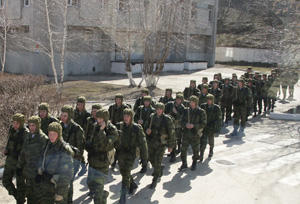
Ready to Help the Police (photo: Nezavisimaya gazeta / Aleksandr Shalgin)
An NG source in the Defense Ministry said VDV unit and formations throughout Russia were in “full” combat readiness, and at “hour X” were ready to come to the assistance of police and the MVD’s Internal Troops (VV) in the event of disturbances in the capital or other major cities.
KPRF Duma Deputy and former Black Sea Fleet Commander, Vladimir Komoyedov put it in this context:
“There’s nothing bad about the army coming to help people, to help clean up disasters. In the days of the USSR, soldiers also harvested crops, cleaned up man-made disasters, and separated ethnic groups who were fighting. But our leaders have proclaimed the principle that the army is outside politics. The troops should be occupied with their business — combat training, ensuring military security — and that’s all. But it isn’t happening like this… Now once again signs of instability are appearing — and no longer just in Russia’s south, but also in the entire country. And we no longer have an army at all.”
The VDV spokesman felt compelled to respond right away to this story. He told RIA Novosti the VDV is not in “full,” but rather “permanent” combat readiness for any missions assigned by its command. And he noted that VDV sub-units are not specially trained for the mission of securing law and order.
But he didn’t say they couldn’t or wouldn’t give it a try.
The use of the VDV for an internal contingency is unlikely, but certainly conceivable. It would probably be a last-resort measure. And its effect on any situation might be unpredictable.
In the right circumstances, the VDV might handle themselves professionally. In the wrong circumstances, they might be like oil on a fire.
 Russian Defense Policy