Monthly Archives: February 2011

Walking Back Serdyukov’s Personnel Policies (Part II)

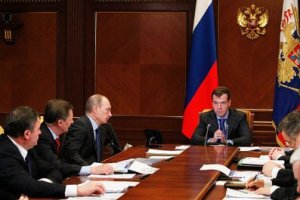
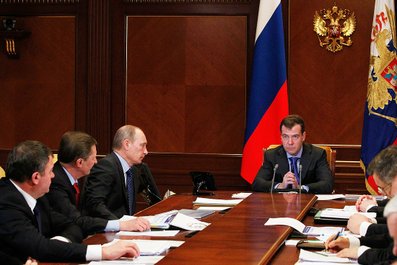
Medvedev in Meeting on Military Pay (photo: Kremlin.ru)
So officers were cut too drastically, and their numbers are going to be increased.

One recalls Ilya Kramnik saying officer cuts were causing serious tension in the ranks.  As if to prove the point, on Wednesday, near Novosibirsk, a drunken major living outside the “shtat” threatened to blow up his room in the unit’s dormitory.  This summer Aleksey Nikolskiy said halving officers caused trouble for brigades in the Vostok-2010 exercise.

But it’s not just an officer shortage that’s led to this policy reversal.  Difficulties with conscription and sergeants have forced the Defense Ministry to plug holes with more officers. 

Aleksandr Sharavin talked to BFM.ru about the situation:

“I think this is connected with the fact that now the situation in the army is very tense.  They cut officers from 450 thousand [sic] to 150.  They cut warrant officers completely, and professional sergeants aren’t appearing, we didn’t train them, and still can’t do this.  What we’ve got is a lot of conscript soldiers, few contractees, generally no professional sergeants, and a triple load laid on the remaining officers.  Now we have to compensate by increasing the number of officers.”  

Increasing the officer ranks wasn’t the only personnel policy reversal announced on 2 February.  A preliminary decision to increase contractees in the Armed Forces was also discussed.  Serdyukov said:

“This issue isn’t finally decided, but we have a proposal for an increase.  The Security Council was ordered to review this issue, in the course of the month a concrete figure – how much the number of contractees will be increased from 2012 – will be determined.”     

Utro.ru entitled it’s coverage of this story “Army Reform Reversed,” and reminded readers that army contract service was curtailed last winter because the military couldn’t afford it.  And now apparently it can?

We don’t know how many contract sergeants might be added starting next year.  In fact, no one seems to know how many there are now.  Newsru.com claims the army currently has 180,000 contract soldiers, sergeants, and warrants.  If that’s true, the Armed Forces are about 900,000.  But if there are fewer contractees, and conscripts are less than 560,000, then the Armed Forces are that much below 900,000.

Can an about-face on the elimination of warrant officers be far behind?

As early as 27 January, Rossiyskaya gazeta reported Deputy Defense Minister Pankov said some cadets might be inducted into VVUZy in 2011.  It was just back in the fall that the Defense Ministry put a two-year moratorium on them.  As it is, VVUZy now have about 45,000 cadets in the classes of 2011, 2012, and 2013.

But the Defense Ministry is looking at having these would-be officers join 5,000 other former cadets as sergeants.  The Defense Ministry is talking about salaries as high as 40,000 rubles a month for professional NCOs.  But current NCO training efforts in VVUZy are going very slowly, and the army wants 250,000 of them, according to Nezavisimaya gazeta.

Let’s return for a bit to Medvedev’s Tuesday session on raising pay for servicemen and law enforcement.  We’re talking Defense Ministry, MVD, MChS, FSB, FSO, and SVR here.  Men with ranks, badges, and guns.  Medvedev called higher pay for them:

“. . . an issue of state importance.  In the last analysis, our efforts to reform the Armed Forces, create a new profile of the Armed Forces and, of course, reform the system of law enforcement organs, including reforming the Internal Affairs Ministry and creating police depend on it.”

The Defense Ministry is talking median pay of 50,000 rubles a month for lieutenants starting in 2012.  Just a sampling . . . a cadet would get 18,200, a contract soldier 24,800, a squad sergeant 34,600, and a brigade commander 93,800 rubles per month.

NG’s Vladimir Mukhin reports the Finance Ministry believes the new military pay plan will cost another 1 percent of Russia’s GDP, taking the defense budget from nearly 3 to nearly 4 percent of GDP.  All this while the government wonders whether outyear budgets will be in deficit or not.

The last couple days represent the first major defeat for Serdyukov.  His military personnel policies are a complete and utter shambles.  Political analyst Aleksey Mukhin commented to BFM.ru on Defense Minister Serdyukov’s prospects: 

“ It’s fully possible that soon they’ll call him enemy No. 1 for the reform which is being conducted.”

If they don’t already.  One guesses he’ll keep his post though.

So after flirting briefly with paying relatively few officers more money, the Defense Ministry’s going to pay more officers more money instead.  And this is more officers at the same time President Medvedev’s ordered a 20 percent cut in government bureaucracy.

The fact is military reform’s gone beyond the military now and become more of a factor in domestic politics.  Vlasti are just a bit nervous about social stability in the runup to elections this year and next, and are also a little worried about the guys with the guns.  For the regime, the extra money is worth keeping 70,000 potential ex-officer opponents out of the streets.  It may feel this provides some insurance that the guys with guns will do as they’re told.

As BFM.ru concludes, the Tunisian [or Egyptian] “virus” could spread.  And the terrorist threat is high.  So Russia’s leadership has to think about an effective and combat capable army.

Commentator Sergey Markov told BFM.ru that the regime wants to increase the number of officers who can fight, but it will continue cutting those in support functions and replacing them with civilians:

“But everyone understands perfectly that you can’t do without a real combat force.”

Walking Back Serdyukov’s Personnel Policies (Part I)

And so it’s begun. 

The first of Defense Minister Serdyukov’s major reform planks – cutting the officer corps from 355,000 to 150,000, or no more than 15 percent of the million-man army – has been reversed.

The Armed Forces’ officer manning level was apparently one topic in yesterday’s meeting between President Medvedev and his “power” ministers about plans to raise pay for servicemen in 2012.

Serdyukov told the media about the decision to increase officers in the Armed Forces by 70,000:

“A decision’s been taken to increase officer personnel by 70 thousand.  This is connected with the fact that we’re deploying additional military units, establishing military-space defense, that is, an entire service (of troops), and the increase is happening in connection with this.”

First, this raised some interesting questions about VKO.  Is it really going to become a service (vid or вид).  After all, the Space Troops are only a service branch (род войск) right now.  That’s quite a promotion.  And are we really supposed to believe the expansion of VKO or the Space Troops will require 70,000 additional officers? 

Of course not, it’s a convenient excuse to walk back a large part of the 50 percent cut in army officers Serdyukov announced when he launched his reforms in October 2008.

Most media outlets were pretty confused on what this means for officer numbers.  They assumed the Russian Army’s at 150,000 officers right now, just add 70,000 for a total of 220,000.  But it’s not so simple.

When Serdyukov started cutting officers, there were 305,000 occupied officer billets.  Krasnaya zvezda said the Armed Forces had 181,000 officers at the end of last year.  So a grand total of 124,000 officers were either discharged, placed outside the “org-shtat” at their commander’s “disposition,” or forced to accept an NCO billet between late 2008 and the end of 2010.  Returning 70,000 to the ranks might leave us wondering only about what happened to the other 54,000.  And 181,000 plus 70,000 takes the officer corps basically back to 250,000, or fully one-quarter of the million-man army.

The army officer corps has endured considerable sturm und drang in a little over two years all for the sake of shedding just 55,000 officers.

More on this tomorrow.

New Deputy Defense Minister

Antonov with Medvedev and Serdyukov (photo: Kremlin.ru)

Today President Medvedev made Anatoliy Ivanovich Antonov Deputy Defense Minister for International Military Cooperation.  He’ll bear responsibility for organizing and conducting the Ministry’s contacts with foreign military departments.  Kremlin.ru notes Antonov was one of the negotiators for the new Treaty on Strategic Offensive Arms.  Medvedev said Antonov’s experience in this successful negotiating process will enable him to fulfill his new duties effectively.

Anatoliy Antonov

PIR-Tsentr’s short biography of Ambassador Antonov says he’s been serving as Director of the Foreign Ministry’s Security and Disarmament Issues Department.  He was born in 1955.  In 1978, he graduated the USSR Foreign Ministry’s Moscow State Institute of International Relations (MGIMO or МГИМО).  In 1983, he completed graduate study at the same institution.  Antonov’s worked in the Foreign Ministry since 1978.  He’s headed government delegations in G8, NPT, Inhumane Weapons Convention, and multilateral export control negotiations.  He’s a member of the U.N. Secretary General’s Consultative Council on Disarmament.

In mid-2007, Antonov helped then-President Putin unveil his offer to use Russia’s Gabala and Armavir radars in NATO missile defense, according to Novosti KM.RU.

Antonov makes nine deputies to Serdyukov; a tenth deputy slot for finance-economic work has been vacant since Vera Chistova’s departure in the fall.

Antonov’s quite different from his predecessors in this job.

International military cooperation seemed to fall off the Defense Ministry’s radar for a while after Anatoliy Serdyukov took over.  You may recall, former Main Directorate for International Military Cooperation (GU MVS) Chief, General-Colonel Anatoliy Mazurkevich fled the Defense Ministry when Serdyukov arrived.  GU MVS essentially disappeared from the military department’s organizational chart.

GU MVS’ roots stretch back to the General Staff’s old 10th Main Directorate, which had a long history of involvement in arranging arms sales and providing military advisors and training to Soviet client states in the bad old days.

Blaming Yudashkin

Aleksandr Kanshin has reemerged . . . late of the Public Chamber, he’s now Deputy Chairman of the Defense Ministry’s Public Council, and he blames new army uniforms designed by fashion mogul Valentin Yudashkin for the recent outbreak of illnesses among conscripts in the Central Military District.

Vesti.ru and Newsru.com picked up what Kanshin told Interfaks:

“Judging by documents I’ve been made familiar with, one of the causes of illnesses among the young reinforcements in the troops, particularly in the Central Military District (TsVO), is manufacturing defects in the new winter field uniform supplied to conscripts at the assembly points of the military commissariats.  In other words, the new type uniform ‘from Yudashkin’ doesn’t defend soldiers against freezing in low temperatures.”

“At times, TsVO servicemen have to wear warm things under the new winter uniform.”

Kanshin also said he’s talked with TsVO Commander, General-Lieutenant Vladimir Chirkin who recognizes the new uniform needs improvement, but he also indicates 80 percent of his personnel are dressed in the old field uniform which is much warmer.

Vesti.ru reported the majority of the district’s servicemen are negative about the Yudashkin uniform because the air temperature is -20° (-4° F) and the wind blows through it outside.

Newsru.com pointed back to several scandals over the Yudashkin uniform, including last December when it said 250 soldiers became seriously ill in their unit in Yurga.  It was proposed at the time that they became sick because the new uniform didn’t protect them against the cold.

These new digital cammies were developed between May 2007 and 2010.  Besides fashion designer Yudashkin, specialists from the Central Scientific-Research Institute of the Garment Industry and the Defense Ministry’s Central Clothing Directorate participated in creating them.

Gzt.ru claims Yudashkin isn’t to blame.  The winter uniform was changed and sewn in defense industry factories with cheap materials.  Perhaps these are Kanshin’s “manufacturing defects.”  Sounds like corruption though, if someone substituted inferior materials.

Doctors told journalists that Yudashkin’s boots don’t keep out the cold either.

According to Gzt.ru, the military prosecutor is checking the situation in the TsVO.  Meanwhile, the military officially denies the uniforms are to blame, and maintains the emergency situation is just a seasonal outbreak of illness.