Category Archives: Command and Control

Step Closer to Four OSKs Instead of 6 MDs

ITAR-TASS reports today that the reform of the operational-strategic level of command and control has entered its final phase.  According to the Genshtab’s plan, on 1 December 2010 military districts (MDs) will shrink from 6 to 4.  A Genshtab source told ITAR-TASS that 4 MDs and operational-strategic commands (OSK or ОСК) will be formed–Western, Southern, Central, and Eastern, with their commanders having operational control over all (or most) of the troops (forces) of the armed forces and other militarized structures located on their territory.  

The Genshtab representative says the Western MD/OSK, based in Piter, will include the Moscow and Leningrad MDs, with Baltic and Northern Fleets, VVS, VDV, and other militarized structures operationally subordinate to it.  The Southern MD/OSK in Rostov-na-Donu will have the North Caucasus MD, with the Black Sea Fleet and Caspian Flotilla operationally subordinate.  The Central MD/OSK in Yekaterinburg will have the Volga-Ural MD and the western part of the Siberian MD.  The Eastern MD/OSK in Khabarovsk will have the eastern part of the Siberian MD and the Far East MD, with the Pacific Fleet operationally subordinate to it.

The question of subordinating units and formations of the RVSN, naval strategic nuclear forces, LRA, and the Space Troops hasn’t been decided.  According to the source:

“This issue is now under long-term study, Genshtab Chief Army General Nikolay Makarov is personally occupied with it.”

The Genshtab source said the new MD/OSKs will be tested out during the Vostok-2010 operational-strategic exercise at the end of June.

ITAR-TASS said this major command change will not involve officer cuts, but there will be a redistribution of the officer corps to new service locations.

So there’s more smoke from a fire somewhere, presumably.  If this pans out, it will be the culmination of a command and control change long talked about, and even tried out piecemeal at times.  After many waves of reform since late 2008, one has to wonder whether this is the time for more disruption.  Maybe it is since things are already disrupted.  Which generals will be the winners or losers?

It will be hard to judge the value of this effort just from the name changes or the movement of a major combined formation from one order-of-battle column to another.  A lot will depend on what the exact terms of ‘operational subordination’ are when it comes to the fleets and other major militarized formations outside the Defense Ministry’s administrative control.  The four MD/OSK commanders will certainly have more responsibility, and they must be hoping and working to get the real authority they need to go along with it.

Shamanov’s Press Conference

General-Lieutenant Shamanov

Ever-loquacious VDV Commander, General-Lieutenant Vladimir Shamanov held a wide-ranging press conference on Wednesday.  The Defense Ministry web site covered it hereITAR-TASS also published a number of short items on it. 

Shamanov detailed the work of five immediate deployment VDV battalions, lobbied again for a helicopter regiment, and discussed training issues and his procurement desires.  He joined the dogpile on top of the Russian OPK although he once seemed to defend it, and he credited Putin alone for the initiative to modernize the military’s arms and equipment.

He described his forces as combat ready, and manned and equipped at 100 percent.

Relative to combat readiness, Shamanov announced that the VDV has dedicated five battalions for immediate deployment which, if necessary, will be its first units sent into combat.  He said:

“By agreement with the General Staff, in the VDV we’ve dedicated five battalions for immediate deployment.  The uniqueness of service in these battalions is such that personnel from each of the battalions goes on leave for 45 days as a complete unit.  Therefore, at a minimum four battalions are always ready for combat deployment.  Today one of the sub-units of such a battalion from the 31st Airborne-Assault Brigade (Ulyanovsk) is fulfilling missions in Kyrgyzia [sic].”

Shamanov also gave voice to his desire, more modestly expressed than in April, for some aviation assets for VDV.  Speaking about the VDV’s future development, he said his troops must become airmobile.  To this end, he’s “given the Genshtab’s Main Operations Directorate [GOU] a request on the issue of forming a helicopter regiment in one of the three airborne-assault divisions [DShD or ДШД].”

Shamanov discussed VDV training at great length.  He started, of course, by speaking about jump training.  The parachute jump training plan was 70 percent fulfilled during the winter training period.  He blamed poor weather, saying troops often jumped in minus 30 degrees Celsius—the lowest acceptable temperature.  The plan for jumps from An-2 aircraft was fulfilled, but only 70 percent fulfilled from Il-76 aircraft.  He noted the VDV conducted its first-ever drop of a BMD-2 with its crew on-board, and said this hasn’t been done in 7 years, and then it was a BMD-1.  Use of the BMD-2 was significant, he said, because the BMD-2 represents 80 percent of VDV’s combat vehicle inventory.

Shamanov talked about large Spetsnaz assault group jump training in guided parachutes.  He said the use of guided parachutes allows reconnaissance troops to complete a horizontal flight of 20 kilometers, and:

“Our goal is to get so that such movements reach 40 kilometers, as they do in the Israeli Army.”

The VDV Commander noted that the multi-component Polet-K command and control system was tested for the first time in winter training.  He said: 

“It still isn’t the full suite envisioned in the future.  We are one-third through its introduction into the forces.  This process won’t happen in a year.”

Also for the first time, an artillery sub-unit of the 98th Airborne-Assault Division used Russian-made ‘Eleron’ UAVs for target designation on the Luga training grounds.  Shamanov said five ‘Eleron’ UAVs were employed in the training, and they conducted supplemental reconnaissance to a range of 10 kilometers in advance of fire missions.  This summer, 12 VDV crews will train on Israeli-made UAVs in Moscow Oblast.  Shamanov said:

“Unfortunately, our representatives did not go to Israel where they produce the ‘Hermes’ UAV which has been bought by Russia.”

Shamanov noted more attention to air defense training in the VDV this winter.  There were 40 firings of manportable ‘Strela-10’ and ‘Igla’ SAMs.

For the summer training period, Shamanov noted the VDV has 9,300 conscripts to get through three jumps in the course of 1.5 months.  The VDV will participate in ‘Vostok-2010’ and the CSTO’s ‘Cooperation-2010.’  There will be a VDV-level CSX (КШУ), as well as a CSX involving the 98th VDD (or ВДД).

Following the lessons of the Georgian war, the VDV is periodically training on the Navy’s large assault ships (BDK or БДК).  Shamanov says:

“In the winter training period we transported the 108th Regiment on large assault ships three times.  The exercises ended with a naval assault landing by a reinforced assault-landing battalion (ДШБ).

Last but not least, Shamanov commented on VDV procurement, and transport aircraft in particular:

“Work on the State Armaments Program for 2011-2020 is being completed.  According to our requests, in it there is the modernization of Il-76 aircraft, renewal of production and modernization of An-124 aircraft, the purchase of 30-40 An-70 aircraft.”

An-70

But the VDV Commander stressed these were his requests, and the final say isn’t his.  Utro.ru quoted him:

“In the development of the state [armaments] program, we gave our proposals, whether they’ll be realized in the confirmed version of the state program, I can’t say yet.”

Gzt.ru and Lenta.ru covered the An-70 and An-124 story in detail.

Shamanov said troop testing of the ‘Shakhin’ thermal sight for infantry weapons is complete.  He said:

“There has to be one approach for weapons—they have to be all-weather.  Not long ago the thermal sight ‘Shakhin’ went through troop testing.  After the testing we returned it to the designers for reworking.  We’ve given the task that our weapons work according to the aviation principle—turn your head and firing systems turn after it.”

He commented on air-dropping the BMD-4M, and added that, “The BMD-4M has every chance in the future, owing to its qualities, to be the forces’ main infantry combat vehicle.”

Although he seemed more like a supporter of Russian-made weapons six months ago, Shamanov now applauds Prime Minister Putin [not President Medvedev?] for searching for good weapons and equipment abroad.  Shamanov said the prospect of foreign competitors has forced “the domestic OPK to move,” as reported by Utro.ru.  He continued:

“Last year when industry was told that we’d look for alternatives abroad, they began to move.  In particular, the atmosphere around Mistral is creating a significant context for the domestic OPK.  When people declare that they’re ready to produce 21st century weapons but their equipment is from the 30s and 40s [of the 20th century], how can you talk about the 21st century?  Therefore, every official supports Vladimir Vladimirovich Putin’s initiative on the requirement to renew our armaments.  As long as this doesn’t happen, we’ll being shifting in place, and this won’t be just a lament of Yaroslav’s daughter [reference to the Prince Igor’s wife in the Lay of the Host of Igor after his defeat by the Turkic Polovtsy in 1185].”

At the same time, Shamanov concluded that GAZ and Izhevsk vehicles perform better for the VDV in the snow that equivalent Italian and Canadian ones.

Shamanov also said it’s essential to decide what to buy without any kind of lobbying, and for his part, he bases his decisions on saving soldiers’ lives and fulfilling missions.

Serdyukov on Mistral

Defense Minister Serdyukov today said Moscow still plans on acquiring four Mistral amphibious assault ships.  He said Russia is talking not just with France, but also Spain and the Netherlands, about Mistral

According to RIA Novosti, Serdyukov said:

“At present, we’re in pre-contract negotiations on this type of ship with three governments.  They are Spain, the Netherlands, and France.  We plan to sign a contract for four of these ships.”

He also said one ship would be completely foreign-made, but Russian shipbuilders would participate in building the other three.  And the fourth ship will be built, to the maximum extent, in Russia.  

Serdyukov reiterated that the Defense Ministry is working on this acquisition according to President Medvedev’s decision.  And the Defense Minister added: 

“We are now occupied with the issue very seriously.” 

He concluded that the issue of buying the ships will be resolved positively “if there aren’t any revisions, including in the financing question.”  And finally Serdyukov noted:

“We understand now that the Northern and Pacific Fleets need these ships.”

Meanwhile, Baltic Shipbuilding Plant ‘Yantar’ is trying to tout its proyekt 11711 large amphibious ship Ivan Gren as an alternative to buying or building foreign ships.  VPK.name published a version of this story based on an earlier Interfaks report.

More on OSKs, and ASU TZ

On Monday, Olga Bozhyeva reminded readers the proposed OSKs were former Genshtab Chief Baluyevskiy’s idea, and she called them part of a command reorganization along an American model.  She contends Baluyevskiy lost his job for pushing the change from military districts (MDs) to operational-strategic commands (OSKs).  And now the OSK will apparently win out, even though Baluyevskiy’s long gone. 

Bozhyeva says Baluyevskiy and the shift to OSKs were defeated in the past by MD commanders [and their powerful patrons] who stood to lose out in the process.  She claims Baluyevskiy’s opposition to the  Navy Main Staff transfer from Moscow to St. Petersburg was a pretext for his dismissal when the OSK was the real issue.  And his OSK experiment in the Far East was quietly dismantled after his departure. 

Actually, it’s more likely Baluyevskiy went down for opposing–rightly or wrongly–the whole range of ideas pushed by Defense Minister Anatoliy Serdyukov.  By contrast, Baluyevskiy’s replacement has been a veritable extension of Serdyukov on policy issues.

With Baluyevskiy gone, according to Bozhyeva, the MD commanders bent the OSK idea to their way of thinking, proposing to make every MD an OSK, without cutting or consolidating MDs, and duplicating efforts in the process.  She says this reflected the MDs as ‘sacred cows’ upon which no one would encroach, and this tracked with new Genshtab Chief Makarov’s background as an MD commander.  Recall that Baluyevskiy was a career Genshtabist.

Bozhyeva continues, saying this year Makarov has begun to think about how to command the ‘new profile’ army.  And wars of the future will hardly accommodate a command structure like the MD.  But Bozhyeva reports a rumor that the name Military District could be retained to appease opponents of merging MDs in favor of modern OSKs.  She concludes, if the OSKs are realized, it’ll be possible to talk of a really ‘new profile’ army.

Dmitriy Litovkin also had his say on the OSK story last Friday.  He describes the possible move to OSKs in terms of more responsive command and control, reducing the transmission of orders from 16 to 3 steps.  But, he cautions, the OSKs are still just a proposal at this point.

Litovkin says the military hasn’t tried to hide the fact that the OSK is borrowed from the U.S. concept.  The main thing achieved in such an approach, he continues, is responsiveness in issuing and receiving combat orders.  The Defense Ministry says this new OSK structure will be tightly tied to the new automated battlefield command and control system ASU TZ (АСУ ТЗ).

Litovkin mentions how Prime Minister Putin saw ASU TZ at Voronezh, and how the system is supposed to centralize command and control down to the ‘electronic soldier’ on the battlefield.  This fall brigade exercises are supposed to employ ASU TZ with the aim of controlling several hundred ‘objects’ in battle simultaneously.  This summer the OSK model will be tried as part of the Vostok-2010 exercise in the Far East.

Litovkin’s source says:

“Developing ASU TZ without trying it in the new armed forces structure is impossible.  We need to understand in practice not just how this works, but also, possibly, that we are developing something unnecessary or, conversely, we aren’t making anything.”

Not a big vote of confidence for the new system.

Litovkin concludes by saying the possibility of unit and even garrison relocations might be a limitation on the OSK scheme.  Forces would need to be better balanced among the four strategic directions.  For example, the Western OSK would have too many motorized rifle units and the Eastern too few.

Idea of OSKs Waxes Again

In Russian defense policymaking, ideas never die; they wax and wane, and wax again.  Andrey Nikolskiy in Thursday’s Vedomosti reported a source in the Defense Ministry’s central apparatus claims the idea of establishing four regional Operational-Strategic Commands (OSKs) in place of Russia’s current military districts and fleets is waxing again.  This is hardly a new story.

The West reportedly would combine the Moscow Military District (MD) and Leningrad MD, and the Baltic Fleet, under a headquarters located in St. Petersburg.  The East would combine the Far East MD with part of the Siberian MD, and the Pacific Fleet, with its headquarters in Khabarovsk.  The North would combine the remainder of the Siberian MD with part of the Volga-Ural MD, and the Northern Fleet, with Yekaterinburg as the headquarters.  Finally, the South would put the North Caucasus MD with the remainder of the Volga-Ural MD, and the Black Sea Fleet and Caspian Flotilla, with Rostov-on-Don as the headquarters.

Vedomosti  is circumspect on the four OSKs.  It maintains that no decision has been taken yet, and the possibility of creating them is being studied.  Interfaks was quick to claim they’ll be established before the end of the year.  Putting the West headquarters in Piter would track with the apparently continuing effort to relocate the Navy Main Staff to the country’s ‘northern capital.’

So, a little about what would happen if this idea were implemented . . . clear losers are the LenVO, SibVO, and PUrVO, which all disappear.  The VMF won’t like the idea and the VVS is perhaps more ambivalent since its air forces and air defense armies (AVVSPVOs) pretty much exist within the current MD structure anyway.  The East would have 14 active maneuver brigades instead of the DVO’s 10.  The West would have 9 instead of 6.  And the North might be created with 6 brigades.  Of course, the OSKs would also have greater territory to cover than the MDs.

In retrospect, new Ground Troops CINC General-Colonel Aleksandr Postnikov foreshadowed renewed talk of OSKs replacing MDs when he arrived in March mentioning the possibility of an MVO-LenVO merger.

Former Genshtab Chief Yuriy Baluyevskiy’s one-year experiment with an Eastern Regional Command at Ulan Ude headed by General-Lieutenant Nikolay Tkachev was euthanized by his successor, Nikolay Makarov, in October 2008.  Theoretically, it might have been one regional command alongside analogous western and southern structures.  Baluyevskiy’s initiative probably dated back to 2005 discussions about a new command structure in the RF Security Council.  But it’s not clear what kind of regional commands were considered.  Were they to overlay the MDs and fleets like the High Commands of Forces of late Soviet days or replace them in a more radical restructuring?

This winter, then Ground Troops CINC, Army General Boldyrev said that each MD would become an OSK, and the MD-OSK commander would have operational control over all military units on its territory–Navy, Air Forces, MVD Internal Troops (VV), etc.  Boldyrev said:

“The operational-strategic command is a military district.  Such is its function and standing.  The legal status of the OSK has been drafted, its approval is planned in the very near future, this will possibly happen before the end of this year.  The district commander has been declared the commander of the operational-strategic command.”

Nezavisimoye voyennoye obozreniye has been predicting the MD’s replacement for some time, writing in September last year: 

“. . . the leadership of the country and of the Armed Forces are returning to the idea that was proposed several years ago by former RF Armed Forces General Staff Chief, Army General Yuriy Baluyevskiy, who attempted to create Operational-Strategic Commands in theaters of operations, but not on the basis of individual districts, but rather by unifying several districts and fleets under the command of the OSK.” 

The MD is still more part of the administrative, training, and mobilization system for the paradigmatic ‘large-scale war’ of Soviet planning.  The OSK would have to become a combatant command for fighting regional or local wars here and now.  Consolidating three MDs and possibly downgrading fleet commands somewhat might save a few hundred senior officer positions.

As Vedomosti describes it, if the four OSKs actually stand up, they will include armed forces units, not other militarized forces like the VV or FSB Border Guards.  This isn’t surprising since these OSKs would be permanent, not just wartime, command structures. 

The control of strategic nuclear forces is always an issue in debating structures like the OSK.  Would OSK commanders really control and operate the RVSN, SSBNs, and long-range bombers on their territory?  If not, how would the OSK’s general purpose forces support strategic operations?  

Abolishing 6 MDs and especially 4 fleets and their long histories would be a politically daunting task, sure to raise lots of opposition in the ranks and among the publicly vocal ex-military.

Finally, it might be argued that the military has experienced near ‘permanent revolution’ over the last 18 months, and doesn’t need another major organizational innovation while the situation settles out from previous changes.

In any event, the replacement of MDs with OSKs still remains a rumor at this point.

Hint of Navy Main Staff Move?

Forum.msk.ru yesterday provided a hint that the Navy Main Staff might soon leave Moscow for St. Petersburg.

It reported that a ‘tasty morsel’ of Defense Ministry property in Tushino is being prepared for sale–the base of the Central Fleet Depot, Naval Infantry v/ch 40135, as well as large Military Polyclinic No. 10 (which is apparently being closed as no longer needed).  The old buildings are coming down and the grounds will become a shopping center.

According to the report, the Central Fleet Depot includes:

  • V/ch 40135–a convoy battalion and service company;
  • The Navy Main Staff security battalion–a full-fledged combat capable sub-unit;
  • A construction company; 
  • The Navy Orchestra; 
  • A training unit for the units of central subordination;
  • Polyclinic No. 6; 
  • An automotive battalion.

All of these are effectively service and support elements for the Navy Main Staff.

The depot is a transit point for Navy conscripts as well as transferring officers.  It has a small hotel for the Main Staff.  Until this winter, there was also a branch of the Central Navy Archives here, but it was closed and sent to Gatchina, near Piter.  Now it seems the Central Navy Depot has been closed too.  The sailors and anchors at its gates have been replaced by civilian security guards.

Look for the rest of these Navy Main Staff support elements to turn up near Piter.

Electronic Warfare Chief Interviewed

Colonel Oleg Ivanov

 On Radioelectronic Warfare (REB or РЭБ) Specialists’ Day, Krasnaya zvezda interviewed the Chief of REB Troops, Colonel Oleg Anatolyevich Ivanov, about trends and developments in his branch of service.

Ivanov says the growth of information technology for military command and control has given rise to a new kind of confrontation–achieving C2 supremacy and it can exert a decisive influence on a war.  And REB has ‘priority significance’ in this area.  The basic mission of REB is gaining and holding C2 supremacy in combat actions.

Ivanov notes also REB Troops’ role in information protection.  He says they exert control over the military radio transmission network and radio discipline has been pretty good; the number of violations are down.

Ivanov says formations (brigades), units, and sub-units participated in Kavkaz-2009 and Zapad-2009 to create a complex radioelectronic situation for the networks of the exercise participants.  Combined arms units learned to fulfill their missions in conditions of active radioelectronic jamming.  REB units and sub-units worked out their radioelectronic suppression missions against the probable enemy’s targets as well as the radioelectronic defense of their own troops.  REB Troops received positive evaluations.

Asked about defense industry support to the REB Troops, Ivanov says 120 enterprises are involved, and they are largely divided, as in Soviet times, into two practically independent directions–those that work on REB systems and equipment against troop C2 on the one hand, and against weapons C2 on the other.  Sozvezdiye leads the former, and Rostekhnologiya’s ‘Electronic Technologies’ the latter.  He notes that Vega, OSK, and some independent enterprises are players also.

Not surprisingly, Ivanov says to accelerate the development of new EW systems ‘structural integration’ of these OPK enterprises is needed.  And a lead organization to make scientific-technical decisions is needed too.  Coordination of efforts will optimize the use of time and resources for creating new systems and equipment.

But Ivanov doesn’t say who his favorite to be the industry lead is.

Ivanov says Russian EW means are equal to the best foreign counterparts.  They can neutralize and block the most dangerous armaments (particularly, highly-accurate weapons) in real time.  Automated jamming stations from the 1980s and 1990s are serving well with modernization and are meeting current requirements [does this mean there’s been nothing new in the interval?].  But Ivanov says fundamentally new and unique multifunctional systems are being created along with incremental improvements in older systems.  He can’t say more owing to their secret nature.  He thinks it’s possible, however, to say they represent technological breakthroughs.

Ivanov calls EW comparable in effect to the employment of modern highly-accurate weapons, and, by some indicators, even superior to them.

KZ asks Ivanov about personnel issues, particularly one-year conscripts and young officers.

He responds that the issue of training specialists is very acute.  The rapid introduction of new equipment leads to the need for mass retraining of specialists, not just soldiers and sergeants, but officers too.  Officers might get a two-week retraining course, but a soldier takes several months and then only half a year remains for him to serve.

So all personnel are tested in the Inter-Service Training Center to evaluate their capabilities for assimilating the training program, then divided into training groups.  Next, REB Troops are trying to keep trained specialists as contractees.  Lastly, efforts are made to simplify and automate systems to ease demands on personnel.  But practice shows that making a high-class specialist in a year is very difficult, but an acceptable level of skill is possible if servicemen are focused on combat training as prescribed in their programs [i.e. not busy shoveling snow or building the commander’s dacha].

Turning to officers, Ivanov says Russian EW officers have lots of opportunities in the civilian sector, so manning the officer ranks is an ‘issue of special discussion.’  The problem, he says, isn’t as acute as the late 1990s, owing to a rise in status of officers in recent years.  But he doesn’t sound exactly convinced on this score himself.

Summing up the future for REB Troops, Ivanov concludes they have great possibilities, and coming qualitative changes in the development of EW forces and means must support its growth into a specific fundamental type of combat action which in many ways will determine the course and outcome of a battle.

New Chief of Defense Minister’s Apparat

Mikhail Mokretsov (photo: RIA Novosti)

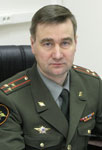
Yesterday’s press announced that Mikhail Mokretsov, ex-Director of the Federal Tax Service (FNS) and long-time colleague of Anatoliy Serdyukov, will be the Defense Minister’s Apparat Chief.  

Kommersant says Serdyukov had largely kept his old team in place, and still influenced personnel decisions in the Finance Ministry’s FNS.  And the FNS has been a stable supplier of high-level cadres for Serdyukov’s Defense Ministry.  Along with ex-deputy directors of the FNS Dmitriy Chushkin and Yevgeniy Vechko, not less than 10 other highly placed former tax service officials have come over to Serdyukov’s Defense Ministry. 

Kommersant indicates this may represent the end of Serdyukov’s ‘agreement’ with Finance Minister Kudrin to leave his old cronies in place in the FNS for three years.

Mokretsov’s work in the tax service has drawn some praise.  Deputy Chairman of the Duma’s Budget Committee Andrey Makarov says the Defense Ministry can use another strong manager like Mokretsov, and he adds:

“The main thing in reforming the army is to stop the stealing.  Control and auditing are essential there.”

Perhaps playing the provocateur, Gzt.ru suggests that some in the Genshtab see Mokretsov’s arrival as a precursor to Serdyukov’s departure from the Defense Ministry.  Under this scenario, Serdyukov would be preparing Mokretsov to take his place as Defense Minister when he moves to a higher post.  But a PA source denied any prospect for a change of Defense Minister and specifically ruled out Mokretsov’s chances.

Mokretsov will occupy a long-vacant post.  Its last occupant, Andrey Chobotov left with former Defense Minister Sergey Ivanov when he became Deputy Prime Minister.  Chobotov apparently works in Ivanov’s office and in the government’s Military-Industrial Commission (VPK).  Since Chobotov had the job, the apparat has been considered a Defense Ministry ‘service’ [not to be confused with an armed service] and this brings its chief the title of Deputy Defense Minister.

According to Gzt.ru, retired General-Lieutenant Andrey Kazakov has been the acting apparat chief since Chobotov’s departure.  Kazakov has served in the Defense Minister’s apparat, primarily as Chief of the Defense Ministry’s Affairs Directorate, since at least 2001.

The apparat chief wields serious power–at least within the administrative system.  According to Gzt.ru, he is not simply the Defense Minister’s right hand.  He’s a chief of staff and critical gatekeeper whose agreement is necessary to get documents signed and decisions made.  This power is largely unofficial, deriving from personal proximity to the Defense Minister.

The apparat chief’s official, statutory powers are more modest.  Mil.ru lists six official elements under him.  The Expert Center of the RF Defense Minister’s Apparat is something of a ‘think tank’ preparing analytical information and reports on military-technical policy, force structure, and force development, under the Defense Minister’s direction.  The Main Legal Directorate of the RF Defense Ministry has been reinvigorated of late, and its role is self-evident.  The above-mentioned Affairs Directorate serves as property manager and business agent for the Defense Ministry in Moscow.   The Directorate of State Assessment of the RF Defense Ministry is responsible for ensuring that military infrastructure complies with an array of government regulations.  The apparat also includes, without explanation, Inspection of State Architectural-Construction Oversight and the Management Directorate of the RF Defense Ministry.

Gzt.ru got our old friend Leonid Ivashov to comment on yesterday’s news.  Ivashov hates to contemplate the idea of career growth for Serdyukov, and he thinks the idea of Serdyukov putting Mokretsov in place behind him is ‘patently untenable.’  He holds even less back than usual when he says:

“If the task is to destroy the country the way Serdyukov has destroyed the army, then such an appointment is possible.  Serdyukov is a destroyer.  And the fact that they are dragging their nonprofessionals into the [Defense] Ministry supports this.  It’s very sad that the Defense Minister of our country is first when it comes to being an example of corruption and disrespect for the army.  Mokretsov can’t help Serdyukov straighten out financial flows which go through the military department.  But he will absolutely help him steal from them.”

Ivashov goes on to complain about Serdyukov’s commercialization of Defense Ministry functions, e.g. turning rear services into Oboronservis.

Vitaliy Shlykov, who views Serdyukov favorably, sees the Mokretsov move as promoting creation of a civilian Defense Ministry that still doesn’t exist.  And Shlykov doesn’t see Serdyukov leaving the Defense Ministry since it is, in many ways, a higher post than a deputy prime minister with a portfolio, who doesn’t really run anything.

Today’s Vedomosti intimates that Mokretsov will focus on auditing the State Defense Order on the heels of Prime Minister Putin’s remarks this week about corruption, waste, and poor results in the OPK .

More about Mokretsov specifically . . .

He joined the tax service in 2000, moving quickly from department chief to deputy director of the Tax Ministry’s Directorate for St. Petersburg, deputy director of the Directorate for Moscow, and Chief of the Directorate for International Tax Relations.  In 2004, he became deputy director of the renamed Federal Tax Service under Serdyukov, and Director of the FNS in February 2007 when Serdyukov left for the Defense Ministry.  

The 49-year-old Mokretsov was born in Udmurtiya, and graduated in 1984 from the Leningrad Financial-Economic Institute.  He was called up after graduation and served two years as a finance officer in the Soviet Army.  Between 1986 and 2000, he worked in unnamed government and commercial enterprises in St. Petersburg.

Kavkaz, Perimeter, and ‘Dead Hand’

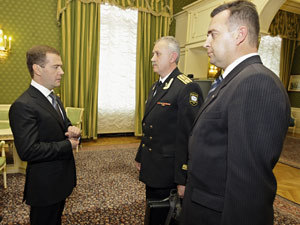
President Medvedev with Cheget Officer-Operator (photo: RIA Novosti)

A retired colonel (probably with some firsthand experience though none is noted) used yesterday’s Komsomolskaya pravda to add to the still fairly small public body of knowledge on Soviet and Russian nuclear command and control.

Colonel Mikhail Timoshenko writes that the Soviet nuclear ‘suitcase’ was created 20 years after the U.S. developed its ‘briefcase.’  Developed in the 1970s under Brezhnev, the Soviet system came in response to the short flight-time of U.S. missiles and fears of a surprise strike.  Short-tenured CPSU General Secretary Chernenko (1984-85) was the first Soviet leader to be accompanied by the ‘suitcase’ and officers responsible for operating it.

According to Timoshenko, the ‘suitcase’ (codenamed Cheget) is part of the Kazbek automated command and control system for strategic nuclear forces and was actually introduced in 1983.  It answered the threat of a sudden nuclear attack in which the Soviet NCA might not reach the command post, or might not be able to send orders over ordinary communication lines.  The system had to have conference-call capabilities so the General Secretary, Defense Minister, and General Staff Chief could all use it.  And it had to be simple for elderly men trying to think and decide under extraordinary stress and time constraints.

Timoshenko paints a little scenario of how it would work.  The silence of the missile attack warning center is broken by an alert signal.  The launch warning puts probable targets and time-to-target information on display screens.  The duty officer asks himself, is it a system malfunction or is it war?  He decides to send the alert signal to the duty general in the Genshtab’s Central Command Post (ЦКП).  The seconds are flying.

The duty general sends the alert signal to the Gensek, Defense Minister, and NGSh as well as the duty officers of the armed services.  The three not-so-young people constituting the NCA have to decide if everyone lives or dies.  Some kind of mistake is possible.  Try the hotline, but the president is playing golf and can’t come to the line.  Or maybe he isn’t playing golf, and he’s really hidden in his bunker.  There are only seconds left to think.

Finally, the codes are entered and the Gensek (or one of the three in the NCA) presses the button.  And in front of the duty crews the indicator panel says, “Order.  Conduct Launch.”  The crews turn their keys and press their launch buttons.  Nuclear war has begun.

Timoshenko says people may wonder whether the Russian nuclear ‘suitcase’ is fundamentally different from the Soviet one.  He answers by saying it’s different in the way it’s put together.

In 1993, the Kazbek system’s service life expired.  ‘Holes’ in Cheget and Kazbek had to be patched.  Only Soviet parts were used in its development, but he USSR’s collapse left almost all microelectronics production ‘abroad.’ It was forbidden to use imported elements that might have ‘bugs.’  And there were practically no specialists remaining who knew all the intricacies of the system and terminal.  But naval officers continued to follow in the RF President’s shadow the way they had the Gensek.  And they were inseparable, practically part of his family, in the next room or behind a wall, checking the system, testing comms channels.

Timoshenko says the next problem was what if the Gensek or President, Defense Minister, and NGSh were spread out all over the country or abroad, and they still needed to be connected instantly.  Can you imagine a Soviet-era Defense Minister being ‘temporarily inaccessible’ for even an hour?

So, Timoshenko says, we had to create the Kavkaz mobile communications system, the signal of which cannot be decoded or jammed.  With such a channel, the three special subscribers could quickly get information on a nuclear attack regardless of their location, the repeater is always with the special subscriber.

But what if somehow the comms didn’t work, Kazbek or the missile attack warning system didn’t work, or all three people with the Cheget were killed? There’d be no one to make decisions or give orders.  Even more improbable–what if missile duty crews can’t launch.  What to do?  A safey net, some insurance was needed.

Simultaneously with Kazbek, development work on the Perimeter system began at Experimental-Design Bureau (ОКБ) Leningrad Polytech.  Perimeter was intended for the assured retaliatory launch of ICBMs and SLBMs, if the enemy has destroyed all command levels.  But the main thing is the system evaluated the situation and made decisions independently.

In Perimeter, there was a component with the name ‘Dead Hand.’  If its sensors reliably confirmed a mass nuclear strike, and the system itself lost comms with the RVSN’s main command nodes, several command missiles with powerful radio transmitters would launch.  Flying over Russian territory, these missiles would repeat a signal and launch codes to Russia’s missile forces.  Having gotten the signal, launch systems would work in automatic mode, giving a guaranteed retaliatory blow to the enemy.

But how can a machine know when it’s time, not too early or too late.  Creating a reliable system with such parameters is highly difficult. Timoshenko says there were lots of conditions that could block the system’s operation.

Testing was conducted from 1979 to 1982.  According to Timoshenko, the U.S. learned of Perimeter from one of its developers in 1993.  And the New York Times published an article entitled, “Russia Has ‘Doomsday’ Machine” on October 3, 1993.

Timoshenko says, at the insistence of its American ‘friends,’ the system was taken off combat duty in June 1995 as part of START I [?].

He goes on to note that naval officers with the nuclear ‘suitcase’ are not so visible these days.  They’ve probably been ordered to keep a low profile.  He relates how Yeltsin handed over his beloved ‘suitcase’ to Putin on the day of his resignation.  But Gorbachev didn’t personally hand his over to Yeltsin.   A general carried it to the new Russian President’s office.

Timoshenko tells one last story.  In 2000, NII AA [presumably the Moscow-based Scientific-Research Institute for Automated Equipment named for Akademik V. S. Semenikhin] was competing the job of chief designer and one candidate was from a Russian-American computer and electronics firm called RAMEK-VS.  Timoshenko says imagine how much would have been paid in Soviet days to get close to the nuclear button and C2 systems.

Makarov Describes the Army He’s Building

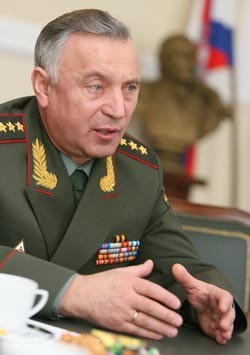
Nikolay Makarov (photo: Viktor Vasenin)

Today’s Rossiyskaya gazeta interview with General Staff Chief Nikolay Makarov has lots of questions and answers on the state of U.S.-Russian negotiations on a new strategic arms treaty, and on missile defense.  If you’re interested in those, you’ll need to read for yourself.

If you’re interested in the other things Makarov said, read on.

Asked isn’t it strange that Russia’s army would be cut when NATO is drawing closer to its borders, Makarov answers:

“We proceeded from the fact that the world has changed to a significant degree in the last 15-20 years.  Russia needs armed forces capable of reacting promptly to any threats and challenges.  Our army, if you take the first Chechen campaign, couldn’t cope with these functions.  To fulfill missions we were forced to man military units with, as a rule, untrained soldiers and officers in the course of combat actions.”

Makarov goes on, saying, after 1996, the army manned 13 percent of its regiments at 80 percent of their wartime complement, so they would be ready for action in a few days if needed.  The remaining 87 percent stayed at cadre level, with equipment and supplies in storage.  So Russia kept a big army that ate up enormous resources, but couldn’t carry out missions. Officers and warrants were almost 50 percent of personnel, and there weren’t enough soldiers.  Possible variants for the best structure were considered and the brigade was selected.  And today any brigade can be ready for action in only one hour, according to Makarov.

Makarov says, in Afghanistan and Chechnya, battalions were reinforced with reconnaissance, artillery, air defense, logistics, and repair units before they deployed for combat.  But battalion commanders weren’t so good at commanding these attached units not normally in their TO&E.  So, says Makarov, it was decided to add these units to battalions, so their commanders can learn how to employ them.  And three battalions organized as such and fully manned comes to 4,500 or 5,000 men–a ‘half division’ rather than a regiment.  And, he notes, battalions can operate independently or as part of brigade tactical groups.

He goes on to explain the Russian Army’s changed outlook:

“In the past we fought with multimillion-man groupings of troops, the basis of which were fronts.  The experience of military conflicts of the past decades showed that such a war was possible, but unlikely.  In the future, troops will go over to actively maneuvering actions.  The actions of inter-service groupings on the entire depth of the enemy’s force structure are replacing frontal battles.  The sides will try to destroy critically important objectives, and also conduct noncontact combat actions.”

The interviewer asks Makarov why only 2 tank brigades in 85 Ground Troops brigades, doesn’t the infantry need armored support?

Makarov answers that, like cavalry in the new age of automatic weapons, today the tank’s role is becoming secondary.  But what’s causing the change? He says it’s the information and artificial intelligence inside equipment, highly accurate weapons used as part of a single information space, and weapons that ‘see’ and ‘know’ everything and can be used against troops and targets in automatic mode.  But he calls robot-tanks with highly accurate weapons a thing of the future at this point.  And Makarov adds that no one is forsaking tanks:

“Here you’re talking only two brigades. Actually we are filling motorized rifle brigades with a great number of tanks.”

Makarov explains the advantages of modular brigades and battalions. Modularity means freedom in structuring battalions and brigades.  If we need a fist of motorized rifle and tank battalions and artillery batteries, we make it.  Commanders in the past didn’t have this freedom.  The entire army force structure was laid out for the conduct of a large-scale war.

Makarov explains modularity as a reaction to Chechnya and even World War II where C2 and force structure was created out of troop units that weren’t coordinated [неслажённые –a difficult one in English, troops that weren’t previously trained and melded together into a cohesive unit or formation].

Asked if there aren’t place in the RF where one can fight with divisions, Makarov says the Russian Army hasn’t gone completely away from divisions [but almost].  But he goes on to insist that their modular nature allows brigades to be used just as well as divisions in Siberia or the Far East, just as well in a large-scale war as independently.

Asked how the army can be trained to fight in a new way, he says:

“The last twenty years there was no intensive combat training in the Russian Army, graduates of commissioning schools and academies didn’t reinforce their theoretical knowledge with practical actions.  And like a foreign language–if there’s no practice, in 2-3 years it’s forgotten.  At the same time, officers without such practice rose in position and rank, some even served to the point of commanding armies.”

“Two tasks stood before us.  First of all, to change the mentality of commanders and their views on war.  It certainly wouldn’t be the one they were taught in the past.  Troop actions, capabilities and forms of their employment have become absolutely different.”

“In order to get to a common understanding, a common methodology is needed.  We are beginning to introduce it, but we are dedicating the current year to individual training of servicemen and combat coordination [слажевание]  of brigades.  From January to February 2010 at the base of the Military Academy of the General Staff we conducted supplementary courses with military district, fleet, and army commanders and their deputies.  Officers ranking from general-colonel to colonel serve in these positions in the armed forces.  Special demands are made on them as organizers, directors, those directly responsible for teaching and training subordinate military command and control organs and troops.”

“We’ve built a training chain, but we understand that this is just the first step.  Everything that officers study in theory still needs to be assimilated in practice.  For this in the second half of May we plan to conduct an operational assembly on the base of one of the units of the Moscow Military District where we are developing a single methodology of training in brigades and below.”

Makarov says 148 new ‘programmatic-regulation documents’ have already been developed.  The Kavkaz, Zapad, and Ladoga exercises last year showed some problems with them, but working groups from the Center for Military-Strategic Research and the Main Combat Training Directorate are reworking them.  The revised regulations will be used in Vostok-2010.  The goal is to have a new combat training program and new combat manuals before 1 October.  Once approved, they’ll be used to organize training starting in 2011.

Makarov also takes this opportunity to expound on his views of netcentric command and control.  He mentions that the U.S. war in Iraq showed that former canons about needing to have 2-3 or 5-6 times superiority in forces and means for military victory no longer necessarily apply.  He says Moscow has the ambitious goal of achieving netcentric command and control in 2-3 years, but the future system is being established in the SKVO this year.

The last issue raised for part one of Makarov’s interview–contract service.  Makarov says the media claimed he had recognized the failure of military reform, when what he really addressed were the miscalculations in contract service over a period of several years.

He says 6-month conscripts were forced into contracts just to meet the [previous] Genshtab’s dictate to have not less than 95 percent contractees in permanent readiness units.  He says these guys were not professionals, but rather just highly [well, not terribly highly] paid conscript soldiers who left the army at the end of their two years anyway.  So, Makarov concludes, it’s no surprise that contract service became a fiasco.

But he adds, we aren’t turning away from it.  A fully contract army would be the very best variant if Russia could afford it [can’t it?], but it can’t according to Makarov.  So he continues:

“Therefore we want to select as professionals only those who’ve served in the army [as conscripts], and only for positions determining the combat capability of military units, related to the operation of complex and expensive equipment.  In the Navy, practically all positions are such.  In motorized rifle brigades not less than 20 percent of the TO&E will be contractees–tank, antiaircraft, and artillery system drivers, gunner-operators, some other specialties.  Plus sergeants.”

“Moreover, if a sergeant is a professional, has served 10-15 years and the level of his training is higher than a new lieutenant, he should get more than the young officer.  We understand that the pay of a contract soldier has to guarantee the attractiveness of military service.  All this will be put into the new pay system.”

Asked about housing for contractees, Makarov says professional soldiers and sergeants need to live like officers in service apartments or dormitories.