Category Archives: Conscription

Suicide Watch (Part II)

Let’s look at more unusual suicide cases (or reported attempts).  Recall the story of Albert Kiyamov – beaten by a sergeant and pushed to his death from a barracks window in May 2010.  There’s still no word on the investigation or charges against the sergeant.  And there was a similar case reported in the same brigade after Kiyamov was killed.

While these seemed like isolated incidents, defenestrations apparently aren’t aberrations.  The authorities are hard-pressed to determine whether young soldiers are jumping or being pushed to cover up other crimes and violence. Suffice it to say the line between suicide and murder in the Russian Army is blurry. 

In late August, a conscript was beaten and thrown from the fourth floor of a barracks in the 35th Independent Motorized Rifle Brigade.  According to Newsru.com, the victim’s father, rights defenders, and other conscripts say two soldiers tried to take his personal items, uniform articles, and boots before beating and pushing him off the building.  He survived the fall, but broke his arms and legs. 

The military prosecutor determined there were “nonregulation relations” in the unit, and charges have been filed against the perpetrators.  But the prosecutor claims the victim jumped to escape his attackers, according to IA Regnum.

In mid-July, a conscript in a Railroad Troops brigade in Stavropol apparently argued with a major before the officer hit him several times with the butt of a rifle, according to Newsru.com.  The soldier then, according to the prosecutor’s account, jumped from the fifth story of his barracks sustaining numerous injuries including several broken bones.  His parents said he’d told them about this particular officer.  In somewhat uncharacteristic fashion, the major quickly acknowledged using force against the conscript, and was relieved of duty.  But no charges of forcing someone to attempt suicide.

In late May, a conscript hung himself in a unit in Mari El.  He was beaten before this because he refused to give other soldiers 1,000 rubles.  The victim’s parents believe these men killed their son.  The case is being investigated under Article 110 “Incitement to Suicide.”

In early February, a conscript in a unit near Orenburg was found dead in his bunk with a knife in his chest.  Two junior sergeants apparently killed the young man in a fight, then tried to make it look like suicide.

In mid-January, a conscript shot himself twice on a firing range at the training center in Yelan.  The confused incident has been classified variously as an accident, suicide, and murder.  According to Komsomolskaya pravda, the victim told his family he’d been forced to sign a request to serve in a unit in Tajikistan.

While most Russian Army suicide victims are conscripts, there are other cases, and other circumstances.  In mid-March, a warrant officer from a Moscow unit shot and killed his wife before turning the gun on himself.

Finally, a last poignant case, in early September, a young man jumped from the roof of a nine-story apartment block in Orel just days before he was due to report to his unit near Moscow.  It’s unknown why he killed himself or what he felt about going to serve.

Despite reducing conscription to one year and “humanizing” military service, the Russian Army remains a violent, dangerous place.  Conscription keeps it a lumpen army in which there are few limits, and the strong prey on the weak pretty much without restraint.  The violence remains a significant reason why those who can still avoid serving.

The Defense Ministry no longer publishes its monthly and yearly statistics on “noncombat losses,” crime, and accidents in the Armed Forces.  But it seems the suicide rate is as high as it was two, three, or four years ago – 20 some per month, and 200 or 250 suicides annually.  Still basically a full “suicide battalion” every year.  There’s just not enough public or political outrage to change the situation.  

Suicide Watch (Part I)

Russia has a high suicide rate by world standards.  And a significant number of 18- and 19-year-old Russian males are prone to suicide for various reasons – everything from problems with girlfriends to drug abuse and psychological or behavioral disorders.  But subject them to the stresses of compulsory military service and suicide appears to become more likely.

Russian Army service is dangerous even without suicides.  “Noncombat losses” result from training mishaps, infectious diseases, ordnance explosions, transportation accidents, and murder. 

Though intended to, the shift to one-year conscription has probably not reduced dedovshchina – the catchall term once connoting petty hazing of younger conscripts by their elders but now encompassing a wide range of barracks violence, abuse, and crime against soldiers.

Dedovshchina has always had potential to drive desperate conscripts to take their own lives to escape it.  Hence, the majority of Russian Army suicide cases are investigated under Article 110 of the RF Criminal Code, “Incitement to Suicide.”  Western legal tradition has long experience with incitement, but “incitement to suicide” is a little unusual.  Not so for Russian military prosecutors and criminal investigators.

With only a little digging, here’s a sad list of some recent Russian Army suicide (or attempted suicide) cases:

  • In late August, a conscript on guard duty in Volgograd shot himself, leaving a suicide note blaming dedovshchina in his unit.  The case is being investigated under Article 110.
  • In late August, a conscript from a Krasnoyarsk unit was detailed to the Railroad Troops brigade in Abakan to help prepare for Tsentr-2011.  With only three months left to serve, he went AWOL, and  apparently hung himself.
  • In mid-August, a conscript in Kaliningrad jumped off the boiler house roof and sustained a number of serious injuries, but survived.  He had left a note asking that no one be blamed in his death.
  • In early August, a conscript in the 735th Missile Regiment, 62nd Missile Division in Uzhur killed himself while on guard duty at night.  He had served six months.
  • In early March, in Belogorsk, a conscript due to demob in a few days shot himself to death.
  • In early February, a conscript in Sergeyevka shot himself to death.  The case was being investigated under Article 110.

It’s rare for the Russian press to publish much follow up on what exactly happened with these young men.

Tomorrow we’ll look at some less routine cases.

Three-Month Combat Training

Three-and-a-half years after it started phasing in one-year service, the Russian Army’s condensing combat training into three months so it can put draftees in line units for their remaining months.  One wonders what they’ve tried to this point, or if they’re just now addressing the implications of the shortened draft term.

Twelve weeks of basic training is about the norm by world standards for draftee armies.  But the Russians have compressed what they previously taught over a longer period, so the question is how well conscripts absorb, retain, and employ their lessons.

Officially, Russia’s three-month accelerated combat training program is experimental.  Krasnaya zvezda reports, since June, the 19th Independent Motorized Rifle Brigade in North Ossetia, has been trying a new program to take new draftees and turn them into professionals, ready to serve in combat sub-units [подразделения], in three months.

The army daily claims these new conscripts focus exclusively on the combat training course, which now reportedly includes 1.5-2 times more “practical exercises” than in the past.  The course covers 90 days (536 hours).  It retains the traditional first month of individual training, and the last two consist of training and coordination [слаживание] of sections, platoons, and companies (batteries).  The course ends with several days of test exercises, sub-unit combat firings, and company-tactical exercises.

The brigade’s deputy commander says:

“In the new program, theory has been practically thrown out, the stress is on the practical part.  In connection with cutting the conscript service term to one year, the task of preparing, in three months, a coordinated sub-unit, ready to fulfill missions in various conditions, stands before us.”

The choice of the 19th IMRB wasn’t accidental.  As KZ notes, the formation saw action in the five-day war with Georgia.  It has a “reinforced company-tactical group” of BMP-3s fueled for a 500-kilometer roadmarch ready to depart garrison within 30 minutes, according to KZ.

KZ then describes how outsourcing repair and support work has enabled draftees to focus entirely on combat training.

This week, Mil.ru updated the experiment.  It said the brigade is currently finishing platoon coordination and beginning company coordination, which will continue until mid-August.  The Defense Ministry says the Ground Troops’ Main Combat Training Directorate is monitoring the accelerated program.  In late August, it will oversee the company tactical exercises, and determine their capabilities for action under combat conditions.  Conclusions about the three-month combat training program will come in September.

Writing in Nezavisimaya gazeta yesterday, Vladimir Mukhin questions whether it’s possible to train professionals in three months.  He notes the Southern MD was supposed to be 70 percent contractee-manned by now, according to the Defense Ministry old contract service plan.  Parents of green soldiers feel like their sons are serving in a “hot spot,” according to Mukhin.  Conscripts from this formation died in the Georgian conflict.  The onus is on the political leadership, says Mukhin, rather than military commanders to explain why units here aren’t manned with professionals.

Mukhin quotes former Ground Troops’ Chief, General-Colonel Yuriy Bukreyev:

“If a conscript soldier has basic military training, then it’s possible to give him the skills to employ him in combat conditions in the North Caucasus.  I’m giving the same conclusion from the Soviet Afghan experience again, when I headed the staff of the Turkestan Military District.  But then soldiers served two years.  At first, they were in training sub-units, they underwent additional mountain training in special training centers.  Only afterwards, that is when they’d served in the troops a year or more, were they sent to Afghanistan.  Today conditions are a little different.  The conscript soldier’s service term’s been shortened to 12 months.  And this means the intensity of combat training should increase.  The Ground Troops’ Glavokomat is just conducting an experiment in training first-year soldiers to carry out missions under the conditions of an armed conflict.  We’d like to hope that raw soldiers won’t be drawn into resolving such missions.  Professional sub-units would appear more effective here.  But, unfortunately, in our Armed Forces reliable conditions for the mass recruitment of contractees into the troops still haven’t been established.”

Russia’s Fading Army Fights Losing Battle to Reform Itself

A very good article by the Wall Street Journal’s Richard Boudreaux . . . though missing a few of the most up-to-date pieces of the story, his report captures important aspects of the Russian contract service experiment that even so-called specialists overlook.

“VOLGOGRAD, Russia—Sergei Fetisov, a 23-year-old welder, signed on for one of the most ambitious projects in Vladimir Putin’s Russia: rebuilding the remains of the once-mighty Soviet Red Army.”

“A cornerstone of that effort was the creation of special combat-ready units staffed entirely by professional soldiers, not conscripts.  Mr. Fetisov volunteered to be one of them.  He enlisted for a renewable three-year stint, enticed by higher pay and the chance to learn new skills.”

“One of his first tasks, he recalls, was toiling past midnight shoveling snow and ice from a football-field-size parade ground.  The work that followed was menial, humiliating and of little practical use, he says.  Combat training consisted of two firing exercises a year, he says, and a chunk of his paycheck was routinely withheld by corrupt officers.”

“‘When I realized that being a professional soldier was just the same as serving as a conscript, I wanted to tear up my contract and get out of there,’ he says.  He quit when his commitment ended in July, he says, ‘but we had guys who simply ran away.’”

“With volunteers like Mr. Fetisov leaving in droves, the Defense Ministry has abandoned the initiative altogether.  The program’s failure shows the limits of Mr. Putin’s grand plan to transform the army from a cumbersome machine designed for European land war into a lithe force capable of fighting regional wars and terrorism.”

“Russia’s struggle to rebuild its armed forces comes as the world’s military balance is in flux.”

“Two decades after the Cold War ended, China is engaged in a military buildup that has many of its neighbors, including Russia, scrambling to bolster their defenses.  The U.S., still the world’s dominant military power, is trying to rein in defense spending—while simultaneously keeping a wary eye on China, projecting power in the volatile Middle East and dealing with the North Atlantic Treaty Organization’s persistent concerns about Moscow.”

“Currently, Russia is at odds with NATO’s air assault in Libya. Moscow has stayed out of the military conflict, despite its stakes in weapons deals and oil-exploration ventures with Col. Moammar Gadhafi’s regime.  But Mr. Putin said last month that the bombing in Libya is part of a ‘steady trend’ of U.S. military intervention around the world and ‘a timely indicator that our efforts to strengthen [Russia’s] defense are justified.’”

“In February, Russia outlined a $650 billion plan to acquire new warplanes, ships, missiles and other arms over the next decade, the Kremlin’s biggest spending spree since the Cold War.”

“Mr. Fetisov’s account of poor morale in the army’s ranks, however, raises questions about Russia’s long-term ability to assert power abroad.”

“The Defense Ministry declined to comment on Mr. Fetisov’s complaints, but has acknowledged that widespread discontent among volunteers undermined its enlistment campaign.  Defense Minister Anatoly Serdyukov has said that the program had been poorly managed and would cost too much to fix.”

“‘We cannot afford to create a fully professional army,’ he said in October.  ‘If we save funds elsewhere, we will certainly go back to this idea, but well prepared.’”

“The setback has the Kremlin in a bind.  Counting on volunteers to make up nearly half of all soldiers, Mr. Putin had bowed to public sentiment and shortened the draft from two years to one.  Now, the dearth of volunteers and a drop in Russia’s draft-age population have prompted the Defense Ministry to cancel some deferments and step up conscription of men 18 and older, risking discontent over a twice-yearly ritual that began anew on April 1 and is widely evaded.”

“Russia relies mainly on its nuclear arsenal to project power and protect its territory.  Tensions with the West have eased, but Mr. Putin sought a revival of conventional forces, which had been weakened by budget cuts, to put muscle behind his push for influence in former Soviet republics that are now independent.”

“The army’s decline became evident in the mid-1990s with its battering by separatist rebels in Chechnya.  The land, air and naval forces Mr. Putin inherited when he became president in 2000 were a pale shadow of the Red Army, five million strong at the time of the Soviet Union’s breakup in 1991.  They stand at one-fifth that size today.”

“Under the enlistment program, launched in 2004, officers were to train volunteers as career specialists and make the new combat-ready units fully operational by 2010.  The shift to professional soldiers was supposed to better enable the army to operate the high-tech weaponry Russia plans to acquire.”

“The U.S. abolished the draft in 1973, attracting volunteers through advertising, pay increases, educational benefits and re-enlistment bonuses.  By the time of the Persian Gulf War of 1991, the move was widely viewed as a success.”

“Russia’s campaign to attract volunteers, by contrast, was not as well funded or advertised.  By 2008, the army said it had signed up 99,000 volunteers for the new units, about 40,000 short of the goal.”

“Then the number began a sharp decline as most of them chose not to re-enlist or went AWOL.  That trend was evident during Russia’s clumsy but ultimately successful invasion that year of neighboring Georgia.  Conscripts were sent to fight and die there, despite Mr. Putin’s promise that only professionals would serve in hot spots.”

“Despite the shortage of volunteers, Mr. Serdyukov, the defense minister, announced at the end of 2009 that Russia’s ground forces had been reorganized into 85 brigades of ‘permanent combat readiness,’ doing away with bulkier divisions and making the army more mobile.  Only later did officials acknowledge that the brigades were made up mostly of one-year conscripts, men with few combat skills.”

“The enlistment drive’s failure puts constraints on Russia’s reach.  When ethnic rioting in June threatened to tear Kyrgyzstan apart, its president appealed for Russian peacekeepers, the kind of force Moscow once deployed routinely as a political tool.  This time the Kremlin demurred—in part, defense analysts say, because the army couldn’t spare a full brigade of professional soldiers.”

“Democratic reformers have lobbied for years to end the draft, arguing that a smaller, professionalized force could better defend the nation’s interests.  Opinion polls show majority support for the idea, and Mr. Putin endorsed it early in his presidency.”

“But tradition-bound generals favored keeping a large conscript army. Mr. Putin opted in 2003 for a compromise:  The Defense Ministry would continue to draft, but also would start recruiting for the combat units.  The government budgeted $3.3 billion for higher pay and better housing for volunteers.”

“By the time Mr. Fetisov received a draft notice four years later, the plan was faltering.  Recruiting stations, unaccustomed to any task other than rounding up draft-age men, were given no blueprint for luring volunteers.”

“The army was a tough sell, too.  Salaries for contract soldiers averaged $270 per month at the end of 2007, about half the average salary for civilians.  Housing construction at bases fell behind schedule.  Residential buildings paid for by the military were turned over without running water, plumbing or electrical wiring, government auditors reported.”

“Mr. Fetisov, who has dyed-blond hair and a passion for video games, had no interest in leaving his $370-a-month welding job.  He lived with his mother and two brothers in Volgograd, a ‘hero city’ once named Stalingrad and famed for resisting the Nazis in World War II, but he wasn’t attracted to military life.”

“Once he was drafted, however, an army contract seemed to offer advantages.  Draftees at the time served 18 months, earning next to nothing.  But they had the option to go professional six months after induction.  Mr. Fetisov, who says he was offered $400 a month, thought a contract would raise his status in the army and enable him to master new skills.”

“He reported to the 99th Artillery Regiment’s base near Nizhny Novgorod in November 2007.”

“His disillusionment began with midnight snow-shoveling duty.  ‘We worked in cleaning, construction, regular things, not serving as soldiers,’ he says.  ‘We didn’t do anything that would help us in a combat situation.’”

“Mr. Fetisov and others who served in recent years say the army’s search for contract servicemen centered exclusively on draftees already under its control.”

“The 99th Artillery, for example, had 600 volunteers on three-year contracts, including Mr. Fetisov, and 300 draftees.  Officers were under instruction to recruit as many new volunteers as possible.”

“Mr. Fetisov says they resorted to an unusual recruiting technique:  Nearly every night at 11 that first winter, conscripts were mustered on the parade ground and made to stand in formation for hours, facing superiors who sometimes were drunk.”

“‘Finally an officer would say, ‘Those willing to sign contracts, you’re dismissed.  The rest of you, stay at attention,’‘ Mr. Fetisov recalls.  ‘A personnel officer would tell stories about the great treatment contract soldiers get.’”

“‘They had to stand there in the cold until at least two or three men agreed to sign,’ Mr. Fetisov says.  ‘This went on for weeks, but they never got 100%’ of the regiment on contract.”

“Volunteers under contract lived three to a room in new barracks with televisions and DVD players.  Conscripts slept in bunk beds, 20 to a room.”

“Beyond that, the distinction seemed to blur.  Volunteers and conscripts alike were treated harshly, Mr. Fetisov says.  Sometimes a soldier who broke disciplinary rules was ordered to dig a deep pit and stay inside for days, he says.”

“His accounts were corroborated by two other contract soldiers, Artyom Pugach and Denis Pushkin, who served at the base and were interviewed separately.”

“The three soldiers say they experienced arbitrary deductions from their paychecks of $20 to $135 a month for what they say an officer described as ‘needs of the regiment.’  Some contract soldiers had to forfeit their final month’s pay in exchange for discharge papers, says Mr. Pushkin.”

“A 2008 study by Citizen and Army, a Russian human-rights group, said such deductions were widespread, amounting to large-scale misappropriation.  Mr. Fetisov says his commander had leeway with payroll money because his contract, like many others, didn’t state the salary he was promised.  He says the commander threatened to punish anyone who challenged the cuts.”

“‘We were told there were some financial difficulties with the military reform,’ he says.  ‘But we could see that the commanders got new cars.…We saw what they were driving, and it was clear what was being spent on what.’”

“Crime and coercion plagued other volunteer units.  Police in Russia’s Far East broke up gangs that extorted cash from soldiers on paydays at three bases.”

“In Kaliningrad, a military prosecutor’s inquiry led to the annulment in 2006 of 83 contracts signed under pressure, according to that city’s chapter of the Soldiers’ Mothers Committee, an advocacy group.  Elsewhere, commanders of soldiers who went AWOL kept them on the roster, pocketing their salaries, says Alexander Golts, a military specialist and deputy editor of Yezhedevny Zhurnal, an online Russian publication.”

“In 2009, Mr. Fetisov was among 160 soldiers sent to form the all-volunteer artillery battalion of the new 6th Specialized Tank Brigade.  There, he says, he injured his hand badly while cleaning the artillery barrel of a tank, and army doctors neglected it.  When his three-year contract came up for renewal, Mr. Fetisov bailed out.  At the time, he says, only 10 volunteers remained of the 160.  The rest had been replaced by draftees.”

“‘The army ran out of fools,’ his mother, Tatyana Fetisova, said recently as she listened to her son tell his story.”

“And so it went at bases across Russia.  The exodus left a handful of all-volunteer units, staffed by a few thousand contract soldiers, in an army made up overwhelmingly of conscripts, say defense officials and independent observers.”

“‘It’s no secret how the contract service was implemented,’ Mr. Serdyukov, the defense minister, told news magazine Odnako.  ‘Active duty soldiers were induced to sign contracts by all means.  Their [low] monthly salary and standard barracks life made them quit the armed forces as early as possible.  There was no systematic preparation of military specialists.’”

“Mr. Serdyukov, a former business executive close to Mr. Putin, was appointed during the enlistment effort and felt cheated by officers who resisted or mismanaged it, says Vitaly Shlykov, a retired colonel who advises him.  The minister, he says, concluded that Russia must change the culture of its officer corps before trying to switch to a professional army.”

“Backed by Mr. Putin and the current president, Dmitry Medvedev, Mr. Serdyukov is slashing the number of officers and changing the way new ones are educated.  He is training Russia’s first corps of career sergeants since the czarist era, starting with a class of 300.”

“But those leaders will take a generation to develop, Mr. Shlykov says, and meanwhile ‘Russia will have a conscription army for years to come.’”

“That is bad news for Russia, says Mr. Fetisov, the former enlistee, but at least those who serve will do so with fewer illusions.”

“‘Now everybody knows you just put up with a year of hell,’ he says, ‘and then you’re free.’”

Walking Back Contract Service (Part II)

Here are some particulars from Deputy Chief of the General Staff, GOMU Chief General-Colonel Vasiliy Smirnov’s press-conference on the spring draft — and contract service — last week.

After dropping his lower spring draft number (203,720) bombshell, Smirnov said an increase in contractees will accompany this reduction in conscripts.  The Defense Ministry will determine clear, strict criteria for selecting and training contractees, and will raise the prestige of their service (along with their pay and living conditions, of course). 

In other remarks to the press, Smirnov emphasized that conscript service will remain, and the Armed Forces will retain mixed manning (i.e. conscripts and contractees).

Smirnov listed the following priorities for contract manning:

“In 2011, we will man sergeant posts, Navy afloat personnel, Airborne Troops [VDV] formations and military units, formations deployed on the territory of the Chechen Republic, and also the most knowledge-intensive and high technology military specialties, which determine the combat capability of formations and military units, with servicemen on contract.”

Priorities for Contract Service

In the near term, according to Smirnov, the Defense Ministry will put contractees in all sergeant-squad leader billets and positions involving maintenance or operation of complex or new weapons systems and equipment.

He said training of professional sergeants in the Defense Ministry’s higher educational institutions began in six schools in 2009, expanded to 19 last year, and will be conducted in 24 in 2011.

In his Q&A with the media, Smirnov said there’s no plan to switch to large numbers of contractees immediately, but rather:

“The number of contractees will increase gradually, mainly because of the large-scale introduction of new types of armaments.”

So he linked the need for contractees to presumed future success in acquiring new equipment under GPV 2011-2020.

Smirnov told the media a pereattestatsiya was conducted last year, and only 174 thousand competent contractees remain.  He also noted (as indicated on his slide above) that Spetsnaz would also be a priority for contractees.  He said there are currently 55,000 contract sergeants in the training pipeline.

Smirnov defended the earlier contract effort in the mid-2000s, saying it was successfully fulfilled despite being only half financed at 76 billion rubles, and:

“The main Navy and VDV units and formations are half manned with contract servicemen.”

Not a stunning testament to the earlier program.

It’s interesting that Smirnov talked so much about contract NCOs when, less than two months ago, the Federal Targeted Program for Manning Sergeant Billets with Contractees, 2009-2015 was cut in half.  Financing was reduced from 243 to 152 billion rubles, and the number of contract sergeants to be trained from 107,000 to 65,000.  For stories on this, see KommersantNewsru.com, or Komsomolskaya pravda.  The sources in these reports also put the number of contractees remaining much lower than Smirnov’s 174,000; they say at or just above 100,000.

One finds it hard to fathom that the Defense Ministry can find 425,000 contractees when just a half dozen years ago it failed to recruit, train, and retain 133,000.  Thus far in these early pronouncements on reinvigorating contract service nothing’s been said about what or how it will be different this time.  The Defense Ministry will have to make such a case to its political masters, the public, and the men it’s trying to sign up at some point.

Some things, like the Defense Ministry’s other priorities, are already known.  A renewed contract service effort will have to compete with a new higher pay system for a larger number of officers starting next year.  And the Defense Ministry is also at the outset of a new and expensive GPV that’s supposed to provide modern weapons and equipment which demand long-term, professional enlisted personnel (aka contractees).  And there are overdue and unfinished agenda items like the provision of permanent and service housing to officers.

Yes, your author is skeptical that the renewed push for contractees can gain traction.  We have to remember this magical 425,000 number is somewhere off in the future.  There’s no promised delivery date.  And the entire issue began with the tacit recognition that, for many reasons, Russia can only conscript so much manpower.  Keeping fewer guys from being shaved and inducted pretty much against their will is always good politics on the cusp of a presidential election year.

Walking Back the Draft

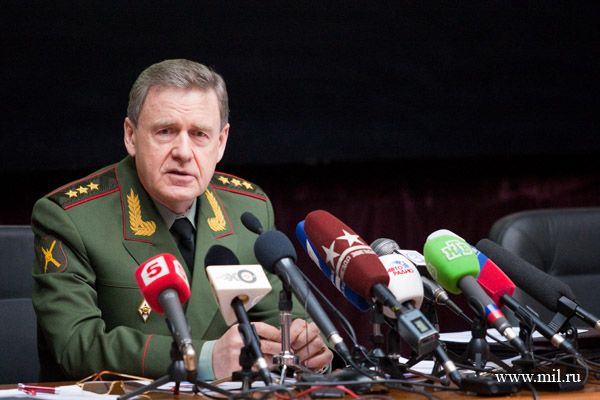
General-Colonel Vasiliy Smirnov

Reversing decisions made in the context of Defense Minister Anatoliy Serdyukov’s military reforms is apparently necessary, no matter how painful.  In early 2010, Serdyukov and General Staff Chief Nikolay Makarov announced their intention to curtail professional contract service and rely on the one-year draft to man the Armed Forces.  Scarcely more than a year later, they’ve been forced to retreat from this plan.

Yesterday Deputy General Staff Chief, General-Colonel Vasiliy Smirnov said Moscow will draft only about 200,000 young men in this spring’s callup.  See Mil.ru’s transcript of the press-conference.

The Russian military has tried to conscript in excess of 270,000 men in every draft campaign since one-year service started.  But General-Colonel Smirnov said the military will now induct only 203,720 men this spring, and (not mentioning problems with numbers) he attributed the reduction to a Defense Ministry and General Staff decision to raise the quality of the callup contingent.  He added that coming drafts would also aim for about 200,000 new soldiers, plus or minus 3-5 percent.

The Russians are also refraining from measures to round up more men.  Newsru.com noted the spring callup will run only until July 15, not August 31 which would have allowed for drafting more men before they enter higher educational institutions (VUZy).  President Medvedev decided not to make technicum (post-secondary trade school) graduates liable to the draft so they can attend VUZy if they choose.  Other ideas, such as extending the upper age limit for the draft from 27 to 30, or raising the service term back to 18 months or 2 years, remain off the table.

So Moscow is facing its manpower limitations head-on.

The simple fact is a million-man Russian Army was never going to have 600,000 or 700,000 conscripts, perhaps not even 540,000 at any given moment.  Vladimir Mukhin already reported in January on the fall callup’s failure, and approximately 20 percent undermanning in the ranks.  That would put draftees at about 430,000, or at what Smirnov says they now plan to conscript each year.  Mikhail Lukanin wrote last June that the military’s conscription targets were unrealistic when the number of 18-year-olds alone won’t reach 600,000 during the next couple years.  Army General Makarov said it himself back in September when he noted that only about 13 percent of draft-liable manpower serves in the army.  His 13 percent of 3 million 18- to 27-year-olds is 390,000.

Where does all this leave Russian Army manpower?

Taking recent pronouncements on the intention to have 220,000 officers and 425,000 contractees in the future, conscripts might number 355,000 at some point in a million-man army.  Smirnov’s statement yesterday indicates they intend to have somewhat more than 400,000 at any given time for now.  Where they are today is harder.  If there are 181,000 officers and 174,000 contractees (as Smirnov said yesterday), and there are no more than 540,000 conscripts presently serving, the Armed Forces are comprised of less than 900,000 men.  How much less depends on the actual number of conscripts.  That’s at least ten percent below their authorized level.  If there are only 500,000 conscripts, that’s about 850,000, or 15 percent under one million, and so on.

Levada Defenders’ Day Poll

The widely-respected Levada-Tsentr asked 1,600 Russians in 130 inhabited points in 45 regions its usual slate of Defenders’ Day questions reflecting attitudes toward the military and military service.  Its margin of error is 3.4 percent.

Are there military threats to Russia from other countries?

This one ticked up a bit this year.  “Definitely yes, most likely yes” rose from 47 percent last year to 53 percent this year.  It’s a little higher, but not way off the norm since 2000.

Is the Russian Army capable of defending the country from a real military threat from other countries?

“Definitely yes, most likely yes” ticked down a little from 63 to 59 percent, and “most likely no, definitely no” rose from 22 to 28 percent this year.

To serve or not to serve . . . would you want your son, brother, husband, or other close relative to serve in the army?

Respondents answered 36 percent yes to service, and 54 percent no to service. This was only a slight change from last year’s 34 and 57 percent – within the error margin.

If no, why not?

Interestingly, “dedovshchina, nonregulation relations, and violence in the army” declined from 37 to 29 percent in a year when, by every official account, reported cases of barracks violence increased significantly.

Should a family member serve if called up or look for a way to evade service?

Basically unchanged from last year, 46 percent say serve, and 41 percent say look for a way to avoid it.

Lastly, a question not asked every year . . . .

How widespread is dedovshchina and abuse of young soldiers by officers and older servicemen?

“In the majority of military units” has fallen over time to 39 percent, “everywhere” has declined to 13 percent.  These two answers together in 2006 were 82 percent.  “In a small number of military units” and “isolated instances” have both increased over time and represent 27 and 11 percent respectively this year.

Golts on the Sudden Increase in Officers

Yezhednevnyy zhurnal’s Aleksandr Golts says Defense Minister Anatoliy Serdyukov’s explanation that 70,000 more officers are needed because of VKO doesn’t hold water since it will be created on the basis of existing formations and units.

Golts concludes that Russian military reform has reached its next turning point.  He recalls that cutting officers to 150,000 and eliminating a large number of cadre formations and units represented the rejection of the old mass mobilization army concept.

But the reduction of so many officers could not but bring bitter opposition.  Nevertheless, Serdyukov stubbornly implemented the cuts, ignoring cries about the destruction of the country’s glorious officer corps (which Golts says hasn’t existed in a very long time).

Then suddenly the chief of the military department reversed himself.  Suddenly, it appears there are not too many officers, but a shortage.  The Armed Forces agonizingly cut 200,000 officer positions just to reintroduce 70,000!

Golts thinks there are several possible reasons.

The most obvious is the state’s inability to meet its obligations (primarily permanent apartments) to dismissed officers.  In mid-2010, there was information about 70,000 officers outside the shtat (штат or TO&E).  Later in the year, the number given was 40,000.  But says Golts:

“. . . to find out how many officers are really outside the shtat is impossible:  whatever figure Defense Ministry officials want to name, they name.  It’s possible to suppose that, having realized their inability to settle up with future retirees, the military department simply decided to put them back in the shtat.”

The second possible cause, according to Golts, is that the Defense Ministry failed to fill the officer posts it cut with well-trained sergeants and civilian personnel because the wages it offered were too low.  On the issue of more sergeants, Golts concludes:

“Sergeant training programs are failing.  Training centers simply can’t put out as many junior commanders as the Armed Forces need – they require not less than 100 thousand.  There’s no where to get them from.  And so they decided again to use officers to perform sergeant functions in combat sub-units, as rear service guys, service personnel.  If so, then this is a serious blow to reform.  Because the officer will cease being the elite of the Armed Forces, again turning into a low-level functionary.”

And Golts provides his third, worst case possibility:

“The generals convinced the president, but most of all, the premier [Putin] that it’s possible to achieve combat readiness by returning to the old mobilization model.  This is an ultimate end to reforms.  If so, then after presidential elections in 2012 the term of conscript service will inevitably be raised.  And everything will be back to normal.”

Golts concludes this concession by Serdyukov – heretofore supported by President Medvedev and Prime Minister Putin – will make those who hate him conclude he’s lost support, and they will triple their attacks on reforms.  In the worst case, this will be the first step toward overturning them.

Walking Back Serdyukov’s Personnel Policies (Part II)

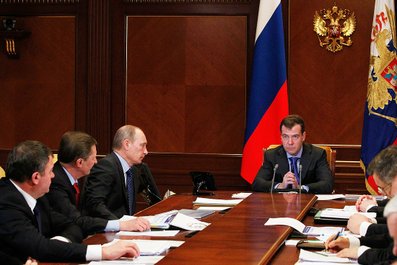
Medvedev in Meeting on Military Pay (photo: Kremlin.ru)

So officers were cut too drastically, and their numbers are going to be increased.

One recalls Ilya Kramnik saying officer cuts were causing serious tension in the ranks.  As if to prove the point, on Wednesday, near Novosibirsk, a drunken major living outside the “shtat” threatened to blow up his room in the unit’s dormitory.  This summer Aleksey Nikolskiy said halving officers caused trouble for brigades in the Vostok-2010 exercise.

But it’s not just an officer shortage that’s led to this policy reversal.  Difficulties with conscription and sergeants have forced the Defense Ministry to plug holes with more officers. 

Aleksandr Sharavin talked to BFM.ru about the situation:

“I think this is connected with the fact that now the situation in the army is very tense.  They cut officers from 450 thousand [sic] to 150.  They cut warrant officers completely, and professional sergeants aren’t appearing, we didn’t train them, and still can’t do this.  What we’ve got is a lot of conscript soldiers, few contractees, generally no professional sergeants, and a triple load laid on the remaining officers.  Now we have to compensate by increasing the number of officers.”  

Increasing the officer ranks wasn’t the only personnel policy reversal announced on 2 February.  A preliminary decision to increase contractees in the Armed Forces was also discussed.  Serdyukov said:

“This issue isn’t finally decided, but we have a proposal for an increase.  The Security Council was ordered to review this issue, in the course of the month a concrete figure – how much the number of contractees will be increased from 2012 – will be determined.”     

Utro.ru entitled it’s coverage of this story “Army Reform Reversed,” and reminded readers that army contract service was curtailed last winter because the military couldn’t afford it.  And now apparently it can?

We don’t know how many contract sergeants might be added starting next year.  In fact, no one seems to know how many there are now.  Newsru.com claims the army currently has 180,000 contract soldiers, sergeants, and warrants.  If that’s true, the Armed Forces are about 900,000.  But if there are fewer contractees, and conscripts are less than 560,000, then the Armed Forces are that much below 900,000.

Can an about-face on the elimination of warrant officers be far behind?

As early as 27 January, Rossiyskaya gazeta reported Deputy Defense Minister Pankov said some cadets might be inducted into VVUZy in 2011.  It was just back in the fall that the Defense Ministry put a two-year moratorium on them.  As it is, VVUZy now have about 45,000 cadets in the classes of 2011, 2012, and 2013.

But the Defense Ministry is looking at having these would-be officers join 5,000 other former cadets as sergeants.  The Defense Ministry is talking about salaries as high as 40,000 rubles a month for professional NCOs.  But current NCO training efforts in VVUZy are going very slowly, and the army wants 250,000 of them, according to Nezavisimaya gazeta.

Let’s return for a bit to Medvedev’s Tuesday session on raising pay for servicemen and law enforcement.  We’re talking Defense Ministry, MVD, MChS, FSB, FSO, and SVR here.  Men with ranks, badges, and guns.  Medvedev called higher pay for them:

“. . . an issue of state importance.  In the last analysis, our efforts to reform the Armed Forces, create a new profile of the Armed Forces and, of course, reform the system of law enforcement organs, including reforming the Internal Affairs Ministry and creating police depend on it.”

The Defense Ministry is talking median pay of 50,000 rubles a month for lieutenants starting in 2012.  Just a sampling . . . a cadet would get 18,200, a contract soldier 24,800, a squad sergeant 34,600, and a brigade commander 93,800 rubles per month.

NG’s Vladimir Mukhin reports the Finance Ministry believes the new military pay plan will cost another 1 percent of Russia’s GDP, taking the defense budget from nearly 3 to nearly 4 percent of GDP.  All this while the government wonders whether outyear budgets will be in deficit or not.

The last couple days represent the first major defeat for Serdyukov.  His military personnel policies are a complete and utter shambles.  Political analyst Aleksey Mukhin commented to BFM.ru on Defense Minister Serdyukov’s prospects: 

“ It’s fully possible that soon they’ll call him enemy No. 1 for the reform which is being conducted.”

If they don’t already.  One guesses he’ll keep his post though.

So after flirting briefly with paying relatively few officers more money, the Defense Ministry’s going to pay more officers more money instead.  And this is more officers at the same time President Medvedev’s ordered a 20 percent cut in government bureaucracy.

The fact is military reform’s gone beyond the military now and become more of a factor in domestic politics.  Vlasti are just a bit nervous about social stability in the runup to elections this year and next, and are also a little worried about the guys with the guns.  For the regime, the extra money is worth keeping 70,000 potential ex-officer opponents out of the streets.  It may feel this provides some insurance that the guys with guns will do as they’re told.

As BFM.ru concludes, the Tunisian [or Egyptian] “virus” could spread.  And the terrorist threat is high.  So Russia’s leadership has to think about an effective and combat capable army.

Commentator Sergey Markov told BFM.ru that the regime wants to increase the number of officers who can fight, but it will continue cutting those in support functions and replacing them with civilians:

“But everyone understands perfectly that you can’t do without a real combat force.”

Blaming Yudashkin

Aleksandr Kanshin has reemerged . . . late of the Public Chamber, he’s now Deputy Chairman of the Defense Ministry’s Public Council, and he blames new army uniforms designed by fashion mogul Valentin Yudashkin for the recent outbreak of illnesses among conscripts in the Central Military District.

Vesti.ru and Newsru.com picked up what Kanshin told Interfaks:

“Judging by documents I’ve been made familiar with, one of the causes of illnesses among the young reinforcements in the troops, particularly in the Central Military District (TsVO), is manufacturing defects in the new winter field uniform supplied to conscripts at the assembly points of the military commissariats.  In other words, the new type uniform ‘from Yudashkin’ doesn’t defend soldiers against freezing in low temperatures.”

“At times, TsVO servicemen have to wear warm things under the new winter uniform.”

Kanshin also said he’s talked with TsVO Commander, General-Lieutenant Vladimir Chirkin who recognizes the new uniform needs improvement, but he also indicates 80 percent of his personnel are dressed in the old field uniform which is much warmer.

Vesti.ru reported the majority of the district’s servicemen are negative about the Yudashkin uniform because the air temperature is -20° (-4° F) and the wind blows through it outside.

Newsru.com pointed back to several scandals over the Yudashkin uniform, including last December when it said 250 soldiers became seriously ill in their unit in Yurga.  It was proposed at the time that they became sick because the new uniform didn’t protect them against the cold.

These new digital cammies were developed between May 2007 and 2010.  Besides fashion designer Yudashkin, specialists from the Central Scientific-Research Institute of the Garment Industry and the Defense Ministry’s Central Clothing Directorate participated in creating them.

Gzt.ru claims Yudashkin isn’t to blame.  The winter uniform was changed and sewn in defense industry factories with cheap materials.  Perhaps these are Kanshin’s “manufacturing defects.”  Sounds like corruption though, if someone substituted inferior materials.

Doctors told journalists that Yudashkin’s boots don’t keep out the cold either.

According to Gzt.ru, the military prosecutor is checking the situation in the TsVO.  Meanwhile, the military officially denies the uniforms are to blame, and maintains the emergency situation is just a seasonal outbreak of illness.