Category Archives: Defense Industry

Ten Pantsir-S1s for Russia, or for UAE or Syria?

We all miss things, right?

In Friday’s NVO, Viktor Myasnikov published an insightful article on Pantsir-S1.  He hints that maybe the ten Pantsir-S1s ceremoniously delivered to the VVS aren’t actually for Russia’s VVS.  More interestingly, he provides numbers on the quantity really needed to rearm the Russian Armed Forces by 2020—500 for the VVS and 500 for the Ground Troops’ VPVO.

“‘Pantsir’ is one of the most talked about combat vehicles of the last 20 years.  Everything about it’s been heard, many have seen it at exhibitions, but it only began to come to the troops in recent days.  In the long years of design work (which began in 1990), testing, and disrupted contracts, ‘Pantsir’ received the honorary epithet ‘longsuffering.’”

“Now they’re talking about it again in superlative terms.  One could get the impression this is some panacea against all means of aerospace attack.  Actually, this is a close-range—up to 20 km—air defense system.  It exceeds hand-held ‘Igla’ and ‘Strela’ SAMs, but doesn’t approach the level of ‘Tor.’  And ‘Pantsir’s’ place in the order of battle has been designated perfectly concretely—it will replace ‘Tunguska,’ which in its time replaced ‘Shilka.’  True, it will really only replace ‘Tunguska’ when it gets on a tracked chassis.  For now this is a wheeled rear area variant designated to cover important targets—airfields, bases, air defense positions . . .”

“Initially ‘Pantsir’ was planned for tracked transport in as much as it needed to take the place of ‘Tunguska’ in tank columns to cover them against helicopters and other low flying enemy aircraft.  But the concept began to change due to underfinancing.  And a cheaper variant ‘Pantsir’ put on wheels, became positional as the last line of air defense for rear area targets.”

“The uniqueness of ‘Pantsir’ in the arms market is guaranteed by the fact that U.S., NATO, and Israeli armed forces are not threatened by cruise missiles, planned munitions and UAVs of the potential enemy [many would differ with this assertion].  It [Russia?  Arab states?] doesn’t have them in the necessary amount and won’t have them in the coming years.”

“In accordance with the State Program of Armaments to 2015 it’s planned to deliver 20 of such systems to the RF Armed Forces.  10 have already been received.”

“At the same time the Russian Air Forces’ demand is specified as a minimum of 100 systems of this type.  Incidentally, other specialists believe it’s essential to buy 200-250 systems by 2015 and 400-500 by 2020.  Besides that, the Ground Troops could buy 500-600 vehicles by 2020 for replacing ‘Tunguskas.’  They certainly could, of course, they could, but who will provide them?”

“Besides this, there’s no trusting official announcements that all overdue export contracts for the supply of ‘Pantsirs’ to the UAE and Syria have been fulfilled [actually it’s pretty clear supplies are just starting].  Therefore it’s strange that 10 vehicles suddenly turn out to be withdrawn from the export orders.  Suspicions immediately arise that the buyer has refused them or not accepted them due to complaints about quality.  Meanwhile, some anonymous sources from Tula defense industrial enterprises maintain that everything’s normal with the quality, but the vehicles are just taking a pre-sales run on normal asphalt road conditions.  After the [9 May Victory Day] parade the ‘Pantsirs’ will be repainted desert camouflage and handed over to the foreign buyer.  There’s no need to show them to anyone until the next parade.”

“There are suspicions that the ‘KamAZes’ for these ‘Pantsirs’ are not quite serial models.  ‘Cause in their build-out they are too close to the one in which Vladimir Chagin wins ‘Dakar.’  Would it make sense to have imported turbocharged engines on them?  Such capability of automotive equipment for covering stationary S-400 SAMs is a little unnecessary.  But it’s exactly right for the Middle Eastern or North African desert.”

“But there is another side to this.  It’s been announced that these 10 ‘Pantsirs’ will participate in joint exercises of Russia, Belorussia and Kazakhstan.  And also before the handover to the troops at the ‘Shcheglovskiy val’ enterprise an archpriest blessed them.  Such a ritual wouldn’t be arranged for a buyer from a Muslim state.”
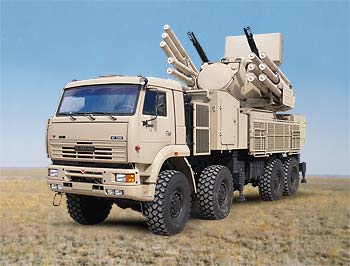
Pantsir-S1 and the Priority on Arms Exports

KBP's Pantsir-S1

Recent announcements about deliveries of the Pantsir-S1 highlighted the priority still enjoyed by arms exports over domestic procurement of weapons systems for the Russian Armed Forces.

On 18 March, the Russian Air Forces took delivery of their first 10 Pantsir-S1 antiaircraft missile-gun systems (ZRPK) from the Tula-based Design Bureau of Instrument-building (KBP).  These Pantsir-S1 systems will march on Red Square during the coming 9 May Victory Day parade, before heading to the Elektrostal-based 606th Guards Air Defense Missile Regiment that also has the S-400.  Some of the regiment’s Pantsir-S1s will participate in live-fire exercises at Ashuluk in April.

The Pantsir-S1 will replace the 1970s-era Tunguska-M1 in Russian air defense units.  A short- and medium-range missile-gun system, it provides point defense for civilian or military assets like S-400 SAMs.  VVS Deputy CINC for Air Defense, General-Lieutenant Sergey Razygrayev has said three Pantsir-S1 systems will be deployed around each S-400 launcher.

The Pantsir-S1 has 2 twin-barrel 30-mm 2A38M antiaircraft guns and 12 57E6-E SAMs.  It is reportedly effective against targets with a reflective surface of 2-3 square centimeters and speeds to 1,000 meters per second, at a maximum range of 20 kilometers and altitude of 15 kilometers.

The Pantsir-S1 can be mounted on various vehicles and ships, and General-Lieutenant Razygrayev has said it will become a standard air defense system for each of Russia’s armed services and combat arms in the future.

When the VVS got its 10 Pantsir-S1 systems, the KBP deputy general director announced that the Air Forces will receive more than 20 units in coming years.  An unnamed source told ITAR-TASS, the VVS would get 25 Pantsir-S1 by 2012.

Development of the Pantsir-S1 dates back to the early and mid-1990s.

The United Arab Emirates (UAE) signed a contract to buy 50 Pantsir-S1s for $734 million in 2000. Syria also contracted for 36 systems.  Ex-Defense Minister, now Deputy PM for the OPK Sergey Ivanov said in early 2008 that 24 systems would go to customers in 2008, from a total order book of 64 for the Pantsir-S1 (of course, 50 + 36 should be 86, not 64).  But the Pantsir-S1 didn’t finish development and testing until some time in 2008, and entered production later in 2008 or in 2009.

Pantsir-S1 deliveries to the UAE and Syria reportedly began in 2009, and the system is already supposedly operational in the UAE.  An OPK source told Interfaks that the first stage of Pantsir-S1 deliveries to these two countries had been successfully completed.

This month Moscow announced the sale of 38 Pantsir-S1s to Algeria for $500 million.  The systems are supposed to be delivered this year and next.  The Russians are reportedly close to a Pantsir-S1 export deal with Libya, and Saudi Arabia, India, and Belarus have been mentioned as other potential buyers of the system.

So these are pretty lucrative sales for KBP, roughly $13-15 million per unit.

Now back to the Russian Armed Forces which have only 10 newly-received Pantsir-S1 themselves.

In late 2007, the commander of Troop Air Defense for the Russian Ground Troops gave his opinion that Pantsir-S1 needed improvements before it could enter his inventory, specifically he wanted its size reduced and better performance against certain types of targets.  For its part, the VVS had been looking, and waiting, for Pantsir-S1 since at least 2002.  AVN reported in late 2008 that the VVS wants to buy more than 100 of the systems.

Even if the Defense Ministry paid $15 million (unlikely), 100 is still a modest buy of $1.5 billion against annual military procurement of about $40 billion these days.  But one can guess that the military is haggling with KBP over the price it’ll pay for the Pantsir-S1.  And this purchase has to fit with other defense procurement and KBP’s production for its foreign buyers.

More on the Unified Tactical Level Command and Control System

On 7 March, Russkiy Newsweek spent some time on Sozvezdiye [Constellation], aka the Unified Tactical Level Command and Control System (YeSU TZ).  The system is sometimes called by the name of its manufacturer–Sozvezdiye.  General Staff Chief Makarov in February said the system would be ready by November.

Russkiy Newsweek concludes, if it actually appears, it will be a technological revolution.  One Defense Ministry interlocutor said it now takes a day for orders to reach field commands from Moscow, but they will go practically in real time with this system.

The author, Viktor Poltavtsev, says NATO already operates in a netcentric fashion, and Makarov is quoted about how an Iraqi Army superior in tanks and artillery was defeated by smaller coalition forces that could see and forecast events, calculate variants, and receive possible solutions in real time.  Poltavtsev says, in the Genshtab, they believe the U.S. Army was 80 times more powerful than its opponent as a result of this information advantage.

But back to Sozvezdiye, Anatoliy Tsyganok thinks this not-yet-fielded system is already obsolete.  He says:

“Every Defense Minister picks his toy.  Igor Sergeyev–Bulava, Sergey Ivanov–GLONASS.  The current minister–the command and control system.”

Despite willingness to entertain possible arms imports in many areas, there is a fear of imports when it comes to command and control systems. Aleksandr Golts notes that Russia lacks a component base–it can’t produce chips or circuit boards, but doesn’t want to buy them abroad either.

The Georgians’ U.S.-made Harris system reportedly performed magnificently in 2008.  One Sozvezdiye associate said that, when the smoke of that little war cleared, it was obvious the Russian Army had no communications, old or new, and things began to stir in the Genshtab.  But Sozvezdiye’s testing has brought mixed results.  YeSU TZ was tested last summer during Kavkaz-2009.

Poltavtsev gives a little explanatory background.  Akatsiya, around since the mid-1990s, is a Genshtab-Military District level comms system that was produced by Sistemprom.  But it didn’t make too much sense without a tactical system to reach brigades-battalions-companies and individual soldiers.

Enter Sozvezdiye.  The Voronezh NII of Communications (aka Sozvezdiye) has worked since 2000 on a tactical level system.  Its specialty heretofore had been satellite radio comms.

Sistemprom awaits the completion of Sozvezdiye’s system so it can connect the two, to create a single command and control system.  As Poltavtsev describes it, generals will sit at Akatsiya stations and command divisions or brigades that have Akveduk.  Brigade commanders will use Akveduk to command their battalions and companies in real time using fast, well-protected channels.

So YeSU TZ is supposed to be the computer network that unites the battlefield–people, equipment, artillery, etc., like a computer game.

Battalion and company commanders are supposed to be able to use digital channels to get reconnaissance photos, video, and other data, to give commands to troops, and to connect to higher staff elements.  Today the commander still has to scream into the radio, but tomorrow he might send soldiers orders to their hand-held devices.

But this is still theoretical.  Everything will depend on the reliability of the equipment and comms channels.  And the system can be blocked if the RF spectrum is suppressed.  The system might not work against a modern, well-equipped enemy that can do this.

Poltavtsev says Russian EW (or REC) systems were used against Sozvezdiye during testing in December at Alabino.  And mobile phones, Internet, radios, and even some hospital equipment in the area stopped working as a result.  A Sozvezdiye rep says their system was jammed on the Taman brigade’s range, but they can get around this by changing transmitters.

The main thing, according to him, is developing algorithms for use in combat that everyone understands.  Users say Sozvezdiye is complex and difficult to use, and it will take a while for commanders to sort out its arrows and symbology.

The Defense Ministry has acknowledged that YeSU TZ needs significant reworking, but there’s no other way.  General Staff Chief Makarov said everyone built their own C2 systems in the past; there were 16 military C2 systems in Soviet days.  Now a common one is being built.  However, Poltavtsev asked a PAK FA developer if his system is already integrated into Sozvezdiye, and he asked what it was, he’d never heard of it.

An interesting account of Sozvezdiye . . . it sounds a little like the story of Bulava, i.e. ‘we have to unify our different systems,’ ‘there’s no other way but to make it work,’ etc.  These are understandable, even commendable at times, goals and sentiments, but they don’t always lead to development of successful military systems.  Sometimes the primary goal has to be a system that works.  And sometimes designers and builders even have to start over.

Moscow Considering Italian Light Armored Vehicles?

Russkiy Newsweek yesterday said a source close to the Defense Ministry claims Moscow is considering buying Italian IVECO M65 vehicles, also known  as the LMV (Light Multirole Vehicle).  The source said negotiations are in the final stage, and LMVs are reportedly being tested in Russia, but opinions on their suitability for Russian conditions are varied.

Another problem–the LMV is basically an analogue of Russia’s Tigr, produced by Arzamas Machinebuilding Plant, a company belonging ultimately to Oleg Deripaska.  The LMV is 1.5 or 2 times more expensive than Tigr and carries fewer personnel.  But it is considered more explosion resistant.  Deripaska’s people dispute this, however, saying it depends on how close the vehicles are to the explosion.

Russkiy Newsweek says the LMV was shown to Putin last year, and Medvedev this year.  It adds LMV to a list of proposed or actual Russian arms buys abroad, including British sniper rifles, Israeli UAVs, and French Mistral helicopter carriers.  The possibility that United Shipbuilding Corporation (OSK or ОСК) chairman and Deputy PM Igor Sechin (a long-time Kremlin insider and Putin crony) could still derail the Mistral deal is raised, but somehow this seems unlikely now for many reasons.  Why wreck a lucrative deal when you can get a piece of it instead?

The article concludes noting that this is the logical continuation of a new Russian military-technical policy–Russia can no longer be considered a closed market and soon Russian companies will have to compete with foreign producers for this internal market, according to CAST’s Ruslan Pukhov.

But there’s more to this story than that . . . some foreign samples are always good if you can get them, some palms might get greased in the process too.  It’s not a bad idea to scare the domestic defense industries, but are they really in a condition to compete with foreign producers?  Rather than stimulate them to get better and more efficient, they could just collapse in the face of a real competition for sales.  And it really goes against everything Russian to rely on foreigners, especially when they’re part of an allegedly hostile NATO.  But mucking about in NATO’s Old European rear area isn’t bad for stirring a little alliance discord.  Just weeks ago too the Russian press had stories featuring President Medvedev with the Tigr and the VDV seems pretty committed to the vehicle.  Let’s just say many factors are in play, which will be the critical ones?

More on Carriers from Gorshkov Conference

Navy CINC Vysotskiy (photo: RIA Novosti)

RIA Novosti has more coverage of Navy CINC Vysotskiy’s carrier comments from yesterday.  Vysotskiy said there’s a plan to build and launch an aircraft carrier by 2020, and the technical proposal for it has to be developed and ready by the end of 2010.

“According to the plan, by year’s end we’ll receive the technical proposal for a future aircraft carrier with the basic tactical-technical characteristics.  Then development of the working documentation will begin.” 

He said experimental-design work (OKR) was already under way.

Vysotskiy noted that a Federal Goal Program (FTsP) was needed to construct an aircraft carrier, because financing to do it in the State Defense Order (GOZ) would be very complex.

Former Navy CINC, now advisor to the Defense Minister, Vladimir Masorin, remarked that carriers make it possible to influence the situation in the world, and its different regions.  He added that, if Russia wants to become a great naval power, it has to have carriers and they will have to be nuclear-powered.  He believes the main thing is preserving Russia’s scientific potential and carrier pilot skills:

“Aircraft carriers can’t be built in a short period.  We have to preserve our scientists, designers, and pilots.”

Limited Productive Capacity, High Demand for Arms and Equipment

Surprisingly little attention, beyond routine press service reports, went to last Tuesday’s (16 February) government conference on the State Armaments Program, 2011-2020 (GPV-2020).  RIAN and older media reporting indicates the GPV-2020 will be adopted next month.

Prime Minister Putin told the attendees, “We are talking about the time frames and kinds of weapons systems we need to provide to our army and fleet, that have to be put into the arms inventory.”  Noting that nuclear deterrence forces, space, and air defense would be emphasized, Putin also said:

“We have to satisfy, as I already said, the troops’ need for modern communications, command and control, reconnaissance and, of course, complete the fifth generation aircraft, new combatant designs for the Navy.”

He reiterated earlier declarations that modern armaments in the forces must be 30 percent by 2015, and 70 percent by 2020.

Other Putin sound bytes:

“We have to provide essential financial resources for this task.  The Finance Ministry, the Economic Development Ministry have made the necessary calculations, and today we’ll need to analyze them.  Right off I want to note that we can’t allow any inflated estimates, ineffective expenditures.”

“The State Armaments Program has to give long-term guidance for developing the defense-industrial complex itself.  This must enable our enterprises to embark on a corresponding modernization.”

“We’ve conducted a whole series of meetings on these issues, but the Defense Ministry must provide the corresponding technical parameters.  We have to support the technological equipping of our defense-industrial complex exactly under these parameters.”

Finally, Putin indicated defense orders will go to enterprises that will be in a condition to produce truly competitive systems in terms of combat power, range, and protection.

Participants in the conference also reportedly discussed a new draft Federal Targeted Program (FTP or ФЦП) on the Development of the OPK.

On 15 February, Putin met with Industry Minister Khristenko and Director of the Federal Service for Military-Technical Cooperation (FSMTС or ФСВТС) Mikhail Dmitriyev.  Khristenko told Putin last year OPK enterprises received 148 billion rubles in state support (6 billion in credits, 60 billion in capital injections, 76 billion in state-guaranteed credits, and 6 billion in subsidized interest rates on export credits).  According to Khristenko, this support allowed the OPK to increase its production 10 percent.

Unnamed Defense Ministry sources said the 76 billion rubles in state-guaranteed credits are difficult to use, and not all were used.  The 60 billion rubles in capital injections were basically a direct budgetary grant, and, according to one aviation plant manager, 20 billion of it went (get this!) to compensate RSK MiG and other producers for the fiasco with their 34 faulty MiG-29s sold to, and returned by, Algeria.

FSMTC Director Dmitriyev told Putin the volume of Russia’s current arms export contracts is $34 billion, and exports will be $9-10 billion over the next two years.

Aleksey Nikolskiy writing for Vedomosti indicated Dmitriyev said several enterprises have orders for some systems scheduled out to 2017, and some foreign customers have raised the issue of quicker deliveries.  He argued that additional production capacity is needed, but Putin proposed only to review the issue of synchronizing domestic and export orders for arms.  He said, “We have to understand in what time frame we can and have to produce for ourselves and our foreign partners.”

A source close to Rosoboroneksport said the issue concerned limitations in production capacity for the S-300PMU2 and S-400 air defense systems, the Su-35 fighter, and surface-to-surface missiles that don’t allow for simultaneously meeting the demands of foreign customers and the Russian Armed Forces.  Vedomosti noted that VVS CINC Zelin already complained about limited productive capacity for the S-400.  A similar jam exists with the Su-35, which is supposed to enter the VVS and some foreign air forces by the end of 2011.  A Defense Ministry source said there’s a proposal to build two new factories for air defense systems, and to enlarge existing enterprises producing critical equipment, and the government might soon adopt the proposal.

Konstantin Makiyenko of CAST (ЦАСТ) told Vedomosti, for the past 2 years, Rosoboroneksport has received more orders than what it has supplied abroad, and the lack of sufficient productive capacity has become the main limiting factor on the growth of arms exports.  He says either increase the capacity or the army will have to wait for arms it doesn’t need too much, but air defense systems and fighters don’t fall into the category of things not urgently needed.

As Mikhail Rastopshin and others have been so kind to note, there have been a raft of OPK development and armaments programs over the years, but they don’t seem to get completed, each melding into the next albeit under a longer deadline.   In early 2009, Dmitriy Litovkin estimated no more than 20 percent of any arms program has ever been accomplished, even during the years of high oil revenues.

And you can’t do an armaments program without OPK development, and Russia’s defense-industrial base has been increasingly poorly positioned to support the arms program in recent years, according to Rastopshin and others.  And don’t forget about declining RDT&E.  Hard times for research institutes and design bureaus could mean that, rather than modern or futuristic weapons based on ‘new physical principles,’ new units of obsolete designs could be produced under an armaments program.

Here’s a telling reminder.  The  much-vaunted 2003 Urgent Tasks of the Development of the Russian Armed Forces document called for modern weapons at the level of 35 percent in 2010, 40-45 percent in 2015, and 100 percent by 2020-2025.  And now Moscow’s talking 30 percent by 2015 and only 70 percent by 2020.

As recently as 2006, the Russian military claimed 20 percent of its weapons inventory was modern.  But in March 2009, Defense Minister Serdyukov admitted the starting point was actually lower:

“. . . the bulk of [arms and equipment] are physically and morally obsolete. Natural loss is not being compensated by procurement.  As a result, the proportion of modern arms and military equipment is around 10 percent.”

This was when President Medvedev said large-scale rearmament would begin in 2011.

Nevertheless, in his November 2009 address to the Federal Assembly, Medvedev said:

“One of the most difficult yet fundamental tasks is reequipping the troops with new systems and models of armaments and military hardware.  There is no need to discuss some abstract notions here: one needs to obtain these weapons.  Next year, more than 30 land and sea-based ballistic missiles, five Iskander missile systems, about 300 modern armored vehicles, 30 helicopters, 28 warplanes, three nuclear submarines, and one corvette-class combatant must be delivered to the troops, as well as 11 spacecraft.  All this has to be done.”

A pretty daunting list when foreign customers are asking for their weapons too.

Retired Officer Rails Against Army’s ‘Sergeantization’

One retired Colonel A. A. Karasev, deputy of the Saratov city duma and chairman of the Saratov branch of the Union of Soviet Officers, has written in KPRF.ru about communists and former servicemen picketing Prime Minister Putin’s reception office in Saratov on 17 February.

According to him, they demonstrated their concern about ruinous army reforms and carried signs saying “Putin!  Return Serdyukov to the Furniture Store.”  And, of course, they addressed an open letter to Putin.

Their letter said they’d taken to the streets before what used to be Soviet Army and Navy Day to make their woes, pains, and demands known to the head of government, and to defend the army, OPK, veterans, and their families from the outrages committed by bureaucrats and Duma deputies.

Their particulars included:

  • The U.S.-Russian balance of strategic forces is broken.  The leadership’s rush to a new strategic arms agreement is only reducing Russia’s security.
  • The OPK continues to be destroyed.  Defense factories in Saratov have closed.  Remaining plants get financing only in late spring or summer each year.
  • The Defense Ministry has not thought out its reforms of the army in the American mold.  The combat possibilities of Russia’s brigades are less than those of the formations and units of the ‘probable enemy’ [they really think the U.S. and Russia will go head-to-head?].
  • ‘Sergeantization’ [i.e. officer cuts and efforts to create professional NCOs] of the army means its enfeeblement.  There isn’t a sergeant with an intermediate specialized education [i.e. vocational high school diploma] who can replace an officer from a higher command or engineering school.  Promising contract-sergeants 20-30,000 ruble pay after training only adds extra tension to their relations with officers.
  • Military pensions have fallen to the level of pay for the least qualified workers, and below the subsistence minimum in many cases.
  • Military wives have not received social guarantees to compensate for their inability to work in many garrisons.

They want all these problems rectified, of course, but want to start with firing Serdyukov and his team.

The tension over what they’ve termed ‘sergeantization’ is interesting. 

In the Defense Ministry’s view, officers who’ve been cut, or turned into sergeants themselves, either weren’t needed or weren’t performing officer work or supervising troops.  So officers have been cut, and those that remain will really be officers with real units to command.  Some of them will get premium pay to reward them for now, and, from 2012, much higher base pay, for example, maybe 60,000 rubles for a lieutenant.  Meanwhile, as the Defense Ministry sees it, there won’t be any problem with newly-minted professional sergeants entering the ranks and earning higher pay [which still won’t approach that of officers].

The KPRF has an alternate scenario for the future.  It sees many officers, who were needed, put out of the service and replaced by some poorly trained contract sergeants who will earn more than before.  Two-thirds of officers don’t get premium pay for now, and the KPRF is probably skeptical that greatly increased pay for all remaining officers will be actually be delivered in 2012.  The future it sees has a mass of officers and sergeants, not differentiated by much of anything, including pay.  While the officer-NCO interaction was long ago worked out in Western armies, it’s still a troubling vision for an army in the throes of major structural changes and lacking a professional NCO tradition.

Sitnov on Serdyukov’s Reforms

General-Colonel Anatoliy Sitnov

Yesterday’s Segodnya.ru published a speech (or an excerpt) given by former Armaments Chief, retired General-Colonel Sitnov.  He now serves as deputy director of RUIE’s (РСПП) Commission on the OPK.  Not heretofore a prominent critic, he offers a fairly withering critique of Defense Minister Serdyukov’s reforms.

He first offers up Milyutin as an example of someone who made an army reform match its purpose.  According to Sitnov, Milyutin’s reform of the army enabled it to defend Russia from rapidly growing military powers in the West.  He says Milyutin also devised the mobilization system since it was impossible for Russia to maintain a permanent army large enough to cover its expanses.

Then Sitnov fast forwards.  His first major complaint is cutting the officer corps from 355,000 to 150,000.  He believes this was done because the country’s authorities fear it.  He criticizes the Defense Ministry’s remaking of the army on the ‘American principle.’  Sitnov says Russia is now trying to defend an enormous country with brigades that are no more than ‘patrol forces.’  He alleges Russia’s brigades can fight for only one day since they lack rear services, reconnaissance, maintenance, staffs, and command and control systems.  He argues that Russia long ago settled on the division as its basic military unit to cover its open spaces.

Sitnov concludes the Russian Army is unready to fight 5th generation wars.  He says America is already fighting 4th generation wars, employing automated systems that integrate units and highly intelligent weapons.  But 5th generation war features automated command and control, robot systems, and the use and control of systems with automated means of guidance, targeting, and destruction.

And this, he continues, is just the technical part.  He rhetorically asks whether an army can perform its missions when the country has no agriculture, industry, science, education, system of state administration or strategy for its development (ouch!).  The army reflects society and, in Russia’s case, society’s imbalances are reflected in its army.

Sitnov spins off into a geopolitical monologue.  He sounds like other ex-generals of the Soviet generation.  If the U.S. continues to occupy positions on Russia’s periphery, Russia’s territorial integrity will become an issue in 10-15 years.  Foreign pressure on Russia to share its empty spaces and resources, like Baykal’s fresh water, will intensify.

Lastly, Sitnov believes it would be naive to think Serdyukov took the decisions on army reform; rather he thinks Serdyukov was just the instrument picked for a policy of purging the army.  Now he says, parallel with the army purge, there is a campaign against the MVD.

Sitnov’s criticism of brigades makes some sense, but defending the MVD?  Also, most observers probably would agree that Serdyukov was simply sent to fix the army, once and for all, and the leadership didn’t worry too much about how.

Trouble Building Submarines at Sevmash

Northern Machinebuilding Enterprise (Sevmash)

Here is 9 February RIA Novosti verbatim:

“Sevmash” Will Not Meet Schedules for Nuclear Submarine Construction Due to Insufficient Personnel

SEVERODVINSK, 9 Feb – RIA Novosti.  The “Sevmash” enterprise in Severodvinsk, Arkhangelsk Oblast will fall behind schedule in constructing nuclear submarines, it was announced to RIA Novosti on Tuesday in the enterprise’s press service.

Information about the lag in the schedule was heard in the session of the interdepartmental coordinating council which took place under the leadership of RF Government Military-Industrial Commission member Vladimir Pospelov and Deputy Navy Commander-in-Chief for Armaments Nikolay Borisov.

Members of the coordinating council discussed the state of affairs in producing nuclear submarines at “Sevmash” – “Yuriy Dolgorukiy,” “Aleksandr Nevskiy,” “Vladimir Monomakh” (project 955 “Borey”), and also “Severodvinsk” and “Kazan.”

“Today, as noted in the session, there is some lag from the construction schedule acknowledged by Sevmash and its partner-enterprises,” stated the press service’s announcement.

Factory General Director Nikolay Kalistratov explained the delay was caused by a lack of qualified personnel.

“It’s essential to apply maximum effort to realize the outlined plans and complete orders on time.  In the near future, we have to attract an additional 500 qualified production workers in the specialties pipefitter, machinist-fitter, ship finisher.  It should also be noted that over two years we’ve increased the number of basic production workers by 2,000 people, but this force is still insufficient,” said the director of the enterprise’s press service.

The directors of TsKB MT [Central Design Bureau of Naval Technology] “Rubin,” SPMBM [St. Petersburg Naval Machinebuilding Bureau] “Malakhit,” “Rosatom” state corporation, RF Ministry of Industry and Trade and other departments also attended the session.

Now at the “Sevmash” factory in various degrees of completion are three strategic nuclear submarines of project 955 “Borey” – “Yuriy Dolgorukiy,” “Aleksandr Nevskiy” and “Vladimir Monomakh.”  Work on construction of the fourth strategic nuclear submarine of this project, with the provisional name “Saint Nikolay” began in December 2009.  In all by 2015 it is planned to build eight nuclear submarines of this class.

This statement seems to imply there’s no problem with money, but, at a certain point, more workers equal money because higher wages should attract them, the northern climate notwithstanding.  So to some degree, this is a Sevmash call for more resources to do the work already on its order books.  Although these Sevmash officials said work’s begun on the fourth 955, RIA Novosti from 8 February made it clear there’s no firm idea of when its keel-laying ceremony would occur.  And Navy CINC Vysotskiy said the problem was “technological,” not related to the fate of the Bulava SLBM or to funding.  So maybe he meant a labor shortage, but, as noted, a lack of labor  is an inability or unwillingness to pay what it costs to do the work.

Yuriy Dolgorukiy SSBN has more sea trials before handover to the Navy. Sevmash says Aleksandr Nevskiy will be launched in 2010 (it was laid down in early 2004).  Vladimir Monomakh is about two years behind it.  The big question for these boats is when and if they’ll have a missile.  Late last year, a number of Russian media outlets claimed SSBN production was frozen due to Bulava’s problems.  But Sevmash’s call for more workers doesn’t track with that.  In October, the Russian government also announced Sevmash would receive 4 billion rubles to add to its working capital for modernization, along with a 6 billion ruble credit from VEB.

When Will the Air Forces Get More S-400s?

First S-400 Battalion on Duty in 2007 (photo: Leonid Yakutin)

On 9 February, RIA Novosti quoted Air Forces CINC Aleksandr Zelin:

“All that has been planned and must be supplied in the coming years, has been agreed with Almaz-Antey, will be fulfilled on time.  The S-400 antiaircraft missile system is fully entering the Air Forces’ weapons inventory.  The shift in the schedule for its supply has some organizational but mainly a technical character.”

Reminding the press that he’s member of the Almaz-Antey board of directors, Zelin said, “At the last session, we talked over all issues connected with planned supplies of the S-400 to the Air Forces.”

It sounds like Zelin is admitting the S-400 has been delayed, and the reasons are technical in nature.  Maybe there’s been some problem in the S-400’s operations or capabilities. 

So where does the S-400 stand?  Two battalions were fielded at Elektrostal near Moscow in 2007 and 2008, and Air Forces spokesmen have said repeatedly that 5 additional battalions will be delivered this year. The State Armaments Program, 2007-2015, called for 18 battalions by 2015.  But, as Mikhail Rastopshin has said, 18 battalions don’t cover Russia’s main administrative and industrial centers or support its strategic nuclear forces. 

In the midst of his late November criticism of Russian defense industry’s inability to provide the VVS with the UAVs it needs, Zelin also said Russian needs a second factory to produce the S-400 Triumf and other future air defense systems.  According to him, Almaz-Antey cannot fully satisfy the country’s demand for S-400 systems.  Not sounding too sure, he added that, “In 2010, we need to receive another five battalions, but everything depends on the industry and financing.”

Commenting on the S-400 tests at Ashuluk, Zelin said he was satisfied with the results, but the tactical-technical characteristics in the system are “still less than we wanted.”  He may be referring to lingering, well-known problems with the S-400’s long-range missiles.

VVS CINC General-Colonel Aleksandr Zelin

Zelin went on to criticize the pace of development of the next generation S-500:

“Development of this system doesn’t satisfy me.  We would like for the existing potential in the Almaz-Antey concern to be doubled or even tripled.”

He said he planned to raise the S-500 development issue at the December board meeting.

More recently, on 28 January, Rosoboroneksport General Director Isaykin indicated that, although he has foreign orders for the S-400, Russia’s requirements would be met first.

On 17 September, Almaz General Director Ashurbeyli told ITAR-TASS that the S-500 would need 4-5 years to complete.  On possible S-400 export orders, he said he could only say two countries had signed large agreements for more than 10 battalions, but contracts remained to be finalized.  But Zelin made another statement this day that the system would go first to Russia’s armed forces.

So to recap.  The S-400 supply schedule has shifted for technical reasons.  The VVS hasn’t gotten a battalion since 2008.  Zelin admits he’s not fully happy with the S-400’s capabilities.  He says everything depends on the manufacturer, with whom he’s unhappy.  Meanwhile, foreign customers are already lined up for the S-400 that Russia can’t get and Almaz-Antey is marching off on the new S-500.