Category Archives: Force Structure

Team VKO Taking Shape

Team VKO is taking shape according to Kommersant.  Last fall, President Medvedev, of course, ordered the establishment of a unified VKO.  Since then, it’s become clear that Space Troops (KV) Commander, General-Lieutenant Oleg Ostapenko would head it.

And KV will be the base for the new service [vid or вид].  According to the Genshtab plan, VKO will unite all PVO and PRO systems.  And it will control the current KV, Moscow-based OSK VKO, and PVO units from the Air Forces.

The paper’s Defense Ministry source says VKO’s top officers have been identified, and paperwork was sent for Medvedev’s signature last month.  So expect a decree soon.

General-Lieutenant Valeriy Ivanov will be in charge of PVO and PRO for VKO.  He’s a 50-year-old career SAM officer, who commanded PVO divisions or corps in the Far East, Volga, and Moscow MDs.  From 2007-10, he commanded the Far East’s 11th AVVSPVO.  He became commander of the OSK VKO about this time last year.

General-Major Oleg Maydanovich is a 47-year-old KV missile engineer who will head VKO’s space monitoring.  He has long service at Plesetsk and Baykonur, and has been chief of both.  He’s now chief of Russia’s space systems testing and control center.

Colonel Andrey Ilin will be chief of the VKO’s command and control post at Krasnoznamensk.  He served many years at the space tracking post in Shchelkovo.  He’s been chief of staff at Plesetsk since last year.

Russian Military Power

Finland’s National Defense University has published a study entitled Russian Politico-Military Development and Finland.  If the media reporting is accurate, it may read a little like a latter-day Soviet Military Power.

Now few have read the document since there’s only a two-page English precis to go with press accounts of its contents.  Perhaps the entire thing will appear in English soon.

But here’s the gist. 

NATO and other Western countries believe war is an outdated idea, and U.S. power and interest in Europe are waning.  Russia, meanwhile, is seeking to revise the verdict of the Cold War, restore its great power status, and regain the Soviet sphere of influence.

It’s modernizing its crumbling armed forces with increasing investments [i.e. the 19-trillion-ruble State Program of Armaments or GPV 2011-2020].  The formation of the Unified Strategic Command (OSK) West (aka the new Western MD) has shifted the Russian Army’s center of gravity from Western Europe to the Northwest [at Finland].  And:

“The Russian armed forces are being improved by forming high-readiness forces with a capability of achieving operational results directly from peacetime employment.”

Finally, the study’s authors seem to see a Russian military resurgence that needs to be met by reinvigorating Finland’s territorial defense system:

“A large military reserve force is an indication of the will to defend the country, and has a major preventative value.”

It’s worth challenging three central propositions here.

Russia’s “increasing investments” in its military.  The Finnish report is reacting a priori to plans for large outlays for defense procurement that may or may not happen.  They authors are concerned about Russia’s intention to modernize, and what its forces might look like after modernization.  The current GPV could go the way of its predecessors; the first annual state defense order (GOZ) to fulfill the GPV isn’t exactly proceeding smoothly.  It’s important also to consider what’s being modernized.  In many cases, Moscow plans to replace arms and equipment from the 1980s and earlier, and not everything will be a world-class fourth- or fifth-generation weapons system.  Lots of the “new” models will be based on late Soviet-era designs.  

The shift to the Northwest.  To some extent, there may be an effort to get forces closer to their likely theater of operations.  But hysterical assertions of vastly increased Russian forces shouldn’t be taken seriously.  It’s largely the same forces organized differently, and certainly not all opposite Finland.  The creation of OSK West or the Western MD was also an attempt to cut redundant command and staff echelons and get the Ground Troops out of the expensive environs of Moscow and Moscow Oblast.  One could easily argue the Defense Ministry’s placed a higher priority on forces in the Southern or Eastern MDs. 

The formation of high readiness units.  The report’s authors are quoted as saying Russia’s high readiness forces will be ready to leave garrison, and begin offensive operations in an hour, according to Vzglyad’s interpretation of a Russian-language media outlet in Estonia.  In reality, the forces are now more highly ready to depart the garrison and get combat orders.  No one can say what those orders will say.  Any combat missions will have to be carried out by troops who generally have less than six months in the army, and they’ll be lucky to execute a successful defensive operation.  Also, let’s hope the Finnish study says that this high readiness was really more about getting rid of useless, hollow, low readiness cadre units.

But, as Newsru cites a former deputy commander of the OGV(s) in the North Caucasus, it’s hardly possible to talk about Russian efforts to encircle anyone “in the condition which we’re in, and with those obvious army problems which we have.”

No one should misunderstand.  The Finns are to be admired for their perspicacity when it comes to Moscow.  They’re keen observers of what’s happening in Russia.  They have to be. 

But there’s obviously a huge issue of perspective.  Things look very different from Helsinki, Washington, Paris, London, and Berlin.  Russia’s capabilities are somewhat hyped in a public debate about what level of forces and readiness Finland needs to deter Russia.

But, all in all, it doesn’t help anyone in the long-term to inflate [re-inflate?] a Soviet-style military threat.  A realistic assessment of Russian capabilities and intentions will lead to practical, affordable measures to counter them.

Makarov’s Press-Conference (Part III)

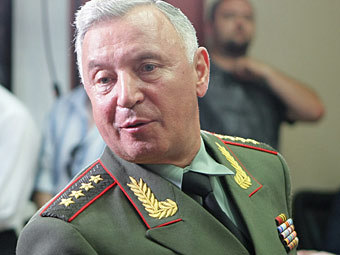
Army General Makarov (photo: RIA Novosti / Aleksey Nikolskiy)

Still plumbing General Staff Chief Makarov’s Monday press-conference . . .

Makarov indicated Russia’s Israeli-made UAVs will be used in the Tsentr-2011 exercise.  According to Krasnaya zvezda, he once again worked Vega over for wasting years and money without meeting the military’s requirements, forcing it to turn to Israel to obtain unmanned aircraft.

According to Interfaks, the General Staff Chief asserted Russia won’t buy anything but PGMs for its combat aircraft:

“The purchase of conventional [unguided] means has stopped.  We are buying only highly-accurate means.”

“Western countries conduct military operations almost without ground forces.  Aircraft operate outside the air defense zone and sustain minimal losses.”

Izvestiya noted, however, replacing Russia’s dumb bombs with smart weapons won’t be cheap.  Tens of thousands of rubles versus millions.  But one of the paper’s interlocutors concluded:

“The Defense Ministry believes there’s money for buying them, contracts for the first deliveries of new munitions have already been concluded.”

He estimates they will comprise perhaps half of Russia’s aviation weapons inventory by 2020.

Izvestiya quoted Ruslan Pukhov to the effect that guided ASMs made up only 1 percent of Russia’s stockpile in the five-day war with Georgia, and Russian aircraft had to brave Georgia’s air defenses on most missions, losing four Su-25, two Su-24, and a Tu-22M3.  He added, however, that a Su-34 employed an anti-radar Kh-31P to destroy a radar in Gori.

Lenta.ru recalled General-Lieutenant Igor Sadofyev’s late 2010 comments about plans for a radical increase in PGMs and UAVs in the Air Forces by 2020.  You can refresh your memory here.

Some military commentators and news outlets managed to tie together Makarov’s comments on Arab revolutions, Central Asian exercises, snipers, and sniper rifles in interesting, but not always accurate, ways.

KZ summarized Makarov pretty simply as saying the armed conflicts in Arab countries were difficult to predict, and similar events can’t be ruled out in Central Asia.  In its replay of his remarks, he said:

“. . . we should be ready for everything, therefore we are working on this in the exercises.”

So, Moscow’s pretty obviously looking at the possible repetition of a Libyan or Syrian scenario somewhere in Central Asia . . . no surprise there . . . makes sense.

Komsomolskaya pravda said:

“Our military isn’t hiding the fact that current exercises are directly linked to the probable export of military aggression from Afghanistan into the Central Asian republics after NATO troops withdraw from there.”

It cites Makarov:

“[The exercises] envision developing variants for localizing armed conflicts on the territory of these countries.”

That doesn’t really sound Libyan or Syrian, does it?  It’s not internal.  It’s good old external spillover.  Oh well, as long as it’s “localized” on someone else’s territory, and doesn’t cross Russia’s borders.

ITAR-TASS’s version of Makarov got people more spun up:

“The world situation is complex, quickly changing, particularly in North Africa and the Middle East.  It was difficult to forecast what happened in a number of countries of this region, events developed with great speed.  Now no one can say what will happen next.  But this is a signal for all states.  We military men need to be prepared for the worst scenarios.”

This led a few outlets to take the next step on their own, i.e. a repeat of the Arab scenario inside Russia.

You can read likely exaggerations of what Makarov really said in Gazeta.ru or Rbcdaily.ru.  In its version, the latter claimed Makarov didn’t exclude internal unrest following the Arab example in Russia, and the army has to be ready for the worst case scenario of political developments inside the country.

Pouring gas on the fire it lit, Rbcdaily introduced the sniper issue here.

Of course, snipers are great for urban warfare or urban unrest.  Rbcdaily’s Defense Ministry source says Makarov plans to put independent sniper platoons in every brigade.  They’ll be armed with British rifles, of course.  And the snipers themselves will have to be long-term professionals – contractees, so that’ll have to wait until the middle of next year.

Igor Korotchenko tells Rbcdaily:

“A sniper is a piece of work, he can’t be trained in a year, therefore they must absolutely be professional contractees.  We can’t count on conscript soldiers here, like in the old days when there were enough gifted guys who learned to fire the SVD well among the conscripts.”

KZ didn’t mention Makarov talking about snipers.

Just to finish this off, Makarov’s Syrian comments weren’t construed or misconstrued as much.  KZ said simply that he said Russia is not planning a military presence in Syria, nor the introduction of extra security measures at its material-technical support base in Tartus.

ITAR-TASS put it this way:

“This base remains in our hands.  Besides it, our advisors work in Syria.  That’s enough.  We don’t intend to adopt any preventative measures.  . . . we have to watch closely those forces opposing the government.  There are legal demands, and there are opposition demands which, in our view, need to be ignored because they are illegal.”

Another Bet on Space Troops

The press continues picking up tidbits on the formation of Aerospace Defense (VKO).  In contrast to some recent information, Kommersant said yesterday General-Lieutenant Oleg Ostapenko and his Space Troops (KV) have the upper hand in carrying out President Medvedev’s number one task from last year’s Federal Assembly address.

Meanwhile unofficial Air Forces (VVS) representatives are still confident VKO will be subsumed in the VVS (in Air Defense or PVO specifically). 

But normally well-informed military journalists have consistently maintained KV will get the mission and organization.  And General-Lieutenant Ostapenko has publicly stated he already has it. 

We can’t forget that General Staff Chief Nikolay Makarov at one point suggested the Genshtab might take KV and PVO and establish VKO under its own control.

Kommersant’s most recent information says coordination of a candidate for chief of VKO has begun, and KV Commander Ostapenko is the frontrunner.  VKO will be established on the foundation of KV, according to the business daily.

Three VKO command and control posts will be established – in the VVS Glavkomat in Zarya (Balashikha, long PVO’s headquarters), in Krasnoznamensk (space monitoring’s headquarters), and in KV’s Moscow headquarters.

Kommersant’s information suggests VVS Commander, General-Colonel Aleksandr Zelin’s future hasn’t been decided and he could retire (or be retired).

Krasnaya zvezda reported that, in his recent press-conference, Zelin indicated OSK VKO (the old Moscow Air Defense District) will join a VKO Command including both KV and the VVS’ PVO and PRO Command on December 1.

The path seems pretty clear for KV to take charge of Russia’s VKO, but the bureaucratic struggle for it probably isn’t over.  There’s still time for surprises before the December 1 deadline.

Where’s the Logic?

A “highly-placed” Navy source has told RIA Novosti that S-400 / Triumf surface-to-air missile systems are arriving in the Baltic Fleet.  The source claims fleet air defense personnel are going to Ashuluk for training.

The news agency said a “highly-placed Baltic Fleet staff representative” confirmed announcements from several media outlets about the fleet receiving two S-400 battalions before the end of 2011.

Perhaps some healthy skepticism is in order.

The S-400 isn’t exactly bursting out the factory gates.  A second S-400 regiment hasn’t appeared at Dmitrov, and a third has already been promised for Moscow’s outskirts. 

There’s also a little matter of earlier spurious reports about where the S-400 would appear.  Recall General Staff Chief Makarov’s remark that it was deployed in the Far East in 2009.  Since then, there was talk of using it to defend the Kurils or Kamchatka, but Air Forces generals have spoken of the system strictly in terms of protecting Russia’s “central administrative and industrial zones,” i.e. Moscow and adjacent oblasts. 

Maybe it would make some sense to protect the country’s northwestern approaches from ever-dangerous Germans, Swedes, Finns, etc.  But it’s not really logical to do so until Moscow’s air defenses are modernized.

And it’s certainly not logical (from a bureaucratic viewpoint) for the VVS or VKO Troops (VVKO?) to let these precious new systems slip from their hands into the Navy’s control.  A second service operator at this point would complicate training and maintenance.

Maybe it’s another tactic for negotiating with the U.S. over missile defense in Eastern Europe (like deploying Iskander SSMs in Kaliningrad).

For its part, Interfaks (according to TsAMTO) reported the Navy S-400s would be placed in Russia’s Baltic exclave.

At any rate, there would seem to be few persuasive arguments and little sense behind a deployment of the S-400 in the Baltic Fleet any time soon.

Who Will Own VKO (Part II)

Returning to former General-Major Tazekhulakhov’s article in NVO . . . to make VKO an integral organism under unitary leadership and command and control, with personal responsibility for solving the tasks laid on the system, Tazekhulakhov believes it best, in the current Armed Forces structure, to concentrate troops (forces) and VKO system resources in one service or troop branch.

The ex-Deputy Chief of VPVO then reviews five possibilities:

  1. Give VVS PVO (including air defense aviation) to KV, and turn KV into a new branch called VVKO.
  2. Disband KV, give RKO to the VVS and space launch, monitoring, and other supporting structures to RVSN.
  3. Using KV as the base, create a new branch VVKO by including those VVS forces and resources currently in OSK VKO (the old KSpN, Moscow AVVSPVO, Moscow Air Defense District, etc.).
  4. Without transferring or resubordinating any of VVS or KV, establish a Strategic Command of VKO (SK VKO), and designate a commander to whom every MD / OSK, and every PVO, RKO, and REB resource would be subordinate for VKO missions in peace and wartime.
  5. Divide VKO along the existing MD / OSK lines with each of the four commanders responsible for the mission with common command and control exercised by the RF Armed Forces Central Command Post (ЦКП ВС РФ).

Tazekhulakhov says none of these possibilities is ideal.  Currently, VKO elements belong to different services, troop branches, Armed Forces structures, and even civilian departments.  PVO and RKO forces and resources aren’t evenly distributed throughout the RF.  And some are operationally subordinate to regional MD / OSK commanders and others (RKO and REB) to the center.  Triple subordination — administrative, operational, and support — violates one-man command for the VKO system.

Tazekhulakhov says the first three variants ask service or branches to perform missions outside their traditional competence.  Variant four would require agreement on the authorities of the VVS CINC, MD / OSK commanders, and the SK VKO commander.  Variant five makes it hard to find one commander responsible for VKO.

Of all variants, Tazekhulakhov finds variant two best.  It keeps the current integrity of VVS, and cuts one branch and reduces command and control organs.

But he’s found another problem not yet addressed — how to treat operational-tactical PVO and PRO of the MDs and fleets.  For it to operate on the same territory and with the same missions as strategic VKO, reconnaissance and warning information exchange and command and control and REB coordination has to be worked out.  And MD / OSK commanders won’t want to subordinate their forces, plans, and responsibilities to a VKO commander.

Lastly, Tazekhulakhov steps back to look at a bigger picture.  Why develop VKO?  With whom and how is Russia preparing to fight?  He concludes, from all appearances, U.S. missile defense won’t seriously impede Russian strategic nuclear forces, and, to some extent, Moscow has wasted time worrying about it:

“Russians need to stop getting harnessed, it’s time to get moving, and not simply waddle, but race full speed.  The result of our procrastination is obvious:  Russia is still trying through negotiations to find a compromise between its and NATO’s positions on missile defense, under cover of the protracted negotiating process, the American missile defense system in Europe is already approaching very close to Russia’s borders.  Evidently, it doesn’t do to waste time, hope and focus on NATO.  It’s essential to take serious military-political decisions and do what’s needed and useful for Russia, without looking at others.  No one, first and foremost the U.S., will give us anything, especially in the armaments area.  We have to rely only on ourselves.  Russia, undoubtedly, has no other way.”

Who Will Own VKO (Part I)

Retired General-Major Aleksandr Tazekhulakhov — Deputy Chief of Troop Air Defense in 2005-2009 — has written on military reform (and on VKO) before, but his piece in Friday’s Nezavisimoye voyennoye obozreniye caught one’s attention.

Let’s get to the main points of his very long, but interesting, article.

Essentially, Tazekhulakhov asks whether trying to decide which service or branch will own VKO isn’t the most expensive and useless project.

The former air defender suggests that, if the character of future wars, dangers, and threats are considered:

“. . . it is essential to give priority to the development and improvement not of separate services and troop branches of the Armed Forces, but of strategic and operational-strategic reconnaissance-combat (offensive and defensive) systems, which are being established on the basis of troop (force) groupings on strategic axes with concrete combat missions.”

Tazekhulakhov says President Medvedev is looking for a unified VKO system, while Defense Minister Serdyukov is planning to deliver VKO Troops [войска ВКО].  The former one-star says:

“Considering that the creation of a system of aerospace defense (VKO), or of VKO Troops could turn out to be the most visible, expensive and at the same time most senseless and useless project, it’s essential to review once more the existential problems and variants for solving this complex mission.”

He stresses that the national missions of VKO can only be resolved according to a common concept and plan, under united command and control.  And he argues against near- or medium-term thoughts of providing equal defense for all Russian territory and borders.  He cautions against thinking the combat potential of VKO systems might someday compare with that of strategic nuclear forces:

“No country in the world today has or can foresee in the medium-term future a missile defense [ПРО] system which would be capable of repulsing a mass (counterforce) missile-nuclear strike, or even a strike consisting of several ICBMs.  Therefore it’s expedient to limit the scale of employing VKO systems to the following framework:  repulsing strikes employing single or small groups (3-5) of ICBMs, IRBMs, operational-tactical missiles, tactical missiles, single, group, or mass strikes by other means of air attack, destruction (suppression) of satellites and other space objects.  Limiting the scale of VKO system employment will allow for reducing expenditures on its maintenance, for making combat missions specific, and for concentrating efforts on developing the most important system components.”

Establishing the VKO system, according to Tazekhulakhov, is a two-fold task. 

Firstly, PVO, PRO, PRN, and KKP [air defense, missile defense, missile attack early warning, and space monitoring] systems have to come under unitary command and control.  This, he says, is an administrative and organizational task that can and should be done in the timeframe indicated by Medvedev.

Secondly, and more troublesome, is the process of uniting the various supporting elements of VKO — what Tazekhulakhov calls the “hidden part of the iceberg” or the “horizontal system components.”  They include reconnaissance and warning, fire and functional defeat (suppression), command and control, and material support.

He claims, however, that, for 30 years, state leaders, military leaders, military scientists, and industry representatives have tried without success to resolve this problem.  It has administrative, functional, technical, algorithmic, and programming aspects requiring resolution on a state level rather than a departmental [Defense Ministry] one.

Thus, Tazekhulakhov limits his discussion to the possibilities for solving the first (“tip of iceberg” or “vertical system components”) problem.

To be continued.

Valeriy Ivanov on VKO, S-500, S-400

General-Lieutenant Valeriy Ivanov

The Space Troops have seemed pretty confident about getting control of VKO up to this point, but now a senior Air Forces officer has taken his turn to suggest the VVS may have a leg up.

On Friday, Commander of the Operational-Strategic Command of Aerospace Defense (OSK VKO), General-Lieutenant Valeriy Ivanov described for journalists how his command provides air defense for 140 key facilities in Russia’s capital and central industrial regions. 

At a conference in Mozhaysk to commemorate the 70th anniversary of the defeat of the first Nazi air attack on Moscow, Ivanov said 800 OSK VKO personnel secure Moscow’s airspace on a daily basis, and he claimed his command covers two-thirds of Russian Federation territory, according to RIA Novosti

The OSK VKO Commander also said he expects to receive the S-500, new radars, and fighter aircraft by 2015.  Several news outlets repeated an early 2011 Interfaks report saying that ten S-500 battalions will be acquired under GPV-2020. 

Regarding President Medvedev’s late 2010 order to set up a unified VKO command by December 1, 2011, Ivanov told ITAR-TASS that VKO has already been established and is being improved:

“The VKO system is now being integrated, developed, and modernized.  We are now taking, uniting Space Troops and our OSK VKO.” 

But, according to ITAR-TASS, Ivanov had to admit there’s no clarity yet on the new form of VKO, and “our state’s political leadership will make the final decision on this.”

Krasnaya zvezda also provided a somewhat less categorical-sounding Ivanov quote:

“The Aerospace Defense system which we’re creating is now being integrated and developed.  Currently, the process of amalgamating Space Troops and the Operational-Strategic Command is going on.”

Komsomolskaya pravda relayed this Interfaks quote about the fate of aviation:

“Aviation carrying out air defense missions will be immediately subordinated to the VKO commander.  The one who directs the battle will also command [aviation].”

RIA Novosti also reported General-Lieutenant Ivanov saying the second S-400 regiment (at Dmitrov) will be on duty by July 31.  He said a third regiment will appear at Zvenigorod by the end of this year.

Naval Aviation Chief Interviewed

Hero of Russia, General-Major Igor Kozhin

On Sunday, RIA Novosti interviewed Naval Aviation Chief, General-Major Igor Kozhin on his branch’s 95th anniversary.

The news agency’s recap reminded that Naval Aviation lost its strike assets to the Air Forces on 1 April.  And, by year’s end, all remaining Su-27, MiG-31, Tu-22 and part of its transport aircraft will move to the VVS.  Only land-based ASW and carrier aviation will remain.

Asked about training, General-Major Kozhin focused on cost and retention.  He claimed training a pilot costs a rather exorbitant $1.5 to 2 million annually.  He indicated the need to keep older, experienced personnel — even in a civilian capacity — to train his younger pilots.

On upcoming training, Kozhin said his one regiment of 20 carrier-qualified pilots will conduct 100 takeoffs and landings from the Fleet Admiral of the Soviet Union Kuznetsov in August and September.

Kozhin said Kuznetsov is currently preparing for sea, and there’s no plan for capital repairs even though a replacement isn’t foreseen at this time.

He gave no hint of any impending carrier deployment as rumored earlier this year. 

RIA Novosti asked about renting the NITKA carrier trainer in Ukraine.  Kozhin answered by updating the construction of a similar facility at Yeysk, in Krasnodar Kray.  He said toward fall the takeoff and landing strip will be complete, then landing systems will be installed, and the ground-based carrier simulator will be functional in 2013.  He said the entire Naval Aviation training complex will be finished in 2015.

Finally, on new aircraft, Kozhin said the first four MiG-29K for Naval Aviation could apppear in 2012, but the Defense Ministry will have to sign the contract before mid-August.  Otherwise, the first delivery will be in 2013.  In all, a Navy buy of 20 is planned, but the factory is busy now filling India’s order for fighters for the ex-Gorshkov being renovated at Sevmash.

Second S-400 Regiment Delayed

The second S-400 regiment, or “regimental set,” hasn’t commenced combat duty at Dmitrov after all. 

This was supposed to happen on May 15, but didn’t.  According to RIA Novosti, a VVS spokesman said the official commencement of combat duty was postponed [again] from July 17 until the last ten days of this month.

The news agency says the ceremony will take place on Peremilovskaya Height, outside Dmitrov.  

Newly-minted VVS Main Staff Chief and First Deputy CINC, General-Major Viktor Bondarev said in June that a third S-400 regiment will become operational this fall.