Category Archives: Officer Corps

More Military Personnel Decrees

Kremlin.ru published four more decrees from President Medvedev on military personnel changes today. 

  • General-Lieutenant Studenikin’s removal is surprising.  He’s had some good jobs, and he’s not necessarily too old to serve in another post. 
  • Dismissed General-Colonel Tkachev commanded Baluyevskiy’s experimental Eastern Regional Command, the latest forerunner of today’s four OSKs.
  • There’s a change as chief of staff in the federal chemical weapons storage directorate.
  • That bastard child of the armed forces may be reorganizing – it sounds as if there may be a new Main Directorate of Railroad Troops, presumably it would be part of Bulgakov’s MTO empire.
  • More staff officers from the MDs relieved and dismissed.  Former 58th Army commander Sobolev is dismissed.
  • There’s even a change in one you don’t hear about every day (or even every decade) – the Special Service of Strategic Communications of the RF President.
  • Finally, the changes in the new MDs are getting squared away – commanders and first deputy commanders in the new Southern, Eastern, and Central MDs roll over from their old positions.  Salyukov moves to the General Staff. 

Here are the details. 

Appointed:

  • Colonel Igor Nikolayevich Dylevskiy, Chief, 5th Directorate, Main Operations Directorate, General Staff.
  • Colonel Vladimir Leonidovich Suvorov, Professor, Military Art Faculty (Military Strategy), Military Academy of the General Staff, relieving him of duty as First Deputy Chief, 5th Directorate, Main Personnel Directorate, Defense Ministry.

Relieved of duties: 

  • General-Lieutenant Aleksandr Igorevich Studenikin, Deputy CINC, Ground Troops.
  • Colonel Andrey Gennadyevich Kharitonov, Chief of Staff for Armaments, First Deputy Chief of Armaments, Volga-Ural MD.

Relieved of duties and dismissed from military service:

  • General-Major Vladimir Pavlovich Yedryshev, Chief of Missile Troops and Artillery, Volga-Ural MD.
  • General-Major Nikolay Pavlovich Shebanov, Chief of Staff, First Deputy Chief, Federal Directorate for Safe Storage and Destruction of Chemical Weapons, Ministry of Industry and Trade.

Dismissed from military service:

  • General-Major Yuriy Mikhaylovich Rovchak.

* * *

Appointed:

  • Colonel Sergey Viktorovich Bindel, Chief of Staff, Deputy Chief, Federal Directorate for Safe Storage and Destruction of Chemical Weapons, Ministry of Industry and Trade.

Relieved and dismissed:

  • Rear-Admiral Aleksandr Nikolayevich Menyayelo, Deputy Chief, Main Directorate of Communications.

 Dismissed:

  • General-Lieutenant Andrey Ivanovich Grigoryev.
  • General-Major of Justice Viktor Anatolyevich Salatov.
  • General-Colonel Nikolay Fedorovich Tkachev.

* * *

Appointed:

  • Colonel Dmitriy Yuryevich Boyarskiy, Deputy Director, Department of Planning and Coordination of Material-Technical Support, Defense Ministry, and Chief, Operational-Planning Directorate.
  • General-Major Oleg Ivanovich Kosenkov, Chief, Main Directorate of Railroad Troops, relieved of duty as Chief of Staff, First Deputy Commander, Railroad Troops.

Relieved and dismissed:

  • General-Major Aleksandr Mikhaylovich Bulanov, Special Service of Strategic Communications of the RF President.
  • General-Major Vladimir Nikolayevich Glinin, Chief, Combat Training Directorate, North Caucasus MD.

Dismissed:

  • General-Lieutenant Viktor Ivanovich Sobolev.

* * *

Appointed:

  • General-Lieutenant Aleksandr Viktorovich Galkin, Commander, Southern MD, relieved of duties as Commander, North Caucasus MD.
  • General-Major Nikolay Nikolayevich Pereslegin, Chief of Staff, First Deputy Commander, Southern MD, relieved of duties as Chief of Staff, First Deputy Commander, North Caucasus MD.
  • General-Colonel Oleg Leonidovich Salyukov, Deputy Chief of the General Staff, relieved of duties as Commander, Far East MD.
  • General-Lieutenant Anatoliy Alekseyevich Sidorov, Chief of Staff, First Deputy Commander, Eastern MD, relieved of duties as Chief of Staff, First Deputy Commander, Far East MD.
  • General-Lieutenant Sergey Vladimirovich Surovikin, Chief of Staff, First Deputy Commander, Central MD, relieved of duties as Chief of Staff, First Deputy Commander, Volga-Ural MD.
  • General-Lieutenant Vladimir Valentinovich Chirkin, Commander, Central MD, relieved of duties as Commander, Siberian MD.

Suicidal Lieutenants

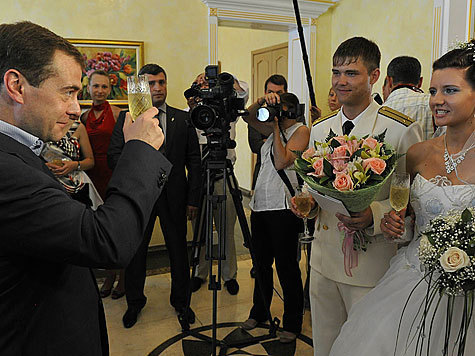
President Toasts the Kuropatkins (photo: Aleksandr Astafyev)

The Pacific Fleet command and investigators say the shooting of a 22-year-old lieutenant assigned to a 35-year-old LST in Fokino was a suicide attempt, and not the result of ‘nonregulation relations’ or dedovshchina.  The incident occurred 1 December.  Lieutenant Maksim Kuropatkin was found with a gunshot wound to the head, and he remains in a coma.  Investigators say he shot himself with his service sidearm in the presence of two witnesses.  No criminal case has been initiated.  Their preliminary conclusion is that Kuropatkin suffered a nervous breakdown caused by difficulty adapting to life in the service.

Moskovskiy komsomolets point out the Kuropatkin case is a little special because President Dmitriy Medvedev was the surprise guest of honor at the lieutenant’s wedding in early July.  Medvedev was touring the Far East, and arrived at Birobidzhan’s wedding palace in time to witness three marriages including Kuropatkin’s.  Medvedev wished the lieutenant and his bride a “long happy family life.”  He ordered the governor of the Jewish AO to find apartments for all three couples.  About a month ago, the Kuropatkins got their apartment.

Kuropatkin’s family doesn’t believe his shooting was a suicide attempt.  They say he was always goal-oriented, and aimed for a military career from age 14 (presumably he attended a Nakhimov Naval School).  He graduated from the Pacific Naval Institute late this spring, married, and had been in his first assignment only a couple months.

They also say Kuropatkin recently mentioned the name of a senior officer who often picked on him, and was constantly nagging him to draw up some kind of documents, and when Kuropatkin refused, he said, “Well, that’s it, it’s the end for you.” 

A 24-year-old lieutenant named Ivan Yegorov died in what was also called a suicide aboard Slava-class CG Varyag in mid-November.  MK sums up saying:

“According to the opinion of knowledgeable people, dedovshchina in the officer environment ranges up to physical violence and shootings.”

RIA Novosti also reported a Baltic Fleet suicide this week.  A 23-year-old lieutenant from the Pionerskiy garrison reportedly shot himself in the chest with a Makarov pistol.  He apparently left a note.  The chair of the Kaliningrad Committee of Soldiers’ Mothers said she was completely surprised by this incident, adding that there have never been “any signals” of problems from the unit where this lieutenant served.

Scapegoat Biront Wins in Court, for Now

Lieutenant Colonel Biront (photo: http://www.odnoklassniki.ru)

Last Tuesday, the Lyubertsy Garrison Military Court held President Medvedev’s dismissal of Lieutenant Colonel Viktor Biront to be illegal.  Recall Biront was the President’s and the Defense Ministry’s scapegoat when the 2512th Central Aviation-Technical Base of Naval Aviation burned in this summer’s infernos near Moscow.

A criminal case for negligence was also raised against Biront, but, according to Moskovskiy komsomolets, they punished him by dismissing him “in connection with nonfulfillment of contract.”  Biront fought back, and an inquiry revealed that, as of 1 February, the base’s firefighting unit had been disbanded, a 50-meter fire break hadn’t been established, and firefighting supplies were absent.  Biront had informed his leadership, but was ignored.  Biront’s lawyer also argued that his client had an impeccable 26-year service record, and had only been in charge of the Kolomna base for 3 months and 25 days.

The lawyer said Biront was left with 70 sailors to dig a fire safety zone around an 8-kilometer perimeter.  And Biront’s predecessor was fined for trying to dig this zone on his own.  The lawyer says the Defense Ministry plans to appeal the overturning of Biront’s dismissal.

In its coverage, Kommersant said Biront’s lawyer pointed out that every due process was violated in his client’s case: 

“First an investigation is performed regarding the disciplinary violation which served as the basis for dismissal, then the serviceman should be familiarized with its results and guaranteed the right to present his objections.  None of this was done.”

The lawyer continues, “The president gave the order to sort it all out and dismiss the guilty, but they didn’t sort it out and found a scapegoat among the unit’s officers.”

In Kommersant’s version, Biront and 30 sailors fought the fires armed with nothing but axes. 

One officer told the paper a chain reaction following Biront’s victory was likely, as others dismissed make similar appeals based on the lack of due process.

So, one can conclude that Medvedev’s ‘tough guy’ on-the-spot firing in the 4 August special Sovbez session was really nothing more than feelgood PR at best, or stupid at worst.  But, if they want to get Biront, they will, especially for being impudent enough to fight the system, and not being a quiet, cooperative victim. 

Biront is one of those allegedly superfluous officers denigrated by the victors in Serdyukov’s ‘new profile’ reforms for being a ‘housekeeper,’ uninterested or unprepared to conduct combat training.

The news about the Biront case has received very little media attention.

Medvedev’s Military Personnel Decrees

President Dmitriy Medvedev’s decrees on changes in Defense Ministry personnel are a relatively new phenomenon.  Decrees have been common for changes in the MVD, but not the Defense Ministry.  Now they’re coming out for generals and colonels occupying nomenklatura-level duties. 

After two years of Serdyukov’s reforms, changes, and cuts, the personnel machinery has begun to make decisions and grind out paperwork on people. 

Interest piqued when General-Lieutenant Burutin, a Putin favorite, was dropped as First Deputy Chief of the General Staff.  But General-Major Buvaltsev moved in the opposite direction, taking a newly-created post as the General Staff Chief’s assistant for command and control.  Serdyukov also swapped out military aides — General-Lieutenant Miroshnichenko for General-Major Medoyev.

Some “general” points on all these dismissals, appointments, etc.

  • Changes in nomenklatura generals and colonels probably represent the “tip of the iceberg” to more widespread changes in colonels, lieutenant colonels, and majors below them in their organizations.
  • The squeeze down to four military districts has made many former MD staff officers redundant.  This is especially pronounced in the Moscow and Leningrad MDs.  It’s also true for the North Caucasus MD and its 58th Army.  This is harder to understand since it just rolled over directly into the new Southern MD. 
  • Individual services and their main staffs were hit, since some of their responsibilities are reportedly moving to the four new MDs.  This was true for Ground Troops, Navy, Engineering Troops, and Rear Services.
  • There’s been a veritable bloodbath in the Defense Ministry’s Main Armaments Directorate — recall this is following First Deputy Defense Minister Vladimir Popovkin’s move to the new civilian side of Serdyukov’s Defense Ministry (he’s taking the armaments portfolio with him, possibly in swap for combat training).  So many, if not all, of these posts will be civilianized and possibly reorganized and consolidated.  Similarly, Rear Services (logistics) is being civilianized, reorganized, and outsourced.
  • Space Troops were touched up pretty well; maybe this is a prelude to melding into the Air Forces.
  • There were several changes at the helms of military-educational institutions.  Not surprising since they are being consolidated rapidly. 
  • Mr. Korotchenko notwithstanding, corruption cases probably don’t have much to do with these changes.  If you’re going to be put on trial, they keep you in the service.
  • In all the decrees, there were some plain old appointments, especially in the Pacific Fleet.  We’re still waiting for a new commander to replace Vice-Admiral Sidenko who now commands the Eastern MD.

November 23 was so busy, there were actually two separate decrees on military personnel posted to Kremlin.ru

In the first decree . . .

Those relieved of current duties:

  • Colonel Vladimir Gennadyevich Gulin, Chief, Armor-Tank Service, North Caucasus MD.
  • Colonel Aleksandr Nikolayevich Ivanov, Chief of Armaments, and Deputy Commander of Space Troops for Armaments.
  • Colonel Anatoliy Mikhaylovich Mordvin, Chief of Reconnaissance, Deputy Chief of Staff for Reconnaissance, Leningrad MD.
  • Colonel Nikolay Borisovich Ostrin, Chief, Missile-Artillery Weapons Service, North Caucasus MD.
  • General-Major Yuriy Ivanovich Rukovichnikov, Chief of Rear Services, Deputy Commander for Rear Services, 58th Combined Arms Army.

These guys are just in limbo, awaiting some reassignment or possibly dismissal from the service.

Dismissed from military service: 

  • Vice-Admiral Sergey Viktorovich Kuzmin, Chief, Combat Training Directorate, Navy.
  • Rear-Admiral Aleksandr Sergeyevich Litenkov, Commander, Central Combat Post, Navy (he had also been a surface force commander in the Northern Fleet in the past).

In the second decree, General-Major of Medical Service Aleksandr Borisovich Belevitin added the duty of Chief, Military-Medical Academy to his primary job as Chief, Main Military-Medical Directorate.

Relieved of current duties:

  • Colonel Nikolay Fedorovich Arkhipov, Chief, Directorate of Planning and Organization of Development and Serial Orders of Weapons and Military Equipment, Main Armaments Directorate.
  • Colonel Sergey Valentinovich Vasiliyev, Chief, Directorate of Coordination of Use, Repair, and Disposal of Armaments and Military Equipment, Main Armaments Directorate.

Relieved and dismissed from military service:

  • General-Lieutenant Aleksandr Germanovich Burutin, First Deputy Chief, General Staff.
  • General-Major Anatoliy Vasilyevich Gulyayev, Chief, Organizational-Planning Directorate, and Deputy Chief, Main Armaments Directorate.
  • General Major Yevgeniy Ivanovich Safonov, Chief Engineer, and Deputy Commander, Railroad Troops.

Dismissed from military service:

  • Admiral Viktor Nikolayevich Gladkikh (he was the Defense Ministry’s Chief Personnel Inspector, and had worked on establishing military police, his staff element has probably been civilianized).
  • General-Major Viktor Valentinovich Boronchikhin.
  • General-Major Vladimir Petrovich Kuzheyev.
  • General-Major Viktor Sergeyevich Skrobotov.
  • Rear-Admiral Vyacheslav Vladimirovich Trofimov.
  • Rear-Admiral Yuriy Aleksandrovich Uvarov.

On 18 November, Medvedev’s decree made General-Major Ivan Aleksandrovich Buvaltsev an Assistant to the Chief of the General Staff for Command and Control – a new post.  He had been Chief of Staff, First Deputy Commander, Leningrad MD.  And he was once Chief of Combat Training for the Moscow MD.

Relieved of current duties:

  • Colonel Aleksandr Nikolayevich Anistratenko, Chief of Staff for Armaments, First Deputy Chief of Armaments, Moscow MD.
  • Colonel Aleksandr Anatolyevich Arzimanov, Chief of Armaments, Deputy Commander of the 58th Army for Armaments.
  • Colonel Gleb Vladimirovich Yeremin, Chief of Air Defense Troops, Moscow MD.
  • Colonel Oleg Yuryevich Knyazyev, Chief of Staff, Rear Services, First Deputy Chief of Rear Services, Moscow MD.
  • Colonel Aleksandr Nikolayevich Nesterenko, Chief, Engineering Troops, Siberian MD.
  • Colonel Boris Aleksandrovich Ovsyannikov, Chief, Missile-Artillery Weapons Service, Moscow MD.
  • Colonel Pavel Polikarpovich Ovchinnikov, Chief of Rear Services, Deputy Commander of Air-Assault Troops for Rear Services.

Relieved of current duties and dismissed:

  • General-Major Vadim Anatolyevich Odrinskiy, Deputy Commander, North Caucasus MD.
  • General-Major Viktor Nikolayevich Tamakhin, Chief of Radiological, Chemical, and Biological Defense Troops, Volga-Ural MD.

Dismissed from military service:

  • General-Lieutenant Sergey Ivanovich Antonov.  He was a Deputy Chief of the Ground Troops’ Main Staff.

Medvedev’s 29 October decree appointed:

  • Captain First Rank Oleg Viktorovich Apishev, Chief of Fleet Reconnaissance, Deputy Chief of Staff for Reconnaissance, Pacific Fleet.
  • Captain First Rank Anatoliy Vladimirovich Zelinskiy, Deputy Commander for Personnel, Pacific Fleet.
  • Captain First Rank Igor Olegovich Korolev, Chief, Technical Directorate, Pacific Fleet.
  • Rear-Admiral Andrey Vladimirovich Ryabukhin, Deputy Commander, Pacific Fleet, relieved of duty as Commander, Belomorsk Naval Base, Northern Fleet.
  • Captain First Rank Viktor Nikolayevich Liina, Commander, White Sea Naval Base, Northern Fleet, relieving him from duty as Deputy Commander, Submarine Forces, Northern Fleet.
  • Captain First Rank Igor Vladimirovich Smolyak, Commander, 30th Surface Ship Division, Black Sea Fleet.
  • Colonel Roman Valeryevich Sheremet, Commander, 8th Brigade, Aerospace Defense.

Relieved of current duty and dismissed from military service:

  • General-Major Sergey Stepanovich Ivanitskiy, Commander, 14th Missile Division.

The 26 October decree appointed:

  • Colonel Igor Sergeyevich Afonin, Commander, 14th Missile Division (he had commanded the 8th Missile Division).
  • General-Major Valeriy Alekseyevich Konurkin, Deputy Chief, Military Training-Scientific Center, “Air Forces Academy,” Air Forces (the academy has simply been renamed).
  • General-Lieutenant Aleksandr Ivanovich Miroshnichenko, Assistant to the RF Defense Minister.
  • Colonel Leonid Aleksandrovich Mikholap, Commander, 8th Missile Division.
  • General-Major Yuriy Petrovich Petrushkov, Chief, Military Training-Scientific Center, “Air Forces Academy” Branch (Yeysk, Krasnodar Kray).

Relieved of current duty:

  • Colonel Dmitriy Aleksandrovich Yashin (he commanded the 138th Independent Motorized Rifle Brigade, Leningrad MD).

Relieved of duties and dismissed from military service:

  • General-Major Nikolay Ivanovich Vaganov, Deputy Chief for R&D, Main Armaments Directorate.
  • General-Major Aleksandr Nikolayevich Ionov, Chief, Organization-Mobilization Directorate, Deputy Chief of Staff for Organization-Mobilization Work, Leningrad MD.
  • General-Major Aleksandr Vasilyevich Mazharov, Chief of Armaments, Deputy Commander for Armaments, Leningrad MD.

The 1 October decree appointed:

  • Colonel Gennadiy Nikolayevich Lapin, Deputy Chief of the Military Academy of Rear Services and Transport for Training and Scientific Work.
  • Mr. Igor Nikolayevich Lyapin, Director, Transportation Support Department, Defense Ministry.
  • Colonel Aleksey Anatolyevich Obvintsev, Chief, Military-Medical Academy Affiliate (St. Petersburg), relieved of duty as Chief, Military Institute of Physical Fitness.

Relieved of duties:

  • General-Major Yuriy Mikhaylovich Rovchak, Deputy Chief of Military Academy of Communications named for S. M. Budennyy.

Relieved and dismissed from military service:

  • General-Major Aleksandr Viktorovich Kochkin, Chief, Organization-Planning Directorate, Deputy Chief, Main Missile-Artillery Directorate.
  • General-Major Igor Basherovich Medoyev, Assistant to the RF Defense Minister.

Dismissed from military service:

  • General-Major of Medical Service Vladimir Borisovich Simonenko.

The 21 September decree relieved:

  • Vice-Admiral Sergey Viktorovich Kuzmin, Chief of the Combat Training Directorate, Navy.
  • Colonel Vladimir Mikhaylovich Prokopchik, Deputy Chief, Engineering Troops.
  • Captain First Rank Vasiliy Anatolyevich Shevchenko, Chief, Technical Directorate, Pacific Fleet.

Appointed:

  • Rear-Admiral Valeriy Vladimirovich Kulikov, Chief, Combat Training Directorate, Navy.

Relieved and dismissed from military service:

  • General-Major Aleksandr Vasilyevich Stetsurin, Chief, Automotive Service, Volga-Ural MD.
  • General-Major Aleksandr Nikolayevich Yakushin, Chief of Staff, First Deputy Commander, Space Troops.

Dismissed from military service:

  • Rear-Admiral Anatoliy Ivanovich Lipinskiy.

Medvedev’s first military personnel decree on 8 July made Grigoriy Naginskiy a Deputy Defense Minister without portfolio, though he’s continued to work on housing and construction.  The decree also appointed Vice-Admiral Vladimir Korolev as Commander, Black Sea Fleet.  And it made General-Lieutenant Sergey Zhirov Director of the Defense Ministry’s Department of Rear Services Planning and  Coordination, instead of Chief of Staff, First Deputy Chief of Rear Services.

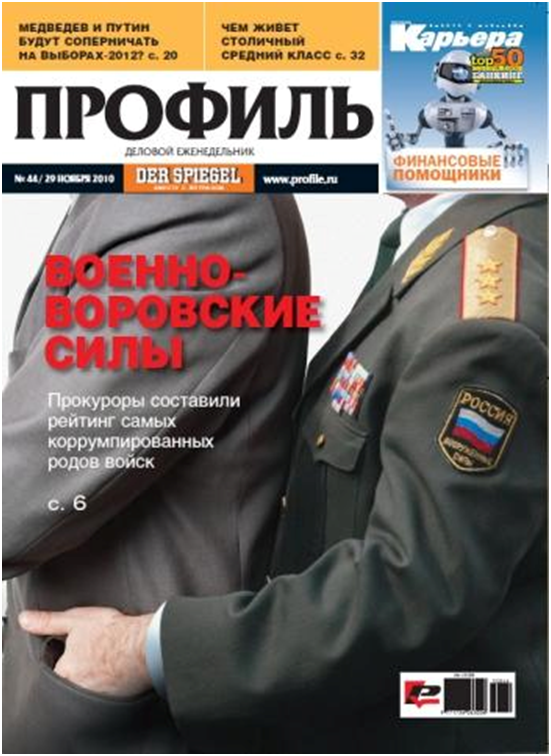
Military-Theft Forces

Prosecutors Rate the Most Corrupt Service Branches

40-50 Percent of State Defense Order Simply Stolen in Recent Years . . . no wonder large-scale procurement hasn’t happened.  Serdyukov supporter Korotchenko tries to paint opponents of military reforms as people trying to protect their corrupt schemes.  This surely goes on, but there also have to be people opposing them for reasons other than greed.  Finally, it’s at least conceivable that, if Serdyukov doesn’t make progress against corruption, it could cost him his job (if he stays that long, he is approaching the four-year mark).  Thus endeth the precis for this post . . .

This week Profil investigates military corruption.  The magazine notes the number and scale of Defense Ministry corruption cases is growing by leaps and bounds, reaching losses of 2.2 billion rubles for the first ten months of 2010.  It concludes, despite a significant cut in the officer corps and Defense Minister Anatoliy Serdyukov’s battle against “thieves in broad stripes [generals],” the number of corruption crimes is not only not declining, but has substantially increased.  Profil obtained an analytical report compiled by the Main Military Prosecutor (GVP) showing who has stolen how much this year.

The GVP presented its report to a closed session of the Duma Defense Committee.  It says its analysis shows “efforts to counteract corruption in the troops are insufficiently effective.”

Profil’s first graphic . . .

Growth of Corruption Crimes in the Army (First 10 Months of 2010)

Troops/Military District/Fleet                     2009       2010       Growth (%)

North Caucasus MD                                             184          311                 69

Moscow MD                                                              94           152                61.7

Air-Assault Troops (VDV)                                 34            119                250

Siberian MD                                                             76            117                 54

Strategic Missile Troops (RVSN)                  59              93                 57.6       

Northern Fleet                                                      50              59                 18

Space Troops                                                        27              44                 63

Caspian Flotilla                                                      5                  7                 40

Black Sea Fleet                                                      2                  6                 200

Profil suggests the recent wave of military retirements signed off by President Dmitriy Medvedev could have been sparked by corruption charges.  While possible, there’s no evidence to support this thesis. 

A Profil source in the Defense Ministry says, not surprisingly, officials responsible for the State Defense Order (GOZ or ГОЗ), capital construction, and the disposition of military property (first and foremost real estate) inflict the greatest losses on the budget.  The article quotes Igor Korotchenko:

“In the course of recent years, 40-50% of resources allocated for the State Defense Order were simply stolen.  This happened, for example, when money was directed at the fulfillment of some concrete work, but there were no real results.  Write-offs appeared in the end or a weapons system was developed that simply didn’t meet its technical requirements.”

Profil suggests that many officers are rushing to get one last bite of military money before Serdyukov’s reforms completely derail their schemes.  It cites Ruslan Pukhov offering two different explanations for rising military corruption:

“Feeling an impending dismissal, officials are probably trying to take the maximum from their positions.  However, it can’t be ruled out that the prosecutor has really reinforced his work in different areas.  Corruption is an acute issue for the prosecutor.”

Pukhov thinks that, although the percentage increase in corruption looks really bad for the VDV, “corruption in the armed forces is spread equally and the growth in corruption crimes in separate branches or districts is connected only with where they are being investigated.”

A very good point, Mr. Pukhov.  Yes, the results of this little anticorruption experiment are very much influenced by where and how it is being conducted.  One should also pay much more attention to the absolute numbers of corruption cases than the percentage changes, and nothing has been said about the relative size of the various parts of the armed forces . . . no per capita figures are provided.  Are 44 crimes in the relatively small Space Troops more significant than 152 in the larger Moscow MD?

Korotchenko, a fairly strong Serdyukov proponent, says the Defense Minister and his tax service colleagues are beginning to break existing corrupt ties, institute financial transparency, and deprive the generals of the right to conclude any contracts.  Dividing the Ministry into military and civilian halves will keep military men out of financial expenditures, and this “process of shifting generals out of the feeding trough” will continue until 2012.  The generals will provide requirements, and civilians will allocate the financing.

A second graphic with some absolute figures on losses due to corruption . . .

Growth of Corruption Crimes in the Army (First 10 Months of 2010)

Troops                                                                  Loss Amount                      Annual Growth

                                                                           (millions of rubles)                        (times)

Strategic Missile Troops (RVSN)                      59.8                                            15          

Air-Assault Troops (VDV)                                   57.5                                            12.2

Space Troops                                                            47.6                                              2.2

Korotchenko claims:

“The campaign against Serdyukov is mainly heated up by those people who’ve been deprived of the feeding trough.  So, the director of a large defense enterprise has for many years sawed off rubles by the billion every year in the transfer of money that comes to fulfill the Gosoboronzakaz.  When Serdyukov deprived this director of such a trough, he began to finance any actions directed at discrediting and, possibly, even removing the Defense Minister.”

So, Korotchenko asserts most conflicts over army reform are banal conflicts of interest for those who can’t steal like they used to.  But didn’t the GVP just say they’re doing a better job of stealing than ever before?

Korotchenko continues:

“Of course, Serdyukov is not an angel, and many of his actions on the military reform plane call forth questions, but it’s another thing that before he arrived, corruption in the Defense Ministry had achieved such a level that he was forced to cut to the bone.  Many scandals proceed only because their financial-economic interests were affected:  the meetings of the airborne guys is just one in this series.”

Then Profil turns to Vitaliy Shlykov, who says:

“Broad publicity for corruption scandals in the Defense Ministry cannot but affect the minister.”

But he believes the Kremlin knows no one can fight corruption like Serdyukov, therefore the GVP report isn’t a real blow to him.

Profil concludes, so far, Serdyukov hasn’t squandered the trust placed in him, but the struggle against corruption only strengthens him as long as it’s a success.  If corruption keeps growing, it’s possible the Defense Minister himself could wind up on the “shot list.”

Master and Commanders

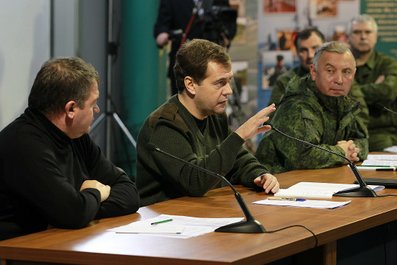
Major media outlets covered President Dmitriy Medvedev’s dialogue with five commanders (three Ground Troops, two Navy) at Gorokhovets.  But one’s own look at what was said, and how it was said, is sometimes better.

The Supreme CINC took some surprisingly forthright views and questions from his commanders.  He didn’t make specific promises about providing the troops new assault helicopters, better protected combat vehicles, or tanks.  He just kept saying the GPV will be fulfilled.

Medvedev told one commander “we all know well what kind of army we had” before this most recent reform began in late 2008.  This is funny since it’s a slam on Vladimir Putin, who was responsible for the army’s condition for most of this decade.

Much of the dialogue depends on an artificial dichotomy between combat (combat training) and noncombat (housekeeping) officers, and on the need to shed the latter.  It is easy now, of course, to belittle officers in the 1990s, and much of the 2000s, who tried to keep their subordinates paid and housed, and conscripts from beating or killing each other, at a time when there was not enough money, fuel, equipment, or even troops for training.  A lot of officers neglected those housekeeping duties and turned to private schemes, crime, or corruption in those days. 

The two naval officers practically beg Medvedev for contractees because their conscripts can’t learn their jobs in one year.  The Supreme CINC is supportive, but he won’t do it until the concept is fiscally viable (not a bad idea since the most recent contract service effort was spoiled by failure to deliver pay and benefits that would attract professional enlisted).

And, finally, Medvedev revealed he is committed to finding Russia access to naval facilities abroad to support the Navy’s deployments.

But let’s look at exactly what was said . . .

VDV Colonel Igor Timofeyev, commander of the 56th Independent Air-Assault Brigade, told Medvedev his troops would like Army Aviation to have new helicopter types, for landing troops and providing effective fire support, i.e. all-purpose assault helicopters.  He also said his companies depend on UAZ vehicles for transport, which lack sufficient personnel protection, and can’t mount extra firepower.  Then he gets to his point . . . having seen new vehicles at Gorokhovets, he hopes he will have them in his own formation soon.

Medvedev avoids responding directly:

“Of course, the fact is what we have today is undoubtedly better than what we had at the beginning of this decade, but all this is still very, very far from what we are aiming for.  You mentioned ‘UAZy.’  I could also name other vehicles, I simply won’t do this in order not to put anyone in an awkward position.  But, unfortunately, the degree of their protection from very simple types of armaments, including infantry-type armaments, is practically nil.  We haven’t even been working on proper armor plating for a very long time, because we considered it expensive.  The mission now is to ensure that all transportation means, all our light and heavier types of transport means receive an effective defense against infantry weapons and, if possible, against heavier types of weapons.  This is definitely more expensive, but these are the lives of people, the lives of our servicemen, this is ultimately the effectiveness of the employment of the Armed Forces.  Therefore it’s essential for us to work on this, just as we will, of course, work on and fulfill the State Program of Armaments as a whole.”

The Supreme CINC doesn’t address the colonel’s call for better air support, and he admits the VDV’s vehicles are inadequate, but promises only that everyone’s transport means are going to receive more protection.  But nothing specific.

Next it’s the turn of Colonel Yakov Ryazantsev, commander of the 57th Independent Motorized Rifle Brigade.  Ryazantsev talks about the difficult process of dismissing officers who forgot about combat readiness and combat training or weren’t prepared to work under ‘modern conditions.’

Medvedev took this opportunity to say this is the reason for much criticism of the military reform process:

“Often in the media and in the statements of independent analysts we read very severe things about how the reforms are being conducted, about the condition of the Armed Forces’ combat capability.  This is normal, undoubtedly, because there should be critical stories, should be investigation of what is being done.  We have an open society, and the Armed Forces cannot appear like a closed corporation in this sense.  Nevertheless, sometimes these judgements bear an exceedingly severe character.  Some of them concern dismissals from the ranks of the Armed Forces.  In this context, I have a question for you:  what number of servicemen in your view in percentage terms were dismissed from your brigade?”

Ryazantsev goes one better and gives precise numbers:  415 officers of 611 in the former 81st Motorized Rifle Division were dismissed.  He says they were officers who focused on ‘everyday problems’ rather than the fulfillment of military service duties.

Meandering a bit, Medvedev returns to the issue of combat training vs. housekeeping, saying:

“And we all know well what kind of army we had.  We were just talking about ‘paper’ divisions and cadre sub-units.  That’s all there was.  And not just, by the way, in latest Russian history, but in the Soviet period it was, since every year the number of cadre units increased and increased.  How did this reflect on our combat capability?  It’s clear how.  And officers, unfortunately, who served in such places, were occupied mainly with housekeeping tasks.”

“But today those who aren’t prepared to serve are not allowed to serve.  So what you just said, once again strengthens my certainty in this.”

Next Colonel Valentin Rogalev, commander of the 74th Independent Motorized Rifle Brigade, tells Medvedev he can’t say his arms and equipment are fully adequate, especially when it comes to tanks and BMPs.  Referring to the GPV and plans to modernize 30 percent of equipment by 2015, Rogalev says:

“And we hope, Comrade Supreme CINC, that fundamentally new types of tanks and BMPs with greater firepower and also increased crew protection will enter the arms inventory soon, not as single units, but systematically.  This will significantly raise the brigade’s combat possibilities.”

In his response, Medvedev talks about galvanizing the OPK to produce what the army needs, about the GPV, and about spending money wisely, but he doesn’t promise Colonel Rogalev anything.

Then the Navy took over.  Captain First Rank Sergey Pinchuk described the condition of his Baltic Fleet surface ship brigade:

“In the ship formation I command, 10 years ago there were ships with an average service life of 10-15, but some even with 25 years.  They were mainly technically inoperable, technically unready, insufficiently manned, with minimal supplies, ships generally didn’t go to sea for years.  Today new ships have entered the formation.  They are multipurpose corvette class ships for missions in the near ocean zone.”

“The armaments and military equipment mounted on the new ships allows us to cut personnel on the ship substantially, practically by three times.  And the requirements on this personnel have increased significantly.  Besides officers, these are contract servicemen.  You talked about them today.  In the fleet, large effort on their training, education, creation of favorable service conditions is being conducted.  However, one would like to see that this category of servicemen has also found support at the state level.”

In his response to Pinchuk, Medvedev acknowledges that “we are still just preparing” to support contractees in terms of competitive pay and normal service and living conditions.

One wonders how long it will take to get ready . . . they spent most of the past decade preparing to implement contract service before pulling the plug earlier this year.

Nevertheless, Medvedev insists “I understand this and the Defense Ministry leadership understands,” and we “will return to the issue of supporting contractees in the near future.”

Again, no commitment.

Last up is Captain First Rank Ildar Akhmerov, commander of the 44th ASW Ship Brigade.  Akhmerov describes greatly increased underway time and Horn of Africa antipiracy operations by his four ships, and then concludes the sea time and servicing of complex shipboard equipment and systems are increasing the requirements on the training of all crew members.  The price of a mistake far from Russia is too high.  As formation commander, he says he has to increase the number of contractees on deployed ships by taking them from other ships, because conscripts can’t master complex equipment in their short time.  So in the fleet and the district, they’ve made great efforts in selecting contractees, and providing them housing.  But at present, this issue remains highly important not only at the level of a fleet formation, a district, but even on a state level.

Akhmerov continues saying his ships in the Gulf of Aden need higher quality rear and technical support than other ships.  But Russia has no bases in foreign countries in the Indian or Pacific Ocean where his ships could take on supplies, repair, and get some kind of rest for their crews.  This is presently done by support ships in the detachment of ships, but a shore base would increase the quality of rear and technical support and reduce costs.

Medvedev responds:

“On contractees, I just told your colleague.  We, of course, understand this problem.  And the fact that you have to pull contractees from other ships is not very healthy.  Now we simply have to understand what sum will be sufficient to motivate contractees.  We have discussed this more than once in Sovbez sessions, the Minister and Chief of the General Staff participated in this discussion.  I think here we will need to some degree to proceed from lieutenant’s pay, but for this we need to prepare so that this decision will be financially supported.  But, I repeat yet again, without modern, well-paid, socially motivated contractees in the army, nothing, of course, will occur in the Armed Forces.”

On the issue of foreign bases, he said:

“As you know, bases on the territory of foreign states aren’t created on the order of President of the Russian Federation.  For this, it’s necessary to conduct complex political-diplomatic work . . . .”

“I won’t hide from you that we have some ideas on this issue, but I won’t say them out loud for understandable reasons.  But it’s obvious that when, let’s say, support ships follow ships, this is very expensive and the expenditures are really huge.  And this is very often ineffective when this support train has to drag itself over the territory of the entire world ocean.  In this sense, our current partners have much better conditions, because they have staked out bases in the most varied parts of the world, visit and replenish themselves.  Generally, this is an issue which demands really attentive state interest.”

Medvedev Talks to Brigade Commanders

Medvedev Speaks at Brigade Commanders' Assembly

According to Kremlin.ru, President Dmitriy Medvedev traveled to the Gorokhovets training ground near Nizhniy Novgorod today to observe battalion-level ground and air maneuvers.  It’s a modern twist on an old tradition of presidential speeches before end-of-training-year assemblies in Moscow. 

Medvedev inspected a new field camp, different weapons and equipment, and watched a Tunguska demonstration.

Afterward he met brigade commanders observing the exercise, and addressed them about the process of reforming the armed forces.

Medvedev said for two years Russia has been actively modernizing its armed forces to make them more compact, effective, and better equipped, and completing ‘org-shtat’ measures [i.e. TO&E changes] to achieve a ‘new profile.’  Flanked by Defense Minister Serdyukov and General Staff Chief Makarov, he promised the assembled commanders a defense budget worth 2.8 percent of Russia’s GDP every year until 2020, but he said getting this level of spending will not be easy, and it requires adjustments and cuts elsewhere.

He particularly emphasized establishing the new system of higher pay to replace earlier ad hoc measures like premium pay.  He seemed to say extra money will be squeezed out for this, but people will be watching how it’s spent.  Kremlin.ru posted some of Medvedev’s opening remarks:

“This is creating the conditions to equip the troops with new equipment in accordance with the current edition of the State Program of Armaments and, what is a no less important task and really no less complex, to resolve all social issues which exist for servicemen.  This issues are also well-known.”

 “First and foremost is the indexation of pay which we are already now conducting, and implementation of the housing construction program.  From 2012, the planned reform of the military pay system not according to those fragmentary pieces which exist at present, not according to those selective approaches which exist, but a full reform of pay.”

“In the final accounting, we should get so that base salary, monetary salary of servicemen will be increased practically three times. And in the process to preserve and to extend to all the Armed Forces that which we talked about in the past, that which we did according to groundwork laid in bounds of order 400 and some other Defense Ministry documents.”

“All planned measures, reform measures should be calculated and materially supported in the most rigorous way.  An adjustment in the military budget is being conducted and oversight of the use of resources is being organized for this.  I promise the attention of all Defense Ministry leaders on this:  all these processes need to be completed in coordination with other government structures in order that we should have absolute precision here.”

“A high level of financial support for the Armed Forces allows, I hope, for freeing servicemen from noncore housekeeping functions – that, in fact, was done long ago in the armies of other countries.  The troops need first and foremost to put their attention on operational training, combat exercises, to concentrate exclusively on these issues.  Security duties (firstly, perhaps not even security, but cleaning), everyday support, food preparation should be transferred to civilian organizations.”

Medvedev told the commanders their brigades should be self-sufficient, modern, balanced, and capable of fulfilling missions given them, and he invited their feedback because, as he said, the success of the military’s transformation depends on it.

“It would also be useful for me to know your opinion on the quality of the reform, on the organizational changes, what, in your view, has proven itself useful, and where there are problems.”

Despite soliciting their honest opinions, one doubts the Supreme CINC will hear many complaints from this audience.  They are, after all, winners in the reform process since they managed to continue serving in command positions.

Shurygin on the VDV’s Discontent

Writing in Zavtra, Vladislav Shurygin has added his take on Sunday’s VDV protest.  As usual, it’s a different cut with different details, but a unique one that shouldn’t be ignored.

Here’s the gist.  Shurygin says it’s not just the VDV’s discontent, but the military’s.  He enumerates the VDV’s specific grievances.  He claims the airborne has lost its status as the Supreme CINC’s strategic reserve and been placed operationally under OSKs West, South, Central, and East. 

Much of Shurygin’s article comes down to the VDV’s alleged loss of elite status.  Others, however, would say Serdyukov’s handled the airborne with kid gloves compared to how other services have suffered.  They might also say it’s high time the VDV got knocked down a notch or two.  

Shurygin seems to want to say that vlasti are more worried, or should be more worried, about discontent in the army than they appear.  He says Serdyukov can’t be dislodged from the Defense Ministry by his opponents, only the internal imperatives of vlasti will move him to another job; then he’ll be replaced by someone who’ll begin his own reform.

Shurygin quotes one Russian Airborne Union (SDR or СДР) official on how servicemen are left socially unprotected:

“In the framework of this reform which is destructive for the country, the overwhelming majority of servicemen have been dismissed without serving the term enabling them to get a pension.  Half of them don’t have housing.  Our country already has a sad experience of dismantling troops.  In the distant 1950s, the Defense Ministry decided to eliminate Naval Infantry under the pretext of missile-nuclear weapons development, saying that, if necessary, conventional infantry could fully replace it.  Nearly 50 years later history’s repeating itself.  Only now the VDV and Spetsnaz ended up in the role of unneeded forces.”

Shurygin continues:

“Meanwhile, the attitude of high state officials toward the VDV has been drawing criticism for a long time already.  In July, when the VDV observed its 80th anniversary, neither the Supreme CINC, nor the Prime Minister appeared at a ceremonial concert in the Kremlin palace and they didn’t even send the nominal greeting customary in such instances.  Then a directive according to which the VDV command would become subordinate to the Main Command of the Ground Troops was prepared, and VDV formations and units are in fact being transferred into operational subordination to the commands of strategic axes ‘North,’ [sic] ‘West,’ ‘South,’ and ‘East.’  That is, they’re being taken from the reserve of and immediate subordination to the Supreme CINC of the RF Armed Forces.  Add to this the estrangement of the VDV from work with premilitary youth in DOSAAF and the elimination of the Ryazan Airborne Higher Military Command School, which has been dropped into the Ground Troops training center (Combined Arms Academy), and the elimination of the VDV Personnel Directorate, which will put a final end to the elite status of the VDV, traditionally proud of its own unique personnel school.  In fact, a quiet destruction of the troops is going on.”

Shurygin says VDV Commander Shamanov’s doctors say confidentially that, in intensive care, he was in no condition for paperwork, and his right hand was immobilized when he supposedly authored his message urging VDV on Poklonnaya Gora to avoid confronting the Defense Ministry.   

So Shurygin doubts Shamanov wrote this, but he doesn’t allow for the possibility that the general dictated words to be issued in his name.

Shurygin adds that sources close to the Defense Ministry say the Shamanov document turned up in the hands of Deputy Defense Minister Nikolay Pankov, was edited by his people, and sent to the hospital for Shamanov’s signature as he was being wheeled into surgery. 

Shurygin shifts gears reprinting part of an interview he gave Baltinform prior to the Poklonnaya Gora demonstration.  Asked about Serdyukov, he says:

“The reform Serdyukov is conducting causes confusion in specialists.  The opposition to the pogrom he’s conducted in the army is very great.  Tens of thousands of people are opposed — they really see what is happening in the troops, and are trying to get this information to the public.”

“The fact that this [Seltsy] scandal received publicity is not evidence of conspiracy, but evidence of the crudest error in Serdyukov’s judgment, who left himself open, conducting himself rudely and offending an honored officer, a Hero of Russia.  And this outrageous incident only became the latest reason again to raise the theme of reform.  If the main reformer conducts himself in such an unworthy manner, then this automatically calls forth questions about the entire reform he’s conducted.  I think that opposition to Serdyukov is located not at the Kremlin level or any mysterious officials, but at the level of those whom military reform has literally ‘run over like a tank.'”

 I relate to [Serdyukov] as an absolutely incompetent person who occupies a job that is not his.  And for three years already he’s been learning the completely new business of managing the army at the cost of huge damage to the latter.  First they constantly destroy army structures like a house of cards, then they try to ‘sculpt’ and create something out of them.”

  “Some directives are suspended, others are given out and then are suspended.  The army leadership is feverishly searching as if trying to get a careening wagon down a hill in the necessary direction, but still just increasing the chaos and disintegration.  Massive break-ups were undertaken in place of approaching reforms from a scientific viewpoint and working out experiments on specially selected parts.”

“The Armed Forces have been ‘cut to the bone.’  They’ve broken everything in them, both the bad, and the good.  They broke it, then observed the mistakes, and are now trying to correct them.”

Asked if Serdyukov will finish his reforms or be replaced because of complaints from his opponents, Shurygin concludes:

“It seems to me he’ll go to that phase when it’ll be officially acknowledged that the reform has taken place.  Then a moment will come when it’s necessary to make a change in the official hierarchy, and Serdyukov will be transferred to another position.  The one who comes into his place, will begin his own reform anew, perhaps, a more ‘quiet’ one.  But he won’t avoid long work analyzing the mess of forest cut down by Serdyukov.”

Officer Discontent on Poklonnaya Gora

Reviewing the press on Sunday’s VDV meeting on Poklonnaya Gora, one could say there’s an inclination to dismiss it as the howling of old cranks who don’t constitute an organized challenge to anything or anyone.  But behind that initial take, some media saw palpable discontent among officers, both retired and active duty.  Nezavisimaya gazeta suggested there might be more below the surface of this rather feeble demonstration – either more powerful interests or much larger numbers of affected individuals.  Ekspert concluded, at a minimum, the whole episode might lead Defense Minister Serdyukov to take the opinions of officers more seriously.      

The VDV demonstration goes back to the 30 September Seltsy incident, and the Russian Airborne Union’s (SDR) call for Serdyukov resign for insulting Hero of Russia, Colonel Krasov as well as for destroying the army.  Kommersant put the number of participants at about 1,500.  Retired General-Colonel Vyacheslav Achalov and other organizers threaten to resume protesting on 17 November if President Medvedev doesn’t fire Serdyukov.  They also want General Staff Chief Nikolay Makarov, Deputy Defense Minister Nikolay Pankov, and Main Personnel Directorate Chief Viktor Goremykin to resign. 

The conspiracy-minded protesters maintain that Vladimir Shamanov’s crash was no accident; they think someone tried to kill him since he’s the only man standing in the way of the VDV’s ruin.

The Defense Ministry didn’t officially comment on yesterday’s protest, but Kommersant garnered an unofficial reaction.  An unnamed Defense Ministry representative said:

“Criticism should be constructive.  When memorial days like 7 November are used for political purposes, it’s unseemly.  Moreover, criticizing the minister for the reform is premature, since it’s not complete yet.”

So the Defense Ministry didn’t think the protest was helpful, but they also think 7 November is still a holiday.  The last is the best though.  Exactly when, where, and how are opponents supposed to raise their objections?  When everything’s over and done with?  Another insight into current regime thinking about the proper interaction of politics and policymaking . . . none.

Nezavisimaya gazeta was most interested that it wasn’t just the usual non-systemic outcasts at the VDV rally, but Just Russia (Справедливая Россия) flags showed that some of the official opposition was there too.  Federation Council Speaker and Just Russia leader Sergey Mironov was once a VDV senior sergeant himself.  NG sees SR trying to play an army card to its advantage while remaining part of the official opposition.

The paper says Mironov could be using the military, and showing support for officers against Serdyukov (and Medvedev by extension) for his own purposes.  And he’s politicizing the army – something not done in recent years and generally considered unacceptable.  NG indicates some think there’s more to all this than just a reaction to Serdyukov’s alleged rudeness to the VDV:

“There is, incidentally, an opinion that the [Seltsy] incident was only a pretext, and the interests of some military circles and retired officers connected to them, who feed off the army and are dissatisfied with the current military reform, are behind the protest.”

Novyye Izvestiya describes Poklonnaya Gora as quite the retrograde affair replete with Soviet flags, and the usual representatives of the radical opposition.

One participant bragged to its reporter after passing through one of many metal detectors:

“We don’t need weapons, we could take the Kremlin with a stool leg.”

But Novyye had more serious points too, like one ex-VDV who complained of Serdyukov’s cuts in military medicine, and his commercialization of military hospitals.  He asked:

“What military doctors will be on the battlefield?  There aren’t any remaining.  But there’s no one to fight, in a year’s army service what can you learn?  Only to sweep the parade ground.”

The paper concludes VDV veterans believe only military men can solve the army’s problems, the army needs to be mobile and highly capable, and it shouldn’t be shameful to serve in it.  At least everyone seems to agree on the last two.

Writing for Ekspert, Stanislav Kuvaldin describes Seltsy and Poklonnaya Gora as a breakdown in communications between the Defense Minister and the officer corps.  One SDR leader told Kuvaldin:

“Serving officers are silent, but they think the same things.  We grew them and indoctrinated them.”

He went on to say that even if they are silent about Serdyukov and reforms in exchange for today’s higher officer pay, it doesn’t mean they’ve been suppressed.

A key element of Serdyukov’s reform is basically tripling officer pay, and this higher pay is already a serious factor in calculations about serving, but it hasn’t happened yet (except for those getting special premium pay).  Nevertheless, potentially higher pay won’t automatically mean Serdyukov will be more popular, and it doesn’t mean the VDV will get over Serdyukov’s insult to one of its officers and a Hero of Russia, according to Kuvaldin.

Kuvaldin reports the Defense Ministry may compromise on some of the VDV’s more specific complaints, i.e. not moving the VDV Headquarters to Ryazan and preserving the VDV Museum, but not reversing the VDV Higher Military Command School’s subordination to the Combined Arms Academy.

In the end, Kuvaldin writes, this dissatisfaction is only creating tense moments for Serdyukov, not a serious threat:

“In the end, if after two years of reforms, vulgar insults to the head of one military school have become the cause for veterans to come out, it’s possible only to talk about an unpleasant emotional backdrop for the minister, but not about a hypothetical organized resistance.”

However, possibly, the situation will force the minister to deal with officers’ opinions more attentively and respectfully.

But this author wouldn’t bet on it.

In a not particularly surprising postscript, the GAI stopped SDR leader Pavel Popovskikh — former colonel, VDV Reconnaissance Chief, and defendant in the murder of journalist Dmitriy Kholodov — for driving drunk after the demonstration.  The story was widely reported, but an alternative version hasn’t gotten as much play.  Segodnya.ru reported that Popovskikh’s friends and others say he stopped drinking long ago.  The website also says Vladislav Shurygin wrote in his blog that traffic cops were ordered to stop Popovskikh and check him for alcohol, but they sheepishly released him with an apology when they found he was sober.

Poklonnaya Gora Coverage

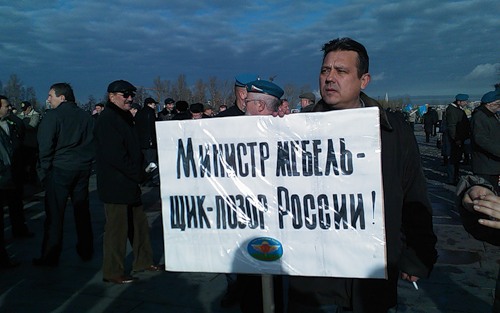
Furniture Man Minister Is Russia's Shame

A Livejournal blogger’s provided photos and comments on today’s meeting of airborne and other veterans on Poklonnaya Gora.  Organized by former VDV Commander Achalov, the protest is dedicated to denouncing Defense Minister Anatoliy Serdyukov and his reforms.  The blogger puts the number of demonstrators at less than 4,000.

According to Lenta.ru, current and former VDV generals have appealed to airborne veterans not to get into it with the Defense Ministry.  They included current chief of staff, Nikolay Ignatov, former Commander Georgiy Shpak, and former First Deputy Defense Minister Aleksandr Kolmakov.  An address from VDV Commander General-Lieutentant Vladimir Shamanov, who remains in the hospital following last weekend’s car accident, was also read.

Shamanov asserted that an ‘unprecedented propaganda campaign’ has been unleashed against Serdyukov in the last month to force his dismissal.  He added that some of ‘our respected and honored comrades’ have been drawn into this ‘politicized game.’

He said everyone from platoon commander to Defense Minister makes mistakes:

“However, this doesn’t mean that we need to demand their immediate resignation for every miscalculation.”

Sounding like the ultimate devotee of civilian control of the army, Shamanov said Serdyukov is making long overdue changes at the Supreme CINC’s direction.  He denied the VDV has lost any combat capability due to Serdyukov’s reforms and again promised it’ll remain an independent branch, receive new weapons and equipment, and get two more formations.  

He told airborne men ‘not to believe loud, but misleading announcements about how the VDV’s combat capability will supposedly decline.’  He said corrupt people of all stripes and so-called oppositionists are against the army’s renewal.

Shamanov called on delegates to this ‘conference’ of the Russian Airborne Union not to allow themselves to be dragged into an unnecessary confrontation with the Defense Ministry.