Category Archives: Rear Services

Return to Cam Ranh?

Russia Departs Cam Ranh in 2002 (photo: ITAR-TASS)

The Russian Navy’s possible return to Vietnam became the latest military rumor floated in the media last week.  If it happens, it won’t have exactly the same purposes as in 1979, and it probably won’t be on the same scale.  But it will be part and parcel of the issue of being, or wanting to remain, a naval power.  Moscow might have to ask itself if it still is one, or will be one in the future.

On Wednesday, former Navy Main Staff Chief, Admiral Viktor Kravchenko told Interfaks the Navy is proposing to reestablish a material-technical support base (PMTO or ПМТО) at Cam Ranh.

The news service quotes Kravchenko:

“Without a system of bases for deployment, full support of Navy ships in distant waters is problematic.  Navy surface ships and submarines need repair, resupply, and crew rest to fulfill a wide range of missions on the world’s oceans.  If as before Russia considers itself a naval power, the reestablishment and creation of basing points like Cam Ranh is unavoidable.”

A Defense Ministry source told Nezavisimaya gazeta that:

“The [Navy] Glavkomat has finished work on the documents considering and substantiating the need to reestablish a basing point to support Russian ships in the Asia-Pacific region.  If there is a political decision, then the Navy is prepared to reestablish a working base in three years.”

The base would support ships on antipiracy missions in the Pacific and Indian Oceans, according to the source.

The Chairman of the Duma Defense Committee’s Subcommittee on Military-Technical Cooperation, former Captain First Rank Mikhail Nenashev told Interfaks:

“The rent for a naval base at Cam Ranh, in the end, would cost Russia less than regular support of combatants on the world’s oceans using auxiliary ships, tankers, and repair ships.”

And:

“Reestablishing a base at Cam Ranh would help strengthen and develop cooperation with Vietnam and the Asia-Pacific region countries not only in military, but in many others spheres of activity.”

Izvestiya says, Moscow doesn’t intend to return to a Cold War-style global military confrontation with Washington – it has not the forces, means, or desire for it – but the ‘Cam Ranh initiative’ shows that a gradual reanimation of specific military bases abroad could happen.

According to Newsru.com and Vremya novostey, in 1979, Moscow and Hanoi signed a 25-year agreement by which the Soviet Pacific Fleet’s 17th Squadron gained access to Cam Ranh.  Vietnam allowed the Soviet Navy to base 10 surface ships, 8 submarines with a submarine support ship, and 6 auxiliaries at the port.  Later, the 922nd PMTO was established at the Vietnamese port.  The Soviets had POL storage, an ASW and missile armaments base and technical service unit, a Naval Infantry sub-unit, and an air regiment at Cam Ranh.

The base was initially free, but Hanoi asked for $300 million in rent in 1998.  In 2001, Moscow decided not to extend its agreement with Vietnam, and the last Russian elements departed Cam Ranh in mid-2002.  The decisionmaking around the Cam Ranh withdrawal (likewise for Lourdes, Cuba) is anything but clear-cut.  But then President Putin probably made the decision, reportedly against the advice of many senior uniformed officers, in an effort to save money for the military at home, and to make nice with Washington.  Former high-ranking General Staff officer Leonid Ivashov claims the $300 million rent, at least, shouldn’t have been an issue since it could have been written off against Vietnam’s $10 billion debt to Moscow.

Prime Minister Putin’s December 2009 Hanoi visit and major arms deal, including six proyekt 636 diesel submarines, with Vietnam may have started movement on a return to Cam Ranh.  Defense Minister Serdyukov went to Hanoi in February and told Rossiyskaya gazeta the Vietnamese were very interested in constructing a Navy repair plant and Russian help with naval logistics.  However, Serdyukov claimed the Vietnamese didn’t propose anything about Cam Ranh.  But NG’s Vladimir Mukhin speculates a deal for a renewed Russian presence at the base might be inked during President Medvedev’s late October trip to Vietnam.

Izvestiya quotes independent military analyst Aleksandr Khramchikhin:

“Theoretically, I welcome the reestablishment of a Navy base at Cam Ranh.  For Russia, it is a very composite and most useful facility abroad. Without it, the operations of the Pacific Fleet are impeded.  Also very little remains of the Pacific Fleet.  This fact, however, doesn’t change the usefulness of the base at Cam Ranh.  Such a step could, of course, create certain foreign policy difficulties for Russia.  I suppose the U.S. and China will express dissatisfaction, but this will hardly have any real effect.  As concerns Vietnam, it would pay to view it as our most important ally.  Russia largely cast it aside after the collapse of the USSR.  This was a gross mistake worth correcting.”

It’s worth recalling Khramchikhin may view Vietnam through a slightly Sinophobic prism.

Talking to NG, Duma Deputy, and former Black Sea Fleet commander, Vladimir Komoyedov worries there won’t be anything to deploy at Cam Ranh:

“The Pacific Fleet, whose ships need to control the waters of South-East Asia, has hardly received any new units for the last two decades.  And what will we deploy to Cam Ranh?”
Creating ‘New Profile’ Army Not Easy in Far East

A variety of press reports indicate establishing a ‘new profile’ army in the Far East is a difficult and increasingly protracted process.

On 7 September, ITAR-TASS said General Staff Chief, Army General Nikolay Makarov was in Chita to resolve a number of army problems.  The press service noted Makarov was accompanied by new Eastern Military District (MD) Commander, Vice-Admiral Konstantin Sidenko.

Specifically, Makarov was in eastern Siberia (now part of the Eastern MD) working on ‘military organizational development [строительство]’ – a Russian euphemism for TO&E changes and force restructuring – and development of base military towns and their social infrastructure.  In plain English, the General Staff Chief was in the Transbaykal sticks sorting out which units go into this or that brigade, or get disbanded, and how to provide housing and a modicum of other basic services for their soldiers, officers, and families.

But Makarov and Sidenko may have worse problems further east.

On 8 September, ITAR-TASS published a small, but significant report claiming that Khabarovsk Kray’s military garrisons and towns are not ready for winter.

Preparation for heating season in the majority of military buildings in Khabarovsk Kray is breaking down, according to the Kray’s emergency situations commission.  The poor state of preparation of communal infrastructure (i.e. boilers, coal supplies, steam pipes, etc.) and apartment blocks in Lazo, Bikin, and Vanino Rayons is alarming.

A Kray official said, “. . . supplies of winter fuel haven’t been established, boiler equipment hasn’t been repaired, facilities don’t have personnel.”  In Vanino, workers repairing a major boiler received layoff notices.  Days before the start of heating season, several boilers have been completely dismantled and there are no supplies of coal, according to the news agency.

 The emergency situations commission noted that:

“The Defense Ministry has begun transferring housing-communal servicing functions for its garrisons to private organizations, but this process has bogged down.”

The military’s Housing Management Directorate (KEU) representatives in the Far East didn’t deny the problems, but blamed them on a catastrophic lack of financing.  The military’s indebtedness to Far East communal services providers over the first 7 months of the year is 181.6 million rubles, and Khabarovsk Kray accounts for more than 88 million of this amount.

The first deputy chairman of the Khabarovsk Kray government has asked military prosecutors to intervene and force the army to prepare the region’s military towns and villages adequately and forestall emergency situations this winter.

All this comes on top of reports of similar problems last fall.  

Half of Russia’s 85 new army brigades had to move units and construct new barracks, housing, and other essential infrastructure for them, and this was proving especially difficult in the Far East. 

Almost a year ago, Vladivostok’s largest newspaper Zolotoy rog reported that officers in two newly organized brigades in the Far East were in danger of being stranded in ‘open fields,’ or field conditions, because they lacked materials and funding to prepare their garrisons.  However, the deputy commander of 5th Combined Arms Army assured the media that barracks and other buildings were being repaired for brigades at Barabash and Sibirtsevo.

Zolotoy rog reported that one battalion commander took out a private loan to repair barracks for his men.  Some officers who arrived at Barabash left after seeing the condition of their new garrison, and the brigade also had trouble keeping battalion commanders for the same reason.  The brigades reportedly turned to Primorskiy Kray’s governor for help.

So what are we to make of all this?

First, having Makarov travel out east to straighten up a mess is something of a no-confidence vote in new Eastern MD Commander Sidenko.  It’s a particularly inauspicious start since many eyes are on Sidenko to see how he performs as the first naval officer to lead this major ground-oriented command.

Second, Khabarovsk Kray had some pretty stark criticism for Defense Minister Serdyukov’s policy of privatizing logistics support functions for the army.  What might work in the new Western or Southern MDs may not work well in the remote reaches of the Eastern MD.

Third, this early warning of problems may be an attempt to prevent another ‘Steppe’ garrison crisis in Transbaykal this winter.  And the problems are not confined to active military garrisons.  Lots of remote former garrisons – with real living retirees – are caught in limbo between military and civilian municipal services.  Pereyaslavka’s problems last winter are just one case of this.  Pereyaslavka happens to be the administrative center of Lazo Rayon, cited this year as the scene of potential problems this winter.

So while the Defense Ministry and media focus almost exclusively on the attractive leading edge of the army’s ‘new profile,’ it pays to remember that Russian military reform has a large, messy trailing edge that’s found in places like Lazo, Bikin, Vanino, Barabash, Sibirtsevo, and Pereyaslavka.

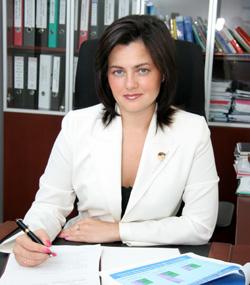
Deputy Defense Minister Shevtsova

Tatyana Shevtsova at the FNS

Last Friday, Tatyana Shevtsova became the newest deputy defense minister – the ninth overall, seventh civilian, second female.  By all accounts, Shevtsova will oversee and audit Defense Ministry spending and other activities.  Kommersant calls her an ‘oversight and monitoring specialist.’  The Defense Ministry’s spokesman has said as much, according to Vedomosti (read it in Moscow Times as well).  Shevtsova’s another member of Defense Minister Serdyukov’s former team at the Federal Tax Service (FNS or ФНС).  Kommersant describes her as a ‘trusted individual’ who will help Serdyukov supervise all but the Defense Ministry’s purely military functions.  In particular, several commentators believe Shevtsova will track outsourced service and support activities paid for in the state defense order (GOZ).

The 41-year-old Shevtsova was born in Kozelsk, Kaluga Oblast, and graduated from the Leningrad Financial-Economic Institute in 1991.  She’s a candidate of economic sciences (Ph.D.). 

She started in the tax service in 1991 as an inspector in the central rayon of St. Petersburg, eventually heading the tax service’s St. Petersburg directorate.  Kommersant reminds that Serdyukov was a deputy director in the St. Petersburg directorate during Shevtsova’s time there in the early 2000s. 

Shevtsova went to Moscow to head the tax service’s large taxpayer department in early 2004.  In mid-2004, Serdyukov became Director of the FNS, and Shevtsova became one of his deputies. 

Shevtsova stayed at the tax service under Mikhail Mokretsov after Serdyukov left for the Defense Ministry in early 2007.  She was in charge of the oversight directorate and all nine inter-regional inspectorates for large taxpayers.

When Mokretsov and others members of Serdyukov’s FNS team departed for the Defense Ministry in mid-2010, Shevtsova did likewise, becoming an advisor.  According to one official who spoke to Kommersant, she spent the last few months ‘studying the situation’ in the Defense Ministry.

A former Defense Ministry official told Vedomosti Shevtsova is “a talented economist as well as an exacting official, whose subordinates at the Federal Tax Service were very afraid of her.”  She reportedly will turn ten Defense Ministry oversight bodies into a system.

Kommersant said Shevtsova will direct oversight organs for administrative, organizational, and financial activities as well as military housing.  The paper’s source says this could translate into oversight over everything except military command and control and operations.  The ninth deputy minister will reportedly gain some responsibilities once discharged by the chiefs of the ministry’s apparatus, Rear Services, and Housing and Construction Service.

Radio Svoboda was kind enough to interview Aleksandr Golts who concluded:

“It’s more or less obvious Anatoliy Eduardovich Serdyukov rapidly gathers his team in those areas important to him.  As we know, at present a so-called second civilian branch of the Defense Ministry is being formed.  Operational troop command and control, combat training remain with the Genshtab.  At the same time, a very strong area which will withdraw from the ministry a great number of functions connected with service and support of all Defense Ministry units and formations is being formed.  This is very complex work in the realm of the state defense order and the like.  Evidently, Ms. Shevtsova will work in this area.”

 Asked about her first steps, Golts commented:

 “If there will be first steps, we haven’t found out anything about them.  The Defense Ministry very precisely hides the most important directions of its activity from any public scrutiny.  Everything happens very quietly.”

Radio Svoboda also asked Viktor Baranets about ‘civilianization’ and the appointment of a reported 50 women to high posts under Serdyukov:

“They are already sarcastically joking  in the army about the ‘feminization’ of the Defense Ministry leadership.  A large number of women who’ve appeared in key Defense Ministry posts, at various times crossed paths with Serdyukov, and with Putin, and with Medvedev.  Of course, they’re Petersburg natives . . . .  There are unofficial reports that [Shevtsova] actively assisted Serdyukov in destroying Khodorkovskiy’s empire.”

Baranets’ sources in the Defense Ministry also say Shevtsova will be responsible for large sums of service and support funding being directed to contractors.  His general and colonel friends joke:

“We only have one vacant post left – deputy defense minister for corruption.  Because all the other jobs are filled.”

 Or anti-corruption one supposes . . . .

Igor Korotchenko told Vedomosti the Defense Ministry’s growing civilian component is designed to supervise the generals’ spending and accounting, especially in the GOZ.  Ruslan Pukhov calls the ‘invasion’ of former tax officials perfectly normal since Western defense ministries are full of civilian auditors who scrutinize massive military budgets.

Lieutenant Colonel Biront’s Defense

Sounding somewhat dazed, Lieutenant Colonel Viktor Biront told Life News his story about how and why the naval aviation depot near Kolomna burned.  According to Biront, higher authorities were completely informed about his situation days before the facility burned, but ignored repeated requests for assistance.

Biront says firefighters worked to save expensive dachas near his base, but weren’t as willing to help him.

According to Biront, the base he commanded for only three months before the fire had just lost 19 officers and 36 warrants as a result of Defense Minister Serdyukov’s cuts in both personnel categories.  He also lost his firefighting unit in February.

Biront describes how he managed to trade his car to get use of a fire engine.

Reports of the value of property lost have varied widely, but Biront indicates they saved most of what was worth saving.

Here’s the interview verbatim: 

“The lieutenant colonel dismissed because of the fire relates how he and his sailors saved the air base from fire for 10 days.”

“Relieved of duty as military base commander after the big fire, 43-year-old Lieutenant Colonel Viktor Biront tells in an exclusive interview with Life News how he and his subordinates saved the military unit from the fire.”

“The morning of 29 July the lieutenant colonel went to the perimeter and posted people on the edge of the burning forest.”

“’Everyone worked in the forest – both civilians and military,’ said Viktor Ivanovich.  ‘I was there also, only leaving periodically to call and request help.  The chiefs of Civil Defense and Emergency Situations came to evaluate the situation.  Then a strong wind started – the gusts were nearly 20 meters per second – and drove everything from the depth of the forest.  It was terrible to be in the fiery pockets.  Here, look – hands, feet all burned.  We stood on the perimeter, still 1.5 kilometers from the facility.  What a terrible picture – the fire was a wall in the forest.  I gave the order to evacuate.  I was last to leave there, because I was shouting to the last so the boys wouldn’t die there.’”

“According to Viktor Biront, the firemen arrived only two hours after the call.”

“’It’s as if we don’t exist for the city:  neither MChS, nor police . . . no one was with us,’ said the lieutenant colonel.  ‘They saved 1.5 million dollar dachas here.  There were both cordons and police there.  The first help came after several hours – no matter how much I called, how much I asked.  Only after a couple hours a firefighting helicopter flew in.  We can’t get through there – everything’s burning, everything’s blazing . . .  I quickly recounted the people.  Then equipment came from Moscow, and by night a deputy defense minister arrived.  It was impossible to go in.  Sailors were simply suffocating in gas masks – they were saturated with smoke.  I gave the command to take them off . . .’”

“The massive fire that destroyed property worth billions of rubles was preceded by 10 days of struggle with the fire.  And over these 10 days, the big bosses, despite all requests, didn’t take any clear decision about how to save the air base.  In fact, saving it depended only on 40 sailors and their commander.  115 hectares – almost three per man.”

“’I’ve been in the position for three months, they gave me this unit in May in a new composition, after reductions,’ Biront says.  ‘They cut 19 officers, 36 warrants.  In all 40 sailors remained, eleven sergeants and four officers – and this is all the people for such a large unit.  Plus civilian personnel whom I treated with great understanding.  I couldn’t send female clerks into the battle with the fire because the average age of my workers is 58-60.  The pay is low, 5-7 thousand, only female pensioners who’ve worked here a long time do this work.  They also helped as they could.  Men came into the forest with axes and shovels – tried to stop the flames.’”

“’The forest near the unit burned for 10 days,’ Viktor Ivanovich continues.  ‘I turned to them repeatedly, high officials came, had meetings here, made plans, a certain Mr. Shumeyev – deputy for security, an ecologist came here.  The sailors stood two days on the perimeter, not allowing the fire to spread.  I called Civil Defense and Emergency Situations.  Sometimes they gave help, but sometimes they refused.  I didn’t have my own firefighting team – they eliminated it in February of this year.  There was simply an ad hoc firefighting team, they dug themselves in and fought by all means.  When I saw this was all very difficult – I put my non-TO&E car to use, I had to give it to the firemen.  Generally, it’s use is forbidden, we used it because I had to pay money.  They brought a fire engine and handed it over there.  I secured a driver, whom we used to the fullest extent.  We hosed, knocked down flames, in general, battling though I didn’t have specialists.  We had to teach our officers who were extinguishing the fire.’”

“’In principle, we coped with the fire the first ten days,’ says the dismissed commander.  ‘I reported to Moscow by phone, by morning reports, by faxes.  I asked for help.  One time they gave equipment.  A KamAZ came from Shcherbinka from the airport, poured out two cisterns and went back.  Local civilians were all in action – villages burning, the government likewise, then they left 14 castoff portable fire extinguishers, literally the day before the conflagration.  They took them from the unit two kilometers into the forest.’”

“They didn’t manage to save the base.  Viktor Biront learned about his dismissal on the television news. At this moment he’s again writing a statement in the prosecutor’s office.  In this document he indicated that they managed to save property worth 40 million rubles.”

“’My people saved the new equipment.  The burned up property there had expired service lives and required repairs.  But then everything was finished, all closed, but they told us we were all morons generally.  Here it’s burning, and they are crawling through hell and saving equipment.  I’m not defending myself, I’ve told it like it is.  In theory in three months I should have cleared out everything that grew up in this forest over 60 years.  Because in 60 years no one ever did anything there.’”

Disappearing Deputy Defense Minister Portfolios

Or who will answer for what?

On Tuesday, Kommersant and Rossiyskaya gazeta described, even if they can’t explain, Deputy Defense Minister portfolio changes.  The shuffling began in early July, when Grigoriy Naginskiy was ‘freed’ from his responsibilities as Chief of Housing and Construction but remained a Deputy Defense Minister.

According to a decree known, but not published, Medvedev removed General-Colonel Dmitriy Bulgakov from his post as Chief of Rear Services, while retaining him as a Deputy Defense Minister without specific duties.  It’s widely believed, of course, Bulgakov has taken charge of a new Material-Technical Support (MTO) empire that will encompass not only logistics but also arms and equipment supplies.

For his part, Defense Ministry Apparatus Chief Mikhail Mokretsov formally became a Deputy Defense Minister (no longer holding just informal ‘Deputy Minister status’).

Kommersant points out there are still eight Deputy Ministers (six are civilians).  A Defense Ministry source told the paper, however, that Bulgakov might be civilianized.  And his MTO organization will be part of the Defense Ministry’s ‘civilian component’ as opposed to its ‘military component.’  Kommersant says the ‘military component’ (planning and operational troop command and control) will just be the General Staff when the current Defense Ministry reorganization is complete.

Bulgakov has apparently indicated that MTO will have a planning and coordination department, a resource and transportation support department, Main Automotive-Armor Directorate (GABTU), and also repair-refurbishment and metrological directorates.  As announced elsewhere, ten new MTO brigades are to be established in the four new OSKs.  Recall that, in the same presidential decree on Naginskiy, Bulgakov’s rear services chief of staff Sergey Zhirov became Chief of the Planning and Coordination Department (read staff).

One should really look at Mil.ru’s ‘Leadership Structure’ page here.  In it, you’ll see Vera Chistova retains her clear responsibility for finance-economic work.  Bulgakov’s biography notes he became simply Deputy Defense Minister in July.  Naginskiy’s contains no similar notation though it could.  Then comes the oft-forgotten Dmitriy Chushkin who followed Defense Minister Serdyukov from the Federal Tax Service in late 2008.  He has no portfolio spelled out in his title, but his bio reads:

“Responsible for forming and conducting the Defense Ministry’s united military-technical policy in the information and telecommunications technology area which aims to increase the effectiveness of the command and control system, as well as supporting and developing its foundations.”

Mokretsov’s bio has a note that he added Deputy Defense Minister to his title in July.

The ultimate plan behind these moves isn’t clear yet.  But it does seem to go back to late June’s replacement of Kolmakov with Popovkin in one of the Defense Ministry’s two First Deputy slots.  More support functions were and are being consolidated under civilians, while purely military training, planning, and operations may now be more solidly under General Staff Chief, First Deputy Defense Minister Nikolay Makarov.

Bulgakov Adds More to His Portfolio?

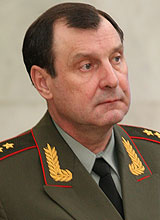
General-Colonel Bulgakov

In addition to his new title Deputy Defense Minister for Material-Technical Support and his responsibility for arms and equipment supplies, General-Colonel Dmitriy Bulgakov has apparently also picked up Grigoriy Naginskiy’s duties as Chief of Housing and Construction. 

Bulgakov accompanied Prime Minister Putin on a tour of military apartments under construction in Volgograd today.  The contractor told Putin the land was acquired three years ago, but delays in installing utilities held up construction until this year.  They also complicated the process and added 5,000 rubles to the per-square-meter cost of the apartments. 

Bulgakov was quoted saying the first batch of apartments in the new mikrorayon for servicemen (739 apartments) will be turned over in December.  He also said 1,978 servicemen need housing in the city.

General Staff Chief Makarov’s Press Conference

Sound bites from General Staff Chief Nikolay Makarov’s press conference today dribbled out one at a time, as usual.

Makarov told reporters President Medvedev signed a decree establishing four operational-strategic commands (OSK) to replace the existing military districts on 6 July, but the text hasn’t been published.  Makarov also said arrangements putting the OSKs in place would be complete on 1 December.

Makarov talked more about the new “unified system of material-technical support (MTO)” also apparently covered in Medvedev’s decree.

Rear Services Chief, Deputy Defense Minister, General-Colonel Dmitriy Bulgakov, as expected, will head the unified MTO system, and new First Deputy Defense Minister Vladimir Popovkin will supervise the new state armaments program, 2011-2020, as well as coordination with military industries. 

Makarov stressed uniting transportation and supply functions under Bulgakov:

“We had a disconnect when all transport for supplies of material means to the troops was at the disposal of the Deputy Defense Minister for Rear Services, but he didn’t have anything he needed to move with this transport.  The other Deputy Defense Minister, on the other hand, had armaments, but no means for transporting them to the troops.”

“This is very important because now the management of transportation and armaments is concentrated in the hands of one man.  The correctness of the decision was confirmed by the recently completed ‘Vostok-2010’ operational-strategic exercise in the Far East.”

 “Now one official serving as a Deputy Defense Minister heads a unified system of material-technical support which has united rear services and armaments.  He alone personally answer for both the transport of supplies of material-technical means, and for these means themselves.  Now one man answers for the state of affairs with armaments and for their supply to the troops, who will also now be responsible for that.”

The way Makarov puts it, Popovkin be on the hook for product quality:

“He will work with defense-industrial complex enterprises to control their production of armaments and military equipment for the Armed Forces.”

Popovkin’s old job of Chief of Armaments, Deputy Defense Minister will disappear most likely.

Makarov told reporters Russia plans to move to netcentric command and control by 2015, once it equips its troops with new C3 systems united in one information space.  Such systems are now scarce, but he says, they are working hard so to install digital equipment everywhere.  Makarov calls this the main renovation that he’s giving all structures and troops starting in the fall of this year.  He says Russia’s new command posts unite reconnaissance, target designation, and troops and weapons to execute combat missions in real time.

It’s interesting that RIA Novosti took time to explain that the netcentric concept is an American creation more than 10 years old, and one not loved by those used to strictly centralized command and control.

Makarov told the press the army will begin forming light brigades, which it currently doesn’t have, this year.  They’ll have light combat vehicles of some type.  While not providing details, Makarov emphasized that light brigades will be built around a standard vehicle, so that, as in Vostok-2010, a brigade can fly in and its personnel can marry up with their normal vehicles in their place of deployment. 

Answering a question, Makarov said Russia will buy more Il-78 tankers in GPV 2011-2020, but he didn’t specify a number.

Makarov announced an intention to equip all Russian combat aircraft with new targeting-navigation systems over the next three years.  He said the new equipment will increase the accuracy of air strikes and allow the Air Forces to “abandon the previous practice of area bombing.”  He said the new system was tried on a Su-24M2 during Vostok-2010.  Installation of the targeting equipment on the Su-24M2 began in 2007.  Makarov said the VVS has nearly 300 Su-24 of all variants, and naval aviation about 60.

Stoletiye.ru had an interesting observation on Makarov and efforts to streamline command and control in the Russian Army.  It said the move to 4 OSKs and other steps are intended to reduce duplication of officer responsibilities and make 2-3 officers responsible for the fulfillment of combat missions.  It quoted Makarov, “We’ve eliminated the system of spreading responsibility throughout the Defense Ministry.”

Naginskiy ‘Freed’ From Housing Duties

Grigoriy Naginskiy

This morning’s press reported (with varying degrees of accuracy) that the Chief of Housing and Construction, Deputy Defense Minister Grigoriy Naginskiy has been ‘freed’ from his principal duties, but remains a Deputy Defense Minister.  See Kremlin.ru for the text of President Medvedev’s decree.

The midst of a year of trying to deliver on huge permanent military housing promises seems an odd time to make yet another change of housing chief.

The decree also moved a two-star named Sergey Zhirov from his post as Chief of Staff, First Deputy Chief of Rear Services to a position called “Director of the Department of Planning and Coordination of Rear Support of the Defense Ministry.”

These could be the opening moves in Defense Minister Serdyukov’s reported effort to establish a unified material support establishment responsible for arms, equipment, and all logistics.

Testing Army Reforms in Vostok-2010

Readers seem eager for anything they can get on Vostok-2010.  Here’s something. 

Russia’s largest maneuvers of the year, Vostok-2010, began June 29, and continue until July 8.  This broad-scale operational-strategic exercise (OSU or ОСУ) encompasses the Siberian and Far East MDs, as well as the Pacific Fleet—in other words, what will reportedly become the new Far East MD or operational-strategic command (OSK or ОСК) before the end of 2010.  

General Staff Chief, Army General Nikolay Makarov talked to RIA Novosti and ITAR-TASS at length about Vostok-2010 recently.  He said the Far East was chosen for its broad expanses, limited infrastructure, and difficult weather and climate.  Eleven combined arms, 3 air forces, and 4 naval training ranges will be used.  Makarov noted up to 20,000 soldiers, 2,500 weapons systems and pieces of equipment, 70 aircraft, and 30 ships will take part in the exercise. 

Makarov said Vostok-2010 will be a logical continuation of last year’s large training events.  Beyond Defense Ministry forces, operational groups and sub-units from the MVD, FSB, FSO, MChS, and FSIN will participate.

As is customary, Makarov said the maneuvers:

“. . . are not directed against any real country or military-political bloc.  They have an exclusively defensive orientation for ensuring the security and defense of the state’s interests on the Far East border against a notional enemy.”

And the exercise’s theme is:

“. . . preparation and employment of formations [military units] in a new TO&E structure to fulfill missions in isolated sectors to ensure the Russian Federation’s military security.”

Makarov said the maneuvers will:

  • Check the effectiveness of the newly-created three-level system of troop command and control;
  • Evaluate the readiness of new TO&E formations and military units to  conduct combat actions in isolated sectors in a constantly changing situation, as well as their mobility and combat possibilities;
  • Resolve training and command and control issues at the operational-strategic and operational level while conducting combat actions;       
  • Organize coordination of military command and control organs with the troops and military formations of other federal ministries and departments, and also local organs of executive authority in resolving joint missions; and
  • Investigate the capabilities of a unified system of material-technical support (MTO) which was created during the structural reformation of the army and fleet.

The exercise will include special operations, air defense and ship combat firings, and air and amphibious assaults.  Makarov said the RVSN will join the exercise play, but no ICBM training launches will occur.  Military transports will bring independent sub-units from the Moscow and Volga-Ural MDs to join the exercise, but they will draw their weapons and equipment from Siberian and Far East storage bases.

Makarov noted the participation of an unidentified number of Su-24M and Su-34 aircraft arriving from Central Russia during a direct flight with aerial refueling.   Black Sea Fleet flagship Slava-class CG Moskva and Northern Fleet Kirov-class CGN Petr Velikiy also completed long-range cruises to participate.

Makarov said new operational and operational-strategic level command and control posts will be used in the exercise, as will ‘fifth generation’ radio communications gear and future soldier systems under development at Sozvezdiye.  Iskander operational-tactical missiles and Russian-made UAVs will also be employed.

Siberian MD Commander, General-Lieutenant Vladimir Chirkin told Krasnaya zvezda the exercise will focus on defensive operations, but also special operations to localize and destroy irregular armed formations in several RF regions.  He said there will be more than a little new given that new combat regulations will be used.  He added:

“We’re moving away from linear tactics, from large-scale front operations.  As the experience of local wars and armed conflicts in recent years shows, there’s no need to utilize a massive quantity of forces and means to conduct front and army operations.”

In Nezavisimaya gazeta, Vladimir Mukhin focused on the logistics of Vostok-2010.  He noted Rear Services Chief, General-Colonel Dmitriy Bulgakov’s expectation that President Medvedev will soon issue a decree combining the jobs of Chief of Armaments and Chief of Rear Services.  And leaving First Deputy Defense Minister Popovkin’s old job vacant could be a hint of this.  After Vostok-2010, Mukhin expects a new deputy defense minister for material-technical support (MTO), presumably Bulgakov, to be appointed.

A lot of the activity before Vostok-2010 has apparently involved trying out new combat service and support arrangements.  A special logistics exercise tested the new MTO system.  And this year, according to Mukhin’s information, ten MTO brigades will be formed, one for each combined arms army.  The Railroad Troops will reportedly be downgraded to a directorate and each MD (OSK) will absorb the Railroad Troops units on their territory.

Krasnaya zvezda described these exercises.  Rear Services troops used 4,000 men, 30 units of different sizes, and 1,000 pieces of equipment in a pipeline-building exercise, training to repair damaged bridges over the Aga River, and refueling a brigade before its Onon River crossing.

General-Colonel Bulgakov talked about the new MTO regiments and the exercises.  He said they are permanent combat readiness units which have all necessary troops support structures and sub-units.  This was the first test of the new TO&E structure for logistics.  Based on the results, Bulgakov thinks this year the army can move from material support regiments (PMO) to material support brigades.  In every district (OSK), there will be a minimum of two, according to him.  Unlike regiments, material support brigades (BMOs?) will have repair and maintenance battalions.  Brigades were chosen to conform as much as possible to the prevailing three link ‘district-army-brigade’ command scheme.

Trud’s Mikhail Lukanin put Vostok-2010’s most difficult missions this way:

  • Moving troops great distances, including Siberian river crossings;
  • Supplying fuel, ammunition, and food to the area of combat actions;
  • Conducting an amphibious assault under enemy fire.

Prominent commentators view Vostok-2010 as a test of the success of Defense Minister Serdyukov’s army reforms.  Trud talked to independent defense analyst Aleksandr Khramchikhin who said:

“Military reform has gone on already for more than a year and a half, but there’s still no answer to the main question:  what have we gotten from it?  That is, after radical cuts in the officer ranks, the reorganization of military command and control organs, turning former divisions into combined arms brigades, are the Armed Forces capable of conducting modern combat actions.”

Anatoliy Tsyganok believes the army made a hash of Zapad-2009, with only 30 percent  of Russia’s maneuver brigades receiving good evaluations, most only satisfactory, and a handful unsatisfactory.  Presumably, he doesn’t expect to be more impressed by Vostok-2010.

Humanizing and Outsourcing the Army

Press outlets report that the Siberian MD’s Yurga-based 74th Independent Motorized Rifle Brigade is the test bed for Defense Minister Serdyukov’s army ‘humanization’ initiative announced in late April.  And today Chief of Rear Services, Deputy Defense Minister General-Colonel Dmitriy Bulgakov expounded upon the extent of, and near-term plans for, outsourcing of food services in the army. 

The 74th IMRB is trying out a 5-day work week and weekend passes for soldiers.  They are permitted to wear civilian clothes while off-base for the first time.  The brigade has also introduced an after-lunch rest hour into the daily regimen. 

ITAR-TASS quotes brigade commander Colonel Andrey Khoptyar: 

“The intensity of combat training in 2010 has risen significantly, the load on soldiers has increased, therefore extra rest time has been allocated.”

Khoptyar said his soldiers are also getting an additional 30 minutes of sleep at night.

The media describes the 74th IMRB as one of Russia’s best performing and best-outfitted formations.  Some of its soldiers live in ‘hotel-type’ accommodations with four-man rooms and their own bath and shower rooms.

Transferring nonmilitary functions and duties from soldiers and their units to contracted commercial firms was another facet of Serdyukov’s April announcement.  Since December, this brigade’s troops have been spared mess hall duty because a private firm ‘MedStroy’ has taken over responsibility for operating its cafeteria.

IA Regnum described this as a “practical trial of new measures in all-around systematic support of day-to-day troop life by outside civilian organizations on an outsourcing basis.”  As the SibVO spokesman says:

“The main idea of the innovations is to free servicemen, to the maximum extent, from performing noncore tasks, establishing conditions for full-fledged combat training of personnel.”

At present, outsourced food service has already been establishing in the SibVO’s Ulan-Ude, Aleysk, and Yurga brigades, and the district military hospital in Chita.  The process of changing to this system of service has already started in two more permanent readiness brigades, the district training center, rear services units of two SibVO armies, three military schools, and 12 military hospitals this year.

The SibVO spokesman says state contracts worth 1 billion rubles have been concluded which bring 1,000 civilian specialists to provide services to more than 20,000 of the district’s troops.  The contracts include food and laundry services, housing-communal services in military towns, recreation services, and other material-technical support, including POL provision to the tune of more than 71 million rubles.

Beyond experiments in the SibVO, today Armed Forces Rear Services Chief Bulgakov told the press 340,000 soldiers in all permanent readiness units, military-educational institutions, and cadet and Suvorov premilitary schools will be fed through outsourced contracts by this year’s end.  He indicated 180,000 soldiers will be fed in 200 units for an annual cost of 6.5 billion rubles by 1 September.   At present, the logistics head said civilian enterprises are feeding 141,000 soldiers in 99 units, except in inaccessible and distant areas.  According to Bulgakov, commercial firms not only provide quality service, but are more economical than having soldiers perform this work.  Bulgakov added that outsourced food service has:

“. . . eliminated the diversion of personnel from combat training activities, food quality has improved, the variety of food prepared has broadened, culinary culture has been raised; the energy value, chemical composition and full achievement of the norms of food rations are reliably meeting normative requirements.”

Bulgakov spoke to reporters during a special rear services exercise supporting an ‘inter-service force grouping’ in the SibVO.  He pointed out how studying U.S. and NATO experiences influenced the Russian Army’s decision to outsource support functions.  According to ITAR-TASS, he said:

“As a result it was evident that the entire U.S. and NATO contingent in Afghanistan and Iraq at present is outsourcing all material-technical support.”

He added that “civilian specialists from commercial structures in these countries are working both in military units in their places of permanent deployment as well as in ‘hot spots.’”