Category Archives: Serdyukov’s Reforms

FOM Defenders’ Day Poll

Time for the annual polls about the army.  And Defense Minister Serdyukov faces a sudden jump in the number of Russians who believe the situation in the army’s worsened during the past year.

The Public Opinion Foundation (FOM) conducted this poll on 12-13 February, with 1,500 respondents in 100 populated areas, in 43 of Russia’s regions.  The poll doesn’t list its margin of error.

Is the Day of the Defender of the Fatherland (23 February – Defenders’ Day) a special day? 

The yes and no answers – let’s call them two-thirds to one-third respectively – have changed little over eight years.  But those picking “difficult to answer” have increased from 5 to 14 percent over that time.

How do you evaluate the situation in the army? 

FOM shows data for the last six years, aggregated as “excellent-good,” “satisfactory,” and “poor-very poor.”  The number responding “excellent-good” has stayed low over that period, starting at 6 percent, going as low as 3 percent in 2006, as high as 11 percent in 2010, and resting at 8 percent this year.  All in all, pretty steady over the period.

“Poor-very poor” and “satisfactory” look like mirror images of each other over time.  The greatest gap between them was in 2006 when 71 percent said “poor-very poor” and 17 percent “satisfactory.”  “Satisfactory” has increased, reaching 42 percent last year, while “poor-very poor” was 33 percent.  In this year’s survey, “satisfactory” holds a slight lead at 40 percent to “poor-very poor’s” 35 percent.  This could be within or very close to the survey’s margin of error.

Is the situation in the army improving, worsening, or staying the same? 

In 2007, 31 percent thought “improving” to 11 percent “worsening.”  Four years later [exactly coinciding with Defense Minister Serdyukov’s tenure], the numbers are almost exactly reversed 35 percent say “worsening” and only 19 percent say “improving.”  And the 35 percent who say “worsening” is a real jump over previous years – 18 percent in 2006, 11 percent in 2007, and 16 percent in 2010.  In other words, the past year’s been difficult for Serdyukov’s Defense Ministry.

Respondents were also asked about some [possible] army reforms they would approve or not approve.  A few examples :

  • Extending the draft age to 30 . . . Approve – 18 percent, disapprove – 67 percent.
  • Removing deferments from students . . . Approve – 29 percent, disapprove – 57 percent.
  • Reducing the number of officers . . . Approve – 24 percent, disapprove – 52 percent.
  • Transferring the army to a contract basis, ending the draft . . . Approve – 51 percent, disapprove – 32 percent.

Serdyukov’s Anniversary

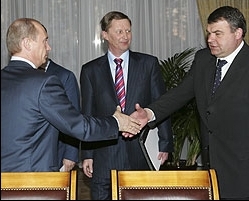
Putin Welcomes Serdyukov as Ivanov Looks On

The fourth anniversary of Anatoliy Serdyukov’s appointment came and went quietly enough on 15 February.  But WikiLeaks has come through as if to mark the occasion.  

On Friday, it posted an Amembassy Moscow assessment of Defense Minister Serdyukov a month and a half after he arrived in the “Arbat Military District.”  Mindful of hindsight bias, one can’t judge this cable too harshly.  But it’s an interesting retrospective on what was expected of the man going in, and what has happened since.

As stated all over the Russian media, Amembassy anticipated Serdyukov would impose discipline on the “Ministry’s notoriously loose financial control system,” and not otherwise initiate major changes.

Aleksandr Golts told Amembassy:

“Serdyukov’s inexperience on military issues would undermine his credibility with the General Staff and other senior officers, hindering his ability to push through needed reforms.”

A bit silly in retrospect.  Yes, he had no credibility with the Genshtab, nor it with him.  But he didn’t care and pushed right through the Genshtab, cutting the Genshtab (it suffered first in the reforms) and building his own bureaucratic machinery in the Defense Ministry.

Amembassy claimed that Serdyukov dismissed then-Chief of the Main Directorate of International Military Cooperation (GU MVS) General-Colonel Anatoliy Mazurkevich, and that Serdyukov’s auditors might be driving other corrupt officers into resignations or dismissals.

The cable describes the Defense Minister aptly as a “detail-oriented micromanager and ruthless policy administrator.” 

But what it doesn’t note (and what has become patently obvious over the last four years) is that the Defense Ministry, and the Russian military, is an unwieldy and untidy establishment not well-suited to micromanagement.  Talk about trying to turn an aircraft carrier on a dime . . . not gonna happen here. 

A couple stories come to mind . . . Serdyukov trying to put new uniforms on the troops, one of his first initiatives.  Now maybe only 20 percent of the troops have them, and the parents of those that do say the new uniforms aren’t as good against the cold as the old ones.

Also, Serdyukov talking about one new brigade commander who didn’t implement his directives.  It’s a big country and a big army.  What Moscow says isn’t always relevant in Chita, etc.

Next, Amembassy summarized the views of Ivan Safranchuk this way:

“He thought the Ministry establishment would try to ‘outlast’ any reforms that Serdyukov sought to impose, with the brass counting on Serdyukov to adjust to their way of thinking — or at least to stay out of their way.  Safranchuk told us that former DefMin Ivanov ultimately had not made a significant impact on how things functioned within the Ministry, despite his reform efforts, and predicted the same fate for Serdyukov.”

This one turned out to be pretty wrong, didn’t it?  There may still be some elements awaiting Serdyukov’s departure and a return to the way things used to be, but too much has changed.  The military establishment can’t ever be exactly what it used to be.  And the brass was definitely no match for Serdyukov, and he didn’t stay out of their way, but rather sent many of them down the highway.  And this Defense Minister has had a greater impact in four years than Sergey Ivanov in nearly six.  Ivanov’s fate was not to be Putin’s successor, and to muddle around in his next job, i.e. First Deputy PM.  As for Serdyukov’s fate, we’ll have to see.  As for his impact, at least some is likely to be lasting.  How long?  Only until the next determined reformer arrives.  None of this is to say Serdyukov’s impact is all positive, mind you.  Some changes may have messed things up worse than they were.  But he got reform off the dime in a way Ivanov never dreamed.

Here’s video of Putin’s meeting with Ivanov and Serdyukov on 15 February 2007.

The cable continues:

“Sergey Sumbayev, a former journalist with Krasnaya zvezda (Red Star), told us that management and accountability within the Ministry were dysfunctional and fostered inefficiency and corruption.  He referred both to financial accountability and responsibility for policy implementation.  Sumbayev thought the Ministry’s entrenched bureaucracy resisted, mostly successfully, institutional change, which generated considerable waste and delayed delivery of modern weapons systems to the armed forces.”

Sumbayev also told Amembassy:

“. . . management experience and tenacious work ethic make [Serdyukov] the ideal ‘technical’ manager that the Ministry needs.  While acknowledging Serdyukov’s political connections, Sumbayev did not think Serdyukov harbored any political ambitions.  He was chosen mainly for his managerial expertise, loyalty, and willingness to please his political bosses.  Serdyukov could probably make progress in streamlining the Ministry’s management structure, reducing waste, and exerting more control over its financial accounting systems.  One year, however, would not be sufficient to accomplish these tasks.”

“Sumbayev speculated that keeping the General Staff off-balance and focused on internal matters over the next year was one of Putin’s objectives in appointing Serdyukov. In this respect, he suggested that Serdyukov had a mandate to shake things up in the Ministry without sparking too much discontent.”

Amembassy concluded that:

“Serdyukov has his work cut out for him in bringing order to a Ministry badly in need of reform.”

Serdyukov’s made progress, but this final assessment probably remains true four years on.

Golts on the Sudden Increase in Officers

Yezhednevnyy zhurnal’s Aleksandr Golts says Defense Minister Anatoliy Serdyukov’s explanation that 70,000 more officers are needed because of VKO doesn’t hold water since it will be created on the basis of existing formations and units.

Golts concludes that Russian military reform has reached its next turning point.  He recalls that cutting officers to 150,000 and eliminating a large number of cadre formations and units represented the rejection of the old mass mobilization army concept.

But the reduction of so many officers could not but bring bitter opposition.  Nevertheless, Serdyukov stubbornly implemented the cuts, ignoring cries about the destruction of the country’s glorious officer corps (which Golts says hasn’t existed in a very long time).

Then suddenly the chief of the military department reversed himself.  Suddenly, it appears there are not too many officers, but a shortage.  The Armed Forces agonizingly cut 200,000 officer positions just to reintroduce 70,000!

Golts thinks there are several possible reasons.

The most obvious is the state’s inability to meet its obligations (primarily permanent apartments) to dismissed officers.  In mid-2010, there was information about 70,000 officers outside the shtat (штат or TO&E).  Later in the year, the number given was 40,000.  But says Golts:

“. . . to find out how many officers are really outside the shtat is impossible:  whatever figure Defense Ministry officials want to name, they name.  It’s possible to suppose that, having realized their inability to settle up with future retirees, the military department simply decided to put them back in the shtat.”

The second possible cause, according to Golts, is that the Defense Ministry failed to fill the officer posts it cut with well-trained sergeants and civilian personnel because the wages it offered were too low.  On the issue of more sergeants, Golts concludes:

“Sergeant training programs are failing.  Training centers simply can’t put out as many junior commanders as the Armed Forces need – they require not less than 100 thousand.  There’s no where to get them from.  And so they decided again to use officers to perform sergeant functions in combat sub-units, as rear service guys, service personnel.  If so, then this is a serious blow to reform.  Because the officer will cease being the elite of the Armed Forces, again turning into a low-level functionary.”

And Golts provides his third, worst case possibility:

“The generals convinced the president, but most of all, the premier [Putin] that it’s possible to achieve combat readiness by returning to the old mobilization model.  This is an ultimate end to reforms.  If so, then after presidential elections in 2012 the term of conscript service will inevitably be raised.  And everything will be back to normal.”

Golts concludes this concession by Serdyukov – heretofore supported by President Medvedev and Prime Minister Putin – will make those who hate him conclude he’s lost support, and they will triple their attacks on reforms.  In the worst case, this will be the first step toward overturning them.

More on the Military Personnel Zigzag

Wednesday’s Argumenty nedeli looked briefly at the reversal of Defense Minister Serdyukov’s cuts in the Russian officer corps, as well as plans to increase officer pay.

AN said Serdyukov said 70 thousand officers were needed to establish Air-Space (Aerospace) Defense (VKO), but noted he didn’t say where he would find so many officers for such a complex and specialized military field.

Those thrown out of the service in the course of implementing the “new profile” can’t be brought back, and training new officers will take 10-12 years following the reform of the military education system and the liquidation of the Mozhayskiy Military-Space Academy.

And, says AN, radically increasing pay won’t be so simple.  The budgets for 2011 and 2012 have been approved, so pay raises will have to wait until 2013 and 2014, after a new Duma and president have been elected.  And increasing the number of contractees [also with higher pay] will be another factor in army financing problems.

A General Staff source told AN:

“The approximate manning of VKO in all duty positions, including conscripts, contractees, and officers, will be 20-22 thousand.  This means the majority of duty positions will transfer there from Space Troops (KV), air defense troops and missile defense.  But after the mass cuts there aren’t enough commanders on the level of company, regiment and even brigade commanders.  And in all services and branches of the Armed Forces at that.  Therefore, it’s incorrect to think that all 70 thousand are going into VKO.”

According to him, the establishment of any new service [if it is a service rather than a branch], especially one as high-tech as VKO, requires “decades of work by all staffs.”

AN also cites Aleksandr Khramchikhin:

“It seems to me that constant casting about on the size of the officer corps just says that military reform issues haven’t been worked out in a strategic plan.”

A short item that says a lot . . . just a couple comments:

  • This piece is saying that VKO officers and specialists will be taken from the ranks of those currently serving in KV, PVO, and PRO.
  • The 70,000 additional officers will plug holes in command positions throughout the Armed Forces.
  • It would be difficult to bring back dismissed officers.  But there are lots of serving officers living in limbo outside the shtat (штат), outside the TO&E at the disposition (распоряжение) of their commanders, who could be called back to their units.
  • Military education’s been hammered, but it looks like Mozhayskiy’s still operating.
  • Delivering the promised new higher pay system in 2012 will be difficult under current and projected budgetary constraints.  So it’s another opportunity for the regime to fail.  But the Kremlin and White House don’t really need to worry about military votes anyway.
  • Kramchikhin’s right on.  Serdyukov’s idea to cut the officer corps in half – from more than 30 to 15 percent of Armed Forces personnel – was right.  But he failed to plan properly for it, and he tried to do it too fast.  Without accounting, or compensating, for the myriad historical, economic, and cultural reasons Russia had so many officers in the first place – reliance on conscripts and the lack of a strong NCO corps being first and foremost.  So another correct step is discredited by hubris, lack of foresight, and poor execution.  Serdyukov didn’t need to measure seven times before cutting, but twice would have been nice.
  • Taking “decades” to put VKO in place would certainly be the old-fashioned speed of Russian military reform.  But if it’s to be done quickly and successfully, it has to be done with more care than Serdyukov’s demonstrated over the last four years.

Walking Back Serdyukov’s Personnel Policies (Part II)

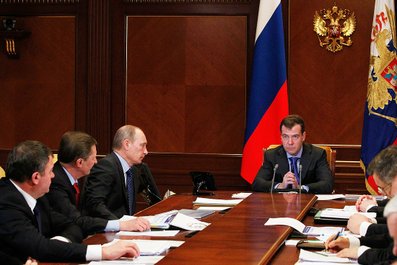
Medvedev in Meeting on Military Pay (photo: Kremlin.ru)

So officers were cut too drastically, and their numbers are going to be increased.

One recalls Ilya Kramnik saying officer cuts were causing serious tension in the ranks.  As if to prove the point, on Wednesday, near Novosibirsk, a drunken major living outside the “shtat” threatened to blow up his room in the unit’s dormitory.  This summer Aleksey Nikolskiy said halving officers caused trouble for brigades in the Vostok-2010 exercise.

But it’s not just an officer shortage that’s led to this policy reversal.  Difficulties with conscription and sergeants have forced the Defense Ministry to plug holes with more officers. 

Aleksandr Sharavin talked to BFM.ru about the situation:

“I think this is connected with the fact that now the situation in the army is very tense.  They cut officers from 450 thousand [sic] to 150.  They cut warrant officers completely, and professional sergeants aren’t appearing, we didn’t train them, and still can’t do this.  What we’ve got is a lot of conscript soldiers, few contractees, generally no professional sergeants, and a triple load laid on the remaining officers.  Now we have to compensate by increasing the number of officers.”  

Increasing the officer ranks wasn’t the only personnel policy reversal announced on 2 February.  A preliminary decision to increase contractees in the Armed Forces was also discussed.  Serdyukov said:

“This issue isn’t finally decided, but we have a proposal for an increase.  The Security Council was ordered to review this issue, in the course of the month a concrete figure – how much the number of contractees will be increased from 2012 – will be determined.”     

Utro.ru entitled it’s coverage of this story “Army Reform Reversed,” and reminded readers that army contract service was curtailed last winter because the military couldn’t afford it.  And now apparently it can?

We don’t know how many contract sergeants might be added starting next year.  In fact, no one seems to know how many there are now.  Newsru.com claims the army currently has 180,000 contract soldiers, sergeants, and warrants.  If that’s true, the Armed Forces are about 900,000.  But if there are fewer contractees, and conscripts are less than 560,000, then the Armed Forces are that much below 900,000.

Can an about-face on the elimination of warrant officers be far behind?

As early as 27 January, Rossiyskaya gazeta reported Deputy Defense Minister Pankov said some cadets might be inducted into VVUZy in 2011.  It was just back in the fall that the Defense Ministry put a two-year moratorium on them.  As it is, VVUZy now have about 45,000 cadets in the classes of 2011, 2012, and 2013.

But the Defense Ministry is looking at having these would-be officers join 5,000 other former cadets as sergeants.  The Defense Ministry is talking about salaries as high as 40,000 rubles a month for professional NCOs.  But current NCO training efforts in VVUZy are going very slowly, and the army wants 250,000 of them, according to Nezavisimaya gazeta.

Let’s return for a bit to Medvedev’s Tuesday session on raising pay for servicemen and law enforcement.  We’re talking Defense Ministry, MVD, MChS, FSB, FSO, and SVR here.  Men with ranks, badges, and guns.  Medvedev called higher pay for them:

“. . . an issue of state importance.  In the last analysis, our efforts to reform the Armed Forces, create a new profile of the Armed Forces and, of course, reform the system of law enforcement organs, including reforming the Internal Affairs Ministry and creating police depend on it.”

The Defense Ministry is talking median pay of 50,000 rubles a month for lieutenants starting in 2012.  Just a sampling . . . a cadet would get 18,200, a contract soldier 24,800, a squad sergeant 34,600, and a brigade commander 93,800 rubles per month.

NG’s Vladimir Mukhin reports the Finance Ministry believes the new military pay plan will cost another 1 percent of Russia’s GDP, taking the defense budget from nearly 3 to nearly 4 percent of GDP.  All this while the government wonders whether outyear budgets will be in deficit or not.

The last couple days represent the first major defeat for Serdyukov.  His military personnel policies are a complete and utter shambles.  Political analyst Aleksey Mukhin commented to BFM.ru on Defense Minister Serdyukov’s prospects: 

“ It’s fully possible that soon they’ll call him enemy No. 1 for the reform which is being conducted.”

If they don’t already.  One guesses he’ll keep his post though.

So after flirting briefly with paying relatively few officers more money, the Defense Ministry’s going to pay more officers more money instead.  And this is more officers at the same time President Medvedev’s ordered a 20 percent cut in government bureaucracy.

The fact is military reform’s gone beyond the military now and become more of a factor in domestic politics.  Vlasti are just a bit nervous about social stability in the runup to elections this year and next, and are also a little worried about the guys with the guns.  For the regime, the extra money is worth keeping 70,000 potential ex-officer opponents out of the streets.  It may feel this provides some insurance that the guys with guns will do as they’re told.

As BFM.ru concludes, the Tunisian [or Egyptian] “virus” could spread.  And the terrorist threat is high.  So Russia’s leadership has to think about an effective and combat capable army.

Commentator Sergey Markov told BFM.ru that the regime wants to increase the number of officers who can fight, but it will continue cutting those in support functions and replacing them with civilians:

“But everyone understands perfectly that you can’t do without a real combat force.”

Walking Back Serdyukov’s Personnel Policies (Part I)

And so it’s begun. 

The first of Defense Minister Serdyukov’s major reform planks – cutting the officer corps from 355,000 to 150,000, or no more than 15 percent of the million-man army – has been reversed.

The Armed Forces’ officer manning level was apparently one topic in yesterday’s meeting between President Medvedev and his “power” ministers about plans to raise pay for servicemen in 2012.

Serdyukov told the media about the decision to increase officers in the Armed Forces by 70,000:

“A decision’s been taken to increase officer personnel by 70 thousand.  This is connected with the fact that we’re deploying additional military units, establishing military-space defense, that is, an entire service (of troops), and the increase is happening in connection with this.”

First, this raised some interesting questions about VKO.  Is it really going to become a service (vid or вид).  After all, the Space Troops are only a service branch (род войск) right now.  That’s quite a promotion.  And are we really supposed to believe the expansion of VKO or the Space Troops will require 70,000 additional officers? 

Of course not, it’s a convenient excuse to walk back a large part of the 50 percent cut in army officers Serdyukov announced when he launched his reforms in October 2008.

Most media outlets were pretty confused on what this means for officer numbers.  They assumed the Russian Army’s at 150,000 officers right now, just add 70,000 for a total of 220,000.  But it’s not so simple.

When Serdyukov started cutting officers, there were 305,000 occupied officer billets.  Krasnaya zvezda said the Armed Forces had 181,000 officers at the end of last year.  So a grand total of 124,000 officers were either discharged, placed outside the “org-shtat” at their commander’s “disposition,” or forced to accept an NCO billet between late 2008 and the end of 2010.  Returning 70,000 to the ranks might leave us wondering only about what happened to the other 54,000.  And 181,000 plus 70,000 takes the officer corps basically back to 250,000, or fully one-quarter of the million-man army.

The army officer corps has endured considerable sturm und drang in a little over two years all for the sake of shedding just 55,000 officers.

More on this tomorrow.

New Deputy Defense Minister

Antonov with Medvedev and Serdyukov (photo: Kremlin.ru)

Today President Medvedev made Anatoliy Ivanovich Antonov Deputy Defense Minister for International Military Cooperation.  He’ll bear responsibility for organizing and conducting the Ministry’s contacts with foreign military departments.  Kremlin.ru notes Antonov was one of the negotiators for the new Treaty on Strategic Offensive Arms.  Medvedev said Antonov’s experience in this successful negotiating process will enable him to fulfill his new duties effectively.

Anatoliy Antonov

PIR-Tsentr’s short biography of Ambassador Antonov says he’s been serving as Director of the Foreign Ministry’s Security and Disarmament Issues Department.  He was born in 1955.  In 1978, he graduated the USSR Foreign Ministry’s Moscow State Institute of International Relations (MGIMO or МГИМО).  In 1983, he completed graduate study at the same institution.  Antonov’s worked in the Foreign Ministry since 1978.  He’s headed government delegations in G8, NPT, Inhumane Weapons Convention, and multilateral export control negotiations.  He’s a member of the U.N. Secretary General’s Consultative Council on Disarmament.

In mid-2007, Antonov helped then-President Putin unveil his offer to use Russia’s Gabala and Armavir radars in NATO missile defense, according to Novosti KM.RU.

Antonov makes nine deputies to Serdyukov; a tenth deputy slot for finance-economic work has been vacant since Vera Chistova’s departure in the fall.

Antonov’s quite different from his predecessors in this job.

International military cooperation seemed to fall off the Defense Ministry’s radar for a while after Anatoliy Serdyukov took over.  You may recall, former Main Directorate for International Military Cooperation (GU MVS) Chief, General-Colonel Anatoliy Mazurkevich fled the Defense Ministry when Serdyukov arrived.  GU MVS essentially disappeared from the military department’s organizational chart.

GU MVS’ roots stretch back to the General Staff’s old 10th Main Directorate, which had a long history of involvement in arranging arms sales and providing military advisors and training to Soviet client states in the bad old days.

Blaming Yudashkin

Aleksandr Kanshin has reemerged . . . late of the Public Chamber, he’s now Deputy Chairman of the Defense Ministry’s Public Council, and he blames new army uniforms designed by fashion mogul Valentin Yudashkin for the recent outbreak of illnesses among conscripts in the Central Military District.

Vesti.ru and Newsru.com picked up what Kanshin told Interfaks:

“Judging by documents I’ve been made familiar with, one of the causes of illnesses among the young reinforcements in the troops, particularly in the Central Military District (TsVO), is manufacturing defects in the new winter field uniform supplied to conscripts at the assembly points of the military commissariats.  In other words, the new type uniform ‘from Yudashkin’ doesn’t defend soldiers against freezing in low temperatures.”

“At times, TsVO servicemen have to wear warm things under the new winter uniform.”

Kanshin also said he’s talked with TsVO Commander, General-Lieutenant Vladimir Chirkin who recognizes the new uniform needs improvement, but he also indicates 80 percent of his personnel are dressed in the old field uniform which is much warmer.

Vesti.ru reported the majority of the district’s servicemen are negative about the Yudashkin uniform because the air temperature is -20° (-4° F) and the wind blows through it outside.

Newsru.com pointed back to several scandals over the Yudashkin uniform, including last December when it said 250 soldiers became seriously ill in their unit in Yurga.  It was proposed at the time that they became sick because the new uniform didn’t protect them against the cold.

These new digital cammies were developed between May 2007 and 2010.  Besides fashion designer Yudashkin, specialists from the Central Scientific-Research Institute of the Garment Industry and the Defense Ministry’s Central Clothing Directorate participated in creating them.

Gzt.ru claims Yudashkin isn’t to blame.  The winter uniform was changed and sewn in defense industry factories with cheap materials.  Perhaps these are Kanshin’s “manufacturing defects.”  Sounds like corruption though, if someone substituted inferior materials.

Doctors told journalists that Yudashkin’s boots don’t keep out the cold either.

According to Gzt.ru, the military prosecutor is checking the situation in the TsVO.  Meanwhile, the military officially denies the uniforms are to blame, and maintains the emergency situation is just a seasonal outbreak of illness.

General Staff Chief Makarov’s Retirement Rumored

On Thursday, Argumenty nedeli said its source claims Defense Minister Serdyukov will soon send some well-known generals into retirement.  The Defense Ministry press service, of course, denies it.

AN’s source says the departure of these generals isn’t due to conflict between them and Serdyukov, but rather to the latter’s policy of “rejuvenating” Russia’s high command.  Among those who will allegedly be retired:

  • General Staff Chief, Army General Nikolay Makarov (61).
  • Deputy Defense Minister for Rear Services, General-Colonel Dmitriy Bulgakov (56).
  • Air Forces CINC, General-Colonel Aleksandr Zelin (57).
  • Navy CINC, Admiral Vladimir Vysotskiy (56).
  • Space Troops Commander, General-Lieutenant Oleg Ostapenko (53).

It’s interesting because none of them is really up against the legal age limit for leaving military service.  And Makarov apparently already has a service term extension from President Medvedev. 

One presumes, according to AN’s information, that the Ground Troops CINC, and RVSN and VDV Commanders are safe for now.

AN also expects some of the newly appointed MD commanders to be dismissed or moved to new posts.

There are other angles to AN’s story besides more rotation in cadres.

First, it repeats earlier press on trouble in finding a replacement for “key military department figure,” former Deputy Defense Minister for Finance-Economic Work Vera Chistova who left her post three months ago. 

An AN source in the Finance-Economic Service claims the lack of a replacement puts in doubt Prime Minister Putin’s promise to deliver a 6.5 percent increase in military pensions on 1 April.  Budget resources weren’t allocated for this.  And there’s still no candidate to replace Chistova.  And without one such issues simply won’t be resolved. 

AN doesn’t mention also that as active duty officer pay is reformed this year, the Defense Ministry will have to figure what to do about retiree pay.  If, as expected, they break the long-standing link between active pay and military pensions, the vets aren’t going to be very happy just before the 2011 and 2012 elections.  Putin just courted representatives of veterans’ organizations about a week ago.

According to AN, the Defense Minister has offered the military finance portfolio to more than one official at different levels in the Finance and Economic Development Ministries, but all of them declined.

The military department’s officers are also talking loudly about the coming appointment of a new Serdyukov deputy who will be called in to “correctly”  track the military’s political preferences ahead of the fast-approaching legislative and presidential elections.  

A high-ranking but unnamed military man tells AN

“He will be an important civilian and definitely a member of ‘United Russia.’  It goes without saying this is connected with the upcoming parliamentary and presidential elections.  The negative mood of officers is great, it is directed against the minister, his assistants and the party of power which is conducting the reforms without considering the human costs.”

Fox News on the Russian Military

We laughed, we cried, two thumbs way down to Fox News for yesterday’s story on the Russian military.  It makes us wonder what kind of crap they say and write on topics we don’t know anything about.  Well, actually, we already know how bad that drek is too.

Now, no one who frequents this blog will accuse your present author of giving Moscow credit for much.  No, of course not.  But Fox News has succeeded in taking the absurd in Russian defense policy and making it ridiculous.  Fox’s article couldn’t garner a C in a high school journalism class.

At the risk of getting some of the stink on us, let’s examine the piece a little:

  1. Ahem, if you didn’t notice, the Russian military’s been falling apart for a long time.  And, actually, in the most objective sense, experts who’ve watched the process would say Defense Minister Serdyukov and his cronies may have arrested the process some over the last 4 years.
  2. Yes, CAST did put out a new monograph, but it’s a slender volume, and certainly neither comprehensive nor groundbreaking in any sense.  CAST is valuable, but hardly well-known.  And its leadership is probably not fully independent of the current regime.
  3. Fox’s claim that Russia only has 8-10 thousand deployable troops is a ridiculous misreading of intentionally hyperbolic statements in the CAST report.  No serious analyst believes that Russian forces aren’t more ready today than they were 5, 10, or 15 years ago.  But this is a relative comparison.  It doesn’t mean they’re sufficiently ready, in sufficient quantity, to execute the missions they’ve set for themselves.
  4. The Russians have already beat the furniture salesman stuff to death, but one supposes it’s still funny to a nonspecialist audience in the U.S., a country where actors become governors and presidents (and good ones at that).  But even the most basic journalistic accounts normally note that Serdyukov married well, gaining a father-in-law with a strong connection to Vladimir Putin.  And Serdyukov’s no dummy; he probably engineered most of the tax case against Khodorkovskiy.  Not sure Fox knows who Khodorkovskiy is though.  The bottom line is, most people accept Serdyukov as a savvy and tough bureaucrat with talent, who was specifically selected to do a job he’s well-suited for.  Doesn’t mean he hasn’t pissed off Russian military men.  That’s exactly what he was supposed to do.
  5. Fox missed the point that Serdyukov was sent in to stop the stealing, not to cut the military’s budget.  Does Fox realize the $78 billion that DoD’s going to trim over five years isn’t much less than what Russia’s military budget will be over that period?  Duh.
  6. Fox saves itself a little by referring to Felgengauer, but it can’t spell his name.
  7. Russian defense industry has problems, yes, but buying abroad is more complex than Fox’s passing mention.  Fox didn’t bother to Google Mistral either.
  8. Fox’s military expert is wrong; Russia still has a military.  But the U.S. needs to worry about whether and what kind it will have in the future.  We don’t need a “sick man of Eurasia,” and a military vacuum there wouldn’t be good for Americans.  And we also need to worry if there will be a country there, by the way.  Fox’s retired general is right, however, when he reminds that Russia is still a nuclear weapons superpower, and it is relying on nukes heavily for its security.  And its conventional weaknesses increase the risks of miscalculation.  But this has been the case for much of the past 20 years. 

But none of this is a news story.  The news story is that even skeptics have to admit the Russian military is doing a little better, and it’ll be interesting to find out how much better the next time it goes into action.  It’ll be interesting to see if it’s somewhere on the former Soviet imperial periphery, or against another internal threat in the North Caucasus.

The Russian media reactions to the Fox article are just starting, we’ll see if they get interesting.

But thanks Fox for providing something to write about this morning.