Category Archives: Serdyukov’s Reforms

Unrest in the Black Sea Fleet?

In Part 2 of his article, Shurygin ended by describing the Black Sea Fleet as being on the verge of an explosion.  We’ll see if he elaborates on this in the final part when it’s published.

Meanwhile, on 12 November, Moskovskiy komsomolets wrote about thousands of officers and families in Sevastopol “thrown to their fate,” without the possibility of getting a job in Ukraine, and left practically without money and housing.  The author, Yekaterina Petukhova, like Shurygin, said the situation in Crimea is on the “verge of revolt.”

Young BSF Officer and Guided Missile Cruiser Moskva

According to Petukhova, 2,000 BSF personnel were cut in 2009, and another 9,000 have been warned that they will be dismissed.  She talked to an officer named Oleg, who said he was one of the “fortunate” ones who were put outside the fleet’s TO&E.

The situation’s not worse anywhere.  They’ve already cut thousands, now they’re mowing down the command and control organs.  When they put you outside the TO&E, for a half year they still pay your salary, but minus premiums and minus the supplement for handling secret information.  But this is nevertheless some money.  But then it’s all gone.  View it however you want.  But we’re all here with Russian citizenship.  Where are they going to let us work?  And we can’t go back anywhere in Russia.  They don’t want to give us the service apartments in Sevastopol which we lived in all this time.  They are proposing several cities in Russia, but there really aren’t apartments there—it’s excavation that could go on forever.  And so officers sit, they don’t get pay, nor can they finalize a pension without a permanent residence permit.

Oleg went on to say that single officers especially don’t know what to do.  They aren’t giving out single apartments and, if they get together with a friend and apply for an apartment for two, they are derided as homosexuals.

He gives his view of how it might end. 

Can you generally imagine such a crowd of healthy men, who know military matters firsthand, wandering around Crimea and the quays?  Some kind of Lenin will be found and he’ll raise a crowd, then people will wish he hadn’t turned up.  The fleet commander is silent, everyone spits on us, a kind of chaos is being created.

Petukhova ends by noting that when Kyiv makes a move against the BSF, Moscow politicians race to the defense of Russian sailors, but they’re all silent when the Russian authorities have driven thousands of BSF men and their families to the edge.  She concludes that the ‘new profile’ of the armed forces has an unpleasant odor.

Railroad Troops Officers Put in Sergeant Posts

Railroad Troops Working in Abkhazia

Today a Railroad Troops spokesman provided a year-ender for these bastard children of the Defense Ministry, and he described their efforts to adopt a ‘new profile’ in 2009.

Most interestingly, the spokesman said that the Railroad Troops have placed 300 excess officers, mostly lieutenants and senior lieutenants, in sergeant billets.  These men, who’ve suddenly discovered they’re no longer officers, will be the first to be promoted into officer positions when they become available, according to the spokesman.  He also said a similar scheme for preserving officer cadres, i.e. demoting them into the NCO ranks, exists in the other services and branches of the armed forces.

So rumors that officers were being ‘offered’ transfers into the NCO ranks turn out to be true.  This was reported as far back as the closure of the SibVO’s 67th Spetsnaz brigade late last winter, but had not been confirmed until now.

The Railroad Troops also put over 1,000 warrant officers into sergeant’s posts, but this downgrading was always an overt part of the Defense Ministry’s plans.

The Railroad Troops spokesman said 1,500 officers and 1,200 warrants were dismissed in 2009, and nearly 1,800 officers and warrants entered the limbo of being placed at the disposal of their commanders, i.e. they’ve lost their duty posts and are outside the TO&E.

Housing remains a problem.  About 3,000 personnel need apartments, or improved housing conditions.  The Railroad Troops need 1,700 apartments for dismissed servicemen.  They were allocated 472 apartments and 81 state housing certificates (GZhS).

Medvedev’s Take on Combat Capability

RF President Dmitriy Medvedev

 You may recall after the five-day war with Georgia, and before Serdyukov’s reform announcement, President Medvedev issued his own theses on combat capability.  

Though he’s not a learned military theoretician, Medvedev’s statement is obviously important.  Find coverage at Rosbalt.  

Medvedev said:  

“The development of five factors is necessary for the effective resolution of combat missions.  We are talking about improving the TO&E structure of the troop basing system.  If we speak plainly and directly, all combat formations must be transferred into the permanent combat readiness category.  Second is increasing the effectiveness of the armed forces command and control system.  It’s impossible to count on success in modern combat without this.  Third is the improvement of the personnel training system, military education and military science.  We need an army equipped with the most modern weapons–the fourth factor.  We’ll give first priority attention to this issue, but fundamentally new high-technology weapons types will have special significance.  The fifth factor is improving the social condition of servicemen.  These five factors will determine the combat capability of our armed forces.”  

This is fairly close to what our military scholar published in Voyennaya mysl.  

Medvedev went on to add that, by 2020, Russia will add to its nuclear deterrence, intelligence, air superiority, ground and naval strike, and operational troop redeployment capabilities.  Russia has planned for serial ship and submarine construction, and establishment of an aerospace defense system, according to Medvedev. 

Before becoming president, Medvedev traveled to Kaliningrad in January 2008.  He was still a first deputy prime minister in charge of ‘priority national projects,’ of which housing is (was?) one.  On that occasion, he noted that the resolution of the social problems of servicemen directly influenced the combat capability of the armed forces.  He said it was necessary to solve their housing problems, “otherwise combat capable armed forces won’t exist.” 

Next, there should be some interesting Putin comments on combat capability, also questions in many public polls on the armed forces are couched in terms of what people think about their combat capability.

Defense Ministry Considering New Ranks?

An old story worthy of a slow Orthodox Christmas Day…. 

In mid-October, an unnamed source told Interfaks that the Russian military might introduce a new rank–either ‘brigade general’ or ‘senior colonel’–in between its colonel (O-6) and general officer ranks.  The story called forth a variety of official and semi-official reactions. 

According to one account, the Defense Ministry termed discussion of a new rank “premature.”  Other accounts said no decision on the introduction of a new rank had been made.  Others dismissed the story as pure rumor, saying the issue was not being worked in the Genshtab or Main Personnel Directorate.  One Genshtab source attributed the story to the imagination of journalists. 

The Interfaks source said the Defense Ministry might confer a new rank on the commanders of its 85 new permanently ready Ground Troops brigades and 33 air bases.  The new rank would supposedly “enhance their status,” and distinguish them from “ordinary” colonels. 

However, in late November, State-Secretary and Deputy Defense Minister Nikolay Pankov said the issue of new ranks was speculation, and had not even been raised.  He said the current rank structure would remain, and denied that either ‘brigade general’ or ‘senior colonel’ would be introduced. 

Deputy Defense Minister Pankov Said No New Ranks

Who knows whether a new higher rank would be significant to Russian officers?  One new brigade commander said that, when you’re living month to month, higher pay is the best incentive and recognition.  The best commanders are already being ‘incentivized’ with Serdyukov’s premium pay.  But, in a couple years, all officers are supposed to share in a new and significantly higher base pay scheme.  

Several well-known defense commentators like the idea of a new rank to distinguish the new brigade commanders.  Anatoliy Tsyganok says he is more concerned about whether they will receive the education and training needed to become operational and operational-strategic commanders at a time of wholesale changes in the Russian military educational system. 

‘Brigade general’ or brigadier would fit well into the current Russian system, since a Russian one-star is a General-Major.  Moscow reportedly would not go with ‘senior colonel’ because it might look like Russia was following the lead of China, North Korea, and Vietnam. 

If this issue comes back around, it’s worth remembering how Pankov flatly denied it.

Evaluating Combat Capability

Part 2 of the Voyennaya mysl article focuses specifically on methods of evaluating and calculating indicators of combat capability for tactical units.

Every unit possessing personnel, arms and equipment, and necessary material supplies has combat capability.  The level of combat capability multiplies the following factors:

  • The quantitative level of personnel, arms and equipment, and supplies.
  • The suitability of arms and equipment.
  • The quality of supplies.
  • The condition of personnel (morale-psychological and physical, discipline, professional training, and combat integration).
  • The condition of the command and control system.

Determining the Combat Capability Level of a Sub-Unit

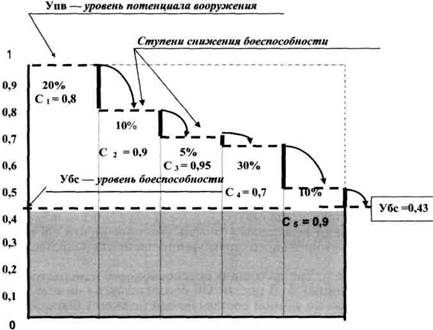
Decrements in each of the factors take the theoretical armaments potential of 1 down to a combat capability level of .43 in the author’s example.

He goes on to show how each of the factors themselves are individually broken down and evaluated.  What could be called sub-factors in them are each evaluated by a familiar excellent (1), good (.95), or satisfactory (.9) standard.  He describes how of positive, good, and excellent training evaluations are converted into the professional training sub-factor.  He has an interesting chart showing things like less than 70 percent positive evaluations is an unsatisfactory, not less than 70 percent positive evaluations is a satisfactory, etc.

The author summarizes by saying his approach allows for identifying problem areas in combat capability with an eye to improving combat potential.  The results of inspections can be used to evaluate soldiers and then the entire sub-unit.  So 60 percent of soldiers at excellent (.8), 20 percent at good (.7), 15 percent at satisfactory (.6), and 5 percent at unsatisfactory (.4) gives the sub-unit an overall evaluation of .73.  This has to be multiplied against the quantitative first bullet above, if it’s .8, then .73 x .8 yields a combat capability level of .584.

The point is, at this working military academic level, the Russians have what might be a fairly rigorous methodology for evaluating their own combat capability.  Who knows if the high command thinks this way when it talks publicly, but combat capability clearly isn’t the same thing as combat readiness.  And the concept of battle readiness needs a closer look.

Combat Capability, Battle Readiness, and Combat Readiness

Interconnection and Correlation of Indicators of Combat Potential

Now that the Russian Armed Forces have moved away from low-strength, cadre divisions and units to a permanently combat ready force structure, it’s time to think a little harder about where they might be . . . yes, Shlykov makes one think.

A two-part article in Voyennaya mysl from early 2009 sheds some light on Russian military thinking in this regard.  It was prepared by retired colonel, a military academic teaching at the soon-to-be-former Combined Arms Academy.  He was a tactical commander of motorized rifle units, and later a professional staff officer with experience in the GOU.  It’s likely violence will be done to his work in an effort to understand and dumb it down.  His construct is full of equations and diagrams like the one above.  But the article helps in understanding what 100 percent combat readiness really means.

The articles examine the concept of combat potential and use it to determine the ‘real combat possibilities’ of a force.  It aims to evaluate and calculate indicators of combat potential, accounting for their combat capability and readiness to fulfill combat missions (battle readiness).

Combat potential expresses the summation of the material and morale possibilities of the armed forces, which determine their capability to fulfill their missions, to conduct combat actions.  Its components are technical equipping, soldierly skill, and morale.

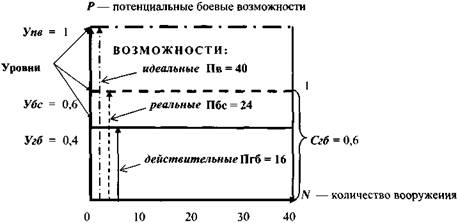
Combat potential has three basic indicators that define the limits of combat possibilities:  ideal, or armaments potential; real, or combat capability potential, and actual, or readiness potential.  Armaments potential is a theoretical and unattainable indicator; based on quantity alone, it seems to be defined as 1 or 100 percent, if the requisite number of armaments are on-hand.  It’s a starting point for the other indicators.

Combat capability is defined as the condition of troops (forces) which allow them to conduct combat actions successfully in accordance with their designation and to realize their combat possibilities.  It is real combat possibilities to conduct combat actions with the forces and means on hand.

At this point, the author defines combat readiness in peacetime as defined by the readiness to transfer from peacetime to wartime, but in wartime it is determined by battle readiness.  Battle readiness expresses preparation or training for fulfilling missions as a portion of potential combat capability.  It is conducting measures to train for battle.  Battle readiness is the actual share of potential combat capability.  Increasing the potential (degree) of battle readiness is the process of turning real combat possibilities into actual ones.

Ideal combat possibilities are simply a question of the quantity of armaments.  Forty arms equals 40 arbitrary units of combat potential or 1 in the diagram above.  If the real combat possibilities are .6, combat capability is 24 (40 x .6), and if the actual possibilities are .4, battle readiness is 16 (40 x .4).  And the ratio of battle readiness to combat capability (16/24) yields a degree of battle readiness of .6, and this seems to be the key output of the first part of the article.

Part two turns to indicators of the combat capability of subunits (battalion and lower) and units (regiments, which don’t exist any longer except for RVSN and VDV).

Shurygin Critiques Military Reform (Part 2)

Continuing on with Reform or Lie, Shurygin describes today’s efforts against officers perceived as disloyal to the Defense Ministry leadership as comparable to Stalin’s repression of the officer corps.  Alluding to the FSB’s monitoring of the army, he says the constant search for leaks includes the use of wiretaps and the compilation of names of officers’ “undesirable” acquaintances and contacts.

In the SibVO, the officer corps has been cut in half.  4,000 dismissed outright, and 2,500 were placed outside the TO&E, i.e. left without a duty post.  According to Shurygin, they’ll get their base pay, but only for six months.  So there are 37,000 officers deprived of a way to make a living.  But he says some have been offered vacant sergeant positions.

Young officers coming out of VVUZy have also been surprised.  Military linguists from the Military University in 2009 were either put out of the service immediately or offered posts in the rear services.  Forty thousand of 142,000 warrant officers found a place in the ‘new profile’ and the rest were dismissed.

Shurygin suggests the High Command has been bought off by the Defense Minister.  He says “loyal” military district commanders are getting 300-400,000 rubles per month, deputy chiefs of the General Staff 500,000, and Makarov himself more than 800,000 rubles every month.

He believes Serdyukov and Makarov’s underlings have to deceive them about the real state of affairs, and report what they want to hear.  There are currently no structures to check up on the reformers, according to Shurygin.  Lapses and failures are presented like victories and successes.

He turns to the contract army.  There are so few contractees now, less than 79,000, that they barely cover the minimal need for them.  One-fourth are women.  The remainder barely cover a fourth of the manning needed for ‘new profile’ brigades.  So all services and branches are 75 percent manned by conscript soldiers.  Of the 300,000 men called up every six months, fully 100,000 are needed simply to cover the deficit in professional contractees.

The professional sergeants program was delayed because the majority of possible candidates couldn’t pass secondary school-style entrance exams.  When finally launched in one location–Ryazan, the sergeants’ training center has less than one-third the trainees intended.

Shurygin describes the closure of the 47th Independent Reconnaissance Aviation Regiment in Shatalovo.  According to him, they flew aircraft to their new base in Voronezh, and transported their engines back to Shatalovo, so that other aircraft could fly into Voronezh. 

Shurygin says Serdyukov has already signed off on a decision to scrap 1,000 aircraft requiring capital repairs.  This will shrink Russia’s aircraft inventory by one-third.  The tank inventory will be cut by a factor of four if only operational tanks are left in the force.  Shurygin asks what will happen in the next five years when another 1,000 aircraft use up their service lives.  Russia will have an air force about the size of Israel’s, according to him.  Only 70 future fixed-wing and helicopter pilots entered training in Krasnodar this year.

Shurygin criticizes Makarov for his less than savvy comments, for instance, about deploying the S-400 to the Far East against North Korean missiles or moving Bulava production to another factory.  He says the degradation of the army has continued for two years under Serdyukov, but he and Makarov don’t have to answer for anything.  They were forced to acknowledge that the infamous Order 400 on premium pay was a mistake that divided officers, and now they’ll be giving it to entire units.

In the future, officers from platoon to division will be earning 75,000-220,000 rubles per month and bonuses and supplements will disappear in favor of a higher pay scale.  But Shurygin complains that Serdyukov intends to ‘reform’ military pensions to decouple them from the new pay scale.

Lastly, Shurygin describes the Black Sea Fleet as on the verge of an explosion.  Officers have been put out.  They can’t keep their service apartments and they can’t get apartments in Russia.  They can’t work in Ukraine and live like bums.  And the situation gets worse every month.

The last part of Shurygin’s hasn’t been published.

Shurygin Critique of Military Reform (Part 1)

Vladislav Shurygin

In part one of Big Reform or Big Lie, military commentator and critic Shurygin complains that opposing views on Serdyukov’s military reforms have not been heard.    

Instead of his idealized view of the former Soviet Army fairly harmoniously serving the state’s interests, he sees today’s Russian military as an army of the underprivileged, who can’t escape service, protecting the interests of particular individuals, or political and economic groups.  He likens it to an old Soviet labor camp, with officers in the roles of overseers and guards, and conscripts as inmates, divided into various upper and lower castes.   

Shurygin provides unsourced polling data that “would shock any sociologist.”  More than 80 percent of conscripts don’t trust the government.  Sixty percent are dissatisfied with the country today, and 90 percent are disenchanted with Russia’s social and economic inequality and don’t want to risk their lives for it.  

He says mass drunkenness, self-interest, protectionism, and corruption is flourishing in the officer corps.  Officers live a pitiful half-beggarly life and are demoralized.  They serve to obtain apartments and a pension, or the possibility of arranging a good existence in the civilian world.  Eighty-eight percent of officers retire within six months of receiving an apartment or a pension.  And the High Command has lost its will, backbone, and ability to talk to the authorities as equals as result of purges.  

So what has two years of reforms brought?  The fully combat-ready brigade as the universal unit from Kamchatka to Pskov, according to Shurygin.  But the lovely paper plans of the staff are far from real implementation.  Many brigades are light, having only 2,200 men instead of 3-5,000.  There are several different forms of brigades and it’s impossible to find even two identical ones.  

Shurygin concludes the brigade is an especially bad fit for Russia’s Far East.  They are spread thin.  Despite this, General Staff Chief Makarov tells the media that they can hold off an enemy for 45 days while mobilization and reinforcement takes place.  Shurygin compares Makarov’s optimistic words to those of Stalin’s generals who promised to defeat the USSR’s enemies on their own territory.  

By contrast, officers in the Far East joke that after the Serdyukov-Makarov “optimization,” the Chinese Army won’t find it hard to defeat Russians.  The problem will be to find them. 

Shurygin believes ‘optimized’ brigades are not equal to the regiments they replaced in combat capabilities.  It is difficult to move brigades as a single combat units.  It’s a chaotic, extended process in which command and control is lost.  He attributes much of this to not having enough officers. 

Regiments of 2,000 had 400 officers and warrants, whereas new brigades of 4,000 have 327 officers.  Weakness in command and control is felt especially in the brigade staff, where officers with combat experience and long years of service are missing because of dismissals.  The old regiment staff had 48 officers and warrants, the new brigade staff only 33 officers. 

Shurygin thinks the new brigades are especially lacking in reconnaissance.  They have a reconnaissance chief, but no department or section to analyze and integrate information for the commander. 

In battle against a technologically advanced enemy, the enemy’s reconnaissance, target designation, and weapons delivery capabilities would exceed those of the ‘new profile’ brigades several times over.

Some things needed for real combat capability have been forgotten.  In copying Western-style brigades, the Defense Ministry forgot to copy their strong logistic support which is still provided by divisions.  Shurygin cites General-Major Vladimirov in calling the new brigades “abnormally inflated regiments,” which Shurygin says have fully lost the mobility and unity of regiments.

Shurygin turns next to the vaunted 1-hour readiness assertion first publicized by Makarov.  He wants to ask Makarov whom he intends for motorized rifle brigades in Tver, Naro-Fominsk, or Samara to fight on one hour’s warning.  By contrast, according to him, the U.S. concept of readiness comes into play once forces are deployed to their theater of action.  Shurygin goes on to explain that VOSO, the Russian staff’s military transportation service responsible for strategic mobility, has been slashed from 2,500 to 400 personnel.  As an example of the current lacked of needed mobility, he says it took 5 days for a partial tank brigade to move 500 kilometers in Russian-Belorussian exercises this summer.  So it’s understandable that Makarov would rather focus on 1-hour readiness than on mobility.

Shurygin ends by citing Khramchikhin on what kind of forces Russia is getting via military reform.  For Georgia or terrorism, Russia has the RVSN and nuclear submarines it can’t use.  For advanced opponents like the U.S. and NATO, Russia is clearly weak and can’t effectively oppose them.  For an equal like China, there simply aren’t enough Russian forces.

Combat Readiness Doesn’t Equal Combat Capability

Vitaliy Shlykov (photo: RIA Novosti)

In an article entitled Secrets of Serdyukov’s Blitzkreig, Shlykov assesses that Defense Minister Serdyukov has done rapidly what none of his predecessors was able to do.  Shlykov’s positive assessment has something to do with the fact that Serdyukov’s success has validated a lot of things the author advocated.  Nevertheless, Shlykov offers a nice rundown of why Serdyukov’s reforms were needed, and also some cautionary notes for the future.

According to Shlykov, someone not following the changes in the armed forces closely over the last year won’t be able to believe what’s happened.  Serdyukov’s 11-minute speech on 14 October 2008 started a completely unexpected ‘revolution from above’ to put the entire force structure into permanent readiness and turn the officer corps from a ‘bloated egg’ into a pyramid.  Shlykov describes how previous cuts in the armed forces left too many officers in place commanding mobilization units with equipment and no soldiers.  Junior officers escaped pitiful conditions in the army by various means.

But slashing the empty, ‘big war’ force structure in favor of a smaller, permanent readiness army was Serdyukov’s most radical move.  Along the way, Shlykov makes note of Ground Troops CINC Boldyrev’s comment that, in 2008, only six army divisions were considered combat ready.

Shlykov’s math on Russian officers and warrants provides an interesting picture of sharply increasing importance of sergeants and soldiers in the force over the next three years.  In 2008, there were 623,500 sergeants and soldiers in a 1,118,800-man army (56 percent).  In 2012, they are supposed to be 850,000 (including 180,000 contractees) of a million-man army (85 percent).  I think this is why some observers are wondering if the much-reduced officers corps will be able to control its subordinates.

Shlykov notes the drastic cut in the military educational establishment–65 to 10 institutions–and the fact that new cadets in 2009 numbered only 3,000, instead of the 18-19,000 of recent years.

Summarizing a bit, he says no element of the military was untouched by cuts and reorganizations.  Actually, there were some major ones–the RVSN and VDV.

The ‘new profile’ brought sharp criticism in the media, and a “muffled discontent” in the military.  Despite this, according to Shlykov, Serdyukov’s basic goals were achieved a year after he began.

Shlykov says military districts will assume a bigger role in the command and control system, taking responsibility for things like engineer brigades and former GRAU arsenals on their territory.  Taking control of things like the Navy’s arsenal in Ulyanovsk could be a major headache.  He mentions the professional sergeant corps training at Ryazan, but not its very slow and difficult start.

The secret of Serdyukov’s success?  His personal qualities, especially his exceptional management capabilities, played the greatest role, Shlykov says.  But being purely civilian–something Shlykov has advocated–also played a part in his success.

Shlykov says Serdyukov has also succeeded because, unlike his predecessors, he broke the taboo on borrowing what works from foreign experience in “military organizational development,” that is basically force structure and force development policy.  Serdyukov saw that the generals basically didn’t have the answers after nearly 20 years of supposed reforms.  Serdyukov saw that there are certain priniciples of military organization that are axiomatic and don’t need to be tested or examined, and can be introduced without further discussion.  Some were suggested by Shlykov’s SVOP but rudely rejected by the Genshtab.

Shlykov says he and his colleagues don’t claim authorship of Serdyukov’s reforms.  He’s inclined to think that generals themselves proposed the majority of them.  All the innovations are dictated by common sense, which many generals have.  What they didn’t have were ministers who were ready to listen.  From the beginning, Serdyukov said he didn’t intend to launch a grandiose reform, but the avalanche began and other changes inevitably followed the first ones.

Finally, Shlykov says we can’t confuse combat readiness with combat capability.  The army now has only 10 percent new equipment which is up to world standard.  Even President Medvedev has warned about this:  “Our next task is more complex–the technical reequipping of the army and navy.”  And common sense can’t get you around this.

Soviet-Type Army Discarded, New One Needs to be Built

Writing in Vedomosti, Aleksey Nikolskiy concludes that Serdyukov’s reforms are irreversible, despite the military’s dissatisfaction.  His plans were quickly implemented, including the liquidation of many low-strength units.  Officer cuts fell mostly on colonels and lieutenant colonels who had no one to command and almost numbered more than lieutenants.  The desired ‘pyramid’ in the officer corps is visible.

Nikolskiy concludes that this new Russian Army isn’t for fighting NATO or China, which either will or have ceased to be mass armies themselves, but rather for action in the post-Soviet space.

The flip side of the radical break-up of the Soviet-style army is the mass, hidden dissatisfaction of officers cut in volumes not seen since the 1990s.  It’s gone to the point where officers are being offered duties once discharged by warrants.  The reformers promise to help discharged officers with apartments, separation benefits, and job placement, but in reality the ex-officers are running into mass violations of their rights.  Nikolskiy says this won’t stop the reforms because opposition to them is so weak.  And Serdyukov has the complete confidence of the White House and the Kremlin.