Category Archives: Shoygu’s Reforms

Shoot Better

Among changes (and changes of emphasis) in his first year, Defense Minister Sergey Shoygu stressed something as basic as shooting better.

Putting metal on target more often.  Something that takes time, practice, and money.

Shoygu broached the issue while reviewing last summer’s exercises in the Eastern and Central MDs.
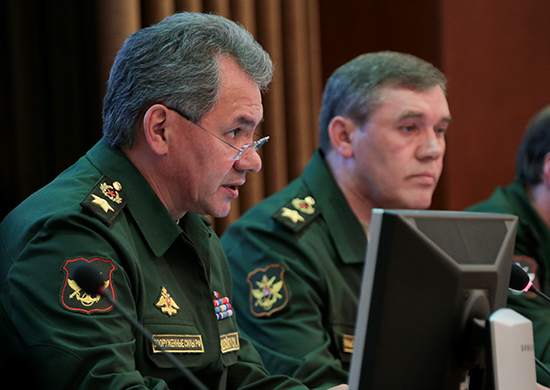
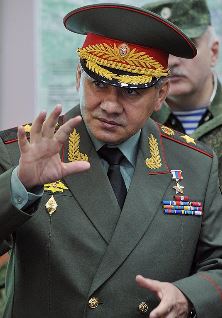
Defense Minister Shoygu Reviewing Exercises (photo: Mil.ru)

Defense Minister Shoygu Reviewing Exercises (photo: Mil.ru)

Shoygu told the assembled brass:

“In the first place, it concerns poor results in destroying targets from TO&E weapons.  One of the main causes of this is an insufficient quantity of ammunition allocated for combat training of brigades according to existing norms.  We already talked about this problem.  Therefore today we need to adopt a clear mechanism to resolve it.”

Shoygu spoke publicly about the need to increase ammunition expenditure “by several times” from the current norm of 20 rounds per tank or artillery crew.  And more explicitly:

“Our colleagues in other countries shoot 160 shells a year per crew.  We have to increase our indicator at least five times.  We have every possibility for this.”

He and his subordinates mulled the irony that Russia destroys old munitions while not enough new ones are manufactured.  Deputy Defense Minister Yuriy Borisov said more money is going to ammunition production.

However, NVO’s Viktor Litovkin noted a different problem — practice firings too routine for crews to learn anything about shooting in combat:

“The first deficiency on which Defense Minister Sergey Shoygu focused is ‘we still shoot poorly.’  The causes here are several.  One of them is the fact that tankers, as a rule, conduct combat firings from training tanks.  Three-four of them per battalion.  The tank range on the brigade training area has been studied down to the last knoll, so that every sight setting is thoroughly well-known.  And how to fire at what distance.  And all targets are well-known.  Behind the sight of a TO&E tank, on unfamiliar terrain, people are lost.  And unacceptable mistakes ensue.”

So, the military leadership is more occupied with the quantity than the quality of training.

There’s a personnel policy connection here too, curiously  unmentioned by the leadership.

There are legions of former conscripts who rarely, if ever, fired live rounds from weapons locked in storage rooms of the barracks during their year of service.  But the planned expansion of contract service should produce many enlisted who stay long enough not only to learn to shoot better themselves, but to teach other contractees and conscripts.

Then there’s always technology.

Recently, Mil.ru reported that the Central MD’s Samara-based peacekeeping brigade [15th Independent Motorized Rifle Brigade] increased the effectiveness of fire training by 20 percent after introducing laser simulators into the process.

This isn’t the first time the army’s used simulators, but it isn’t noted often.

Soldier Outfitted with 9F838 Tselik Laser Fire Simulator (photo: Mil.ru)

Soldier Outfitted with 9F838 Tselik Laser Fire Simulator (photo: Mil.ru)

It shouldn’t be news.  It’s been 34 years since the U.S. Army started using MILES.  What’s surprising is how late this technology is reaching Russian troops.  Mil.ru indicated the 15th IMRB got its simulators through new 2013 procurement.

The system is standard fare.  It looks a tad cumbersome, but it can reportedly be used with any infantry weapon, grenade launcher, or ATGM.

Russia is not so far behind in the technological sense, but more so in simply producing and using laser simulators.

One short dissertation says work on laser simulators began at TsKB Tochpribor in 1986.  Simulators for infantry weapons, BMPs, and tanks were fielded quickly.  The author concludes Soviet ones didn’t lag behind their U.S. or NATO counterparts.

But (he doesn’t note) just around the corner were the USSR’s disintegration and a long hiatus in Russian military procurement.

Still, Tochpribor stayed at the problem, developing new simulators (especially lighter ones) and an automated combined arms training system for up to 900 infantrymen and 180 combat vehicles called Barelef-SV, which passed state testing in 2008.

But domestic development and production like Tochpribor’s cannot fare well against Germany’s Rheinmetall and its €100-million-plus contract to build Moscow a brigade-sized live combat simulation and marksmanship training center slated to open this year in Mulino.

Parts of Russia’s defense industry are getting protection from the possibility of foreign competition (opened up by ex-Defense Minister Serdyukov), but apparently not this part.

Not that Tochpribor and Rheinmetall are in the same league.  The latter’s a world class designer and integrator of military simulators.  A system like that intended for Mulino is network-intensive, and it’s probably beyond Tochpribor’s competence.
Only 7 of 10

Nezavisimoye voyennoye obozreniye published its (Viktor Myasnikov’s) list of the 10 main military events of 2013 on Friday.

Number 7 is “RF Ministry of Defense:  Working on Mistakes.”  Myasnikov describes its importance this way:

“The RF Ministry of Defense leadership headed by Sergey Shoygu reestablished the combat readiness of the Armed Force in the course of 2013.  Active construction, modernization and repair of military towns, bases, airfields, including in the Arctic zone, is on-going.  A number of orders of the previous RF MOD leadership [Serdyukov] were cancelled.  The most important innovation was the conduct of surprise inspections, which transformed into large-scale military exercises.  All services and troop branches take part in them in coordination with other power structures — MVD, including Internal Troops, FSB, MChS, local government organs.  In the course of the inspections, combat training deficiencies are revealed, and coordination of actions is developed, raising the level of combat readiness.”

The complete list reads:

  1. The War in Syria
  2. Mali:  Operation “Serval”
  3. Threat of Nuclear War on the Korean Peninsula
  4. The “Snowden Affair”
  5. The Elimination of Syria’s Chemical Weapons
  6. Agreement with Iran
  7. RF Ministry of Defense:  Working on Mistakes
  8. Boston Marathon Explosions
  9. Civil War in Southern Sudan
  10. Civil War in CAR [Central African Republic]

Still expect to see more “story of the year” lists for comparison with NVO’s.

Wind Blows Hard Across Iturup

Recently saw a compelling piece in Smartnews.ru.

Had not heard of the site, but its text and photos vividly convey the plight of the inhabitants of Russia’s unneeded military towns.

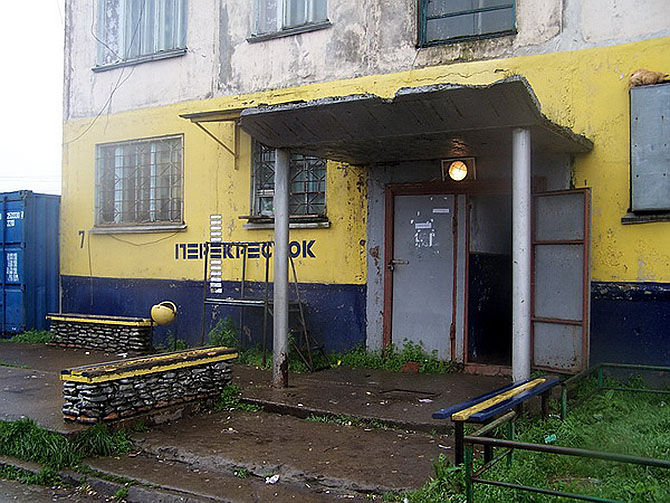
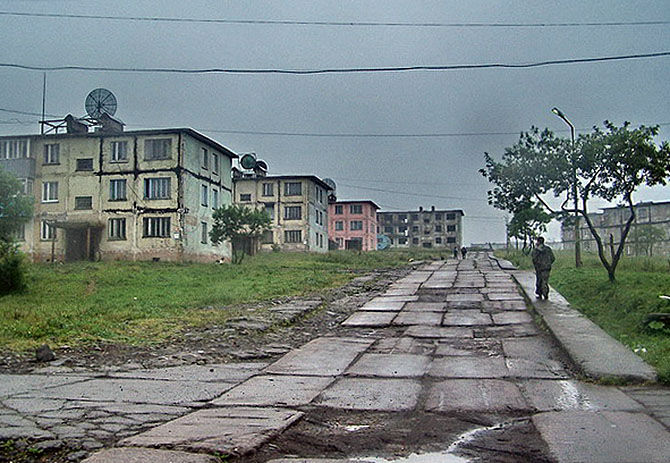
Military Settlement Gornyy on Iturup (photo: ovsiasha.livejournal.com)

Military Settlement Gornyy on Iturup (photo: ovsiasha.livejournal.com)

Five hundred residents of Gornyy, a military settlement on Iturup in the Kuril chain, have appealed for help to resettle them or fix their broken down homes.  Iturup is the northernmost of the four southern Kuril islands which Japan  claims as its Northern Territories.

Gornyy on Iturup Island

Gornyy on Iturup Island

Smartnews writes that the Ministry of Defense still controls Gornyy, but only in a formal sense.  In reality, it has “thrown away” these former colleagues.

Local authorities want to help, but don’t have a legal right.  They can’t spend money on territory still belonging to the MOD.  They aren’t allowed to replace drafty old windows in buildings under a regional initiative called “Warm Windows.”  The Sakhalin Oblast Duma has appealed to Defense Minister Sergey Shoygu on Gornyy’s behalf.

Forces deployed here, units of the 18th Machine Gun-Artillery Division, were withdrawn from the area, but residents remained with no one to maintain their apartment buildings.

A Building in Gornyy (photo:  ovsiasha.livejournal.com)

A Building in Gornyy (photo: ovsiasha.livejournal.com)

Those who could left.  Those not expecting an apartment elsewhere from the MOD, or with nowhere to go otherwise, mostly military pensioners and their families, stayed behind.  Those with jobs work mainly at nearby Burevestnik airfield, built when the Japanese still controlled Iturup.  They will probably become unemployed when a new airport opens on the Sea of Okhotsk side of the island in the not-too-distant future.

One retiree says the once thriving settlement is now like a cemetery.  Some buildings are completely empty.  Their broken windows look like eyes.  The wind blows through neighboring apartments.  He continues:

“. . . we don’t have street cleaning or trash collection.  But mainly, there’s no future.  It’s hard on the morale, it’s simply dying — the feeling that you served at the very edge of the country, protected it, and now no one needs you.”

Officials don’t even come to Gornyy because you can’t pass through it.  It’s the most remote populated place on Iturup.  It’s 50 km to the rayon center (Kurilsk) and the MOD owns the road and isn’t in a hurry to maintain it.

An oblast Duma deputy says:

“It’s not easy living there for the military, I have complaints from several:  the boys have left, there is no one to register them [as legal residents in internal passports], no one can get medical insurance, or even vote in elections.  So people live, although there is some infrastructure there — a school, kindergarten, stores, but they don’t want to live there.”

Local authorities do what they can, arranging traveling medical care for people in Gornyy.

But ultimately, Smartnews writes, neither Gornyy nor Sakhalin can decide anything, the MOD needs to make a final determination on its property and clarify the fate of those living in the settlement.

Some former military in Gornyy, however, still hope the MOD will deploy an S-400 unit near their settlement and revitalize it.

Gornyy is an extreme case, but still similar to that of thousands of other military towns as well as many neglected and forgotten civilian settlements.

Air Forces Half Out-of-Order

"OAK-Service" Initial Corporate Structure (photo: Kommersant)

“OAK-Servis” Initial Corporate Structure (photo: Kommersant)

Kommersant’s Ivan Safronov and Yelena Kiseleva wrote Monday (28 October) on the status of devolving Oboronservis’ Aviaremont into a subsidiary of the United Aircraft Corporation (OAK).  In the process, they indicated less than half of Russia’s combat airplanes are serviceable.

Aviaremont enterprises will become OAK-Servis subholdings.  The factories will repair aircraft for the Defense Ministry, and for other power ministries and agencies.  OAK and the MOD already have an 84-billion-ruble contract for repairs in place.  Meanwhile, Aviaremont owes the MOD 115 billion, which OAK has promised to make good.

OAK-Servis is supposed to provide life-cycle support for MOD (mainly VVS) airplanes.  And it will “correct an unfavorable situation in the condition of the current inventory of the Air Forces, which still aren’t guaranteeing the necessary level of technical combat readiness,” Kommersant writes.

OAK-Servis will establish service centers and 24-7 mobile repair teams, then, in 2015-2018, modernize capital equipment in its repair plants.  It will also grapple with a problem it can’t solve in the short-term, “the cessation of industrial output of components and systems used in the repair of old aircraft models and the rising price of spares and parts.”

But OAK believes it can ensure a profit for plants that once belonged to Aviaremont.  Ruslan Pukhov tells Kommersant less money in the next GPV means less procurement and more repairs and modernization after 2020.

Now for the interesting part . . .

In a sidebar, the authors describe the parlous state of technical readiness in the Air Forces.

All VVS units are supposed to be in “permanent readiness,” with not less than 80 percent of the airplanes in their established composition in a serviceable state.

But Safronov and Kiseleva report only 42 percent of VVS airplanes overall, and 49 percent of its combat airplanes, are serviceable.

The most serious situation with fitness for flying is found in Tu-160 and Tu-22 [Tu-22M3] bombers, the MiG-29 and MiG-25, An-22 transports, L-39 trainers, and others for which serviceability hovers around 20-25 percent.

In 2013, the VVS had 696 airplanes in need of repair, but as (or if) new ones reach the inventory toward 2020, the number in need of repair will reportedly decline to just 49.

The sidebar says, along with repairing MVD, FSB, and MChS platforms, OAK repair plants will also have to maintain and overhaul exported airplanes.

Recall for a moment the MOD’s Action Plan to 2020 . . . the section on equipping the armed forces indicated year-end VVS aircraft serviceability rates will be 55 percent in 2013, 75 percent in 2014, and 80 percent in 2015.

These numbers require pretty fast improvement.

VDV Gets Army’s Air Assault Brigades

Mil.ru reported today on President Putin’s 11 October ukaz transferring administrative and operational control of air assault brigades in Ussuriysk, Ulan-Ude, and Kamyshin from Eastern and Southern MD Commanders to General-Colonel Vladimir Shamanov and the VDV.

The MOD website says the decree is No. 776; it doesn’t appear on Kremlin.ru yet, but may later.

Mil.ru reported VDV commissions are already surveying the condition of weapons, equipment, and facilities in the three brigades, and converting their training program to match that of the VDV.

Shamanov announced that this change, and others, were pending back in early August.

Golts Sidebar

Is a caption even necessary?

Is a caption even necessary?

The Golts article on Sergey Shoygu’s tenure is largely on-point.

But, for whatever reason, Golts neglects a positive change wrought by the new defense minister:  the surprise readiness inspections conducted since the beginning of this year.

While no longer a “surprise” and not as large-scale as the MOD would like us to believe, the exercises demonstrate what’s wrong and needs fixing.

But let’s return to some criticism, or witticism.

Along with Golts’ article, Kommersant published a sidebar listing Shoygu’s “significant” decisions.  Olga Shkurenko compiled it.

“New Annals of Military Organizational Development”

“A Chronicle”

“‘Ogonek’ has recalled the loudest of loud initiatives to strengthen the army and navy put forward during the time Sergey Shoygu has been in the post of defense minister.”

“On 7 November 2012 the minister decided to resurrect the tradition of Suvorov and Nakhimov cadets participating in the 9 May parade.”

On 12 November it became known that shoulderboards soon again will be worn on the shoulders, not on the chest.”

On 7 December it was decided to resubordinate military VUZy to the CINCs and Commanders of the services and branches of the Armed Forces (the MOD’s education department managed them previously).”

On 9 December Shoygu proposed reestablishing the Defense Ministry’s film studio.”

On 24 December the MOD announced that the troops will get a new uniform in 2014 and stop wearing undercollars.”

On 14 January 2013 Shoygu announced that by year’s end the army ‘should forget the word footwrappings.'”

On 25 January the Air Forces agreed with the minister on returning red stars instead of tricolors to the sides of airplanes and helicopters.”

On 4 February Shoygu gave the order ‘to install showers in all military units before the end of 2013.'”

On 26 February plans were announced to reestablish the institution of warrant officers.”

On 7 March mass media announced that the MOD had disposed of gas masks for horses.”

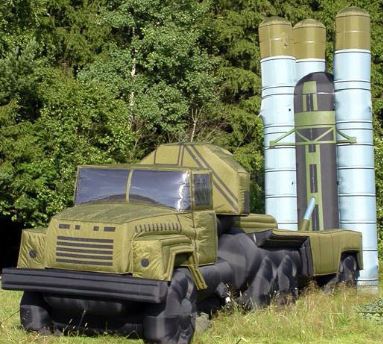
On 13 March ‘Interfaks’ reported from a source in the company ‘Russian Balloon’ that in 2014 purchases of inflatable tanks, aircraft and missile systems would begin.”

On 18 March the MOD press-service said that in 2013 172 dining halls of military units are transferring to the ‘smorgasbord’ feeding system.”

On 29 March the reestablishment of the first sports company was completed.  Then the minister proposed creation of analogous ‘scientific companies.'”

On 2 April the MOD culture directorate was created.  The poster contest ‘Homeland Army’ and the rebirth of army KVN¹ are among its first initiatives.”

On 3 April an OPK source said that the army was rejecting camouflage on tanks and other combat equipment and returning to a one-tone color scheme.”

On 9 and 16 April the recreation of the historic Preobrazhenskiy and Semenovskiy regiments was completed.”

On 4 May the earlier disbanded Taman and Kantemirov tank divisions [sic] were reestablished by decision of the minister.”

On 22 May in the State Duma the minister proposed to send those conducting alternative service in the army and navy to perform construction and housekeeping duties.”

On 23 July after the exercises in the Eastern Military District the MOD chief proposed ‘increasing by several times’ ammunition expenditure norms.”

On 31 July Shoygu ordered commanders to begin every morning in the barracks with a rendition of the Russian Anthem, to compile an obligatory military-patriotic book reading list and take the preparation of demob albums under their control.”

On 14-17 August the first competitions in the tank biathlon took place in the Moscow region at the minister’s initiative.”

On 16 August it was announced that the ‘office suit’ is being introduced for military men and civilians serving in the department.”

On 20 August it became known that in the MOD they are working on the issue of rearranging the Russian anthem in two variants — for a standard choir and for young people.”

¹KVN is a little hard to describe.  Literally, the “Club of the Happy and Resourceful.”  A television game show where teams from various institutions and organizations compete in answering questions and performing skits.

Golts on Shoygu’s Tenure (Part II)

Shevtsova Sporting the "Office Suit" with Four General's Stars

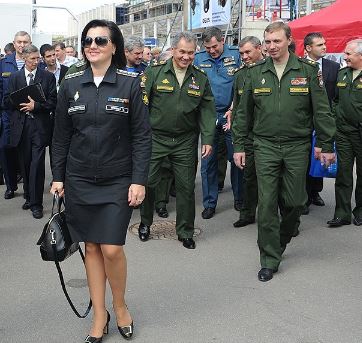
Shevtsova Sporting the “Office Suit” with Four General’s Stars

Continuing with Golts’ Ogonek article, “From Reforms to Uniforms.”

“XXI century style”

“It stands to reason that deeply patriotic content received as a result of regular and repeated performances of the anthem require corresponding forms. Uniforms that is. Shoygu decided to dress all MOD, other staff and management employees in so-called office suits. The minister, his subordinates say, came to the conclusion that wearing a woolen jacket in summer is uncomfortable. So it was decided to sew a uniform reminiscent of the one MChS officers wear.”

“And so now not only the military, but civilian employees of the MOD will have to wear the office suit. Not only that, these same office suits come with shoulderboards. Now every civilian worker has to wear shoulderboards with stars corresponding to his bureaucratic rank. So, at the tank ‘biathlon’ competitions (incidentally, yet another of the minister’s well-known inventions) Deputy Defense Minister Tatyana Shevtsova appeared with four stars on her shoulderboards corresponding to army general rank. And Deputy Minister Anatoliy Antonov, who’s spent his entire life in the diplomatic arena, currently sports general-colonel’s shoulderboards.”

“This redressing is hardly the innocent whim it might appear to be. Really it’s a continuation of that line which began when Shoygu himself donned a general’s uniform at the moment of his appointment as minister of defense. In this logic the Ministry of Defense is not simply the military department, it’s the department where military men command and give orders. And civilian officials turn up there only in the extreme case when they can’t get along without them or there is reluctance to spend money on big salaries to officers. As a result they let civilian employees know that they are not quite military. But cadre officers can’t but experience irritation when civilian bureaucrats receive ‘for nothing’ stars very similar to those which they earned through blood and long years of service.”

“Behind all this is an obvious unwillingness to understand that civilian bureaucrats and servicemen have principally different missions. Civilian bureaucrats are needed to translate the political will of the country’s leadership into the language of military orders, to give the army its missions, to provide the Armed Forces essential financial and material resources, and also armaments. The military themselves have to be occupied with strategic planning and organizing combat training. If those same military men determine threats and missions and are also occupied with material support and financing, this unavoidably will lead to threats multiplying several fold.”

“It seems Sergey Shoygu, an outstanding administrator, to his misfortune ended up somewhere with Dmitriy Rogozin and caught a virus from him which leads the ill person to flamboyant initiatives. Remember the proposals about producing military toys at OPK enterprises, the advertisement of weapons by aged Hollywood stars, and the merger of space and aviation industries? It seems the chief of the military department has set off along the same road.”

“It occurs that the nation’s most popular minister turned up today in a complex situation, from which some organizer talents are clearly not enough to escape. The development of the Armed Forces has gotten to the point of bifurcation. It’s more or less obvious that the missions set down by Serdyukov’s reformers were not fulfilled. Permanent readiness formations exist, it seems, only in the victorious reports of military leaders. Due to the shortage of servicemen in brigades they’re forced to form only permanent readiness battalions which are fully manned. It’s obvious that manning the Armed Forces to one million servicemen in six months as the [supreme] commander-in-chief has demanded is impossible in principle (the single rational explanation for joining MChS to the MOD — an attempt to fulfill the president’s order by bureaucratic means).”

“It’s just as obvious that we aren’t getting any kind of rearmament — the conclusion of a large contract for the production of 37 MiG-35 fighters was just put off to 2016. The main reason is that industry is incapable of meeting a contract. Not everything is OK with the resolution of social problems. Despite promises, the housing line grows, and those who have the right to receive it are not at all in rapture at the idea of being given money instead of apartments.”

“There’s a complex choice in front of Shoygu. It’s possible to go along the path of Serdyukov’s reforms. It would mean honestly announcing that forming million-man Armed Forces is impossible in principle, and attempting to convince the political leadership of the necessity of limiting the army’s size to 600-700 thousand servicemen. And then concentrating on the selection of the quantity of contractees necessary to form fully volunteer Armed Forces. Meanwhile, it’s necessary to engage the defense industry in grievous battles to force it to produce what the army needs and not what it wants. However, all this would place Army General Shoygu in opposition to the Russian military lobby, exactly as it did Serdyukov who is reviled by everyone.”

“The other path is counter-reformation. Agree with the generals’ demands for the return of two-, or better three-year conscript service, return to the mass mobilization army concept, allow VPK [the government’s Military-Industrial Commission] directors to waste the defense budget. But in this case too it’s necessary to grapple with serious conflicts. Not with generals, but with society.”

“Shoygu, however, doesn’t want to lose his ratings. Therefore he’s trying to avoid any conflict. But how do you remain the center of public attention and visible while avoiding fundamental decisions? Here the initiatives about office suits, demob albums and anthem performances go into motion. The danger is the achievements of Serdyukov’s reforms, attained with such difficulty, will go away… in anthem singing.”

Golts on Shoygu’s Tenure (Part I)

Aleksandr Golts is a formidable critic of Russia’s Defense Ministry.  If only the  MOD had a proponent to match wits with him.

Sergey Shoygu

Sergey Shoygu

Golts’ latest appeared in Ogonek on 2 September.  He gives his view on what is getting Defense Minister Sergey Shoygu’s attention.

Nothing else added or explained.  Just translated:

“From Reforms to Uniforms”

“Aleksandr Golts: The Defense Ministry is overgrown with shoulderboards”

“A series of recent Defense Ministry initiatives occasions more and more questions”

“Aleksandr Golts, Daily Journal observer”

“Recently one of the Moscow papers announced sensational news: Defense Minister Sergey Shoygu proposed that the president subordinate the Ministry of Emergency Situations to the military department. It’s all the same, they say, MOD troops by necessity participate, like now in the Far East, in any large-scale rescue operation. Experts, whom journalists rushed to interrogate, shrugged their shoulders: stupidity, of course. Some, who are older, remembered perfectly how in the beginning of the 90s Sergey Shoygu himself and his associates argued: it was essential to remove the civil defense troops from the Armed Forces to establish MChS on the basis of them. They, the rescuers, really have a completely different mission than the army, which, however you look at it, is concentrated on organizing armed force. Everyone knows: Shoygu resolved this problem perfectly. And so in place of civil defense troops, where they sent all army disciplinary offenders, soon appeared MChS, one of the departments most respected by the public. Moreover, the Armed Forces just went through the very painful Serdyukov reforms which, besides everything else consisted of changing structures and missions, redeployments and resubordinations. In the event of uniting MChS [to the MOD] this bureaucratic wheel would be doomed to turn again, really stopping combat training for another 1-2 years. It was impossible to believe that Shoygu, one of the not numerous talented Russian administrators, could come forth with similar initiatives. However in answer to the question are similar things possible, the experts began to hem and haw and in the end said now everything is possible in Russia.”

“Let’s sing friends”

“The fact is recently news has come from the military department, which, putting it mildly, is ‘more and more wonderful.’  Not long ago they decided to be seriously occupied there with the patriotic indoctrination of Armed Forces personnel. Sergey Shoygu ordered: ‘I ask commanding generals and commanders to ensure that the Anthem of Russia is performed. I order that in military collectives every morning should begin with the singing of the Anthem, no matter what the servicemen are doing.’ And later he ordered the famous Aleksandrov Russian Army ensemble to arrange immediately two versions of the anthem — a model, so to say, strict one, for performance exclusively by a choir and orchestra ensemble, and a pop one, for the military-patriotic indoctrination of the young. Stage stars including Lev Leshchenko and the group ‘Lyubeh’ will be invited to perform it. And this despite the fact that according to the Internal Service Regulations the Russian anthem is performed every day at evening roll call in every military unit. But, apparently, one performance of the anthem isn’t sufficient to achieve the necessary degree of patriotism in servicemen. It seems the degree of patriotism is directly dependent on the frequency of its performance. If so, then it shouldn’t stop at two performances a day, they could sing the anthem every hour. They could, in the end, make the army like a monastery and stand several hours for patriotic morning service. The main thing is results you know.”

“The issue of patriotic indoctrination isn’t exhausted by the performance of the anthem. ‘I’m inclined to have commanders lead the process of preparing demobilization albums¹, since every military unit has its own history,’ said Shoygu. It’s proposed to prepare this, more recently strictly individual, product of the soldierly creativity centrally using modern printing and photographic equipment. It’s curious, will the more recently obligatory element of creating such an album — photos depicting precisely what the demob dreams of doing when he leaves his military unit be centrally produced… Obviously, army political workers believe he intends to sing the state anthem again. But this isn’t all. ‘If we aren’t able to prepare a single history course for the country, we need to prepare such a textbook for the army and introduce it into all courses of instruction for servicemen,’ said the minister. If everything is understood with the performance of the anthem, then the authors of this separate army, strictly correct and patriotic history textbook still haven’t been determined. Nevertheless, it’s possible to guess both the authors and the content.”

¹Not necessarily reverent scrapbooks conscripts have traditionally assembled about their service time.