Thrust Control Problem on Bulava

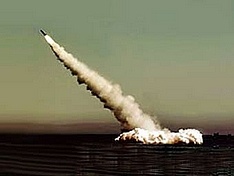
Bulava Test (photo: IA Rosbalt)

 Aleksey Nikolskiy in Vedomosti reports that Bulava testing will resume this summer.  He says the problem in December may have been a defect in the third stage engine, not a design flaw. 

Tests may resume this summer from the modified Dmitriy Donskoy SSBN.  Yesterday ITAR-TASS reported a minimum of two tests would be conducted from Donskoy.  If successful, testing would move to the missile’s intended platform, the new Proyekt 955 Yuriy Dolgorukiy, this fall.  

A Navy Main Staff representative told Vedomosti that Dolgorukiy would need to fire several missiles in a salvo launch.  An industry source said, if all these tests were successful, a “preliminary document on completion of the first phase of testing” could be signed and serial production of the missile could start. 

The Defense Ministry and OPK commission investigating the December failure has provided optimism for those involved, according to a source close to the commission.  In his words, a third-stage thrust control mechanism produced by the Perm-based NPO Iskra failed in the December test.  So some conclude the missile’s overall design is sound and it makes sense to continue work on it. 

Mikhail Barabanov says “shock work” on Bulava might be risky, since MIT already promised that it could produce the missile quickly and cheaply.  Konstantin Makiyenko reiterates the lack of an alternative missile to keep a naval component in Russia’s strategic nuclear forces. 

Denis Telmanov in Gzt.ru adds that a Defense Ministry source has not excluded the possibility that another design bureau, possibly Kolomna Machinebuilding, has gotten orders to work on a missile.  The Makeyev GRTs is another possibility, but its deputy general designer responded that quick development of a missile was physically impossible.  He said, even from an existing system, it would take 5-6 years.  And he said no one in the country’s leadership has taken a decision to start work on a new missile. 

All stories repeated the expressions of support for Bulava from the Defense Minister and Navy CINC.

Moscow Makes Note of U.S. Exercise with Estonia

In Gazeta, Denis Telmanov covers plans for a U.S. amphibious landing exercise in Estonia on 11 July.  According to Tallinn, 500 U.S. Marines will land from the USS Whidbey Island (LSD-41) and conduct a 10-day exercise with an Estonian recce battalion.  Estonia’s Defense Minister says this exercise will show that NATO’s serious about defending the Baltic states.  He said it won’t have any aggressive character, and therefore won’t harm relations with Moscow.  Telmanov raises the issue of whether this exercise prepares a defense against Russia in a Georgian-style scenario.

Then Telmanov turns to Leonid Ivashov to comment and he’s at his vitriolic best.  Ivashov calls the exercise hidden aggression against Russia, “When exercises are conducted, a situation is played out, no one just simply conducts exercises.  In every instance, the U.S. wants to work out scenarios of military action in these countries, since they see a threat from Russia.” 

Ivashov thinks the U.S. has the strategic aim of gaining “maneuver room” in the Baltic.  He concludes, “Controlling this territory, it’s possible to organize everything there as it suits–color revolutions, crises.  But the Baltic–this is a sore point for Russia, right next to the second capital–St. Petersburg.  These exercises need to demonstrate how far these three countries have moved away from Russia.”

New Officers’ Honor Code and Ethics Needed

Over the weekend, a Defense Ministry source told Interfaks-AVN that, until 1 February, officers in units, brigades, and ships are discussing a new honor code.  Deputy Defense Minister Nikolay Pankov is leading this broad discussion on the “moral profile of the contemporary Russian officer.”

A new set of corporate ethics for officers will be adopted during the Defense Ministry’s 3rd All-Army Assembly of Officers this November in Moscow.  The Assembly will address raising the educational level and professionalism of officers, the “social-legal” defense of servicemen, and raising the status of officers in society.

Today Aleksandr Konovalov told Gzt.ru that military men need to choose their work as service to the people not just a profession, and officers need to have higher standards than average citizens.  He describes his idealized vision of an officer who has a high sense of justice and duty, values the lives of his subordinates, and won’t use the army for anyone’s private interests, including those in power.

Vitaliy Shlykov also gave Gzt.ru his view on military professionalism.  He says there are now way too few instructors who can impart the qualities officers need–competence, traditions and ethics, and corporateness.  The basic provisions of the new code need to be laid out first though, according to Shlykov.

Konovalov wants to start from scratch.  “New profile officers” have to be formed outside the existing army traditions, which have appeared spontaneously and not always honorably.

How does this square with the reality that officers commit most crimes in the Russian Armed Forces?  Not well.

In the midst of an optimistic army crime report on 26 November, Krasnaya zvezda admitted:

“One of the main problems is the growth of legal violations among officers, including stealing budget money allocated for defense needs, and other corruption crimes by military officials.  The scale of ‘officer’ crime has reached the highest level in the last decade.  Today every fourth registered crime among the troops is committed by this category of servicemen, a third of them are of the corruption type.  The losses caused to military units and organizations by these crimes have increased by one-third and exceed the half-billion level.  The structure of this type of crime has substantially transformed.  Today the theft of military property and financial means is almost half of all the legal violations of officers.  The quantity of cases of bribetaking, of forgery of duty positions, of appropriations, and expenditures has grown substantially.”

According to KZ, senior officers are more often the perpetrators.  In the last year, they committed more than half of all illegal acts.  In 2008, 20 generals and admirals were held criminally responsible, 1,611 officers, including 160 unit commanders, were found guilty.  Out of the 874 people held criminally responsible in 2009, 162 were commanders of units, 127 were colonels and captains 1st rank and 14 were general officers.  More than 270 people were convicted, including 3 generals.  In 2009, over 5,500 law violations were uncovered in this sphere over the course of prosecutor inspections.  The losses amount to 2 billion rubles.

The smaller officer corps–now 150,000 according to the Defense Ministry–and the possibility of dramatically higher pay for all officers by 2012 might reduce officer crime and make those officers who are still part of the ‘new profile’ more honorable and ethical.

More on ‘Steppe’ Garrison, How Not to Handle PR

According to RIA Novosti, the SibVO has declared ‘Steppe’ fully restored in  heating.  Recall that 2,000 were without heat since 22 December and 100 residents were evacuated in temperatures as low as -47 C (-53 F).  All apartment blocks and the school have heat now.  The restoration ultimately required joint efforts by repair crews from various locations in the SibVO, the Air Forces, and Zabaykalskiy Kray.

The apartment management unit chief, Lieutenant Colonel Konstantin Kondrashov, charged with negligence in maintaining the garrison’s communal services faces a maximum punishment of three months arrest.  The authorities say the repair work costs millions of rubles.

They plan to restore heat to the kindergarten by week’s end.  There are minor problems still in two buildings and one boiler needs another piece of equipment.

Today’s Rossiyskaya gazeta criticizes the SibVO for concealing the problems in ‘Steppe.’  At first the command said there was only a problem with one boiler, but in fact all three in the boiler house broke down, leaving all 2,000 inhabitants without heat.

One resident said, by 28 December, it was +2 C in her apartment with two electric heaters going.  The electric grid couldn’t handle the load.  At this point, people started calling the news agencies and the governor for help.  And the military denied that ‘Steppe’ had been without heat for a week and said there was a problem in only one building.  On 26 December, the SibVO claimed electricity was restored to all three buildings that lost it due to the extraordinary load on the grid.  On 30 December, Lieutenant Colonel Kondrashov said all buildings were getting heat.

One officer said:

“Everything they say about restoring heat is complete bull.  All buildings have ruptured pipes, one after another batteries in apartments give out.  But the garrison’s leadership gives the impression that everything’s normal here!  The SibVO leadership sits in warm offices, not knowing the real situation, I wish one of them had come here.  My name is Nikolay, I’m an officer, serving right now in Steppe.  Believe me, we’re dying out here.  The command hasn’t done anything in the course of a week and concealed the crisis.”

On 30 December, Kray officials intervened with help for the garrison and the situation had improved by 6 January.  On 8 January, 20 repair crews were working in Steppe.

But maybe the incident had something to do with the poor condition and obsolescence of the garrison in the first place.

Unrest in the Black Sea Fleet?

In Part 2 of his article, Shurygin ended by describing the Black Sea Fleet as being on the verge of an explosion.  We’ll see if he elaborates on this in the final part when it’s published.

Meanwhile, on 12 November, Moskovskiy komsomolets wrote about thousands of officers and families in Sevastopol “thrown to their fate,” without the possibility of getting a job in Ukraine, and left practically without money and housing.  The author, Yekaterina Petukhova, like Shurygin, said the situation in Crimea is on the “verge of revolt.”

Young BSF Officer and Guided Missile Cruiser Moskva

According to Petukhova, 2,000 BSF personnel were cut in 2009, and another 9,000 have been warned that they will be dismissed.  She talked to an officer named Oleg, who said he was one of the “fortunate” ones who were put outside the fleet’s TO&E.

The situation’s not worse anywhere.  They’ve already cut thousands, now they’re mowing down the command and control organs.  When they put you outside the TO&E, for a half year they still pay your salary, but minus premiums and minus the supplement for handling secret information.  But this is nevertheless some money.  But then it’s all gone.  View it however you want.  But we’re all here with Russian citizenship.  Where are they going to let us work?  And we can’t go back anywhere in Russia.  They don’t want to give us the service apartments in Sevastopol which we lived in all this time.  They are proposing several cities in Russia, but there really aren’t apartments there—it’s excavation that could go on forever.  And so officers sit, they don’t get pay, nor can they finalize a pension without a permanent residence permit.

Oleg went on to say that single officers especially don’t know what to do.  They aren’t giving out single apartments and, if they get together with a friend and apply for an apartment for two, they are derided as homosexuals.

He gives his view of how it might end. 

Can you generally imagine such a crowd of healthy men, who know military matters firsthand, wandering around Crimea and the quays?  Some kind of Lenin will be found and he’ll raise a crowd, then people will wish he hadn’t turned up.  The fleet commander is silent, everyone spits on us, a kind of chaos is being created.

Petukhova ends by noting that when Kyiv makes a move against the BSF, Moscow politicians race to the defense of Russian sailors, but they’re all silent when the Russian authorities have driven thousands of BSF men and their families to the edge.  She concludes that the ‘new profile’ of the armed forces has an unpleasant odor.

Still Restoring Heat at ‘Steppe’ Garrison

The press reports heat has been restored in 8 of 10 buildings and the school.  Repair crews are working inside 2 buildings restoring the internal heating and water supply system.  They are replacing old electrical, heating, and water supply equipment.

The school will reopen 14 January, and some residents who have heat and water have started to return to their apartments.

Railroad Troops Officers Put in Sergeant Posts

Railroad Troops Working in Abkhazia

Today a Railroad Troops spokesman provided a year-ender for these bastard children of the Defense Ministry, and he described their efforts to adopt a ‘new profile’ in 2009.

Most interestingly, the spokesman said that the Railroad Troops have placed 300 excess officers, mostly lieutenants and senior lieutenants, in sergeant billets.  These men, who’ve suddenly discovered they’re no longer officers, will be the first to be promoted into officer positions when they become available, according to the spokesman.  He also said a similar scheme for preserving officer cadres, i.e. demoting them into the NCO ranks, exists in the other services and branches of the armed forces.

So rumors that officers were being ‘offered’ transfers into the NCO ranks turn out to be true.  This was reported as far back as the closure of the SibVO’s 67th Spetsnaz brigade late last winter, but had not been confirmed until now.

The Railroad Troops also put over 1,000 warrant officers into sergeant’s posts, but this downgrading was always an overt part of the Defense Ministry’s plans.

The Railroad Troops spokesman said 1,500 officers and 1,200 warrants were dismissed in 2009, and nearly 1,800 officers and warrants entered the limbo of being placed at the disposal of their commanders, i.e. they’ve lost their duty posts and are outside the TO&E.

Housing remains a problem.  About 3,000 personnel need apartments, or improved housing conditions.  The Railroad Troops need 1,700 apartments for dismissed servicemen.  They were allocated 472 apartments and 81 state housing certificates (GZhS).

Moscow Upgrading CSTO?

Nogovitsyn to be First Deputy Chief of CSTO's Joint Staff (photo: http://www.1tv.ru)

Several days ago, the Russian press reported General-Colonel Nogovitsyn, a deputy chief of the Genshtab and Russian military spokesman during the war with Georgia, would be moving to the Collective Security Treaty Organization (CSTO).  Nogovitsyn’s an air defense fighter pilot and former deputy CINC of the Air Forces who lost out to Zelin in the bidding to become CINC.  He will replace General-Lieutenant Oleg Latypov, who was not an operator, but a military diplomat who came from the Russian Defense Ministry’s Main Directorate of International Military Cooperation (GU MVS) and had experience in arranging arms sales, supplies, and military activities with former Soviet states.

Nogovitsyn’s move could be a pre-retirement posting or it could mean a little more emphasis on the Russian-led grouping.  Today, Interfaks-AVN reports that an operations center will be established for the Collective Rapid Reaction Force within the CSTO’s Joint Staff.  The chief of the center will be a general-lieutenant and deputy chief of the Joint Staff.  These changes follow decisions on a new structure and functions the CSTO made at its meeting last June.

Restoration of Frozen ‘Steppe’ Garrison Continues

Vesti.ru has a good report on the situation.  Notice that SibVO’s acting chief of apartment management is on the scene.  Restoration has proven more difficult than thought.  The 100 evacuated residents have not returned.  Crews are working inside the buildings, but it’s a large amount of work.  There are problems in every building, including five of 10 apartment blocks where full restoration of heating had been reported earlier.  Of course, the military prosecutors are laying the incident entirely on the chief of the garrison’s apartment management unit, one Lieutenant Colonel Konstantin Kondrashov, who faces criminal charges of ‘negligence.’  During preparations for the heating season, he allegedly failed to take needed maintenance measures in the garrison’s boiler room.  See also Newsru.com coverage.

Troops Blow Warm Air into Apartment Block

Medvedev’s Take on Combat Capability

RF President Dmitriy Medvedev

 You may recall after the five-day war with Georgia, and before Serdyukov’s reform announcement, President Medvedev issued his own theses on combat capability.  

Though he’s not a learned military theoretician, Medvedev’s statement is obviously important.  Find coverage at Rosbalt.  

Medvedev said:  

“The development of five factors is necessary for the effective resolution of combat missions.  We are talking about improving the TO&E structure of the troop basing system.  If we speak plainly and directly, all combat formations must be transferred into the permanent combat readiness category.  Second is increasing the effectiveness of the armed forces command and control system.  It’s impossible to count on success in modern combat without this.  Third is the improvement of the personnel training system, military education and military science.  We need an army equipped with the most modern weapons–the fourth factor.  We’ll give first priority attention to this issue, but fundamentally new high-technology weapons types will have special significance.  The fifth factor is improving the social condition of servicemen.  These five factors will determine the combat capability of our armed forces.”  

This is fairly close to what our military scholar published in Voyennaya mysl.  

Medvedev went on to add that, by 2020, Russia will add to its nuclear deterrence, intelligence, air superiority, ground and naval strike, and operational troop redeployment capabilities.  Russia has planned for serial ship and submarine construction, and establishment of an aerospace defense system, according to Medvedev. 

Before becoming president, Medvedev traveled to Kaliningrad in January 2008.  He was still a first deputy prime minister in charge of ‘priority national projects,’ of which housing is (was?) one.  On that occasion, he noted that the resolution of the social problems of servicemen directly influenced the combat capability of the armed forces.  He said it was necessary to solve their housing problems, “otherwise combat capable armed forces won’t exist.” 

Next, there should be some interesting Putin comments on combat capability, also questions in many public polls on the armed forces are couched in terms of what people think about their combat capability.