So It’s Korobov

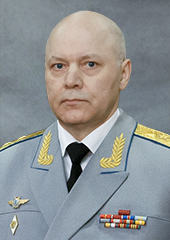
On Tuesday, the Defense Ministry announced that General-Lieutenant Igor Valentinovich Korobov (KOR-uh-buv) is the new chief of Russia’s military intelligence agency, the GRU.

General-Lieutenant Igor Korobov

General-Lieutenant Igor Korobov

Mil.ru carried a sparse press release.

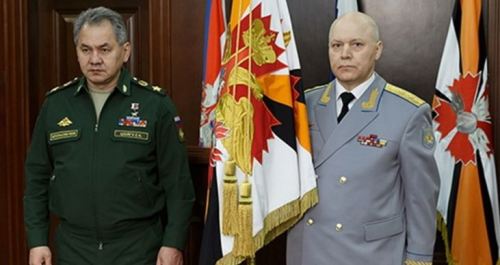
News agencies didn’t have much beyond that.  But TASS provided an official photo of Defense Minister Shoygu and Korobov with the GRU standard.

Shoygu and Korobov

Shoygu and Korobov

It’s clear General-Lieutenant Korobov is no spring chicken.  He’s experienced.  And he’s a career (кадровый) intelligence officer.

We don’t know how long he will head the GRU or when the next transition will occur.  Few can say what (if any) difference it makes who’s in charge.  Fears an outsider from a rival “power” ministry or intelligence service would take over the GRU were apparently exaggerated.

TASS, and a couple other press services, carried one additional note.  They reported Korobov was previously first deputy chief, or second-in-command, of the GRU and chief of strategic intelligence.

The chief of strategic intelligence is in charge of collection, fusion, and reporting of intelligence on military threats to the security and survival of the Russian Federation.  But it’s like one word is so implicit, or regarded as so secret, that it’s left out — agent.  Chief of strategic agent intelligence.

So Korobov managed all GRU human intelligence (HUMINT) collection resources, except its most critical and productive “illegals” and their agents which the Chief of the GRU personally controls, according to Viktor Suvorov (Vladimir Rezun).

While it has capable technical intelligence-gathering means, the GRU relies on HUMINT.  It is focused on information collected from agent operations abroad.  That’s its tradition and its forte.

At its best, Soviet / Russian HUMINT means GRU “illegal” Richard Sorge practically handing Stalin the date of Hitler’s invasion of the USSR months before Operation Barbarossa began.  At its worst, Stalin, for whatever reason, ignoring Sorge’s information.

At its best, it means the USSR defeating the U.S. in just one facet of the Cold War — espionage.  At its worst, GRU officers in the 1990s inventing agents and reports to satisfy their bosses.

We may not learn much about General-Lieutenant Korobov, and it really doesn’t matter.  There’s a new first deputy chief of the GRU and chief of strategic agent intelligence reporting to Korobov now.  Just another turn of the personnel wheel.

What matters more is what it says about Russian intelligence culture.  The Kremlin and the Defense Ministry have never abandoned Soviet (perhaps historically Russian) paranoid mirror-imaging about their enemies.  They believe their enemies have secret diabolical plans to destroy them because they have such plans for their enemies.  Of course, these plans are so secret that no satellite could ever photograph, detect, or eavesdrop on them.  They can only be discovered by human agents, hence the HUMINT emphasis.

Failure to ferret out these hostile plans doesn’t mean they don’t exist; it only means the officers in charge have failed.

And whatever information agents deliver to their handlers, and handlers send back to headquarters, and headquarters prepares and presents to the leadership better fit the latter’s predilections.  Headquarters probably wouldn’t even put forward a story that didn’t track with the leadership’s mindset.

Still Awaiting New GRU Chief

On 13 January, Kommersant’s Ivan Safronov wrote that late GRU Chief General-Colonel Igor Sergun’s successor will be one of the military intelligence directorate’s current deputy chiefs:  Vyacheslav Kondrashov, Sergey Gizunov, Igor Lelin, or Igor Korobov.

General-Lieutenant Vyacheslav Viktorovich Kondrashov reportedly headed a Russian delegation that went to Cairo on an arms sales mission in late 2013.  He is likely a Middle East specialist and Arabic linguist.  He’s an old hand at the GRU headquarters.  It looks like he put on his first star over 20 years ago.  He seems like a timely choice from the GRU’s perspective, but he might not serve much longer.

Sergey Aleksandrovich Gizunov is probably a computer expert or mathematician from the GRU SIGINT apparatus.  He was chief of the Moscow-based 85th Main Center of Special Service which deciphers foreign military communications.  He’d be an unusual pick for an intelligence service that likes experienced field operators at the top.

General-Major (???) Igor Viktorovich Lelin was Russian military attache to Estonia and served for a time as deputy chief of the Defense Ministry’s Main Personnel Directorate (GUK).  He only returned to the GRU in 2014.  Lelin doesn’t seem to have much to recommend him, at least based on what little is known of his background.

Igor Korobov seems to have no information in the public domain.  Safronov’s sources call him a “serious person” and the most probable candidate to take Sergun’s chair.  Although it’s ironic, one has to agree that the lack of data on Korobov makes it utterly impossible to dismiss him as a strong possibility.

According to Safronov, the GRU bureaucracy feared having an outside chief (from the FSO or SVR) imposed upon it following Sergun’s untimely death from a heart attack in the Moscow suburbs on 3 January.  Speculation focused on one former presidential bodyguard named Aleksey Dyumin who quickly turned up as a deputy minister of defense.  So the worry may have passed.  The Genshtab and Defense Ministry now believe the PA will settle on an insider to keep continuity in this important agency.

Ten days ago an ukaz indicating President Putin’s choice was expected “soon,” but no sign of it yet.

Safronov makes the point that the GRU has been busy because of Russia’s operation in Syria.  Its IMINT and SIGINT systems, not to mention its human agent networks, have been working overtime to support Russian military and political decisionmakers.  The GRU also played a critical part in Russia’s invasion of Crimea and eastern Ukraine in 2014.

Just as post-script, we’ve seen in the last day the Financial Times report that Sergun visited Syrian leader Bashar al-Assad to relay Putin’s request that he consider stepping down.  Of course, the Kremlin denied it, but remember Putin said earlier this month that giving Bashar asylum would be easier than Edward Snowden.

Army Commanders

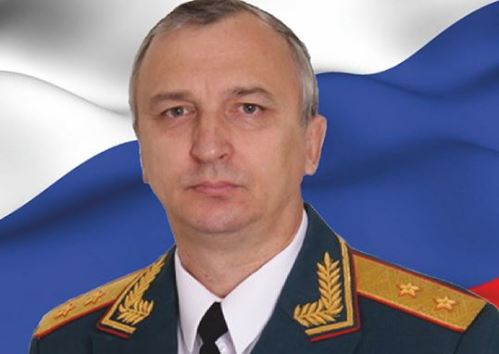
General-Major Aleksandr Chayko

General-Major Aleksandr Chayko

Time to update the leadership lineup for Russia’s army-level ground formations.

Here’s the rundown of armies, headquarters, MD/OSK, and commanders:

1st TA…Bakovka…Western…General-Major Aleksandr Chayko.

6th CAA…Agalatovo…Western…General-Major Andrey Kuzmenko.

20th CAA…Voronezh…Western…General-Major Sergey Kuzovlev.

49th CAA…Stavropol…Southern…General-Major Sergey Sevryukov.

58th CAA…Vladikavkaz…Southern…General-Lieutenant Andrey Gurulev.

2nd CAA…Samara…Central…General-Major Igor Seritskiy.

41st CAA…Novosibirsk…Central…General-Lieutenant Khasan Kaloyev.

36th CAA…Ulan Ude…Eastern…General-Major Dmitriy Kovalenko.

29th CAA…Chita…Eastern…General-Major Aleksey Avdeyev.

35th CAA…Belogorsk…Eastern…General-Lieutenant Sergey Solomatin.

5th CAA…Ussuriysk…Eastern…General-Lieutenant Aleksey Salmin.

The newly organized 1st TA has General-Major Chayko in command.  He previously commanded the 20th CAA.

Four commanders turned over since last check.  General-Major Kuzmenko is new to the 6th CAA.  General-Major Kuzovlev, who reportedly commanded Russian fighters in Lugansk, is reorganizing the 20th CAA on the Ukrainian border. General-Major Kovalenko now commands the 36th CAA and General-Major Avdeyev the 29th CAA.

Where have former commanders gone?

General-Lieutenant Sergey Kuralenko

General-Lieutenant Sergey Kuralenko

General-Lieutenant Sergey Kuralenko, late of the 6th CAA, served in Moscow’s Baghdad anti-IS “information center,” and became a deputy commander of the Western MD in December.  He had already commanded the 49th CAA.  He seems destined to rise higher.

General-Lieutenant Aleksandr Lapin is now chief of staff, first deputy commander in the Eastern MD.

General-Lieutenant Mikhail Teplinskiy departed the 36th CAA for an unspecified post in the Southern MD.

General-Lieutenant Aleksandr Romanchuk is the Russia’s representative to the Joint Control and Coordination Center in eastern Ukraine.

General-Lieutenant Yevgeniy Ustinov and General-Lieutenant Aleksandr Zhuravlev were both, at last word, deputy commanders of the Central MD.

General-Colonel Andrey Kartapolov is perhaps the fastest burner of recent army commanders.  After a brief stint as GOU Chief, he moved quickly to command the Western MD.

General-Colonel Vasiliy Tonkoshkurov is now GOMU Chief.

General-Lieutenant Vladimir Tsilko is a deputy commander of the Eastern MD.

General-Colonel Andrey Serdyukov is chief of staff, first deputy commander of the Southern MD.

General-Lieutenant Igor Turchenyuk is a deputy commander in the Southern MD.  He commanded the invasion of Crimea, and is on the U.S. list of sanctioned Russian individuals.

Twitter Archive

Five years of Russian Defense Policy tweets are available here.  The Advanced Find Add-on lets you search through these 2,200+ tweets.

Constitution Day Promotion List

President Vladimir Putin signed out his military promotion list on the eve of Constitution Day.  It included 1 four-, 1 three-, 8 two-, and 13 one-star promotions along with 2 one-star rear-admiral promotions.

KZ published Putin’s decree here.  The updated list of general and flag officer promotions from this blog is, as always, available here.

Defense Minister Shoygu’s long-time former MChS assistant Pavel Popov put on army general.  He reportedly has responsibility for MOD innovation policy and robotics, inter alia.

Among the promoted were:

  • The chief of GOMU and a deputy chief of the GOU;
  • One army and one deputy army commander;
  • A military district-level air and air defense commander;
  • One VDV division commander;
  • A nuclear-powered submarine diviziya commander;
  • Chiefs of Missile Troops and Artillery, and Electronic Warfare Troops;
  • Two chiefs of regional nuclear weapons storage facilities, i.e. 12th GUMO types.

Particularly interesting cases merit a few more words.

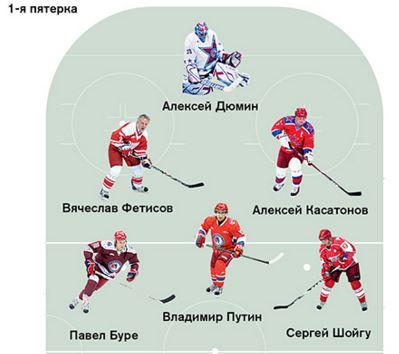
Newly-minted General-Lieutenant Aleksey Gennadyevich Dyumin is apparently the same Colonel Dyumin who served in Putin’s Presidential Security Service, i.e. his immediate bodyguard detail.  According to Vek, he travels, tangentially perhaps, in Putin’s circle of close associates.  He even plays first-team goalie for the president’s hockey squad, according to Forbes.  Dyumin reportedly now occupies the post of deputy chief of the GRU.

Putin's First Five (photo: Forbes)

Putin’s First Five (photo: Forbes)

A variety of Russian social media report that General-Major Konstantin Stepanishchev was leading troops from his 23th Motorized Rifle Brigade fighting for the pro-Russian militia in Lugansk early this year when he was hit by a Grad missile, losing both of his legs.  Six of his boys were killed.

General-Major Gennadiy Anashkin won his Hero of the Russian Federation award in 2008 for leading the Pskov-based 104th Air-Assault Regiment in combat in Tskhinvali.

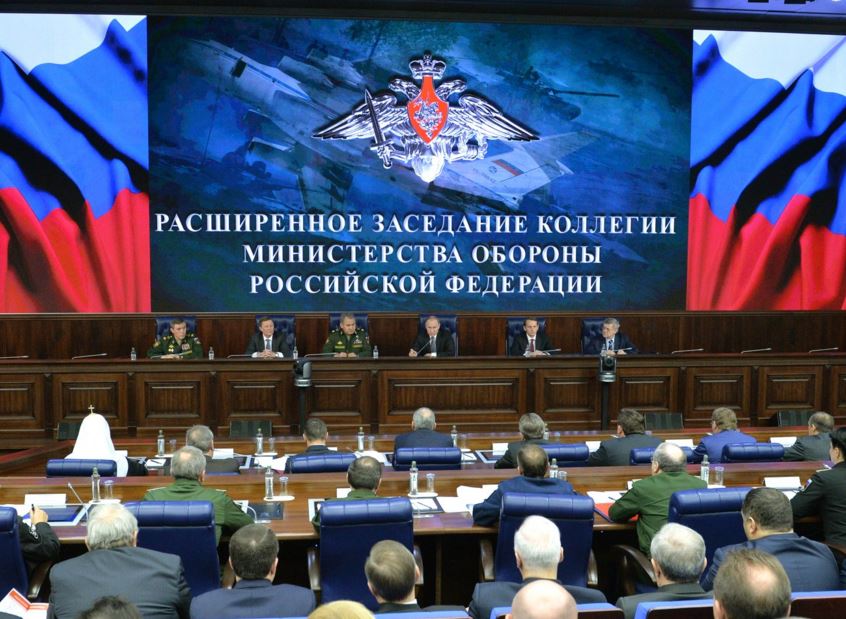
MOD Collegium on 2015

Friday Russian President Vladimir Putin addressed a year-ending expanded meeting of the MOD Collegium.  Below are highlights from his speech, and from Defense Minister Sergey Shoygu’s.  Putin also met separately with Russia’s Military District (MD) commanders, but no transcript was made available.

Putin Addresses the Expanded Meeting (photo: Kremlin.ru)

Putin Addresses the Expanded Meeting (photo: Kremlin.ru)

According to Kremlin.ru, Putin told the Collegium that Russia’s intervention in Syria was prompted not by “incomprehensible abstract geopolitical interests,” nor by the “desire to train [military forces] and test new weapons systems,” although he called the latter “important.”  Rather Putin insisted Russian operations in Syria aim to stop the immediate threat ISIL terrorists pose to the Russian Federation.

Putin told his audience Russian assistance has enabled Damascus to take the offensive in several regions.  As far as other claims of success, the Supreme CINC said only:

“. . . the systematic employment of the forces of the VKS [Aerospace Forces] and Navy, and the use of the newest highly-accurate weapons systems has enabled us to deliver serious damage to the infrastructure of the terrorists, and therefore qualitatively change the situation in Syria.”

He vowed to protect Russian troops saying, “Any targets threatening the Russian grouping or our ground infrastructure will be destroyed immediately.”

Putin then turned to Russian Armed Forces developments and training.  He urged the military not to consider this year’s wartime preparation training by civilian authorities in 14 Russian Federation subjects to be a “secondary” mission.  He mentioned five (not surprising) points of emphasis about this year and next:

  • The updated five-year defense plan (2016-2020);
  • Rearmament and the effective use of the budget;
  • Strategic nuclear forces and aerospace defense;
  • Increasing the intensity of operational and tactical training;
  • Greater cooperation with allies, the CSTO in particular.

Again, he paused to note the need to eliminate shortcomings in territorial defense training in Russia’s regions.

Before turning the mic over to Shoygu, the president stated that the MOD has provided permanent or service housing to 146,000 servicemen over the last four years.

Defense Minister Shoygu outlined first the threat to Russia from an expanding NATO, then from ISIL.  He made the following significant points about 2015:

  • Russia’s armed forces are manned at 92 percent of their authorized level, including 352,000 contractees (i.e. more than the number of conscripts).
  • Six RS-24 Yars (SS-27 Mod 2) regiments were put into service.
  • The share of modern armaments in the RVSN is 51 percent.
  • Two Tu-160, three Tu-95MS, and five Tu-22M3 bombers were modernized.
  • SSBNs carry 56 percent modern weapons.
  • Overall, Russian strategic forces are 55 percent modern.
  • Eight new brigades of various types were formed in the Ground Troops.
  • The Ground Troops acquired 1,772 tanks and armored vehicles, 148 missile and artillery systems, 2,292 vehicles, and two brigade sets of Iskander-M.
  • Ground Troops’ arms and equipment are 35 percent modern.
  • The VKS acquired 243 aircraft of various types, 90 SAM and 208 radar systems.
  • The VKS are 52 percent modern.
  • The VKS operate 1,720 UAV systems against only 180 in 2011.
  • The Navy received two submarines and eight surface ships.
  • The Navy’s modern equipment constitutes 39 percent of its inventory.
  • The VDV’s modern arms are 41 percent of its total.
  • Overall, the armed forces now have 47 percent modern weapons and other equipment, surpassing the goal of 30 percent by 2015.
  • The in-service rate of equipment is 89 percent.
  • There were nine candidates for every seat in MOD VVUZy this year.

Shoygu’s annual report contained many other details summarizing the MOD’s activities this year.

In 2016, he expects the following:

  • Steps to strengthen groupings in the western, south-western, and Arctic strategic directions.
  • Five RVSN missile regiments will go on duty with modern missiles.
  • Two Tu-160 and seven Tu-95MS bombers will be modernized.
  • Two brigade sets each of Iskander-M and Tornado-S MLRS, and one of Buk-3M SAMs will reach the Ground Troops.
  • Six battalions will receive new tanks and BMPs.
  • VKS and Navy will get more than 200 new or modernized aircraft.
  • Five regiments will receive S-400 SAMs.
  • Three Voronezh-DM and Voronezh-M radars will enter service.
  • The Navy will get two submarines and seven surface ships.
  • The armed forces will conduct strategic CSX Kavkaz-2016.

The reader may wish to look back to this 2014 year-ender to make some year-on-year comparisons.

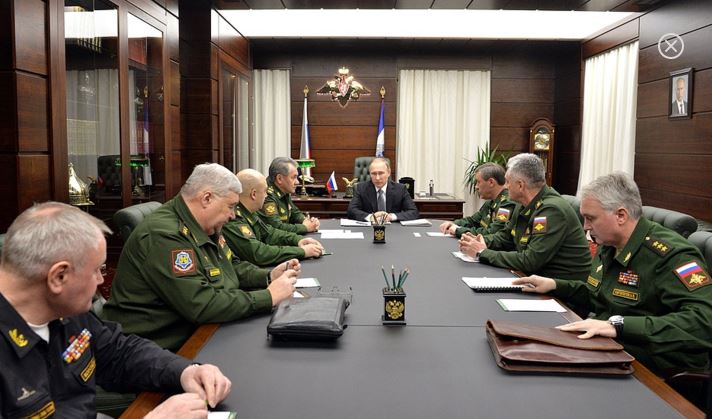
Turning to Putin’s meeting with his top regional commanders, we don’t know what was discussed, but it’s a good pic and a chance to update the lineup and face recce.

Putin's Meeting with MD Commanders (photo: Kremlin.ru)

Putin’s Meeting with MD Commanders (photo: Kremlin.ru)

From the extreme left around the table with Putin in the center, attendees included Unified Strategic Command North Commander Admiral Vladimir Korolev, Southern MD Commander General-Colonel Aleksandr Galkin, Eastern MD Commander General-Colonel Sergey Surovikin, Defense Minister Shoygu, Putin, General Staff Chief Army General Valeriy Gerasimov, Central MD Commander General-Colonel Vladimir Zarudnitskiy, and new Western MD Commander General-Colonel Andrey Kartapolov.

The VDV’s 45th Spetsnaz Brigade

October 24 was the MOD’s Day of Special Designation (Spetsnaz) Subunits.  For the occasion, KZ featured the Airborne Troops’ storied 45th Independent Guards Orders of Aleksandr Nevskiy and Kutuzov Special Designation Brigade.

The 45th was a regiment as recently as 2014, but — as VDV Commander Shamanov promised — it is now a brigade.  Maybe it’s expanded in size with its upgraded status.

We’ve heard nothing yet about whether the 45th was deployed in a deep reconnaissance role prior to (and during) Moscow’s air operation against the various enemies of Syrian leader Assad.  It’s a pretty good bet it did and is.

KZ’s story describes at length the process of joining the brigade.  No one, it says, ends up in the 45th by accident.  All are willing volunteers, and far from every would-be VDV Spetsnaz soldier becomes one.

The very strict selection process including physical and psychological examinations begins with draftees in the Voyenkomat, and continues once conscripts reach the unit.  Besides speed, strength, and endurance tests, candidates have to “spar” in three 3-minute fights.  KZ writes:

“Here’s where the quality of determination is revealed:  this is when a candidate, taking a blow, falls, but then gets up and continues to fight to the end.”

The article reports DOSAAF helps train and identify candidates. Belgorod Oblast’s DOSAAF had an entire company of young men accepted into the 45th last year.  Brigade officers look for potential contractees when they visit VDV and other military units.  However, the article doesn’t provide a current breakdown of conscripts and contractees in the brigade.

The article does say 90 percent of its contractees conclude a second contract. The average contractee makes 35,000-40,000 rubles per month after three years. They are eligible for MOD mortgage and non-resident higher education programs.  The brigade is, KZ writes, a special kind of collective, a family, and officers and soldiers don’t want to leave it.

The article describes the brigade’s jump training.  Traditional D-10, and Arbalet-1 and newer Arbalet-2 ram-air parachutes are used.  About 25 D-10 jumps are needed before trying Arbalet.  Some 20 days of training are required on the Arbalet-2.  Troop testing for this chute was done in the 45th.  A skilled paratrooper can reportedly “plane” up to 17 km in a jump with the Arbalet.  The brigade’s soldiers make about 10 training jumps annually.

Not Much Room Left on the Brigade's Memorial Wall (photo: 45pvdv.ru)

Not Much Room Left on the Brigade’s Memorial Wall (photo: 45pvdv.ru)

Subunit commanders in the 45th remind their soldiers that, “Reconnaissance ends when the shooting starts.”  Especially deep reconnaissance.  The brigade’s primary mission is reconnoitering targets, transmiting their coordinates, and leaving without detection.

But, KZ asks Hero of Russia and deputy commander Lieutenant Colonel Vladimir Seliverstov, with his 15 years of service in the 45th, can’t 21st century technology — satellites and UAVs — replace deep reconnaissance on the ground?  He replies:

“Not fully.  First, a special designation group will direct strike assets against a number of strategic targets no matter what.  Second, after air strikes and artillery preparation, a ground operation begins where special designation subunits will be first to act conducting sabotage and ambushes.  Spetsnaz always work precisely…”

“In recent years, the list of missions put on Spetsnaz has increased substantially.  Some of which I never thought about earlier will be ours.”

Seliverstov notes that the men of the 45th had to equip themselves in 2000, but are now fully outfitted by the state.

KZ writes that an independent reconnaissance detachment from the brigade took part in the operation to “return Crimea to Russia” in the spring of 2014.

The brigade has 14 Heroes of Russia, including four still serving.

A little searching turned up other articles to round out the picture of the 45th. They mostly give the brigade’s history and tend to repeat each other.

There is KZ again, from 2011.

This site gives a bio on current brigade commander Colonel Pankov.  The 47-year-old officer is, of course, career Spetsnaz.  He fought in both Chechen campaigns, and commanded Spetsnaz groups and detachments before becoming deputy commander of the 45th in 2000.  He received his Hero of Russia award in 2001.

Colonel Vadim Pankov (photo: Krasnaya zvezda)

Colonel Vadim Pankov (photo: Krasnaya zvezda)

This one reports that Pankov took command in August 2012 and it has some useful links.

Kubinka’s site covered the brigade’s 20th anniversary in the summer of 2014, and it has some good photos.  The brigade was still a regiment at that point.

The English wiki on the 45th is a little incomplete and a little dated.  The Russian version is more useful, and has a number of sources and links.

But We Make Rockets

Yes, Russia is making rockets now.

Vladimir Putin came to power on the eve of the 21st century promising (among other things) to remake Russian military power.  But progress was slow.  The economy struggled to emerge from the default and devaluation of 1998.  A poor, unready army found itself mired for several years in the Second Chechen War.

Not until after an uneven military performance in the August 2008 five-day war with Georgia — and not until after the 2009 economic crisis, perhaps in 2012 or 2013 — did the funding necessary for significant improvements in combat readiness and larger procurement of weapons and equipment reach the Russian Armed Forces.

Then came war in Crimea and eastern Ukraine and Syria.  Blowback from Syria could make Central Asia or the North Caucasus Russia’s next front. But questions about recent Kremlin bellicosity already bear close to home — on Russia’s domestic political and economic circumstances.

Consider a Gazeta.ru editorial from October 26.

“But we make rockets”

“Can the army and navy replace everything else for citizens”

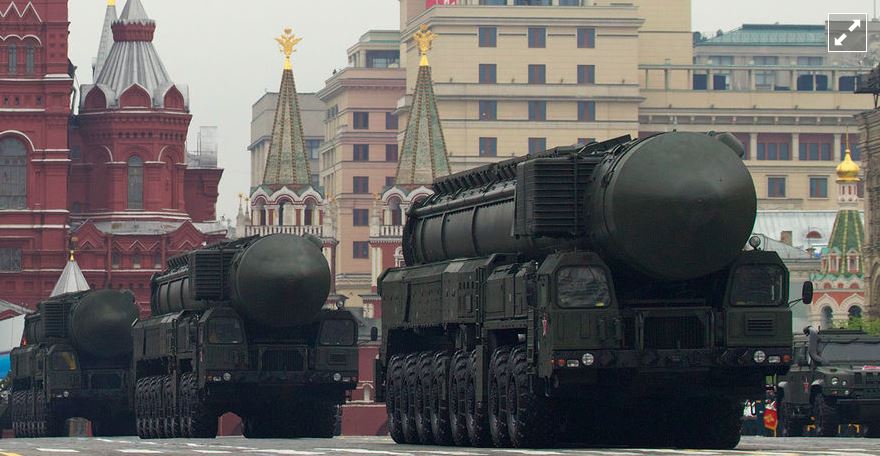
RS-24 Yars ICBMs on Parade (photo: AP / Ivan Sekretarev)

RS-24 Yars ICBMs on Parade (photo: AP / Ivan Sekretarev)

“Often it’s easier for people to accept growing financial hopelessness to the sound of bold military marches.  Not for the first time in Russian history the army is beginning to replace the nation’s economy, life, general human values, and becoming the new old national idea and practically the only effective state institution.”

“Not everywhere in Russian industry are orders shrinking and demand falling.  There is production that is very much in demand.  In the ‘Tactical Missile Weapons’ corporation, for example, they’ve gone to three shifts of missile production for the Syrian front, a source in the defense-industrial complex has told the publication ‘Kommersant-Vlast.’  Against this backdrop, an article appeared in The Independent newspaper about how in Russia, after the events in Crimea and Syria, the army is again becoming the ‘departure point of Russian ideology’ — that very national idea for which they searched so long and unsuccessfully in post-Perestroika Russia and here now, finally, have found.”

“‘Russia has only two reliable allies — the army and navy.’  These famous words of Emperor Aleksandr III (who, incidentally, went down in history we would say now under the nickname Peacemaker) have once again in our history acquired a literal meaning. Other reliable allies of whom Russia was evidently sure over the last year-and-a-half or two years clearly no longer remain with us.”

“In a time of economic crisis, the temptation among Russian authorities to make the army one of the leading state institutions grows even greater.  The remaining institutions are emasculated or work as badly as ever.  In the end, to do this is sometimes simply useless:  the impoverished voter will say — why are your institutions here, is my life improving?  The expenditures are great, but the effect will be, probably, negative.”

“How much better the army is:  there is discipline, and pay, and achievements, and a plan of development.  The share of military expenditures in the budget is growing, but a cut in its absolute size has affected it to a lesser degree than civilian sectors like education and health care.”

“All hope is now on defense — as in ‘peace time’ we placed hope on oil and gas.”

“The army again is a lovely testing ground for demonstrating one more innovation — import substitution.  Not all Russians can understand why it’s necessary to burn up high quality foreign goods. But hardly anyone would object that Russia didn’t buy any aircraft, tanks or missiles abroad.  The president at a session of the Commission on Military-Technical Cooperation Issues announced that thanks to import substitution the country’s defense industrial enterprises are ‘becoming more independent of foreign component supplies.’”

“In general, we found by experience that we didn’t quite succeed in finding any other nation-binding idea over 25 years of not very consistent attempts to draw close to the Western world.  The simple national idea ‘state for the sake of man’ didn’t take root, including, alas, because man somehow didn’t value it very much; attempts to raise free citizens and form a civic nation, bound by common human values, failed.  There were neither citizens, nor values…”

“Being that there wasn’t demand for a free citizen not only above, but even below.  It is precisely therefore that we don’t have normal trade unions, strong nongovernmental organizations, and independent civil initiatives.  It’s not just the state that doesn’t need ‘all this.’  It’s society too.”

“Therefore one year before State Duma elections there isn’t even opposition in political parties to the openly military-oriented budget.”

“Distinct from this is that America which we love to accuse of aggressiveness, but in which military expenditures and their share in the budget are steadily falling in recent years.  In fact, legislative control over the military budget is one of the main forms of civilian society’s control over the army in the USA.  Though in America there were times when the military tried to decide both for society and for politicians.  Considerable force and time was required to put the military under control, but the States succeeded in this.”

“In Russia the easiest and quickest means of unifying the nation turned out to be the bloodless victory in Crimea and the somewhat bloody events in the Donbass.  The idea of abstract imperial power, and the image of ‘the country rising from its knees’ were substantiated, as the man in the street perceived it, and they were near and comprehensible to him.  Like, we lead a miserable life ourselves (when was it otherwise?), but we are a ‘great power’ again.”

“Polite green people, capable quickly without noise and dust of ‘deciding questions,’ create in the multimillion-person army in front of the television an illusion of their own significance.”

“It’s not only the missile corporation that’s working ‘in three shifts’ now, but also the factory of national pride, based exclusively on military victories.”

“Firstly, we are proud of past victories, in which, besides the live heroes of that war, there is no one alive today who isn’t, in essence, a participant:  St. George’s banners and inscriptions on foreign-made cars ‘To Berlin!,’ ‘Thanks granddad for Victory,’ ‘Descendant of a Victor’ flash at every step.  Secondly, they actively urge us to pride in new military victories.”

“Meanwhile the war in distant Syria works for such military-patriotic PR even better than the war in Ukraine.  And further from the borders, pictures of Russian aircraft bombing terrorists a world away inspire the people more than the sullen ‘militiamen’ of which the masses have had enough already.”

“What’s fashionable in war and militancy also enters official political discourse.  Defense Minister Sergey Shoygu has firmly become the second most popular politician and most successful top-manager in the country.  And the president not without some internal pride calls himself the ‘dove with iron wings,’ telling foreign guests directly at a Valday Club session that he was still in the Leningrad courtyard when he learned to ‘strike first’ if a fight is inevitable.”

“And it’s still necessary to remember:  even a war far from the borders, if it’s protracted, requires not  only military, but also great financial resources.”

“So if the economic collapse in Russia continues, pride in the army still cannot fully make up for people the absence of conditions for a normal life.  But for now — in a situation where the authorities live by tactics and not by strategy, — the army and military mobilization of the nation really look like a national idea, and a panacea for the crisis, and a means of supporting a high rating.”

“Polite green people are already capable of becoming not simply a symbol of the Crimean operation, but a symbol of an entire epoch. But they usually don’t solve all the accumulated social, economic, and human problems of a large country.”

How Good Is Russian Electronic Warfare? (Part I)

There’s been a slow accumulation of hysteria about this in the West since Russia’s invasion of Crimea and eastern Ukraine.  Naturally, the Russians didn’t sit on their hands while the U.S. focused exclusively on fighting insurgents and IEDs for more than a decade.

But how much of the Russian EW threat is real and how much imagined?

Let’s turn to Aleksey Ramm who grappled with the question in a two-part article for VPK.  Photos were added along with the translation.

“Electronic Warfare — Myths and Facts — Part I”

“How unique are Russian Army EW systems?”

“Recently Russian electronic warfare systems have acquired the aura of some kind of super weapon, capable, according to average opinion, of causing panic in the probable enemy with the flip of just one switch.”

“It all began with the flight of an Su-24 frontal bomber over the American destroyer ‘Donald Cook’ described in practically all Russian media, during which the Russian aircraft supposedly employed its newest ‘Khibiny’ system.  Its effect on the ship’s electronic equipment almost caused panic leading to the mass resignation of sailors and officers from the ‘Cook.’  Later a photograph appeared on the Internet allegedly of a memorial coin (according to other data — a medal), noting this historic overflight, and on its back side was inscribed ‘Lesson of Peace.’”

“Why did ‘Khibiny’ eat up ‘Cook’?”

“The story of the ‘Donald Cook’ hadn’t quieted down when on 4 August of this year the blog defensenews.com published an article Electronic Warfare: What US Army Can Learn From Ukraine (‘Radioelectronic Warfare:  What Lessons the US Army Can Take From the Ukrainian Conflict’) by author Joe Gould (Dzho Guld), where it’s asserted that the Russian Armed Forces have made a significant jump in the realm not only of developing electronic warfare systems, but in their use, that demonstrates, in the author’s opinion, that a lag has started to take shape for the American military on this issue.”

“We can’t forget that one of the leading developers and producers of Russian electronic warfare systems — Kontsern Radioelectronic Technologies (KRET) is currently conducting an aggressive PR campaign supporting its products.  It’s sufficient to recall that in the media more and more often we hear headlines:  ‘KRET has presented a unique jammer for long-range radar surveillance aircraft,’ ‘Jamming system reliably defends troops from enemy artillery fire’ and the like.”

“Thanks to such popularity of EW it’s not only specialized publications, but even the general media announcing that EW equipment ‘Krasukha-2,’ ‘Krasukha-4,’ ‘Rychag,’ ‘Infauna’ is entering the Russian Army inventory…  And to be honest, it’s fairly difficult even for a specialist to sort things out in this flow of names.”

Krasukha-2 (photo: Nevskii-bastion.ru)

Krasukha-2 (photo: Nevskii-bastion.ru)

“But how effective are the Russian electronic warfare systems being presented and how well is EW organized?  We’ll try to answer these questions.”

“Priority on EW”

“The following fact attests that Russia’s military-political leadership is paying close attention to the development of electronic warfare systems:  the 15th Independent Electronic Warfare Brigade (Supreme Main Command) appeared back in April 2009.  It’s notable that according to some data — besides the 15th obr REB there are only two brigades carrying the title Supreme Main Command in the RF Armed Forces (one engineering and one RKhBZ), but according to other data — it is still the only such brigade of the VGK¹ in the Russian Army.”

“Currently the 15th Brigade, which was earlier based in the Tula oblast town of Novomoskovsk and received its combat banner in accordance with an April 2009 presidential decree, has transferred to [the city of] Tula.  We should note that this formation has been outfitted with the most modern electronic warfare systems, including the still secret [sic] communications suppression system ‘Murmansk-BN’ and ‘Leyer-3’ aerial jamming system.”

Murmansk-BN (photo: www.seyminfo.ru)

Murmansk-BN (photo: http://www.seyminfo.ru)

“Besides the brigade of the Supreme Main Command, since 2009 independent electronic warfare centers have been formed in every military district.  True, the majority of them are currently being reformed into independent electronic warfare brigades.  The exception consists only of the recently formed EW center in the Crimea, subordinate to the Black Sea Fleet command.”

Leyer-3 Mounted on Orlan-10 UAV (photo: Mil.ru)

Leyer-3 Mounted on Orlan-10 UAV (photo: Mil.ru)

“Besides brigades, in every district there are also independent battalions, for example, the independent EW battalion subordinate to the Central Military District command and based in the city of Engels in Saratov oblast.  We should note that, it’s most probable that the mission of such battalions is covering particularly important civilian and military facilities.”

“Strategic battalions equipped with the above mentioned ‘Murmansk,’ and also tactical ones — with ‘Infauna’ systems on a BTR base, R-330Zh ‘Zhitel’ and R-934 jamming stations go into EW brigades and centers.  Besides two battalions in brigades and centers there are also independent companies — one equipped with so-called [anti-]aircraft systems, that is ‘Krasukha-2’ and ‘Krasukha-4’ systems, and a company with aforementioned ‘Leyer-3s.’”

“The recently established Aerospace Forces are also receiving modern electronic warfare systems, we are talking in particular about such equipment as ‘Khibiny’ systems which have recently become almost legendary and are on Su-34 frontal bombers, but also  about Mi-8 helicopters equipped with ‘Rychag’  stations.  Also recently the Russian Air Forces’ aircraft inventory has gotten some jamming source based on the Il-18 — Il-22 ‘Porubshchik.’”

Mi-8MTPR-1 with Rychag EW System (photo: Sdelanounas.ru)

Mi-8MTPR-1 with Rychag EW System (photo: Sdelanounas.ru)

“‘Krasukha,’ ‘Murmansk’ and strong secrets”

“The most secret system in the entire Russian EW arsenal until recently was the ‘Krasukha-2’ jammer, though, currently first place in this nomination has gone to communications suppression station ‘Murmansk-BN,’ supposedly capable of jamming more than 20 frequencies at a range up to 5,000 kilometers.  However, there is no reliable confirmation that the newest system has such characteristics.”

“Judging by existing photographs of ‘Murmansk’ in open sources (several 4-axle increased mobility trucks with tall masts), where beside the main antennas characteristic low-frequency whip antennas are visible, it’s possible to suppose that this system is capable of jamming signals in wavelengths from 200 to 500 MHz.”

“The main problem of such a system, most likely, is that, to achieve the announced range, the signal must reflect off the ionosphere and therefore it is influenced heavily by atmospheric disturbances, which, undoubtedly, affect the operation of ‘Murmansk.’”

“At the Moscow Aerospace Show [MAKS] last year, KRET officially presented the 1L269 ‘Krasukha-2’ system for jamming long-range radar surveillance aircraft (first and foremost American E-3 ‘AWACS’ aircraft) in its static exhibit.  It’s notable that, in the words of the concern’s leadership, this system can jam ‘AWACS’ at ranges of several hundred kilometers.”

“Still, ‘Krasukha’ continues the line of development of the ‘Pelena’ and ‘Pelena-1’ systems worked out back in the 1980s by Rostov NII [scientific-research institute] ‘Gradient.’  A very simple decision put forth by then-director of ‘Gradient,’ but later general designer of the EW department in the USSR Yuriy Perunov underpinned the idea of these items:  the signal of the jamming station must exceed the power of the signal which it is supposed to jam by 30 decibels.”

“Judging by the information we have, it’s very difficult to suppress a target like the E-3 ‘AWACS’ since its radars have more than 30 tunable frequencies which are constantly changing during operations. Therefore, Yuriy Perunov in his day proposed that the most optimal decision would be suppression of entire bands with powerful, focused noise jamming.”

“However, such a decision has serious shortcomings — ‘Pelena’ / ‘Krasukha’ jamming covers only one direction, but the aircraft flies a route, and the effect of the equipment on ‘AWACS’ will be quite limited in duration.  And if there are already two DRLO [long-range radar surveillance] aircraft operating in the area, then even accounting for jamming during the overlap of the particular aircraft E-3 operators will still be able to receive the necessary information.”

“Powerful noise jamming will not only be detected by the radar reconnaissance means of the probable enemy, but will also be a good target for anti-radiation missiles.”

“All these problems were well-known to the developers of ‘Pelena’ from the very beginning, therefore the more modern ‘Krasukha’ became highly mobile to allow it to get away quickly from a strike, but also at the same time to get into a better position to deliver electromagnetic suppression.  It’s possible that not one, but several stations constantly changing position will be used against DRLO aircraft.”

“But ‘Krasukha-2’ is not altogether such universal equipment capable of jamming numerous radars as it is fashionable to believe.  It cannot simultaneously jam both E-8 ‘AWACS’ and E-2 ‘Hawkeye,’ since a jamming station suppressing only the required band of very distinct frequencies for DRLO aircraft radars will be needed for each type of DRLO aircraft.”

“It’s notable that work on ‘Krasukha-2’ began back in 1996 and was completed only in 2011.”

“The ‘+30 dB’ idea is used in yet one more of the newest developments of VNII ‘Gradient’ — 1RL257 ‘Krasukha-4,’ which is at present being actively placed in EW brigades and independent battalions and is designated for suppression of air-based radars, including not only those on fighters and fighter-bombers, but also on E-8 and U-2 reconnaissance aircraft.  True, there are doubts about the effectiveness of ‘Krasukha’ against the ASARS-2 radar at a U-2 altitude, since, judging by the available data, its signal is not only sufficiently complex, but still also noise-like.”

“In the opinion of developers and the military, under certain conditions, the 1RL257 can even jam warhead seekers of AIM-120 AMRAAM ‘air-to-air’ missiles, and also the command and control radars of the ‘Patriot’ surface-to-air missile system.”

“As in the case of ‘Krasukha-2,’ ‘Krasukha-4’ is not a completely original item, but the continuation of a line of jamming equipment in the SPN-30 family, on which work began at the end of the 1960s.  The new station uses not only the concept of the old ‘30s,’ but also, undoubtedly, some of the technical decisions applied in it.  Work on the 1RL257 began in 1994 and was completed in 2011.”

“The ‘Avtobaza’ system also thanks firstly to the Russian media has become together with ‘Khibiny’ some kind of super weapon to the casual observer, knocking down any drone with jamming.  In particular, victory over the American UAV RQ-170 is being ascribed to this system.  At the same time, ‘Avtobaza’ itself, and also the recently accepted into the Defense Ministry inventory ‘Moskva’ system resolve completely different missions — they conduct electronic reconnaissance, they provide target designation for an electronic warfare system and are the command post of an EW battalion (company).  It is understood that ‘Avtobaza’ had a sufficiently tangential relationship to the landing of the American UAV in Iran.”

“‘Moskva’ which is currently entering the force is the continuation of a line of systems of command, control, and reconnaissance of which ‘Mauzer-1,’ adopted into the inventory in the 1970s, is considered the beginning.  In the composition of the new system, there are two vehicles — a reconnaissance station, which detects and classifies types of radiation, their direction, signal power, and also a command post from which data is automatically transmitted to subordinate EW stations.”

“According to the thinking of the Russian military and EW developers, ‘Moskva’ allows for covertly determining the situation and delivering surprise electronic suppression on the enemy’s forces and equipment.  If the system conducts electronic reconnaissance in passive mode, then it forwards commands on radio channels and the enemy can intercept them in certain conditions.  In such a situation, it isn’t even necessary to decode the signals, it’s sufficient to detect the radio traffic and this reveals the presence of each EW battalion (company).”

“Muting satellites”

“Besides battle with the enemy’s aviation means, Russian EW developers devote great attention to suppressing the enemy’s radio traffic, and also muting GPS signals.”

“Developed and produced by Kontsern ‘Sozvezdiye,’ the most well-known silencer of satellite navigation is the R-330Zh ‘Zhitel’ system.  NTTs REB, whose item R-340RP is already being supplied to Russia’s Defense Ministry sub-units, also proposed a sufficiently original solution.  Small diameter jamming transmitters, whose signal is amplified by the antenna array, are placed on civilian cell phone towers.”

“Not just the media, but also some specialists assert that it is practically impossible to mute the GPS signal.  But in Russia technical solutions for ‘turning off’ satellite navigation appeared at the beginning of the 2000s.”

“In the GPS system there is the ‘bearing frequency’ concept.  At the basis of the system lies the transmission of the elementary signal from the satellite to the transmitter, therefore the smallest turning off from the assigned frequency even by milliseconds will lead to a loss of accuracy.  The transmission of the signal goes in a sufficiently narrow band, according to open data — 1575.42 MHz and 1227.60 MHz, and this is the bearing frequency. Therefore modern jammers are focused directly at blocking it which, taking into account the narrowness of the bearing frequency and possession of a sufficiently powerful noise jammer, to silence it does not constitute a special effort.”

Infauna

Infauna

“The ‘Leyer-3’ system with an electronic reconnaissance vehicle on a ‘Tigr’ base, but also several ‘Orlan-10’ pilotless aircraft equipped with dispensable jamming transmitters capable of suppressing not only radio but also cell phones, is a particularly interesting solution in the area of suppressing the probable enemy’s radio traffic.   The ‘Infauna’ RB-531B system produced by Kontsern ‘Sozvezdiye’ fulfills similar missions but without the use of drones.”

__________

¹The practice of holding some forces as reserves of the Supreme CINC dates to the Great Patriotic War (WWII) if not earlier.  The VDV and LRA are both still specified as belonging to the VGK.

Aleksandr Nevskiy Arrives

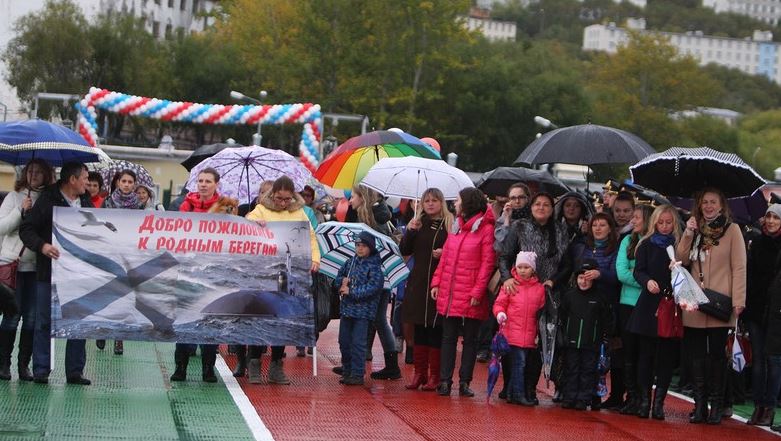
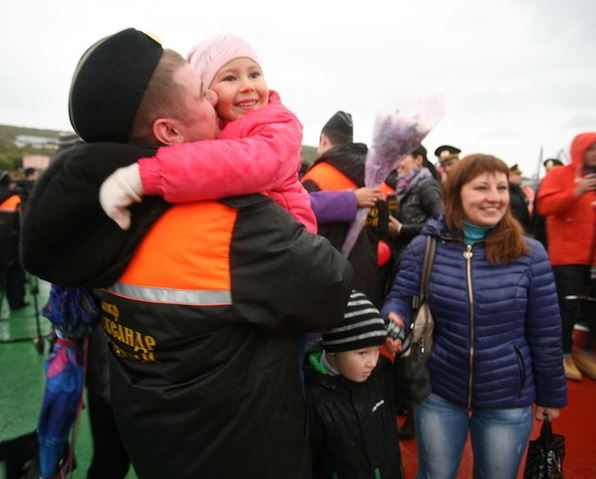
Families Welcome Nevskiy Home for First Time (photo: Pressa-tof.livejournal.com)

Families Welcome Nevskiy Home for First Time (photo: Pressa-tof.livejournal.com)

Following a roughly 40-day inter-fleet transfer, proyekt 955 Borey-class SSBN Aleksandr Nevskiy arrived at Rybachiy at approximately 1700 hours local on September 30.  Families waiting for the submarine held a sign reading “Welcome to Your Native Shores!”

The Pacific Fleet’s website provided lots of good photos of the occasion.

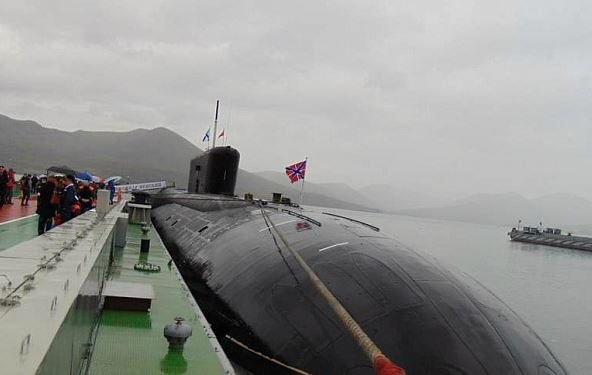
Nevskiy at New Pier (photo: Ministry of Defense)

Nevskiy at New Pier (photo: Ministry of Defense)

NG published this MOD photo of Aleksandr Nevskiy at its new pier.

The MOD press release for Nevskiy’s arrival focused on the reconstruction of the Pacific Fleet’s SSBN base.  It noted that the new base “should systematically underpin the service cycle, base training, technical servicing of submarines, and life cycle support and have essential social infrastructure to allow crewmen to fulfill their duties fully with great efficiency.”

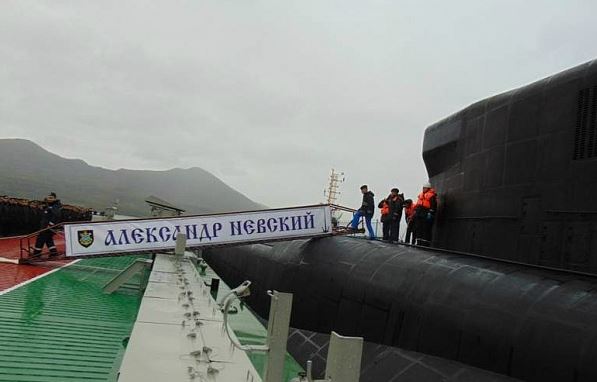
Down the Gangplank (photo: Ministry of Defense)

Down the Gangplank (photo: Ministry of Defense)

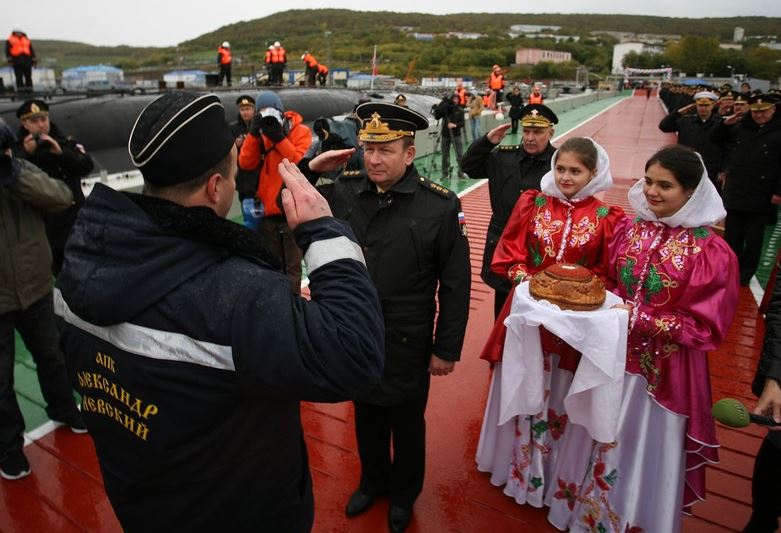
Navy CINC Salutes Nevskiy's Commander (photo: Pressa-tof.livejournal.com)

Navy CINC Salutes Nevskiy’s Commander (photo: Pressa-tof.livejournal.com)

Behind Navy CINC Admiral Viktor Chirkov, Pacific Fleet commander Admiral Sergey Avakyants also salutes.

In remarks to assembled officials, Navy personnel, and families published on Mil.ru, Chirkov said the Pacific Fleet’s submarine force is in a “renewal phase.” Demands on the training of submariners are greater now that 4th generation boats are entering the fleet.

Admiral Chirkov added that the design of 5th generation submarines has begun within the framework of the 2050 Shipbuilding Program.  These future boats will be stealthy, and have improved C3, automated reconnaissance and “collision avoidance” systems, and better weapons, according to him.

In the Interfaks-AVN recap, Admiral Chirkov also referred to the “deep modernization” of existing 3rd generation nuclear subs saying that, “These boats have great modernization potential allowing them to be made practically new and return to the Navy’s order-of-battle as effective and powerful units.”

“The intensity of combat service of [Russian] strategic and multipurpose nuclear-powered submarines on the world’s oceans will be maintained at a level that guarantees our country’s security,” according to the Navy CINC.

Of course, Chirkov didn’t note that — with Russia’s array of land-based ICBMs and position in Eurasia’s heartland — that intensity, that level of submarine operations may not need to be too great.

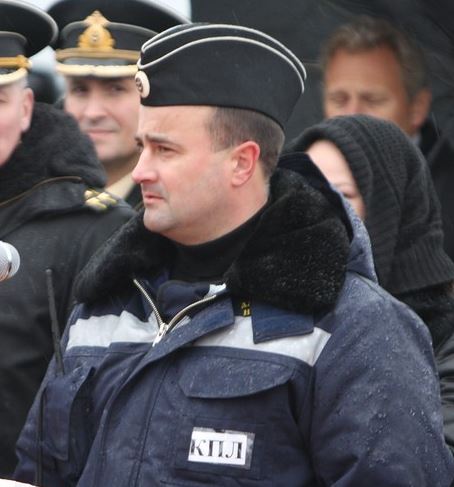
Nevskiy Captain Vasiliy Tankovid Addresses His Crew (photo: Pressa-tof.livejournal.com)

Nevskiy Captain Vasiliy Tankovid Addresses His Crew (photo: Pressa-tof.livejournal.com)

Family Reunion on the Pier (photo: Pressa-tof.livejournal.com)

Family Reunion on the Pier (photo: Pressa-tof.livejournal.com)

A happy scene familiar to every sailor.