Meeting on Gogolevskiy Boulevard

Protesters and Placards (photo: KPRF.ru)

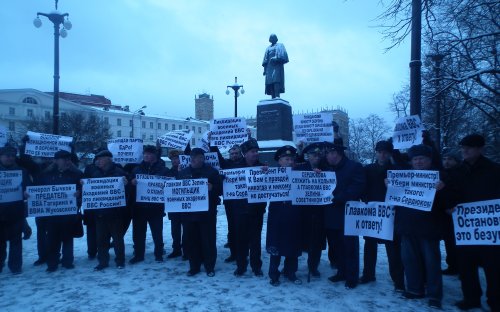
Thursday about 50 military men gathered near Gogol’s statue in the park across from the Defense Ministry to protest the closure of the Air Forces Academy named for Professor N. Ye. Zhukovskiy and Yu. A. Gagarin. 

These largely middle-aged protesters held placards saying “Air Forces CINC Zelin is the Gravedigger of Air Forces Academies!” or “Prime Minister:  Get Rid of Defense Minister Serdyukov!” or “General Bychkov is a Traitor to VVA Gagarin and VVIA Zhukovskiy!”
 
Recall the Zhukovskiy and Gagarin academies — the former for engineers, the latter for pilots and staff officers — were melded in 2008 in the latest and most painful drawdown of an enormous leftover Soviet-era military educational establishment. 
 
The functions of these mid-career academies are being transferred to the new, consolidated Air Forces Military Training-Scientific Center (VUNTs VVS) in Voronezh.
 
The KPRF organized the protest, and it said about 100 attended.  KPRF.ru and Nakanune.ru recapped the event.
 

KPRF Duma member Vyacheslav Tetekin told Novyy region destroying these academies damages VVS combat readiness since the majority of their 1,600 (perhaps not much lower than the total number of flyable VVS aircraft) instructors and professors won’t go to Voronezh to train future senior officers.

Tetekin argued there are already protests against aircraft noise in Voronezh, and he’ll ask fellow KPRF member and Duma Defense Committee chairman Vladimir Komoyedov to address the prime minister and president on the fate of Zhukovskiy and Gagarin.

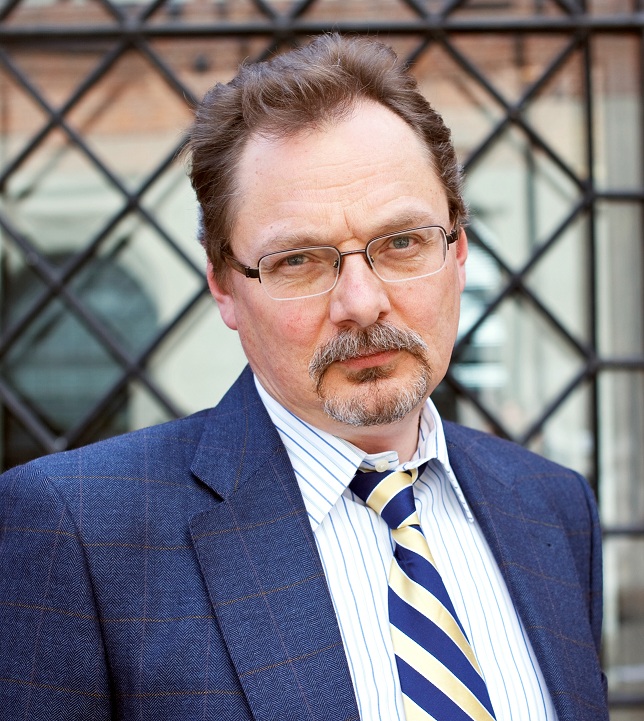
Apparently now retired, General-Lieutenant Ivan Naydenov — a former deputy chief of the academy — claimed Defense Minister Serdyukov just wants the institution’s valuable real estate.  Naydenov said only 29 younger instructors have gone to Voronezh.  He put the total staff at only 700, in contrast to Tetekin’s 1,600.

Naydenov has recorded and posted this appeal to save VVA im. Gagarin.

No one will mistake this little event on Gogolevskiy for what took place on Bolotnaya or Sakharov Square.  Nor will anyone confuse the characters in this drama with demonstrators against Duma election fraud.  Or a scarcely-noticed gathering of older military men with the resonance of the first large-scale political protest in years. 

Nevertheless, older Russian officers have taken to picketing about their grievances more frequently of late.  The personal toll in their situation is lamentable.  But cuts and consolidations Serdyukov has made in Russian military education were very deep and difficult simply because they were so long overdue.

Without a doubt, some of those choosing dismissal over moving will add to the queue for military apartments in Moscow and its suburbs.

Will Serdyukov Go?

Pavel Baev

Back to a familiar topic . . . is it possible or likely Defense Minister Anatoliy Serdyukov will resign or be dismissed from his post prior to the March 4 presidential election?  It is, of course, a topic that won’t quit.  At least not for the next two months. 

Pavel Baev discussed this with BFM.ru over the holiday. 
 
We looked at Baev’s view of Serdyukov’s reforms back in the spring.  He was neither sanguine about them nor forgiving of mistakes made.
 
We also looked earlier at a couple considerations of whether Serdyukov might leave or be forced out of the Defense Ministry. 
 
In August, Mikhail Rostovskiy thought Serdyukov’s position pretty secure, and this author postulated, with once-and-future president Vladimir Putin secure in the Kremlin again, Anatoliy Eduardovich might find relief from the defense portfolio in a job both cushier and more to his liking.
 
In April, Aleksey Makarkin also thought Serdyukov was pretty safe.
 
It’s obvious that the aftermath of the December 4 Duma elections changed a lot of things.
 
Now Oslo-based Professor Baev thinks Serdyukov could be sacrificed in the election run-up for nothing other than loyal performance of the tasks Putin set him to in February 2007.
 
Baev says Putin believes his regime faces an old-fashioned Cold War-style political threat.  Various Western “circles” (NATO, NGOs, CIA) think the regime’s exhausted itself.  Any possible replacement would be welcome to them.
 
Then we get to the essence of Baev’s argument — the fact that the Defense Minister has generated great dissatisfaction and irritation among Russia’s defense factory directors.  Without a serious go-between in the Military-Industrial Commission, Serdyukov’s become the focus of their ire.  They blame him and his subordinates for rejecting Russian weapons and equipment, and claim they’ve hurt Russia’s reputation as an arms exporter.
 
His case in point is the complaint from railcar and armor producer Uralvagonzavod during Putin’s December 15 “direct broadcast” Q and A with citizens.  A caller asked Putin to take Serdyukov and General Staff Chief Makarov by the neck, and replace the former with a “clearheaded Defense Minister.”
 

Baev’s interviewer asks whether Serdyukov will keep his current seat under Putin 2.0:

“. . . I think that the Defense Minister will be replaced even before the election.  The Armed Forces and military enterprises are a large and serious part of the electorate.  It was possible to extinguish accumulated irritation with the promise of money since after long promises they raised pay for officers, although not as substantially as was said.  It’s also possible to give money to OPK enterprises and sacrifice an unliked minister.”

But a resignation won’t be enough:

“I don’t think so because the problems have gone too far.  It’s hardly possible to put the protest mood just on one minister.  Everyone understands perfectly that it’s not the minister who started all this and carried all this out, no one suspects Serdyukov of being a confirmed reformer, having a program, or being a man motivated by a sense of his own mission.  He is a manager, an executive, and extremely stubborn, but he didn’t start this, and that’s clear.  And I don’t think Serdyukov will hold onto the minister’s chair.  The problems and conflicts have become so acute that it’s becoming costly to him.  I think they’ve had enough of him.”

Baev concludes that another civilian should take over the Defense Ministry, and continue separating its intertwined military and civilian functions.  He doubts Serdyukov’s replacement will reverse anything, but simply move forward on the problems reforms have created.

Serdyukov’s departure seems like more of a possibility now than before the Duma elections.  As Baev suggests, Putin could sacrifice his Defense Minister to appease his numerous unhappy defense industrial constituents.  Serdyukov’s fate may hinge on how badly Putin needs a boost for March 4. 

The Defense Minister’s 5-year anniversary comes next month and provides an opportunity for a change short of dismissal.  This author gets the impression Serdyukov’s energy for his difficult job has declined lately.

As for Uralvagonzavod, its workers are unlikely to quit sniping at the Defense Minister.  They, along with other military vehicle makers, have reportedly learned their defense order for 2012 has been drastically cut in favor of procurement in 3-5 years.

Barabanov’s Top 20

Defense commentator Mikhail Barabanov published his annotated list of the top 20 military stories of 2011 in yesterday’s Voyenno-promyshlennyy kuryer.

Some we’ll just note, but Barabanov’s provided interesting details for others.

1.  The continuation of military reform.  The start of the next phase of reforming the Air Forces and Navy.

Barabanov says Air Forces’ reform included the formation of VVKO and the enlargement of Russian air bases.  The reform of the Navy started December 1 and it will soon be restructured into a “new profile.”

2.  Establishment of VVKO.

He comments, “The given construct essentially looks fundamentally like a return to Soviet Voyska PVO Strany (National Air Defense Troops) in the form of a separate service [well, branch] of the Armed Forces.”

3.  The new pay system effective this year.

4.  GPV 2011-2020.

5.  The increase in the Gosoboronzakaz.

Barabanov puts GOZ-2011 at 460 billion rubles, 570 if RDT&E is added.  This was 20 percent more than GOZ-2010, and allowed for the series production of weapons and equipment.

6.  The war between industry and the Defense Ministry.

7.  Development of the PAK FA.

8.  Large helicopter procurement.

Apparently a post-Soviet record.  About 100 new helos, including Mi-28N, Ka-52, Mi-26, and Mi-24 (Mi-35M), were expected to reach the troops.

9.  Bulava began to fly.

10.  OSK “megacontracts” for submarines.

About 280 billion rubles for modernized proyekt 885 and 955.

11.  Ending serial procurement of many ground systems and equipment.

The Defense Ministry said it didn’t need the T-90, BMP-3, or BMD-4 (!?).  Development of an entire spectrum of new armored vehicle platforms began for procurement after 2015.

12.  Domestic space sector failures.

They evidenced the decline of the OPK’s production capability in the space sector.

13.  “Tsentr-2011” exercises.

They checked the “new profile,” and the greatly enlarged military districts.

14.  Importing arms.

Mistral, Rheinmetall’s training ground in Mulino, foreign sniper rifles, and Israeli UAVs.

15.  Continued growth in Russian arms sales.

$11 billion as opposed to 2010’s $10 billion.  This despite the revolutions in the Arab world.  Rosoboroneksport’s order portfolio is $36 billion.

16.  Arab revolutions.

17.  NATO intervention in Libya.

18.  Military actions in Afghanistan, American troops leave Iraq.

19.  Deadend in missile defense negotiations.

20.  Start of reduced U.S. military spending.

Kuznetsov Air Ops

Colonel Nikolay Deriglazov

We’re gradually reaching the end of the slow news season . . . here’s a picture and a couple videos.

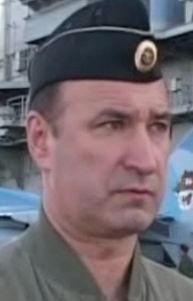
Colonel Deriglazov commands the Su-33 squadron aboard Fleet Admiral of the Soviet Union Kuznetsov.  He speaks about flying off the Russian carrier in the video below.

Hat tip to Militaryparitet.com for highlighting this Vesti.ru report on Kuznetsov pilots in action.  The video shows an officer (an LSO-type) at the “visual landing post.”  Some Russian carrier pilots have 160 landings to their credit, according to Vesti.

The Defense Ministry’s TV Zvezda had this video as well.

The Kuznetsov group remained in port (or at least at anchorage near) Tartus, Syria today, as RIA Novosti reported.

No One to Call (Part II)

Let’s continue our look at the just-completed fall draft before returning to the issue of contract service.

In Nezavisimaya gazeta, Sergey Konovalov counts 220,000 officers and 180,000 contractees at present, then quotes retired general Yuriy Netkachev:

“If we add the number of men called into the troops in the spring and fall of last year (135,900 [sic] and 218,000 lads respectively), then with authorized manning of the army and navy at one million men, undermanning is not less than 15%.  Given such indicators, it doesn’t do to talk about the full combat readiness of the troops.”

With due respect to Netkachev, this adds up to just over 750,000 men in the RF Armed Forces.  That would be 25 percent undermanning against a million-man army. 

Konovalov cites KSMR’s Valentina Melnikova on legal violations in the recent draft.  The fall call-up possibly set a record for rights violations even though it was the smallest post-Soviet draft.  Melnikova claims 6,000 violations were reported — one for every 20 men inducted.  And, according to Konovalov, prosecutorial data seems to support her number.  The main violation was simply drafting guys not fit to serve.  Melnikova believes commissariats did this consciously because it was the only way they could reach even relatively low target numbers.

Konovalov turns to military sociologist Colonel Eduard Rodyukov who worries that, following a precedent set in Chechnya, the Defense Ministry is not inducting men from Dagestan.  Only 121 were inducted against the republic’s plan for 3,320.  And those few entering the army appeared to be Slavs rather than Avars, Dargins, Kumyks, etc.

Rodyukov concludes:

“This is unjust.  In Moscow, to fulfill the call-up plan, they shave everyone for the army – both lame and near-sighted, but in Dagestan and Chechnya potential recruits are sent into the reserve [without serving as conscripts].  A peculiar Slavicization of military collectives is occurring, the structure of which doesn’t correspond to the country’s population.  But the Russian Army is not an imperial army.  It should be international [i.e. interethnic].”

Konovalov believes conscription’s been cut in other “hot” republics of the North Caucasus as well.

Let’s come back to a larger point where we started.  If conscription of Caucasians has been pared for fear of having them in the ranks, overall conscription has been cut in favor of having 425,000 professional volunteers in the army by 2017. 

The Defense Minister recently said he’d go as far as 90 percent contractees and only 10 percent conscripts in the Armed Forces if the budget allowed for it.

Viktor Baranets addresses, in understated fashion, the difficulty of going from about 180,000 contractees today to 425,000:

“But this requires enormous expenditures.  A soldier or contract-sergeant also needs, besides uniforms, weapons, and corresponding social benefits, to be given good housing (and among them there are also many who are married).”

Yes, housing was a huge downfall of the 2003-2007 contract service effort.  So was failure to recruit the right men, and make contract service truly different from being a conscript.

Baranets goes on to suggest G.I. bill-type benefits (privileged VUZ admittance, government hiring preferences, etc.) for Russia’s contractees.

But pay can’t be underestimated as the primary factor in whether the Russian Army can attract contractees this time.

In 2004, a newly-signed contractee might have gotten 10,000 rubles a month.  After accounting for inflation, the Defense Ministry will have to pay at least 20,000 today to give enlisted the same deal. 

General Staff Chief Makarov has talked about minimum pay of 23,000 — not much more than what was offered in 2004 after inflation.  As always, much depends on the supplements and bonuses an individual serviceman receives. 

Contract pay may be better than it was.  But it’s going to be, as Baranets said, an enormous expense.  We’ll have to see if it’s an affordable and sustainable one.

No One to Call (Part I)

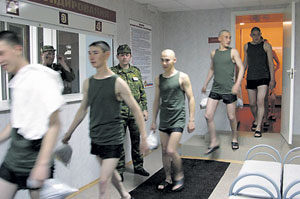
Shaved and Ready to Serve (photo: Yelena Fazliullina / Nezavisimaya gazeta)

“We could call-up 11.7% of all young men.  Of them, 60% got out on health grounds.  Therefore, the RF Defense Ministry confronts the fact that there is almost no one to call-up into the RF Armed Forces.”

Army General Nikolay Makarov

So the General Staff Chief declared on November 11, 2011, and he’s been quoted to this effect many times since. 

Just nine months earlier, the Defense Ministry declared professional contract service would be the primary method of manning the Armed Forces.  And a year before that, the Defense Minister and General Staff Chief said the exact opposite:  conscription would be primary and contract service would be curtailed.  

But the impossibility of manning a million-man Russian Army by means of the draft was clearly understood by many observers at that time.

The Defense Ministry recently issued its customary press-release indicating 100-percent fulfillment of the fall draft campaign.  

Only 135,850 young men were conscripted for one year of obligatory military service.  This was about 80,000 fewer than the number inducted during the spring draft (218,720), and less than half the fall 2010 call-up (280,000). 

This fall’s 135,850 twelve-month soldiers are just about the same number of men typically drafted for a two-year service term in the mid-2000s.

Viktor Baranets published his archive of annual conscription numbers back to 1999, which is handy.  He makes the point that, in contrast to today’s 12 percent or less, 20 percent of available men were being drafted as late as the late 1990s.

Let’s suppose if Makarov’s 12 percent go to serve and 60 percent are excused for health reasons, then 28 percent are escaping through deferments (mostly educational) or evasion. 

Makarov’s precise 11.7 percent or 135,850 conscripts would mean his total draft pool was under 1.2 million men.  This seems odd because census numbers say Russia should have at least two million 18- and 19-year-old men right now.  And that’s not even mentioning some 21- or 22-year-olds who get caught in the commissar’s dragnet. 

There might be some math your author can’t fathom, but it could also be that the widely-reported number of 200,000 long-term draft (or draft summons) evaders is actually much, much higher.

Let’s look at a fairly detailed report on conscription in one oblast — Sverdlovsk.  Nakanune.ru reports the oblast’s military commissar sent out 25,000 draft notices to the region’s youth. 

Almost half were unfit for health reasons, leaving, let’s suppose, 13,000 young men to sort through.  But this, of course, means Sverdlovsk’s a lot healthier place than many places.

Of those 13,000, some 6,000 had deferments.  So we’re down to 7,000 candidate-soldiers.  Of them, 4,056 were inducted this fall. 

That’s a deferment rate of 24 percent for all men summoned to the draft board.  And 4,056 is 16 percent of those summoned.  The MVD got 700 men (3 percent), and the Armed Forces presumably got 3,356 (13 percent).

Now unmentioned are the 2,944 not deferred and not drafted.  Who knows how they might be counted.  But they might be guys evading the draft by simply going missing.  For those keeping score, that could be an 11.7 percent evasion rate.  Just as many dudes avoiding service as going to serve this fall.

The Sociological Center

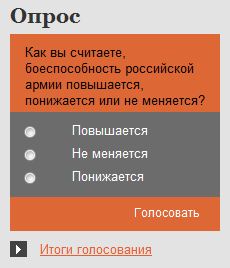
Is the Russian Army's Combat Capability Increasing?

A nice find on Mil.ru . . . the Defense Ministry website has the Internet poll above on its front page.  If you click on Voting Results, you go to the results of all surveys conducted by the Defense Ministry’s Sociological Center.

To this particular question, 78 percent of respondents said its combat capability is decreasing.

Stepping back a bit, clicking on Sociological Center goes to a narrative explaining a little about it.  Its purpose is monitoring social processes in the military to work out scientifically-founded proposals on the morale-psychological support of military organizational development, training, and employment of the Armed Forces.  It also provides information support to commanders, staffs, and personnel officers.  The Center is charged with collecting data about the socio-economic circumstances of servicemen and their families.

The military opinion surveying effort has been around for a while.  During the first big push for contract service beginning in 2003, Defense Ministry pollsters actively asked contractees, or prospective ones, what attracted or discouraged them from signing up.

We’re not told how or when these survey questions were asked.  They’re likely Internet polls rather than more scientific random sampling. 

But one still admires the brutal honesty of publishing these results.  They don’t accord with what Defense Minister Anatoliy Serdyukov wants to see or hear three years after launching military reform.  They indicate how far the Russians have to go to turn around the perception, if not the reality, of life in the Armed Forces.  At the same time, getting feedback is a critical step in correcting their problems.

Your author has regrouped the survey results on various questions thematically.  In the interests of brevity, only the answer with the highest percentage is shown.

Let’s start with other combat capability-related questions:

  • How do you evaluate the Russian Army’s current combat capability?  72 percent said low.
  • Is three months sufficient to train a military specialist?  82 percent said no.
  • What effect is the humanization of service having on combat readiness?  71 percent said it is causing it to decline.
  • Are you satisfied by the media’s presentation of Armed Forces exercises?  75 percent said no.
  • How do you evaluate the present level of combat training?  74 percent said poor.
  • Can the Armed Forces reliably guarantee Russia’s security?  81 percent said no.
  • Is there now a military threat to Russia from other countries?  79 percent said yes.

Some very general questions:

  • Do you approve of the Russian Army’s activity?  62 percent said no.
  • How do you feel when you talk about the Armed Forces?  52 percent said negative.
  • Is it necessary for the media to discuss negative events in the Armed Forces?  75 percent said yes.
  • How does the media portray the activities of the Armed Forces?  64 percent said not objectively.
  • Do you agree that “A powerful army is a powerful Russia?”  80 percent said yes.

On conscription:

  • Should draft evaders be punished?  68 percent said yes.
  • How do you feel about draft evasion?  59 percent said negative.
  • Does military service promote striving for a healthy way of life?  56 percent said yes.
  • Would you want a close relative to serve in the army?  68 percent said no.

On law and order in the ranks:

  • Who should control the military police?  52 percent said the Defense Ministry.
  • Do officers have enough powers to keep order?  84 percent said no.
  • How do you assess measures to counter corruption in the army?  66 percent said they have little effect.
  • Is “dedovshchina” an acute problem?  62 percent said yes.

On personnel, pay, and benefits:

  • Should Order No. 400 premium pay continue or be discontinued?  80 percent said discontinue it.
  • How do you feel about rotating officers’ duty stations?  51 percent are negative.
  • How has Order No. 400 affected corruption in the army?  88 percent said it’s caused it to grow.
  • Is there a “cadre famine” in the Armed Forces?  83 percent said yes.
  • How do you evaluate the consequences of Order No. 400?  89 percent are negative.
  • Where should priests be located?  42 percent said in battalions.
  • Will priests help in forming healthy moral relations in the military collective?  55 percent said no.
  • How do you evaluate the effect of the military mortgage system?  74 percent said low.
  • Will higher pay in 2012 raise the social status of servicemen?  58 percent said no.
  • Will requalifying military arsenal workers increase safety?  65 percent said no.
  • Do military families live better or worse than people in your region?  77 percent said worse.
  • Are social guarantees for servicemen sufficient?  86 percent said no.
  • Has the prestige of the Armed Forces increased in the course of military reform?  59 percent said it remains at the previous level.

The responses on the army’s capabilities weren’t new.  One is surprised, however, at how negative respondents were on premium pay, how little they expect from higher officer pay, and the lack of any improved perception of the prestige of military service.

Cadre Changes

President Medvedev’s military personnel decree from December 22.  

Recall that Colonel Yartsev is being investigated for “taxing” the premium pay his pilots were receiving.

Appoint:

  • Colonel Dmitriy Vilorovich Gorbatenko, Chief, Troop Training Directorate,  Western MD.
  • Captain 1st Rank Oleg Vladimirovich Zhuravlev, Commander, Leningrad Naval Base, Baltic Fleet.

Relieve:

  • Colonel of Medical Service Aleksey Eduardovich Nikitin, Chief, 2nd Directorate, Deputy Chief, Main Military-Medical Directorate, RF Defense Ministry.
  • Colonel Nikolay Nikolayevich Yartsev, Chief, Air Forces Training-Scientific Center “Air Forces Academy Named for Professor N. Ye. Zhukovskiy and Yu. A. Gagarin” Branch (Syzran, Samara Oblast).

Relieve and dismiss:

  • Vice-Admiral Sergey Ivanovich Menyaylo, Deputy Commander, Black Sea Fleet.

Dismiss:

  • General-Major Bagir Yusif ogly Fatullayev.

Serdyukov Year-Ender (Part III)

A good day to finish old business . . . this covers the second half of Defense Minister Anatoliy Serdyukov’s Rossiyskaya gazeta interview.  Serdyukov, while remaining on message, seems tired or uninspired in giving this interview.  He reviews old ground rather than breaking any new.

Serdyukov talks about coming to grips with large existing stockpiles of tanks, BMPs, BTRs, guns, and automatic rifles, and indicates he’s waiting for the defense sector to propose some fundamentally new systems.  In regard to Kalashnikovs, the Defense Ministry is open to new developments from private firms but isn’t eschewing future AK purchases from its traditional supplier either.

On Mistral, Serdyukov tells RG the French will decide where it’s best to produce units 3 and 4, and Sevmash is the likely place.  But he wants them to come in cheaper than number 1 and 2 being built in France.  He expects Russia to acquire leading edge shipbuilding techniques in the process.

Serdyukov shows a flash of interest when asked about conclusions from Russia’s recent space launch failures:

“One conclusion — we have to change our approach to military acceptance.  And we’re occupied with this.  Next year we want to reformat it.  There’s already understanding about what has to be done in training units for military acceptance specialists, their incentives, and technical equipping.”

“Generally, this is a serious question.  We haven’t devoted the due attention to military acceptance because of various obstacles.  Now we are smoothing out the situation.  Not so long ago the prime minister had a conference, and Vladimir Vladimirovich Putin gave a whole series of instructions on price formation and tracking contracts.  Acceptance and production quality was one issue.  Today this task is being worked, and we are preparing proposals by the end of the year [2011].”

Serdyukov says voyenpredy can be civilians, but they should be former military men with lots of practical experience.

The last significant point in the second half of Serdyukov’s interview is his call for differentiated training for new professional sergeants — 3 or 4 months for those in motorized rifle units and 2 years or more for EW or communications specialists, for example.  The comparison he gives is training equivalent to technical secondary school or old school for warrant officers.  He indicates he’s not afraid future NCOs will become “eternal students.”

Medvedev Talks Bulava Acceptance

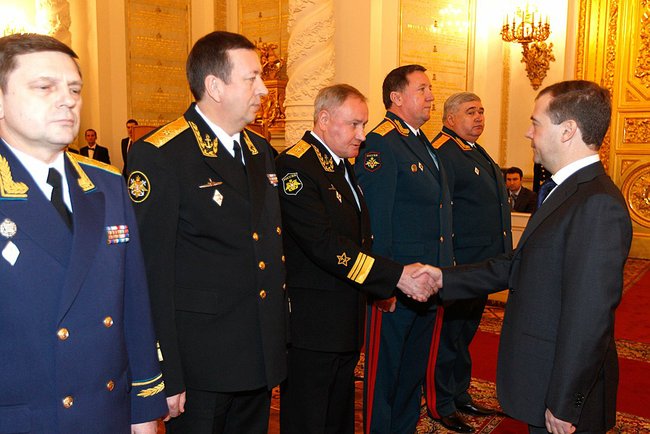
Medvedev Shakes Korolev's Hand

This post is admittedly as much about using a good photo and video as relaying something you haven’t heard.  But the visuals bring the subject to life a little.  At any rate, the lengthy Russian holiday season is upon us, so any post (even one with fluff) is better than none. 

Tuesday Russia’s lame duck President and Supreme CINC Dmitriy Medvedev greeted a group of military men — Armed Forces, MVD, FSB, SVR, and MChS officers — in the Grand Kremlin Palace’s St. George’s Hall to congratulate them on their new command positions or promotions to higher ranks.

Shown above are (from right) Southern MD Commander Aleksandr Galkin, Central MD Commander Vladimir Chirkin, Northern Fleet Commander Vladimir Korolev, Black Sea Fleet Commander Aleksandr Fedotenkov, and VVKO Commander Oleg Ostapenko.

Galkin and Chirkin are apparently there to mark their elevation to three-star general-colonel rank, while the latter three are now at new posts.  And Ostapenko’s sporting a blue uniform.  Didn’t the ex-Space Troops wear green reflecting their RVSN roots?

Kremlin.ru published some of Medvedev’s remarks to his senior officer audience:

“In recent years, we have modernized the Armed Forces in the most substantial way, optimized the structure and manning of the army and navy, improved the combat command and control system, and strengthened the strategic nuclear deterrent forces.  From 1 December of this year, new troops –Aerospace Defense Troops began combat duty, and in November a new radar station for monitoring air space in the western direction was brought into operation.”

“The army and navy have to resolve an entire series of missions relative to supporting the national development strategy and, accordingly, military organizational development during the period of the coming 10 years.  One of the most important goals is the technical reequipping of troops.  Our key priority remains further reequipping of the troops, and weapons and equipment of the most modern and next generation.  And of course, this task also demands the preparation of specialists, demands the preparation of personnel who will be fully capable of using this equipment as intended.  Therefore, it is important to guarantee the proper level of professional knowledge in cadets and young officers.”

“We are continuing the improvement of our armament, and our equipment.  In this context, I would like to note specifically that despite the problems currently remaining in the missile-space sector, nevertheless, we have just made a very important step:  we completed the flight testing cycle of a naval strategic nuclear forces system, I have ‘Bulava’ in mind.  This cycle, I remind you, was not simple, and went forward with certain problems.  Still our industry proved it can develop new, modern, and highly efficient types of strategic weapons.  One of them is the ‘Bulava’ system, which now, after all this testing, will be accepted into the arms inventory.”

Pervyy kanal covered the ceremony, showing Medvedev, three VVKO and/or Air Forces general-majors, a Bulava launch, and assorted siloviki, including Sergey Ivanov, Nikolay Patrushev, Rashid Nurgaliyev, and Aleksandr Bortnikov.

The first general-major wearing the blue uniform is Sergey Popov, late chief of air defense for VVS, now Commander of VVKO’s Air and Missile Defense Command.  The second couldn’t be identified by your author.  The third is Igor Makushev, Commander, 1st Air Forces and Air Defense Command (perhaps just the 1st Air Forces Command since the advent of VVKO).

But returning to Medvedev and Bulava . . . the Supreme CINC’s words unleashed minor euphoria about the SLBM’s imminent acceptance. 

For example, on December 28, RIA Novosti reported its highly-placed Defense Ministry source claimed a decision on accepting the Bulava-Borey weapons system is before the country’s political leadership.

But Medvedev didn’t say the missile is now ready to be accepted.  He just said it would be, and we already knew that.  Also, he never mentioned Borey-class SSBN Yuriy Dolgorukiy which must be accepted in tandem with Bulava for this strategic weapons system to achieve IOC.

Vedomosti’s Defense Ministry source was more on the mark saying Bulava “practice” launches could continue for some time. 

Going slow would seem to track with Defense Minister Serdyukov’s apparently unhurried approach toward Bulava at this point.  There have been reports that Dolgorukiy isn’t ready, and launches next spring and summer could come from Borey unit 2 Aleksandr Nevskiy by then.

At any rate, the Bulava program’s come a long way from the nadir of its December 2009 failure.  But this isn’t exactly the end of the road either.  Moscow still has to work out a reliable and well-controlled production run of some 128 missiles (and 768 warheads) plus spares.  Not to mention ramping up construction and completion of eight Borey-class boats.

Thank you for reading this meandering post, as well as others this year.  Your author wishes you a happy 2012.

С новым годом!