Military Security and Military Policy

These are the next areas of the old and new military doctrines that require comparison.  The old is written in terms of military security, and the new–military policy.  Six of one, a half dozen of the other.  The new doctrine defines military policy as what the state does to ensure the country’s military security.

The old doctrine starts with a long section basically dedicated to a description of how Russia relies on diplomacy, international organizations, and international law to neutralize threats and safeguard its security.  It mentions its joint defense policy with Belarus, the CIS, the CSTO, strategic nuclear arms control agreements with the U.S., confidence-building measure, and nonproliferation.

Then the old doctrine proceeds to military means of ensuring Russia’s security, first and foremost, nuclear means, stating that “the Russian Federation proceeds on the basis of the need to have a nuclear potential capable of guaranteeing a set level of damage to any aggressor (state or coalition of states) under any circumstances.”

“The Russian Federation reserves the right to use nuclear weapons in response to the use of nuclear and other types of weapons of mass destruction against it and (or) its allies, as well as in response to large-scale aggression utilizing conventional weapons in situations critical to the national security of the Russian Federation.”

The new doctrine’s military policy section also says the RF’s policy is to  deter and prevent conflicts and safeguard the country’s security.  No surprise.  It does this by maintaining its armed forces in a state of permanent readiness to protect the country and its allies, in accordance with international law and treaties of course.  The new doctrine is generally more concise in most of its points.

Both doctrines now list main principles for safeguarding security (old) or main tasks for deterring and preventing military conflicts (new).  The old list is actually shorter and more general:

  1. Firm leadership and civilian control over the state’s military organization.
  2. Effective forecasting, identification, and classification of military threats.
  3. Sufficient military forces, means, and resources, and their rational utilization.
  4. Correspondence between readiness, training, and support for the state’s military organization and military security requirements.
  5. Refusal to harm international security and the national security of other countries.

The new doctrine’s longer list captures some of what was in the old and it includes:

  1. Predict the global and regional military-political situation using modern technical systems and information technologies.
  2. Neutralize possible dangers and threats using political, diplomatic, and other nonmilitary means.
  3. Maintain strategic stability and the nuclear deterrence potential at an adequate level.
  4. Maintain the armed forces and other troops at the prescribed level of readiness for combat employment.
  5. Strengthen the collective security system, including the CSTO, CIS, OSCE, and SCO, and to develop relations with the EU and NATO.
  6. Expand the circle of partner states and develop cooperation with them to strengthen international security.
  7. Comply with international treaties for the limitation and reduction of strategic offensive arms.
  8. Conclude and implement arms control agreements and measures to strengthen mutual trust.
  9. Create mechanisms for the regulation of bilateral and multilateral  cooperation in the sphere of missile defense.
  10. Conclude an international treaty prohibiting the deployment of any types of weapons in outer space.
  11. Participate in international peacekeeping activity.
  12. Participate in combating international terrorism.

Then both doctrines move into their use of the armed forces provisions and tasks, in peacetime and wartime.  It’s useful here to start with the new doctrine, since here’s where its nuclear use provisions appear.

The new doctrine says the Russian Federation can use the armed forces to repulse aggression against it or its allies, or in accordance with a U.N. Security Council or other collective security structure decision, or to protect its citizens beyond the borders of the RF in accordance with the norms of international law.

The new doctrine says the “Russian Federation reserves the right to utilize nuclear weapons in response to the utilization of nuclear and other types of weapons of mass destruction against it or its allies, and also in the event of aggression against the Russian Federation involving the use of conventional weapons when the very existence of the state is under threat.” And the decision to utilize nuclear weapons is made by the Russian Federation president.

The new doctrine notes that the RF assigns troop contingents to CSTO peacekeeping forces to participate in peacekeeping operations in accordance with CSTO Collective Security Council decisions.  And to the CSTO Collective Rapid Response forces to resolve tasks determined by the CSTO Collective Security Council.

The new doctrine’s list of the military’s peacetime and wartime tasks:

  1. Defend the RF’s sovereignty and territorial integrity.
  2. Ensure strategic deterrence.
  3. Maintain combat and mobilizational readiness, and training of the strategic nuclear forces, forces and resources that support their functioning, and command and control systems at a level to guarantee infliction of the required damage on an aggressor whatever the conditions of the situation.
  4. Provide timely warning to the supreme commander in chief of the RF armed forces of an air or space attack, and notify state and military leadership about military dangers and military threats.
  5. Maintain the capability of the armed forces for timely deployment on strategic axes, and maintain their readiness for combat use.
  6. Ensure the air defense of the RF’s most important facilities and readiness to rebuff air and space attacks.
  7. Deploy and maintain orbital groupings of space devices supporting the RF armed forces activities.
  8. Protect state and military facilities, lines of communication, and special cargoes.
  9. Maintain infrastructure, and prepare lines of communication for defense purposes, including special-purpose facilities and highways of defense significance.
  10. Protect RF citizens outside the RF from armed attack.
  11. Participate in operations to maintain or restore international peace or suppress aggression on the basis of decisions of the U.N. Security Council or other bodies.
  12. Combat piracy and ensure the safety of shipping.
  13. Ensure the security of the RF economic activities on the high seas.
  14. Combat terrorism.
  15. Prepare for territorial defense and civil defense.
  16. Participate in protection of public order and safeguarding public security.
  17. Participate in eliminating emergency situations and restoring special-purpose facilities.
  18. Participate in securing a state of emergency.
  19. In a period of direct threat of aggression, implement measures to increase combat and mobilization readiness, with a view to carrying out mobilizational and strategic deployment.
  20. Maintain nuclear deterrence potential at the established degree of readiness.
  21. Participate in maintaining a martial law regime.
  22. Fulfill RF international commitments with regard to collective defense and preventing an armed attack on another state that has made a request to the RF.
  23. In wartime, repulse aggression against the RF and its allies, inflict defeat on aggressor forces on terms that meet RF interests.

The old doctrine’s list of peacetime and wartime tasks isn’t as specific as the new:

  1. Form and implement a single state policy to safeguard military security.
  2. Maintain domestic political stability and protect the constitutional system and the RF’s territorial integrity.
  3. Strengthen friendly (allied) relations with other states.
  4. Improve the RF’s defense system.
  5. Support and improve the armed forces and other troops, military formations, and organs, and maintain their readiness.
  6. Prepare measures to transfer the armed forces to a wartime footing (including mobilization deployment).
  7. Improve the economic, technological, and defense industry base, and enhance the mobilization readiness of the economy.
  8. Protect RF facilities and installations on the high seas, in space, and on the territory of foreign states, including activities in the adjacent maritime zone and distant ocean regions.
  9. Protect and defend the RF state border, airspace, underwater environment, and EEZ and continental shelf, and their natural resources.
  10. Support RF political acts by implementing measures of a military nature and by means of a naval presence.
  11. Prepare territorial and civil defense.
  12. Develop necessary military infrastructure.
  13. Safeguard the security of RF citizens and protect them from military threats.
  14. Develop a conscious attitude among the population toward safeguarding the country’s military security.
  15. Monitor mutual fulfillment of arms limitation treaties and CBMs.
  16. Ensure readiness to participate in peacekeeping activities.
  17. In a period of threat and on the commencement of a war, strategic deployment of the armed forces and bringing them into readiness to perform their missions.
  18. Coordinate federal and local efforts to repulse aggression.
  19. Organize and implement armed, political, diplomatic, information, economic, and other forms of struggle.
  20. Adopt and implement decisions on military operations.
  21. Switch the country’s economy and sectors of it onto a war footing.
  22. Organize territorial and civil defense measures.
  23. Aid RF allies to realize their potential for achieving joint objectives. 
  24. Prevent other states from joining the war on the side of the aggressor.
  25. Use the U.N. and other international organizations to prevent aggression, or force the aggressor to end the war at an early stage.

One can also delve further into the old doctrine on the use of the armed forces in its Military-Strategic Principles section on wars and armed conflicts.  It describes in detail the use and tasks of the armed forces in different types of war and conflict.

Perhaps, however, it’s better to move to the last couple sections of the doctrine–the state’s military organization and the military economy.
New Doctrine on Military Conflicts

The 2000 military doctrine had a very long section covering Russia’s views on both wars and military conflicts.  It spent considerable time on local, regional, and large-scale wars.  Most of the stuff was standard fare.  Conflicts could escalate to local, regional, or large-scale wars, strategic initiative in the beginning period of war is crucial, etc.  The section did mention noncontact and information war.

The new military doctrine, by contrast, is very concise in this regard, confining remarks to military conflict only, with this capacious term covering everything from the smallest armed conflict to large-scale war.

The 2010 doctrine describes 7 Characteristic Features of Modern Military Conflicts:

  1. Coordinated employment of military and nonmilitary forces and means.
  2. Mass employment of weapons systems and military equipment based on new physical principles and comparable in effect to nuclear weapons.
  3. Increased scale of employment of aero-space troops (forces) and means.
  4. Increased role of information warfare.
  5. Decreased time of preparation for conducting combat actions.
  6. Increased command and control efficiency through global automated command and control networks for troops (forces) and weapons systems.
  7. Permanently operating zones of military action on the territory of opposing sides.

Then we get to 4 Specifics of Modern Military Conflicts:

  1. Unpredictability in their occurrence.
  2. Wide range of military-political, economic, strategic, and other aims.
  3. Increased role of modern highly effective weapons systems, but also the reallocation of the role of various spheres of armed struggle.
  4. Timely conduct of information warfare measures to achieve political aims without military force, or to gain a favorable international reaction if force is used.

The new doctrine’s section finishes with three propositions.

Military conflicts will feature rapid flow, selectivity and large target destruction, quick maneuver of troops (forces) and fires, use of different mobile troop (force) groupings.  Holding the strategic initiative, preserving reliable state and military command and control, securing ground, naval, and aero-space supremacy will be decisive factors in achieving established aims.

The growing significance of highly accurate, electromagnetic, laser, infrasound weapons, information management systems, UAVs and autonomous underwater vehicles, guided robot armaments and military equipment will characterize military actions.

Finally, nuclear weapons will remain important in preventing nuclear and conventional military conflicts (regional wars, large-scale wars).  If a conventional conflict puts the state’s existence under threat, the possession of nuclear weapons could lead to escalation of the conflict into a nuclear one.

Old and New Doctrines on Dangers and Threats

So what’s the net result in the change from the old to the new military doctrine when it comes to military dangers and military threats?

Ten years later, the new describes a world that’s more multipolar, with emerging powers, and an international security system that’s less effective than a decade ago, from Russia’s official viewpoint.

The new doctrine is a bit more nuanced, including as it does both dangers and threats, not just threats like the old.

Some themes persist from old to new:  foreign military forces surround Russia and present a danger if not a threat; areas of conflict surround Russia and have the same effect; the disruption of Russia’s national C2 systems is a threat; and there is worry, although somewhat less than in 2000, about illegal armed formations of radicals, extremists, and separatists.

Some themes surprisingly dropped away as threats:  large-scale organized crime, contraband or illegal weapons trading operations; foreign information operations; and discrimination against Russians abroad.

The most important new themes, not surprisingly given the events of the last 10 years, as military dangers could be NATO not just expanding but globalizing and the development and deployment of strategic missile defenses and strategic nonnuclear precision weapons.

New Doctrine on Dangers and Threats

At last, the long awaited new military doctrine.  It’ll take a bit to digest it.

The new doctrine doesn’t hem and haw in an introductory section the way the old one did.  It just jumps right in to General Propositions–what the doctrine is and what it’s based on.  Unlike its predecessor, it gives 11 key definitions of terms ranging from military security to military planning.

It defines military danger as a condition of interstate or internal state relations characterized  by an accumulation of factors, capable under certain conditions of leading to the rise of a military threat.

It defines military threat as a condition of interstate or internal state relations characterized by the real possibility of the rise of a military conflict between opposing sides with a high degree of readiness of some state (group of states), of separatist (terrorist) organization for the employment of military force (armed violence).

Section II. covers Military Dangers and Military Threats.  The new doctrine sees a world somewhat changed.  Gone is the unipolar world of a lone superpower and it now describes a world of reduced economic, political, and military influence of single states (or groups of states) and alliances and the corresponding growth of influence of other states, aspiring to all-around domination [are we talking China here?!], of multipolarity, and of globalization.

Unresolved regional conflicts near the Russian Federation remain a problem and the existing architecture (system) of international security doesn’t provide equal security to all states.  This is much gloomier on the U.N. than the old doctrine.

Now, the list of 11 Fundamental External Military Dangers…(the old doctrine addressed only threats, not dangers):

  1. NATO’s globalization and expansion to the RF’s borders.
  2. Destabilization of states and regions and the undermining of strategic stability.
  3. Deploying or building up foreign military forces on territories or in waters adjacent to the RF.
  4. Development and deployment of strategic missile defense systems which undermine strategic stability and upset the missile-nuclear correlation of forces, space militarization, and deployment of strategic nonnuclear precision weapons.
  5. Territorial claims on the RF and interference in its internal affairs.
  6. Proliferation.
  7. Violations of international arms limitation or reduction treaties.
  8. Use of force on the territories of states adjacent to the RF or its allies.
  9. Presence or rise (escalation) of military conflicts on the territories of states adjacent to the RF or its allies.
  10. The spread of international terrorism.
  11. The rise of interethnic or interconfessional tensions, the presence of international armed radical groups near RF borders, territorial disputes, and the growth of armed separatist (religious) extremists in regions of the world.

Then there are just three Fundamental Internal Military Dangers:

  1. Forceful attempts to change the RF constitutional order.
  2. Undermining the RF’s sovereignty, violation of its unity and territorial integrity.
  3. Disruption of the functioning of the RF organs of state authority, important state, military facilities and information infrastructure.

These were a little different in 2000.  The RF’s unity and territorial integrity were explicitly threatened by extremist nationalist, religious, separatist, and terrorist movements.  There were three additional ones as well–the establishment of illegal armed formations (a la Chechnya), illegal arms trade on RF territory that abets sabotage and terrorism, and large-scale organized criminal, terrorist, and contraband activities.

The new doctrine lists 5 Fundamental Military Threats:

  1. Sharp aggravation of the military-political situation (international situation) and creation of the conditions for using military force.
  2. Impeding the work of the system of RF state and military command and control, disturbing the functioning of its strategic nuclear forces, missile attack warning system, space monitoring, nuclear weapons storage facilities, nuclear power, chemical industry, and other potentially dangerous facilities.
  3. The establishment and training of illegal armed formations, their activity on RF territory or that of its allies.
  4. Provocative demonstration of military force in the course of exercises on territories adjacent to the RF or its allies.
  5. Activities of armed forces of other states to mobilize partially or fully, transfer state and military command and control to wartime conditions.

The old doctrine didn’t deal with dangers, giving just 11 Fundamental External Threats (in very abbreviated form):

  1. Territorial claims on the RF, interference in its internal affairs.
  2. Armed conflict near the RF.
  3. Building up troops near the RF or its allies.
  4. Expansion of military blocs.
  5. Presence of foreign troops adjacent to RF territory.
  6. Creation of military formations near RF territory with the aim of using them on RF territory.
  7. Attacks on RF facilities abroad.
  8. Attacks on RF government or military systems, strategic forces, missile early warning, missile defense, space monitoring, or nuclear storage.
  9. Hostile information operations.
  10. Violations of the rights or RF citizens abroad.
  11. International terrorism.

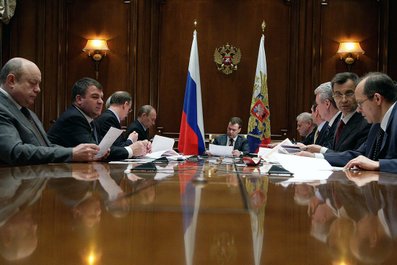
Medvedev Announces New Military Doctrine Approved

Medvedev and Security Council

Medvedev also told the Security Council he’s approved the “Fundamentals of State Policy in Nuclear Deterrence to 2020.”  But only the Military Doctrine’s been posted on Kremlin.ru.

The Russian Military Housing Shuffle

Who knows what the military housing shuffle would sound like, but it would have to be a catchy tune.  Watching the official dancing on Russian military housing is really great sport.

Today it was the turn of Regional Development Minister Viktor Basargin and Prime Minister Vladimir Putin himself.  At an RF Government Presidium session, the duo announced that they were plunking down an additional 35.2 billion rubles to finance 18,500 GZhS for military men, about half of whom are retiring this year and would presumably otherwise add to the military housing queue.

Basargin said, “Our target is to provide housing for retired military by January 1, 2012, and we’ll meet it 80 percent this year.”  Wait a minute Viktor…Vladimir Vladimirovich (and Dmitriy Medvedev) have said repeatedly that retired military men are to receive permanent apartments in 2010, not by 2012.  2012 is the goal for service apartments.

Basargin also made a point of saying this is the first time in six years that such an amount has been laid out in February, with the idea that the work might actually be completed in the same calendar year.

At any rate, Putin chimes in, calling it a timely emission of budget money, not an early one.  And he said, “We’re allocating large additional resources, the [Defense] Ministry will conduct a corresponding tender, and a large scale one at that.”

These GZhS would be worth 1.9 million rubles each for 35.2 billion rubles total.  For an average, smallish permanent military apartment of 39 square meters, that’s a little less than 50,000 rubles per square meter.  A little pricy by the Defense Ministry’s standards but not Moscow or Petersburg prices.

Back on December 30, Putin said 44.4 billion rubles would be spent in 2010 to obtain 45,000 military apartments.  This is more like 988,000 rubles per apartment (vice 1.9 million) and the price per square meter of average, smallish military apartment is more like 25,000 rubles–about what the military wants to pay and a good average for Russia as a whole.  Just as an aside, this day Putin said, “In 2010, we must resolve this [military housing] problem.  People are tired of waiting years for the resolution of this problem.”

Here’s where it gets really interesting [if it ever actually does].  If you take those, let’s call it a round 18,000 apartments Basargin and Putin are talking about and you put them together with the roughly 27,000 [not 45,614] apartments that most knowledgeable and semi-independent observers say the Defense Ministry actually received in 2009, it’s enough to get the military up to the level of housing acquisition it claimed last year (18,000 + 27,000 = 45,000).  So one could suppose that this extra is just catch-up for what wasn’t actually accomplished last year and one could also guess this year’s 45,000 won’t be met, and will have to be finished in 2011, or whatever.

Just as a reminder, who said 27,000?  Well, Vadim Solovyev said it in Nezavisimoye voyennoye obozreniye on 29 January.  On 25 December, NVO had an editorial saying the Defense Ministry came up 17,000 short.  On New Year’s Eve, Izvestiya said only 28,000 were obtained in 2009.  Gazeta reported on December 23 that the Audit Chamber [Счётная палата] had found only 21,000 apartments had been acquired as of 2 October 2009.  And even Krasnaya zvezda on 10 December said that only 25,000 of the planned 45,000 were procured by the end of November.

Rastopshin on OPK’s Problems

In yesterday’s Vremya novostey, Mikhail Rastopshin recalled how President Medvedev reproached the OPK last year for lagging in the production of new types of weapons to rearm Russia’s military. Medvedev said, if Moscow’s enemies possess superior weapons, no strategy or tactics will help Russia.

Rastopshin asks why the rearmament tasks laid down in documents like the National Security Concept and Military Doctrine remain unfulfilled? These documents seem like they did nothing to slow the degradation of the OPK and the army.

Among other basic state documents, Rastopshin mentions the Federal Goal Program (FTsP or ФЦП) Reform and Development of the Defense-Industrial Complex (2002-2006), but it didn’t bring the desired results. The first Russian State Armaments Program for 1996-2005 (GPV-2005) was in ruins a year after it was adopted. The second, the GPV for 2001-2010 (GPV-2010), and the current GPV for 2007-2015 (GVP-2015) are coming to naught.

According to Rastopshin, this attests to an inability to forecast arms and equipment development tens year out. There’s not only a lag of technological generations in traditional armaments, but an absence of entire classes of new weapons based on different physical principles.

After the Georgian war, Medvedev apparently ordered Serdyukov to prepared proposals on outfitting the army with modern combat support equipment. This amounted to ‘reloading’ the GVP. One can suppose that serious proposals didn’t ensue since Medvedev had to return to this problem in late 2009.

Weapons from yesterday are not infrequently put forth as our modern armaments. But there’s no other place to get them since military science and design bureaus are in a steep decline. The insolvency of the domestic defense system can be followed in the munitions sector, which hasn’t produced artillery shells since 2005. Russia lacks war reserves of ammunition, and an army without munitions is no longer an army. The sector has been producing poor quality powder, making it likely that fragmentation shells won’t reach their targets and armor-piercing ones will lose their penetration capability.

Taken as a whole, the existing armaments development system can’t provide a high tempo of rearmament, nor quality which continues to drop in both domestic and export orders. Complaints from foreign buyers are increasing, but domestic complaints are concealed. The fall in quality places doubt over future weapons. And there’s a huge divergence between the army’s demand for new weapons and the OPK’s ability to provide them, according to Rastopshin.

The quality problem won’t be resolved because OPK management is so complicated. The OPK has been reformed 8 times in the past 15 years. The lack of quality restructuring at the top exacerbated problems at the bottom. Management could not bring order to NIIs, KBs, or factories, failure above gave birth to technical breakdowns below. Rastopshin says in today’s RF Government, the Department for OPK Industries has the same status as the Communal Services Department, a situation tantamount to simply ignoring the country’s defense capability.

The creation of industrial holdings was chosen as the path to improved OPK management. Uniting in these holdings enterprises that use old production equipment, lack sufficiently qualified personnel, have eliminated quality control, testing, standardization, and military acceptance offices cannot bring the desired results.  It results only in old weapons unsuited for combat in today’s conflicts.  Rastopshin recommends returning to a Ministry of Defense Industry [sounds a little like one more reform at the top that doesn’t influence the situation below].

Rastopshin sees a gulf between the army’s ‘new profile’ structure and supplying it with new arms.  For this reason, he says, the combat readiness of the new TO&E brigade with old armaments remains extremely low.

He points to NATO’s superiority in conventional arms to say that Russia couldn’t hold out two weeks.  Russia would have to resort not only to strategic, but also tactical nuclear weapons.  So Rastopshin concludes Russia needs to revisit the issue of producing nuclear-armed intermediate and shorter range missiles, and leaving the INF Treaty.  He sees Moscow as having little choice since it’s left choosing between conventional defeat or strategic nuclear conflict.

Rastopshin sums up, it’s time to stop giving the army old, ‘modernized’ weapons, the life cycle of which was long ago used up.  Medvedev himself has said this more than once.

Sadly, Rastopshin offers more criticism than solid answers (except for seeing an INF withdrawal as one path for Russia).  Science and applied science need to be improved as does personnel training for the OPK.  New requirements need to be put on the OPK.  He’d also like to see some of those who have reorganized the OPK punished for irresponsible actions that have damaged the country’s defense capability.

Golts Looks Under the Hood of PAK FA

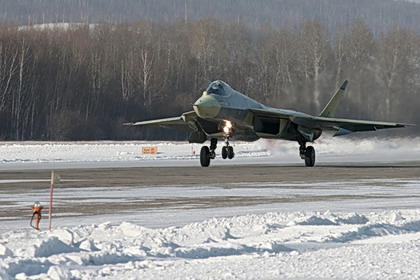
PAK FA in First Test Flight (photo: RIA Novosti)

In today’s Yezhednevnyy zhurnal, Aleksandr Golts turns his skeptical eye toward the PAK FA, Russia’s 5th generation fighter aircraft which just took its first test flight.

Golts says, looking a little like the F-22 and even more than the Su-27, PAK FA called forth a storm, a waterfall of success reports.  He notes that Prime Minister Putin cited it as proof of the wisdom of creating the United Aircraft-building Corporation [UAC or OAK] four years ago. 

Those in charge of the project are breathing easier.  After the Bulava SLBM failures, getting the new fighter off the ground was a matter of principle, especially since the leadership promised that it would fly every year since 2005.  Golts believes the Bulava failures combined with the 5th gen fighter delays caused people to discuss whether Russia could modernize, and whether it could develop high-tech products.  One thing Bulava and PAK FA have in common is that both are truly Russian projects, ones that are being implemented without dependence on significant leftover Soviet-era resources.  Their results could enable observers to question whether the OPK is being managed correctly, whether it was smart for Putin, [Sergey] Ivanov, and Chemezov to herd hundreds of enterprises into several gigantic OPK kolkhozy. 

Golts says some aviation industry leaders worried that OAK was created, not to concentrate resources to build PAK FA, but for Moscow bureaucrats to get their hands on profits from foreign aircraft orders [doesn’t ROE do this already?].  And Golts reminds that around 2000 then-Minister of Industry Ilya Klebanov said PAK FA development would cost $1.5 billion, but as we’ve learned the pricetag was closer to $10 billion over ten years. 

And it had to fly no matter what, and so it did.  But what actually flew, Golts asks.  One thing for sure, the first new airframe in 25 years.  And that’s it.  Everything else–speed, max and min ceilings, radars, weapons systems–all remain to be seen. 

As for the engines, Golts says we just don’t know.  Years ago the engine producers fought it out to be the designer and builder.  NPO ‘Saturn’ won out.  And, according to Golts, its director started to lie.  Putin and Ivanov both recognize that the engine problems will take some time to work out.  But on the day of PAK FA’s first test, the managing director of ‘Saturn,’ who directs the PAK FA program for the United Engine-building Corporation [ODK], claimed the new fighter has the newest engine, not an improved version of the Su-35’s engine, as the press and specialists have written. 

So what Putin and Ivanov worried about was secretly resolved by NPO ‘Saturn’ and the new engine is ready.  This is great news for Air Forces CINC Zelin.  Just four months ago he said that the PAK FA engine couldn’t be foreseen in the near future.  He said it would fly with a ‘Saturn’ engine, the 117S, a ‘deeply modernized’ version of the AL-31F. 

So, according to Golts, either ‘Saturn’ decided to pawn off on the Motherland an engine it demonstrated four years ago or, worse, having pocketed the contract, it simply decided to put old engines in a new aircraft. 

Golts concludes honestly that he can’t say whether PAK FA will be a true 5th generation aircraft, but it has taken off in a thick fog of lies.  And here’s the distinction between it and Bulava; there’s no way to hide Bulava’s failures since the U.S. gets the telemetry and people in other countries can see evidence of an unsuccessful test launch.  There aren’t the same limits on lying about PAK FA. 

So PAK FA is a “cat in a sack.”  You can’t say much for sure about the cat, but don’t worry, it’s a 5th generation sack.

Putin’s Voronezh Trip and Military C3

It takes a while to digest the press devoted to Prime Minister Vladimir Putin’s 18 January trip to Voronezh and Sozvezdiye, or the state-owned communications conglomerate based on the Voronezh Scientific-Research Institute of Military Communications.  Sozvezdiye is the holding which encompasses 16 other enterprises involved in C3, radio, and electronics.

Watch this NTV coverage of Putin at Sozvezdiye.

Sozvezdiye had a big demo set up outside for Putin.  But as the video shows, Putin was wearing his supremely bored look.  Moskovskiy komsomolets picked up on this, noting that Putin gave a cursory look at everything, and inside the display tent, he apparently picked up the mic on a video link system and tried to use it, but the soldier on the other end couldn’t hear the Prime Minister.

The Voronezh trip was the latest in a series of meetings on the state of the OPK.  Putin started by stating the obvious, noting that C3I is a decisive factor in the combat capability of a modern army, and a precondition for the use of highly accurate weapons.  He said it’s difficult to imagine an effective transition to a modern organizational structure without the right C3.  He called C3 a key priority for defense and noted that significant budget money will be spent on them.

Putin proceeded to chide his C3 producer audience, saying that Russia can’t modernize what it’s got; it needs an entirely new generation of systems.  He said C3 producers suffered from poor leadership, organization, and coordination of efforts.  Finally, he had to admit that they basically ignored his 2000 presidential decree on development of a new C3 system.

Specifically, Putin said:

“…we need not only to conduct a fundamental modernization of existing complexes and systems.  We have to say plainly that they unfortunately have already aged greatly.  And become obsolete, and even their technical condition often leaves much to be desired.  Therefore our focus for the coming years is to give the troops new generation equipment, to take a qualitative step forward.  It is precisely on this that I ask you to focus.”

“Our enterprises have a good scientific-technical pool for resolving this task, we need to use it wisely.”

Noting that dozens of OPK organizations work on C3I, he said:

“I ask that you turn attention to precise coordination of their activity, and also concentrate on working out agreed approaches and requirements for product development.”

“Besides this, I would like to turn attention to this, to this time a number of decisions adopted earlier have not been carried out.  So, to the present day, a general designer for development of an automated C2 system for the armed forces has not been appointed.  An integrated structure which would develop and implement a unified scientific-technical policy in this sphere has not been formed.  A special comprehensive program which would allow us to concentrate resources, to reduce and to optimize, to increase the effectiveness of budget expenditures has not been developed.”

Find the text of Putin’s address here.

Different media outlets reached the same conclusion about Putin’s Sozvezdiye visit and whether his words can fix the OPK’s problems and increase the sluggish pace of military modernization.  Segodnya.ru concluded:

“…the fact that Vladimir Putin directly participates in the problem of modernizing the technical outfitting of the army and promises to give the troops new generation equipment in coming years, inspires some optimisim.  Although the sensation remains that loud pronouncements about modernization traditionally hang in the air.”

Writing in Nezavisimaya gazeta, Viktor Myasnikov called it Putin’s “latest attempt to mobilize the military-industrial complex to equip the armed forces with quality modern products.”  Making note of Putin’s exhortations to the C3 producers, Tribuna said, “We’d like to believe they heard him.”  Newsru.com summed it up simply, Putin demanded that they modernize C3, but how to do it is not clear to anyone.

What exactly did Putin order in 2000?  According to Denis Telmanov writing for Gzt.ru before the Voronezh visit, Putin ordered the development of the Unified Tactical Level Command and Control System [ЕСУ ТЗ or YeSU TZ]. 

What’s it supposed to do?  It is supposed to be a large part of a system tying the armed forces together in one modern C2 network, and enabling them operate in a netcentric fashion.  Several media items reported that the Defense Ministry believes YeSU TZ will provide 2 or 3 times the capability of its predecessor. 

Tribuna noted that the Russians have the individual pieces of equipment, bought with a considerable allocation of money, but they haven’t managed to pull them together into one, integrated and modern C2 system.  According to Segodnya.ru, experts believe only Russia’s strategic forces possess a functioning, albeit increasingly obsolete, C2 system.  The armed services and branches, MDs, fleets, and armies have local automated C2 that isn’t necessarily integrated or compatible with other commands.

At the operational-tactical (battalion-brigade) level, Russia has reportedly fallen 20 years behind Western armies in C2.

Testing of YeSU TZ began in 2006 and continues.  In December, troops at Alabino used the equipment in a battalion tactical exercise.  But Telmanov concludes the military is in no hurry to adopt the system because it’s problem plagued and has obsolete elements.  It’s also hard to integrate with the army’s old comms gear. 

Izvestiya on 20 January reported that the system may be too complex for soldiers and sergeants, but even for some officers.  Myasnikov noted that the equipment suffered a lot of breakdowns at Alabino. 

But Sozvezdiye denies the criticism, saying YeSU TZ is reliable and no more difficult to use than a mobile phone.

Nikolay Khorunzhiy writing in Vremya novostey had said back in November that the Akatsiya system was tested during Kavkaz-2009 but could not be fully employed because operator training was deficient.  Combat situation data had to be input by hand and orders sent out by voice radio, defeating the purpose of automation.  Myasnikov also wrote that Akatsiya isn’t working out.

A little nomenclature is in order here.  It’s difficult to square all the press, but it seems Akatsiya is a name for YeSU TZ, but it’s also known by the name Sozvezdiye, a little confusing since this is the C3 production conglomerate’s name as well.  Apparently, Akatsiya is either based on or relies on the Akveduk satellite radio [?] system as one of its component parts.  These in turn evolved out of Polet-K and Manevr before them.  A couple press pieces said one problem with the system is what was basically a radio comms enterprise was put in charge of the broader C2 system effort which required other expertise as well.

A few other issues from the Voronezh visit bear mentioning…

Many press items cited the 2008 five-day war with Georgia as putting attention on C3 weaknesses.  Vremya novostey recalled the image of a wounded 58th Army commander, the recently dismissed, Khrulev borrowing a satellite phone from a journalist to communicate with Moscow.  Several papers cited a Sozvezdiye deputy director saying the holding ‘got raked over the coals’ for South Ossetia and Abkhazia.  He noted that Georgian forces used Harris equipment from the U.S. and it was better than Russian analogues in a number of ways.

Regarding this technological lag, there’s some dispute.  Moskovskiy komsomolets indicated Putin was told “we’ve approached NATO standards” in computerized C2.  Izvestiya, however, cited an industry source saying that there’s no appreciable lag between Russian and U.S. and Israeli systems.

Nezavisimaya gazeta and Izvestiya tackled the cost issue.  First Deputy Sozvezdiye Director Vasiliy Borisov was widely quoted to the effect that equipping one brigade with the new C2 system will cost 8 billion rubles.  Nezavisimaya multiplied this by 85 ‘new profile’ brigades for a price of 680 billion rubles, or when higher echelons have to outfitted as well, the total cost is probably more like 1 trillion rubles, or the price of one complete year of the State Defense Order (GOZ).  Izvestiya quoted Borisov saying the price to outfit a company commander would be 150,000 rubles, and 50,000 for individual soldiers.  The paper concluded that the new equipment won’t be replacing mobile phones any time soon at these prices.

Nezavisimaya also noted that one can’t do C2 properly without the right navigation system, and GLONASS is not up to the job.  It cited 17 operational GLONASS satellites, but press services today noted that 18 are now functioning.  Still, not enough.  Nezavisimaya compares work on C2 to Bulava and GLONASS–other military programs that defense industry is having a hard time bringing to fruition.  Tribuna makes the same point that a fully functioning and reliable GLONASS system is a ‘sine qua non’ for effective C2.

Ozerov Tells Attaches About Defense Ministry Auctions

According to RIA Novosti, the chairman of the Federation Council’s Defense and Security Committee, Viktor Ozerov told foreign military attaches today the unrealized proceeds from last year’s Defense Ministry property auctions had a negative impact on the conduct of military reforms.  The Audit Chamber reported that only 10 percent of what was expected came in from land and other property sales.  

Ozerov, a vacuous former political officer who usually shills for the Defense Ministry, said this affected the financing of military reforms in a negative way.  He blamed unfavorable economic conditions and a lack of investors or potential buyers, as well as insufficiently experienced managers in the Defense Ministry.  Ozerov called these freed up military towns, buildings, and other facilities the “Defense Minister’s reserve.”  

First, could it be that the Defense Ministry wanted too much for property that might not really be worth very much, or might cost too much to clean up for civilian use.  Or maybe auctions for truly valuable properties were rigged.  Second, we’ve been told that Seryukov’s Defense Ministry is all about experienced management.