Tag Archives: Dmitriy Medvedev

Medvedev Inspects Strategic Forces

In Friday’s Nezavisimoye voyennoye obozreniye, Viktor Litovkin claimed, the day before, President Dmitriy Medvedev visited the inner sanctum of Russia’s Aerospace Defense (VKO or ВКО) – the Central Command Post (ЦКП) of the 3rd Independent Air Defense (Missile Warning) Army in Solnechnogorsk.  Now Litovkin admits VKO doesn’t technically exist yet.  But preparations are underway, and he suggests, besides PVO, SPRN, PRO, space monitoring, etc., it will even include the RVSN.  Litovkin maintains tests of this system are ongoing, and Medvedev came to inspect it.  He watched troops track all three of Thursday’s SLBM and ICBM launches, and saw the missiles’ warheads land on their respective targets.  And, according to Litovkin, the point was to demonstrate the reliability of Russia’s nuclear missile capability to Medvedev as new SNV treaty limits loom.

Could the shrinking RVSN be subsumed under VKO as a new service or branch?  Could this explain the fairly rapid command shifts from Solovtsov to Shvaychenko to Karakayev?

A Base By Any Other Name?

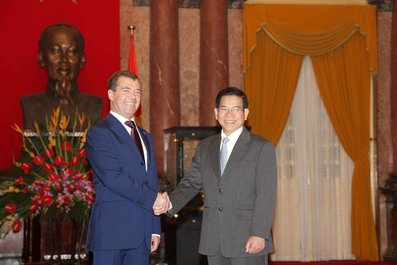
Medvedev with Vietnamese Counterpart Nguyen Minh Triet (photo: Kremlin.ru)

Cam Ranh was sure to be a topic for President Dmitriy Medvedev’s Vietnam trip.  But not a major one if Medvedev foreign policy assistant Sergey Prikhodko is to be believed.  Nevertheless, Prikhodko kept alive the idea of renewing some kind of Russian naval presence in Vietnam, whether called a base or a ‘material-technical support point.’  Prikhodko intimates the latter wouldn’t be anything like the former since times have changed so much.  Others will say the name it’s given is less signficant than what it actually turns out to be (if anything).

On Friday RIA Novosti quoted Prikhodko by name, on the eve of the Vietnam trip, saying:

“I don’t think we need to reestablish (in its old form) a base at Cam Ranh.”

And he claimed there was nothing concerning Cam Ranh in the documents  prepared for the visit.

Today ITAR-TASS coyly cited a Presidential Administration source (using Prikhodko’s exact words) who said Moscow is not tabling the issue of fully reestablishing a naval base at Cam Ranh:   

“Russia has material-technical support points for its Navy in many countries, you undoubtedly know them – from the Maldives on an occasional basis to Syria.  Naturally, the Vietnamese are interested in maximum capitalization on what was done by them and us.  But I don’t think we need to raise the issue of reestablishing the base.”

“It’s logical that in the framework of regular Russian Navy exercises, particularly in recent times, given our increased cooperation with European Union and NATO on antipiracy problems, this is an acute issue.  There’s nothing supernatural here.  And the fact is, in order for our ships to resupply with food and replenish in an efficient manner, they need infrastructure capabilities.”

“The idea of the base belongs to the Vietnamese side, it involves using the good groundwork and experience which Vietnam and Russia had earlier in supporting the security of navigation, supplying ships with food, with refueling.  It’s likely we’re talking about the possibilities of material-technical support of Russian ship cruises.”

“This is not the central subject (in the high-level talks), we have no enemies in this region as in past times, but to have the possibility to visit ports on regular and standard conditions wouldn’t be bad.”

“I don’t know the military’s plans in relation to this base and suppose that they don’t have any.  We’re talking about supporting the reliable functioning of our ships, including those fulfilling functions of various types of our cooperation with international organizations.”

Comparing the possibility of Cam Ranh with the existing situation with Syria, he said:

“This [Cam Ranh] is even better than the Syrian variant.  When it comes to Syria, we are always looking around at the reaction of neighbors, Israel, for example.  Here [Cam Ranh] it’s a much softer and more transparent variant.”

“There are complexities connected with ships passing the Strait of Malacca.  Therefore, on the level of public announcements, all countries in the region are interested that we should send military vessels there.”

It all seems like an awful lot of talk for something that ain’t goin’ happen . . .

Medvedev in Solnechnogorsk

President Medvedev (photo: Izvestiya / Yekaterina Shtukina)

Thursday President Dmitriy Medvedev made his most recent foray among the troops, and expressed what sounds something like a defense of his somewhat embattled Defense Minister, and his military reforms.

At Solnechnogorsk’s Center for Retraining and Improving Rifleman Qualifications, the President decorated some officers.  According to Kremlin.ru, he said:

“Our army is changing now.  And despite the fact that all changes are difficult, they are necessary. Because we understand:  if we can’t make our armed forces modern and effective, more combat capable, better armed, if officers receive pay that doesn’t motivate them to work properly, then we won’t have a proper defense.  Therefore, everything now being done is directed at creating modern and effective armed forces.  There are both problems and good decisions here, I am following them personally as Supreme CINC and I intend to continue to do so.”

He also congratulated General-Colonel Arkadiy Bakhin and Admiral Konstantin Sidenko after appointing them to be permanent commanders of the new Western and Eastern MDs respectively.

At the center, Medvedev inspected the school where Russia’s snipers are trained, and inspected the weapons they use.  The school has practically every type of infantry weapon, including NATO ones.

Izvestiya and Kommersant reported that officers there still venerate the Kalashnikov’s reliability and simplicity, but lament its ergonomics and low single shot density.  A new Kalashnikov will begin testing next year, and Izvestiya imagines the officers told the President what requirements for the new weapon will be, since today’s Russian Army can afford to buy the best.  Kommersant and RIA Novosti both noted that Kalashnikov lags behind Western manufacturers, so this all sounded a little like a rerun of recent domestic production vs. foreign procurement debates.

Medvedev visited the nearby military town of Timonovo, and viewed newly built apartment blocks for Space Troops officers.  Officers already in their apartments told Medvedev they are happy with the quality of the construction.  The President also met several dozen residents, families, and military retirees.  Some of the latter who served at Baykonur but received permanent apartments in Moscow Oblast complained of losing their higher pension ‘coefficient’ when they returned to Russia, and Medvedev promised to look into this.

He talked with representatives of the management company contracted to maintain these buildings for the Defense Ministry.  They said residents complain mostly about poor drinking water, and Governor Boris Gromov said this was because of old pipes that he promised to replace.  Medvedev gave Timonovo a positive evaluation, calling it: 

“A good town, normal level of support.”

This was Medvedev’s first trip to see the troops in a while, and he seems like he generally doesn’t go too often or too far to observe them.  He watched the naval portion of Vostok-2010 in July, and visited Alabino in May.

Political Tinge of the Serdyukov Flap

In this morning’s Nezavisimaya gazeta, Vladimir Mukhin says the Serdyukov flap has taken a political tinge.  NG’s Kremlin sources claim President Dmitriy Medvedev is “very worried about the developing situation.”

Mukhin says there won’t be any public lashing a la Mayor Luzhkov, but Medvedev called Serdyukov last week and categorically directed him “to carry out deliberate, well-considered work to create a positive image of the military reform which the country’s leadership is organizing and conducting.”

He concludes it’s clear Defense Minister Serdyukov has already reacted to the call from the Kremlin and begun “to work on the mistakes.” 

On Friday, Serdyukov unexpectedly met with the Defense Ministry’s ‘heavenly group,’ the superannuated retired generals and marshals in its General Inspectors’ Service (SGI or СГИ).  Mukhin says until now Serdyukov hasn’t paid them their due or used their experience in his reforms.  But all of a sudden he gathered them to inform them about how well his changes are going, and announced he’s forming a Defense Ministry organ to work with veterans and veterans organizations. 

And, of course, veterans – specifically airborne vets, but not only them – were the group most offended by what transpired between Serdyukov and Colonel Krasov at the Seltsy airborne training center.

Mukhin turns to retired General-Lieutenant Yuriy Netkachev for a comment:

“Elections are coming, and successes in military reform aren’t apparent.  The social situation of servicemen and military pensioners especially is worsening.  In this case, any incident similar to what happened in Seltsy could be a detonator for mass protest acts by a large number of veterans’ social organizations.  The party of power can’t allow such a thing on the eve of elections.  The opposition has already been using the dissatisfaction of the airborne veterans.  And therefore we will very soon be witness to a mass PR campaign on behalf of the head of the military department and his steps to form a new profile for the army and fleet.”

He didn’t, but Mukhin could have quoted former Soviet General Staff Chief, now SGI member, Army General Mikhail Moiseyev who supported Serdyukov and obediently told ITAR-TASS there’s no other way except to reform the Russian Army:

“We no longer need 192 divisions, it’s better to have a smaller quantity of permanent readiness brigades which will define the army’s combat readiness.”

That, of course, is a real no-brainer, and surely there must be aspects of Serdyukov’s reforms Moiseyev doesn’t agree with.  We’d like to hear about them.

Moiseyev also thinks Serdyukov is going to establish an assistant to the commander of each MD and fleet commander for work with veterans.

Kremlin Source Denies Serdyukov Resignation

According to Moscow News , an unnamed Kremlin source denies Prime Minister Putin asked for Defense Minister Serdyukov’s resignation in the wake of the storm over his harsh words for the chief of the VDV’s Ryazan Higher Command School on 30 September.

The report of Putin asking for Serdyukov to resign originally appeared in Argumeny nedeli.  And it’s being echoed elsewhere.

Titillating, yes, but virtually certainly just a rumor.  Even if Putin’s the power behind President Medvedev’s ceremonial throne, the former president probably wouldn’t try to fire a run-of-the-mill minister, much less Serdyukov, without thoroughly coordinating with Medvedev first. 

The Defense Ministry, like the other power ministries, is part of Putin’s cabinet, but it also reports directly to the President, unlike ordinary ministries. 

Of course, we remember Putin’s the one who put Serdyukov in charge of the Arbat MD in the first place.  It’s at least conceivable he could suggest to Serdyukov that maybe it’s time for him to go.

President’s Tough Talk to Defense Minister Serdyukov

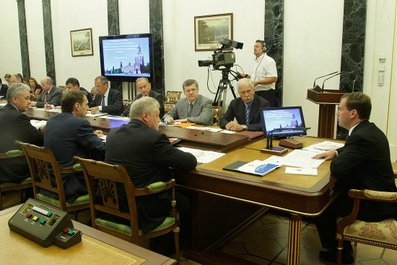
Medvedev at Security Council Meeting

Let’s look at President Dmitriy Medvedev’s criticism of the Navy and the Defense Ministry, his warnings and dismissals of some Navy officers.  It looks somewhat like a script torn from Vladimir Putin’s ‘tough guy’ handbook. 

Kommersant recounted the details of what sparked the President’s ire.  On 29 July, a fire burned the 2512th Central Aviation-Equipment Base of Naval Aviation and Air Defense near Kolomna, several dozen kilometers southeast of Moscow.  The Prosecutor’s Investigative Committee (SK) said the blaze destroyed the staff headquarters, finance unit, club, two bays of vehicle parking, 13 warehouses with various items of aviation equipment, and 17 open equipment storage stands with vehicles on them. 

Medvedev addressed yesterday’s Security Council meeting: 

“I instructed the Defense Ministry to take part in the firefighting effort and help to protect the civilian population, but sadly, in a number of cases, the ministry has proved unable to protect itself.  A fire took place in Moscow Oblast that has caused very serious damage.  The ministry has already carried out a preliminary internal investigation, and the investigation will continue of course.  The evidence so far indicates that this is quite simply a case of neglect of duty and criminal negligence, when personnel failed to bring under control a fire that was not spreading particularly fast, and no one even knew where the base’s commanders had gone.  I have therefore taken the following decision.”      

“Regarding the Navy’s senior command:  Navy CINC Admiral Vysotskiy has been warned about not fulfilling his duties; Chief of the Navy Main Staff and First Deputy CINC  Tatarinov has been warned about not fulfilling his duties; Deputy Chief of Navy Rear Services Sergeyev is dismissed; Chief of Naval Aviation Kuklev is dismissed; Deputy Chief of Naval Aviation Colonel Rasskazov is dismissed; Acting Deputy Chief of Naval Aviation Rear Services Monakov is dismissed; the chief of base 2512 is dismissed.”  

“I am also instructing the Defense Ministry to dismiss a number of other officers and personnel for disciplinary violations.  If anything similar happens in other places and other departments I will do exactly the same again, and without the slightest regret.” 

After discussing the fire situation with other ministers, Medvedev turned back to Defense Minister Serdyukov later in the meeting: 

“Now the Defense Ministry.  I already announced certain decisions.  The Minister needs to take everything under direct control.  Conduct a meeting today with the Ministry’s leadership and say that, if anything else like this burns, everyone will answer for it.” 

“Are there any concerns about the current situation?” 

Serdyukov responded saying plans have been made, operational groups established at all command levels.  Personnel and equipment have been put at the disposal of MChS and regional authorities.  And he noted that Deputy Defense Minister, General-Colonel Dmitriy Bulgakov is his point man for the fire emergency. 

Medvedev chided Serdyukov because the Vladimir Oblast governor had to go to the Defense Ministry for help instead of suitably empowered local commanders. 

Serdyukov said ‘corresponding’ orders have gone to all commanders and garrisons.  He continued with the Defense Ministry’s support of MChS — 11,000 servicemen, thousands of pieces of equipment, 33 kilometers of water pipelines laid in four rayons.  After Bulgakov’s visit to the Federal Nuclear Research Center in Sarov yesterday, another two battalions and special equipment were allocated to efforts there.  Serdyukov said another 28,000 troops can be brought into firefighting in the Central Federal District within 3-12 days. 

Serdyukov concluded: 

“We are taking all steps in full measure, we reinforced all facilities (there are 164 of them, but in immediate areas where there are fires there are 22) behind every responsible commander.  We are conducting all measures there:  increased volumes of water reserves for extinguishing fires, equipment has been brought in, extra personnel, everything literally transferred into a barracks condition, therefore all necessary steps for this, in fact, have been accomplished.  Therefore I submit that this sad incident that happened at base 2512 will not be repeated.” 

Kommersant helped out with a full run-down on the ranks and names of the lesser known Navy officers:  Rear-Admiral Sergey Sergeyev, General-Major Nikolay Kuklev, Colonel Sergey Rasskazov, Colonel Sergey Monakov, and Base Chief Colonel Viktor Biront. 

RIA Novosti covered Serdyukov’s firing of other officers at the base.  They included:  Deputy Base Chief Major R. Gidayatov; Deputy Chief Main Engineer Lieutenant Colonel V. Marchenko; Support and Security Company Commander Major A. Yermolov; Chief of the Material-Technical Support Department V. Karandak; and Chief of the 7th Storage Department V. Melsisidenkov. 

Today the SK said a criminal negligence case has been initiated.  Gazeta ru said, per usual Russian practice, top officials have blamed lower-ranking ones, in this case Navy officers, allowing the ‘untouchables’ to demonstrate their toughness and avoid responsibility.  Kommersant noted that the warnings for Vysotskiy and Tatarinov are just a step from dismissal.  But history shows other general and flag officers have gotten such warnings and still moved forward in their careers. 

Gzt.ru broached the subject of whether this could provide Medvedev an occasion to purge the Defense Ministry and fill it with his ‘own people.’ Konstantin Sivkov and Aleksandr Konovalov agree that he could use this opportunity.  But one has to ask, does this make sense in the scheme of tandem politics?  Medvedev has changed few in the cast inherited from Putin, and he’s very unlikely to start with a stolid Team Putin guy like Serdyukov.  Especially when he appears to be the first man to make some real headway in fixing the post-Soviet military.

Medvedev Opens Discussion on Conscription Changes

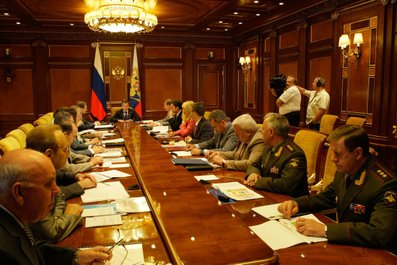
Presidential Meeting on Conscription (photo: Kremlin.ru)

Talk of military conscription changes has swirled in recent months.  Many potential changes have been attributed to General Staff Chief Makarov or his deputy, GOMU Chief Vasiliy Smirnov.  

While they talked about extending the draft age to 30, or tightening deferments, Defense Minister Serdyukov played ‘good cop,’ launching initiatives to ‘humanize’ military service, and make more men willing to serve.

In the last week, the press has published favorable reports on the just-concluded spring draft campaign.  But, meeting with PA officials and ministers in Gorki yesterday, President Medvedev sounded a different note, indicating that a deeper look at Russia’s military manpower resources and policies is needed. 

The meeting included relevant ministers, but not Prime Minister Putin.  Along with Makarov and Smirnov, Defense Minister Serdyukov and ROSTO / DOSAAF Chief Sergey Mayev attended.  Smirnov appears in uniform (bottom right of the picture), though it’s been thought he retired and put on civilian clothes.  He’s already 60, so he’s beyond the age limit for a general-colonel.  He’s served in the General Staff since 1982.  He was a GOMU directorate chief in the mid-1990s, then Deputy Chief, and Chief since August 2002.  Few Russian military officials should know their issues as well as Smirnov.

The key points in Medvedev’s meeting kickoff are that (a) Armed Forces’ manpower requirements are not being met; (b) no decisions on conscription changes have yet been taken; and (c) the public is supposed to get at least some kind of input on the issue.

Kremlin.ru’s coverage of the beginning of the meeting follows.

“Dmitriy Medvedev spoke of the need to conduct a rigorous analysis of the situation with military conscription and draw up proposals for its improvement.”

* * *

“D. MEDVEDEV:  Good day, colleagues!”

“We have an important issue for the life of our state — the issue of military conscription.  It’s clear that the overall effectiveness of the state, and ensuring security in the country depends on how we man our Armed Forces, and our law enforcement organs.”

“It’s clear that now there are complications:  army and navy requirements for conscripts are not being fully met.  This is connected to the demographic component, to demographic problems; this is connected to the health problems of young people.  All these issues have been discussed more than once both in meetings, and in the mass media.  We have to talk conceptually about what to do next.”

“There’s a range of proposals.  I want to say right off that all these proposals are still just proposals.  They need careful analysis.  Not a single one has any kind of preliminary approval, and we need to discuss them.”

“At first we’ll discuss them with the participation of the leadership of the Government, Presidential Administration, Armed Forces leaders, law enforcement structures, and special services.  Subsequent to such a type of decision all the same it needs to be discussed with the broader circle of society.  It’s essential to take public opinion into account in any case  because this concerns a sufficiently significant number of people in our country.”

Medvedev Can Wait for His BSF Basing Report

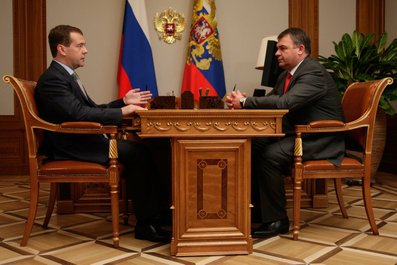
Medvedev and Serdyukov Meeting on 1 May

Whatever the complaints of some Ukrainians, the 21 April deal extending Russia’s basing privileges in Sevastopol is a good deal for Kyiv.  It’s now using the relatively meaningless Russian Black Sea Fleet (BSF) presence to secure a valuable 30 percent discount on Russian natural gas supplies.  

Moreover, in one suited for the ‘be careful what you wish for’ file, Moscow is also left holding the bag when it comes to the economy and infrastructure of Sevastopol, and much of Crimea as well, instead of Kyiv having to worry about assuming responsibility in a few short years. 

On 1 May, President Medvedev ordered Defense Minister Serdyukov to prepare a plan for developing the BSF’s naval base in Sevastopol, and to conclude an agreement with Ukraine on its social infrastructure.  According to Kremlin.ru, Medvedev said: 

“. . . today I want to touch on an issue with you which has taken on particular acuteness for our country in recent times.” 

“We need to think about the social arrangements for this base, that is very important to us, so that our sailors live in modern, full-fledged human conditions, have the chance for recreation and other opportunities a base is supposed to provide.” 

“So we’re agreed that our base will conclude a corresponding agreement with the Ukrainian side, with Sevastopol.  In accordance with this agreement, special support, social-economic support will be rendered to a series of Sevastopol city programs.” 

“This city is really not foreign to us and we need to think in what way to participate in these programs both along Defense Ministry lines and along the lines of other executive organs and business structures.  That’s the task.” 

Medvedev said Serdyukov should present his plan for approval in a month, and the latter responded that he would. 

Curiously, on 7 May, General Staff Chief Nikolay Makarov told RIA Novosti

“A working group’s been created which will evaluate the real condition of the basing point in Sevastopol and make its proposals.  I think this will take not less than two months.” 

“Practically nothing’s been invested there in recent years.” 

One wonders, would Makarov have unilaterally announced that Putin, when he was president, would have to wait an extra month or longer for the plan he ordered? 

Makarov said the Genshtab has no plans to freeze development of other basing points:   

“The fleet has to be.  The more basing points, the better.  And Novorossiysk is one of the key basing points.  And we intend to develop it.” 

Without elaboration, he said the Defense Ministry has modernization plans for the fleet’s ships, submarines, and aircraft to 2020.  Makarov was with Prime Minister Putin visiting the construction work at Novorossiysk.  

Putin Briefed on Novorossiysk

On 24 April, Anatoliy Tsyganok told RIA Novosti conditions at Novorossiysk are not particularly well suited for major base.  He noted it’s only 25 percent complete, and its price tag is continuously rising. 

Nevertheless, Putin reaffirmed Moscow’s commitment to Novorossiysk.  He acknowledged only 13 billions rubles have been spent, and he’s looking at an ultimate cost of 92 billion.  The base is slated for completion by 2020. 

But Moscow, Medvedev, and Putin may need to worry more about new ships and submarines than about infrastructure when it comes to the BSF. 

On 2 May, Anatoliy Baranov in Forum.msk pointed out that there’s practically no fleet there; a minimum of 2 more first rank ships and a submarine are needed for an adequate order-of-battle.  He says the social infrastructure’s not so bad, but 40- and 50-year-old civilian engineers and technicians have to go out with fleet units to conduct training.  What will the Navy do when they retire?  

Rosbalt.ru described a wave of new officer and civilian dismissals in the BSF, which occurred simultaneously with the new agreement with Kyiv.  The fleet, it says, is nothing more than a mixed force division’s worth of units and personnel.   Viktor Yadukha concludes: 

“NATO’s gracious reaction to the BSF lease extension didn’t surprise politicians more.  But if Western special services knew about real plans for its reinforcement, the reaction would have been very severe.” 

Lastly, in today’s Nezavisimaya gazeta, Aleksandr Khramchikhin says: 

“. . . renting empty piers for a great amount of money is not a mistake, but thoughtless, considering how many ships and how well-outfitted a base in Novorossiysk this money could build.” 

He calls today’s BSF a unique collection of floating antiques.  Even if the oldest units were dropped, most BSF ships would still be 20- to 25-years-old.  It will be impossible to avoid sending ships from the 1960s and 1970s off for scrap soon, as has been officially acknowledged.  Khramchikhin recommends placing what’s left at Novorossiysk as a ‘water area security’ (OVR or ОВР) brigade.

Supreme CINC Meets Troops at Alabino

President Medvedev at Alabino

On 5 May, President Medvedev visited Alabino’s 5th Guards Taman Independent Motorized Rifle Brigade (formerly division), a traditional showcase and test bed formation for new equipment and concepts.  

Medvedev and Defense Minister Serdyukov followed up the latter’s late April meeting with the Committee of Soldiers’ Mothers and other public representatives about ‘humanizing’ the armed forces.  At that time, Serdyukov presented ideas for driving the ‘spirit of the prison camp from the army.’  They included freeing soldiers from additional duties to focus completely on training, allowing them more free time, pushing reveille and lights-out back an hour, mandating a rest hour after lunch, instituting a 5-day conscript working week, allowing the possibility of draftees serving close to home, and obtaining weekend passes to leave the garrison. 

Alabino is a place where things like these are typically tried out. 

As Rossiyskaya gazeta put it, Medvedev went to Alabino to see how conscripts live in ‘new profile’ conditions.  He inspected the training grounds, classrooms, and barracks, and answered questions from the new soldiers themselves.  

Medvedev and Serdyukov addressed physical training, one-year conscription, contract service, weekend passes, mobile phones, and hiring civilians to perform nonmilitary support services. 

Taman Brigade Commander Andrey Ivanayev told the Supreme CINC about the experiment with intensive physical training (PT) in his formation.  Ivanayev indicated the troops formerly had 53 hours of PT  per year, but now get 4-5 hours per day, or about 25 per week.  He and Medvedev discussed how soldiers are separated into groups by the physical load they can handle. 

In the Kremlin.ru transcript, Ivanayev said in April testing there were only 88 negative PT evaluations.  According to RIA Novosti’s reporting, Ivanayev thinks the formation’s fitness level has already increased 50 percent.   

Medvedev remarked on the Taman brigade’s outfitting with special PT gear.  He asked Defense Minister Serdyukov about introducing new athletic uniforms in other units.  Serdyukov said:  

“Yes, we are literally this spring buying 50,000 sets and toward fall, apparently, on the order of 100,000 more, the fact is in the course of two years we’re trying to outfit the entire army fully with sports gear for training in summer as well as winter.” 

Most important to the vast majority of Russians, Medvedev told Taman brigade soldiers he doesn’t intend to raise the current 1-year conscription term:  

“That decision on the transition to one-year service which was made, it was painful for us, it isn’t easy, but we won’t change it.  Service in other countries comparable to our country in combat potential is organized in exactly such as way.  And this year still allows us to train a quality specialist, soldier, sergeant.  And despite the fact that there are now certain problems with manning—it’s true, we don’t intend to change the service term.” 

When one soldier asked about enlisted contract service, Medvedev turned to Serdyukov to explain what’s new on this front.  Serdyukov answered: 

“We are now preparing a concept precisely on contract service for soldier and sergeant personnel.  There will be an entire complex of proposals, including on pay, service conduct.  We will equate the entire social package (sergeant like officer) on support, pay and all parameters . . . .” 

“I think in the course of this summer we will prepare and then send you concrete proposals about how this will look, what quantity of contractees we intend to accept, in which specialties particularly and with what kind of pay.” 

Medvedev responded that current pay is not very high, but those who are serving well on it should be retained: 

“However, at the same time, it’s completely obvious according to the well-known principle, better less, but better.  Let there be higher pay and those remaining will really want to serve, instead of us spreading this [pay] among a large quantity of contractees, who won’t have the stimulus, particular desire, or any kind of motive to continue serving and to serve well.” 

When Medvedev pressed him for what he thinks about contractee pay, Moscow MD Commander Valeriy Gerasimov finally said he thinks contractees should get 50-60 percent of lieutenant pay.  Serdyukov said it would be more on the order of 80-85 percent, depending on the duty position.  The more technically complex, the closer to officer pay.  He continues: 

“We are proceeding from the fact that, on the whole, in all the armed forces—a lieutenant from 55, and a sergeant from 35 [thousand rubles per month] . . . .” 

But a little math says that is closer to Gerasimov’s figure, or 64 percent of officer pay . . . 

Medvedev asked his Defense Minister about devising a policy to give conscripts weekend passes to visit home if they live nearby.  Serdyukov said: 

“We are planning over two-three months to proceed on this regime.  Well, naturally, after taking the oath, after he becomes a soldier, after this we’ll introduce it.  We have this really experimental brigade, we are just beginning to work all these approaches out.” 

Medvedev added: 

“Here again we have to proceed from modern approaches.  If a guy serves close by and manning goes according to the territorial principle, then why not let him go home?  Another thing, of course, everyone has to understand what responsibility the soldier carries for any type of infraction in this case, but this is just a question of self-discipline.  You want to go home for the weekend, this means, simply do everything as it’s supposed to be done.” 

Serdyukov chimed in: 

“In the course of five days [of the working week] you need to show the highest indicators, then this will be a particular stimulus for one who wants to pay a visit home on Saturday and Sunday.” 

This policy is especially interesting . . . the possibility of the weekend pass is predicated on several things not really discussed during the Alabino visit.  Working backward, the pass depends on successfully implementing a five-day working week for conscripts.  Then on having conscripts serving relatively close to home in the first place.  At least one voyenkom has already said conscripts from his republic don’t have this chance because they all serve outside their home borders.  A prized weekend pass could also become one more thing to be bought and sold to the highest bidder, or briber.  If implemented, this policy will be difficult to maintain in the face of soldiers who don’t return to the garrison or get into serious trouble while away from it. 

A new conscript asked Medvedev if mobile phones are permitted in the army.  The President asked him if he had one in his pocket, and the soldier replied yes.  Medvedev responded, “Then why did you ask?”  He continued: 

“In fact these rules, as I understand, essentially are established at the unit level, at the level of the corresponding troop formation, but there are no bans on this issue.” 

Gerasimov added that in the Moscow MD anyone may have a cell phone, but they may not be used during training or duty time. 

Discussing training and physical conditioning, Serdyukov turned to one of his earliest initiatives at the Defense Ministry—relieving soldiers from essential nonmilitary duties like kitchen patrol, cleaning, groundskeeping, and utilities maintenance. 

He mentioned the goal of moving to civilian service and support within 12-18 months in all Defense Ministry units, but “everything will depend on our financial condition.  According to preliminary calculations, we have to make do in the bounds of our existing budget.” 

Medvedev said: 

“I think here it’s obvious to everyone that soldiers and officers need to serve the Motherland, be occupied with troop training, improve their physical conditioning, but questions of maintaining the sub-unit, generally, this is an issue which civilian organizations could do successfully for money, as this is done, incidentally, around the world.  Then there won’t be problems with tiresome details and it’ll be possible to concentrate on fundamental service.” 

Civilians already take care of the Taman brigade’s food service, and soon they will maintain its engineering networks, and provide cleaning services.  Serdyukov indicated the FSB is working on licensing firms to work in closed facilities, and Oboronservis will work in remote garrisons where contractors can’t be found.

Rearmament Tempo Less Than 2 Percent Per Year

Vasiliy Burenok

Vasiliy Burenok told a round table at the ‘Army and Society’ exhibition in Moscow Friday that the current pace of Russian force modernization, not more than 2 percent, won’t support the transition to a ‘new profile’ military.

Burenok is Director of the Defense Ministry’s 46th Scientific-Research Institute (46 NII).  The 46 NII is a lead organization involved in formulating the State Armaments Program (GPV) and State Defense Order (GOZ).  It works on military-technical policy documents and program planning methodologies.  Burenok is a member of the Scientific-Technical Council of the RF Government’s Military-Industrial Commission (VPK).

Reviewing history a bit, Burenok told his audience, at the beginning of the 1990s, the rearmament rate was 5-7 percent annually.  But, between 1991 and 2000, financing for new arms and equipment declined more than 50 times, leaving only enough money to maintain existing weapons.

Burenok concludes to get the army to the ‘new profile’ it’s essential to introduce 9 percent new equipment every year, and for some services and combat arms, up to 11 percent.

This 9 to 11 percent is, of course, the difficult target President Medvedev set at the Defense Ministry Collegium.  Burenok indicated just how difficult–going from less than 2 to an 11 percent annual renewal rate.

Armaments Chief and Deputy Defense Minister Vladimir Popovkin also addressed the ‘Army and Society’ round table.  He said GPV 2011-2020 will go to the president for approval in June.  The new GPV will be accompanied by yet another new Federal Targeted Program for OPK Development.

Popovkin said a number of systems won’t be produced under the new GPV.  They include short-range tube artillery, and BTR-80, BMP-2, and BMP-3 combat vehicles that soldiers are afraid to ride in.