Tag Archives: OSK

Southern MD and Black Sea Fleet

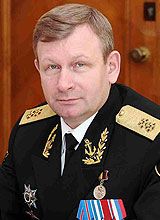
BSF Commander Vladimir Korolev told IA Rosbalt today he thinks resubordinating the BSF to the Southern MD will allow for resolving a large number of missions:

“The South-Western Axis which existed in Soviet times allowed us to coordinate the efforts of various services and troop branches.  This experience is extremely opportune today.”

Korolev acknowledged that military reform may progress painfully:

“Fundamental changes in any structure aren’t coped with easily, naturally, they can’t proceed painlessly in an organism as complex as the fleet.  The strategic command isn’t swallowing the fleet, the BSF will become an integral part of it with its specific sphere of missions.  Adjusting the synchronization of the work of structures, processes, mutual adaptation, delineation of authorities — all this is not simple at all, but it’s very important because such large-scale changes are happening for the first time in the history of our Armed Forces.  But we have to go for this in order for the fleet to develop, to get stronger in accordance with modern requirements.”

He called ‘synergistic cooperation’ the main benefit of establishing the common command uniting the fleet and army:

“The fleet, aviation, and ground units won’t compete among themselves, but organically supplement and support each other.  The events of August 2008 showed how important it is to have a powerful grouping of varied forces which have to act according to a single plan, dispose of an entire arsenal of forces and means, including modern communications systems, on the Southern, as well as on any other axis.”

Rosbalt said the BSF and Caspian Flotilla will transform into the Operational Command of Naval Forces (OKMS or ОКМС) within the Southern MD.

Now it seems Korolev’s putting a happy face on this; it won’t be easy.  Establishing real unified commands is just as hard as it is necessary.  Like it or not, the BSF is getting swallowed and subordinated.  It will operate according to plans made largely by green uniforms in Rostov-na-Donu.

If true, what Rosbalt says about the naval ‘Operational Command’ is very significant.  Remember the much-ballyhooed shift to a three-tier command structure?  The tiers are military district, operational command, and brigade.  The name sounds like the fleet’s being reduced from equal of the MD to equivalent of an army, another operational-level command.  Quite a come down.

GUBP Retirees Against Reform

 A belated post-script to the Colonel Krasov, Seltsy, SDR flare-up against Defense Minister Anatoliy Serdyukov and his reforms . . . .

On the first of this month, Life.ru reported that officers of the now-disbanded Main Directorate of Combat Training and Troop Service (ГУБП or GUBP for short) established a public organization to oppose military reform.

The organizing assembly occurred right after the directorate furled its standard (marking the unit’s dissolution) on 26 November.  Life.ru says 60 men attended.  This new, as yet unnamed organization is apparently seeking official registration.  It expects support from the LDPR faction in the Duma, and from large veterans organizations that have come out against reform.

Its executive secretary, Andrey Serdyuk, said:

“Ill-conceived reform has left the Russian Army without a central combat training methodology – that is, now no one knows what and how we teach soldiers and officers on the battlefield.  Nevertheless, we intend to conduct meetings and demonstrations like our colleagues from the Union of Airborne Troops.  We plan to achieve our goals in three ways – media appearances, organizing public monitoring over the course of reform, and cooperation with public veterans’ organizations.”

Retirees will be the backbone of this organization.  It won’t accept serving military men out of concern for their welfare.

A former chief of the main directorate, General-Colonel Aleksandr Skorodumov will head the group.  He retired in late 2004 after complaining publicly about personnel decisions and reorganizations that look minor compared with Serdyukov’s tenure.  He created a mini-scandal by saying the army had collapsed at that time.

Viktor Ozerov – Chairman of Federation Council’s Defense Committee and an uncritical functionary – admitted:

“There was and undoubtedly will be resistance to reform.  Remember when the General Staff apparatus was cut, how many dissatisfied people there were:  people occupied specific duties, had pay, and then they’re deprived of all this.  But in any instance, there are people standing behind every such decision and their legal rights should be guaranteed upon dismissal.”

Ozerov also said responsibility for combat training will go to the individual services and branches, and inter-service training will be supervised by the military districts / unified strategic commands (OSKs).

Serdyukov himself told the Defense Ministry’s official Public Council on Friday that combat training will be the purview of services, armies, and brigades, and operational training will be under the Genshtab, MDs, and brigades (but apparently not armies?).

The GUBP’s fate was decided in June and sealed in September.  See Moskovskiy komsomolets, Argumenty.ru, and Gazeta.ru for more.  They claim former Moscow MD Commander, General-Colonel Valeriy Gerasimov – newly retooled as a deputy chief of the General Staff – will oversee inter-service training for the Genshtab.  And, by 1 February, a new Directorate of Troop Service and Military Service Security will stand up.  This will actually be a new / old directorate.  It existed several years ago and supervised safety issues, and grappled with crime and dedovshchina among the troops. 

MK presented two opposing opinions on GUBP’s fate. 

Leonid Ivashov said:

“The most experienced officers and generals serve in the GUBP, they develop and monitor combat training.  The Genshtab has several other functions – strategic ones.  No one there will take evaluation trips to far-off garrisons.  Especially since the Genstab’s combat training directorate will be a very truncated version.  Its elimination means our troops won’t be prepared for combat actions.

A Genshtab source gave this view:

“This is simply the latest course of reform which we have going on.  The information about the GUBP’s elimination appeared long ago.  The directorate has a highly inflated number of personnel, and its work has been evaluated as, to put it mildly, ineffective.  No new methods, no training ground equipment, no simulators in recent decades.

Makarov’s Year-Ender

On Tuesday, General Staff Chief Nikolay Makarov provided his year-end wrap-up on the ‘new profile’ of the Armed Forces in the form of a press-conference featuring a videolink with the four new MD / OSK commanders.

It was pretty much a self-congratulatory celebration of how Makarov and company have turned everything in the Russian military around for the better.  As Moskovskiy komsomolets put it, “Nikolay Makarov told the media how bad it was in the army in the past, and how good it will be in the future.”

Rossiyskaya gazeta paraphrased Makarov’s remarks, giving only a couple direct quotes.  First up was President Medvedev’s call for unified aerospace defense (VKO) before the end of 2011.

RG says Makarov said VKO will be fully operational in 2020 when new reconnaissance and weapons systems have been deployed.  He said its purpose is to defend the state [interestingly the state, not the country] from ballistic and cruise missiles.  It needs to be an umbrella against any kind of threat, including low-altitude ones.

Makarov said different military structures have been occupied with the security of the skies.  Space Troops do orbital reconnaissance and ground-based missile early warning.  The air forces and air defense armies (АВВСиПВО or АВВСПВО) and radar troops monitor air space for approaching hostile aircraft.  The Special Designation Command (КСпН) covers the Moscow air defense zone [didn’t this long ago change its name to the OSK VKO?].  Air defense troops (ЗРВ) and fighter aviation cover other important facilities.  The system was set-up on a service (видовой) basis and that’s why it was uncoordinated.  It needs to be made integrated and put under the command of the General Staff [of course – this sounds like Olga Bozhyeva in MK].  In the Defense Ministry, they understand unification won’t be quick and will require a lot of resources, but there’s simply no other way.

Izvestiya proffered a quotation on this one:

“If we look at how this system was built earlier, then it’s possible to see that it acted separately by services and branches of troops, and also by regions.  So, Space Troops answered for space reconnaissance, the work of missile attack warning stations.  The Ground Troops for the activity of radar units.  Now we are uniting all these separate organizations in a unitary whole.  We need to establish the foundation of this system in 2011.  To finish its formation completely by 2020.”

According to RG, Makarov said a modern army would be useless without a new command and control system for the Armed Forces.  Russia’s move to a unified information environment will cost 300 billion rubles, and will be phased, with the initial phase being the replacement of all analog equipment with digital systems by 2012.  Command and control systems will be developed and produced in Russia, but other weapons will be bought abroad.  This is when he broke the news about Mistral winning the amphibious command ship tender.

RG concludes Makarov called for a fully professional Armed Forces, but the words it quoted aren’t particularly convincing:

“Now we can’t do them like this.  But year by year we’ll increase the selection of contract servicemen with commensurate pay.”

However, Moskovskiy komsomolets quoted the General Staff Chief this way:

“We are aiming for a contract army.  Now we can’t make it so instantly, but year by year the number of contract servicemen, with commensurate pay, will increase.”

Olga Bozhyeva viewed this as a total reversal of Makarov’s earlier rejection of contractees and insistence on conscripts as the backbone of the army.

Makarov also talked about efforts to create ‘human’ service and living conditions.  He referred, as always, to outsourcing and civilianizing mess hall and other housekeeping duties.  He repeated that, starting in 2012, officer pay will increase by several times.  According to Krasnaya zvezda, Makarov said 50 percent of officers now receive higher pay through premiums and incentives.  Officers and their families will be moved from remote garrison towns to oblast centers where their children can get a better education and wives can find work.  About the large cut in military towns, he said:

“We had about 22 thousand of them, approximately 5,500 remain, but in all, we’re taking the number of military towns to 180.”

Of course, he didn’t mention who will take care of large numbers of retirees left behind in that archipelago of abandoned military towns.

KZ gave its own recap of Makarov’s press-conference, and it’s interesting to hear his rehash of why the army needed a ‘new profile.’  His remarks blow up any lingering myth about the 2000s, at least the Putin years, as the time of the Russian military’s rejuvenation.  He said:

“Before 2009, 87 percent of the Armed Forces consisted of formations and military units with abbreviated personnel and cadres, practically not having personnel.  They almost didn’t conduct operational and combat training.  The army didn’t just degrade.  During this time, we grew an entire generation of officers and generals who ceased to understand the very essence of military service, they didn’t have experience in training and educating personnel.”

KZ paraphrases more of Makarov.  The personnel training system caused complaints.  VVUZy were teaching the Great Patriotic War.  Low pay and poor prospects for housing made the officer’s profession a low-prestige one.  In units, personnel weren’t occupied with combat training, but serving themselves, and military discipline fell as a result.  On the whole, the Armed Forces stopped fulfilling the missions for which they are intended, and could scarcely react to threats and challenges beyond the state’s borders and inside the country.

Makarov addressed how the MDs were changed to meet future threats and challenges:

“Planning and troop employment happened with significant difficulties, since each of six military districts had a series of missions where one often contradicted another.  Moreover, four air forces and air defense armies were established, as a result, the zones of responsibility of the military districts and these armies didn’t coincide at all.  This led to confusion in employing air defense forces.  At the same time, experience showed that military actions in recent decades are conducted, as a rule, by unified force groupings and forces under a unitary command.  Each of our districts and each of our four fleets existed independently. Each had its own zone of responsibility, not matching the others.  In order to organize any kind of joint actions, it was necessary to establish temporary commands, temporary structures, which, as a rule, were poorly prepared, didn’t have corresponding experience.  All this led to unsatisfactory results.”

Izvestiya quoted him:

“In the bounds of the ongoing transformations, full-blooded troop groupings have been established on all strategic axes.  Four full-blooded commands have appeared for us which, having in their composition and immediately subordinate to them all forces and means, can react adequately to all challenges and threats to the borders of our districts.  Changes in the Armed Forces command and control structure are a necessary occurrence since the old administrative-territorial division had stopped answering the challenges and threats of the time.”

New MDs (photo: ITAR-TASS)

Then Makarov brought in MD commanders over the video so they could attest to how it’s going.  They remarked on how cutting intermediate, redundant command levels has made their jobs easier.  Western MD Commander, General-Colonel Arkadiy Bakhin said 40 percent of his formations and units have outsourced some support functions. 

KZ says earlier MD commanders answered only for Ground Troops, and when they needed forces from another service or branch, they had to get permission from above.  Southern MD Commander, General-Lieutenant Aleksandr Galkin claims making these requests cost the commander time, but now all forces and means are in one command, the fundamentally new unified strategic command (OSK).  Galkin also says freeing soldiers from support tasks means there are now 20-22 training days per month instead of 15-16.

A Thoroughly Modern CINC

You have to like Air Forces CINC, General-Colonel Aleksandr Zelin. 

He’s open and candid about what Defense Minister Anatoliy Serdyukov’s ‘new profile’ reforms mean for him and his service.  He’s talked earlier, more often, and longer about it than his Ground Troops or Navy counterparts.  He’s matter of fact and accepting of the entire process. 

Serdyukov’s changes turned General-Colonel into a trainer and force provider, and he nonchalantly admits as much. 

At 57, Zelin understands he can be replaced at any time, or allowed to serve three more years or even longer. 

If he were a tad younger, he would have been the right kind of general to command one of the new military districts / unified strategic commands (OSK / ОСК), say the Western or Central.  An air or air defense officer would have been just the right choice for a potential future war on those axes.  Instead, the Kremlin has three Ground Troops generals and one admiral (a step in the right direction).  It’s hard to argue against Ground Troops leadership in Russia’s restive south.  But Air Forces (VVS or ВВС) would have been a really good choice in the Western or Central Military Districts . . . a missed opportunity for now.

But back to Zelin.  On Tuesday, he addressed a foreign military attaché audience (and the Russian media) about the future of the VVS.

According to Gzt.ru, Zelin said the VVS will be reduced by a third and spread among the four new  OSKs.  And its Main Command (Glavkomat) will be responsible only for combat training.  The OSKs are in charge of employing the VVS in their theaters.

The VVS now consist of the Glavkomat, 7 operational commands, 7 first-rank air bases, 8 second-rank air bases, and 13 aerospace defense (VKO) brigades.  Before the ‘new profile,’ the Air Forces consisted of 72 regiments, 14 air bases, and 12 independent squadrons and detachments, with a third more aircraft than the VVS now have.

Four of today’s 7 operational commands are subordinate to the new OSKs.  Army Aviation also falls under them.

According to Zelin, in the future, the VVS Main Command (Glavkomat or Главкомат) could become a “branch department” of the General Staff responsible for the combat training of the Air Forces and Air Defense, while the OSKs employ the trained forces.

Zelin says VVS personnel will number 170,000 with 40,000 officers, nearly 30,000 sergeants, and the balance conscripts or civilian specialists.  He says today’s personnel training system doesn’t satisfy him, and so he’ll probably change the system of flight schools.  Only four remain today.  Voronezh will be the main training center.  Flight training will also be conducted in Krasnodar and Lipetsk.  Yaroslavl will remain home to air defense officer training.

According to the CINC, the VVS airfield network won’t change.  Base airfields will be first priority for reconstruction and modernization.  Zelin says civilian airfields could be used for operational purposes in the future.

He noted the VVS plans to go to a fully automated command and control system in the future, and, of course, develop its VKO forces.

Lenta.ua quoted Zelin’s remarks to Interfaks.  Zelin said the VVS will renew 30 percent of its inventory by 2015, and 100 percent new in some areas and 80 percent new overall by 2020.  He doesn’t say where the VVS are today in this regard, but recall Defense Minister Serdyukov has said only 10 percent of equipment in the Armed Forces is modern.

Zelin said the VVS will get new aircraft, air defense, reconnaissance, and electronic warfare systems, but modernization of some existing systems is still part of the plan.  Although the State Armaments Program 2011-2020 and its 19 or 20 trillion rubles have to be finalized, Zelin repeated that 10 T-50 (PAK FA) will be acquired in 2013-2015, and 60 more from 2016.  He mentioned Military-Transport Aviation (VTA or ВТА) is a priority – including the An-124 Ruslan, Il-112, Il-476, Il-76M, and An-70 – but he doesn’t venture any numbers or dates for new production.  Zelin does give a target of 400 new and modernized helicopters in the inventory by 2015.

Who knows what was or wasn’t covered in these media contacts, but it seems odd there’s still no mention of more S-400 deliveries.  Zelin was still talking about getting 5-6 more battalions in 2010 earlier this year.  But no sign of them.  It’ll be a big deal when or if they appear.  Also, no mention of S-500 development.

Goodbye GRU Spetsnaz, Hello Army Spetsnaz

Writing in last Friday’s Stoletiye.ru, Rossiyskaya gazeta correspondent Sergey Ptichkin says that, practically on its 60th anniversary, GRU Spetsnaz have landed in a most unexpected place – the Ground Troops.  His piece is full of bitter sarcasm.

Ptichkin concludes:

“The GRU Spetsnaz brigades have transferred into the Ground Troops structure.  Several units have disbanded altogether.  Ranks for duties have been lowered.  Now a senior lieutenant will command a reconnaissance group, and that’s the ceiling.  All warrant officers have been dismissed – there’s no longer such a rank in the army.  And it’s strange that professional sergeants haven’t magically appeared in place of full-grown warrants.  The issue of halting parachute training for reconnaissance men is on the agenda.  Really, why parachutes if they’ve become ‘pure infantrymen?’  They can deliver them to any rebellious village in the mountains or forests on trains or in KamAZes.”

According to Ptichkin, professional Spetsnaz believe:

“. . . it’s simply impossible to train an eighteen-year-old boy into a genuine reconnaissance man-saboteur in one year.  In Afghanistan, Spetsnaz soldiers were sent out only after a year of intensive combat training.  That is real service, when a professional military reconnaissance man was born even at the very lowest level, began a year after callup, but now they’re dismissed into the reserves where they forget everything they learned after a few months.”

Ptichkin recalls the GRU Spetsnaz’ anniversary ten years ago.  Even though their relations with the Spetsnaz were tense, the Defense Minister and General Staff Chief came and paid their respects.

But this year:

“Neither the Defense Minister, nor the Chief of the General Staff, not even their current chief – the Ground Troops CINC came.”

“Many veterans and even serving officers consider this day a quiet farewell to the GRU Spetsnaz, born 60 years ago.  It’s possible something more mobile, combat ready, and effective will take its place.”

So he’s thrown Putin and Medvedev’s own description of the kind of army they want back at them.  Of course, the Spetsnaz have always considered themselves the ultimate fighting force.

Ptichkin says the Defense Minister didn’t even issue a traditional order of recognition for the day of Spetsnaz troops.

“There is still the symbol of military reconnaissance – the bat [literally, ‘flying mouse’].  But very soon it’ll be possible to boldly replace this silent night hunter on the emblem with a grey field mouse.  A sweet and inoffensive ground-pounder.”

ITAR-TASS’ coverage of the Spetsnaz anniversary also clearly identified them as subordinate to the Ground Troops, CINC General-Colonel Aleksandr Postnikov, and his Chief of Reconnaissance, Deputy Chief of Staff for Reconnaissance, Colonel Vladimir Mardusin.

The press service said Mardusin indicated that:

“. . . at present, army Spetsnaz are organized in independent brigades of special designation, which exist in every military district, and battalions in several combined arms formations of the Southern Military District.  Within the formation of the new profile of the armed forces, independent brigades of special designation were transferred to the Ground Troops and are in direct subordination to military district commanders / unified strategic commands.”

Izvestiya’s Dmitriy Litovkin predicted the GRU Spetsnaz’ transfer from the General Staff’s Main Intelligence Directorate (GRU) to the Ground Troops last November on the day of military intelligence (6 November).  This was after the 67th, 12th, and 3rd Spetsnaz brigades were disbanded, and even the 16th was in danger of the same.

Igor Korotchenko told Litovkin:

“It’s possible to judge what’s happening in the GRU only through open information.  For example, one of the results of the reform is taking the force component from the GRU and resubordinating Spetsnaz to the military district commanders.  Only space, radioelectronic, and agent reconnaissance, and also the analytic service remain in today’s ‘Aquarium.’”

Just a reminder, this would mean they were taken even before the six old MDs were reformed into 4 MDs / OSKs.  The poor performance of the GRU generally and the Spetsnaz specifically in the 2008 Georgian conflict may have provided impetus for the change.  Litovkin and others have reported that the GRU and Spetsnaz received an ‘unsatisfactory’ for their efforts in that brief war.   Meanwhile, subordinating Spetsnaz to warfighting MD CINCs on different strategic directions would seem to make sense, the angst of the GRU, its officers, and veterans notwithstanding.

We should, however, get back to the original Ptichkin article.  It has a lot of interesting stuff you might want to peruse.  Some is hyperbolic though, so take it with a grain of salt . . .

He describes all details of their formation from 24 October 1950.  The Spetsnaz were subordinate to the General Staff (GRU) because they were first and foremost strategic, and strategic nuclear, warfighting assets designed to disrupt U.S. and NATO capabilities – nuclear weapons, logistics, transport, communications, etc. – in deep rear areas, including even North America.

And, according to Ptichkin, they were supermen capable of singly accomplishing missions not even combined arms sub-units could handle.  And the Spetsnaz were more secret than Soviet nuclear weapons; not even all generals or marshals knew about more than their general outlines.

Everything changed with Afghanistan and glasnost.  Every power structure wanted its own special forces.  And the GRU Spetsnaz were thrust into the forefront of a war they weren’t created for.  But through the skill of their commanders they adapted and were successful.  Ptichkin claims a single Spetsnaz detachment could pacify an entire province.  And, according to him, if the Spetsnaz had been unleashed fully, the Afghan war would have been won and the country under Soviet control by the mid-1980s.

He says Tajikistan in 1992 proves this isn’t a fantasy.  The 15th Spetsnaz brigade under Colonel Vladimir Kvachkov, one of the accused in the Chubays’ assassination attempt, was given a free hand there and pacified the country. 

Ptichkin says Spetsnaz weren’t so involved in the First Chechen War, and the results were bad of course.  But they were used more extensively in the Second Chechen.  And he claims the Chechen Spetsnaz battalion under Sulim Yamadayev prevented Georgian saboteurs from blowing the Roki tunnel in August 2008.

And so, says Ptichkin, for 30 years, Spetsnaz have fought in places they weren’t intended to be, but have fought beautifully anyway.  Instead of landing in he main enemy’s rear areas, they are sitting on their own territory prepared, in extreme circumstances, to be sent to the next hot spot in the CIS, and not further afield.

As proof of how they’ve been used, it’s interesting to note the holiday press which says 8 Spetsnaz became Heroes of the Soviet Union in 40 years, but 44 have become Heroes of the Russian Federation in less than 20 years.

Collegium in Southern Military District

Anatoliy Serdyukov conducted another extramural Defense Ministry collegium today, this time in Rostov-na-Donu, and the new Southern Military District (MD).

RIA Novosti quoted a spokeswoman who said:

“Participants in the session are reviewing issues concerning formation of the YuVO.  In particular, they will review questions about optimizing the deployment of formations and military units on the district’s territory, work with personnel, medical and housing support for servicemen, and also preparations for the heating season.”

So, they’re talking about possibly moving some brigades or regiments to better locations, and probably about who will command some of them.

The YuVO began operations in its new composition on 1 October.

According to ITAR-TASS, Serdyukov spoke of the ‘doubling’ of the ‘potential’ of the armed forces in the south with the establishment of the new district, but added this isn’t connected with the army’s counterterrorism missions in the region.

One would like to know how that ‘doubling’ was calculated since the MD’s ground units haven’t changed.

The Southern MD, or Unified Strategic Command (OSK) ‘South’ encompasses not only the former SKVO, but also the Black Sea Fleet and Caspian Flotilla.

Western MD Opens for Business

According to ITAR-TASS, General-Colonel Valeriy Gerasimov told journalists yesterday that the new Western Military District (MD) was fully formed and functional on 1 September.  Gerasimov said:

“The Western Military District started functioning on 1 September.  Command and control organs of the former Leningrad and Moscow Military Districts, Northern and Baltic Fleets, and also the 1st Air Forces and Air Defense Command went into the composition of the staff located in St. Petersburg.”

Gerasimov said the majority of Moscow MD staff officers:

“. . . were appointed to positions in the staff of the Western Military District and other organs of military command and control.  Part of the officers, having served out their prescribed terms, were dismissed, but those who have a half-year to a year remaining to serve are at the disposition [of their commanding officers].”

Gerasimov himself went from Commander, Moscow MD to become a deputy chief of the General Staff.

The Defense Ministry now wants the other three new MDs / OSKs to be functional by 1 October.

Winners and Losers in Organizing New MDs and Armies

Today a Ground Troops spokesman told ITAR-TASS three current Leningrad Military District (MD) brigades will form a 6th Combined Arms Army (CAA) in the new Western MD.  The 200th, 138th, and 25th Motorized Rifle Brigades will comprise the new army, and its headquarters will probably be Agalatovo, just north of St. Petersburg.  The spokesman also said a surface-to-air missile brigade and independent engineering brigade will be added to the Western MD.

These comments came in conjunction with a visit by Ground Troops CINC, General-Colonel Aleksandr Postnikov to the region to check on the formation of the new MD.  The spokesman said Postnikov may be working on peacetime coordination between the district’s Ground Troops, the Northern and Baltic Fleets, and Air Forces units.  He said, in wartime, “everything’s clear – [the district’s] commander directly commands everything deployed within the district’s boundaries.  But there’s still no experience of coordination in peacetime and we need to get it.”

Nezavisimaya gazeta’s Vladimir Mukhin also wrote today that the third new CAA will be based in Maykop, Southern MD.  Mukhin says that staffs, commands, formations, and military units in the Far East, Siberian, and Moscow MDs are being liquidated in the shift to four new MDs / OSKs, and, as a result, several thousand officers will be placed outside the TO&E beginning 1 September.  He thinks many of them won’t find vacant posts, and will be discharged from the army.

Serdyukov’s Defense Ministry will also be putting some soon-to-be-vacant properties up for sale, e.g. Moscow MD headquarters (Polina Osipenko Street, Moscow), Far East MD headquarters (Seryshev Street, Khabarovsk).  The initial asking prices for these buildings and land will be several billion U.S. dollars.  As long planned, proceeds from these sales, along with the sale of the Navy Main Staff, military educational institutions, and other military establishments in Moscow, are supposed to fund construction of housing for servicemen as well as military garrison infrastructure in new army deployment locations.

Mukhin talked to General-Lieutenant Yuriy Netkachev about Maykop.  Netkachev says Moscow is resurrecting the army headquarters located there until 1993.  He believes Maykop was chosen to reinforce against threats from Georgia as well as threats to the 2014 Winter Olympics in Sochi.

In the Central MD, Mukhin says the 67th Spetsnaz Brigade will move yet again, from IVVAIU in Irkutsk to Chita or Transbaykal Kray.  The IVVAIU building will be sold.

Mukhin sees Moscow’s demilitarization and moving forces closer to their likely operational theaters as the right policy, but asks if it’s underpinned with resources.  It has serious impact on servicemen and their families, and they’ve been forgotten in this process.

Mukhin quotes servicemen’s union chief Oleg Shvedkov:

“Continuing steps to transition the troops into a new profile supposes not only a significant cut in professional servicemen, but also their relocation to a new place of service.  And this means new everyday life problems are possible:  transfers, absence of housing, work for spouses, education for children, and the like.  The Defense Ministry is trying to resolve these issues on its own, but it would be more correct for the government to work on them through a special federal program.”

Vice-Admiral Chirkov and the Pacific Fleet

Vice-Admiral Chirkov

Baltic Fleet Commander, Vice-Admiral Viktor Chirkov is apparently being tapped to replace Vice-Admiral Konstantin Sidenko in the Pacific Fleet, according to Russian press agencies and a Kommersant source in the Navy Main Staff.  

Sidenko will command the new Eastern Military District and Combined Strategic Command (OSK) East.  Chirkov will be replaced in the Baltic Fleet by his chief of staff, Rear-Admiral Sergey Farkov.  Kommersant’s source calls these changes a ‘normal rotation.’ 

Gzt.ru’s source says the Pacific Fleet is expecting the Chirkov announcement ‘any minute,’ but drawing up the papers, including the President’s decree on the appointment, is ongoing. 

Viktor Viktorovich Chirkov is a surface warfare officer with Pacific Fleet roots.  He was born on 8 September 1959 in Alma-Ata, capital of the former Kazakh SSR.  In 1982, he graduated from the Vladivostok Higher Naval School and became head of the mine-torpedo department on old Riga-class corvette Lun in the Pacific Fleet.  He served as assistant commander of a corvette, then executive officer of Kotlin-class destroyer Vozbuzhdennyy.  

In 1986-1987, Chirkov completed Higher Special Officers’ Classes in Leningrad, and became commander of the infamous Krivak-class frigate Storozhevoy.  Under a mutinous crew, this Soviet Baltic Fleet unit tried, unsuccessfully, to defect in 1975.  Later it transferred to the Pacific Fleet. 

From 1990 to 1993, Chirkov commanded Udaloy-class destroyer Admiral Spirodonov.  He was deputy chief of staff for an ASW ship division, deputy division commander, and commander of an ASW ship division during 1993-1998.  In 1997, he completed the Kuznetsov Naval Academy as a correspondence student.  

After graduating from the Military Academy of the General Staff in 2000, Chirkov served for five years as chief of staff, first deputy commander of Troops and Forces in the North-East on Kamchatka.  In the first years of this assignment, he served under Vice-Admiral Sidenko.  

In 2005-2007, he commanded the Primorskiy Mixed Forces Flotilla.  For the next two years, he was chief of staff, first deputy commander of the Baltic Fleet, and became its commander in September 2009. 

Chirkov is married with two sons. 

A Pacific Fleet staff source told Gzt.ru Chirkov is happily anticipated since he’s an old friend and ‘not an outsider.’  Another calls him a wise and honorable officer who knows his business. 

Vitaliy Shlykov talked to Gzt.ru about the Pacific Fleet’s growing importance: 

“In the Baltic there’s nothing to do, everyone’s friends, allies.  But the Pacific Ocean is the future, it’s necessary to turn all attention there.  And we don’t have enemies there, so there’s time to strengthen this fleet before there’s a confrontation between the U.S. and China.” 

“Of course, given this state of affairs, the significance of the fleet is growing sharply in comparison with Russia’s other fleets.” 

NVO’s Viktor Litovkin notes that Chirkin will be first to command the Pacific Fleet in its new condition of subordination to OSK East.  He thinks the new commander has multiple problems to solve, including obtaining new ships, dismantling old nuclear submarines, and building housing for servicemen.  Chirkin will also have to grapple with getting contract sailors, rather than conscripts, to man his afloat forces for long deployments.

Commander for New Army in Chita

General-Major Romanchuk

By the Defense Minister’s order dated 12 August, General-Major Aleksandr Vladimirovich Romanchuk became acting commander of the new combined arms army being formed in Chita.  ITAR-TASS quoted a SibVO spokesman:

“The command and staff of the army, and also a number of army-subordinate formations and military units, will be formed under his leadership.  Formations and military units based in Transbaykal Kray will comprise the army.”

The Chita Combined Arms Army (CAA) will be the easternmost large formation in the new Central Military District (MD), or Combined Strategic Command (OSK) Center.  Who knows what number the new army will receive . . . maybe the former 29th CAA will be resurrected.

Romanchuk was born 15 April 1959 in Lugansk, Ukraine.  He grew up in a military family in Azerbaijan.  Commissioned out of the Baku Higher Combined Arms Command School in 1980, he served as a tank platoon and company commander, then chief of staff and deputy commander of a tank battalion in the Transcaucasus MD.  He graduated from the Military Academy of Armored Troops in 1989 and, for a very short period, commanded an independent tank battalion in the Central Group of Forces (Czechoslovakia). 

Returning home with the rest of Soviet forces, he became deputy commander and commander of a machine gun-artillery regiment in the Transbaykal MD during the 1990s.  He was a colonel in his late 30s by the end of this phase of his career.

When the Transbaykal MD folded into the Siberian MD, Romanchuk became chief of an armaments and equipment storage base, and chief of staff and deputy commander of a Siberian MD tank division.  He served a tour of duty in Chechnya during the late 1990s or early 2000s.

Between 2001 and 2003, he was deputy commander of the Guards Taman Motorized Rifle Division in the Moscow MD.  He became commander of the 4th Guards Kantemir Tank Division in Naro-Fominsk at the end of 2003.  He was promoted to general-major (one star) in mid-2005.

He likely attended the Military Academy of the General Staff between mid-2006 and mid-2008, and then became a deputy commander of the Novosibirsk-based 41st CAA.  In July 2009, he became chief of staff and first deputy commander of that army.

Romanchuk is married with two sons.