Tag Archives: Sergey Ivanov

Serdyukov’s Carte Blanche

In an editorial Monday, Vedomosti supported the carte blanche President Dmitriy Medvedev has apparently given Defense Minister Anatoliy Serdyukov and his military reforms.  The paper likes the reforms enough that it wants the President to think about the possible effectiveness of the ‘army method’ in reforming the MVD.  Here’s what Vedomosti had to say:

“Renaming the Army”

“Dmitriy Medvedev’s and Anatoliy Serdykov’s joint trip to a model Moscow suburban military unit went beyond the protocol of the visit.  The President’s speech in awarding outstanding military men became a new signal to officers, the army, and society:  ‘Despite the fact that all changes are difficult, they are necessary…  Everything that is now being done is directed at establishing modern and effective armed forces.  Here there are both problems and good decisions, I am following this personally as Supreme CINC.’  The Kremlin demonstrated that, despite the recent media scandal, it trusts the civilian Defense Minister, won’t bow to the generals’ and veterans’ opposition, and intends to continue its planned military reform.”

“The new carte blanche for Serdyukov for further transformation is important for many reasons.  The current minister is not the first civilian director of the military department.  However, he specifically replaced a campaign of reforming with systematic transformations.  In his inheritance from Sergey Ivanov, Serdyukov received a much truncated army of the Soviet type, not answering modern requirements.  Dedovshchina, obsolete armaments (modern equipment is not much more than 10% of the general inventory) and command and control, and manning were its main problems.  Add to this corruption among the generals which prevented equipping the army with new types of armaments and communications.  The victorious August war of 2008 showed that the victors couldn’t suppress the enemy’s aviation and artillery and were inferior to the vanquished in modern communications and reconnaissance means.”

“Serdyukov’s attempts to establish control over expenditures on purchases for the army met severe resistance from rear services officers and generals.  Not long ago he acknowledged to journalists:  ‘When I came to the Defense Ministry, speaking plainly, I was surrounded by large amounts of thievery.  Financial licentiousness, the impunity of people whom no one had checked out (…) was so deeply ingrained that it had already become a way of thinking.’  The minister confirms that the transparency of the defense order is a ways off.  The unnecessary secrecy of the military budget is interfering with this.  Meanwhile, progress in the struggle against traders in shoulderboards is obvious.  In 2006, corruption cases were started against seven generals, in 2007, when Serdyukov became minister, — against 16, in 2008 — against 20, in the first half of this year — against eight more.”

“Besides this, the Defense Ministry put up for sale unneeded property and facilities which were being illegally rented out to enrich a few people, and didn’t allow for building apartment blocks for officers needing housing on these grounds.”

“On the whole, it’s possible also to consider organizational transformations a success:  the transition to a more modern system of command and control and the reduction in the excess number of generals and higher officers.  In 2008, of 249 generals and admirals who underwent certification [аттестация], 50 were dismissed, and 130 sent to new places of service.  One can’t avoid mistakes in cutting and dismissing officers, but those deprived of a sinecure cried loudest of all about the collapse of the army and treason.”

“The struggle with barracks hooliganism goes on with varying success.  According to the Main Military Prosecutor’s data, in 2006, more than 5,800 people suffered beatings from fellow servicemen, in 2009 — 3,000.  And for the first five months of 2010, 1,167 soldiers suffered from dedovshchina — 1.5 times more than the analogous period of 2009, of them, four died.  The cause is not only in the growth — because of the cut in the service term — the number of new conscripts went from 123,000 in the fall of 2006 to the current 270,600.  Generals, having botched the program costing 84 billion rubles to transfer to contract, now are forced to call up those with criminal records.  Military police will remain a paper tiger for ‘dedy’ and ethnic clans.  We note that Serdyukov hasn’t forsaken a professional army, but put off its creation until the time when the Defense Ministry will be able to select and not collect contractees through deception and duress.”

“Nevertheless, it’s notable that over 3 and 1/2 years, the reform, being conducted by independent managers without legal changes and loud renamings, has really moved forward.  It’s possible it’s worth the President considering the effectiveness of the army method in reforming the MVD.”

TsOPI Critiques Serdyukov’s Reforms

In last week’s Nezavisimoye voyennoye obozreniye, IMEMO’s Vladimir Yevseyev presented the results of a recent round table on reform in the RF Armed Forces. The Center for Social-Political Initiatives (TsOPI or ЦОПИ), with support from Germany’s Rosa Luxemburg Foundation, sponsored the event.

Yevseyev described early reform as cutting personnel without changing the army’s structures during a time of political paralysis in the 1990s.  In the Putin era, he says there were still failures and the army’s equipment levels dropped, but the army began to believe it could still fight.

At this time, former Defense Minister Ivanov more than once declared the end of army reform, the troops started to get limited quantities of new weapons, and there was an unsuccessful attempt to move to professional enlisted force.  Yevseyev tries unconvincingly to point out successes in the Putin-Ivanov period.  His leading examples are especially dubious:

“— the elimination of cadre units and formations and forming of permanent readiness units numbering nearly 200 thousand servicemen on a contract basis.”

“— partial fulfillment of the federal targeted program of transition to manning with servicemen conducting military service on contract in a number of formations and military units in 2004-2007 that as a whole with a corresponding change in legislation in 2008 allowed a reduction in the conscripted service term to one year.”

The hollow unit problem wasn’t tackled until late in 2008, and Yevseyev has already labeled contract service a failure.  Moreover, the contract service program probably didn’t attract more than 80,000 soldiers.

And contract service didn’t have anything to do with one-year conscript service.  That change was made to try to encourage more young Russian men to serve rather than avoid serving.  Professional enlisted service, had it worked, would have allowed Moscow to continue drafting only 260,000 men per year for two years, rather than 540,000 per year to serve for a year as it is now.

But Yevseyev comes to the right conclusion:

“. . . radical change in the reform of the Armed Forces did not happen.  The main reason for this was that the Russian leadership could not take the fundamentally important decision on bringing the size of the Armed Forces into correspondence with the economic possibilities we have and with observable (future) external threats.”

Yevseyev writes that the most acute phase of military reform came with Defense Minister Serdyukov, and the war with Georgia, which revealed the army’s shortcomings.
 
But, says Yevseyev, Serdyukov’s initiatives like reducing officers and cutting warrants ran into difficulties.  Forty thousand officers placed outside the TO&E couldn’t be retired because they still lack permanent housing.  And many would-be officer graduates in 2009 and 2010 were forced into sergeant’s duties.

Yevseyev says Serdyukov’s reform is bringing an increased flow of negative consequences as shown in the results of TsOPI’s polling. It surveyed more than 2,500 people, including nearly 1,700 servicemen, in nine major cities.  According to 61 percent of respondents, reform has degraded the entire military command and control system.  Sixty-four percent said the army’s ‘new profile’ has seriously reduced their social status.  Thirty-two percent are not sure their housing, pension, and pay rights will be observed during Serdyukov’s reform.  Twenty-three percent are worried about their outplacement rights, and 8 percent about their medical benefits.

Yevseyev and his colleagues discussed three major problems for the Armed Forces:  rearmament, infrastructure, and manning.

They say 40 percent of Soviet arms and equipment were modern at the end of the 1980s, with the percentage declining to only 10-12 percent by 2005, and 5 percent at present.  They give a useful rundown of what’s been produced over recent years.

In 2004-2008:

  • 36 ‘Topol-M’ ICBMs;
  • 2 battalions of Iskander SSMs;
  • 2 battalions of S-400 SAMs;
  • 150 T-90 tanks;
  • 700 armored combat vehicles;
  • 20 self-propelled artillery systems;
  • 1 Tu-160 strategic bomber;
  • 3 Su-34 bombers;
  • 30 helicopters;
  • 1 diesel submarine;
  • 2 corvettes; and
  • 13 smaller ships and auxiliaries.

In 2009:

  • 49 new or modernized aircraft;
  • 31 helicopters;
  • 304 armored combat vehicles; and
  • 20 artillery systems.

Yevseyev and company conclude:

“It would seem that the situation with equipping the country’s Armed Forces is beginning to be corrected.  But in reality such rates of military equipment supply allow full rearmament across 30-50 years, which significantly exceeds the length of its service life.”

So this will make it difficult to increase the share of new weapons and equipment to 30 percent by 2015, even for permanent readiness units and formations.

They point next to the massive lingering Russian military structure.  Four years ago there were 26,000 military organizations of one type or another, and now only 6,000.  And that will be reduced to 2,500.  But they say, instead of consolidating and realizing cost savings, some of this process was fake, and some organizations were just named as subsidiaries [filialy] of larger ones.  As an example, they cite the shift from regiments to brigades and 1,000 reported TO&E changes, of which only 30 actually involved a physical unit relocation.

Finally, Yevseyev and the round table participants point to a potential unit leadership void when officers and professional enlisted are being cut (or not recruited) at the same time.  They say, given the training time they need, conscripts shouldn’t comprise more than 30 percent of a permanent readiness unit.

Yevseyev sums up:

“. . . the process of implementing military reform in the Russian Armed Forces now prompts the most serious misgivings.  In essence, the military personnel training system is being destroyed, the decline in the Armed Forces’ equipping continues, their system of manning and command and control is being broken.  All this leads to the weakening of the country’s defense capability and requires taking immediate measures to eliminate the negative consequences we are already experiencing.”

New Chief of Defense Minister’s Apparat

Mikhail Mokretsov (photo: RIA Novosti)

Yesterday’s press announced that Mikhail Mokretsov, ex-Director of the Federal Tax Service (FNS) and long-time colleague of Anatoliy Serdyukov, will be the Defense Minister’s Apparat Chief.  

Kommersant says Serdyukov had largely kept his old team in place, and still influenced personnel decisions in the Finance Ministry’s FNS.  And the FNS has been a stable supplier of high-level cadres for Serdyukov’s Defense Ministry.  Along with ex-deputy directors of the FNS Dmitriy Chushkin and Yevgeniy Vechko, not less than 10 other highly placed former tax service officials have come over to Serdyukov’s Defense Ministry. 

Kommersant indicates this may represent the end of Serdyukov’s ‘agreement’ with Finance Minister Kudrin to leave his old cronies in place in the FNS for three years.

Mokretsov’s work in the tax service has drawn some praise.  Deputy Chairman of the Duma’s Budget Committee Andrey Makarov says the Defense Ministry can use another strong manager like Mokretsov, and he adds:

“The main thing in reforming the army is to stop the stealing.  Control and auditing are essential there.”

Perhaps playing the provocateur, Gzt.ru suggests that some in the Genshtab see Mokretsov’s arrival as a precursor to Serdyukov’s departure from the Defense Ministry.  Under this scenario, Serdyukov would be preparing Mokretsov to take his place as Defense Minister when he moves to a higher post.  But a PA source denied any prospect for a change of Defense Minister and specifically ruled out Mokretsov’s chances.

Mokretsov will occupy a long-vacant post.  Its last occupant, Andrey Chobotov left with former Defense Minister Sergey Ivanov when he became Deputy Prime Minister.  Chobotov apparently works in Ivanov’s office and in the government’s Military-Industrial Commission (VPK).  Since Chobotov had the job, the apparat has been considered a Defense Ministry ‘service’ [not to be confused with an armed service] and this brings its chief the title of Deputy Defense Minister.

According to Gzt.ru, retired General-Lieutenant Andrey Kazakov has been the acting apparat chief since Chobotov’s departure.  Kazakov has served in the Defense Minister’s apparat, primarily as Chief of the Defense Ministry’s Affairs Directorate, since at least 2001.

The apparat chief wields serious power–at least within the administrative system.  According to Gzt.ru, he is not simply the Defense Minister’s right hand.  He’s a chief of staff and critical gatekeeper whose agreement is necessary to get documents signed and decisions made.  This power is largely unofficial, deriving from personal proximity to the Defense Minister.

The apparat chief’s official, statutory powers are more modest.  Mil.ru lists six official elements under him.  The Expert Center of the RF Defense Minister’s Apparat is something of a ‘think tank’ preparing analytical information and reports on military-technical policy, force structure, and force development, under the Defense Minister’s direction.  The Main Legal Directorate of the RF Defense Ministry has been reinvigorated of late, and its role is self-evident.  The above-mentioned Affairs Directorate serves as property manager and business agent for the Defense Ministry in Moscow.   The Directorate of State Assessment of the RF Defense Ministry is responsible for ensuring that military infrastructure complies with an array of government regulations.  The apparat also includes, without explanation, Inspection of State Architectural-Construction Oversight and the Management Directorate of the RF Defense Ministry.

Gzt.ru got our old friend Leonid Ivashov to comment on yesterday’s news.  Ivashov hates to contemplate the idea of career growth for Serdyukov, and he thinks the idea of Serdyukov putting Mokretsov in place behind him is ‘patently untenable.’  He holds even less back than usual when he says:

“If the task is to destroy the country the way Serdyukov has destroyed the army, then such an appointment is possible.  Serdyukov is a destroyer.  And the fact that they are dragging their nonprofessionals into the [Defense] Ministry supports this.  It’s very sad that the Defense Minister of our country is first when it comes to being an example of corruption and disrespect for the army.  Mokretsov can’t help Serdyukov straighten out financial flows which go through the military department.  But he will absolutely help him steal from them.”

Ivashov goes on to complain about Serdyukov’s commercialization of Defense Ministry functions, e.g. turning rear services into Oboronservis.

Vitaliy Shlykov, who views Serdyukov favorably, sees the Mokretsov move as promoting creation of a civilian Defense Ministry that still doesn’t exist.  And Shlykov doesn’t see Serdyukov leaving the Defense Ministry since it is, in many ways, a higher post than a deputy prime minister with a portfolio, who doesn’t really run anything.

Today’s Vedomosti intimates that Mokretsov will focus on auditing the State Defense Order on the heels of Prime Minister Putin’s remarks this week about corruption, waste, and poor results in the OPK .

More about Mokretsov specifically . . .

He joined the tax service in 2000, moving quickly from department chief to deputy director of the Tax Ministry’s Directorate for St. Petersburg, deputy director of the Directorate for Moscow, and Chief of the Directorate for International Tax Relations.  In 2004, he became deputy director of the renamed Federal Tax Service under Serdyukov, and Director of the FNS in February 2007 when Serdyukov left for the Defense Ministry.  

The 49-year-old Mokretsov was born in Udmurtiya, and graduated in 1984 from the Leningrad Financial-Economic Institute.  He was called up after graduation and served two years as a finance officer in the Soviet Army.  Between 1986 and 2000, he worked in unnamed government and commercial enterprises in St. Petersburg.

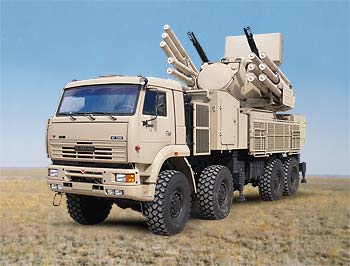
Pantsir-S1 and the Priority on Arms Exports

KBP's Pantsir-S1

Recent announcements about deliveries of the Pantsir-S1 highlighted the priority still enjoyed by arms exports over domestic procurement of weapons systems for the Russian Armed Forces.

On 18 March, the Russian Air Forces took delivery of their first 10 Pantsir-S1 antiaircraft missile-gun systems (ZRPK) from the Tula-based Design Bureau of Instrument-building (KBP).  These Pantsir-S1 systems will march on Red Square during the coming 9 May Victory Day parade, before heading to the Elektrostal-based 606th Guards Air Defense Missile Regiment that also has the S-400.  Some of the regiment’s Pantsir-S1s will participate in live-fire exercises at Ashuluk in April.

The Pantsir-S1 will replace the 1970s-era Tunguska-M1 in Russian air defense units.  A short- and medium-range missile-gun system, it provides point defense for civilian or military assets like S-400 SAMs.  VVS Deputy CINC for Air Defense, General-Lieutenant Sergey Razygrayev has said three Pantsir-S1 systems will be deployed around each S-400 launcher.

The Pantsir-S1 has 2 twin-barrel 30-mm 2A38M antiaircraft guns and 12 57E6-E SAMs.  It is reportedly effective against targets with a reflective surface of 2-3 square centimeters and speeds to 1,000 meters per second, at a maximum range of 20 kilometers and altitude of 15 kilometers.

The Pantsir-S1 can be mounted on various vehicles and ships, and General-Lieutenant Razygrayev has said it will become a standard air defense system for each of Russia’s armed services and combat arms in the future.

When the VVS got its 10 Pantsir-S1 systems, the KBP deputy general director announced that the Air Forces will receive more than 20 units in coming years.  An unnamed source told ITAR-TASS, the VVS would get 25 Pantsir-S1 by 2012.

Development of the Pantsir-S1 dates back to the early and mid-1990s.

The United Arab Emirates (UAE) signed a contract to buy 50 Pantsir-S1s for $734 million in 2000. Syria also contracted for 36 systems.  Ex-Defense Minister, now Deputy PM for the OPK Sergey Ivanov said in early 2008 that 24 systems would go to customers in 2008, from a total order book of 64 for the Pantsir-S1 (of course, 50 + 36 should be 86, not 64).  But the Pantsir-S1 didn’t finish development and testing until some time in 2008, and entered production later in 2008 or in 2009.

Pantsir-S1 deliveries to the UAE and Syria reportedly began in 2009, and the system is already supposedly operational in the UAE.  An OPK source told Interfaks that the first stage of Pantsir-S1 deliveries to these two countries had been successfully completed.

This month Moscow announced the sale of 38 Pantsir-S1s to Algeria for $500 million.  The systems are supposed to be delivered this year and next.  The Russians are reportedly close to a Pantsir-S1 export deal with Libya, and Saudi Arabia, India, and Belarus have been mentioned as other potential buyers of the system.

So these are pretty lucrative sales for KBP, roughly $13-15 million per unit.

Now back to the Russian Armed Forces which have only 10 newly-received Pantsir-S1 themselves.

In late 2007, the commander of Troop Air Defense for the Russian Ground Troops gave his opinion that Pantsir-S1 needed improvements before it could enter his inventory, specifically he wanted its size reduced and better performance against certain types of targets.  For its part, the VVS had been looking, and waiting, for Pantsir-S1 since at least 2002.  AVN reported in late 2008 that the VVS wants to buy more than 100 of the systems.

Even if the Defense Ministry paid $15 million (unlikely), 100 is still a modest buy of $1.5 billion against annual military procurement of about $40 billion these days.  But one can guess that the military is haggling with KBP over the price it’ll pay for the Pantsir-S1.  And this purchase has to fit with other defense procurement and KBP’s production for its foreign buyers.

Military Police, Open Up!

On 12 March, Krasnaya zvezda profiled what might be the armed forces’ first military police department (OVP) in the Astrakhan military garrison, under the Navy’s Caspian Flotilla.

A Statute and Instruction cover the authority and operations of Russia’s military police (MPs).  The KZ article says their formal functions reinforcing discipline, providing security, conducting antiterrorism measures, and controlling traffic.

Russian military police are a long time coming and far from all are happy about the idea.  Instituting an MP force was first debated in the mid-1990s, but it didn’t happen.  The major sticking point was whether the military police would answer to, or be independent of, the Defense Ministry.

As recently as very late 2005, Deputy Defense Minister Nikolay Pankov didn’t support the idea, but hardly a month later, after the notorious Sychev abuse case, then-President Putin and then-Defense Minister Ivanov came out for establishing a military police force, primarily to halt violent crime and abuse in the barracks.  But the concept fell by the wayside after several months of debate.

Just as suddenly as the thought of military police disappeared, it resurfaced last fall.  The force was to be established on 1 December with a strength of 5,000 personnel, and military police units were to work jointly with local military komendaturas [commandant’s offices] for the first year before subsuming them.

As in the 1990s, the idea encountered considerable opposition primarily from the RF Human Rights Ombudsman Vladimir Lukin and Main Military Prosecutor Sergey Fridinskiy.  Lukin supports military police but only if they are independent of the Defense Ministry.  He has said military officials don’t need one more bureaucratic apparatus.  For his part, Fridinskiy said:

“We need to think clearly about all aspects of this issue, including those connected with legal and financial support. Moreover, where will we find such a number of qualified people?  In our country’s conditions, it’s not a certainty that military police will bring positive changes.  Where is the guarantee that we won’t get the very same excesses that they always talk about in connection with the [civilian] police–we aren’t selecting different people, it’s all the same contingent.”

Fridinskiy seems to be worried about military prosecutors tripping over MPs, or MPs fouling the work of his prosecutors.  He definitely doesn’t entertain the idea that they could work well together. 

There were press rumors over the winter that Defense Minister Serdyukov had decided to scrap the plan to institute MPs, but defense spokesmen denied the reports.  And at least the very first OVP has appeared and gotten some publicity.

The Astrakhan garrison’s OVP chief is an O-4 who once served as head of the security department for an armaments storage base, and chief of the garrison’s guardhouse.  His KZ interviewer says the OVP Chief knows all the ins and outs of garrison service firsthand.

The OVP Chief says the composition of an OVP is determined by the size, locations, and characteristics of the garrison it serves.  His OVP has a security and convoy section, investigation section, and an MP platoon, and he describes its initial capabilities as modest.

The security and convoy section guards and transports prisoners to the prosecutor’s and military-investigative organs, to disciplinary battalions, or investigative detention.  The investigative section prepares cases against soldiers accused of disciplinary offenses.  The MP platoon is responsible for patrol service, preventing crime, and maintaining discipline within the garrison.

The article indicates the OVP will spend a lot of its efforts on searching for AWOL soldiers.  The OVP Chief indicated that komendaturas and military commissariats haven’t been able to concentrate on this job in the past for lack of resources.  Russian AWOLs are known as ‘sochintsy’ from the abbreviation SOCh, or those ‘willfully leaving the unit.’

The Astrakhan OVP Chief recognizes that liaison and relations with unit commanders, local civilian law enforcement, and municipal authorities will be key for him to do his job.  More likely and problematic, however, is the possibility of crossed wires with military prosecutors or the local branch of the military-investigative directorate.  There are already lots of investigators out there investigating military incidents.  The investigative authority of the MPs was a contentious issue in the debate over them.

Russia’s 5,000-strong MP force is a modest start for a million-man army, and the success of the effort can’t be judged until it’s possible to see how many, or how few, OVPs are established.  Past initiatives in military law enforcement aren’t particularly encouraging.

For example, the 2005 effort to reestablish the guardhouse–administrative confinement–in order to do away with the army’s five disciplinary battalions (disbats)–the idea was abandoned when Serdyukov arrived because it required sending men guilty of more serious offenses into the civilian penal system where, unlike the disbat, they would get a permanent criminal record.  The guardhouse effort also went unrealized because it was costly; 98 old guardhouses needed to be rebuilt and 44 new ones were proposed.  And so the disbat lives.  Similarly, the Defense Ministry may discover it doesn’t want to pay to create a lot of OVPs.

Only time will tell how far or wide MPs will be implemented.

Leadership Looking at the OPK’s Problems

Since fall, Putin, Medvedev, and Serdyukov have focused on the problems of Russia’s defense-industrial complex (OPK) and whether it will be up to the job of rearming the armed forces by 2020.

At an OPK conference in Nizhniy Novgorod on 24 December, Serdyukov noted that the oblast has nearly 16 billion rubles worth of state contracts for arms and equipment.  Defense Ministry armaments chief Vladimir Popovkin said, however, that the region’s producers who fail to supply weapons on time will be subject to millions of rubles in fines.

Conference participants also discussed necessary measures to organize timely placement of tasks and financing with contractors.  In particular, the Defense and Finance Ministries are reportedly trying to make production advances available in January 2010 for next year’s contracts.

In Vremya novostey, some Nizhniy Novgorod producers gave their own views on their problems.  They call the state’s pricing policy one of their main problems.  Despite the government constant statements about an increasing State Defense Order (GOZ), defense enterprises are not being paid on time or fully.  The oblast’s production grew in 2009, but the Defense Ministry has not hurried to pay for it.  Advances range from 30-70 percent, but firms often wait a long time for the balance and may have to take out expensive loans in the interim.  The profitability of the region’s defense producers was low in 2009 in part because of higher prices for natural gas and electricity.  Enterprises shaved some personnel to improve their bottom lines.  They’ve asked for tenders in December, rather than in spring or summer for the 2010 GOZ, and for higher advance payments.  They say they cannot cut prices as the government has asked because they work within the real economy where inflation is a factor.

On 22 December, Putin discussed the 1.17 trillion ruble 2010 GOZ (8 percent higher than this year’s) with the government’s presidium.  He said the GOZ can’t “be limited only to modernization,” the forces need to receive “large shipments of modern equipment, not just individual samples.”  Putin noted the recent series of conferences on the OPK and said, “We’ll be seriously occupied with these problems.  However it’s already now obvious:  it’s necessary not simply to increase financing for the state defense order, that’s necessary itself, but it doesn’t solve all problems.  It’s necessary to seriously increase the demands for quality in production, reestablish effective cooperation links, to work on personnel support for the OPK.”  He also said long-term rearmament programs need to be formed and they need to be closely linked to the missions facing the armed forces.   Defense industry needs to make its technological development and modernization plans, conduct RDT&E and organize series production of equipment for the troops under these programs.  Putin promised to concentrate the work of the government’s Military-Industrial Commission (VPK), the Defense Ministry, and other core ministries on this in 2010.

On 18 December, Putin visited St. Petersburg to have a conference on shipbuilding.  He called for naval shipbuilding to develop a minimum 30-year plan of development.  He said there’s nothing wrong with buying foreign equipment if, in the future, Russian ships are built with 100 percent domestic materials and equipment.  He called on naval shipbuilding to have clear priorities and not shift between projects.  Writing in Nezavisimoye voyennoye obozreniye a week later, Vladimir Shcherbakov noted that Putin’s words don’t square with the government’s actions.  Shcherbakov doesn’t believe buying the French Mistral amphibious landing ship will do much to move Russian shipbuilding forward.  He contrasts the government’s willingness to send money to the Amur Shipbuilding Factory working on the Akula-class SSN Nerpa for lease to India and its inability to help save smaller shipyards like Avangard in Petrozavodsk from bankruptcy.  He suspects Mistral may be a special deal just for Mezhprombank’s United Industrial Corporation (OPK) and its shipyards.  Whereas Putin had praise for civilian shipbuilding, he criticized the quality of naval construction.  Putin called for military shipbuilding to reestablish its technological and production links among enterprises, but he didn’t say anything about the state’s United Shipbuilding Corporation (OSK) which is supposed to perform this function.  To Shcherbakov, the government, Defense Ministry, and Navy just aren’t prepared to provide proper financing and orders to shipbuilders.

On 12 December, TV Tsentr’s Postscriptum featured independent views on rearmament from Leonid Ivashov and Ruslan Pukhov.  They talked about the role of corruption in high prices for defense production.  Pukhov said, “Of course, there is monstrous corruption and ineffective management, which exists in an entire range of defense enterprises, and then this collusion between the purchasing authorities of the armed forces branches and services and military-industrial complex enterprises, when under the cover of secrecy a huge quantity of resources are doled out, and it is practically stolen.  In the opinion of many high officials and directors of the Defense Ministry, kickbacks often go up to 50 percent.”  Ivashov said, “There are many causes for high prices.  Which of them is first, I don’t know, however there is pervasive corruption, Putin recognized this, and Medvedev recognizes this, it exists and, it means a system of kickbacks exists.  And for a defense enterprise director or even a group of enterprises to receive a defense order, they openly demand a kickback, this raises the price.

On 9 December, Viktor Litovkin reviewed Putin’s recent activity on OPK issues, noting that his 8 December visit to Uralmashzavod and other Sverdlovsk Oblast enterprises was his third trip to OPK plants in two months.  He earlier visited missile producers in Kolomna, and liquid-fueled rocket engine maker Energomash in Khimki.  Litovkin noted that Russian tank production is now more important to India than Moscow.  In Nizhniy Tagil, Putin called for a unified plan of future design work for armored systems.  Putin said Uralvagonzavod would receive 10 billion rubles in early 2010 to establish and run armor “service centers” for the Defense Ministry, relieving troops of this noncore function.

In early December, Air Forces Commander-in-Chief indicated he is not happy with the development of Russia’s new S-500 air defense system.  He doesn’t want a continuation of the S-400, but a system to counter missiles in “near space.”  Sergey Ivanov once called for it to be a 5th generation anti-air, anti-missile or aerospace defense system.