Tag Archives: T-50

PAK FA Update

PAK FA

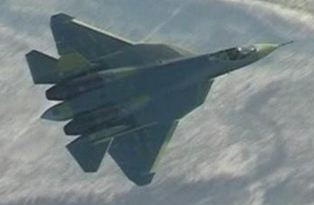
Sukhoy announced that its third PAK FA prototype conducted its first test flight today.  Operating from KnAAPO’s factory runway, the aircraft flew for more than an hour.

To run back a few milestones, the first PAK FA flew on January 29, 2010.  A second prototype joined it in March of this year.  PAK FA’s first public flight was August 17 at MAKS-2011.  And Sukhoy says the PAK FA has completed more than 100 test flights to date.  The hundredth flight apparently occurred early this month or in late October.

On November 11, ARMS-TASS reported that the third prototype will test the onboard phased array radar (AFAR)  system designed by the Tikhomirov NII of Instrument-building (NIIP).  Nezavisimoye voyennoye obozreniye published the same news, citing a Sukhoy spokesman.

T-50 Flight Aborts at MAKS Today

The T-50 or PAK FA aborted its demonstration flight at Zhukovskiy today when its right engine malfunctioned as it started down the runway.  The pilot stopped the flight, deploying his brake chutes.  The aircraft was traveling about 100 kmph when the malfunction occurred.  The cause is being investigated.

Here’s RIA Novosti and other video of what occurred.


Kommersant reports its sources say the problem was a malfunction in the power plant’s automatic controls which allowed an uncontrolled supply of fuel to the engine.  The incident could have had more serious consequences if the aircraft had actually taken off.

T-50 at MAKS-2011

A little Russia Today video of the T-50’s public debut on Wednesday at MAKS that someone was kind enough to upload . . .


The demonstration flight was made with Prime Minister Putin and other officials in attendance.  Novyye izvestiya said RIA Novosti reported the T-50 prototype wouldn’t perform the most complex maneuvers since it’s still in flight testing.

The press indicated one of the two prototypes will make a daily 15-minute flight at MAKS, but the aircraft isn’t on ground display.

RIA Novosti reported Sukhoy’s information that the two T-50, or PAK FA, prototypes have completed 84 flights.  Two more prototypes will join testing this year.

ITAR-TASS said air frame testing will finish in late 2012, and in 2013, ten T-50s will go to the Lipetsk Center for Combat Employment and Flight Crew Retraining.  VVS CINC Aleksandr Zelin noted only that his service will receive its first model for testing in 2013. 

Press reports say serial production is scheduled to begin in 2014-2015, with the Defense Ministry buying more than 50, 60, or even 150 of the fifth generation fighter in all.  ITAR-TASS noted that the plane’s state acceptance is planned for 2016.

General Director and Designer of Tactical Missile Weapons Corporation, Boris Obnosov told Interfaks his company is working on a new 200-km interceptor [air-to-air] missile for the PAK FA.  Test missiles reportedly will come this year, and series production next.  This Aviaport.ru article talks a little about weapons being designed for PAK FA.

Air Forces Prospects

With MAKS-2011 underway, this is something of a moving target.  Before getting to the main topic, a little news from Zhukovskiy . . . some of today’s headlines. 

OAK President Mikhail Pogosyan told the press two more T-50 prototypes will join the development and testing program this year.  He expects more than 100 military transport aircraft to be bought under GPV 2011-2020.  Il-112, Il-476, and Il-76MD will come first, then ten An-124 in 2014-2015, and later a larger number of An-70s.  Pogosyan said, starting from 2011, OAK will deliver more than 20 combat aircraft each year.

VVS CINC, General-Colonel Zelin told the media he foresees five squadrons of Su-34 (possibly as many as 120 aircraft).  The VVS will have six by the end of 2011 and will get 12 next year under the current contract for 32 aircraft.

For Air Forces Day, RIA Novosti had military commentator Konstantin Bogdanov describe how he sees things developing for this armed service.  How he puts the Air Forces’ future picture together is worth a look.

Bogdanov says he sees, for the first time since the Soviet collapse, movement, a turnaround in procurement financing, and real deliveries of aircraft in 2011. 

Interestingly, he begins with the Su-35S.  Forty-eight of these “transitional” 4++ generation fighters will be procured, but there could be more if there is any delay in the 5th generation T-50.  Bogdanov suggests, even without a  delay, the pragmatic Defense Ministry leadership could decide to blend 4th and 5th generation technology and equipment in one aircraft.

Bogdanov maintains one Su-34 flew missions in the 5-day war with Georgia [has anyone seen this elsewhere?], then got its serial production go-ahead, and contract for 32 aircraft in fall 2008.  Modernizing the aged Su-24 is a backup plan for the Su-34.  Bogdanov claims VVS CINC Zelin has hinted that ALCM-armed Su-34s could go to LRA.

Some old Su-27s have been updated to Su-27SM, and even a few new Su-27SM3 — unsold to China — have been obtained.

RSK MiG’s future, according to Bogdanov, looks less certain.  Russia had to buy the defective Algerian MiG-29SMTs.  It’s unclear if the Defense Ministry will have any requirement for the MiG-35.  And this leaves MiG with the possibility of providing MiG-29Ks to replace the Navy’s Su-33 fighters on the Kuznetsov’s deck.

Bogdanov then mentions how Irkut has parleyed its export success into more domestic sales.  He says the firm has redeveloped its Indian Su-30MKI into the Su-30SM, and it may sell as many as 40 to the Defense Ministry.  Twelve might go to replace Naval Aviation’s Su-24s at Gvardeyskoye in the Black Sea Fleet [apparently these aircraft weren’t swept up by the VVS earlier this year].  Similarly, says Bogdanov, KnAAPO last fall sold the VVS four Su-30M2s, domestic versions of its Su-30MK2 export.

Turning to rotary-wing aircraft, Bogdanov sees stable order books for Russian helicopter makers.  The order books are balanced in terms of military and civilian, and internal and external buyers, and all sales sectors are growing.

He says by 2010 the military’s contract for Mi-28N helicopters reached 100 units and serial production of its main competitor, the Ka-52, continued.  Mi-8s have been bought by the dozens.  And the hangars and flight decks of Mistral helicopter carriers will have to be filled in the future.

Bogdanov concludes more than 100 helicopters of all types may be procured before the end of 2011.  He repeats the familiar goal of 1,000 new helicopters by 2020, and says the near-term future for this sector looks good.

Bogdanov sees more clouds in military transport development and production.  Il-476 production at Ulyanovsk still needs to stand up, and Zelin’s already announced that a new A-100 AWACS will be based on it.  Restarting An-124 production and buying the An-70 from Ukraine are possibilities with details to be worked out.

Focused on platforms, Bogdanov gives short shrift to organizational and human aspects of VVS development.  He notes the Air Forces are completing the change from mission-oriented air armies and divisions to territorial composite or mixed formations (air bases), and he briefly mentions scandals over the handling of “order 400” premium pay.  But he concludes:

“In coming years we’ll see more than a few painful symptoms in the VVS, both strictly aviation-related and internal, and those connected to the general background of difficult transformations of the country’s armed forces.  Let there be pains, but let them be growing pains.”

Zelin’s Press Availability

Air Forces CINC, General-Colonel Aleksandr Zelin made a variety of remarks to the media this morning.  It’s not clear where yet, but it might have been a press-conference at ITAR-TASS.  It’s the season for such things with Air Forces Day and MAKS-2011 just ahead.

At any rate, Zelin had a lot of information on the status of different VVS programs and plans:

  • Army aviation will expand by more than 1,000 helicopters by 2020.  The number of army aviation bases will grow from 8 to 14 during that time.  He mentioned reestablishing production of Mi-26 transports in a POL supply variant.  Zelin doesn’t sound like he’s willing to surrender the VVS’ hold on army aviation.
  • Zelin mentioned getting 8 or 6 new Su-34 this year.  ITAR-TASS gave both numbers, but we’ve seen six elsewhere.
  • The VVS CINC criticized work on the Su-35, saying it has a number of problems.  PAK FA / T-50 is going on schedule, but he wouldn’t say when he expects it to enter the inventory.
  • On UAVs, some drones will go to the Ground Troops per a Genshtab decision, but Zelin says operational-tactical unmanned aircraft will stay at air bases under the control of military district commanders.
  • Without mentioning S-500 development, Zelin talked about new Morfey and Vityaz SAMs.  Morfey is a short-range system mentioned before as part of S-500.  Zelin described Vityaz in greater detail, calling it an improvement on the S-300 with greater capabilities and 16 missiles per launcher.  See ITAR-TASS for this.
  • Zelin said there will be four S-400 regiments by the end of 2011.  He said the second one, the 210th Air Defense Regiment, went on combat duty with it last week, so two more are expected.  The CINC said the manufacturer’s had problems with the system’s long-range missile, but there is an understanding on how to resolve them.  The Air Forces, he says, still want Almaz-Antey to build another production plant.  Interfaks posted on this.
  • The next 6 Pantsir-S gun-missile air defense systems will go to the OSK VKO around Moscow.  Zelin said the first 4 went to the 4th Air Forces and Air Defense Command at Novorossiysk.
  • Another flight demonstration group will be formed using Yak-130 trainers.
  • Zelin expects to get a new A-100 AWACS aircraft, based on the Il-476, by 2016.  He says it will have both air and ground surveillance missions.  The plan has Genshtab and financial support, according to Zelin.

Su-35S to Start State Testing

In their excitement about new armaments, many observers have a hard time keeping book on the latest weapons, forcing yours truly to follow a few important systems like the Su-35S.  Some even say the Su-35S is already in the inventory, but a close look at press reporting shows otherwise.

The media reported the first series production Su-35S flew at KnAAPO in Komsomolsk-na-Amure yesterday.  After these factory trials, this aircraft will be delivered to the Defense Ministry.

Sukhoy has successfully completed preliminary testing on the Su-35S prototype.  Preliminary testing confirmed that its on-board systems meet technical requirements, checked its reliability and controllability, its engines, and navigation system.

According to ITAR-TASS, a Sukhoy spokesman said:

“The Su-35S has been presented for state joint testing [ГСИ or GSI].  The first step in the framework of the fighter’s state joint testing will be receipt of the preliminary finding of the customer – Russia’s Air Forces on the aircraft’s correspondence to main requirements with the aim of providing it to Air Forces’ operational units.”

Now recall that late last August Sukhoy said the Su-35S was completing preliminary testing and would start state testing in the fall.  Fall has become the following spring, and Sukhoy announces again that the Su-35S is ready to start GSI.

The Russians advertise the Su-35S as a 4++ generation fighter, using fifth generation technologies to give it an advantage over similar aircraft.

The Defense Ministry gave Sukhoy a contract to deliver 48 Su-35S by 2015, but Voyenno-promyshlennyy kuryer, among others, says the military department will probably buy 48 more in 2015-2020.  VPK goes further:

“According to some assessments, the Russian Air Forces need 150-200 Su-35S.  The Defense Ministry now intends to buy 60 fifth generation T-50 fighters in all.”

So VPK suggests some think the Su-35S should be a primary fighter rather than just a gap filler for PAK FA.

More on the “Second Phase” Engine

Lenta.ru had an informative piece on the PAK FA’s “second phase” engine yesterday. 

It calls the “second phase” engine “Item 129” [Изделие 129].  Lenta also says the provision of the first “Item 129” engines will coincide with the first PAK FA or T-50 fighters entering the force in 2015.

It notes the “first phase” engine is “Item 117” or AL-41F1 [АЛ-41Ф1].

The AL-41F1 will be used in the prototypes and the first series models which will enter the Air Forces’ inventory in 2015.  It has 19,334 lb. dry thrust, and 33,047 lb. with afterburners.  It is equipped with a plasma ignition system, all-aspect thrust-vectoring control, and digital controls.

The Lenta piece says a less powerful variant of the AL-41F1 – the AL-41F1S or “Item 117S” – will be put on the Su-35S fighter.  The AL-41F1S has an older digital control system and a little less thrust.  

According to Lenta, not much is known yet about “Item 129.”  It was announced earlier it will have increased thrust and greater fuel efficiency than the AL-41F1.  “Item 129” will reportedly have 24,054 lb. dry thrust, and 39,566 lb. with afterburners.  The newer engine’s also likely to have a longer service life.  

Lenta adds a report from Sukhoy that it expects to finish prototype airframe testing either this year or next.  In 2013, the Defense Ministry’s supposed to get 10 experimental aircraft for combat employment testing.

“Second Phase” Engine for PAK FA

More on the “second phase” engine saga . . . managing director of NPO Saturn, Ilya Fedorov has told ITAR-TASS development of the so-called “second phase” engine for the PAK FA is running ahead of schedule.  

The completion of R&D [ОКР] and provision of the engine to Sukhoy and the Defense Ministry is planned for 2015.  Fedorov says:

“NPO Saturn entities and cooperating structures are now working on a rough draft of the engine.  Everything’s been agreed.  Work’s being conducted in Moscow, Rybinsk, and in other places.  We have firm certainty that the second phase engine will be done earlier than everyone expects.”

“Work on the future engine model is in a very advanced stage . . . .”

Fedorov adds it wouldn’t be profitable to drag out development and continue putting out “first phase” engines which are being used on the T-50 test aircraft.

What’d we learn?

Fedorov emphasized what’s out there now is definitely still “first phase.”  The “second phase” team is working from a “rough,” but agreed draft, and there’s advanced work on the model.  One supposes that’s possible.  Finally, Fedorov says he’s ahead of schedule, but makes no big promises, and the story emphasizes that the delivery plan is 2015.

PAK FA Engine Update

Saturday ITAR-TASS printed an interesting update on the PAK FA engine story.  It doesn’t really clarify anything (actually quite the opposite), but it’s part of the story. 

Recall last spring the engine designers were saying developing a “second phase” engine for PAK-FA could take another 5-6 years, while Sukhoy was saying it might be 10-12 years.  In what follows below, the engines aren’t specifically identified as “second phase,” but they are called “seriously distinct from the 117S.”

General Designer of the A. M. Lyulka Scientific-Technical Center (a Moscow subsidiary of NPO Saturn) Yevgeniy Marchukov claims the construction of an engine for the fifth generation fighter is going successfully, and it will go into serial production. 

The second experimental T-50 reportedly took off with this engine on 3 March.

Marchukov said:

“The engines in the experimental prototypes of the future Russian fifth generation fighter are seriously distinct from the 117S engines intended for Su-35 aircraft, both in their parameters and in their fundamentally new automated control system.  The T-50 aircraft with NPO Saturn engines fully corresponds to the tactical-technical requirements for the aircraft.  And with these engines produced serially, the PAK FA will be supplied for the needs of the Russian Air Forces.”

For his part, Saturn managing director Ilya Fedorov noted that the enterprise “supported the takeoff of the aircraft in the necessary time,” just as it was ready for flight.

ITAR-TASS goes on to add that special stand tests and service life tests on the engine continue at the Lytkarinskiy Machinebuilding Plant (another Saturn subsidiary).  Ground development is being conducted on the T-50-KNS model with aircraft systems from OKB Sukhoy at the Gromov Flight Test Institute.  Flight tests are also ongoing.  T-50-1 has more than 40 flights, the T-50-2 two flights, and the Su-27 flying laboratory has 32 flights.

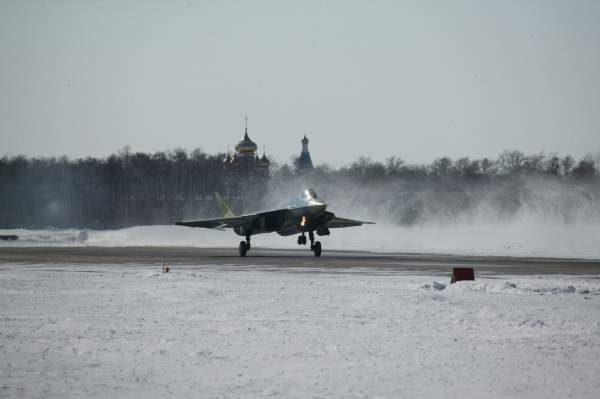
Second PAK FA Prototype Flies

Novyye izvestiya has 1TV’s video coverage and story on the flight.

Pilot.strizhi.info posted these photos, along with links to the high resolution originals from Sukhoy.org.

Second PAK FA Takes Off

Landing

PAK FA Chutes Deployed