Category Archives: Air Forces

Dismissals

Today’s decree on Armed Forces personnel cleared the decks on the Air Forces somewhat.  The biggest news was the retirement of air defense chief General-Lieutenant Razygrayev.  Melnik and Smarshchek were LRA generals.

Relieve and dismiss from military service:

  • General-Major Valeriy Alekseyevich Konurkin, Deputy Chief, Air Forces Training Center, “Air Forces Academy.”
  • General-Lieutenant Sergey Nikolayevich Razygrayev, Chief, Air Defense, Deputy CINC of the Air Forces for Air Defense.
  • General-Lieutenant Khadzhibikar Bamatgireyevich Ukurov, Chief, Military Academy of Aerospace Defense named for Marshal of the Soviet Union G. K. Zhukov.

Dismiss from military service:

  • General-Major Leonid Ivanovich Melnik.
  • General-Major Nikolay Nikolayevich Smarshchek.

Premium Corruption

Senior Lieutenant Igor Sulim

Senior Lieutenant Igor Igoryevich Sulim joins the ranks of new media whistleblowers (most recently, MVD Majors Matveyev and Dymovskiy).

This 24-year-old senior flight-instructor of the Air Forces’ elite 4th Combat Employment and Retraining Center in Lipetsk has gone public complaining of corruption, specifically his commander’s systematic extortion of premium pay from his subordinates. 

Sulim made the charges in an open letter to Defense Minister Serdyukov, Investigative Committee Chairman Bastrykin, and VVS CINC General-Colonel Zelin, which he also placed on the Internet.

Recall that premium pay – aka Order No. 400 or 400-A – is the stopgap measure Serdyukov instituted early in his tenure to raise military pay [for the best performers] until a new, higher pay system could be introduced starting next year.  Premium pay’s allowed the officers to double, triple, or even quadruple their pay, but it’s also been plagued by problems and scandals from the very beginning.

According to Sulim, every month when officers receive their premium pay, they have to give their commander, Colonel Sidorenko, a specific sum.  In Sulim’s case, 13,600 rubles every month.

Life.ru printed excerpts from Sulim’s letter:

“In January of last year, Colonel Kovalskiy got unofficial information on the amounts servicemen needed to hand over after getting their premiums to each sub-unit commander.  Commanders couldn’t refuse this because all were threatened with dismissal during requalification [pereattestatsiya].”

Sulim says every month officers were picked to collect the money which went to Colonel Sidorenko.

“Every month from 140 to 185 thousand rubles were collected from sub-units.  I know that just from the four squadrons of unit 62632-A nearly 7 million rubles were collected in a year.”

“I tried to go to the Tambov Garrison Military Prosecutor.  But evidently Colonel Kovalskiy has good connections there because the commander [Sidorenko] became aware immediately about all those who want to get out from under the yoke of extortion.  And all our efforts led to the start of an investigation into the facts of slander against the unit commander.”

And Sulim’s command took him off flight status in retaliation.

Now a host of investigators — from the VVS, the SK, prosecutors — have flocked to check out Sulim and his allegations.

Where are we on this one?

It may take a while to play out.  If experience is a guide, young whistleblower Sulim may become target rather than hero of the story.  The Russian military [political, or bureaucratic] system doesn’t care much for those “sweep dirt out of the izba.”

Uncontained by the Defense Ministry, this latest scandal could undercut the much-heralded launch of the new pay system next year.  The draft law due for Duma consideration provides for continuing premium pay.

Extortion and theft damaged efforts to use combat pay as a motivator for service during the second Chechen war.  There have always been problems with commanders and finance officers handling pay in cash.

Commanders have used control of cash as a mechanism of control over their subordinates, as a zona-type obshchak for meeting unit needs or meting out a rough social justice, or, at worst, as a source of personal enrichment.  For some time, the military’s talked about electronic funds transfer to avoid pay-related criminal activity.

And Igor Igoryevich Sulim is apparently not just any young pilot.  His father is General-Major Igor Vadimovich Sulim, just relieved of duty in early March as Chief of the VVS’ Directorate of Frontal and Army Aviation.  It’s entirely possible that this personnel action has some connection to his son and his revelations, or vice versa.

Finally, the national angle to the Sulim story.  And what will it, like many other corruption stories, say about Russia’s national struggle against corruption (if there really is one)?

For additional info on Sulim, see Lipetsknews.ru or his complete letter here

There are many infamous cases of premium pay machinations . . . for summary articles see Svpressa.ru or Baranets in Komsomolskaya pravda.

Aerospace Defense Troops

Svpressa.ru’s Sergey Ishchenko published an interesting piece on VKO late last Friday.  He wrote that Space Troops Commander, General-Lieutenant Oleg Ostapenko recently reported to the Federation Council on the creation of VKO, making it clear that Ostapenko’s branch, as reported earlier and elsewhere, will be the basis of Russia’s unified VKO due to stand up by 1 December.

Ishchenko makes these additional points:

  • The long-range missile for the S-400 is still in testing.
  • He doubts the S-500 will be delivered in 2015.
  • His interviewee believes the new Aerospace Defense Troops will get all or some of Russia’s SAM force from the VVS.
  • The interviewee thinks the S-500 is on schedule.

Ishchenko says the debate over the lead for VKO didn’t necessarily center on what’s best to protect Russia’s security, but rather on who would receive new resources and general officer billets.

The Air Forces argued they were best suited to lead it, but the Space Troops apparently argued persuasively that they were better prepared to handle Russia’s future transatmospheric threats.

Now, a quick editorial aside from Ishchenko’s narrative . . . this decision is probably a good thing for the Air Forces, which already have their hands full and don’t need more missions.  They stand to lose only some part of the surface-to-air missile business (which hasn’t always been a core mission for them anyway).  And the VVS will benefit by concentrating on their most important tasks.

But back to Ishchenko . . . he provides a fine review of the USSR’s space weapons and space defense efforts, which, arguably, met or exceeded those of the United States.  He notes President Yeltsin’s 1993 decree on creating VKO, for which no one moved so much as a finger, at least partially because of the country’s economic and budgetary predicament at that time. 

Then Ishchenko gets more interesting.  He details the danger posed to Russia by U.S. “noncontact” wars in Iraq (sic), Yugoslavia, and Libya.  These, however, are really wars of the past rather than the future, he says.  Ishchenko moves on to the threat of Prompt Global Strike.

He talks about a hypersonic bomber cruising at Mach 5-7 speeds and altitudes up to 30,000 meters, beyond the reach of Russia’s current SAMs.  Of course, IOC isn’t before 2025, but Moscow needs to start thinking today about how to counter it.  Meanwhile, the state-of-the-art Russian SAM, the S-400, is barely fielded and its extended range missile is still being tested.  Its successor, the S-500, is supposed to be ready in 2015, but Ishchenko is skeptical.

The end of Ishchenko’s article is a brief interview with the chief editor of the journal Vozdushno-kosmicheskaya oborona, Mikhail Khodarenok.  Khodarenok’s a retired colonel, professional air defender, graduate of the General Staff Academy, and former staffer of the General Staff’s Main Operations Directorate (GOU).  In the late 1990s and early 2000s, he was an outstanding military journalist for Nezavisimoye voyennoye obozreniye, but by 2003 or 2004, he left for VKO and Voyenno-promyshlennyy kuryer, both wholly owned by air defense system designer Almaz-Antey.

Ishchenko asks what Khodarenok knows about the process of creating the Aerospace Defense Troops.  The latter hems about not having access to secret directives and documents before concluding:

“But I can say that much has already been determined.  In particular, it’s decided that Space Troops will be the basis of VKO.  Although there were other proposals.  The Air Forces, in particular, proposed taking their service as the basis.”

Asked about this tug-of-war for VKO within the Defense Ministry, he says:

“And this is a beloved Russian pasttime.  In our Armed Forces, they are constantly getting rid of something or resubordinating.  What happened, for example, with army aviation.  In my memory, five times it was given to the Air Forces, then returned to the Ground Troops.  Usually then five years of complete confusion.  Billions lost.  And it all begins again.”

Asked what will be in VKO:

“The basis is the Space Troops.  Evidently, the surface-to-air missile troops (ZRV) will be transferred to them from the VVS.  Fully or partially.  This isn’t determined yet.”

Finally, asked whether Almaz-Antey General Director Igor Ashurbeyli was replaced because of problems with the S-400’s long-range missile or issues in the S-500’s development, Khodarenok says:

“Ashurbeyli’s resignation was not connected with engineering problems in any way.  Neither with difficulties on the S-500, nor on the S-400.”

“I have my suppositions on this score.  But I don’t want to share them.  I repeat:  the most important thing is that the S-500’s development is on schedule.  And this system really will very much help the country’s aerospace defense.”

The Sound of Managed Democracy?

The classic dilemma of civil-military relations . . . is jet noise the sound of freedom — or in this case, of managed democracy?

Or is jet noise a dangerous nuisance?

Last Sunday, Svpressa.ru ran an article on complaints about a major expansion of Baltimor Air Base on the outskirts of Voronezh.  Baltimor also goes by the name Voronezh-B.  This is just the most recent article on local concerns about Baltimor.  Novaya gazeta published on the situation in the middle of last year.

By year’s end, Baltimor is supposed to be Russia’s largest air base, with 200 aircraft, according to Svpressa.  A second, 3,500-meter runway is being built there to accommodate all aircraft types.  Takeoffs and landings at Baltimor occur just a few hundred meters away from apartment blocks.  Residents expect the jet noise to double along with the number of aircraft.  Here’s a video of local aircraft operations.  And another

Svpressa notes the air base was used little after 1990, except for spikes during the Chechen wars.  And from about 4 years ago, it was all but abandoned, overgrown, and broken down.  At the same time,  apartment construction grew outward toward the base.

The resumption and expansion of activity at Baltimor put nearby residents into action.  They believe, with 200 aircraft, flights will be virtually constant.  And a former serviceman told Svpressa he expects the base to have 200 flight days (and nights) a year, with as many as 10 aircraft up simultaneously.

Not surprisingly, residents worry about crashes, about fuel and munitions storage depots, about airport-level noise and vibration, and its effect on young children and infants.  Svpressa reprints their long petition to Voronezh officials asking who and how the air base’s expansion was approved:

“How was such a document signed?  Who was responsible for preparing it?  Why is the population’s opinion supplanted by the conclusions of some ‘experts’ and the silent consent of the oblast administration?”

The website also publishes Air Forces CINC Aleksandr Zelin’s answer.  He asserts they illegally built too close to the airfield, and emphasizes the state’s interest in expanding an existing air base rather than building a new one for “several billion rubles.”

The case of Baltimor Air Base is interesting in its own right, but it’s significant on two other levels.

On the first, the Baltimor situation is evolving in the context of debate over the Air Forces’ force structure and base structure.

Defense Minister Serdyukov’s major reforms pointed immediately at concentrating the Air Forces at fewer bases.  The exact number, however, has shifted constantly downward from 55 at first.  Recall at the 1 April Security Council session on the aviation sector, Medvedev told ministers and officials:

“Now the airfield network of military aviation does not correspond to the basing requirements of aviation groupings.  At the Defense Ministry collegium which took place recently [18 March], I gave orders to establish several large air bases.  Taking into account the deployment of troops, they will be situated on the main strategic axes.”

At the collegium, Serdyukov in fact announced, instead of 33 air bases, there will be eight army aviation bases subordinate to the four military districts / OSKs, and the number of aircraft at each will increase 2.5 or 3 times.  Of course, saying that and getting to that point are two different things entirely. 

Gazeta.ru printed a nice summary of the VVS ground infrastructure issue.  It concluded fewer bases would make things cheaper, but also easier for a potential enemy.  It said a similar effort to resubordinate air and air defense forces to MD commanders in the early 1980s failed.  Rossiyskaya gazeta said experts think the number of air bases should be different for different MDs, as should the mix of aircraft.

It seems, for economic reasons, these large air bases will be picked from the list of existing ones, they won’t necessarily take advantage of vast swaths of unpopulated territory, and they’re likely to irritate the civilian population.

Abandoning old bases and airfields leads to another, longstanding but growing problem of late — the archipelago of unneeded garrisons and military towns.  The Defense Ministry would like to shuffle them off to someone else’s responsibility, and resettling retired military, dependents, and civilian workers elsewhere has been problematic.  BRAC-like processes are especially painful in Russia. 

On the second level, Baltimor could become politically and socially significant.  It’s rare in Russia these days for a military problem to have that kind of potential.  

If politicians ignore or downplay what the locals feel is their basic right to health and environmental protection for the sake of an intangible state interest, there’s a chance Baltimor could become a more serious regional, or even national, issue.  Especially if similar circumstances arise in other cities.

This may seem a stretch, but remember ordinary Russians tend to be galvanized by the local impact of things like auto import tariffs, immigration, building roads through forests, etc.  And concern about the impact of air bases would come on top of other civil-military issues.

In Chelyabinsk, and several other places, the locals are protesting explosive ammunition destruction that is rocking parts of their cities.  Prosecutors already found that the military lied about the size and power of demolition activities not far from Chelyabinsk.  Chelyabinsk residents are also angry about overflights of the city from nearby military airfields.

Su-35S to Start State Testing

In their excitement about new armaments, many observers have a hard time keeping book on the latest weapons, forcing yours truly to follow a few important systems like the Su-35S.  Some even say the Su-35S is already in the inventory, but a close look at press reporting shows otherwise.

The media reported the first series production Su-35S flew at KnAAPO in Komsomolsk-na-Amure yesterday.  After these factory trials, this aircraft will be delivered to the Defense Ministry.

Sukhoy has successfully completed preliminary testing on the Su-35S prototype.  Preliminary testing confirmed that its on-board systems meet technical requirements, checked its reliability and controllability, its engines, and navigation system.

According to ITAR-TASS, a Sukhoy spokesman said:

“The Su-35S has been presented for state joint testing [ГСИ or GSI].  The first step in the framework of the fighter’s state joint testing will be receipt of the preliminary finding of the customer – Russia’s Air Forces on the aircraft’s correspondence to main requirements with the aim of providing it to Air Forces’ operational units.”

Now recall that late last August Sukhoy said the Su-35S was completing preliminary testing and would start state testing in the fall.  Fall has become the following spring, and Sukhoy announces again that the Su-35S is ready to start GSI.

The Russians advertise the Su-35S as a 4++ generation fighter, using fifth generation technologies to give it an advantage over similar aircraft.

The Defense Ministry gave Sukhoy a contract to deliver 48 Su-35S by 2015, but Voyenno-promyshlennyy kuryer, among others, says the military department will probably buy 48 more in 2015-2020.  VPK goes further:

“According to some assessments, the Russian Air Forces need 150-200 Su-35S.  The Defense Ministry now intends to buy 60 fifth generation T-50 fighters in all.”

So VPK suggests some think the Su-35S should be a primary fighter rather than just a gap filler for PAK FA.

More on the “Second Phase” Engine

Lenta.ru had an informative piece on the PAK FA’s “second phase” engine yesterday. 

It calls the “second phase” engine “Item 129” [Изделие 129].  Lenta also says the provision of the first “Item 129” engines will coincide with the first PAK FA or T-50 fighters entering the force in 2015.

It notes the “first phase” engine is “Item 117” or AL-41F1 [АЛ-41Ф1].

The AL-41F1 will be used in the prototypes and the first series models which will enter the Air Forces’ inventory in 2015.  It has 19,334 lb. dry thrust, and 33,047 lb. with afterburners.  It is equipped with a plasma ignition system, all-aspect thrust-vectoring control, and digital controls.

The Lenta piece says a less powerful variant of the AL-41F1 – the AL-41F1S or “Item 117S” – will be put on the Su-35S fighter.  The AL-41F1S has an older digital control system and a little less thrust.  

According to Lenta, not much is known yet about “Item 129.”  It was announced earlier it will have increased thrust and greater fuel efficiency than the AL-41F1.  “Item 129” will reportedly have 24,054 lb. dry thrust, and 39,566 lb. with afterburners.  The newer engine’s also likely to have a longer service life.  

Lenta adds a report from Sukhoy that it expects to finish prototype airframe testing either this year or next.  In 2013, the Defense Ministry’s supposed to get 10 experimental aircraft for combat employment testing.

“Second Phase” Engine for PAK FA

More on the “second phase” engine saga . . . managing director of NPO Saturn, Ilya Fedorov has told ITAR-TASS development of the so-called “second phase” engine for the PAK FA is running ahead of schedule.  

The completion of R&D [ОКР] and provision of the engine to Sukhoy and the Defense Ministry is planned for 2015.  Fedorov says:

“NPO Saturn entities and cooperating structures are now working on a rough draft of the engine.  Everything’s been agreed.  Work’s being conducted in Moscow, Rybinsk, and in other places.  We have firm certainty that the second phase engine will be done earlier than everyone expects.”

“Work on the future engine model is in a very advanced stage . . . .”

Fedorov adds it wouldn’t be profitable to drag out development and continue putting out “first phase” engines which are being used on the T-50 test aircraft.

What’d we learn?

Fedorov emphasized what’s out there now is definitely still “first phase.”  The “second phase” team is working from a “rough,” but agreed draft, and there’s advanced work on the model.  One supposes that’s possible.  Finally, Fedorov says he’s ahead of schedule, but makes no big promises, and the story emphasizes that the delivery plan is 2015.

Another Trouble Brigade

Today’s Presidential ukaz on military personnel changes is attracting attention because it relieved and dismissed General-Lieutenant Vadim Volkovitsky from the service.  Of late Volkovitskiy was First Deputy CINC of the Air Forces (VVS), and Chief of the Main Staff. 

General-Lieutenant Volkovitskiy

He’s a career air defender who’s been a two-star for the last ten years.  He’ll be 55, statutory retirement age next Friday.  He commanded air and air defense troops in the Urals in 2006, and came to Moscow and the VVS headquarters in 2007.

We don’t really know why Volkovitskiy’s going out right on time, but it does seem President Medvedev and Defense Minister Serdyukov have made an effort to keep senior officers from serving forever.

God-Forsaken Pechenga

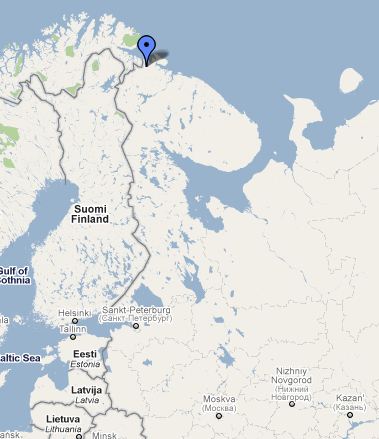
Far more interesting is the President relieving Colonel Vitaliy Leonidovich Razgonov, Commander of the 200th Independent Motorized Rifle Brigade based at god-forsaken Pechenga.  He’s only been commander there for 18 months. 

The 200th Brigade remains in its Cold War deployment along the Russian border with Norway.  It’s probably not what the Defense Ministry has in mind for its future Arctic brigade. 

This brigade has more than its share of trouble, and Colonel Razgonov’s apparent inability to control his men might — repeat might — have something to do with the change of command.  The ukaz, of course, gives no reason.

Just on Monday, Komsomolskaya pravda published on all of v / ch 08275’s problems.  The paper’s reporters say this command is unable to maintain elementary order.  The brigade’s officers complain that today’s young men are already so corrupted that the army can’t fix them, and that they don’t have any tools to deal with disorder among their men.  But KP says the soldiers don’t look disorderly during the day, but become that way at night when they’re unsupervised in the barracks.  The paper suggests the officers themselves are corrupt and disorderly at Pechenga.

Several weeks ago a conscript from Dagestan got three and a half years for killing an ethnic Russian junior sergeant in June 2010.  The command initially tried to make it look like an accident rather than murder.  Svpressa.ru suggests 4 or 5 men from Dagestan beat the victim.  The Soldiers’ Mothers Committee helped his family get the military prosecutors on the case.

Another conscript was beaten severely right on the brigade’s parade ground in early March.  According to IA Regnum, the young man — a graduate of the Murmansk School of Music — had two operations and his spleen was removed.

Last September a conscript shot and killed another conscript before shooting himself to death.  The parents of the shooter don’t believe this version of what happened, and have turned to the Soldiers’ Mothers Committee for help.

Last May, the chief of the brigade’s missile-artillery service stabbed his wife and six-year-old son to death.  He was subsequently diagnosed as a paranoid-schizophrenic.  This can happen anywhere, but it’s interesting it happened in a place already so afflicted with misfortune.  One wonders if there isn’t more to the story.

Where does this leave us?

It’s hard to say.  All the evidence of trouble is, so to say, circumstantial when it comes to Colonel Razgonov and whether he’s up to the job or has been derelict.  We don’t have enough information.  Maybe Razgonov himself asked to be relieved.  Who knows?  But it may be that someone in the chain, in the Defense Ministry or elsewhere, recognized a situation that needs to change.  The question now is will it?

VKO Game On

Yes, it’s game on in the fight for control over Russia’s future unified aerospace (air-space) defense or VKO.

General Staff Chief Nikolay Makarov’s recent statements sound like he’s hard over on putting VKO under the General Staff’s immediate control.  But the Space Troops (KV) definitely aren’t out of the game, and even the Air Forces (VVS) – running third right now – are still in the competition to own VKO.

Say VKO falls under the General Staff, is it up to the job of running what will amount to a service or major command?  This at a time when it’s been cut back, and refocused on strategic planning?  And, entirely aside from organizing or reorganizing for VKO, there’s an issue how much a unified VKO will actually improve current Russian capabilities.  Acquiring new capabilities is a different problem altogether.

But let’s recall how we reached this point.  In late 2010, President Dmitriy Medvedev set the task of unifying the command and control of VKO under a single strategic command by 1 December 2011.  He cited this as his third major task for the military in his 18 March speech before the expanded Defense Ministry collegium:

“This year a unitary air-space defense system must be established.  It is necessary to unite existing anti-air and anti-missile defense, missile attack warning, and space monitoring systems under common command and control.  Moreover, this needs to be done not in the abstract, on paper or in electronic form, but in the context of the current situation, including the decision of the issue of our participation or nonparticipation in the system of European anti-missile defense which is being established.  It is necessary to form several large air bases, taking into account the deployment of units.  This will increase the mobility of sub-units, and allow for the establishment of military infrastructure echeloned along main strategic axes.”

Medvedev sounds like he’s saying he won’t be fooled by bureaucratic paper lash-ups or procedures.  He wants blood drawn — forces and systems taken from one command and given to the new VKO command, whatever its shape or subordination.  The real sticking point, of course, is anti-air defense assets now under the VVS.

Friday’s Rossiyskaya gazeta reported Army General Makarov and Defense Ministry Serdyukov are currently studying proposals on VKO.  But they’re keeping them within a small circle, and don’t intend to create public debate on the issue.  And the paper thinks the form and control of VKO will be revealed in the next months, if not weeks.

Let’s turn for a moment to what Makarov’s been saying.

Interfaks reported Saturday that the General Staff Chief said flatly:

“Air-space defense will be created in the General Staff, under the General Staff’s leadership, and the General Staff will command and control it.”

Vesti.ru said he dismissed the idea of the KV running VKO:

“The Space Troops are only one element of all the components of this air-space defense.”

Well, you can say that, but they also appear to have three of VKO’s four cited components.

At any rate, Makarov continued, saying VKO:

“. . . has to be multilayered, by altitude and by range, and has to integrate all forces and means that exist, but are very few of now.  We are counting on production taking off, beginning literally next year.”

He also noted:

“No one will take back those means which are now transferring to the districts [MD / OSKs].  This [VKO] will be implemented in Troop PVO.”

The chief of Ground Troops’ Air Defense (ПВО СВ) also said as much in late December.

None of this is very different from what Makarov’s said all along.

Rossiyskaya gazeta summed Makarov up this way on 15 December:

“The thing is various military structures are involved in securing the skies at present.  The Space Troops answer for orbital reconnaissance and the work of missile attack warning stations.  The Air and Air Defense Armies with the aid of radar companies and border posts inform staffs about approaching enemy aircraft.  The Special Designation Command covers the Moscow Air Defense Zone.  Air defense troops and fighter aviation cover other important facilities.”

“The system is built on the service [видовой] principle and is therefore uncoordinated.  We need to make it integrated and place it under the Genshtab’s command.”

Despite Makarov’s strong words, Rossiyskaya gazeta has been told that the leadership is still studying putting VKO under the KV’s control.  Especially since, as noted, it already has 3 of 4 of its components – PRO, SPRN, and KKP.  But, the paper thinks, no one is talking about putting SAMs (ZRK) or Air Defense Aviation (APVO) under the KV.  However, the KV might get independent radar brigades and some SAM units equipped with the S-300, S-400, and the future S-500.

On 24 March, the KV’s spokesman repeated earlier statements from its commander, General-Lieutenant Oleg Ostapenko, saying basic documents setting out the establishment of VKO on the basis of KV have been prepared and presented to the Defense Ministry and General Staff.

On 27 January, Ostapenko told RIA Novosti:

“There’s already a decision that the system of VKO will be built on the base of the Space Troops.”

It might also be worth noting Vedomosti’s Defense Ministry sources were, at least at one point, reporting that KV had the upper hand in the VKO sweepstakes.

Lastly, the VVS remains a possible home for VKO.  The Air Forces might not have much to recommend them over the Genshtab or KV, but they operate the existing VKO prototype in the Moscow region’s Special Designation Command (KSpN).

Israeli and Russian UAVs for Ground Troops

Yesterday Aviaport.ru wrote that Defense Minister Anatoliy Serdyukov, his First Deputies, Vladimir Popovkin and Nikolay Makarov, Air Forces CINC, Aleksandr Zelin, and industry representatives attended a demonstration of Russian and Israeli UAVs at Kubinka on 10 March. 

The systems shown included the Israeli mini Bird Eye 400 and medium-range Searcher MkII, and also an unnamed Russian mini selected in comparative testing last fall. 

Aviaport.ru says Russian systems were only on static display, but Israeli ones were actively demonstrated.  The Searcher MkII performed a six-hour continuous flight in the vicinity of Kubinka at an altitude of  five km, relaying imagery to its ground station in real time.

Israeli drones arrived in Russia last year, and operators and technicians were trained, but they are only just starting to be used.  A Defense Ministry source tells Aviaport.ru these UAVs are already receiving high marks from the military.

UAV.ru’s editor-in-chief Denis Fedutinov thinks new pilotless aircraft will be based at the 924th Combat Training and Personnel Retraining Center.  The Center’s personnel previously used only Russian-made UAVs, the most modern of which was the 1980s-vintage Pchela.  Fedutinov says:

“Compared with them [Pchela], the impression of Israeli systems will be like switching from a Zhiguli to a Mercedes.”

Nevertheless, according to Fedutinov, the “door isn’t closed” for Russian developers.  The tests of the mini-UAV last year showed an increase in quality of Russian systems, and there was a promise to buy several dozen Russian systems for experimental use in the Ground Troops.  

The tactical-class segment still isn’t occupied, and there are two Russian contenders — VEGA’s Tipchak and Kronshtadt’s Dozor-100.  The latter is reportedly preferred given Popovkin’s negative comments about the former.

Fedutinov thinks when it comes to larger systems there’s still a possibility for cooperation with the Israelis, and there is Russian interest in the Heron system.  But decisions on this issue are essentially political.

After meeting his French counterpart in Paris — mainly about the Mistral acquisition, Defense Minister Serdyukov declared his interest in procuring all types of UAVs, from reconnaissance to strike variants, according to ITAR-TASS.  Serdyukov stated:

“At present, we’re studying the line-up of Israeli pilotless aircraft in detail.  As is known, ‘Helicopters of Russia’ has agreed with the Israelis on establishing an SP [joint venture] to produce such systems.”

Serdyukov added that a UAV operator training center will be set up soon:

“Where this center will be located isn’t decided yet.  These systems will be part of the Ground Troops.”

He said the Defense Ministry wants to buy all types, from light to heavy UAVs.  Russia is also interested in the foreign practice of using satellites to control unmanned reconnaissance and strike aircraft, Serdyukov said.