Category Archives: Force Structure

Serdyukov’s Duma Session

ITAR-TASS reported a few tidbits from Defense Minister Serdyukov’s closed session before the Duma yesterday.  Not surprisingly, Serdyukov told Duma deputies:

“We fulfilled those tasks which the President gave to conduct the Armed Forces to a new profile in 2010.  The Armed Forces’ combat readiness increased 1.5 times.  We believe that the combat readiness of the army and navy will grow 3-3.5 times toward 2020.”

RIA Novosti reported that Serdyukov said combat capability, not combat readiness.  Combat capability seems to make more sense.

ITAR-TASS says Serdyukov familiarized deputies with the basic tasks of transitioning to the new profile, and the completion of reforms planned for 2010.  Attention was given mainly to implementing the State Program of Armaments and social issues for servicemen.  He said:

“I familiarized deputies with the transformation of the military districts, changes in army corps and brigades, and military command and control at all levels.”

Corps?  Did he really say that?

Answering a question about housing for servicemen, Serdyukov said the Defense Ministry has fulfilled the government’s order about this:

“In 2009, we obtained 45,500, and in 2010 55,000 apartments from all sources.  This attests to the fact that the government’s order has been fulfilled and is being fulfilled.”

As usual, the official news sources turned to Duma Defense Committee Chairman Viktor Zavarzin for comment, and he said:

“I give high marks to today’s meeting of the chief of the defense department and deputies.  We have established tight coordination with the Defense Ministry on legislative support of military reform, and bringing the Armed Forces to a new profile. “

“We are certain we will decide all issues concerning the rearmament of the army and navy, and social support of servicemen with the Defense Ministry leadership.  I say that we need to preserve this pace which exists in the Defense Ministry and with us next year to take the work to the intended results.”

Regarding rearmament, Zavarzin said:

“Besides, in ten years, the share of modern weapons in the army should be not less than 70 percent, for which unprecedented sums have been allocated.  For this, not only a principled position of the Defense Ministry, but also readiness by OPK enterprises for serial deliveries of modern types of armaments is required.”   

Zavarzin said Serdyukov didn’t have much to say on the Mistral purchase, but Zavarzin said:

“In our view, we don’t need to acquire a hunk of metal, but we need the documentation and understanding of those ideas and developments abroad which will enable us to realize the possibilities of our industry.”

Is Russian shipbuilding really going to learn that much from Mistral?

Zavarzin expressed the opinion of the deputies who think:

“We need to give the Defense Minister great credit because he is deeply involved in these issues and, as the one ordering, aiming to supply the army and navy modern armaments and military equipment. Our convictions are that we should create a competitive environment and competitive structures which would push Russia’s defense-industrial complex to the development and creation of the newest weapons systems, including for the Navy.”

At the same time, Zavarzin credited the Defense Ministry for understanding that military social issues deserve special attention too:

“We are talking about creating attractive conditions for those who are serving, but also providing all stipulated benefits to those who are dismissed from military service.  And this is the guarantee of permanent and service housing for servicemen and their family members, but also increasing pay to servicemen and military pensioners.  By 2012, the new pay system for servicemen should be functioning.”

“It’s understood that the level of pay and military pensions today is far from what’s really needed.  Here it’s necessary to change the situation in a cardinal way.”

ITAR-TASS also talked to members of the three other factions in the Duma. 

The KPRF’s Gennadiy Zyuganov negatively evaluated the army’s combat capability saying:

“The state of preconscription training is zero, and mobilization reserves have disappeared.  The general condition is such that today the army is not in a state to defend the country reliably in the event of a small conflict.”

Zyuganov claimed that defense is spending every third RF ruble, and “spending it absolutely ineffectively.”

He complained that outsourcing support functions to civilian companies has doubled the cost of maintaining each soldier.  Zyuganov also said that, “Switching to expensive cars is a luxury in hard times.”

The Just Russia spokesman supported Serdyukov’s formation of a single queue for military apartments, saying:

“We all know that earlier this was a very corrupt sphere where there was a great deal of injustice and complaints.”

Just Russia supported publishing the apartment queue on the Internet, as well as Serdyukov’s ‘humanization’ of conscript service (an extra day off, ability to communicate with family, service near home, and weekend passes), though nothing was said about the extent to which any of these have been implemented in units.

But the Just Russia faction leader also said:

“Today we raised the issue of material support for civilian workers serving the RF Armed Forces.  Today their wages are so low that a whole row of military commanders complains that they can’t fill vacant positions:  simply no one comes for such pay.”

According to RIA Novosti, Just Russia also supports giving military retirees the option of civilianizing their pensions, a move also advocated by the Defense Ministry, but opposed by the Finance Ministry.  The move would spare the Defense Ministry from choosing between paying more in pensions as active pay rises, or breaking the sacred link between active pay and pensions.  For its part, the Finance Ministry doesn’t want pay out for more expensive civilian pensions.

The LDPR was skeptical of Serdyukov.  Its spokesman said:

“We didn’t hear any news that would surprise us.  And the points of this endless reforming, they are all mainly well-known.  It feels like the man [Serdyukov] is in the flow of what’s happening, but our faction doesn’t always share those methods with which this is happening, particularly cuts, civilianization.”

Sounds like he’s tired of sound bytes too.

Igor Barinov, Deputy Chairman of the Defense Committee from United Russia, expressed concern that Serdyukov’s VVUZ reductions have cut military education to the bone:

“Of course, optimization on this level was essential.  But I think it was clearly a mistaken decision to stop induction [of new cadets] into military VUZy altogether this year and next.”

Mikhail Grishankov, also from United Russia, said there have been failures in the program of providing housing to servicemen.

Southern MD and Black Sea Fleet

BSF Commander Vladimir Korolev told IA Rosbalt today he thinks resubordinating the BSF to the Southern MD will allow for resolving a large number of missions:

“The South-Western Axis which existed in Soviet times allowed us to coordinate the efforts of various services and troop branches.  This experience is extremely opportune today.”

Korolev acknowledged that military reform may progress painfully:

“Fundamental changes in any structure aren’t coped with easily, naturally, they can’t proceed painlessly in an organism as complex as the fleet.  The strategic command isn’t swallowing the fleet, the BSF will become an integral part of it with its specific sphere of missions.  Adjusting the synchronization of the work of structures, processes, mutual adaptation, delineation of authorities — all this is not simple at all, but it’s very important because such large-scale changes are happening for the first time in the history of our Armed Forces.  But we have to go for this in order for the fleet to develop, to get stronger in accordance with modern requirements.”

He called ‘synergistic cooperation’ the main benefit of establishing the common command uniting the fleet and army:

“The fleet, aviation, and ground units won’t compete among themselves, but organically supplement and support each other.  The events of August 2008 showed how important it is to have a powerful grouping of varied forces which have to act according to a single plan, dispose of an entire arsenal of forces and means, including modern communications systems, on the Southern, as well as on any other axis.”

Rosbalt said the BSF and Caspian Flotilla will transform into the Operational Command of Naval Forces (OKMS or ОКМС) within the Southern MD.

Now it seems Korolev’s putting a happy face on this; it won’t be easy.  Establishing real unified commands is just as hard as it is necessary.  Like it or not, the BSF is getting swallowed and subordinated.  It will operate according to plans made largely by green uniforms in Rostov-na-Donu.

If true, what Rosbalt says about the naval ‘Operational Command’ is very significant.  Remember the much-ballyhooed shift to a three-tier command structure?  The tiers are military district, operational command, and brigade.  The name sounds like the fleet’s being reduced from equal of the MD to equivalent of an army, another operational-level command.  Quite a come down.

Makarov’s Year-Ender

On Tuesday, General Staff Chief Nikolay Makarov provided his year-end wrap-up on the ‘new profile’ of the Armed Forces in the form of a press-conference featuring a videolink with the four new MD / OSK commanders.

It was pretty much a self-congratulatory celebration of how Makarov and company have turned everything in the Russian military around for the better.  As Moskovskiy komsomolets put it, “Nikolay Makarov told the media how bad it was in the army in the past, and how good it will be in the future.”

Rossiyskaya gazeta paraphrased Makarov’s remarks, giving only a couple direct quotes.  First up was President Medvedev’s call for unified aerospace defense (VKO) before the end of 2011.

RG says Makarov said VKO will be fully operational in 2020 when new reconnaissance and weapons systems have been deployed.  He said its purpose is to defend the state [interestingly the state, not the country] from ballistic and cruise missiles.  It needs to be an umbrella against any kind of threat, including low-altitude ones.

Makarov said different military structures have been occupied with the security of the skies.  Space Troops do orbital reconnaissance and ground-based missile early warning.  The air forces and air defense armies (АВВСиПВО or АВВСПВО) and radar troops monitor air space for approaching hostile aircraft.  The Special Designation Command (КСпН) covers the Moscow air defense zone [didn’t this long ago change its name to the OSK VKO?].  Air defense troops (ЗРВ) and fighter aviation cover other important facilities.  The system was set-up on a service (видовой) basis and that’s why it was uncoordinated.  It needs to be made integrated and put under the command of the General Staff [of course – this sounds like Olga Bozhyeva in MK].  In the Defense Ministry, they understand unification won’t be quick and will require a lot of resources, but there’s simply no other way.

Izvestiya proffered a quotation on this one:

“If we look at how this system was built earlier, then it’s possible to see that it acted separately by services and branches of troops, and also by regions.  So, Space Troops answered for space reconnaissance, the work of missile attack warning stations.  The Ground Troops for the activity of radar units.  Now we are uniting all these separate organizations in a unitary whole.  We need to establish the foundation of this system in 2011.  To finish its formation completely by 2020.”

According to RG, Makarov said a modern army would be useless without a new command and control system for the Armed Forces.  Russia’s move to a unified information environment will cost 300 billion rubles, and will be phased, with the initial phase being the replacement of all analog equipment with digital systems by 2012.  Command and control systems will be developed and produced in Russia, but other weapons will be bought abroad.  This is when he broke the news about Mistral winning the amphibious command ship tender.

RG concludes Makarov called for a fully professional Armed Forces, but the words it quoted aren’t particularly convincing:

“Now we can’t do them like this.  But year by year we’ll increase the selection of contract servicemen with commensurate pay.”

However, Moskovskiy komsomolets quoted the General Staff Chief this way:

“We are aiming for a contract army.  Now we can’t make it so instantly, but year by year the number of contract servicemen, with commensurate pay, will increase.”

Olga Bozhyeva viewed this as a total reversal of Makarov’s earlier rejection of contractees and insistence on conscripts as the backbone of the army.

Makarov also talked about efforts to create ‘human’ service and living conditions.  He referred, as always, to outsourcing and civilianizing mess hall and other housekeeping duties.  He repeated that, starting in 2012, officer pay will increase by several times.  According to Krasnaya zvezda, Makarov said 50 percent of officers now receive higher pay through premiums and incentives.  Officers and their families will be moved from remote garrison towns to oblast centers where their children can get a better education and wives can find work.  About the large cut in military towns, he said:

“We had about 22 thousand of them, approximately 5,500 remain, but in all, we’re taking the number of military towns to 180.”

Of course, he didn’t mention who will take care of large numbers of retirees left behind in that archipelago of abandoned military towns.

KZ gave its own recap of Makarov’s press-conference, and it’s interesting to hear his rehash of why the army needed a ‘new profile.’  His remarks blow up any lingering myth about the 2000s, at least the Putin years, as the time of the Russian military’s rejuvenation.  He said:

“Before 2009, 87 percent of the Armed Forces consisted of formations and military units with abbreviated personnel and cadres, practically not having personnel.  They almost didn’t conduct operational and combat training.  The army didn’t just degrade.  During this time, we grew an entire generation of officers and generals who ceased to understand the very essence of military service, they didn’t have experience in training and educating personnel.”

KZ paraphrases more of Makarov.  The personnel training system caused complaints.  VVUZy were teaching the Great Patriotic War.  Low pay and poor prospects for housing made the officer’s profession a low-prestige one.  In units, personnel weren’t occupied with combat training, but serving themselves, and military discipline fell as a result.  On the whole, the Armed Forces stopped fulfilling the missions for which they are intended, and could scarcely react to threats and challenges beyond the state’s borders and inside the country.

Makarov addressed how the MDs were changed to meet future threats and challenges:

“Planning and troop employment happened with significant difficulties, since each of six military districts had a series of missions where one often contradicted another.  Moreover, four air forces and air defense armies were established, as a result, the zones of responsibility of the military districts and these armies didn’t coincide at all.  This led to confusion in employing air defense forces.  At the same time, experience showed that military actions in recent decades are conducted, as a rule, by unified force groupings and forces under a unitary command.  Each of our districts and each of our four fleets existed independently. Each had its own zone of responsibility, not matching the others.  In order to organize any kind of joint actions, it was necessary to establish temporary commands, temporary structures, which, as a rule, were poorly prepared, didn’t have corresponding experience.  All this led to unsatisfactory results.”

Izvestiya quoted him:

“In the bounds of the ongoing transformations, full-blooded troop groupings have been established on all strategic axes.  Four full-blooded commands have appeared for us which, having in their composition and immediately subordinate to them all forces and means, can react adequately to all challenges and threats to the borders of our districts.  Changes in the Armed Forces command and control structure are a necessary occurrence since the old administrative-territorial division had stopped answering the challenges and threats of the time.”

New MDs (photo: ITAR-TASS)

Then Makarov brought in MD commanders over the video so they could attest to how it’s going.  They remarked on how cutting intermediate, redundant command levels has made their jobs easier.  Western MD Commander, General-Colonel Arkadiy Bakhin said 40 percent of his formations and units have outsourced some support functions. 

KZ says earlier MD commanders answered only for Ground Troops, and when they needed forces from another service or branch, they had to get permission from above.  Southern MD Commander, General-Lieutenant Aleksandr Galkin claims making these requests cost the commander time, but now all forces and means are in one command, the fundamentally new unified strategic command (OSK).  Galkin also says freeing soldiers from support tasks means there are now 20-22 training days per month instead of 15-16.

I’m Good Until 2026

Happy 51st RVSN Day . . . Commander General-Lieutenant Sergey Karakayev indicated that service life extension can keep Voyevoda, Stiletto, and Topol in the strategic missile inventory until 2026.  The RVSN is working on ICBM modernization, and has RDT&E in the GPV to deal with new challenges and threats to its missile force.

According to ITAR-TASS, Karakayev said:

“Nevertheless, the service life of the RS-18 ICBM (U.S. and NATO classification Stiletto) has already reached 33 years.  For the RS-20V missile (Voyevoda) and RS-12M (Topol), this term is 23 and 24 years respectively.  And the initial warranty period was defined as 10-15 years.  Practice has shown that the service life of the systems considerably exceeds the established warranty term of use.  It is quite difficult now to determine definitely what kind of safety margin there is.  A series of experimental-design work is being conducted with this goal.”

“The economic expedience of such work is obvious.  For example, extending the service life of the RS-20V (Voyevoda) missile system will allow us to keep the world’s most powerful missiles in the RVSN force until 2026.  Such possibilities also exist for RS-18 and RS-12M missiles.”

“Replacing them with new missiles would require financial outlays far exceeding expenditures on this work.  At present, there are no unresolved technical problems to the further extension of the service lives of the missile systems.”

“Together with the general designers from a whole row of domestic industrial enterprises and organizations, the missile troops are conducting work not only to support the condition and the improvement of existing missile armament, but also their significant modernization, with a constant goal:  under any conditions, to provide a guaranteed resolution of the missions of nuclear deterrence.  Everything is subordinate to this, including measures to modernize the combat equipment of missile systems, which are fully adequate for both the emerging and forecasted military-strategic environment.”

“The scientific-technical and design pool of domestic military missile building will allow us to react flexibly to rising challenges and threats to Russia’s security.  The RDT&E laid out in the State Program of Armaments for 2011-2020 is directed at this.”

Early Bidding on VKO

2011 should be interesting on the Aerospace Defense (VKO or ВКО) front. 

The President’s poslaniye has been turned into orders, including Medvedev’s directive to unify missile defense (PRO), air defense (PVO), missile attack warning (PRN), and space monitoring systems under the command and control of a single strategic command before next December.

This issue will likely take more than a year to come to any kind of resolution.  Moreover, it’s likely to be a bruising bureaucratic battle royale over control and organization that does nothing to improve Russia’s military capabilities, certainly in the near-term and possibly longer. 

Both Deynekin and Svpressa.ru below make the point that there are real live officers who’ll get jerked around (again) by major moves in aerospace-related branches.  Konovalov wonders whether the Kremlin won’t spend too much effort against the wrong threat.

According to RIA Novosti, a Defense Ministry source says the issue of establishing this command by taking PVO from the Air Forces (VVS) and giving it to the Space Troops (KV) is being worked.  And he doesn’t rule out that “significant organizational and structural changes” could occur in the KV.  But, of course, the final decision on this strategic command lies with the Supreme CINC.

RIA Novosti interviewed former VVS CINC, Army General Petr Deynekin, who said:

“. . . the new structure [VKO] shouldn’t be subordinate to some new command.  It should go under the Air Forces, since they are the most modern service of the armed forces.”

He also warned the Defense Ministry against a reorganization which creates more tension in the officer corps.

Olga Bozhyeva in Moskovskiy komsomolets reviews the past history of transformations involving PVO and Missile-Space Defense (RKO), and concludes the VVS and KV will both end up subordinate to a new command under the General Staff.

Interviewed for Novyy region, Leonid Ivashov sees nothing new in Medvedev’s order on a unitary VKO command.  But it will be an uphill task.  He says Russia currently has practically no missile defense system.  The PVO system’s been reduced to point defense, and it doesn’t cover much of Russia’s territory.  More than anything, he sees it as a defense-industrial issue – can the OPK provide the military with new air and space defense systems?

Svpressa.ru concludes there’s no doubt aerospace attack is Russia’s biggest threat, but over the last two decades armed forces reformers have just played their favorite game of putting services and branches together and taking them apart again, and:

“No one considers the money and material resources expended, or even the fates of thousands of officers who’ve fallen under the chariot wheel of organizational-personnel measures.”

Svpressa.ru describes how RKO and the Military-Space Forces (VKS) went to the RVSN under Defense Minister Sergeyev in 1997, then PVO went to the VVS, and they had to create the KV as a home for elements the RVSN no longer wanted in 2001.  The article concludes that this kept VKO divided in half.  Now VVS and KV generals are already hotly debating how Medvedev’s new order on VKO will be implemented.

Svpressa.ru asked Aleksandr Konovalov what he thinks.  Konovalov says VKO is being created against the U.S., when Russia faces more immediate threats from countries without any space capabilities.

In terms of how a unitary strategic command of VKO might be established, Konovalov concludes:

“It’s still impossible to judge this.  I think Serdyukov doesn’t know the answer to this question yet.  Another thing worries me more.  Here we’ve created four operational-strategic [sic] commands – ‘East,’ ‘Center,’ ‘South,’ and ‘West’ – in the Armed Forces in the event of war.  And in peacetime on these borders four military districts remain.  I can’t understand how they will interact.  And it’s all right if I don’t understand.  It’s worse if the Defense Ministry itself is also ignorant.  Judging by everything, it’s impossible to rule this out.  And there are much more real enemies than the U.S. against these newly-minted operational-strategic [sic] commands and districts.  That’s something to think about.  But VKO . . .  If there’s extra money, VKO could also be created.  It could be useful some time.”

A Thoroughly Modern CINC

You have to like Air Forces CINC, General-Colonel Aleksandr Zelin. 

He’s open and candid about what Defense Minister Anatoliy Serdyukov’s ‘new profile’ reforms mean for him and his service.  He’s talked earlier, more often, and longer about it than his Ground Troops or Navy counterparts.  He’s matter of fact and accepting of the entire process. 

Serdyukov’s changes turned General-Colonel into a trainer and force provider, and he nonchalantly admits as much. 

At 57, Zelin understands he can be replaced at any time, or allowed to serve three more years or even longer. 

If he were a tad younger, he would have been the right kind of general to command one of the new military districts / unified strategic commands (OSK / ОСК), say the Western or Central.  An air or air defense officer would have been just the right choice for a potential future war on those axes.  Instead, the Kremlin has three Ground Troops generals and one admiral (a step in the right direction).  It’s hard to argue against Ground Troops leadership in Russia’s restive south.  But Air Forces (VVS or ВВС) would have been a really good choice in the Western or Central Military Districts . . . a missed opportunity for now.

But back to Zelin.  On Tuesday, he addressed a foreign military attaché audience (and the Russian media) about the future of the VVS.

According to Gzt.ru, Zelin said the VVS will be reduced by a third and spread among the four new  OSKs.  And its Main Command (Glavkomat) will be responsible only for combat training.  The OSKs are in charge of employing the VVS in their theaters.

The VVS now consist of the Glavkomat, 7 operational commands, 7 first-rank air bases, 8 second-rank air bases, and 13 aerospace defense (VKO) brigades.  Before the ‘new profile,’ the Air Forces consisted of 72 regiments, 14 air bases, and 12 independent squadrons and detachments, with a third more aircraft than the VVS now have.

Four of today’s 7 operational commands are subordinate to the new OSKs.  Army Aviation also falls under them.

According to Zelin, in the future, the VVS Main Command (Glavkomat or Главкомат) could become a “branch department” of the General Staff responsible for the combat training of the Air Forces and Air Defense, while the OSKs employ the trained forces.

Zelin says VVS personnel will number 170,000 with 40,000 officers, nearly 30,000 sergeants, and the balance conscripts or civilian specialists.  He says today’s personnel training system doesn’t satisfy him, and so he’ll probably change the system of flight schools.  Only four remain today.  Voronezh will be the main training center.  Flight training will also be conducted in Krasnodar and Lipetsk.  Yaroslavl will remain home to air defense officer training.

According to the CINC, the VVS airfield network won’t change.  Base airfields will be first priority for reconstruction and modernization.  Zelin says civilian airfields could be used for operational purposes in the future.

He noted the VVS plans to go to a fully automated command and control system in the future, and, of course, develop its VKO forces.

Lenta.ua quoted Zelin’s remarks to Interfaks.  Zelin said the VVS will renew 30 percent of its inventory by 2015, and 100 percent new in some areas and 80 percent new overall by 2020.  He doesn’t say where the VVS are today in this regard, but recall Defense Minister Serdyukov has said only 10 percent of equipment in the Armed Forces is modern.

Zelin said the VVS will get new aircraft, air defense, reconnaissance, and electronic warfare systems, but modernization of some existing systems is still part of the plan.  Although the State Armaments Program 2011-2020 and its 19 or 20 trillion rubles have to be finalized, Zelin repeated that 10 T-50 (PAK FA) will be acquired in 2013-2015, and 60 more from 2016.  He mentioned Military-Transport Aviation (VTA or ВТА) is a priority – including the An-124 Ruslan, Il-112, Il-476, Il-76M, and An-70 – but he doesn’t venture any numbers or dates for new production.  Zelin does give a target of 400 new and modernized helicopters in the inventory by 2015.

Who knows what was or wasn’t covered in these media contacts, but it seems odd there’s still no mention of more S-400 deliveries.  Zelin was still talking about getting 5-6 more battalions in 2010 earlier this year.  But no sign of them.  It’ll be a big deal when or if they appear.  Also, no mention of S-500 development.

Army Outsourcing

Defense Minister Anatoliy Serdyukov conducted another extramural collegium Wednesday, this time in Khabarovsk.  Serdyukov and company congratulated themselves for completing the ‘large-scale work’ of forming the Eastern Military District (VVO or ВВО), and the other three new districts, ahead of schedule.  This reshuffling was done in less than a year, so it probably really doesn’t count as ‘large-scale work.’

General Staff Chief Nikolay Makarov reported the VVO has operated since 1 October.  For his part, Serdyukov noted:

“The Eastern Military District is the largest in combat composition, area, and length of ground and maritime borders.”

The VVO sports the Pacific Fleet, an air and air defense army, and four combined arms armies, leading the Defense Minister to conclude:

“Unifying all forces and means under a single commander allowed for a substantial increase in the combat possibilities and potential of the district.”

Possibly, yes, but it remains to be realized and proven . . . since the very same forces have just been aggregated in a new way.  Is this new whole more than the sum of its parts, or not?

Attendees discussed unified logistics as well as unified combat forces.  Reports said along with unified commands a unified system of material-technical support (MTO) is being established in the military districts.  As previously reported, it is supposed to unite arms supply and logistics in one function and organization.

At any rate, the collegium had new or semi-new business as well . . .

Serdyukov, Makarov, and other attendees also discussed Defense Ministry outsourcing.

Before the meeting, Makarov told wire services the issue of delimiting spheres of activity between the military department and outside organizations that will provide support functions for servicemen and military towns, including heating, electricity, and food service, would be discussed.  According to Rossiyskaya gazeta, Makarov said:

“We need to clearly determine the bounds within which structures should work to support the everyday life of military bodies.”

Speaking like an old-hand, Makarov said the outsourcing system will take care of noncore tasks like feeding the troops and providing utilities to military towns.  The Defense Ministry’s board of directors discussed transferring responsibilities and corresponding property to these contractors.  Are they going to operate or own these assets?

RG reminded readers 340,000 troops are supposed to be fed by civilian firms by year’s end.  They include students in cadet corps, Suvorov schools, military VUZy, and patients in Defense Ministry hospitals.  The paper said outsourced food service would be coming soon to permanent readiness units.  And laundry services, part of military transportation, and equipment supply, including aviation, POL, and support for all deployed Navy ships, will be outsourced.

Finally, Army General Makarov said the collegium discussed in detail the issue of replacing or scrapping worn out equipment.  According to RIA Novosti, Makarov indicated there’ll be a major inventory and weeding out of what’s usable and what isn’t:

“In the course of 2011, everything that’s inoperable, particularly, in the aviation and ship inventory, we will manage to restore and put back on the line.  That which has outlived its time according to its parameters should be withdrawn from service.  This is quite a solid sum which could be redirected to acquiring new types of equipment and armaments.”

Not sure how much they make on this scrap sale.  Not so long ago the Defense Ministry said it was cutting repairs (as well as RDT&E) to focus more money on buying new systems.

Vox Populi

How did readers react to the Vedomosti editorial supporting Defense Minister Serdyukov and his reforms?  Basically, two ways — perhaps about 30 percent expressed qualified agreement, and 70 percent believed it was paid PR written, if not by Serdyukov himself, then by one of his minions.

None of this is scientific, of course.  It’s just an attempt to make sense of 84 posted comments on the article.  Vedomosti is a mainstream, semi-liberal paper (certainly neither far left nor far right) with an educated readership.  Take it for granted that those disagreeing with the editorial were more likely to comment.

With that said . . . let’s look at opponents of the piece.

The thrust of their comments, if it’s even possible to summarize them, boils down to this: 

  • The editorial is part of a ‘special operation’ to rehabilitate Serdyukov and reforms after the Seltsy dust-up (was it really that serious or damaging?), and to head off Achalov’s 10,000-man meeting (which Achalov now says will be more like 5,000).
  • The editorial fails to recognize how demoralized the army is by reforms and a reformer like Serdyukov.  One reader even suggested that, after buying arms abroad, Russia might once again hire foreign officers too.
  • The editorial’s opponents say it’s Serdyukov who’s destroyed the army, and one argued you can only reform the army if you were commissioned a lieutenant and fought in a ‘hot spot.’
  • Finally, less polemical types argued Vedomosti didn’t address the state of the Russian Army’s combat capability under Serdyukov.  One said cutting is not reform, and the division-to-brigade transformation was really no more than a recognition of the true state of affairs in most formations.  Another suggested going to Siberia or the Far East and sounding the combat alarm in a motorized rifle brigade to observe directly how combat readiness has collapsed (of course, maybe that’s why this year’s training is to focus on small units).

The comments of those who agree with the editorial actually mesh up kind of nicely (at least for purposes of contrast) with those above:

  • The army was destroyed in the 1990s by its own bloated cadre officer corps that turned into a band of uniformed profiteers (but were they any different from other Russians at that time?).  This generals’ mafia was capable neither of defending the country nor returning conscript sons home safely to their mothers.  One reader said the near-disaster in South Ossetia only confirmed the correctness of Serdyukov’s direction.
  • These readers said the right civilian makes a good Defense Minister.  One compared Serdyukov (once again) to Robert McNamara.
  • Another reader said he supports Serdyukov, but he still can’t tell if Russia’s combat readiness or the effectiveness of its defense expenditures is higher under him or not.
  • A final reader wants to give Serdyukov a chance and more time to see if he can improve the country’s defense capability.  He says he was a conscript in 2000-02 and only fired his weapon three times during that period.

Medvedev Inspects Strategic Forces

In Friday’s Nezavisimoye voyennoye obozreniye, Viktor Litovkin claimed, the day before, President Dmitriy Medvedev visited the inner sanctum of Russia’s Aerospace Defense (VKO or ВКО) – the Central Command Post (ЦКП) of the 3rd Independent Air Defense (Missile Warning) Army in Solnechnogorsk.  Now Litovkin admits VKO doesn’t technically exist yet.  But preparations are underway, and he suggests, besides PVO, SPRN, PRO, space monitoring, etc., it will even include the RVSN.  Litovkin maintains tests of this system are ongoing, and Medvedev came to inspect it.  He watched troops track all three of Thursday’s SLBM and ICBM launches, and saw the missiles’ warheads land on their respective targets.  And, according to Litovkin, the point was to demonstrate the reliability of Russia’s nuclear missile capability to Medvedev as new SNV treaty limits loom.

Could the shrinking RVSN be subsumed under VKO as a new service or branch?  Could this explain the fairly rapid command shifts from Solovtsov to Shvaychenko to Karakayev?

A Base By Any Other Name?

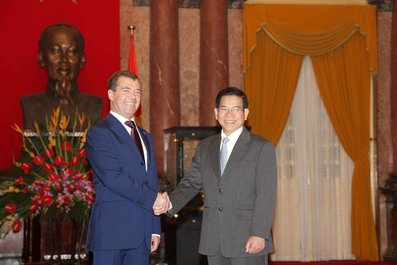
Medvedev with Vietnamese Counterpart Nguyen Minh Triet (photo: Kremlin.ru)

Cam Ranh was sure to be a topic for President Dmitriy Medvedev’s Vietnam trip.  But not a major one if Medvedev foreign policy assistant Sergey Prikhodko is to be believed.  Nevertheless, Prikhodko kept alive the idea of renewing some kind of Russian naval presence in Vietnam, whether called a base or a ‘material-technical support point.’  Prikhodko intimates the latter wouldn’t be anything like the former since times have changed so much.  Others will say the name it’s given is less signficant than what it actually turns out to be (if anything).

On Friday RIA Novosti quoted Prikhodko by name, on the eve of the Vietnam trip, saying:

“I don’t think we need to reestablish (in its old form) a base at Cam Ranh.”

And he claimed there was nothing concerning Cam Ranh in the documents  prepared for the visit.

Today ITAR-TASS coyly cited a Presidential Administration source (using Prikhodko’s exact words) who said Moscow is not tabling the issue of fully reestablishing a naval base at Cam Ranh:   

“Russia has material-technical support points for its Navy in many countries, you undoubtedly know them – from the Maldives on an occasional basis to Syria.  Naturally, the Vietnamese are interested in maximum capitalization on what was done by them and us.  But I don’t think we need to raise the issue of reestablishing the base.”

“It’s logical that in the framework of regular Russian Navy exercises, particularly in recent times, given our increased cooperation with European Union and NATO on antipiracy problems, this is an acute issue.  There’s nothing supernatural here.  And the fact is, in order for our ships to resupply with food and replenish in an efficient manner, they need infrastructure capabilities.”

“The idea of the base belongs to the Vietnamese side, it involves using the good groundwork and experience which Vietnam and Russia had earlier in supporting the security of navigation, supplying ships with food, with refueling.  It’s likely we’re talking about the possibilities of material-technical support of Russian ship cruises.”

“This is not the central subject (in the high-level talks), we have no enemies in this region as in past times, but to have the possibility to visit ports on regular and standard conditions wouldn’t be bad.”

“I don’t know the military’s plans in relation to this base and suppose that they don’t have any.  We’re talking about supporting the reliable functioning of our ships, including those fulfilling functions of various types of our cooperation with international organizations.”

Comparing the possibility of Cam Ranh with the existing situation with Syria, he said:

“This [Cam Ranh] is even better than the Syrian variant.  When it comes to Syria, we are always looking around at the reaction of neighbors, Israel, for example.  Here [Cam Ranh] it’s a much softer and more transparent variant.”

“There are complexities connected with ships passing the Strait of Malacca.  Therefore, on the level of public announcements, all countries in the region are interested that we should send military vessels there.”

It all seems like an awful lot of talk for something that ain’t goin’ happen . . .