Category Archives: Force Structure

Goodbye GRU Spetsnaz, Hello Army Spetsnaz

Writing in last Friday’s Stoletiye.ru, Rossiyskaya gazeta correspondent Sergey Ptichkin says that, practically on its 60th anniversary, GRU Spetsnaz have landed in a most unexpected place – the Ground Troops.  His piece is full of bitter sarcasm.

Ptichkin concludes:

“The GRU Spetsnaz brigades have transferred into the Ground Troops structure.  Several units have disbanded altogether.  Ranks for duties have been lowered.  Now a senior lieutenant will command a reconnaissance group, and that’s the ceiling.  All warrant officers have been dismissed – there’s no longer such a rank in the army.  And it’s strange that professional sergeants haven’t magically appeared in place of full-grown warrants.  The issue of halting parachute training for reconnaissance men is on the agenda.  Really, why parachutes if they’ve become ‘pure infantrymen?’  They can deliver them to any rebellious village in the mountains or forests on trains or in KamAZes.”

According to Ptichkin, professional Spetsnaz believe:

“. . . it’s simply impossible to train an eighteen-year-old boy into a genuine reconnaissance man-saboteur in one year.  In Afghanistan, Spetsnaz soldiers were sent out only after a year of intensive combat training.  That is real service, when a professional military reconnaissance man was born even at the very lowest level, began a year after callup, but now they’re dismissed into the reserves where they forget everything they learned after a few months.”

Ptichkin recalls the GRU Spetsnaz’ anniversary ten years ago.  Even though their relations with the Spetsnaz were tense, the Defense Minister and General Staff Chief came and paid their respects.

But this year:

“Neither the Defense Minister, nor the Chief of the General Staff, not even their current chief – the Ground Troops CINC came.”

“Many veterans and even serving officers consider this day a quiet farewell to the GRU Spetsnaz, born 60 years ago.  It’s possible something more mobile, combat ready, and effective will take its place.”

So he’s thrown Putin and Medvedev’s own description of the kind of army they want back at them.  Of course, the Spetsnaz have always considered themselves the ultimate fighting force.

Ptichkin says the Defense Minister didn’t even issue a traditional order of recognition for the day of Spetsnaz troops.

“There is still the symbol of military reconnaissance – the bat [literally, ‘flying mouse’].  But very soon it’ll be possible to boldly replace this silent night hunter on the emblem with a grey field mouse.  A sweet and inoffensive ground-pounder.”

ITAR-TASS’ coverage of the Spetsnaz anniversary also clearly identified them as subordinate to the Ground Troops, CINC General-Colonel Aleksandr Postnikov, and his Chief of Reconnaissance, Deputy Chief of Staff for Reconnaissance, Colonel Vladimir Mardusin.

The press service said Mardusin indicated that:

“. . . at present, army Spetsnaz are organized in independent brigades of special designation, which exist in every military district, and battalions in several combined arms formations of the Southern Military District.  Within the formation of the new profile of the armed forces, independent brigades of special designation were transferred to the Ground Troops and are in direct subordination to military district commanders / unified strategic commands.”

Izvestiya’s Dmitriy Litovkin predicted the GRU Spetsnaz’ transfer from the General Staff’s Main Intelligence Directorate (GRU) to the Ground Troops last November on the day of military intelligence (6 November).  This was after the 67th, 12th, and 3rd Spetsnaz brigades were disbanded, and even the 16th was in danger of the same.

Igor Korotchenko told Litovkin:

“It’s possible to judge what’s happening in the GRU only through open information.  For example, one of the results of the reform is taking the force component from the GRU and resubordinating Spetsnaz to the military district commanders.  Only space, radioelectronic, and agent reconnaissance, and also the analytic service remain in today’s ‘Aquarium.’”

Just a reminder, this would mean they were taken even before the six old MDs were reformed into 4 MDs / OSKs.  The poor performance of the GRU generally and the Spetsnaz specifically in the 2008 Georgian conflict may have provided impetus for the change.  Litovkin and others have reported that the GRU and Spetsnaz received an ‘unsatisfactory’ for their efforts in that brief war.   Meanwhile, subordinating Spetsnaz to warfighting MD CINCs on different strategic directions would seem to make sense, the angst of the GRU, its officers, and veterans notwithstanding.

We should, however, get back to the original Ptichkin article.  It has a lot of interesting stuff you might want to peruse.  Some is hyperbolic though, so take it with a grain of salt . . .

He describes all details of their formation from 24 October 1950.  The Spetsnaz were subordinate to the General Staff (GRU) because they were first and foremost strategic, and strategic nuclear, warfighting assets designed to disrupt U.S. and NATO capabilities – nuclear weapons, logistics, transport, communications, etc. – in deep rear areas, including even North America.

And, according to Ptichkin, they were supermen capable of singly accomplishing missions not even combined arms sub-units could handle.  And the Spetsnaz were more secret than Soviet nuclear weapons; not even all generals or marshals knew about more than their general outlines.

Everything changed with Afghanistan and glasnost.  Every power structure wanted its own special forces.  And the GRU Spetsnaz were thrust into the forefront of a war they weren’t created for.  But through the skill of their commanders they adapted and were successful.  Ptichkin claims a single Spetsnaz detachment could pacify an entire province.  And, according to him, if the Spetsnaz had been unleashed fully, the Afghan war would have been won and the country under Soviet control by the mid-1980s.

He says Tajikistan in 1992 proves this isn’t a fantasy.  The 15th Spetsnaz brigade under Colonel Vladimir Kvachkov, one of the accused in the Chubays’ assassination attempt, was given a free hand there and pacified the country. 

Ptichkin says Spetsnaz weren’t so involved in the First Chechen War, and the results were bad of course.  But they were used more extensively in the Second Chechen.  And he claims the Chechen Spetsnaz battalion under Sulim Yamadayev prevented Georgian saboteurs from blowing the Roki tunnel in August 2008.

And so, says Ptichkin, for 30 years, Spetsnaz have fought in places they weren’t intended to be, but have fought beautifully anyway.  Instead of landing in he main enemy’s rear areas, they are sitting on their own territory prepared, in extreme circumstances, to be sent to the next hot spot in the CIS, and not further afield.

As proof of how they’ve been used, it’s interesting to note the holiday press which says 8 Spetsnaz became Heroes of the Soviet Union in 40 years, but 44 have become Heroes of the Russian Federation in less than 20 years.
New Air Forces Commander in Far East

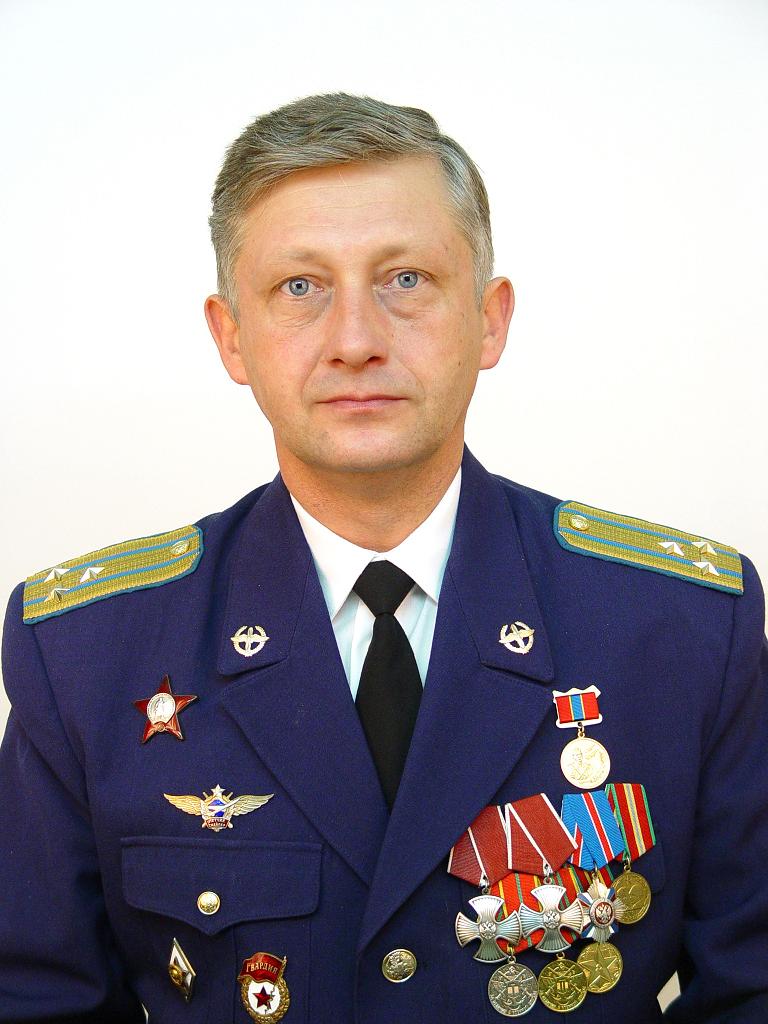
Colonel Dronov

On Monday, the Defense Ministry announced Colonel Sergey Vladimirovich Dronov as the new Chief of Air Forces and Air Defense in the Far East.  His predecessor, General-Lieutenant Valeriy Ivanov, has a new post in the Operational-Strategic Command of Air-Space Defense (OSK VKO or ОСК ВКО).

The 48-year-old Dronov was born in rural eastern Ukraine.  In 1983, he graduated from the Yeysk Higher Military Aviation School for Pilots, and began his service as a fighter-bomber pilot in the former Belorussian Military District.  So he’s an aviator, no surprise.

According to the Defense Ministry website, he served in aviation units in the North Caucasus and Siberia, and in command positions from flight commander to division commander.  He graduated from the mid-career Gagarin Air Forces Academy in 1992, and the General Staff Academy in 2007.

Dronov started his Far East service as commander of the Ussuriysk Composite Aviation Division in 2008.  In August 2009, he was assigned as deputy commander of the Air Forces and Air Defense Army (AVVSPVO) in the Far East.

The Defense Ministry reached down to replace an O-8 with an O-6.  This may be part of its continuing effort to reduce its top-heavy rank structure.  Recall Defense Minister Serdyukov’s description of the ‘bloated egg’ in rank distribution.  But Dronov will probably be promoted to general-major soon.

It’ll be interesting to see how other appointments play out.  Dronov just took over the existing Khabarovsk-based 11th AVVSPVO.  That’s an easy one.  But presumably, with the cut to four MDs, two of the current five AVVSPVOs might disappear.  The 6th AVVSPVO in St. Petersburg might meld into the Moscow-based Special Designation Command (КСпН) in the new Western MD.  And the 14th in Novosibirsk could be subsumed by the Yekaterinburg-based 5th  in the Central MD.  Look for more air and air defense command appointments.

Shamanov Sides with Serdyukov

General-Lieutenant Shamanov

VDV Commander Vladimir Shamanov knows which side his bread’s buttered on.  Talking to the press yesterday, Shamanov supported the boss in the storm over his alleged obscenity and грубость at the VDV’s Seltsy training center.

In short, Tverskaya, 13 reported the airborne chief doesn’t believe the story about Defense Minister Serdyukov.  He denies the boss ordered Colonel Krasov dismissed as head of the airborne commissioning school.

According to Shamanov, Serdyukov expressed doubts about constructing the Church of the Prophet Elijah opposite the airborne training school, since cadets aren’t there for long.  The Defense Minister suggested [politely one is sure] that they move the church to a populated area adjacent to the training center where the congregation can take care of it [but aren’t the VDV cadets and officers the congregation?].  Shamanov concludes:

“All the rest is cock and bull.”

Apparently answering the Union of Russian Airborne Troops’ appeal to the President and Patriarch, Shamanov told ITAR-TASS and RIA Novosti he’s satisfied with the course of army reforms, and doesn’t see any reason to worry about the fate of his service branch:

“The plans that will be presented to the Supreme CINC for approval indicate that the VDV’s composition will remain as before.  Also two more district-level airborne formations [соединение] should come into service raising the troops’ potential overall.”

As if to assure people the VDV won’t march on the Kremlin, Shamanov added that the situation in his branch is “normal,” and his troops are occupied with combat training as usual.

Tverskaya, 13 reported Shamanov saying for the umpteenth time that his branch will remain independent [i.e. not be subordinated to the Ground Troops] under Serdyukov’s ‘new profile’ reforms.  He added that the VDV will get the BMD-4M according to the ‘concept’ of GPV 2020.

We should recall that Serdyukov may have helped Shamanov on some occasions, and certainly did in one instance.  The Defense Minister at least acquiesced in Shamanov’s return to lead the VDV in May 2009.  And last September, he helped Shamanov out of his own scandal when he tried to order a detachment from the VDV’s 45th Independent Reconnaissance Regiment to detain an investigator looking into his son-in-law, a well-known criminal figure.  Shamanov only got a reprimand for this incident.  He could easily have been dismissed.  Serdyukov likely retained him because the airborne general is a useful ally.

In today’s Tverskaya, 13, Deputy Defense Minister Naginskiy offered an impassioned defense of Serdyukov.  Naginskiy was on the Seltsy inspection with the Defense Minister.

Naginskiy said they saw facilities unfinished since 2008.  But he doesn’t exactly deny the press reports:

“Nothing terrible happened there.  I think if people standing 120 meters behind us heard something, filled it in, and put it on the Internet, they are dishonest.  I can say there was no boorishness or cursing, but there were raised voices, when on the territory of a unit entrusted to you someone is selling things and someone is building for 180 million rubles, undoubtedly, this calls forth natural indignation and, as it should, a conversation in raised voices.”

Naginskiy goes on, questioning why they need a church at Seltsy when troops go there to train and then return to Ryazan, but:

“I’m in absolute solidarity with the Defense Minister — what I saw there brought indignation.  There were no orders to move the church.”

This morning Nezavisimaya gazeta’s Viktor Litovkin reported some comments from Colonel Krasov himself: 

“In particular, Serdyukov expressed dissatisfaction over the incomplete repair of the cafeteria and engineering networks.  The conversation was very emotional both from Krasov’s side [speaking of himself in the third person] and from Serdyukov’s side.  However, this was a businesslike dialog.  The Ryazan school has already eliminated deficiencies revealed during the military minister’s visit.”

That certainly sounds like some type of unpleasantness transpired.  Litovkin says it’s strange neither Shamanov nor Krasov remembered [or mentioned] any obscenities.  But nevertheless he concludes:

“If this is ‘cock and bull’ as General Shamanov says, or simply ‘businesslike dialog,’ as Colonel Krasov asserts, then it’s no longer worth worrying about the battle against dedovshchina and nonregulation relations in the armed forces.”

It isn’t worth it because the abuse of subordinates apparently begins from the Defense Ministry’s very top, and won’t ever be rooted out.

Litovkin finishes saying the VDV have nothing to gain from fighting with Serdyukov, and are just trying to silence the whole incident.  There will be other defense ministers, but the VDV will always exist.

Izvestiya’s Dmitriy Litovkin says his Defense Ministry sources say there were no demands to raze the church.  He claims Serdyukov may have wanted to move it outside the base’s gates to ease access for its parishioners.  He finds the whole situation odd since there are 200 churches on Russian military property, and next year the army will begin training military chaplains.

Return to Cam Ranh?

Russia Departs Cam Ranh in 2002 (photo: ITAR-TASS)

The Russian Navy’s possible return to Vietnam became the latest military rumor floated in the media last week.  If it happens, it won’t have exactly the same purposes as in 1979, and it probably won’t be on the same scale.  But it will be part and parcel of the issue of being, or wanting to remain, a naval power.  Moscow might have to ask itself if it still is one, or will be one in the future.

On Wednesday, former Navy Main Staff Chief, Admiral Viktor Kravchenko told Interfaks the Navy is proposing to reestablish a material-technical support base (PMTO or ПМТО) at Cam Ranh.

The news service quotes Kravchenko:

“Without a system of bases for deployment, full support of Navy ships in distant waters is problematic.  Navy surface ships and submarines need repair, resupply, and crew rest to fulfill a wide range of missions on the world’s oceans.  If as before Russia considers itself a naval power, the reestablishment and creation of basing points like Cam Ranh is unavoidable.”

A Defense Ministry source told Nezavisimaya gazeta that:

“The [Navy] Glavkomat has finished work on the documents considering and substantiating the need to reestablish a basing point to support Russian ships in the Asia-Pacific region.  If there is a political decision, then the Navy is prepared to reestablish a working base in three years.”

The base would support ships on antipiracy missions in the Pacific and Indian Oceans, according to the source.

The Chairman of the Duma Defense Committee’s Subcommittee on Military-Technical Cooperation, former Captain First Rank Mikhail Nenashev told Interfaks:

“The rent for a naval base at Cam Ranh, in the end, would cost Russia less than regular support of combatants on the world’s oceans using auxiliary ships, tankers, and repair ships.”

And:

“Reestablishing a base at Cam Ranh would help strengthen and develop cooperation with Vietnam and the Asia-Pacific region countries not only in military, but in many others spheres of activity.”

Izvestiya says, Moscow doesn’t intend to return to a Cold War-style global military confrontation with Washington – it has not the forces, means, or desire for it – but the ‘Cam Ranh initiative’ shows that a gradual reanimation of specific military bases abroad could happen.

According to Newsru.com and Vremya novostey, in 1979, Moscow and Hanoi signed a 25-year agreement by which the Soviet Pacific Fleet’s 17th Squadron gained access to Cam Ranh.  Vietnam allowed the Soviet Navy to base 10 surface ships, 8 submarines with a submarine support ship, and 6 auxiliaries at the port.  Later, the 922nd PMTO was established at the Vietnamese port.  The Soviets had POL storage, an ASW and missile armaments base and technical service unit, a Naval Infantry sub-unit, and an air regiment at Cam Ranh.

The base was initially free, but Hanoi asked for $300 million in rent in 1998.  In 2001, Moscow decided not to extend its agreement with Vietnam, and the last Russian elements departed Cam Ranh in mid-2002.  The decisionmaking around the Cam Ranh withdrawal (likewise for Lourdes, Cuba) is anything but clear-cut.  But then President Putin probably made the decision, reportedly against the advice of many senior uniformed officers, in an effort to save money for the military at home, and to make nice with Washington.  Former high-ranking General Staff officer Leonid Ivashov claims the $300 million rent, at least, shouldn’t have been an issue since it could have been written off against Vietnam’s $10 billion debt to Moscow.

Prime Minister Putin’s December 2009 Hanoi visit and major arms deal, including six proyekt 636 diesel submarines, with Vietnam may have started movement on a return to Cam Ranh.  Defense Minister Serdyukov went to Hanoi in February and told Rossiyskaya gazeta the Vietnamese were very interested in constructing a Navy repair plant and Russian help with naval logistics.  However, Serdyukov claimed the Vietnamese didn’t propose anything about Cam Ranh.  But NG’s Vladimir Mukhin speculates a deal for a renewed Russian presence at the base might be inked during President Medvedev’s late October trip to Vietnam.

Izvestiya quotes independent military analyst Aleksandr Khramchikhin:

“Theoretically, I welcome the reestablishment of a Navy base at Cam Ranh.  For Russia, it is a very composite and most useful facility abroad. Without it, the operations of the Pacific Fleet are impeded.  Also very little remains of the Pacific Fleet.  This fact, however, doesn’t change the usefulness of the base at Cam Ranh.  Such a step could, of course, create certain foreign policy difficulties for Russia.  I suppose the U.S. and China will express dissatisfaction, but this will hardly have any real effect.  As concerns Vietnam, it would pay to view it as our most important ally.  Russia largely cast it aside after the collapse of the USSR.  This was a gross mistake worth correcting.”

It’s worth recalling Khramchikhin may view Vietnam through a slightly Sinophobic prism.

Talking to NG, Duma Deputy, and former Black Sea Fleet commander, Vladimir Komoyedov worries there won’t be anything to deploy at Cam Ranh:

“The Pacific Fleet, whose ships need to control the waters of South-East Asia, has hardly received any new units for the last two decades.  And what will we deploy to Cam Ranh?”

Collegium in Southern Military District

Anatoliy Serdyukov conducted another extramural Defense Ministry collegium today, this time in Rostov-na-Donu, and the new Southern Military District (MD).

RIA Novosti quoted a spokeswoman who said:

“Participants in the session are reviewing issues concerning formation of the YuVO.  In particular, they will review questions about optimizing the deployment of formations and military units on the district’s territory, work with personnel, medical and housing support for servicemen, and also preparations for the heating season.”

So, they’re talking about possibly moving some brigades or regiments to better locations, and probably about who will command some of them.

The YuVO began operations in its new composition on 1 October.

According to ITAR-TASS, Serdyukov spoke of the ‘doubling’ of the ‘potential’ of the armed forces in the south with the establishment of the new district, but added this isn’t connected with the army’s counterterrorism missions in the region.

One would like to know how that ‘doubling’ was calculated since the MD’s ground units haven’t changed.

The Southern MD, or Unified Strategic Command (OSK) ‘South’ encompasses not only the former SKVO, but also the Black Sea Fleet and Caspian Flotilla.

Collegium on MDs and Antiterrorism

Last Thursday, Defense Minister Serdyukov conducted an extramural ‘board of directors’ meeting in St. Petersburg.  The agenda had two publicized items — forming the new Western Military District (MD) and antiterrorism.

Deputy Defense Minister, General-Colonel Dmitriy Bulgakov (effectively chief of material-technical support) and acting commander of the new Western MD (ZVO or ЗВО), General-Colonel Arkadiy Bakhin reported on the new district.  Genshtab GOU Chief, General-Lieutenant Andrey Tretyak reported “On the Condition of Antiterrorist Work in the RF Armed Forces and Measures to Neutralize Terrorist Threats.”

In its coverage, ITAR-TASS noted that recommendations from forming the ZVO will be applied to the new Southern, Central, and Eastern MDs. 

After the collegium, General Staff Chief Nikolay Makarov told journalists that work on the ZVO was being closely analyzed, and all issues had been resolved in the main.  But its command doesn’t fully recognize the importance of its tasks, and its combat training demands higher quality work.  Makarov called this a consequence of the fact that, for 15 to 20 years, almost 85 percent of officers in command and control organs didn’t command troops. 

Of course, Makarov considers himself a ‘troop general’ and that 85 percent figure makes it easy for him to oversee cutting the officer corps by 50 percent.

Makarov said the terrorist attack near Buynaksk was being closely analyzed, and noted that commanders didn’t take measures necessary to protect their people.  But the tasks essential to countering terrorist threats have been identified.

Krasnaya zvezda reported that Serdyukov met human rights organization representatives during a break in the collegium.  More on this later.

Creating ‘New Profile’ Army Not Easy in Far East

A variety of press reports indicate establishing a ‘new profile’ army in the Far East is a difficult and increasingly protracted process.

On 7 September, ITAR-TASS said General Staff Chief, Army General Nikolay Makarov was in Chita to resolve a number of army problems.  The press service noted Makarov was accompanied by new Eastern Military District (MD) Commander, Vice-Admiral Konstantin Sidenko.

Specifically, Makarov was in eastern Siberia (now part of the Eastern MD) working on ‘military organizational development [строительство]’ – a Russian euphemism for TO&E changes and force restructuring – and development of base military towns and their social infrastructure.  In plain English, the General Staff Chief was in the Transbaykal sticks sorting out which units go into this or that brigade, or get disbanded, and how to provide housing and a modicum of other basic services for their soldiers, officers, and families.

But Makarov and Sidenko may have worse problems further east.

On 8 September, ITAR-TASS published a small, but significant report claiming that Khabarovsk Kray’s military garrisons and towns are not ready for winter.

Preparation for heating season in the majority of military buildings in Khabarovsk Kray is breaking down, according to the Kray’s emergency situations commission.  The poor state of preparation of communal infrastructure (i.e. boilers, coal supplies, steam pipes, etc.) and apartment blocks in Lazo, Bikin, and Vanino Rayons is alarming.

A Kray official said, “. . . supplies of winter fuel haven’t been established, boiler equipment hasn’t been repaired, facilities don’t have personnel.”  In Vanino, workers repairing a major boiler received layoff notices.  Days before the start of heating season, several boilers have been completely dismantled and there are no supplies of coal, according to the news agency.

 The emergency situations commission noted that:

“The Defense Ministry has begun transferring housing-communal servicing functions for its garrisons to private organizations, but this process has bogged down.”

The military’s Housing Management Directorate (KEU) representatives in the Far East didn’t deny the problems, but blamed them on a catastrophic lack of financing.  The military’s indebtedness to Far East communal services providers over the first 7 months of the year is 181.6 million rubles, and Khabarovsk Kray accounts for more than 88 million of this amount.

The first deputy chairman of the Khabarovsk Kray government has asked military prosecutors to intervene and force the army to prepare the region’s military towns and villages adequately and forestall emergency situations this winter.

All this comes on top of reports of similar problems last fall.  

Half of Russia’s 85 new army brigades had to move units and construct new barracks, housing, and other essential infrastructure for them, and this was proving especially difficult in the Far East. 

Almost a year ago, Vladivostok’s largest newspaper Zolotoy rog reported that officers in two newly organized brigades in the Far East were in danger of being stranded in ‘open fields,’ or field conditions, because they lacked materials and funding to prepare their garrisons.  However, the deputy commander of 5th Combined Arms Army assured the media that barracks and other buildings were being repaired for brigades at Barabash and Sibirtsevo.

Zolotoy rog reported that one battalion commander took out a private loan to repair barracks for his men.  Some officers who arrived at Barabash left after seeing the condition of their new garrison, and the brigade also had trouble keeping battalion commanders for the same reason.  The brigades reportedly turned to Primorskiy Kray’s governor for help.

So what are we to make of all this?

First, having Makarov travel out east to straighten up a mess is something of a no-confidence vote in new Eastern MD Commander Sidenko.  It’s a particularly inauspicious start since many eyes are on Sidenko to see how he performs as the first naval officer to lead this major ground-oriented command.

Second, Khabarovsk Kray had some pretty stark criticism for Defense Minister Serdyukov’s policy of privatizing logistics support functions for the army.  What might work in the new Western or Southern MDs may not work well in the remote reaches of the Eastern MD.

Third, this early warning of problems may be an attempt to prevent another ‘Steppe’ garrison crisis in Transbaykal this winter.  And the problems are not confined to active military garrisons.  Lots of remote former garrisons – with real living retirees – are caught in limbo between military and civilian municipal services.  Pereyaslavka’s problems last winter are just one case of this.  Pereyaslavka happens to be the administrative center of Lazo Rayon, cited this year as the scene of potential problems this winter.

So while the Defense Ministry and media focus almost exclusively on the attractive leading edge of the army’s ‘new profile,’ it pays to remember that Russian military reform has a large, messy trailing edge that’s found in places like Lazo, Bikin, Vanino, Barabash, Sibirtsevo, and Pereyaslavka.

Western MD Opens for Business

According to ITAR-TASS, General-Colonel Valeriy Gerasimov told journalists yesterday that the new Western Military District (MD) was fully formed and functional on 1 September.  Gerasimov said:

“The Western Military District started functioning on 1 September.  Command and control organs of the former Leningrad and Moscow Military Districts, Northern and Baltic Fleets, and also the 1st Air Forces and Air Defense Command went into the composition of the staff located in St. Petersburg.”

Gerasimov said the majority of Moscow MD staff officers:

“. . . were appointed to positions in the staff of the Western Military District and other organs of military command and control.  Part of the officers, having served out their prescribed terms, were dismissed, but those who have a half-year to a year remaining to serve are at the disposition [of their commanding officers].”

Gerasimov himself went from Commander, Moscow MD to become a deputy chief of the General Staff.

The Defense Ministry now wants the other three new MDs / OSKs to be functional by 1 October.

Winners and Losers in Organizing New MDs and Armies

Today a Ground Troops spokesman told ITAR-TASS three current Leningrad Military District (MD) brigades will form a 6th Combined Arms Army (CAA) in the new Western MD.  The 200th, 138th, and 25th Motorized Rifle Brigades will comprise the new army, and its headquarters will probably be Agalatovo, just north of St. Petersburg.  The spokesman also said a surface-to-air missile brigade and independent engineering brigade will be added to the Western MD.

These comments came in conjunction with a visit by Ground Troops CINC, General-Colonel Aleksandr Postnikov to the region to check on the formation of the new MD.  The spokesman said Postnikov may be working on peacetime coordination between the district’s Ground Troops, the Northern and Baltic Fleets, and Air Forces units.  He said, in wartime, “everything’s clear – [the district’s] commander directly commands everything deployed within the district’s boundaries.  But there’s still no experience of coordination in peacetime and we need to get it.”

Nezavisimaya gazeta’s Vladimir Mukhin also wrote today that the third new CAA will be based in Maykop, Southern MD.  Mukhin says that staffs, commands, formations, and military units in the Far East, Siberian, and Moscow MDs are being liquidated in the shift to four new MDs / OSKs, and, as a result, several thousand officers will be placed outside the TO&E beginning 1 September.  He thinks many of them won’t find vacant posts, and will be discharged from the army.

Serdyukov’s Defense Ministry will also be putting some soon-to-be-vacant properties up for sale, e.g. Moscow MD headquarters (Polina Osipenko Street, Moscow), Far East MD headquarters (Seryshev Street, Khabarovsk).  The initial asking prices for these buildings and land will be several billion U.S. dollars.  As long planned, proceeds from these sales, along with the sale of the Navy Main Staff, military educational institutions, and other military establishments in Moscow, are supposed to fund construction of housing for servicemen as well as military garrison infrastructure in new army deployment locations.

Mukhin talked to General-Lieutenant Yuriy Netkachev about Maykop.  Netkachev says Moscow is resurrecting the army headquarters located there until 1993.  He believes Maykop was chosen to reinforce against threats from Georgia as well as threats to the 2014 Winter Olympics in Sochi.

In the Central MD, Mukhin says the 67th Spetsnaz Brigade will move yet again, from IVVAIU in Irkutsk to Chita or Transbaykal Kray.  The IVVAIU building will be sold.

Mukhin sees Moscow’s demilitarization and moving forces closer to their likely operational theaters as the right policy, but asks if it’s underpinned with resources.  It has serious impact on servicemen and their families, and they’ve been forgotten in this process.

Mukhin quotes servicemen’s union chief Oleg Shvedkov:

“Continuing steps to transition the troops into a new profile supposes not only a significant cut in professional servicemen, but also their relocation to a new place of service.  And this means new everyday life problems are possible:  transfers, absence of housing, work for spouses, education for children, and the like.  The Defense Ministry is trying to resolve these issues on its own, but it would be more correct for the government to work on them through a special federal program.”

Commander for New Army in Chita

General-Major Romanchuk

By the Defense Minister’s order dated 12 August, General-Major Aleksandr Vladimirovich Romanchuk became acting commander of the new combined arms army being formed in Chita.  ITAR-TASS quoted a SibVO spokesman:

“The command and staff of the army, and also a number of army-subordinate formations and military units, will be formed under his leadership.  Formations and military units based in Transbaykal Kray will comprise the army.”

The Chita Combined Arms Army (CAA) will be the easternmost large formation in the new Central Military District (MD), or Combined Strategic Command (OSK) Center.  Who knows what number the new army will receive . . . maybe the former 29th CAA will be resurrected.

Romanchuk was born 15 April 1959 in Lugansk, Ukraine.  He grew up in a military family in Azerbaijan.  Commissioned out of the Baku Higher Combined Arms Command School in 1980, he served as a tank platoon and company commander, then chief of staff and deputy commander of a tank battalion in the Transcaucasus MD.  He graduated from the Military Academy of Armored Troops in 1989 and, for a very short period, commanded an independent tank battalion in the Central Group of Forces (Czechoslovakia). 

Returning home with the rest of Soviet forces, he became deputy commander and commander of a machine gun-artillery regiment in the Transbaykal MD during the 1990s.  He was a colonel in his late 30s by the end of this phase of his career.

When the Transbaykal MD folded into the Siberian MD, Romanchuk became chief of an armaments and equipment storage base, and chief of staff and deputy commander of a Siberian MD tank division.  He served a tour of duty in Chechnya during the late 1990s or early 2000s.

Between 2001 and 2003, he was deputy commander of the Guards Taman Motorized Rifle Division in the Moscow MD.  He became commander of the 4th Guards Kantemir Tank Division in Naro-Fominsk at the end of 2003.  He was promoted to general-major (one star) in mid-2005.

He likely attended the Military Academy of the General Staff between mid-2006 and mid-2008, and then became a deputy commander of the Novosibirsk-based 41st CAA.  In July 2009, he became chief of staff and first deputy commander of that army.

Romanchuk is married with two sons.