Category Archives: Law, Order, and Discipline

Soviet Fathers and Russian Sons

The story of Igor Sulim and the premium pay scandal is like the 19th century one about Russian society’s generation gap.  With liberals and nihilists reversed.

In Sulim’s story, the fathers are old senior and mid-grade officers who span Soviet and Russian worlds.  They have no problem taking whatever’s not nailed down.  The sons are post-Soviet junior officers, reared on the Internet, familiar with Western-style justice and rule-of-law, and ready to demand an end to corruption (that costs them money).

Perhaps your author reads too much into this.  Or just maybe there’s some truth in this description.  Let’s review some new details first.

The investigation into Senior Lieutenant Sulim’s accusations is a very slow roll.  Rolling the victims.  Here’s an update on the action (or inaction?).

Sulim posted his first video on May 31.  Gorod48.ru wrote about it.

Sulim explained why he felt he had to complain to Defense Minister Serdyukov and go public about corruption in his unit despite the military’s “corporate ethic” against it.  He said he exhausted other avenues and had no other resource at his disposal.  He didn’t intend to be a one-man campaign against corruption but he’s getting support, and hearing similar stories, from others.  And he thanks his fellow officers supporting him despite the difficulties and pressure they face.

He concludes speaking out is his civic duty.  Russians should unite around one idea and struggle together so Russia doesn’t lose its greatness and remains a great power.  And so the next generation doesn’t hate the current one for being silent and patient, believing nothing will ever change.  It’s not revolution or spilled blood he wants, but the path of civilized development.

On June 2, Moskovskiye novosti wrote that Sulim predicted a disciplinary reprimand and deprivation of his premium pay would come his way for going over his superior officers (and, in fact, both came pretty quickly).  The “army Navalnyy” and other officers are being pressured in every way by the authorities, and the entire Lipetsk center’s been deprived of premium pay to turn other officers against Sulim.  He was removed from flight status.  Public Chamber member Anatoliy Kucherena reported over half of 150 personnel he met said they were aware of the corrupt pay scheme at the base.

On June 3, Nezavisimoye voyennoye obozreniye addressed the basic flaw in Serdyukov’s Order 400 and premium pay:

“Here is the misfortune — the essentially socialist army was not ready for these market relations.  Indoctrinated on the principle that everyone in the line is equal before the commander and in battle, before life and death, everyone to an equal degree responsible for his country and its security, officers became accustomed to distinguishing one from another only by stars on the shoulderboards and by position, where the difference in pay between lieutenant and colonel, a general even, was minimal:  a couple — four thousand rubles.  And here suddenly it became colossal — several times.  And, of course, when not everyone started receiving such premiums for the very same service-work, but just those chosen by still incomprehensible principles, a Bolshevist idea immediately arose — take it and divide it up.”

“But it was impossible not to understand to what the revolutionary introduction of market relations and big money for different categories of  servicemen could lead.  But has pay become a schism in combat units?  There’s no unambiguous answer.”

“What’s the result?  To what is the Senior Lieutenant Sulim phenomenon leading?  Most likely just to changes in the various fates of various officers and various military units.  But over some kind of time everything will remain as before.  If Orders No. 400, 400A and 155 aren’t be suspended and changed.  If from 1 January next year, the difference in pay and premiums for the very same service-work aren’t so monstrously striking.  It’s not worth destroying the monolithic army line with the almighty ruble.  This could bring serious consequences in a real battle.”

Sulim gave Ogonek an interview.  Sulim said his father was not happy about him going public, but Sulim stressed it was his own personal decision.  General-Major Sulim’s being pressed to keep his son’s mouth shut.

Ogonek asked Sulim if he isn’t afraid of sharing MVD Major Dymovskiy’s fate:

“His colleagues, as I understand it, didn’t support Dymovskiy.  There are more and more of us now.  If I had been alone, perhaps, I would have repeated his fate.  But my colleagues are supporting me so, everyone is ready to go only forward.”

By mid-June, Sulim’s antagonists — Colonels Kovalskiy and Sidorenko — were both relieved of duty, but his supporters — Majors Kubarev and Smirnov — had been hauled before an Air Forces attestation commission in Moscow, called cowards for not refusing to pay kickbacks, and all but told they would be transferred from their elite Lipetsk duty, according to Komsomolskaya pravda.  The paper points out Kubarev is a Su-34 pilot qualified for aerial refueling, and Smirnov was regiment’s top pilot last year.

In Moskovskiy komsomolets, Olga Bozhyeva wrote that Sulim’s reprimand was for violating the law’s prohibition on “discussing and criticizing the orders of a commander.”  The authorities apparently didn’t go after him for revealing some of the stupid things said and written by Deputy VVS CINC General-Major Viktor Bondarev.  Instead, they focused on his criticism of the Defense Ministry’s anticorruption orders posted on his blog.  For its part, MK posted new audio clips indicating that the even the local FSB is in on getting kickbacks at Lipetsk, and this didn’t happen just in the 3rd Squadron, but all over the center.  Bozhyeva asks, if this happens in an elite formation like Lipetsk, what happens in less prestigious units?

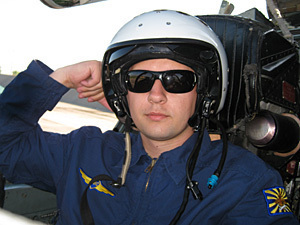
Senior Lieutenant Igor Sulim

There is lots on Sulim’s blog.  Most recently, he wrote about meeting with VVS Deputy CINC, General-Lieutenant Sadofyev, who asked him why he had to “create a scandal.”  Of course, Sulim’s made the point many times that he tried to go through the chain, through channels, and to do it without blood, and quietly.  But Sadofyev and the older generation really don’t get it. 

The new Russian generation of sons might make even congenitally pessimistic observers of Russia a little hopeful.  The authorities could be playing an ultimately futile game of whack a mole with an entire generation of  Dymovskiys and Matveyevs and Sulims.

Life in the Disbat

Komsomolskaya pravda’s Viktor Sokirko had an interesting article today about life in a disbat — a disciplinary battalion.  It features a rather idyllic video showing some of the inmate-soldiers’ daily activities.

Sokirko says only two disbats remain, and he was invited inside one to see a “prison in shoulderboards.”  The 28th Independent Disciplinary Battalion looks like other units with barracks, parade grounds, etc.  But it also has barbed wire, guard dogs, and a security company.

The acting commander says he has 162 men under guard, although he could accommodate 800.

Most are inside for “nonregulation relations” or dedovshchina.  There’s also theft, extortion, AWOL, and less often, desertion.

One Russian conscript from Abkhazia is serving 6 months for refusing to scrub the barrack floor.  He adopted the “law of the mountains,” and refused to do “women’s work.”  Another, a sergeant, got two years for rupturing the spleen of a soldier who cursed him for sending him to clean the latrine.

The acting commander says his charges aren’t beaten or thrown into pits, but simply forced to march in formation and live strictly according to regulations (including learning every line).  And there’s cleaning the barracks.

If they don’t toe the line, there’s the guardhouse, and no one wants to go there, so even the proud and independent Caucasians follow orders.  More than half the inmates — 96 — are North Caucasians.  The article claims only 2 percent of the Russian Army is drafted there, but half the men in the disbat are Caucasians.

The commander says there’s no special treatment in the disbat:

“Here everyone scrubs the toilets, and eats lard.  The friendship of peoples in miniature.”

Inmates don’t get a permanent record from time in the disbat, and the command claims only 5 percent of its former inmates become criminals subsequently.

Interestingly, Rossiyskaya gazeta wrote about the disbat in 2009.  It said there were still 5 disbats with about 1,200 inmates in all.  It noted, while they don’t get a record, their disbat time doesn’t count, and they still have to complete their conscription term.  RG said 40 percent were serving time for AWOL, about the same for dedovshchina, and the rest for other crimes.

Sergey Ivanov had proposed the guardhouse as a replacement for the disbat.  Disciplinary cases would go to the guardhouse, and any soldier committing a crime not covered in the regs would be handled in civil court and prisons.  But Anatoliy Serdyukov didn’t support the plan to build and rebuild guardhouses.  Of course, he also claimed the disbat provided a better chance to get a guy back on track.

Arsenal Explosion Blows Up a Couple Careers

Friday Kremlin.ru published Defense Minister Serdyukov’s list of those responsible for the June 2 fire and explosion at the 102nd Artillery Munitions Arsenal.

Not surprisingly, small fish got dismissed while large ones got off with reprimands.

The text of Serdyukov’s report to President Medvedev concludes:

“The basic causes of what happened were nonobservance of the requirements of explosives and fire safety while working with munitions, a negligent attitude by the Central Military District directorate and the command of the 102nd arsenal toward fulfilling their immediate duties in organizing and supporting daily functions, but also not fulfilling the requirements of Russian Federation Government order No. 135 from 17 February 2000 regarding the establishment and designation of prohibited zones and areas.”

Those dismissed for failures before or during the disaster:

  • General-Major S. V. Khokh, Chief, Technical Support Directorate, Central MD.
  • Colonel L. V. Chumakov, Chief, Material-Technical Support Planning and Coordination Directorate, Central MD.

Those getting reprimands:

  • Deputy Defense Minister, Army General D. V. Bulgakov.
  • Commander, Central MD, General-Colonel V. V. Chirkin.

Those receiving severe reprimands:

  • Acting Chief of Staff, Central Military District, General-Major S. A. Chuvakin.
  • Chief, Main Missile-Artillery Directorate, RF Ministry of Defense, General-Major A. L. Romanovskiy.
  • Chief, Material-Technical Support Planning and Coordination Department, RF Ministry of Defense, General-Lieutenant S. A. Zhirov.  

Warned about incomplete duty fulfillment:

  • Deputy Commander of the Central Military District for Material-Technical Support, General-Major Yu. A. Svintsov.

Dismissed early for nonfulfillment of contract terms:

  • Acting Chief, Missile-Artillery Armaments Service, Central Military District, Colonel A. N. Kozlov.
  • Section Chief (base, arsenal, and depot administration and security), Material-Technical Support Planning and Coordination Directorate, Central Military District, Colonel Kh. Kh. Beglov.
  • Chief, 102nd Arsenal (artillery munitions, 1st rank), Central Military District, Colonel Yu. I. Banin.

Lipetsk Scandal Update

Let’s update the action.

It’s rare when a single incident like Lipetsk is deemed serious enough to warrant a quick public response.  But that’s what’s happening.

Defense Minister Anatoliy Serdyukov has ordered checks for corruption in large formations, formations, and units [i.e. army-level down].  His press-service says they’ll look specifically for premium pay kickback schemes.  And servicemen and their families are urged to fill out electronic complaint forms on Mil.ru if they know about extortion rackets.  They don’t need to observe the chain of command either.

Newsru.com has a good recap.  VVS Deputy CINC, General-Major Bondarev has confirmed the existence of a kickback scheme at Lipetsk.  But he also called Sulim and others cowards for not refusing to pay.  He also denied putting any pressure on the men.

As Newsru notes, MK has audio of Bondarev indicating otherwise.  Talking to Sulim, Bondarev claims he’s just angry he wasn’t promoted, his father illegally got him into the elite Lipetsk unit, and warns him that his fellow servicemen will kill him when they lose their premium pay.  The tape also showed that Sulim only wants to resign because of the corruption, not for personal reasons, as Bondarev claims. 

In fact, Sulim hopes to continue serving.

Gazeta.ru focused on Bondarev’s comment that it’s possible violations at Lipetsk are administrative rather than criminal [which would make Kovalskiy no more guilty than Smirnov or Sulim].  Bondarev claims Major Kubarev retracted his support for Sulim [Kubarev’s also being reported as Kubyrev].

Gazeta then talked to Sulim, who points out Bondarev only investigated in the 3rd squadron, not in the 1st or 4th squadrons, because the leadership is trying to limit the damage, and to make it look like it’s one squadron’s problem, and not a base-wide scheme.

You can see Bondarev’s own words in his 24 May interview with Ekho moskvy.

The RVSN actually moved out on this scandal before the Defense Ministry:

“Taking into account the recent events in one of the RF Defense Ministry’s units,  connected with the illegal collection of money from servicemen, and to preclude the occurrence of similar situations in RVSN units, RVSN Commander, General-Lieutenant Sergey Karakayev has decided to establish permanently functioning commissions in every missile army to prevent similar legal violations.”

The press release said commissions will conduct anonymous surveys of officers and their families, and also look for this during inspections.  But there might already be a lot of work to do.

Look at the impassioned comment a retired RVSN lieutenant colonel left on the webpage for Olga Bozhyeva’s interview with Sulim and Smirnov:

“Such kickbacks go on THROUGHOUT Russia’s VS [Armed Forces]!!  It would be possible to jail ALL commanders of ALL units in Russia in good conscience!!”

“I live in the military town of an RVSN division.  Many of my acquaintances are still serving.  Previously they included ONLY SELECTED ‘RELIABLE’ officers in the order for the annual receipt of this mad money (extra MONTHLY pay up to 160-200 thousand rubles!!!) — but not more than 30% of the unit’s officers.  EVERYONE knows that they collect ‘tribute’ from this money paid according to MO RF Order № 400:  and who gets it, and who doesn’t, and their wives, and the osobisty (FSB), and the prosecutors, and even conscript soldiers [know who gets it]!!  And such corruption arranges EVERYTHING — it’s clear that both prosecutors and osobisty get it!  And it also arranges the officers who give the most ‘tribute’ — refuse to pay, they find a reason and deprive you of this mad, undeserved money!!!”

“Of course there’s hostility among officers, and their wives because of the payment of this money!  You bet!  Of two similar officers fulfilling similar duties, one gets SEVERAL TIMES more!!  Not 2, 3, 5, 10, or 20 thousand rubles a months more, but several times more!!!  Meanwhile, it’s usually not the best, but the ‘reliable’ one who will ‘kickback’ money without a fuss!!”

“THIS UNDERMINES ALL FOUNDATIONS of the Russian Army and its COMBAT READINESS!!  ONLY AN ENEMY OF RUSSIA could think up such a thing!!”

Loss of Fear or Loss of Faith?

Senior Lieutenant Sulim

Olga Bozhyeva has a great interview with the protagonists of the Lipetsk premium pay extortion scandal.  Essentially, Major Smirnov and Senior Lieutenant Sulim detail a farcical investigation, and what looks like a wider-ranging criminal conspiracy.  The entire Air Forces, not just the Lipetsk center, are in serious damage-control mode.

Bozhyeva introduces the piece as showing that even elite units suffer from corruption, and points out the center’s chief, General-Major Aleksandr Kharchevskiy, gave Vladimir Putin a test flight, and led combat aircraft that overflew Red Square on Victory Day 2010.  The two young aviators told her they had to talk immediately because time is against them.

Smirnov described his experience with the extortion scheme.  He said those refusing to pay got reprimands that could be used to force them out, and, with many officers being cut already, this threat was especially serious.  Or, he says, higher-ups would simply take away their “400” pay, and give it to someone willing to pay tribute.  Smirnov says the extortionists also collected as much as 240,000 rubles a year from conscripts.  He also recalled seeing Sulim’s draft complaint about corruption, and agreeing to support the younger officer.  Their ex-squadron commander, Major Yevgeniy Kubarev, joined them.

The VVS sent Deputy CINC, General-Major Viktor Bondarev to investigate, but, as Smirnov says, everyone who wanted to see him had to talk to the center’s Chief of Staff, Colonel Eduard Kovalskiy (the scheme’s ostensible organizer), Kharchevskiy, the new squadron commander (a Kovalskiy crony), zampolit (and bag man) Colonel Sergey Sidorenko, and FSB man Major Zatsepin first.  Afterwards, Kovalskiy already knew all details of what they told the VVS investigator.  Kovalskiy apparently talked to the father of one officer in an attempt to pressure him against supporting Sulim and Smirnov.  The squadron CO reportedly told one officer, if he talked openly, he’d be the first dismissed.

Sulim confirmed that his father is a VVS one-star general.  Bondarenko asked Sulim, don’t you think they’ll dismiss your father after this?  Then Sulim sums it up:

“So it’s hardly possible to talk about any real observance of legality.  Now you understand why we came to you [Bozhyeva].”

Sulim and Smirnov don’t accuse Kharchevskiy, but Smirnov says he’s afraid the extortion scheme goes higher, up to the VVS Glavkomat, because, if this involved just one colonel and one air group, it would’ve been cleared up quickly.

Smirnov says he and Kubarev have sent their families away from Lipetsk, as a precaution.

At the end, Bozhyeva asks Sulim and Smirnov what results they want from the interview.

Smirnov says:

“Our goal is for a fair, independent commission, a fair prosecutor to come.”

Sulim adds:

“Not from Tambov, but from Moscow.  That is, those people to whom I, in essence, wrote on the Internet.  Otherwise, they’ll choke all of us here with these kinds of investigations.  We’re standing before such a precedent now!”

Smirnov then says, “All the Armed Forces are watching us.”

Then with the wisdom of someone twice his age, Sulim concludes:

“If they manage to strangle us now, then those men that rob officers will lose their fear completely, and those they rob, — they will finally lose their faith in their commanders.  The consequences will be terrible.”

Where’s the Head of the Snake?

A Defense Ministry commission has established some facts of extortion and kickbacks alleged by Air Forces Senior Lieutenant Sulim, according to Interfaks.  The military prosecutor also says the investigation thus far confirms what Sulim charged in his Internet address, and cases are being brought against some officers.

RIA Novosti identifies Colonel Eduard Kovalskiy as a “unit” commander, and Colonel Sergey Sidorenko as his deputy for socialization work.  Yesterday, it looked like Kovalskiy was Sidorenko’s deputy.  But both men are too senior in rank for a squadron.  The two made 2 million rubles off the premium pay extortion scheme since 2010, and will be prosecuted for exceeding their authority.

RIA Novosti cited officials saying Sulim continues to serve, and has not resigned as other media sources claimed.

Lifenews.ru reported five officers from Sulim’s squadron have given statements confirming his allegations.

Yesterday various sources provided excerpts from a long Moskovskiy komsomolets interview with Sulim, and with his deputy squadron commander, Major Anton Smirnov, who’s supporting him. 

Smirnov says he was told he had to participate in the collection of tribute, or his career was over.  He anticipates criminal charges against himself since he had to handle kickbacks.

Of the official investigation thus far, Smirnov says the Defense Ministry and VVS commission was no more than a “fire brigade” sent to “extinguish the scandal.”

 The two officers say officials from all power ministries, the military prosecutor and counterintelligence, have come to their unit, and pressured officers to contradict Sulim’s charges.

According to the MK interview, Sulim tried to resign, but his request lacked all necessary signatures.

We have to look closely at Sulim’s and Smirnov’s long interview, but one issue is salient . . . in this particular scheme to extort premium pay from subordinates, and funnel it upwards, where’s the head of the snake?  And how many schemes like it exist in other units and formations?

Premium Corruption

Senior Lieutenant Igor Sulim

Senior Lieutenant Igor Igoryevich Sulim joins the ranks of new media whistleblowers (most recently, MVD Majors Matveyev and Dymovskiy).

This 24-year-old senior flight-instructor of the Air Forces’ elite 4th Combat Employment and Retraining Center in Lipetsk has gone public complaining of corruption, specifically his commander’s systematic extortion of premium pay from his subordinates. 

Sulim made the charges in an open letter to Defense Minister Serdyukov, Investigative Committee Chairman Bastrykin, and VVS CINC General-Colonel Zelin, which he also placed on the Internet.

Recall that premium pay – aka Order No. 400 or 400-A – is the stopgap measure Serdyukov instituted early in his tenure to raise military pay [for the best performers] until a new, higher pay system could be introduced starting next year.  Premium pay’s allowed the officers to double, triple, or even quadruple their pay, but it’s also been plagued by problems and scandals from the very beginning.

According to Sulim, every month when officers receive their premium pay, they have to give their commander, Colonel Sidorenko, a specific sum.  In Sulim’s case, 13,600 rubles every month.

Life.ru printed excerpts from Sulim’s letter:

“In January of last year, Colonel Kovalskiy got unofficial information on the amounts servicemen needed to hand over after getting their premiums to each sub-unit commander.  Commanders couldn’t refuse this because all were threatened with dismissal during requalification [pereattestatsiya].”

Sulim says every month officers were picked to collect the money which went to Colonel Sidorenko.

“Every month from 140 to 185 thousand rubles were collected from sub-units.  I know that just from the four squadrons of unit 62632-A nearly 7 million rubles were collected in a year.”

“I tried to go to the Tambov Garrison Military Prosecutor.  But evidently Colonel Kovalskiy has good connections there because the commander [Sidorenko] became aware immediately about all those who want to get out from under the yoke of extortion.  And all our efforts led to the start of an investigation into the facts of slander against the unit commander.”

And Sulim’s command took him off flight status in retaliation.

Now a host of investigators — from the VVS, the SK, prosecutors — have flocked to check out Sulim and his allegations.

Where are we on this one?

It may take a while to play out.  If experience is a guide, young whistleblower Sulim may become target rather than hero of the story.  The Russian military [political, or bureaucratic] system doesn’t care much for those “sweep dirt out of the izba.”

Uncontained by the Defense Ministry, this latest scandal could undercut the much-heralded launch of the new pay system next year.  The draft law due for Duma consideration provides for continuing premium pay.

Extortion and theft damaged efforts to use combat pay as a motivator for service during the second Chechen war.  There have always been problems with commanders and finance officers handling pay in cash.

Commanders have used control of cash as a mechanism of control over their subordinates, as a zona-type obshchak for meeting unit needs or meting out a rough social justice, or, at worst, as a source of personal enrichment.  For some time, the military’s talked about electronic funds transfer to avoid pay-related criminal activity.

And Igor Igoryevich Sulim is apparently not just any young pilot.  His father is General-Major Igor Vadimovich Sulim, just relieved of duty in early March as Chief of the VVS’ Directorate of Frontal and Army Aviation.  It’s entirely possible that this personnel action has some connection to his son and his revelations, or vice versa.

Finally, the national angle to the Sulim story.  And what will it, like many other corruption stories, say about Russia’s national struggle against corruption (if there really is one)?

For additional info on Sulim, see Lipetsknews.ru or his complete letter here

There are many infamous cases of premium pay machinations . . . for summary articles see Svpressa.ru or Baranets in Komsomolskaya pravda.

Russia’s Fading Army Fights Losing Battle to Reform Itself

A very good article by the Wall Street Journal’s Richard Boudreaux . . . though missing a few of the most up-to-date pieces of the story, his report captures important aspects of the Russian contract service experiment that even so-called specialists overlook.

“VOLGOGRAD, Russia—Sergei Fetisov, a 23-year-old welder, signed on for one of the most ambitious projects in Vladimir Putin’s Russia: rebuilding the remains of the once-mighty Soviet Red Army.”

“A cornerstone of that effort was the creation of special combat-ready units staffed entirely by professional soldiers, not conscripts.  Mr. Fetisov volunteered to be one of them.  He enlisted for a renewable three-year stint, enticed by higher pay and the chance to learn new skills.”

“One of his first tasks, he recalls, was toiling past midnight shoveling snow and ice from a football-field-size parade ground.  The work that followed was menial, humiliating and of little practical use, he says.  Combat training consisted of two firing exercises a year, he says, and a chunk of his paycheck was routinely withheld by corrupt officers.”

“‘When I realized that being a professional soldier was just the same as serving as a conscript, I wanted to tear up my contract and get out of there,’ he says.  He quit when his commitment ended in July, he says, ‘but we had guys who simply ran away.’”

“With volunteers like Mr. Fetisov leaving in droves, the Defense Ministry has abandoned the initiative altogether.  The program’s failure shows the limits of Mr. Putin’s grand plan to transform the army from a cumbersome machine designed for European land war into a lithe force capable of fighting regional wars and terrorism.”

“Russia’s struggle to rebuild its armed forces comes as the world’s military balance is in flux.”

“Two decades after the Cold War ended, China is engaged in a military buildup that has many of its neighbors, including Russia, scrambling to bolster their defenses.  The U.S., still the world’s dominant military power, is trying to rein in defense spending—while simultaneously keeping a wary eye on China, projecting power in the volatile Middle East and dealing with the North Atlantic Treaty Organization’s persistent concerns about Moscow.”

“Currently, Russia is at odds with NATO’s air assault in Libya. Moscow has stayed out of the military conflict, despite its stakes in weapons deals and oil-exploration ventures with Col. Moammar Gadhafi’s regime.  But Mr. Putin said last month that the bombing in Libya is part of a ‘steady trend’ of U.S. military intervention around the world and ‘a timely indicator that our efforts to strengthen [Russia’s] defense are justified.’”

“In February, Russia outlined a $650 billion plan to acquire new warplanes, ships, missiles and other arms over the next decade, the Kremlin’s biggest spending spree since the Cold War.”

“Mr. Fetisov’s account of poor morale in the army’s ranks, however, raises questions about Russia’s long-term ability to assert power abroad.”

“The Defense Ministry declined to comment on Mr. Fetisov’s complaints, but has acknowledged that widespread discontent among volunteers undermined its enlistment campaign.  Defense Minister Anatoly Serdyukov has said that the program had been poorly managed and would cost too much to fix.”

“‘We cannot afford to create a fully professional army,’ he said in October.  ‘If we save funds elsewhere, we will certainly go back to this idea, but well prepared.’”

“The setback has the Kremlin in a bind.  Counting on volunteers to make up nearly half of all soldiers, Mr. Putin had bowed to public sentiment and shortened the draft from two years to one.  Now, the dearth of volunteers and a drop in Russia’s draft-age population have prompted the Defense Ministry to cancel some deferments and step up conscription of men 18 and older, risking discontent over a twice-yearly ritual that began anew on April 1 and is widely evaded.”

“Russia relies mainly on its nuclear arsenal to project power and protect its territory.  Tensions with the West have eased, but Mr. Putin sought a revival of conventional forces, which had been weakened by budget cuts, to put muscle behind his push for influence in former Soviet republics that are now independent.”

“The army’s decline became evident in the mid-1990s with its battering by separatist rebels in Chechnya.  The land, air and naval forces Mr. Putin inherited when he became president in 2000 were a pale shadow of the Red Army, five million strong at the time of the Soviet Union’s breakup in 1991.  They stand at one-fifth that size today.”

“Under the enlistment program, launched in 2004, officers were to train volunteers as career specialists and make the new combat-ready units fully operational by 2010.  The shift to professional soldiers was supposed to better enable the army to operate the high-tech weaponry Russia plans to acquire.”

“The U.S. abolished the draft in 1973, attracting volunteers through advertising, pay increases, educational benefits and re-enlistment bonuses.  By the time of the Persian Gulf War of 1991, the move was widely viewed as a success.”

“Russia’s campaign to attract volunteers, by contrast, was not as well funded or advertised.  By 2008, the army said it had signed up 99,000 volunteers for the new units, about 40,000 short of the goal.”

“Then the number began a sharp decline as most of them chose not to re-enlist or went AWOL.  That trend was evident during Russia’s clumsy but ultimately successful invasion that year of neighboring Georgia.  Conscripts were sent to fight and die there, despite Mr. Putin’s promise that only professionals would serve in hot spots.”

“Despite the shortage of volunteers, Mr. Serdyukov, the defense minister, announced at the end of 2009 that Russia’s ground forces had been reorganized into 85 brigades of ‘permanent combat readiness,’ doing away with bulkier divisions and making the army more mobile.  Only later did officials acknowledge that the brigades were made up mostly of one-year conscripts, men with few combat skills.”

“The enlistment drive’s failure puts constraints on Russia’s reach.  When ethnic rioting in June threatened to tear Kyrgyzstan apart, its president appealed for Russian peacekeepers, the kind of force Moscow once deployed routinely as a political tool.  This time the Kremlin demurred—in part, defense analysts say, because the army couldn’t spare a full brigade of professional soldiers.”

“Democratic reformers have lobbied for years to end the draft, arguing that a smaller, professionalized force could better defend the nation’s interests.  Opinion polls show majority support for the idea, and Mr. Putin endorsed it early in his presidency.”

“But tradition-bound generals favored keeping a large conscript army. Mr. Putin opted in 2003 for a compromise:  The Defense Ministry would continue to draft, but also would start recruiting for the combat units.  The government budgeted $3.3 billion for higher pay and better housing for volunteers.”

“By the time Mr. Fetisov received a draft notice four years later, the plan was faltering.  Recruiting stations, unaccustomed to any task other than rounding up draft-age men, were given no blueprint for luring volunteers.”

“The army was a tough sell, too.  Salaries for contract soldiers averaged $270 per month at the end of 2007, about half the average salary for civilians.  Housing construction at bases fell behind schedule.  Residential buildings paid for by the military were turned over without running water, plumbing or electrical wiring, government auditors reported.”

“Mr. Fetisov, who has dyed-blond hair and a passion for video games, had no interest in leaving his $370-a-month welding job.  He lived with his mother and two brothers in Volgograd, a ‘hero city’ once named Stalingrad and famed for resisting the Nazis in World War II, but he wasn’t attracted to military life.”

“Once he was drafted, however, an army contract seemed to offer advantages.  Draftees at the time served 18 months, earning next to nothing.  But they had the option to go professional six months after induction.  Mr. Fetisov, who says he was offered $400 a month, thought a contract would raise his status in the army and enable him to master new skills.”

“He reported to the 99th Artillery Regiment’s base near Nizhny Novgorod in November 2007.”

“His disillusionment began with midnight snow-shoveling duty.  ‘We worked in cleaning, construction, regular things, not serving as soldiers,’ he says.  ‘We didn’t do anything that would help us in a combat situation.’”

“Mr. Fetisov and others who served in recent years say the army’s search for contract servicemen centered exclusively on draftees already under its control.”

“The 99th Artillery, for example, had 600 volunteers on three-year contracts, including Mr. Fetisov, and 300 draftees.  Officers were under instruction to recruit as many new volunteers as possible.”

“Mr. Fetisov says they resorted to an unusual recruiting technique:  Nearly every night at 11 that first winter, conscripts were mustered on the parade ground and made to stand in formation for hours, facing superiors who sometimes were drunk.”

“‘Finally an officer would say, ‘Those willing to sign contracts, you’re dismissed.  The rest of you, stay at attention,’‘ Mr. Fetisov recalls.  ‘A personnel officer would tell stories about the great treatment contract soldiers get.’”

“‘They had to stand there in the cold until at least two or three men agreed to sign,’ Mr. Fetisov says.  ‘This went on for weeks, but they never got 100%’ of the regiment on contract.”

“Volunteers under contract lived three to a room in new barracks with televisions and DVD players.  Conscripts slept in bunk beds, 20 to a room.”

“Beyond that, the distinction seemed to blur.  Volunteers and conscripts alike were treated harshly, Mr. Fetisov says.  Sometimes a soldier who broke disciplinary rules was ordered to dig a deep pit and stay inside for days, he says.”

“His accounts were corroborated by two other contract soldiers, Artyom Pugach and Denis Pushkin, who served at the base and were interviewed separately.”

“The three soldiers say they experienced arbitrary deductions from their paychecks of $20 to $135 a month for what they say an officer described as ‘needs of the regiment.’  Some contract soldiers had to forfeit their final month’s pay in exchange for discharge papers, says Mr. Pushkin.”

“A 2008 study by Citizen and Army, a Russian human-rights group, said such deductions were widespread, amounting to large-scale misappropriation.  Mr. Fetisov says his commander had leeway with payroll money because his contract, like many others, didn’t state the salary he was promised.  He says the commander threatened to punish anyone who challenged the cuts.”

“‘We were told there were some financial difficulties with the military reform,’ he says.  ‘But we could see that the commanders got new cars.…We saw what they were driving, and it was clear what was being spent on what.’”

“Crime and coercion plagued other volunteer units.  Police in Russia’s Far East broke up gangs that extorted cash from soldiers on paydays at three bases.”

“In Kaliningrad, a military prosecutor’s inquiry led to the annulment in 2006 of 83 contracts signed under pressure, according to that city’s chapter of the Soldiers’ Mothers Committee, an advocacy group.  Elsewhere, commanders of soldiers who went AWOL kept them on the roster, pocketing their salaries, says Alexander Golts, a military specialist and deputy editor of Yezhedevny Zhurnal, an online Russian publication.”

“In 2009, Mr. Fetisov was among 160 soldiers sent to form the all-volunteer artillery battalion of the new 6th Specialized Tank Brigade.  There, he says, he injured his hand badly while cleaning the artillery barrel of a tank, and army doctors neglected it.  When his three-year contract came up for renewal, Mr. Fetisov bailed out.  At the time, he says, only 10 volunteers remained of the 160.  The rest had been replaced by draftees.”

“‘The army ran out of fools,’ his mother, Tatyana Fetisova, said recently as she listened to her son tell his story.”

“And so it went at bases across Russia.  The exodus left a handful of all-volunteer units, staffed by a few thousand contract soldiers, in an army made up overwhelmingly of conscripts, say defense officials and independent observers.”

“‘It’s no secret how the contract service was implemented,’ Mr. Serdyukov, the defense minister, told news magazine Odnako.  ‘Active duty soldiers were induced to sign contracts by all means.  Their [low] monthly salary and standard barracks life made them quit the armed forces as early as possible.  There was no systematic preparation of military specialists.’”

“Mr. Serdyukov, a former business executive close to Mr. Putin, was appointed during the enlistment effort and felt cheated by officers who resisted or mismanaged it, says Vitaly Shlykov, a retired colonel who advises him.  The minister, he says, concluded that Russia must change the culture of its officer corps before trying to switch to a professional army.”

“Backed by Mr. Putin and the current president, Dmitry Medvedev, Mr. Serdyukov is slashing the number of officers and changing the way new ones are educated.  He is training Russia’s first corps of career sergeants since the czarist era, starting with a class of 300.”

“But those leaders will take a generation to develop, Mr. Shlykov says, and meanwhile ‘Russia will have a conscription army for years to come.’”

“That is bad news for Russia, says Mr. Fetisov, the former enlistee, but at least those who serve will do so with fewer illusions.”

“‘Now everybody knows you just put up with a year of hell,’ he says, ‘and then you’re free.’”

Another Trouble Brigade

Today’s Presidential ukaz on military personnel changes is attracting attention because it relieved and dismissed General-Lieutenant Vadim Volkovitsky from the service.  Of late Volkovitskiy was First Deputy CINC of the Air Forces (VVS), and Chief of the Main Staff. 

General-Lieutenant Volkovitskiy

He’s a career air defender who’s been a two-star for the last ten years.  He’ll be 55, statutory retirement age next Friday.  He commanded air and air defense troops in the Urals in 2006, and came to Moscow and the VVS headquarters in 2007.

We don’t really know why Volkovitskiy’s going out right on time, but it does seem President Medvedev and Defense Minister Serdyukov have made an effort to keep senior officers from serving forever.

God-Forsaken Pechenga

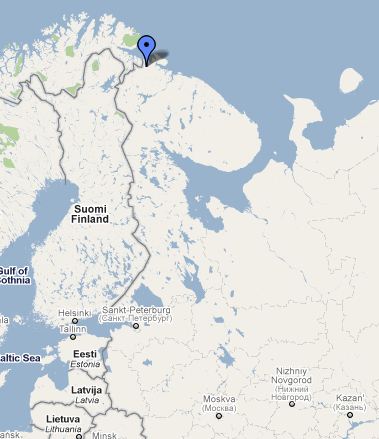
Far more interesting is the President relieving Colonel Vitaliy Leonidovich Razgonov, Commander of the 200th Independent Motorized Rifle Brigade based at god-forsaken Pechenga.  He’s only been commander there for 18 months. 

The 200th Brigade remains in its Cold War deployment along the Russian border with Norway.  It’s probably not what the Defense Ministry has in mind for its future Arctic brigade. 

This brigade has more than its share of trouble, and Colonel Razgonov’s apparent inability to control his men might — repeat might — have something to do with the change of command.  The ukaz, of course, gives no reason.

Just on Monday, Komsomolskaya pravda published on all of v / ch 08275’s problems.  The paper’s reporters say this command is unable to maintain elementary order.  The brigade’s officers complain that today’s young men are already so corrupted that the army can’t fix them, and that they don’t have any tools to deal with disorder among their men.  But KP says the soldiers don’t look disorderly during the day, but become that way at night when they’re unsupervised in the barracks.  The paper suggests the officers themselves are corrupt and disorderly at Pechenga.

Several weeks ago a conscript from Dagestan got three and a half years for killing an ethnic Russian junior sergeant in June 2010.  The command initially tried to make it look like an accident rather than murder.  Svpressa.ru suggests 4 or 5 men from Dagestan beat the victim.  The Soldiers’ Mothers Committee helped his family get the military prosecutors on the case.

Another conscript was beaten severely right on the brigade’s parade ground in early March.  According to IA Regnum, the young man — a graduate of the Murmansk School of Music — had two operations and his spleen was removed.

Last September a conscript shot and killed another conscript before shooting himself to death.  The parents of the shooter don’t believe this version of what happened, and have turned to the Soldiers’ Mothers Committee for help.

Last May, the chief of the brigade’s missile-artillery service stabbed his wife and six-year-old son to death.  He was subsequently diagnosed as a paranoid-schizophrenic.  This can happen anywhere, but it’s interesting it happened in a place already so afflicted with misfortune.  One wonders if there isn’t more to the story.

Where does this leave us?

It’s hard to say.  All the evidence of trouble is, so to say, circumstantial when it comes to Colonel Razgonov and whether he’s up to the job or has been derelict.  We don’t have enough information.  Maybe Razgonov himself asked to be relieved.  Who knows?  But it may be that someone in the chain, in the Defense Ministry or elsewhere, recognized a situation that needs to change.  The question now is will it?

Would the Army Oppose Siloviki Loyal to Putin?

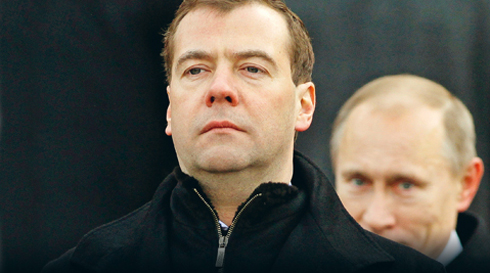
Medvedev and Putin (photo: Reuters)

An unnamed FSB veteran thinks it would.

Monday New Times published a piece on the state of the tandem and political prospects over the next year leading up to the elections which will determine who will be Russia’s president until 2018.

The article’s authors ask whether Medvedev and Putin, frightened by North African events, might be determined to preserve the status quo by any means.  Or perhaps the president and prime minister face an inevitable clash.  The authors have consulted unnamed experts and present their findings.  Scenario No. 2 is Apocalypse Tomorrow.  The mood of the siloviki – in this case, rank-and-file men with uniforms, ranks, and guns – is key to Scenario No. 2 – the tandem blown up.  The authors ask “how would the siloviki conduct themselves if Medvedev decided to fire the premier and his entire government?  On whom would the experts bet?”

The authors asked former USSR intelligence and special service veterans of coup d’etats to sketch out what we’d see in the event of Apocalypse Tomorrow.  They sketch out some of the things Putin and the government would do in addition to calling for the support of the siloviki.

In the end, the article examines the possibility that Putin might agree to go, with the right personal and financial guarantees in place.  His situation is not, after all, exactly like Mubarak’s or Qaddafi’s.

The article ends like this:

“’Putin can hardly count on the silovik bloc if the matter gets to mass bloodshed,’ even a highly placed employee of the FSB’s Spetsnaz Center, which today joins in its structure Directorate A (formerly Group A) and Directorate V (formerly Group Vympel).  ‘His sole full-blooded reserve capable of entering the fray is the Internal Troops [VV], and mainly the VV Spetsnaz’ – the so-called maroon berets.  ‘They are the ones in 1993, after one of the Vympel groups refused to participate in suppressing the civilian population, who fulfilled the given mission’ (this means preventing the storming of the Ostankino television center – New Times).  ‘As far as the FSB Spetsnaz goes, after so many years of ‘reforming’ silovik sub-units, officers will scarcely be zealous in putting down civilians.  Quite the opposite.  It wasn’t for this that they risked their lives in the Caucasus.’  The weakest link, in the opinion of the same expert, is the army:  ‘Among the troops there’s a lot of negative information and dissatisfaction with the reforms that are being introduced.  Promises that a lieutenant will soon receive 50 thousand rubles just remain promises, the apartment issue isn’t resolved.  After the mass dismissal of officers – just in the past year 140 thousand completely young ‘reservists’ were put out in the streets – they will easily return to the ranks [i.e. Serdyukov’s reversal increasing the officer ranks by 70,000], but now they know who their enemy is.  Plus the disbanding of the GRU Spetsnaz.  As a result, the opposition will have something to oppose the Internal Troops.  So the generals will think a thousand times before giving the order to open fire, and if there is the slightest suspicion about the illegitimacy of the mission received, they’ll do everything to sabotage it.’”

“The experts polled by New Times come together on one thing:  a bloody scenario has a greater than 50% probability in one case:  if the premier and his closest silovik circle seriously fear for their lives and property and don’t get a security guarantee.  And now before their eyes there’s even a living example:  going peacefully into retirement Mubarak has a chance to preserve part of his billions frozen in Switzerland, Qaddafi shooting at his own people no longer has such a chance.”

Interesting scenarios, but there are a couple things your present author isn’t so sure about.  Firstly, two things not factored in that could be significant are:  the mood of the average militiaman [i.e. cop] who are very numerous and are also being ‘reformed,’ and the unhappiness among military retirees and older vets demonstrated recently in their Moscow assembly and last year on Poklonnaya gora.  One’s not sure, though, if they’re more supportive of Medvedev or Putin.  Given the choice, they’d probably shoot both.  Secondly, is Medvedev really the type to enter that kind of standoff (or any standoff actually) while holding very few, if any, good cards to play?  At the same time, one is cautious about assuming rational actors.  It’s perfectly conceivable the Russians could blunder and miscalculate their way into Apocalypse Tomorrow.

Meanwhile, Ancentr.ru was following a similar tack earlier this week . . . it looked at the recent personnel decisions regarding General-Lieutenant Valeriy Yevnevich which moved him from the GUBP to Deputy Chief of the General Staff and then to Assistant to the Defense Minister (ostensibly, to advise on peacekeeping activities).  The website thinks this interesting since Yevnevich is a ‘political’ general who as Taman division commander supported President Yeltsin in the 1993 battle with his opponents.  And, it says, such a decisive and staunch supporter of ‘democracy’ as Yevnevich could be useful to vlasti in a responsible post given the general growth in political tension in society, including also a “rise in disloyalty in the army.”  For example, he could command special VDV or other sub-units in an emergency to ensure their loyalty to the regime.  Ancentr.ru goes on to detail other reports from NVO’s Vladimir Mukhin about the level of discontent in the army’s ranks as well as ex-General Staff Chief and Security Council staff member Yuriy Baluyevskiy’s possible role as leader of a military backlash against Defense Minister Serdyukov’s reforms.