Category Archives: Military Leadership

Serdyukov and Gates ‘Reload’

Gates and Serdyukov (photo: Reuters / Larry Downing)

Defense Minister Serdyukov and Defense Secretary Gates signed two documents yesterday.  RIA Novosti covered the event.  The first document was a memorandum of understanding on bilateral military cooperation replacing an old one from 1993.  The second, more important one established a ministerial-level working group on defense relations under the aegis of the U.S.-Russian Bilateral Presidential Commission established in July 2009.

A joint statement from the two defense chiefs said:

“The following issues will be at the center of attention of the U.S.-Russian working group on defense relations:  armed forces reform and transformation, high-priority defense and national security policy issues, transparency and strengthening trust to improve mutual understanding, regional and global security, new challenges and threats, and cooperation in areas of mutual interest.”  

The document apparently says, as co-chairmen of the working group, the Defense Minister and Defense Secretary will meet at least once a year.  And Serdyukov has invited Gates to Moscow.

In his remarks on their talks yesterday, Serdyukov said:

“The transformations occurring in the Russian and U.S. armies are very large-scale and very painful.  But they are absolutely necessary to create a modern army, a 21st century army.”

Gates said both men face similar problems in reforming their armed forces:

“Mr. Serdyukov and I are making great efforts to implement broad reforms which are painful but necessary.”

An unnamed U.S. official explained:

“The Minister and Secretary are trying to introduce new thinking into the military system.  The visit of the Russian minister was a chance to learn more about Russian military reform, and understand issues on which we can be useful.  So the first session of the talks concerned only military reform.”

However, Kommersant picked the pithy winner of the day when it quoted former NSC staffer Steven Pifer: 

“Yesterday Robert Gates presented his plan for reducing military expenditures under which the budget of the Defense Department will be cut by $100 billion over five years.  It’s possible this experience will be interesting to Defense Minister Serdyukov, but I’m not sure it applies to reforming the Russian Armed Forces.”

Right on, brother.  Mr. Gates surely knows the $20 billion of chump change he wants to trim each year is not a lot less than what annual Russian defense budgets have been, give or take some, in recent years.  That $20 billion isn’t far off what the Russian government initially proposed to spend for arms procurement each year until 2020.   

Saying the U.S. and Russian militaries are in the same boat when it comes to their reform efforts certainly makes for good feelings and good press in the midst of an important high-level visit.  But it’s a great exaggeration that doesn’t really help anyone in the longer run.

The U.S. already has full-fledged, albeit overstretched, 21st century military forces; ones that are constantly and painfully reinvented to meet the threats and demands of the future.  It’s painful all right.

Russia, on the other hand, is 18 years into attempts to reshape its Soviet-era Armed Forces into a modern military.  It still has a fundamentally 20th century force, and not a late 20th one at that.  It’s true to say that Serdyukov has ushered in Russia’s first comprehensive reform effort, and it’s very painful.  But he’s hurt more by the fact that his predecessors didn’t do enough, fast enough. However, he may be doing too much, too fast.  And the ultimate results may not be what Putin, Medvedev, and Serdyukov intended.

But the main point remains it’s naïve to suggest the two military establishments are in anything like the same place.

Similarly, it wouldn’t pay to get excited about the new framework for defense consultations and cooperation.  We’ve been here several times.  Like U.S.-Russian relations as a whole, over time these frameworks are driven off-track by Russian actions and U.S. overreactions.  But they never die.  They just get reloaded.

Serdyukov Meets Gates at Pentagon

Mr. Serdyukov Goes to Washington (photo: ITAR-TASS)

ITAR-TASS reports Defense Minister Anatoliy Serdyukov and his U.S. counterpart Robert Gates will meet for a total of 5 hours today.  And the Russian press service concludes: 

“This is highly unusual and attests to the great significance the U.S. Defense Department attaches to the visit.” 

Aside from all the customary ceremonies, there will be three sets of talks today.  The morning session is dedicated to discussing military reform plans and defense spending on both sides.  ITAR-TASS says the Americans consider this the most important topic from their viewpoint. 

The press service quotes The New York Times saying the two men “simultaneously declared war on longstanding and ineffective bureaucratic organizations,” adding that they’ll find a common language as they compare their efforts. 

A working lunch will be devoted to nuclear arms control and missile defense.  RIA Novosti quoted a Defense Department spokesman who said you can’t meet Russians without discussing missile defense, but it won’t be the main topic of the visit.  Today’s afternoon session will cover a variety of regional and global security problems.  Serdyukov will visit an unspecified U.S. Army base as well as the Naval Academy. 

In an interview published in today’s Kommersant, Gates said: 

“I’ve attentively followed Defense Minister Serdyukov’s reform efforts.  I have the impression that the scale and depth of the reforms he’s conducting correspond to what I’m trying to do in the U.S.  The thing is in the coming years we don’t expect significant budget increases.  Therefore, we have to decide how best to use the resources we have.” 

“I know the Russian Defense Minister has an interest in how to select highly professional soldiers and how to keep them in the armed forces, how to exert command and control of the armed forces in order to strengthen national security.  This is especially complicated in the face of economic problems standing before each of our countries.” 

Apparently, Gates doesn’t understand precisely.  The Defense Ministry already has an answer — to jettison its failed professional contract service program, return to reliance on conscripted soldiers, and see if they can train and retain some professional NCOs. 

Asked if Russia’s a threat to the U.S. and about its new ballistic missiles, Gates replied:  

“No.  I don’t view Russia as a threat.  We are partners in some areas and competitors in others.  But we cooperate on important issues.” 

Good answer. 

“From the viewpoint of our program modernization the new SOA agreement is a great achievement.  Just as the agreements which preceded it.  They establish rules of the game which provide transparency and predictability.  Modernization programs within the bounds of the new SOA agreement are absolutely normal.  We’ll conduct our own modernization. 

Asked about cooperation on missile defense and the Gabala radar specifically, Gates said the U.S. is interested in Gabala and in the possibility of establishing a missile launch data exchange center [JDEC] in Moscow.

Mr. Serdyukov’s Restrained Smile

Defense Minister Serdyukov (photo: Reuters)

 On 31 August, Sobesednik offered a not-altogether-serious, but nonetheless-interesting psychological portrait of Defense Minister Anatoliy Serdyukov . . . the magazine interviewed an expert in nonverbal  communication and microfacial expressions, a specialist in physiognomy, a professional image consultant, a handwriting analyst, and, yes, a numerologist. 

Of course, these observers had the advantage (or perhaps disadvantage) of knowing at least a little something about their subject, his reputation, and style beforehand. 

The nonverbal and microfacial expert said Serdyukov’s restrained smile and concentration are most characteristic of his expression.  He looks as if he’s suffering over the resolution of some problem with knitted brows, and he’s a man of few words.  His external appearance and pudginess suggest he senses and feels more than he hears or sees, and he likes both physical and psychological comfort. 

According to this observer, there’s nothing that bespeaks talent or charisma in Serdyukov, but he does exude efficiency and discipline. 

Finally, he concludes: 

“Anatoliy Serdyukov is a man capable of resolving problems on the orders of those who appointed him to this position.  His entire external appearance, his restrained gestures, constant concentration on business, and small number of public speeches speak exactly to this.”  

The physiognomy expert says Serdyukov’s round and soft appearance are characteristic of a peacetime military man.  A man occupied with logistical issues, who knows how to set goals and achieve them.  A businessman or administrator, not a wartime leader. 

His crooked brows and wrinkled forehead attest to difficulties in government service; it would have been easier for him in business.  A sharp visage compensates for his external softness.  His mouth is narrow; he is no orator.  However, his correctly formed ears connote someone who listens to information and the opinions of others. 

The image consultant notes Serdyukov practically never wears military attire.  He prefers his civilian clothing, and avoids ingratiating himself with the uniformed military.  His suits are conservative and classic.  He’s a restrained and severe man.  He can be somewhat aggressive (shown by the broad contrasting stripes on his ties).  Such people are usually burning to reform things and implement their ideas and goals, no matter what. 

The handwriting analyst says Serdyukov’s handwriting indicates his concrete way of thinking, and tactical planning.  He has a great sense of his own importance.  The pinching, arc, and intricacy of his letters show palpable internal emotion and willfulness, but other features indicate he’s inclined to self-control.  The constant requirement to control himself and hold his emotions is externally expressed as tension and restraint. 

Using Serdyukov’s birth date, the numerologist produced a number to reveal his character — 811962279112.  Four 1’s means he’s likely to be military, severe, and direct.  But the absence of 5’s means he has weak intuition and his actions are sometimes illogical. 

In all seriousness, it’s pretty easy to laugh all this off since Serdyukov’s a well-known public figure, but recall The Atlantic article describing Brenda Connors’ analysis of then-President Vladimir Putin’s gait, and how it explains his character and behavior. 

So Serdyukov’s a bit repressed.  In fairness, one probably shouldn’t expect any Defense Minister (or any minister for that matter) to be a happy man or woman.

Bad News for Would-Be Officers

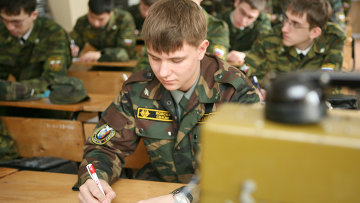
Future Officer, or Sergeant? (photo: RIA Novosti / Valeriy Titiyevskiy)

There’s no better time for bad news about changes in military education than the beginning of Russia’s academic year.

The Defense Ministry said Monday it’s stopping induction of cadets into military higher educational institutions (VVUZy or ВВУЗы).  And new students will not matriculate next year either.

There’s no doubt there’s lots of excess capacity that needs to be cut from Russia’s military education system, but, as usual, there seems to be more angst about the way the process is being managed than about the need for some kind of change itself.  The Defense Ministry is trying to ram many young men who signed up to be officers into sergeant’s billets, and generally changing the rules in the middle of the game.  There’s no doubt large numbers of VVUZ professors and other teaching staff will be pushed out of the service, but the Defense Ministry is denying this for now.  Perhaps most interesting, RIA Novosti elected to editorialize on this issue, saying it exemplifies the Defense Ministry’s, and the Defense Minister’s, poor way of dealing with the public and presenting its initiatives.

Deputy Chief of the Defense Ministry’s Main Personnel Directorate (GUK or ГУК), Tamara Fraltsova (who doubles as Chief of the Military Education Directorate) made the announcement during a video conference marking the opening of the Presidential Cadet Corps in Orenburg.  Specifically, she said:

“In the course of this year and next, the Defense Ministry is refraining from selecting cadets for its VUZy.”

“This is connected to an overabundance of officer personnel and a deficit of officer positions in the Armed Forces.”

“At present, graduation of cadets exceeds the officer positions we have in the Armed Forces by four times.”

In other words, the military educational system is still too big, and needs more cuts.  There are 56 teaching institutions in all – VVUZy and their branches (filialy). 

The ‘overabundance’ of officers is part and parcel of Defense Minister Serdyukov’s ‘new profile’ reforms in which officers are being reduced to 150,000 from well in excess of 300,000 in late 2008. 

Fraltsova has previously indicated VVUZy would be cut further and unified into ten ‘inter-service scientific-training centers.’  Duplicative or overlapping specialty training will also be eliminated.

Izvestiya reported that Fraltsova said the military education system is still configured to support a 4-million-man, rather than a 1-million-man, army.

Nevertheless, Fraltsova maintained that all 15,000 VVUZ graduates were placed in military billets last year.  But she didn’t say what kind of billets.

Krasnaya zvezda quoted her:

“. . . there is a chance for higher quality manning of the Armed Forces.  So, the requirements for future officers must be stricter.”

“There is a need for a review and selection of military specialties, according to which education in military VUZy is provided.  Part of [these specialties] will be transferred to the civilian ranks, part will go into to the duty category of sergeant personnel.”

There’s been media reporting for months that any cadet receiving even a single ‘2’ – an unsatisfactory mark – is now drummed out.  But this doesn’t eliminate many – 70 percent of cadets graduate without ever getting even a ‘3,’ according to the Defense Ministry.

Writing in Komsomolskaya pravda, Viktor Baranets indicated that only 100 of 600 lieutenants who arrived in the Pacific Fleet got officer jobs, and, in Voronezh, only the very top-ranked graduates found officer posts in the Air Forces.  About 20 percent of cadets normally graduate ‘with distinction.’  So the remaining 80 percent either accepted a sergeant position, or immediate dismissal into the reserves and the civilian world.  

Grani.ru reported that most graduates of the Defense Ministry’s Military University – a social sciences institution located in Moscow – got a ‘free diploma’ and an immediate discharge.   

According to Izvestiya, Fraltsova said there are only 5,000 command positions in the Armed Forces against an influx of 15,000 newly-commissioned junior officers.  The paper quotes her:

“Let them compete for what they will get.  The rest simply received a free higher education.  In my opinion, this is fair.”

She claims these changes are improving student performance, and she wants to use competitive ratings to make initial officer assignments.

She dismisses worries about the impact of cadet reductions on VVUZy teaching staffs because, in many cases, they’ll be busy teaching noncommissioned officers.  Some will be one-year conscript sergeants, and others three-year contractees getting nearly 3 years of post-secondary schooling.

Fraltsova revealed that 60 percent of VVUZy already teach on a ‘for-profit’ basis, and this will fully employ their instructors.

The effects of officer corps cuts, and VVUZy cuts, have rippled down to Russia’s venerable Suvorov and Nakhimov schools.  Without places in VVUZy, these young men will have to seek spots in other power ministry academies, if they want to be officers.  Premilitary Suvorov and Nakhimov schools now have to compete for students with the new Presidential Cadet Corps, which are supposed to train youth for the civil service in each federal district.

Forum.msk’s Anatoliy Baranov remarked that Fraltsova and her ilk “will suddenly observe in 10-15 years that everyone in higher military institutions has died, and there is no one and no way to teach new officers.”  Leonid Ivashov told Gzt.ru simply, “We are witnessing the destruction of Russian military education.”

RIA Novosti published surprisingly stark criticism of Fraltsova’s (and Serdyukov’s) performance. 

First, it quoted her:

“. . . not everyone in Russian society is sympathetic to this initiative.  Yes, these are very severe measures, not many like them, and we are being subjected to criticism for this decision.”

The news agency said Fraltsova’s press conference left the media with the impression that the Defense Ministry still doesn’t know what to do about the military education system.

It called the halt in VVUZ induction a ‘radical step,’ which calls attention to the Defense Ministry’s secretiveness in making important decisions.  The agency complains that, since 2008, when the ‘new profile’ started, the media and society have learned about most changes after the fact.  Veterans and other social groups have written to Serdyukov asking to give input, but it’s not clear their letters are even answered.  RIA Novosti concludes, in this case, the military department has once again ‘stepped on a rake.’

Yesterday Deputy Defense Minister, State Secretary Nikolay Pankov went on TV in damage control mode, saying these changes are intended to improve military education as well as to save money.  He intimated there will be lots more pain in going from 56 to 10 institutions.  Pankov said 20 percent of this year’s 10,000 VVUZ graduates will become sergeants instead of officers, but the Defense Ministry will keep these reluctant NCOs in mind if officer billets come open.

Vice-Admiral Chirkov and the Pacific Fleet

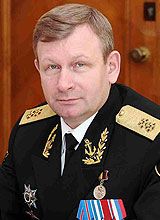
Vice-Admiral Chirkov

Baltic Fleet Commander, Vice-Admiral Viktor Chirkov is apparently being tapped to replace Vice-Admiral Konstantin Sidenko in the Pacific Fleet, according to Russian press agencies and a Kommersant source in the Navy Main Staff.  

Sidenko will command the new Eastern Military District and Combined Strategic Command (OSK) East.  Chirkov will be replaced in the Baltic Fleet by his chief of staff, Rear-Admiral Sergey Farkov.  Kommersant’s source calls these changes a ‘normal rotation.’ 

Gzt.ru’s source says the Pacific Fleet is expecting the Chirkov announcement ‘any minute,’ but drawing up the papers, including the President’s decree on the appointment, is ongoing. 

Viktor Viktorovich Chirkov is a surface warfare officer with Pacific Fleet roots.  He was born on 8 September 1959 in Alma-Ata, capital of the former Kazakh SSR.  In 1982, he graduated from the Vladivostok Higher Naval School and became head of the mine-torpedo department on old Riga-class corvette Lun in the Pacific Fleet.  He served as assistant commander of a corvette, then executive officer of Kotlin-class destroyer Vozbuzhdennyy.  

In 1986-1987, Chirkov completed Higher Special Officers’ Classes in Leningrad, and became commander of the infamous Krivak-class frigate Storozhevoy.  Under a mutinous crew, this Soviet Baltic Fleet unit tried, unsuccessfully, to defect in 1975.  Later it transferred to the Pacific Fleet. 

From 1990 to 1993, Chirkov commanded Udaloy-class destroyer Admiral Spirodonov.  He was deputy chief of staff for an ASW ship division, deputy division commander, and commander of an ASW ship division during 1993-1998.  In 1997, he completed the Kuznetsov Naval Academy as a correspondence student.  

After graduating from the Military Academy of the General Staff in 2000, Chirkov served for five years as chief of staff, first deputy commander of Troops and Forces in the North-East on Kamchatka.  In the first years of this assignment, he served under Vice-Admiral Sidenko.  

In 2005-2007, he commanded the Primorskiy Mixed Forces Flotilla.  For the next two years, he was chief of staff, first deputy commander of the Baltic Fleet, and became its commander in September 2009. 

Chirkov is married with two sons. 

A Pacific Fleet staff source told Gzt.ru Chirkov is happily anticipated since he’s an old friend and ‘not an outsider.’  Another calls him a wise and honorable officer who knows his business. 

Vitaliy Shlykov talked to Gzt.ru about the Pacific Fleet’s growing importance: 

“In the Baltic there’s nothing to do, everyone’s friends, allies.  But the Pacific Ocean is the future, it’s necessary to turn all attention there.  And we don’t have enemies there, so there’s time to strengthen this fleet before there’s a confrontation between the U.S. and China.” 

“Of course, given this state of affairs, the significance of the fleet is growing sharply in comparison with Russia’s other fleets.” 

NVO’s Viktor Litovkin notes that Chirkin will be first to command the Pacific Fleet in its new condition of subordination to OSK East.  He thinks the new commander has multiple problems to solve, including obtaining new ships, dismantling old nuclear submarines, and building housing for servicemen.  Chirkin will also have to grapple with getting contract sailors, rather than conscripts, to man his afloat forces for long deployments.

Commander for New Army in Chita

General-Major Romanchuk

By the Defense Minister’s order dated 12 August, General-Major Aleksandr Vladimirovich Romanchuk became acting commander of the new combined arms army being formed in Chita.  ITAR-TASS quoted a SibVO spokesman:

“The command and staff of the army, and also a number of army-subordinate formations and military units, will be formed under his leadership.  Formations and military units based in Transbaykal Kray will comprise the army.”

The Chita Combined Arms Army (CAA) will be the easternmost large formation in the new Central Military District (MD), or Combined Strategic Command (OSK) Center.  Who knows what number the new army will receive . . . maybe the former 29th CAA will be resurrected.

Romanchuk was born 15 April 1959 in Lugansk, Ukraine.  He grew up in a military family in Azerbaijan.  Commissioned out of the Baku Higher Combined Arms Command School in 1980, he served as a tank platoon and company commander, then chief of staff and deputy commander of a tank battalion in the Transcaucasus MD.  He graduated from the Military Academy of Armored Troops in 1989 and, for a very short period, commanded an independent tank battalion in the Central Group of Forces (Czechoslovakia). 

Returning home with the rest of Soviet forces, he became deputy commander and commander of a machine gun-artillery regiment in the Transbaykal MD during the 1990s.  He was a colonel in his late 30s by the end of this phase of his career.

When the Transbaykal MD folded into the Siberian MD, Romanchuk became chief of an armaments and equipment storage base, and chief of staff and deputy commander of a Siberian MD tank division.  He served a tour of duty in Chechnya during the late 1990s or early 2000s.

Between 2001 and 2003, he was deputy commander of the Guards Taman Motorized Rifle Division in the Moscow MD.  He became commander of the 4th Guards Kantemir Tank Division in Naro-Fominsk at the end of 2003.  He was promoted to general-major (one star) in mid-2005.

He likely attended the Military Academy of the General Staff between mid-2006 and mid-2008, and then became a deputy commander of the Novosibirsk-based 41st CAA.  In July 2009, he became chief of staff and first deputy commander of that army.

Romanchuk is married with two sons.

Deputy Defense Minister Shevtsova

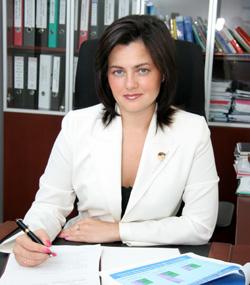
Tatyana Shevtsova at the FNS

Last Friday, Tatyana Shevtsova became the newest deputy defense minister – the ninth overall, seventh civilian, second female.  By all accounts, Shevtsova will oversee and audit Defense Ministry spending and other activities.  Kommersant calls her an ‘oversight and monitoring specialist.’  The Defense Ministry’s spokesman has said as much, according to Vedomosti (read it in Moscow Times as well).  Shevtsova’s another member of Defense Minister Serdyukov’s former team at the Federal Tax Service (FNS or ФНС).  Kommersant describes her as a ‘trusted individual’ who will help Serdyukov supervise all but the Defense Ministry’s purely military functions.  In particular, several commentators believe Shevtsova will track outsourced service and support activities paid for in the state defense order (GOZ).

The 41-year-old Shevtsova was born in Kozelsk, Kaluga Oblast, and graduated from the Leningrad Financial-Economic Institute in 1991.  She’s a candidate of economic sciences (Ph.D.). 

She started in the tax service in 1991 as an inspector in the central rayon of St. Petersburg, eventually heading the tax service’s St. Petersburg directorate.  Kommersant reminds that Serdyukov was a deputy director in the St. Petersburg directorate during Shevtsova’s time there in the early 2000s. 

Shevtsova went to Moscow to head the tax service’s large taxpayer department in early 2004.  In mid-2004, Serdyukov became Director of the FNS, and Shevtsova became one of his deputies. 

Shevtsova stayed at the tax service under Mikhail Mokretsov after Serdyukov left for the Defense Ministry in early 2007.  She was in charge of the oversight directorate and all nine inter-regional inspectorates for large taxpayers.

When Mokretsov and others members of Serdyukov’s FNS team departed for the Defense Ministry in mid-2010, Shevtsova did likewise, becoming an advisor.  According to one official who spoke to Kommersant, she spent the last few months ‘studying the situation’ in the Defense Ministry.

A former Defense Ministry official told Vedomosti Shevtsova is “a talented economist as well as an exacting official, whose subordinates at the Federal Tax Service were very afraid of her.”  She reportedly will turn ten Defense Ministry oversight bodies into a system.

Kommersant said Shevtsova will direct oversight organs for administrative, organizational, and financial activities as well as military housing.  The paper’s source says this could translate into oversight over everything except military command and control and operations.  The ninth deputy minister will reportedly gain some responsibilities once discharged by the chiefs of the ministry’s apparatus, Rear Services, and Housing and Construction Service.

Radio Svoboda was kind enough to interview Aleksandr Golts who concluded:

“It’s more or less obvious Anatoliy Eduardovich Serdyukov rapidly gathers his team in those areas important to him.  As we know, at present a so-called second civilian branch of the Defense Ministry is being formed.  Operational troop command and control, combat training remain with the Genshtab.  At the same time, a very strong area which will withdraw from the ministry a great number of functions connected with service and support of all Defense Ministry units and formations is being formed.  This is very complex work in the realm of the state defense order and the like.  Evidently, Ms. Shevtsova will work in this area.”

 Asked about her first steps, Golts commented:

 “If there will be first steps, we haven’t found out anything about them.  The Defense Ministry very precisely hides the most important directions of its activity from any public scrutiny.  Everything happens very quietly.”

Radio Svoboda also asked Viktor Baranets about ‘civilianization’ and the appointment of a reported 50 women to high posts under Serdyukov:

“They are already sarcastically joking  in the army about the ‘feminization’ of the Defense Ministry leadership.  A large number of women who’ve appeared in key Defense Ministry posts, at various times crossed paths with Serdyukov, and with Putin, and with Medvedev.  Of course, they’re Petersburg natives . . . .  There are unofficial reports that [Shevtsova] actively assisted Serdyukov in destroying Khodorkovskiy’s empire.”

Baranets’ sources in the Defense Ministry also say Shevtsova will be responsible for large sums of service and support funding being directed to contractors.  His general and colonel friends joke:

“We only have one vacant post left – deputy defense minister for corruption.  Because all the other jobs are filled.”

 Or anti-corruption one supposes . . . .

Igor Korotchenko told Vedomosti the Defense Ministry’s growing civilian component is designed to supervise the generals’ spending and accounting, especially in the GOZ.  Ruslan Pukhov calls the ‘invasion’ of former tax officials perfectly normal since Western defense ministries are full of civilian auditors who scrutinize massive military budgets.

Lieutenant Colonel Biront’s Defense

Sounding somewhat dazed, Lieutenant Colonel Viktor Biront told Life News his story about how and why the naval aviation depot near Kolomna burned.  According to Biront, higher authorities were completely informed about his situation days before the facility burned, but ignored repeated requests for assistance.

Biront says firefighters worked to save expensive dachas near his base, but weren’t as willing to help him.

According to Biront, the base he commanded for only three months before the fire had just lost 19 officers and 36 warrants as a result of Defense Minister Serdyukov’s cuts in both personnel categories.  He also lost his firefighting unit in February.

Biront describes how he managed to trade his car to get use of a fire engine.

Reports of the value of property lost have varied widely, but Biront indicates they saved most of what was worth saving.

Here’s the interview verbatim: 

“The lieutenant colonel dismissed because of the fire relates how he and his sailors saved the air base from fire for 10 days.”

“Relieved of duty as military base commander after the big fire, 43-year-old Lieutenant Colonel Viktor Biront tells in an exclusive interview with Life News how he and his subordinates saved the military unit from the fire.”

“The morning of 29 July the lieutenant colonel went to the perimeter and posted people on the edge of the burning forest.”

“’Everyone worked in the forest – both civilians and military,’ said Viktor Ivanovich.  ‘I was there also, only leaving periodically to call and request help.  The chiefs of Civil Defense and Emergency Situations came to evaluate the situation.  Then a strong wind started – the gusts were nearly 20 meters per second – and drove everything from the depth of the forest.  It was terrible to be in the fiery pockets.  Here, look – hands, feet all burned.  We stood on the perimeter, still 1.5 kilometers from the facility.  What a terrible picture – the fire was a wall in the forest.  I gave the order to evacuate.  I was last to leave there, because I was shouting to the last so the boys wouldn’t die there.’”

“According to Viktor Biront, the firemen arrived only two hours after the call.”

“’It’s as if we don’t exist for the city:  neither MChS, nor police . . . no one was with us,’ said the lieutenant colonel.  ‘They saved 1.5 million dollar dachas here.  There were both cordons and police there.  The first help came after several hours – no matter how much I called, how much I asked.  Only after a couple hours a firefighting helicopter flew in.  We can’t get through there – everything’s burning, everything’s blazing . . .  I quickly recounted the people.  Then equipment came from Moscow, and by night a deputy defense minister arrived.  It was impossible to go in.  Sailors were simply suffocating in gas masks – they were saturated with smoke.  I gave the command to take them off . . .’”

“The massive fire that destroyed property worth billions of rubles was preceded by 10 days of struggle with the fire.  And over these 10 days, the big bosses, despite all requests, didn’t take any clear decision about how to save the air base.  In fact, saving it depended only on 40 sailors and their commander.  115 hectares – almost three per man.”

“’I’ve been in the position for three months, they gave me this unit in May in a new composition, after reductions,’ Biront says.  ‘They cut 19 officers, 36 warrants.  In all 40 sailors remained, eleven sergeants and four officers – and this is all the people for such a large unit.  Plus civilian personnel whom I treated with great understanding.  I couldn’t send female clerks into the battle with the fire because the average age of my workers is 58-60.  The pay is low, 5-7 thousand, only female pensioners who’ve worked here a long time do this work.  They also helped as they could.  Men came into the forest with axes and shovels – tried to stop the flames.’”

“’The forest near the unit burned for 10 days,’ Viktor Ivanovich continues.  ‘I turned to them repeatedly, high officials came, had meetings here, made plans, a certain Mr. Shumeyev – deputy for security, an ecologist came here.  The sailors stood two days on the perimeter, not allowing the fire to spread.  I called Civil Defense and Emergency Situations.  Sometimes they gave help, but sometimes they refused.  I didn’t have my own firefighting team – they eliminated it in February of this year.  There was simply an ad hoc firefighting team, they dug themselves in and fought by all means.  When I saw this was all very difficult – I put my non-TO&E car to use, I had to give it to the firemen.  Generally, it’s use is forbidden, we used it because I had to pay money.  They brought a fire engine and handed it over there.  I secured a driver, whom we used to the fullest extent.  We hosed, knocked down flames, in general, battling though I didn’t have specialists.  We had to teach our officers who were extinguishing the fire.’”

“’In principle, we coped with the fire the first ten days,’ says the dismissed commander.  ‘I reported to Moscow by phone, by morning reports, by faxes.  I asked for help.  One time they gave equipment.  A KamAZ came from Shcherbinka from the airport, poured out two cisterns and went back.  Local civilians were all in action – villages burning, the government likewise, then they left 14 castoff portable fire extinguishers, literally the day before the conflagration.  They took them from the unit two kilometers into the forest.’”

“They didn’t manage to save the base.  Viktor Biront learned about his dismissal on the television news. At this moment he’s again writing a statement in the prosecutor’s office.  In this document he indicated that they managed to save property worth 40 million rubles.”

“’My people saved the new equipment.  The burned up property there had expired service lives and required repairs.  But then everything was finished, all closed, but they told us we were all morons generally.  Here it’s burning, and they are crawling through hell and saving equipment.  I’m not defending myself, I’ve told it like it is.  In theory in three months I should have cleared out everything that grew up in this forest over 60 years.  Because in 60 years no one ever did anything there.’”

President’s Tough Talk to Defense Minister Serdyukov

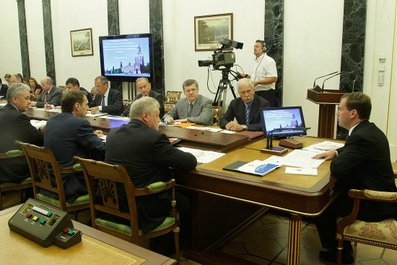
Medvedev at Security Council Meeting

Let’s look at President Dmitriy Medvedev’s criticism of the Navy and the Defense Ministry, his warnings and dismissals of some Navy officers.  It looks somewhat like a script torn from Vladimir Putin’s ‘tough guy’ handbook. 

Kommersant recounted the details of what sparked the President’s ire.  On 29 July, a fire burned the 2512th Central Aviation-Equipment Base of Naval Aviation and Air Defense near Kolomna, several dozen kilometers southeast of Moscow.  The Prosecutor’s Investigative Committee (SK) said the blaze destroyed the staff headquarters, finance unit, club, two bays of vehicle parking, 13 warehouses with various items of aviation equipment, and 17 open equipment storage stands with vehicles on them. 

Medvedev addressed yesterday’s Security Council meeting: 

“I instructed the Defense Ministry to take part in the firefighting effort and help to protect the civilian population, but sadly, in a number of cases, the ministry has proved unable to protect itself.  A fire took place in Moscow Oblast that has caused very serious damage.  The ministry has already carried out a preliminary internal investigation, and the investigation will continue of course.  The evidence so far indicates that this is quite simply a case of neglect of duty and criminal negligence, when personnel failed to bring under control a fire that was not spreading particularly fast, and no one even knew where the base’s commanders had gone.  I have therefore taken the following decision.”      

“Regarding the Navy’s senior command:  Navy CINC Admiral Vysotskiy has been warned about not fulfilling his duties; Chief of the Navy Main Staff and First Deputy CINC  Tatarinov has been warned about not fulfilling his duties; Deputy Chief of Navy Rear Services Sergeyev is dismissed; Chief of Naval Aviation Kuklev is dismissed; Deputy Chief of Naval Aviation Colonel Rasskazov is dismissed; Acting Deputy Chief of Naval Aviation Rear Services Monakov is dismissed; the chief of base 2512 is dismissed.”  

“I am also instructing the Defense Ministry to dismiss a number of other officers and personnel for disciplinary violations.  If anything similar happens in other places and other departments I will do exactly the same again, and without the slightest regret.” 

After discussing the fire situation with other ministers, Medvedev turned back to Defense Minister Serdyukov later in the meeting: 

“Now the Defense Ministry.  I already announced certain decisions.  The Minister needs to take everything under direct control.  Conduct a meeting today with the Ministry’s leadership and say that, if anything else like this burns, everyone will answer for it.” 

“Are there any concerns about the current situation?” 

Serdyukov responded saying plans have been made, operational groups established at all command levels.  Personnel and equipment have been put at the disposal of MChS and regional authorities.  And he noted that Deputy Defense Minister, General-Colonel Dmitriy Bulgakov is his point man for the fire emergency. 

Medvedev chided Serdyukov because the Vladimir Oblast governor had to go to the Defense Ministry for help instead of suitably empowered local commanders. 

Serdyukov said ‘corresponding’ orders have gone to all commanders and garrisons.  He continued with the Defense Ministry’s support of MChS — 11,000 servicemen, thousands of pieces of equipment, 33 kilometers of water pipelines laid in four rayons.  After Bulgakov’s visit to the Federal Nuclear Research Center in Sarov yesterday, another two battalions and special equipment were allocated to efforts there.  Serdyukov said another 28,000 troops can be brought into firefighting in the Central Federal District within 3-12 days. 

Serdyukov concluded: 

“We are taking all steps in full measure, we reinforced all facilities (there are 164 of them, but in immediate areas where there are fires there are 22) behind every responsible commander.  We are conducting all measures there:  increased volumes of water reserves for extinguishing fires, equipment has been brought in, extra personnel, everything literally transferred into a barracks condition, therefore all necessary steps for this, in fact, have been accomplished.  Therefore I submit that this sad incident that happened at base 2512 will not be repeated.” 

Kommersant helped out with a full run-down on the ranks and names of the lesser known Navy officers:  Rear-Admiral Sergey Sergeyev, General-Major Nikolay Kuklev, Colonel Sergey Rasskazov, Colonel Sergey Monakov, and Base Chief Colonel Viktor Biront. 

RIA Novosti covered Serdyukov’s firing of other officers at the base.  They included:  Deputy Base Chief Major R. Gidayatov; Deputy Chief Main Engineer Lieutenant Colonel V. Marchenko; Support and Security Company Commander Major A. Yermolov; Chief of the Material-Technical Support Department V. Karandak; and Chief of the 7th Storage Department V. Melsisidenkov. 

Today the SK said a criminal negligence case has been initiated.  Gazeta ru said, per usual Russian practice, top officials have blamed lower-ranking ones, in this case Navy officers, allowing the ‘untouchables’ to demonstrate their toughness and avoid responsibility.  Kommersant noted that the warnings for Vysotskiy and Tatarinov are just a step from dismissal.  But history shows other general and flag officers have gotten such warnings and still moved forward in their careers. 

Gzt.ru broached the subject of whether this could provide Medvedev an occasion to purge the Defense Ministry and fill it with his ‘own people.’ Konstantin Sivkov and Aleksandr Konovalov agree that he could use this opportunity.  But one has to ask, does this make sense in the scheme of tandem politics?  Medvedev has changed few in the cast inherited from Putin, and he’s very unlikely to start with a stolid Team Putin guy like Serdyukov.  Especially when he appears to be the first man to make some real headway in fixing the post-Soviet military.

Disappearing Deputy Defense Minister Portfolios

Or who will answer for what?

On Tuesday, Kommersant and Rossiyskaya gazeta described, even if they can’t explain, Deputy Defense Minister portfolio changes.  The shuffling began in early July, when Grigoriy Naginskiy was ‘freed’ from his responsibilities as Chief of Housing and Construction but remained a Deputy Defense Minister.

According to a decree known, but not published, Medvedev removed General-Colonel Dmitriy Bulgakov from his post as Chief of Rear Services, while retaining him as a Deputy Defense Minister without specific duties.  It’s widely believed, of course, Bulgakov has taken charge of a new Material-Technical Support (MTO) empire that will encompass not only logistics but also arms and equipment supplies.

For his part, Defense Ministry Apparatus Chief Mikhail Mokretsov formally became a Deputy Defense Minister (no longer holding just informal ‘Deputy Minister status’).

Kommersant points out there are still eight Deputy Ministers (six are civilians).  A Defense Ministry source told the paper, however, that Bulgakov might be civilianized.  And his MTO organization will be part of the Defense Ministry’s ‘civilian component’ as opposed to its ‘military component.’  Kommersant says the ‘military component’ (planning and operational troop command and control) will just be the General Staff when the current Defense Ministry reorganization is complete.

Bulgakov has apparently indicated that MTO will have a planning and coordination department, a resource and transportation support department, Main Automotive-Armor Directorate (GABTU), and also repair-refurbishment and metrological directorates.  As announced elsewhere, ten new MTO brigades are to be established in the four new OSKs.  Recall that, in the same presidential decree on Naginskiy, Bulgakov’s rear services chief of staff Sergey Zhirov became Chief of the Planning and Coordination Department (read staff).

One should really look at Mil.ru’s ‘Leadership Structure’ page here.  In it, you’ll see Vera Chistova retains her clear responsibility for finance-economic work.  Bulgakov’s biography notes he became simply Deputy Defense Minister in July.  Naginskiy’s contains no similar notation though it could.  Then comes the oft-forgotten Dmitriy Chushkin who followed Defense Minister Serdyukov from the Federal Tax Service in late 2008.  He has no portfolio spelled out in his title, but his bio reads:

“Responsible for forming and conducting the Defense Ministry’s united military-technical policy in the information and telecommunications technology area which aims to increase the effectiveness of the command and control system, as well as supporting and developing its foundations.”

Mokretsov’s bio has a note that he added Deputy Defense Minister to his title in July.

The ultimate plan behind these moves isn’t clear yet.  But it does seem to go back to late June’s replacement of Kolmakov with Popovkin in one of the Defense Ministry’s two First Deputy slots.  More support functions were and are being consolidated under civilians, while purely military training, planning, and operations may now be more solidly under General Staff Chief, First Deputy Defense Minister Nikolay Makarov.