Category Archives: Naval Modernization

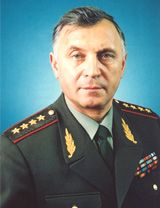
Navy CINC Vysotskiy on Parity, Space, Carriers

Navy CINC Vysotskiy

ITAR-TASS reported Navy CINC Vladimir Vysotskiy’s remarks at a military-historical conference dedicated to the 100th anniversary of the birth of long-time Soviet Navy CINC Sergey Gorshkov.  Vysotskiy said: 

“For the first time in history Russia threw down the gauntlet to old naval powers.  Having achieved nuclear parity with the U.S. Navy, the [Soviet] Navy became a strategic service of the armed forces.  Thanks to this we are developing many of the most serious goals to ensure keeping this parity, and we are correcting all approaches which were laid down in the ‘unforgettable’ 1990s.  Russia is the inheritor of a great state that has to possess an oceanic fleet capable of defending national interests wherever they are.  And they are everywhere in the world’s oceans.” 

In Vysotskiy’s estimation, “putting the fleet into operationally important areas of the world’s oceans allows us to look with certainty into the future, with the support of the Supreme CINC.”

Vysotskiy pointed to Gorshkov’s emphasis on nuclear weapons, submarines, and naval aviation, and noted that, “The memory of Gorshkov allows us to stand not on a crude defense, but to move forward.” 

RIA Novosti’s account quoted Vysotskiy on space and aircraft carriers:

“Without air supremacy it’s impossible to conquer space.  The one who understands this is on the right path.” 

He observed that space and air forces are the main danger even for submarines.  And submarines have to rely on space-based comms.  Vysotskiy said it’s essential for Russia to build ‘aviation-carrying systems’ which are very similar to space systems in their own way. 

“Today it’s necessary to understand the significance of these systems, it’s necessary to do this today, this must be a collective work of the state.” 

In other words, he wants the state to see things the same way and pay for it. 

He said today 9 countries have ‘aviation-carrying fleets,’ and 14 will by 2014. 

“If China intends to have one, this is understood, and if even Thailand intends to have one, then we also need to understand this in Russia today.” 

He also noted that costly investment in [naval] construction is justified even in a time of crisis since 90 percent of the world’s cargo is delivered by ships which need to be protected.  But one wonders how much of Russia’s is.  All in all, a weak justification.

Makarov Meets the Press

Chief of the General Staff Nikolay Makarov

General Staff Chief Nikolay Makarov spoke at length to the press yesterday. In no particular order, here are some of the impressions and reports that followed in his wake.

RBCdaily quoted Makarov on the possible Mistral purchase:  “Ships of the Mistral type have very great multifunctionality, and they surpass our ships in all parameters by three times.”  He went on to say that Russian shipbuilders would only be able to produce helicopter carriers of this quality in 5-10 years.  Aleksandr Khramchikhin commented that, in the first place, Russia doesn’t currently have comparable ships and, in the second, it will take 50 years.

Makarov said the final decision on buying the Mistral had not been made.

According to Rossiyskaya gazeta, Makarov said the Russian Army went to brigades vice divisions to avoid the previous need to flesh out units with reservists and take days to bring them to combat readiness.  ‘Modular’ battalions by contrast are permanently ready for battle in an hour.

Makarov didn’t rule out establishment of some type of ‘rapid reaction forces,’ though these are closest in nature to today’s VDV.  And this wouldn’t mean VDV would simply change its name. And other services need rapid reaction capabilities too for action in the air, on the sea, etc.  Aren’t permanently ready brigades rapid reaction forces already?

On the Navy headquarters move to St. Petersburg, Makarov claimed Moscow is overflowing with army and navy leadership [but haven’t they just cut 200,000 officers and lots of excess command structures to create a personnel pyramid?].  And with today’s networks the fleet can be commanded from thousands of kilometers away from the Genshtab and other main commands.

Makarov doesn’t foresee any change to the one-year conscription policy, but there may be changes in NCO acquisition.  Instead of six months training in MD training centers, they may only get 3, so they can serve 9 months in troop units.  Makarov thinks they’ll cut back on conscript sergeants once their professional ones start to appear.

Moskovskiy komsomolets quoted Makarov on the new strategic arms agreement with the U.S. to the effect that it’s 97 percent complete, and it only remains to agree on the relationship between offensive and defensive weapons, and there will not be anything in the treaty to Russia’s detriment in this regard.

On Mistral, Makarov said, after study, we’ve concluded we need this type of ship, which can be an amphibious assault ship, hospital, command ship, and helicopter carrier.

On the Navy and Piter, MK notes Makarov wanted to avoid Baluyevskiy’s fate and didn’t contradict his superiors.  He expounded on his vision (perhaps dream) of Russian netcentric warfare:

“Earlier it was like this:  the closer to subordinates, the more reliable the command and control.  Now all leading countries, including us also, are going to netcentric command and control systems.  This allows completely remote means of reconnaissance, command and control, electronic warfare, fire, command posts–all spread over an enormous distance, but located in a single information-communications space and capable of solving tasks in real time.”

On a related note, Makarov said the new Sozvezdiye tactical level command and control system will be part of the netcentric structure toward the end of the year.

Gazeta’s coverage focused on Makarov’s comments about establishing the personnel pyramid, i.e. going from armed forces with about 500,000 officers and warrants to one of 150,000 officers and 720,000 soldiers in the space of a year.  It also noted Makarov’s remark that brigade commanders in their training assembly at the General Staff Academy are learning new warfare and command and control principles.

Izvestiya quoted Makarov at length on the Navy Main Staff’s move to Piter.

“Presently all command and control organs are concentrated in Moscow, but we want these command and control organs to be as close as possible to the troops they control [didn’t he also call this the old way of doing business?].  The dispersal of command and control and fire means at great distances doesn’t have any great significance, what’s important is maintaining uninterrupted and clear command and control of troops and weapons.  Therefore, the transfer of the Navy Main Staff to St. Petersburg won’t place any kind of extra burden on the command and control system, with the exception perhaps, only in the initial period of its functioning in a new place.”

Viktor Baranets in Komsomolskaya pravda focused on Makarov’s words on the U.S. and Iran, noting his statements that the U.S. has a plan to strike Iran, and, if it occurs, it’ll be terrible for Iran, the region, and the U.S.

Krasnaya zvezda covered the Iran issue.  It noted that Russia’s need for ready units forced the shift to brigades.  It also covered Makarov’s comment that the Voronezh conference agreed on changes needed in the Sozvezdiye C2 system, and that it would be received this July and fielded in November.  KZ also quoted Makarov at length on the capabilities of the 5th generation fighter aircraft.

KZ also indicated that Makarov noted the U.S. as an example where units and commands are often separated by great distances when he talked about the Navy Main Staff and Piter.

Generally, it seems those invited to this press availability only asked Makarov ‘soft ball’ questions.

Trouble Building Submarines at Sevmash

Northern Machinebuilding Enterprise (Sevmash)

Here is 9 February RIA Novosti verbatim:

“Sevmash” Will Not Meet Schedules for Nuclear Submarine Construction Due to Insufficient Personnel

SEVERODVINSK, 9 Feb – RIA Novosti.  The “Sevmash” enterprise in Severodvinsk, Arkhangelsk Oblast will fall behind schedule in constructing nuclear submarines, it was announced to RIA Novosti on Tuesday in the enterprise’s press service.

Information about the lag in the schedule was heard in the session of the interdepartmental coordinating council which took place under the leadership of RF Government Military-Industrial Commission member Vladimir Pospelov and Deputy Navy Commander-in-Chief for Armaments Nikolay Borisov.

Members of the coordinating council discussed the state of affairs in producing nuclear submarines at “Sevmash” – “Yuriy Dolgorukiy,” “Aleksandr Nevskiy,” “Vladimir Monomakh” (project 955 “Borey”), and also “Severodvinsk” and “Kazan.”

“Today, as noted in the session, there is some lag from the construction schedule acknowledged by Sevmash and its partner-enterprises,” stated the press service’s announcement.

Factory General Director Nikolay Kalistratov explained the delay was caused by a lack of qualified personnel.

“It’s essential to apply maximum effort to realize the outlined plans and complete orders on time.  In the near future, we have to attract an additional 500 qualified production workers in the specialties pipefitter, machinist-fitter, ship finisher.  It should also be noted that over two years we’ve increased the number of basic production workers by 2,000 people, but this force is still insufficient,” said the director of the enterprise’s press service.

The directors of TsKB MT [Central Design Bureau of Naval Technology] “Rubin,” SPMBM [St. Petersburg Naval Machinebuilding Bureau] “Malakhit,” “Rosatom” state corporation, RF Ministry of Industry and Trade and other departments also attended the session.

Now at the “Sevmash” factory in various degrees of completion are three strategic nuclear submarines of project 955 “Borey” – “Yuriy Dolgorukiy,” “Aleksandr Nevskiy” and “Vladimir Monomakh.”  Work on construction of the fourth strategic nuclear submarine of this project, with the provisional name “Saint Nikolay” began in December 2009.  In all by 2015 it is planned to build eight nuclear submarines of this class.

This statement seems to imply there’s no problem with money, but, at a certain point, more workers equal money because higher wages should attract them, the northern climate notwithstanding.  So to some degree, this is a Sevmash call for more resources to do the work already on its order books.  Although these Sevmash officials said work’s begun on the fourth 955, RIA Novosti from 8 February made it clear there’s no firm idea of when its keel-laying ceremony would occur.  And Navy CINC Vysotskiy said the problem was “technological,” not related to the fate of the Bulava SLBM or to funding.  So maybe he meant a labor shortage, but, as noted, a lack of labor  is an inability or unwillingness to pay what it costs to do the work.

Yuriy Dolgorukiy SSBN has more sea trials before handover to the Navy. Sevmash says Aleksandr Nevskiy will be launched in 2010 (it was laid down in early 2004).  Vladimir Monomakh is about two years behind it.  The big question for these boats is when and if they’ll have a missile.  Late last year, a number of Russian media outlets claimed SSBN production was frozen due to Bulava’s problems.  But Sevmash’s call for more workers doesn’t track with that.  In October, the Russian government also announced Sevmash would receive 4 billion rubles to add to its working capital for modernization, along with a 6 billion ruble credit from VEB.

What Others Say About Bulava and Borey

New Borey-class SSBN Yuriy Dolgorukiy on Sea Trials

According to Navy Commander-in-Chief Vladimir Vysotskiy, the slight delay in the laydown of the 4th Borey SSBN unit came from “technological causes” unconnected with the problems of the developmental Bulava SLBM.  Vysotskiy also denied that there were any financing problems behind the postponement.  He said, “All preparatory work for the laydown was complete.”  The laydown was moved from 22 December to sometime in the first quarter of 2010.  Sevmash shipyard officials in Severodvinsk report that they weren’t told any more than that.  However, Vladimir Yevseyev of IMEMO told Gazeta.ru the delay in the next Borey is connected with the unsuccessful test launches of Bulava.  Yevseyev said, “There really is a connection with the postponement of the laydown.  The perspectives are unclear, two boats out, one building, but no missiles.  It’s only possible to put Bulava on boats of this class, therefore after the last unsuccessful launch they decided to wait it out, it’d be strange to spend so much money and lay down a boat without missiles.”

Serdyukov Not Abandoning Bulava SLBM

Reporting on a Rossiyskaya gazeta interview to be published Thursday, ITAR-TASS quoted Defense Minister Anatoliy Serdyukov saying he is not giving up on the Bulava, despite a string of unsuccessful test launches.  Asked if the Bulava’s problems influenced the delay in the laydown of the fourth Borey SSBN, Serdyukov stated, “The laydown will happen, and we certainly aren’t abandoning the Bulava.  What’s the cause of unsuccessful launches?  I think there are really many causes, among them, the unpreparedness of the production base to make everything precisely.  Here the question of production discipline still has an impact.  Someone tries to replace materials with others, this also drags a mass of consequences.  In general, there is an entire tangle of problems and, unfortunately, they are not being resolved as quickly as we would like.  Nevertheless, I think that the missile will fly.”

Selivanov Describes a Pathetic Navy

Lenta.ua picked up some of former Main Staff Chief Selivanov’s comments about the state of the Navy at a KPRF round table on Serdyukov’s reforms.  He says 80-85 percent of the Navy’s platforms have been written off.  In the fleets, he sees only about 30-35 ships and submarines.  The Soviet Navy used to get 10 or 11 nuclear submarines per year.  Now, in the Northern and Pacific Fleets, there are just a handful of nuclear submarines.  The fleets have about 129 aircraft.  The Navy can’t perform any of the operations required of it and the West long ago surpassed it technologically.  Russia is looking at steam catapults and the U.S. is working on electromagnetic ones.

Bulava SLBM Test Failure

The failed Bulava test launch yesterday is today’s big story.  See Myasnikov in Nezavisimaya gazeta or D. Litovkin in Izvestiya for coverage. 

Myasnikov recounts delays this fall in conducting the missile’s 12th test firing.  He recalls the story of how the project was given to MIT under the apparently ill-conceived thought of unifying naval and land-based strategic missiles.  Meanwhile, the SS-N-20  follow-on missile Bark, and the TYPHOON SSBNs to carry it, basically went away.  The Defense Ministry refuses to return to stand tests for Bulava.  Myasnikov says test missiles alone may have already run $3 billion.  The rest of the Navy is starved for resources, but Bulava has a strong lobby to keep it going.

D. Litovkin wonders whether it is Bulava’s control systems or poor manufacturing.  He wants to believe the system will work, but notes that time is running out for the current DELTA IV SSBN force, even with overhaul and modernization.

ITAR-TASS says the Defense Ministry blames a defect in the third-stage engine.