Category Archives: Naval Modernization

Mistral Endgame?

Mistral (photo: ITAR-TASS)

Maybe.  Maybe not. 

The Mistral contract endgame may in fact be upon us.  But some major players have warned (more than once) of a protracted negotiating process.

Kommersant reports Rosoboroneksport and DCNS signed a “contract” on June 10 for the first two Mistral units, according to a source familiar with the course of negotiations. 

After meeting President Medvedev at the G8 summit on May 26, French President Sarkozy said a “contract” would be signed in 15 days [that would have been June 10].  Now Sarkozy also said in late May that a Mistral “contract” would be signed on June 21 when Prime Minister Putin visits France.  Kommersant suggests this could be an official unveiling of whatever was signed on June 10.  But an RF government source said this isn’t planned, according to ITAR-TASS

As for the terms and price . . . the Russians were insisting that the Mistral come equipped with the SENIT 9 tactical combat information system and licensed rights for €980 million, but the French were saying no such tech transfer for €1.15 billion.  Also according to this story, the French don’t intend to provide SIC-21 in the Mistral package.

In contrast to Kommersant, RIA Novosti says what was signed last week was no more than a “protocol of intent” to sign a “contract.”  The news agency said the date and place for the “contract” signing remains up in the air, but it could be the international naval exhibition in St. Petersburg from June 29 to July 3.

It also says the price will be between €1 and €1.2 billion, and the French military still opposes giving SENIT 9 to Russia.

Rosoboroneksport’s press-service denied that a “contract” has been signed, and told media outlets the negotiations are in their concluding phase, and a Mistral contract is in the process of “technical formation.”

Utro.ru sums up what many may think about acquiring four units of Mistral:

“Military experts still don’t know precisely why Russian sailors need them, since all of two [sic] ships will scarcely substantially change the situation in the fleet.  It’s not excluded that Russia, first and foremost, wants the technologies the French use in constructing ‘Mistrals.’”

It’s also not excluded that perhaps some involved want the deal itself, commissions, bribes, and kickbacks, more than they want the ships.

Smiling, But Not About Mistral

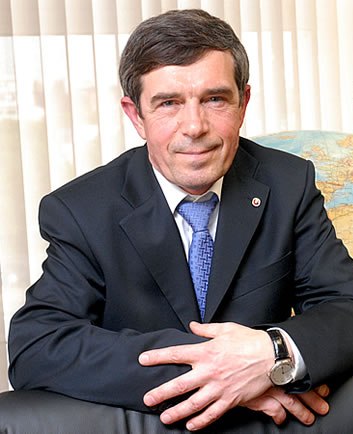
Anatoliy Isaykin

FGUP Rosoboroneksport General Director Anatoliy Isaykin is smiling, but not about Mistral.

In fact, Isaykin’s poured cold water on thoughts of quickly resolving the Russo-French impasse over these helicopter carriers.

As if to answer anyone looking for a date when negotiations will be completed,  Voyenno-promyshlennyy kuryer quotes Isaykin:

“Dates are guesses.  Such contracts, when we’re talking hundreds of millions of euros, — this is years and years of negotiations.  It’s simply funny to expect we’ll conclude such a contract over several months.”

Of the complex and lengthy contracting process, VPK says don’t expect a detailed contract to be signed earlier than next year.  The political agreement on the acquisition was one thing, but now there’s routine pre-contract work which takes months, if not years, agreeing step-by-step on hundreds of points and compromises.

Recall early this year Isaykin was very reserved about the political agreement on Mistral, reminding the press it contained nothing about costs or timeframes.

More Mistral Negotiations

Mistral in Piter (photo: RIA Novosti / Aleksey Danichev)

Might as well start the week with Mistral news.  An informed RIA Novosti source in the OPK suggests this week could be decisive for negotiations on the sale of Mistral to Russia.  But can anything really be decisive in a drawn-out process like this?

The news agency’s interlocutor, much like Anatoliy Antonov, says:

“The situation is not very simple, the negotiating process is going with difficulty.”

“The stumbling block remains the ship’s outfitting, disagreement concerns two NATO standard command and control systems — combat information-command system Senit 9 and battle group (fleet) command and control system SIC-21.”

“The French agreed to transfer Senit 9 to Russia without a production license, they don’t want to transfer SIC-21 with the ship at all.”

RIA Novosti reminds that Russia has insisted on Mistral’s transfer with all  its systems and equipment.

Ruslan Pukhov bravely tells RIA Novosti, when it comes to amphibious command ships, it’s a buyer’s market, so Russia will find another country to sell it if France declines.  That’s at least half true, but it’s also true that France is something of a special case.  The Dutch, Spanish, or South Koreans might not be willing to give everything Moscow wants either.

Does That Box Come With Electronics?

The latest Mistral story is more complex than what you’ve probably read so far.

Russian press services report a highly-placed military source claims Paris has “registered” Moscow’s demand for systems and equipment on Mistral that fully satisfy the Russian Navy’s requirements.

Media sources also say the negotiations foresee a state contract for the provision of two Mistrals, spare parts, instrumentation, and essential operator documentation, as well as equipment, services, and construction documentation needed to build two more Mistrals in Russia.

A source also told the wire services preparation for the acquisition of Mistral “is going logically and systematically” within the bounds of the negotiating process with the French side.

Newsru.com, by contrast, claims this is the Defense Ministry’s way of countering reports that Moscow has decided not to buy Mistral since France is trying sell Russia “empty boxes” for a billion euros. 

Newsru is referring to Vedomosti’s story from earlier this week saying the entire Mistral deal is under threat because the ships’ outfitting is unacceptable to Russia since it doesn’t include modern command, control, and communications systems, and is only a “basic variant” of the ship, a “box without electronics” essentially.

Newsru recaps Tuesday’s Vedomosti:

“. . . the preliminary agreement actually didn’t include the construction of two more ships in Russia, or crew training and the transfer of shipbuilding technologies.  As “Vedomosti” stated with reference to sources in the Presidential Administration and the RF Defense Ministry, the negotiations with the French have reached a dead end, and now resolution of the problem is being sought at the political level.”

On the issue of providing C3 systems (specifically, Senit 9 and SIC-21) on-board Mistral, Vedomosti implies it’s more about money than technology transfer.  Russia can either pay an extra 200 million euros for a full electronics fit, or try to argue at the political level for the ships at the price of 890 million euros which was supposedly on the protocol signed late last year by now-retired Vice-Admiral Nikolay Borisov and Deputy PM Igor Sechin.  Other sources have said Borisov and Sechin exceeded their mandate in agreeing to a price well over 1 billion euros.  We don’t really know what was on that protocol.

The point – overlooked by many including yours truly – is that there’s no real contract for Mistral yet, and it’s a long way off.  All there are so far are protocols, agreements, and understandings.  What was signed in January at Saint-Nazaire was an “intergovernmental agreement” for the possible construction of two Mistrals, not a specific contract covering that and the construction of two more in Russia.

Wednesday Interfaks.ru ran its review of the Mistral story concluding that the negotiating process is difficult, but the French have decided to meet Russia’s requirements.

Interfaks also published something else that might be useful when thinking about Mistral:

“Meanwhile in mid-March, Deputy Defense Minister Anatoliy Antonov, who’s overseeing international cooperation issues, told journalists in Paris that Russia doesn’t intend to force the signing of the contract for the purchase of the French ‘Mistral’ helicopter carriers until it’s determined that all technical parameters won’t impinge on the Defense Ministry’s interests.  ‘It’s early to talk about dates, too many technical details have to be decided.  The contract has to be adapted to our conditions.  Complex expert professional work in the verification of all parameters of a future agreement is going on,’ said the Deputy Minister.  And he noted talk about how all technical nuances are reflected and have been laid down in the contract.  ‘The negotiating process is complex, I would say difficult,’ said Antonov.  He added that, essentially, the negotiations have just begun.  ‘We have to discuss the entire complex of issues.  The task of acquiring ships and their technologies has been given to us.  That’s the most important thing,’ said the Deputy Minister.  In his opinion, an important part of the negotiating process is ‘the contract’s price.’  ‘It’s important to understand that on the issue of buying Mistral type ships agreements were reached at the level of the presidents of the two countries, and negotiators have all necessary authorities and instructions.  We have to work calmly and implement all agreements,’ said Antonov.  He noted that now it’s essential that all agreements ‘be put on paper and to reflect the political agreements of the two presidents in figures so that they meet the interests of the two countries.’”

A professional diplomat and negotiator is never going to say a process is easy, and this one isn’t.  But it does sound like there’s a draft contract, while price and exactly what the presidents agreed remains at issue.

GPV, Exports, and OPK Capacity

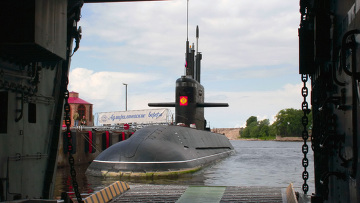
New Sub at Admiralty (photo: RIA Novosti)

This morning RIA Novosti reported on a familiar topic — the conflict between planned acquisition embodied in the State Program of Armaments, 2011-2020, and the Russian OPK’s capacity and capability to deliver it.  In this case, new diesel-electric submarines from St. Petersburg’s Admiralty Wharves.  Also familiar is one reason for the bind — a lingering priority on production for sale abroad.

A highly-placed OPK source tells the news agency that the GPV’s plan for conventional submarine deliveries might not be fulfilled due to Admiralty’s heavy load of orders.  The Russian Navy is reportedly supposed to get 20 new diesel-electric boats by 2020, and Russia also has ten foreign deliveries scheduled.  The OPK source notes that Admiralty has become a sole source for conventional subs, and he calls for shifting some sub production to Nizhniy Novgorod and Komsomolsk:

“In view of the large volume of new submarine construction for the Navy, and also for export, it’s essential to diversify production, utilizing, for example, the capacity of ‘Krasnoye Sormovo’ Shipbuilding Plant in Nizhniy Novgorod and the Amur Shipbuilding Plant in Komsomolsk-na-Amure.  Otherwise the state program in the diesel submarine construction area could be disrupted.”

RIA Novosti notes “Krasnoye Sormovo” built plenty of Soviet submarines, 280 in all, including 25 nuclear-powered ones.  Its last boat was a diesel-electric for China in 2005.  The plant also outfits Russian Navy and export subs with torpedo- and mast-related equipment.

The article also speculates that construction of French-designed Mistral helicopter carriers could be problematic if Admiralty is selected.  The shipyard is reportedly planning on new construction space on Kronshtadt for this reason.  The OPK source says Mistral would be Admiralty’s main concern, and occupy its main capacity and personnel.  So, he continues, it’s logical to send some orders (i.e. submarines) to other factories that have the capabilities.

Igor Korotchenko tells RIA Novosti “Krasnoye Sormovo” could provide extra buildingways if Admiralty can’t meet all its export contracts.  He says Admiralty is now building five subs under the GOZ, six for Vietnam, and:

“In the event new contracts are signed for sub construction with Venezuela and Indonesia there will be an obvious problem with inadequate buildingway space, and then a backup could be required.”

RIA Novosti notes rather dryly along the way that no Russian GPV has been fulfilled completely because of the country’s insufficient modern industrial capacity.

One wonders what, if any, work and investment would be required to bring “Krasnoye Sormovo” and Amur back into the sub-building business.

Russia Not Likely to Buy Ukraina

Slava-class CG Ukraina

Will Russia buy the aging, semi-finished Slava-class CG Ukraina?  Probably not, unless the price is really right, i.e. basically zero.  It’s unlikely Russia will pay Ukraine to complete the cruiser because Russian shipyards have suggested towing it to Russia, refurbishing, and updating there. 

The questions are compelling only because of a recent video, varying reports about the ship and a possible deal, and what this all says about Moscow’s military procurement.

Military parity highlighted Podrobnosti.ua’s video.  Like the photo above, the video shows a major combatant in declining condition.

Nevertheless, according to recent ITAR-TASS, Ukraine’s Defense Minister is optimistic Kyiv and Moscow will finish Ukraina together.  And he claims the ship is 95 percent complete.

By way of review, Ukraina is a 1970s- or 1980s-vintage design being constructed as Fleet Admiral Lobov at Nikolayev’s [Mykolayiv’s] 61 Communards Shipbuilding Plant when the USSR collapsed.  Kyiv failed to find a foreign buyer for the ship, and reportedly spends $1 million every year maintaining it.  So that doesn’t mean a plethora of options or a very strong negotiating position for the Ukrainian side.

Talk of Russia buying Ukraina peaked last year in the wake of the base agreement extension between Moscow and Kyiv.  News outlets noted that the acting chief of the Russian Navy’s Technical Directorate inspected the cruiser and declared it 50 percent ready.  He said Ukraina would need 15 billion rubles for repairs and 35 billion for modernization — $1.7 billion in all.  The Navy’s 50 percent sounds a lot more like the 70 or 75 percent we’ve been hearing for many years than the Ukrainian Defense Minister’s 95 percent.

Reported pricetags for Ukraina, in its current shape, start at $70 or $80 million and run to ridiculous numbers.  In January, Argumenti.ru reported the Russian Defense Ministry would not pay scrap metal prices for Ukraina, but commented that Moscow would accept the ship as a gift.

Then there’s also the issue of whether the Russian Navy really needs it.  It’s an issue often forgotten in procurement debates.  Granted Ukraina is a something of a special case.  But it should also be a pretty easy decision.

Novyy region quoted a couple opinions last May.  Former Black Sea Fleet Commander Vladimir Komoyedov said:

“The ship hasn’t aged 15-20 years yet according to its capabilities.  However, it needs, of course, to be deployed in the ocean, in open theaters, and not in the Black Sea, not in the Baltic — there just isn’t sufficient space for it there.  The ships [Slava-class] are very good, not at all badly designed.  It can’t be said this cruiser belongs just to Ukraine alone.  Ukraine’s share of it, as far as I remember, is 17, a maximum of 20 percent.  Therefore the question’s about the purchase not of a full ship, but of a share — all the rest belongs to Russia.  The purchase issue has stood for a long time, and it needs to be resolved once and for all.  If such a decision is made, it’ll be the right one.  It’s better than the tin can Mistral by a factor of two.”

Defense analyst Aleksandr Khramchikhin, on the other hand, said:

“It’s very hard to understand who needs this ship now.  Undoubtedly, for our fleet which is shrinking into nothing, now such a cruiser has already become pointless.  We have to begin, so to speak, from below, and not from above, not with cruisers, but with frigates at least.  Moreover, these cruisers have a very narrow anti-aircraft carrier mission.  They were built exclusively for war with American carrier battle groups.  It doesn’t seem to me that this mission is all that acute for us now.  Therefore, it’s hard for me to comprehend why we need this ship, and where to put it if it is finished.”

All that said, the Russians might buy Ukraina anyway.  If they do, it’ll indicate a new State Program of Armaments gone awry in its first year.

Careful How You Read

Be careful what you read, but be even more careful how you read it (or who translates it).

The Russians won’t put both SLBMs and SLCMs on their fifth generation submarines.  Would that really make military sense?  What they apparently intend is to build a multipurpose hull to fit out as either SSBN or SSN.  Now does that raise interesting arms control verification issues?

Several days ago, in advance of March 19 – the 105th anniversary of Nikolay II’s designation of the submarine as an Imperial Navy ship class (i.e. Submariner’s Day since 1996) – a “highly-placed RF Navy Main Staff representative” elected to tell RIA Novosti about work on Russia’s fifth generation submarine.

Production of the fourth generation proyekt 955 SSBNs and proyekt 885 SSNs is just really now reaching the ramp-up stage.  But design and development of fifth generation submarines is included in the State Program of Armaments, 2011-2020, according to RIA Novosti’s Navy Main Staff source.

When you Google “Russian fifth generation submarine,” you get a string of English-language news and blog items that say things like:

“. . . a high-level Russian navy insider said a future ballistic-missile submarine would also carry cruise missiles.”

“Russia is planning to equip its fifth-generation nuclear submarines with both ballistic and cruise missiles, a media report said.”

Even RIA Novosti’s own English-language site bollixed it:

“Russia’s proposed fifth-generation nuclear submarines will be armed with both ballistic and cruise missiles, a senior Navy source told RIA Novosti on Saturday.”

RIA Novosti actually wrote:

“The fifth generation submarine will be standardized for ballistic as well as for cruise missiles.” 

And RIA Novosti’s unnamed admiral actually said:

“The concept for creating a new nuclear submarine (APL or АПЛ) envisages a unified hull both for multirole [i.e. attack] as well as for strategic submarines, therefore design bureaus Rubin and Malakhit which today specialize in designing strategic and multirole submarines respectively are working on its development.” 

Rusnavy.com got it right.  

As always said about new submarines, the unknown admiral said the fifth generation will be distinguished for its lowered noise, automated control systems, reactor safety, and long-range weapons.  But he added:

“I’m not talking about ballistic missiles, we’re talking long-range cruise missiles and torpedoes.”

Hypersonic Cruise Missile for Navy?

Yesterday Lenta.ru relayed an Interfaks item in which NPO Mashinostroyeniye General Director Aleksandr Leonov said Russia is working on a naval hypersonic cruise missile.  But, he said:

“It’s difficult to say when all this will be turned into metal.  But technically today I don’t see obstacles to this direction being realized this decade.”

Leonov also claimed that development of this missile is included in GPV 2011-2020.  He didn’t talk about the characteristics of the missile, but said the general trend is to increase its speed to hypersonic, not to increase its range.  It’s designed for anti-ship and land attack missions, and will be fired from various launch platforms.  

Leonov noted that today up to 80 percent of Russian Navy cruise missiles were developed by NPO Mashinostroyeniye.  It produced both the Granit (SS-N-19) and Bazalt (SS-N-12) ASCMs.

He didn’t mention that the hypersonic missile development’s being done as part of Russia’s BrahMos joint venture with India.  Some sources claim the BrahMos II cruise missile has surpassed Mach 5 in stand testing.

Mistral Contract Signing Today

The Elysee announced Sunday that French President Sarkozy and Russian Deputy Prime Minister Igor Sechin will sign the Mistral contract in Saint-Nazaire today.

InoSMI.ru and Militaryparitet.com provided the story from Le Point.

Sarkozy and Sechin will inspect the Mistral and Tonnerre, as well as the Dixmude, which is still under construction.

Le Point says the Mistral deal was originally entrusted to oligarch shipbuilder Sergey Pugachev and his holding company United Industrial Corporation (OPK), and rumors circulated about French and / or Russian middlemen receiving commissions for brokering it.  Ultimately, Russia’s United Shipbuilding Corporation (OSK) — headed by Sechin — took over negotiations with Paris.

Le Point claims the Russians asked the French to provide Link 11 and Link 16 combat information systems along with Mistral.  The French demurred, saying transferring these NATO systems required the agreement of all 27 alliance members.  Moscow reportedly persisted as recently as the NATO-Russia Lisbon Summit, saying this equipment would support its participation in joint operations with NATO.  Its request is formally being studied, but won’t be approved, according to Le Point.

More on Mistral

Vedomosti’s Aleksey Nikolskiy published an informative piece on Monday.

He says the announced deal for the first two Mistral helicopter carriers, built in France, includes spare parts and training for a grand total of €1.3 billion (52 billion rubles).  The deal reportedly includes the option to build two more units in a Russian shipyard.  While the deal’s sealed, the final contract is still being worked between France’s DCNS and Russia’s OSK.

Nikolskiy said the Elysee website said the Mistral package would provide 4 years of work for 1,000 French shipbuilders (5 million man-hours) at STX in Saint-Nazaire.

Paris is selling Moscow the SENIT 9 combat information system aboard Mistral, but apparently without license rights.

The contract for unit one is worth €700 million, and €600 million for unit two.

OSK maintains Russia will get a 20 percent share of the work on unit one, fabricating some sections for the ship in Russia.  Its share of the work on the second unit could be more, according to analyst Mikhail Barabanov.

An OSK representative told Nikolskiy the main goal of this deal is to get modern technology, and a possible Russian builder for the optional units hasn’t been determined.

Nikolskiy juxtaposes two views on Russia’s need for Mistral.  He quotes Barabanov:

“Why does the Russian Navy need this ship which was designed for the French Navy’s overseas expeditions?”

And he repeats General Staff Chief Makarov’s statement from June that the first Mistral will go to the Pacific Fleet to transport forces where they might be needed, particularly the Kuril Islands.

As post-script, Nikolskiy gives a snapshot of what 52 billion rubles for two Mistrals could buy:

  • 2 Borey-class (proyekt 955) SSBNs, or
  • 3 proyekt 11356 frigates (Talwar– / Krivak IV-class), or
  • 50 Su-30 fighters, or
  • 800 T-90 tanks, or
  • 50,000 apartments for servicemen.

Of course, you can generally double these alternative purchases if Russia builds a third and fourth Mistral.