Category Archives: Serdyukov’s Reforms

Medvedev’s Military Personnel Decrees

President Dmitriy Medvedev’s decrees on changes in Defense Ministry personnel are a relatively new phenomenon.  Decrees have been common for changes in the MVD, but not the Defense Ministry.  Now they’re coming out for generals and colonels occupying nomenklatura-level duties. 

After two years of Serdyukov’s reforms, changes, and cuts, the personnel machinery has begun to make decisions and grind out paperwork on people. 

Interest piqued when General-Lieutenant Burutin, a Putin favorite, was dropped as First Deputy Chief of the General Staff.  But General-Major Buvaltsev moved in the opposite direction, taking a newly-created post as the General Staff Chief’s assistant for command and control.  Serdyukov also swapped out military aides — General-Lieutenant Miroshnichenko for General-Major Medoyev.

Some “general” points on all these dismissals, appointments, etc.

  • Changes in nomenklatura generals and colonels probably represent the “tip of the iceberg” to more widespread changes in colonels, lieutenant colonels, and majors below them in their organizations.
  • The squeeze down to four military districts has made many former MD staff officers redundant.  This is especially pronounced in the Moscow and Leningrad MDs.  It’s also true for the North Caucasus MD and its 58th Army.  This is harder to understand since it just rolled over directly into the new Southern MD. 
  • Individual services and their main staffs were hit, since some of their responsibilities are reportedly moving to the four new MDs.  This was true for Ground Troops, Navy, Engineering Troops, and Rear Services.
  • There’s been a veritable bloodbath in the Defense Ministry’s Main Armaments Directorate — recall this is following First Deputy Defense Minister Vladimir Popovkin’s move to the new civilian side of Serdyukov’s Defense Ministry (he’s taking the armaments portfolio with him, possibly in swap for combat training).  So many, if not all, of these posts will be civilianized and possibly reorganized and consolidated.  Similarly, Rear Services (logistics) is being civilianized, reorganized, and outsourced.
  • Space Troops were touched up pretty well; maybe this is a prelude to melding into the Air Forces.
  • There were several changes at the helms of military-educational institutions.  Not surprising since they are being consolidated rapidly. 
  • Mr. Korotchenko notwithstanding, corruption cases probably don’t have much to do with these changes.  If you’re going to be put on trial, they keep you in the service.
  • In all the decrees, there were some plain old appointments, especially in the Pacific Fleet.  We’re still waiting for a new commander to replace Vice-Admiral Sidenko who now commands the Eastern MD.

November 23 was so busy, there were actually two separate decrees on military personnel posted to Kremlin.ru

In the first decree . . .

Those relieved of current duties:

  • Colonel Vladimir Gennadyevich Gulin, Chief, Armor-Tank Service, North Caucasus MD.
  • Colonel Aleksandr Nikolayevich Ivanov, Chief of Armaments, and Deputy Commander of Space Troops for Armaments.
  • Colonel Anatoliy Mikhaylovich Mordvin, Chief of Reconnaissance, Deputy Chief of Staff for Reconnaissance, Leningrad MD.
  • Colonel Nikolay Borisovich Ostrin, Chief, Missile-Artillery Weapons Service, North Caucasus MD.
  • General-Major Yuriy Ivanovich Rukovichnikov, Chief of Rear Services, Deputy Commander for Rear Services, 58th Combined Arms Army.

These guys are just in limbo, awaiting some reassignment or possibly dismissal from the service.

Dismissed from military service: 

  • Vice-Admiral Sergey Viktorovich Kuzmin, Chief, Combat Training Directorate, Navy.
  • Rear-Admiral Aleksandr Sergeyevich Litenkov, Commander, Central Combat Post, Navy (he had also been a surface force commander in the Northern Fleet in the past).

In the second decree, General-Major of Medical Service Aleksandr Borisovich Belevitin added the duty of Chief, Military-Medical Academy to his primary job as Chief, Main Military-Medical Directorate.

Relieved of current duties:

  • Colonel Nikolay Fedorovich Arkhipov, Chief, Directorate of Planning and Organization of Development and Serial Orders of Weapons and Military Equipment, Main Armaments Directorate.
  • Colonel Sergey Valentinovich Vasiliyev, Chief, Directorate of Coordination of Use, Repair, and Disposal of Armaments and Military Equipment, Main Armaments Directorate.

Relieved and dismissed from military service:

  • General-Lieutenant Aleksandr Germanovich Burutin, First Deputy Chief, General Staff.
  • General-Major Anatoliy Vasilyevich Gulyayev, Chief, Organizational-Planning Directorate, and Deputy Chief, Main Armaments Directorate.
  • General Major Yevgeniy Ivanovich Safonov, Chief Engineer, and Deputy Commander, Railroad Troops.

Dismissed from military service:

  • Admiral Viktor Nikolayevich Gladkikh (he was the Defense Ministry’s Chief Personnel Inspector, and had worked on establishing military police, his staff element has probably been civilianized).
  • General-Major Viktor Valentinovich Boronchikhin.
  • General-Major Vladimir Petrovich Kuzheyev.
  • General-Major Viktor Sergeyevich Skrobotov.
  • Rear-Admiral Vyacheslav Vladimirovich Trofimov.
  • Rear-Admiral Yuriy Aleksandrovich Uvarov.

On 18 November, Medvedev’s decree made General-Major Ivan Aleksandrovich Buvaltsev an Assistant to the Chief of the General Staff for Command and Control – a new post.  He had been Chief of Staff, First Deputy Commander, Leningrad MD.  And he was once Chief of Combat Training for the Moscow MD.

Relieved of current duties:

  • Colonel Aleksandr Nikolayevich Anistratenko, Chief of Staff for Armaments, First Deputy Chief of Armaments, Moscow MD.
  • Colonel Aleksandr Anatolyevich Arzimanov, Chief of Armaments, Deputy Commander of the 58th Army for Armaments.
  • Colonel Gleb Vladimirovich Yeremin, Chief of Air Defense Troops, Moscow MD.
  • Colonel Oleg Yuryevich Knyazyev, Chief of Staff, Rear Services, First Deputy Chief of Rear Services, Moscow MD.
  • Colonel Aleksandr Nikolayevich Nesterenko, Chief, Engineering Troops, Siberian MD.
  • Colonel Boris Aleksandrovich Ovsyannikov, Chief, Missile-Artillery Weapons Service, Moscow MD.
  • Colonel Pavel Polikarpovich Ovchinnikov, Chief of Rear Services, Deputy Commander of Air-Assault Troops for Rear Services.

Relieved of current duties and dismissed:

  • General-Major Vadim Anatolyevich Odrinskiy, Deputy Commander, North Caucasus MD.
  • General-Major Viktor Nikolayevich Tamakhin, Chief of Radiological, Chemical, and Biological Defense Troops, Volga-Ural MD.

Dismissed from military service:

  • General-Lieutenant Sergey Ivanovich Antonov.  He was a Deputy Chief of the Ground Troops’ Main Staff.

Medvedev’s 29 October decree appointed:

  • Captain First Rank Oleg Viktorovich Apishev, Chief of Fleet Reconnaissance, Deputy Chief of Staff for Reconnaissance, Pacific Fleet.
  • Captain First Rank Anatoliy Vladimirovich Zelinskiy, Deputy Commander for Personnel, Pacific Fleet.
  • Captain First Rank Igor Olegovich Korolev, Chief, Technical Directorate, Pacific Fleet.
  • Rear-Admiral Andrey Vladimirovich Ryabukhin, Deputy Commander, Pacific Fleet, relieved of duty as Commander, Belomorsk Naval Base, Northern Fleet.
  • Captain First Rank Viktor Nikolayevich Liina, Commander, White Sea Naval Base, Northern Fleet, relieving him from duty as Deputy Commander, Submarine Forces, Northern Fleet.
  • Captain First Rank Igor Vladimirovich Smolyak, Commander, 30th Surface Ship Division, Black Sea Fleet.
  • Colonel Roman Valeryevich Sheremet, Commander, 8th Brigade, Aerospace Defense.

Relieved of current duty and dismissed from military service:

  • General-Major Sergey Stepanovich Ivanitskiy, Commander, 14th Missile Division.

The 26 October decree appointed:

  • Colonel Igor Sergeyevich Afonin, Commander, 14th Missile Division (he had commanded the 8th Missile Division).
  • General-Major Valeriy Alekseyevich Konurkin, Deputy Chief, Military Training-Scientific Center, “Air Forces Academy,” Air Forces (the academy has simply been renamed).
  • General-Lieutenant Aleksandr Ivanovich Miroshnichenko, Assistant to the RF Defense Minister.
  • Colonel Leonid Aleksandrovich Mikholap, Commander, 8th Missile Division.
  • General-Major Yuriy Petrovich Petrushkov, Chief, Military Training-Scientific Center, “Air Forces Academy” Branch (Yeysk, Krasnodar Kray).

Relieved of current duty:

  • Colonel Dmitriy Aleksandrovich Yashin (he commanded the 138th Independent Motorized Rifle Brigade, Leningrad MD).

Relieved of duties and dismissed from military service:

  • General-Major Nikolay Ivanovich Vaganov, Deputy Chief for R&D, Main Armaments Directorate.
  • General-Major Aleksandr Nikolayevich Ionov, Chief, Organization-Mobilization Directorate, Deputy Chief of Staff for Organization-Mobilization Work, Leningrad MD.
  • General-Major Aleksandr Vasilyevich Mazharov, Chief of Armaments, Deputy Commander for Armaments, Leningrad MD.

The 1 October decree appointed:

  • Colonel Gennadiy Nikolayevich Lapin, Deputy Chief of the Military Academy of Rear Services and Transport for Training and Scientific Work.
  • Mr. Igor Nikolayevich Lyapin, Director, Transportation Support Department, Defense Ministry.
  • Colonel Aleksey Anatolyevich Obvintsev, Chief, Military-Medical Academy Affiliate (St. Petersburg), relieved of duty as Chief, Military Institute of Physical Fitness.

Relieved of duties:

  • General-Major Yuriy Mikhaylovich Rovchak, Deputy Chief of Military Academy of Communications named for S. M. Budennyy.

Relieved and dismissed from military service:

  • General-Major Aleksandr Viktorovich Kochkin, Chief, Organization-Planning Directorate, Deputy Chief, Main Missile-Artillery Directorate.
  • General-Major Igor Basherovich Medoyev, Assistant to the RF Defense Minister.

Dismissed from military service:

  • General-Major of Medical Service Vladimir Borisovich Simonenko.

The 21 September decree relieved:

  • Vice-Admiral Sergey Viktorovich Kuzmin, Chief of the Combat Training Directorate, Navy.
  • Colonel Vladimir Mikhaylovich Prokopchik, Deputy Chief, Engineering Troops.
  • Captain First Rank Vasiliy Anatolyevich Shevchenko, Chief, Technical Directorate, Pacific Fleet.

Appointed:

  • Rear-Admiral Valeriy Vladimirovich Kulikov, Chief, Combat Training Directorate, Navy.

Relieved and dismissed from military service:

  • General-Major Aleksandr Vasilyevich Stetsurin, Chief, Automotive Service, Volga-Ural MD.
  • General-Major Aleksandr Nikolayevich Yakushin, Chief of Staff, First Deputy Commander, Space Troops.

Dismissed from military service:

  • Rear-Admiral Anatoliy Ivanovich Lipinskiy.

Medvedev’s first military personnel decree on 8 July made Grigoriy Naginskiy a Deputy Defense Minister without portfolio, though he’s continued to work on housing and construction.  The decree also appointed Vice-Admiral Vladimir Korolev as Commander, Black Sea Fleet.  And it made General-Lieutenant Sergey Zhirov Director of the Defense Ministry’s Department of Rear Services Planning and  Coordination, instead of Chief of Staff, First Deputy Chief of Rear Services.
Medvedev Calls for Unified Aerospace Defense

Yesterday President Dmitriy Medvedev delivered the annual Federal Assembly address.  It was rather brief, uninspiring, and contained relatively little on the military, except his call for work on a unified aerospace (air-space) defense (VKO or ВКО).  This could be a death knell for independent Space Troops.  He also repeated his warning that an agreement on missile defense is needed, or another round of the arms race will ensue.

But let’s look from the beginning . . . Medvedev suggested the army’s modernization might help jumpstart the scientific and technical modernization of the economy.  He said the 20 trillion rubles for the State Program of Armaments will be doubly effective if they give Russia dual-use technologies that can help modernize production processes and develop both fundamental and applied research.  And Medvedev again mentioned creation of a Russian DARPA:

“Therefore we are creating a special structure which will research and develop breakthrough technologies for the defense sector.  There are such structures, you know, in other countries.  We are expecting many of them will find application in everyday life.”

There seems to be a huge disconnect between Medvedev’s almost offhand comments here and what military men expect out of that 20 trillion.  One doubts many in the armed forces see any of this funding going to R&D.  They see it going almost entirely toward procurement of existing weapons and equipment woefully lacking in today’s military inventory.  Perhaps it’s Medvedev’s way of selling (as if he needs to) these expenditures to the average citizen.  

At any rate, Medvedev then gets down to brief comments on the armed forces:

“The development of our state and society is impossible without effective support of national security and defense.  We have taken a course for a deep modernization of the Armed Forces, for conducting systemic, meaningful transformations in them.  The combat component of the Armed Forces, the combat readiness system, command and control, and material-technical support of troops have already been updated.  Our combat exercises have again become regular and, what’s of no small importance, large-scale.  Four military districts have been formed instead of six.  In the framework of the State Program of Armaments to 2020, troops are being outfitted with modern equipment.”

“What tasks still have to be resolved?  First.  In the next year, particular attention needs to be given to strengthening the country’s aerospace defense, to unify existing air and missile defense systems, missile attack warning, and space monitoring.  They should act under the unitary command and control of a strategic command.”

“Second.  Today’s Russia, it goes without saying, also needs a modern army and fleet, compact and mobile troops manned with high-class specialists and the newest weapons.  This requires both serious resources (I just stated the volumes of these resources), and new, sometimes complex, decisions.  At the same time, it is necessary to fulfill all obligations to people who chose army service for themselves, first and foremost to resolve the housing question within the planned time.”

“Third.  The army should free itself from ancillary tasks and noncore functions.  These functions need to be transferred to civilian organizations, to concentrate attention, most of all, on real combat training.  A young man only goes to the army for one year, and the program of training in military affairs is not becoming easier.  It is essential that every young man assimilate the program in full measure.”

Medvedev goes on to describe his discussions about European missile defense with NATO in Lisbon.  He repeats his warning that, if an agreement on missile defense isn’t reached and a full-fledged joint cooperation mechanism isn’t created over the next decade, another round of the arms race will begin:

“And we will be forced to make a decision on the deployment of new strike means.  It is perfectly obvious that this would be a very grave scenario.”

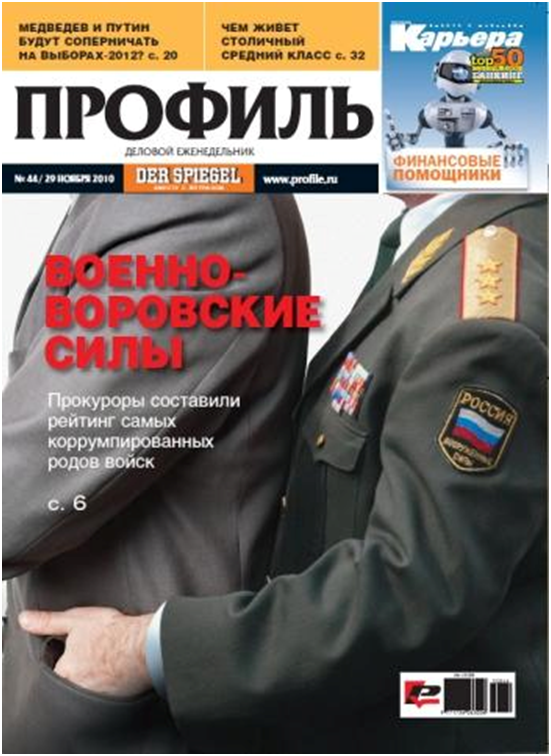
Military-Theft Forces

Prosecutors Rate the Most Corrupt Service Branches

40-50 Percent of State Defense Order Simply Stolen in Recent Years . . . no wonder large-scale procurement hasn’t happened.  Serdyukov supporter Korotchenko tries to paint opponents of military reforms as people trying to protect their corrupt schemes.  This surely goes on, but there also have to be people opposing them for reasons other than greed.  Finally, it’s at least conceivable that, if Serdyukov doesn’t make progress against corruption, it could cost him his job (if he stays that long, he is approaching the four-year mark).  Thus endeth the precis for this post . . .

This week Profil investigates military corruption.  The magazine notes the number and scale of Defense Ministry corruption cases is growing by leaps and bounds, reaching losses of 2.2 billion rubles for the first ten months of 2010.  It concludes, despite a significant cut in the officer corps and Defense Minister Anatoliy Serdyukov’s battle against “thieves in broad stripes [generals],” the number of corruption crimes is not only not declining, but has substantially increased.  Profil obtained an analytical report compiled by the Main Military Prosecutor (GVP) showing who has stolen how much this year.

The GVP presented its report to a closed session of the Duma Defense Committee.  It says its analysis shows “efforts to counteract corruption in the troops are insufficiently effective.”

Profil’s first graphic . . .

Growth of Corruption Crimes in the Army (First 10 Months of 2010)

Troops/Military District/Fleet                     2009       2010       Growth (%)

North Caucasus MD                                             184          311                 69

Moscow MD                                                              94           152                61.7

Air-Assault Troops (VDV)                                 34            119                250

Siberian MD                                                             76            117                 54

Strategic Missile Troops (RVSN)                  59              93                 57.6       

Northern Fleet                                                      50              59                 18

Space Troops                                                        27              44                 63

Caspian Flotilla                                                      5                  7                 40

Black Sea Fleet                                                      2                  6                 200

Profil suggests the recent wave of military retirements signed off by President Dmitriy Medvedev could have been sparked by corruption charges.  While possible, there’s no evidence to support this thesis. 

A Profil source in the Defense Ministry says, not surprisingly, officials responsible for the State Defense Order (GOZ or ГОЗ), capital construction, and the disposition of military property (first and foremost real estate) inflict the greatest losses on the budget.  The article quotes Igor Korotchenko:

“In the course of recent years, 40-50% of resources allocated for the State Defense Order were simply stolen.  This happened, for example, when money was directed at the fulfillment of some concrete work, but there were no real results.  Write-offs appeared in the end or a weapons system was developed that simply didn’t meet its technical requirements.”

Profil suggests that many officers are rushing to get one last bite of military money before Serdyukov’s reforms completely derail their schemes.  It cites Ruslan Pukhov offering two different explanations for rising military corruption:

“Feeling an impending dismissal, officials are probably trying to take the maximum from their positions.  However, it can’t be ruled out that the prosecutor has really reinforced his work in different areas.  Corruption is an acute issue for the prosecutor.”

Pukhov thinks that, although the percentage increase in corruption looks really bad for the VDV, “corruption in the armed forces is spread equally and the growth in corruption crimes in separate branches or districts is connected only with where they are being investigated.”

A very good point, Mr. Pukhov.  Yes, the results of this little anticorruption experiment are very much influenced by where and how it is being conducted.  One should also pay much more attention to the absolute numbers of corruption cases than the percentage changes, and nothing has been said about the relative size of the various parts of the armed forces . . . no per capita figures are provided.  Are 44 crimes in the relatively small Space Troops more significant than 152 in the larger Moscow MD?

Korotchenko, a fairly strong Serdyukov proponent, says the Defense Minister and his tax service colleagues are beginning to break existing corrupt ties, institute financial transparency, and deprive the generals of the right to conclude any contracts.  Dividing the Ministry into military and civilian halves will keep military men out of financial expenditures, and this “process of shifting generals out of the feeding trough” will continue until 2012.  The generals will provide requirements, and civilians will allocate the financing.

A second graphic with some absolute figures on losses due to corruption . . .

Growth of Corruption Crimes in the Army (First 10 Months of 2010)

Troops                                                                  Loss Amount                      Annual Growth

                                                                           (millions of rubles)                        (times)

Strategic Missile Troops (RVSN)                      59.8                                            15          

Air-Assault Troops (VDV)                                   57.5                                            12.2

Space Troops                                                            47.6                                              2.2

Korotchenko claims:

“The campaign against Serdyukov is mainly heated up by those people who’ve been deprived of the feeding trough.  So, the director of a large defense enterprise has for many years sawed off rubles by the billion every year in the transfer of money that comes to fulfill the Gosoboronzakaz.  When Serdyukov deprived this director of such a trough, he began to finance any actions directed at discrediting and, possibly, even removing the Defense Minister.”

So, Korotchenko asserts most conflicts over army reform are banal conflicts of interest for those who can’t steal like they used to.  But didn’t the GVP just say they’re doing a better job of stealing than ever before?

Korotchenko continues:

“Of course, Serdyukov is not an angel, and many of his actions on the military reform plane call forth questions, but it’s another thing that before he arrived, corruption in the Defense Ministry had achieved such a level that he was forced to cut to the bone.  Many scandals proceed only because their financial-economic interests were affected:  the meetings of the airborne guys is just one in this series.”

Then Profil turns to Vitaliy Shlykov, who says:

“Broad publicity for corruption scandals in the Defense Ministry cannot but affect the minister.”

But he believes the Kremlin knows no one can fight corruption like Serdyukov, therefore the GVP report isn’t a real blow to him.

Profil concludes, so far, Serdyukov hasn’t squandered the trust placed in him, but the struggle against corruption only strengthens him as long as it’s a success.  If corruption keeps growing, it’s possible the Defense Minister himself could wind up on the “shot list.”

Master and Commanders

Major media outlets covered President Dmitriy Medvedev’s dialogue with five commanders (three Ground Troops, two Navy) at Gorokhovets.  But one’s own look at what was said, and how it was said, is sometimes better.

The Supreme CINC took some surprisingly forthright views and questions from his commanders.  He didn’t make specific promises about providing the troops new assault helicopters, better protected combat vehicles, or tanks.  He just kept saying the GPV will be fulfilled.

Medvedev told one commander “we all know well what kind of army we had” before this most recent reform began in late 2008.  This is funny since it’s a slam on Vladimir Putin, who was responsible for the army’s condition for most of this decade.

Much of the dialogue depends on an artificial dichotomy between combat (combat training) and noncombat (housekeeping) officers, and on the need to shed the latter.  It is easy now, of course, to belittle officers in the 1990s, and much of the 2000s, who tried to keep their subordinates paid and housed, and conscripts from beating or killing each other, at a time when there was not enough money, fuel, equipment, or even troops for training.  A lot of officers neglected those housekeeping duties and turned to private schemes, crime, or corruption in those days. 

The two naval officers practically beg Medvedev for contractees because their conscripts can’t learn their jobs in one year.  The Supreme CINC is supportive, but he won’t do it until the concept is fiscally viable (not a bad idea since the most recent contract service effort was spoiled by failure to deliver pay and benefits that would attract professional enlisted).

And, finally, Medvedev revealed he is committed to finding Russia access to naval facilities abroad to support the Navy’s deployments.

But let’s look at exactly what was said . . .

VDV Colonel Igor Timofeyev, commander of the 56th Independent Air-Assault Brigade, told Medvedev his troops would like Army Aviation to have new helicopter types, for landing troops and providing effective fire support, i.e. all-purpose assault helicopters.  He also said his companies depend on UAZ vehicles for transport, which lack sufficient personnel protection, and can’t mount extra firepower.  Then he gets to his point . . . having seen new vehicles at Gorokhovets, he hopes he will have them in his own formation soon.

Medvedev avoids responding directly:

“Of course, the fact is what we have today is undoubtedly better than what we had at the beginning of this decade, but all this is still very, very far from what we are aiming for.  You mentioned ‘UAZy.’  I could also name other vehicles, I simply won’t do this in order not to put anyone in an awkward position.  But, unfortunately, the degree of their protection from very simple types of armaments, including infantry-type armaments, is practically nil.  We haven’t even been working on proper armor plating for a very long time, because we considered it expensive.  The mission now is to ensure that all transportation means, all our light and heavier types of transport means receive an effective defense against infantry weapons and, if possible, against heavier types of weapons.  This is definitely more expensive, but these are the lives of people, the lives of our servicemen, this is ultimately the effectiveness of the employment of the Armed Forces.  Therefore it’s essential for us to work on this, just as we will, of course, work on and fulfill the State Program of Armaments as a whole.”

The Supreme CINC doesn’t address the colonel’s call for better air support, and he admits the VDV’s vehicles are inadequate, but promises only that everyone’s transport means are going to receive more protection.  But nothing specific.

Next it’s the turn of Colonel Yakov Ryazantsev, commander of the 57th Independent Motorized Rifle Brigade.  Ryazantsev talks about the difficult process of dismissing officers who forgot about combat readiness and combat training or weren’t prepared to work under ‘modern conditions.’

Medvedev took this opportunity to say this is the reason for much criticism of the military reform process:

“Often in the media and in the statements of independent analysts we read very severe things about how the reforms are being conducted, about the condition of the Armed Forces’ combat capability.  This is normal, undoubtedly, because there should be critical stories, should be investigation of what is being done.  We have an open society, and the Armed Forces cannot appear like a closed corporation in this sense.  Nevertheless, sometimes these judgements bear an exceedingly severe character.  Some of them concern dismissals from the ranks of the Armed Forces.  In this context, I have a question for you:  what number of servicemen in your view in percentage terms were dismissed from your brigade?”

Ryazantsev goes one better and gives precise numbers:  415 officers of 611 in the former 81st Motorized Rifle Division were dismissed.  He says they were officers who focused on ‘everyday problems’ rather than the fulfillment of military service duties.

Meandering a bit, Medvedev returns to the issue of combat training vs. housekeeping, saying:

“And we all know well what kind of army we had.  We were just talking about ‘paper’ divisions and cadre sub-units.  That’s all there was.  And not just, by the way, in latest Russian history, but in the Soviet period it was, since every year the number of cadre units increased and increased.  How did this reflect on our combat capability?  It’s clear how.  And officers, unfortunately, who served in such places, were occupied mainly with housekeeping tasks.”

“But today those who aren’t prepared to serve are not allowed to serve.  So what you just said, once again strengthens my certainty in this.”

Next Colonel Valentin Rogalev, commander of the 74th Independent Motorized Rifle Brigade, tells Medvedev he can’t say his arms and equipment are fully adequate, especially when it comes to tanks and BMPs.  Referring to the GPV and plans to modernize 30 percent of equipment by 2015, Rogalev says:

“And we hope, Comrade Supreme CINC, that fundamentally new types of tanks and BMPs with greater firepower and also increased crew protection will enter the arms inventory soon, not as single units, but systematically.  This will significantly raise the brigade’s combat possibilities.”

In his response, Medvedev talks about galvanizing the OPK to produce what the army needs, about the GPV, and about spending money wisely, but he doesn’t promise Colonel Rogalev anything.

Then the Navy took over.  Captain First Rank Sergey Pinchuk described the condition of his Baltic Fleet surface ship brigade:

“In the ship formation I command, 10 years ago there were ships with an average service life of 10-15, but some even with 25 years.  They were mainly technically inoperable, technically unready, insufficiently manned, with minimal supplies, ships generally didn’t go to sea for years.  Today new ships have entered the formation.  They are multipurpose corvette class ships for missions in the near ocean zone.”

“The armaments and military equipment mounted on the new ships allows us to cut personnel on the ship substantially, practically by three times.  And the requirements on this personnel have increased significantly.  Besides officers, these are contract servicemen.  You talked about them today.  In the fleet, large effort on their training, education, creation of favorable service conditions is being conducted.  However, one would like to see that this category of servicemen has also found support at the state level.”

In his response to Pinchuk, Medvedev acknowledges that “we are still just preparing” to support contractees in terms of competitive pay and normal service and living conditions.

One wonders how long it will take to get ready . . . they spent most of the past decade preparing to implement contract service before pulling the plug earlier this year.

Nevertheless, Medvedev insists “I understand this and the Defense Ministry leadership understands,” and we “will return to the issue of supporting contractees in the near future.”

Again, no commitment.

Last up is Captain First Rank Ildar Akhmerov, commander of the 44th ASW Ship Brigade.  Akhmerov describes greatly increased underway time and Horn of Africa antipiracy operations by his four ships, and then concludes the sea time and servicing of complex shipboard equipment and systems are increasing the requirements on the training of all crew members.  The price of a mistake far from Russia is too high.  As formation commander, he says he has to increase the number of contractees on deployed ships by taking them from other ships, because conscripts can’t master complex equipment in their short time.  So in the fleet and the district, they’ve made great efforts in selecting contractees, and providing them housing.  But at present, this issue remains highly important not only at the level of a fleet formation, a district, but even on a state level.

Akhmerov continues saying his ships in the Gulf of Aden need higher quality rear and technical support than other ships.  But Russia has no bases in foreign countries in the Indian or Pacific Ocean where his ships could take on supplies, repair, and get some kind of rest for their crews.  This is presently done by support ships in the detachment of ships, but a shore base would increase the quality of rear and technical support and reduce costs.

Medvedev responds:

“On contractees, I just told your colleague.  We, of course, understand this problem.  And the fact that you have to pull contractees from other ships is not very healthy.  Now we simply have to understand what sum will be sufficient to motivate contractees.  We have discussed this more than once in Sovbez sessions, the Minister and Chief of the General Staff participated in this discussion.  I think here we will need to some degree to proceed from lieutenant’s pay, but for this we need to prepare so that this decision will be financially supported.  But, I repeat yet again, without modern, well-paid, socially motivated contractees in the army, nothing, of course, will occur in the Armed Forces.”

On the issue of foreign bases, he said:

“As you know, bases on the territory of foreign states aren’t created on the order of President of the Russian Federation.  For this, it’s necessary to conduct complex political-diplomatic work . . . .”

“I won’t hide from you that we have some ideas on this issue, but I won’t say them out loud for understandable reasons.  But it’s obvious that when, let’s say, support ships follow ships, this is very expensive and the expenditures are really huge.  And this is very often ineffective when this support train has to drag itself over the territory of the entire world ocean.  In this sense, our current partners have much better conditions, because they have staked out bases in the most varied parts of the world, visit and replenish themselves.  Generally, this is an issue which demands really attentive state interest.”

Medvedev Talks to Brigade Commanders

Medvedev Speaks at Brigade Commanders' Assembly

According to Kremlin.ru, President Dmitriy Medvedev traveled to the Gorokhovets training ground near Nizhniy Novgorod today to observe battalion-level ground and air maneuvers.  It’s a modern twist on an old tradition of presidential speeches before end-of-training-year assemblies in Moscow. 

Medvedev inspected a new field camp, different weapons and equipment, and watched a Tunguska demonstration.

Afterward he met brigade commanders observing the exercise, and addressed them about the process of reforming the armed forces.

Medvedev said for two years Russia has been actively modernizing its armed forces to make them more compact, effective, and better equipped, and completing ‘org-shtat’ measures [i.e. TO&E changes] to achieve a ‘new profile.’  Flanked by Defense Minister Serdyukov and General Staff Chief Makarov, he promised the assembled commanders a defense budget worth 2.8 percent of Russia’s GDP every year until 2020, but he said getting this level of spending will not be easy, and it requires adjustments and cuts elsewhere.

He particularly emphasized establishing the new system of higher pay to replace earlier ad hoc measures like premium pay.  He seemed to say extra money will be squeezed out for this, but people will be watching how it’s spent.  Kremlin.ru posted some of Medvedev’s opening remarks:

“This is creating the conditions to equip the troops with new equipment in accordance with the current edition of the State Program of Armaments and, what is a no less important task and really no less complex, to resolve all social issues which exist for servicemen.  This issues are also well-known.”

 “First and foremost is the indexation of pay which we are already now conducting, and implementation of the housing construction program.  From 2012, the planned reform of the military pay system not according to those fragmentary pieces which exist at present, not according to those selective approaches which exist, but a full reform of pay.”

“In the final accounting, we should get so that base salary, monetary salary of servicemen will be increased practically three times. And in the process to preserve and to extend to all the Armed Forces that which we talked about in the past, that which we did according to groundwork laid in bounds of order 400 and some other Defense Ministry documents.”

“All planned measures, reform measures should be calculated and materially supported in the most rigorous way.  An adjustment in the military budget is being conducted and oversight of the use of resources is being organized for this.  I promise the attention of all Defense Ministry leaders on this:  all these processes need to be completed in coordination with other government structures in order that we should have absolute precision here.”

“A high level of financial support for the Armed Forces allows, I hope, for freeing servicemen from noncore housekeeping functions – that, in fact, was done long ago in the armies of other countries.  The troops need first and foremost to put their attention on operational training, combat exercises, to concentrate exclusively on these issues.  Security duties (firstly, perhaps not even security, but cleaning), everyday support, food preparation should be transferred to civilian organizations.”

Medvedev told the commanders their brigades should be self-sufficient, modern, balanced, and capable of fulfilling missions given them, and he invited their feedback because, as he said, the success of the military’s transformation depends on it.

“It would also be useful for me to know your opinion on the quality of the reform, on the organizational changes, what, in your view, has proven itself useful, and where there are problems.”

Despite soliciting their honest opinions, one doubts the Supreme CINC will hear many complaints from this audience.  They are, after all, winners in the reform process since they managed to continue serving in command positions.

A Thoroughly Modern CINC

You have to like Air Forces CINC, General-Colonel Aleksandr Zelin. 

He’s open and candid about what Defense Minister Anatoliy Serdyukov’s ‘new profile’ reforms mean for him and his service.  He’s talked earlier, more often, and longer about it than his Ground Troops or Navy counterparts.  He’s matter of fact and accepting of the entire process. 

Serdyukov’s changes turned General-Colonel into a trainer and force provider, and he nonchalantly admits as much. 

At 57, Zelin understands he can be replaced at any time, or allowed to serve three more years or even longer. 

If he were a tad younger, he would have been the right kind of general to command one of the new military districts / unified strategic commands (OSK / ОСК), say the Western or Central.  An air or air defense officer would have been just the right choice for a potential future war on those axes.  Instead, the Kremlin has three Ground Troops generals and one admiral (a step in the right direction).  It’s hard to argue against Ground Troops leadership in Russia’s restive south.  But Air Forces (VVS or ВВС) would have been a really good choice in the Western or Central Military Districts . . . a missed opportunity for now.

But back to Zelin.  On Tuesday, he addressed a foreign military attaché audience (and the Russian media) about the future of the VVS.

According to Gzt.ru, Zelin said the VVS will be reduced by a third and spread among the four new  OSKs.  And its Main Command (Glavkomat) will be responsible only for combat training.  The OSKs are in charge of employing the VVS in their theaters.

The VVS now consist of the Glavkomat, 7 operational commands, 7 first-rank air bases, 8 second-rank air bases, and 13 aerospace defense (VKO) brigades.  Before the ‘new profile,’ the Air Forces consisted of 72 regiments, 14 air bases, and 12 independent squadrons and detachments, with a third more aircraft than the VVS now have.

Four of today’s 7 operational commands are subordinate to the new OSKs.  Army Aviation also falls under them.

According to Zelin, in the future, the VVS Main Command (Glavkomat or Главкомат) could become a “branch department” of the General Staff responsible for the combat training of the Air Forces and Air Defense, while the OSKs employ the trained forces.

Zelin says VVS personnel will number 170,000 with 40,000 officers, nearly 30,000 sergeants, and the balance conscripts or civilian specialists.  He says today’s personnel training system doesn’t satisfy him, and so he’ll probably change the system of flight schools.  Only four remain today.  Voronezh will be the main training center.  Flight training will also be conducted in Krasnodar and Lipetsk.  Yaroslavl will remain home to air defense officer training.

According to the CINC, the VVS airfield network won’t change.  Base airfields will be first priority for reconstruction and modernization.  Zelin says civilian airfields could be used for operational purposes in the future.

He noted the VVS plans to go to a fully automated command and control system in the future, and, of course, develop its VKO forces.

Lenta.ua quoted Zelin’s remarks to Interfaks.  Zelin said the VVS will renew 30 percent of its inventory by 2015, and 100 percent new in some areas and 80 percent new overall by 2020.  He doesn’t say where the VVS are today in this regard, but recall Defense Minister Serdyukov has said only 10 percent of equipment in the Armed Forces is modern.

Zelin said the VVS will get new aircraft, air defense, reconnaissance, and electronic warfare systems, but modernization of some existing systems is still part of the plan.  Although the State Armaments Program 2011-2020 and its 19 or 20 trillion rubles have to be finalized, Zelin repeated that 10 T-50 (PAK FA) will be acquired in 2013-2015, and 60 more from 2016.  He mentioned Military-Transport Aviation (VTA or ВТА) is a priority – including the An-124 Ruslan, Il-112, Il-476, Il-76M, and An-70 – but he doesn’t venture any numbers or dates for new production.  Zelin does give a target of 400 new and modernized helicopters in the inventory by 2015.

Who knows what was or wasn’t covered in these media contacts, but it seems odd there’s still no mention of more S-400 deliveries.  Zelin was still talking about getting 5-6 more battalions in 2010 earlier this year.  But no sign of them.  It’ll be a big deal when or if they appear.  Also, no mention of S-500 development.

Shamanov Doing Well, His Staff Not So Well

Interfaks reports the VDV’s spokesman says Airborne Commander, General-Lieutenant Vladimir Shamanov is doing well enough to receive visitors and work from his hospital bed, though doctors won’t say at this point when he might be discharged.

Tuesday’s Argumenty.ru reported bad news for Shamanov’s staff.  A Defense Ministry commission working in the VDV will soon issue its decision on cutting the airborne staff.  A military source says it’s only a formality since a decision, not favorable to the VDV, has already been made.

The officer said the commission arrived immediately after Defense Minister Serdyukov’s 30 September dust-up with VDV Colonel Krasov at the Seltsy training center near Ryazan.  It had mainly finance and personnel people.  Scheduled to work for two weeks, the commission needed more than a month, and didn’t finish until after Shamanov’s car accident on 30 October.

According to Argumenty.ru’s source, the report will consider it expedient to cut the VDV’s Main Staff by two times, transfer its headquarters from Moscow to Ryazan or Tula, and sell its current premises in Sokolniki.

Short Stories

There aren’t enough hours in the day . . . quick takes on some stories of interest.

Rossiyskaya gazeta . . . Minregion again sternly warns of problems in heating military towns due to Defense Ministry debts . . . the Far East is the most serious case.

Nezavisimaya gazeta . . . Ukrainian Defense Ministry may not be able to cooperate on An-70 transport for financial reasons.

Argumenty nedeli . . . long expose on the death of Russian military medicine, and the consequences, as a result of Serdyukov’s cuts and reforms.

ITAR-TASS . . . the interdepartmental commission met at Sevmash today with Vladimir Popovkin leading a review of Yuriy Dolgorukiy’s readiness to test fire the Bulava.

ITAR-TASS . . . on Tuesday, Chelyabinsk’s governor called on Serdyukov to stop explosions at Chebarkul.  This mini-scandal’s been evolving since they started in early October.  Expired munitions are being destroyed, but locals are complaining of damage from tremors.  Serdyukov was supposed to go to Chelyabinsk, but sent logistics deputy Bulgakov in his place.  Bulgakov supervised an elaborate demonstration to show that the explosions aren’t powerful enough to shake Chelyabinsk.  Residents say they can feel them in the city’s high-rise buildings.  The military doesn’t get much credit for trying to get rid of old bombs like those that nearly leveled one of Ulyanovsk’s rayons last November.  See Novyy region or Moskovskiy komsomolets.

There is growing media attention to the military housing problem — will Medvedev, Putin, and the Defense Ministry keep their promise to solve the permanent housing problem by the end of 2010, or are they just changing the rules and extending their own deadline?  See IA Rosbalt, Svpressa.ru, or Nezavisimaya gazeta.

Dollar’s Inevitable Collapse Threatens Russia

Segodnia.ru recently publicized a report entitled Armed Forces:  Year 2010, prepared by the Center for Strategic Assessments and Forecasts (TsSOiP or ЦСОиП).  It interviewed one of the report’s authors – retired Colonel and Doctor of Technical Sciences, Aleksandr Fomin – about the state of Russia’s military and threats to Russia.

How does one characterize Colonel Fomin?  In this interview, his thoughts range from a little far right to far left / neo-Marxist.  Yet he sounds like President Medvedev in 2009 calling for a new world financial order to break the dollar’s hold on the international economy.  But that resemblance disappears once he starts excoriating Russia’s elite — co-conspirator in U.S. domination of Russia.

He generally argues the dollar’s inevitable collapse will lead to conflict or war, for which Russia is poorly prepared.  His arguments will appeal to some, but they represent a somewhat simplistic view of international economics and finance.  The rest is a short geopolitical treatise we’ve heard many times about how Russia arrived in its current condition.

Take heart, however, the analytical report is more interesting and original, but it’s 40-odd pages, so some patience on your part will be required.

By way of foretaste, on with Fomin’s interview . . .

Asked simply what’s going on in the Russian Army, Fomin answers:

“There’s a myth that the incredible militarization of the country and rebirth of its military might almost to the level of the Soviet Union has happened in recent years.  This doesn’t correspond to reality – in reality, as the analysis shows, the Russian Armed Forces have degraded.”  

“If we look at the trend of general financing of the Armed Forces for the last 10 years , adjusted for inflation, then we get as a true expression of the financing volume are 4% increases per annum on average.  At such a growth rate, it’s possible only to offset depreciation, but not guarantee the development of the armaments system.  Now recall corruption, and you find that in reality the Armed Forces didn’t develop, but degraded.”

“Today, in the spirit of political correctness, it’s believed that Russia’s main military enemy is international terrorism. They’re ashamed to identify the U.S., NATO, and China as the real potential enemies.  But if we call things by their names, then today Russia is inferior to these probable enemies in the size of its Armed Forces by 20 times in the West and 35 times in the East.”

We’ll have to read his full report to figure out how he came up with these numbers. 

Fomin goes on to say that Russia’s nuclear weapons won’t save it either, since Moscow’s elite keep its money, and educates its children, in the West.  He concludes flatly:

“It is very probable that Russian nuclear weapons will never be employed.”

Next Fomin constructs his scenarios for future wars and threats to Russia:

“In the coming decades, and possibly, years the U.S. and EU’s problems with China will inevitably sharpen, the cause of them is the struggle for energy resources.  Iran, Pakistan and . . . Russia will be drawn into this confrontation.  They will start to use our country as a buffer in the military resolution of the China problem.”

The interviewer asks Fomin what threatens Russia externally, what geopolitical positions has it lost, which ones does it still hold?

“The main threat not just to Russia, but also the world as a whole comes from the virtual world financial system, based on the American dollar, which for a long time already hasn’t been supported by real assets and is held up only by U.S. military might, the potential of which allows them to oppose everyone else in the world.  But sooner or later this system will collapse, for internal reasons.  But however the collapse occurs, its agony (possibly the current financial crisis is the beginning of this agony) could plunge the world into the Third World War.”

“As already said above, today Russia is practically undefended.  Its political leadership, like the appanage princes of Rus in the 12th -13th centuries, are trying to hold off threats  by means of multibillion tribute payments allegedly into international reserves.  However, in Russia the easily accessible oil, could soon be gone:  according to expert evaluations, 30% of wells are already unprofitable.  Then Russia will simply be of no interest to the rest of the world . . . .”

“If we talk about Russia’s lost geopolitical positions, then of course – this is NATO’s expansion to the East, the reinforced U.S. role to Russia’s south (Afghanistan, Iran, Pakistan, Georgia).  It’s possible to add the real threat of losing the Far East and Siberia to this.  They [NATO and U.S.] managed to spoil [Russia’s] relations with Ukraine, Belorussia, and Iran.”

Asked about the threat that Russia is becoming ensnared in U.S. “anti-Iran” policy, Fomin responds:

“. . . the U.S., economy of which is based on proliferating the dollar throughout the world and managing oil prices, has a very painful relationship to [Iran’s] nuclear energy development – to oil’s energy competitiveness.  Especially in the Near East.  In its relationship with Iran, Russia turns out to be hostage to its own financial system:  if the country holds its reserves in other countries’ hard currency, then it can’t oppose them on their main positions in the military-political sphere.  Some disagreements are possible, but there can’t be a lengthy tendency toward the complication of relations – in the case of a sharp worsening it would be easy to block hard currency accounts.”

“And, Russia for 20 years already has been unable to conduct an independent foreign policy, since it is tightly integrated into the world economic system dominated by the U.S.”

“Russia risks losing the remains of its authority among Muslim countries, after abrogating its earlier agreed supply of defensive weapons (in the first place, S-300 surface-to-air missile systems) to Iran.” 

Asked again about threats, Fomin says:

“External threats have been discussed above.  To this it’s possible to add that, as a result of the actions of the financial authorities of the G20 countries, the fundamental bases of the current crisis haven’t been eliminated.  Because of the fact that some paper (toxic assets) has been traded for others (newly printed dollars, euros, and pounds), the situation hasn’t changed principally.  The disease has been driven inside and its symptoms are still appearing to a lesser degree.  But it definitely will crawl outside again.  Therefore, the financial-economic crises will continue further.  Sooner or later the American dollar unsupported by real assets, as a world currency, must collapse.  Several types of dollar exist already now — for internal and external demand.  The Americans are trying to do everything possible meanwhile to ‘save face.’  Provoking situations to create the objective appearance of a reason for the collapse of the dollar are possible:  a terrorist attack on the U.S., war in the Near East, aggravation of the situation in the Far East.  A new world war which will be catastrophic for Russia as an extreme case.”

“Now about internal threats.  For clarity, in every case, we are distinguishing two understandings:  country and state.  It’s possible to love your country while being critical toward the state, which imagines itself as society’s management apparatus.”

“If we talk about the country as a whole, then the main internal threats are well-known:  complex demographic situation, a lopsided well-developed raw materials economy, low labor productivity, conditioned by the low wage level of labor, proliferation of narcotics, brain drain abroad, degradation of science, culture, education, health care, pensions, national defense, law and order, agricultural economy, neglected transportation and ecological problems, corruption.  In the coming decade, the aggravation of energy problems, connected with the exhaustion of easily accessible supplies of Russian oil.”

“But there is still one more serious problem which is the source of all the rest.  This is the multibillion outflow of capital from Russia, including into so-called international reserves (it’s simpler to say into the financial systems of Western countries).  It bleeds the entire economy, and doesn’t allow for moving off a dead stop in solving the majority of urgent problems.  If there were no capital outflow, many internal Russian threats would be eliminated in some time.”

Fomin goes on to argue that current capital outflow (legal and otherwise) is more burdensome and damaging to Russia’s economy than tribute paid to the Mongols centuries ago.  He says international reserves accumulated in 2010 could have plugged the gap in Russia’s pension fund.

Fomin now turns to internal threats to the state.  Number one is the populace’s increased protest activity.  He says the average Russian understands clearly that the state exists not to improve his welfare, but only the quality of life of 1 percent of Russians, without, of course, provoking large-scale protests from the other 99 percent. 

Among other threats, he cites hypertrophic centralization and underdeveloped local government, inflation caused by capital outflow, low wages, and unemployment all leading back to protest activity.

Fomin notes that Russia dropped to 154th (from 146th) on TI’s international corruption index this year.

He observes that the Russian government failed the test of August’s forest fires, causing a mortality spike equal to the number of men lost by the USSR in Afghanistan.  He calls Prime Minister Putin’s web cameras for monitoring the rebuilding of housing a symptom of the level of Russia’s corruption and ungovernability.

Fomin goes on to label major internal problems — education, health care, agriculture, housing, national defense, culture, science, ecology — the first four he notes are ‘national projects.’  Agriculture he puts on the level of military security in importance.  But rather than develop it, the country’s elite chooses to buy food abroad with oil and gas profits.  Agricultural imports support the livelihood of many middlemen in the process.

Fomin has one last assessment of Russia’s current elite class:

“At present, Russian state authorities and the so-called ‘elite’ view the country as a private firm working solely to get profits and the sooner, the better.  Profit is the main goal of the private firm.  It’s not for the realization of long-term goals.  Its main mission:  collect capital, send money abroad, make itself comfortable, and invest the money in a profitable business.” 

Mending Fences with the Church?

Serdyukov and the Patriarch

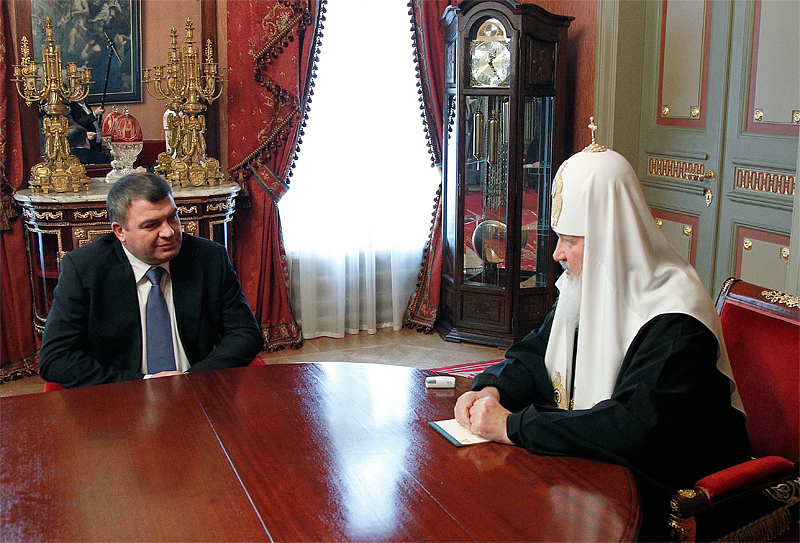
Defense Minister Anatoliy Serdyukov met Patriarch Kirill yesterday, and only Rossiyskaya gazeta alluded to the possibility it might be a fence-mending effort following the Seltsy incident several weeks ago.  Serdyukov had met Kirill previously, but the timing of this meeting sure looks like an effort to repair  army-church ties.

Patriarchia.ru, Krasnaya zvezda, and Komsomolskaya pravda reprinted portions of the Patriarch’s comments:

“The Armed Forces are now undergoing a very important phase of reform, and we are attentively following what is happening.” 

“The army in Russia was always a powerful patriotic force influencing the mood of society, and the well-being of people.  The army was always an elite of our society, including intellectual and cultural.  Therefore I am deeply convinced the Armed Forces reform, which assumes an entire series of very important organizational decisions, scientific-technical and simply technical, must include both spiritual and cultural dimensions.”

Defense Minister Serdyukov told the Patriarch: 

“It’s always pleasant for me when there’s a chance to meet with you, to discuss these or other issues connected with reform.”

“This reorganization now being conducted is a deliberate, calculated process and, as the initial results already show, quite effective.”

According to RG and KP, Serdyukov told Kirill about plans to open a center for regimental priest training on the base of one of the military academies, most likely in Moscow.  Alluding to the Seltsy problem, Serdyukov also noted the Defense Ministry now has a working group on the issue of constructing Orthodox Churches in military units.  And Serdyukov repeated yesterday he never gave anyone an order to take down the church on the VDV’s Seltsy training grounds.