Category Archives: Serdyukov’s Reforms

Ozerov Tells Attaches About Defense Ministry Auctions

According to RIA Novosti, the chairman of the Federation Council’s Defense and Security Committee, Viktor Ozerov told foreign military attaches today the unrealized proceeds from last year’s Defense Ministry property auctions had a negative impact on the conduct of military reforms.  The Audit Chamber reported that only 10 percent of what was expected came in from land and other property sales.  

Ozerov, a vacuous former political officer who usually shills for the Defense Ministry, said this affected the financing of military reforms in a negative way.  He blamed unfavorable economic conditions and a lack of investors or potential buyers, as well as insufficiently experienced managers in the Defense Ministry.  Ozerov called these freed up military towns, buildings, and other facilities the “Defense Minister’s reserve.”  

First, could it be that the Defense Ministry wanted too much for property that might not really be worth very much, or might cost too much to clean up for civilian use.  Or maybe auctions for truly valuable properties were rigged.  Second, we’ve been told that Seryukov’s Defense Ministry is all about experienced management.

Fridinskiy’s Latest Military Corruption Report

Sergey Fridinskiy (photo: photoxpress)

An Interfaks reporter has interviewed Main Military Prosecutor (GVP) Sergey Fridinskiy for the pages of today’s Izvestiya

Not surprisingly, Fridinskiy didn’t really bite when asked if the GVP had any hand in the recent Defense Ministry cadre ‘revolution.’  He said the GVP keeps its hands on its part [i.e. law enforcement]. 

Fridinskiy says the GVP monitored the implementation of the ‘new profile.’  In some places, it went more or less normally, but in others, it got out of hand and there were mass violations of servicemen’s rights, like putting 600 men in a barracks for 300.  So the prosecutor reacts to such a situation.  Fridinskiy said the GVP gave quarterly reports on violations to the Defense Minister. 

Asked about the military’s involvement in the tragic ‘Lame Horse’ club fire in Perm, Fridinskiy said the chief and chief engineer of the KECh which was responsible for the property were aware of what was going on there and might have been getting a cut, but the fact that they allowed gross fire safety violations resulting in a tragedy with many victims is what resulted in the investigation and criminal case against them.  He indicated the KECh chief died in the fire, and they are investigating whether the chief engineer got bribes.  Fridinskiy noted other responsible military officials in the district got disciplinary punishment. 

On the ‘Steppe’ garrison boiler house case, Fridinskiy revealed that state inspectors looked at it in May or June and declared it unfit for use, but the locals did cosmetic repairs and used it anyway.  He says other districts and garrisons, especially Kostroma, are being inspected.  He believes old equipment is largely to blame, but it’s up to the GVP to force people to do their jobs and not let the situation reach the point of an accident. 

Fridinskiy termed the general crime situation in the armed forces as stable, with some favorable points.  Registered offenses were down 16 percent in 2009 against the year before.  The numbers of grievous and especially grievous crimes were down.  These figures were for all uniformed power ministries, not just the armed forces.  Dedovshchina looked like it would continue a significant decline, but actually ended up increasing by 2 percent.

Asked to address the reported interethnic Baltic Fleet incident, involving Slavs and Caucasians, Fridinskiy said:

“As a rule, we’re talking not about interethnic fights, but interpersonal conflicts.  For us it’s just accepted:  if a Slav gives it to another Slav based on appearance, then this is simply a fight.  But if the very same thing happens with a Caucasian participating, then another hue appears here, even though the fight is based, as a rule, on a normal everyday situation.  However taking into account the mentality of southerners, who’re inclined to stick together, a fight between two guys grows into a group fight, and the appearance of an interethnic conflict comes up.  When the affair goes to criminal responsibility for nonregulation relations, an ethnic motive doesn’t figure in.  But rumors continue to pressurize the circumstances.”

Fridinskiy claims that in the group of ‘barracks hooligans’ in the Kaliningrad garrison there were both North Caucasians and Slavs [but were they part of the same group or in different groups?].  He said 8 were charged in the incident, and some have already been convicted.

Asked about crime among higher officers, Fridinskiy says malfeasance, exceeding authority, and fraud were the biggest offenses.  Eight generals [probably from all power ministries] were convicted and six got prison terms from 3 to 5 years.  He said the theft of state money was greatest in the GOZ, RDT&E, and housing programs.  He indicates he’s investigating 8 cases where apartments didn’t get built by the SU-155 construction firm, despite the fact there were state contracts in place for them.

Fridinskiy seems to indicate he registered 1,500 crimes among senior officers in 2009 [as of late October, he had this number at a little less than 900].

As for how to fix the crime situation in the military, Fridinskiy doesn’t offer much advice beyond using the law.  Of course, that gives him lots of business.

You’ll Be Missed, Mr. Kanshin

Aleksandr Kanshin

Press reports yesterday and today say that Mr. Kanshin and his commission have been dropped from the composition of Russia’s Public Chamber (OP) in 2010.

Kanshin is the ex-zampolit and board chairman of the MEGAPIR empire–the National Association of Armed Forces Reserve Officer Organizations, who for several years chaired the OP’s Commission on the Affairs of Veterans, Servicemen, and Family Members.

Kanshin and his commission served as a loyal, but objective and critical, voice when it came to the Defense Ministry and its policies.  His loss, and especially the loss of the commission altogether, is quite a blow against independent information on what’s occurring inside the armed forces.  It means one less critic the Arbat military district will have to fend off.

It will be interesting to see who and why someone got rid of them.  Also, what will come of Kanshin; he’ll probably stay engaged on military and defense issues, but probably without the same kind of access and platform for his views.

Mr. Kanshin particularly followed premilitary fitness and training, manpower, conscription, ‘social protection’ issues, the OPK, and dedovshchina and hazing problems.  He frequently visited the MDs.

Training Session for High-Level Commanders

The Defense Ministry’s Press Service and Information Directorate reports that leadership personnel from the MDs, fleets, and combined formations [armies] of the armed services have assembled at the General Staff Academy for days of ‘practical study’ of new forms and capabilities for employing the armed forces in today’s conditions in the framework of operational-strategic commands (OSK).

In the course of the exercises, these high-ranking officers will “work out issues touching on the most acute aspects of the army and navy’s life and activities–from organizing combat training and troop service in formations [divisions and brigades] and military units [regiment and lower] within the new organizational structure of the armed forces to their effective employment in possible military conflicts and operations.”

Their study and exercises will include lectures, seminars, ’round tables,’ group operational meetings, etc.  They will be tested and quizzed on the results.  The assemblies will end with demonstration exercises in mobilization preparation which will occur in SibVO military units.  The training session ends on 5 February.

Wonder if they’ll talk about the new service regulations and combat documents that were in the works last year?

The press service renderings of this Defense Ministry announcement didn’t really do it justice, so perhaps this provides a closer reading on what’s going on.

Commander Provides Glimpse Inside ‘New Profile’

Colonel Anatoliy Omelchenko

For many years, Colonel Omelchenko commanded the 237th Center for Demonstrating Aviation Systems named for I. N. Kozhedub in Kubinka.  In other words, he ran the home base for Russia’s Vityazi and Strizhi flight teams that fly over the Kremlin in Victory Day parades and perform at air shows.

In mid-2008, Omelchenko became deputy commander of the 32nd Air Defense Corps at Rzhev, Tver Oblast.  The 32nd was part of central Russia’s air defenses known as the Special Designation Command (and before that as the Moscow Air Defense District).

With the advent of the ‘new profile,’ Omelchenko became commander of the new 6th Air-Space Defense Brigade (and of the Rzhev garrison as well).  It is one of the country’s 13 new air-space defense (VKO) brigades and likely part of the Operational-Strategic Command of Air-Space Defense (OSK VKO) that replaced the old Special Designation Command.

In late December, the local Veche Tveri paper reported that the region’s governor, other officials, and military commanders had met to discuss coordination and cooperation in the ‘social sphere,’ i.e. housing, communal services, and employment.  The military representatives were primarily VVS and RVSN officers based on what forces call Tver Oblast home and Omelchenko spoke at length in the meeting.

The Defense Ministry has bought 425 apartments in Tver and is considering 705 more.  A civilian official reported on rising unemployment in parts of the oblast.  Then Omelchenko noted that, in the transition to the ‘new profile,’ 4 units were disbanded and 10 units and sub-units were reformed in the process of creating his brigade.  In all, 957 military personnel (557 officers, 180 warrants, 220 sergeants and soldiers) and more than 300 civilian workers were subject to ‘org-shtat measures.’  As of 19 December, 31 officers and 15 warrants were dismissed.  All warrant billets were abolished and their duties given over to sergeants, and 40 officers and 33 warrants were put into sergeant posts.

Omelchenko said units at Andreapol and Bezhetsk were particularly affected.  More than 300 servicemen from the former went to the air base at Kursk and other units.  Its aviation-technical base and independent comms battalion became a komendatura–more than 200 servicemen and 65 civilians were transferred to it, Kursk, or other unitsIts automated C2 center was downgraded and 155 civilians were let go.  Sovetskaya Rossiya published a good account of the angst at Andreapol as its 28th Guards Fighter Aviation Regiment disbanded in favor of the 14th Fighter Aviation Regiment at Kursk.

The situation at Bezhetsk was much the same.  Its unit sent 284 servicemen to the air base at Khotilovo and other units.  Two hundred servicemen and 65 civilians from the tech base and comms battalion became a komendatura, went to Khotilovo, or other unitsIts understrength radar battalion became an independent company.  And nearly 150 civilians were dismissed.

Omelchenko noted that the growth in the closed military town of Khotilovo-2 due to its regiment’s change into an air base has strained the housing situation.  The command is unable to provide housing for servicemen according to legal norms.  Two hundred to 250 apartments are needed.  Khotilovo doesn’t have enough jobs for military wives and nearly 200 jobs are needed for women with specialized training or technical education.  They might be found in Vyshnyaya Volochka, but there’s no public transportation.  Khotilovo’s ancient kindergarten has only 40 spots and probably 90 are needed.

Omelchenko’s life was probably easier in Kubinka.

Shurygin Critiques Military Reforms (Part 3 of 3)

On 13 January, Vladislav Shurygin published the final installment of Big Reform or Big Lie.

He focuses first on Putin’s military housing promises.  Former housing chief Filippov said, in early 2009, that more than 90,000 Defense Ministry servicemen needed apartments.  This represented a drop from 160,000 just a few years earlier.  But while the Defense Ministry was housing those 70,000 servicemen who came off the list for apartments, 80,000 waiting for apartments in order to retire joined the list, as did not less than 40,000 dismissed under Serdyukov’s reforms.  So no one really knows how many are on the list; it’s an issue of how many names the Defense Ministry recognizes.

According to Shurygin, the Defense Ministry has sifted the housing list and pushed tens of thousands of names off it.  Some in closed garrison towns have been counted as having housing while others were pushed into seeking dismissal at their own request and losing their rights to apartments.  Shurygin believes not more than one year after Putin declares that all servicemen have been housed Russian courts will still be full of military men suing the Defense Ministry over housing.

A lot of Shurygin’s information comes from the Duma roundtable on the preliminary results of Serdyukov’s reforms, held late last November.

There’s not one decision by ‘reformers’ and ‘optimizers’ that doesn’t bring sad consequences, according to Shurygin.  He cites the catastrophic state of Russia’s overflowing arsenals and munitions depots.  This summer Serdyukov transferred responsibility for them from the GRAU to the MDs and fleets who aren’t technically prepared to manage them.  Shurygin notes it was GRAU personnel who were punished for the November blasts at the Navy’s arsenal in Ulyanovsk.  Convenient people are punished rather than those who are truly guilty, according to him.

Arsenal management is split between the lower-paid military officers who supervise the storage area without adequate resources, and better-paid OAO Oboronservis people who operate the ‘technical’ area.  Disarmament of unneeded munitions is performed without the experience of servicemen, long ago dismissed, who knew how to assemble and disassemble them.  GRAU personnel are now just contracting officers who are no longer technically qualified for their work.

Now rotated to forestall corruption, factory voyenpredy now work on munitions, aircraft, and submarines, whether they are experts on the production of these systems or not.

Shurygin spends time describing the closure of the 5967th Arms and Equipment Storage Base (the former 16th Guards Tank Division) in Markovskiy village, Perm Kray.  He says the formation performed well in Stabilnost-2008, but was disbanded anyway. 

The Defense Ministry rapidly closed it last November.  No troops were left to guard the equipment, including 433 tanks, and money to pay for moving equipment arrived late.  All officers, warrants, and contractees were placed indefinitely outside the TO&E, and it was quietly made clear that they could be put out for ‘violating their contracts’ for any reason.  Civilians in support services were dismissed, and servicemen had to be brought in to perform essential jobs.  The kindergarten and military hospital are in limbo; the hospital doesn’t even have guards.  People in Markovskiy not only lost jobs, but also their emergency medical services which had been provided by the base.  Shurygin reports that the garrison’s telephone network and electricity grid are being sold to private operators.

Shurygin sums up a bit:

“The Defense Ministry has forgotten about one of its missions–this is guaranteeing the social defense of servicemen, civilian personnel, military pensioners, and family members.”

“The military unit, military hospital and KECh (apartment management unit) are our town-forming enterprises.  Eliminating them and putting nothing in their place, the Defense Ministry has thrown its servicemen to an arbitrary fate,  since a preliminary analysis of the consequences of dismantling our units was not conducted, and the mechanism for transferring the garrison to municipal control still hasn’t been determined, and also the timeframe, mechanism for transferring property hasn’t been determined.”

“And there are hundreds of such garrisons today!  And many thousands of such complaints!”

Shurygin asks somewhat rhetorically why Putin and Medvedev are silent about all this.  And he goes on to try to get at the nature of the Putin-Serdyukov relationship, postulating that maybe the latter is some kind of secret silovik, a KGB operative who visited Dresden and Putin in the late 1980s.  Sounds a tad far-fetched.

Nevertheless, it is true that Putin seems to trust Serdyukov, and Serdyukov is an ‘untouchable.’  Shurygin concludes an effort to remove Serdyukov would be the cause of one of the first conflicts between Putin and Medvedev.

Shurygin quotes General-Major Aleksandr Vladimirov, who says Serdyukov’s reforms have taken on such momentum that they cannot be stopped.

In them, Shurygin sees the complete destruction of the former Soviet military machine [a bad thing from his viewpoint].  Specifically, he sees the liquidation of its mobilization system, military science, personnel policy, state order, rear services, and technical support systems, its military service ideology, and its historical regiments [replaced by nameless brigades].  He sees the sale of a great part of its facilities, infrastructure, and land.  He also sees the liquidation of its military-industrial complex [but this clearly started long before Serdyukov].

What else does Shurygin see?  A physical cut in army manpower, in the officer corps and high command, the overturning of the military education and junior command personnel training systems, the practical destruction of the Suvorov military school system, the reduction of the armed forces’ presence abroad [could blame Putin, Yeltsin, and Gorbachev for this].

So Shurygin concludes that the field has been cleared, what will be built in its place and who will do it?  Russia’s leadership doesn’t know the army, is afraid of it, and doesn’t believe it is loyal to the leadership.  Reform has been placed completely in the Defense Ministry’s hands and it does as it pleases.  The criteria according to which the armed forces are being built aren’t obvious, but they are being built under the tyranny of the most unprofessional officials.  The professionalism of the high command is so low, that this itself is a national security problem.  And all the problems are getting worse.  Russia’s political elite has lost the skills to control the state and army, and the army as a school for training the nation’s elite has been lost.  The officer corps has been degraded and lumpenized.

The army’s situation has increased the power of the police and special services over society.

Quite simply, according to Shurygin, Russia is losing its capability to mount an armed defense even within its national boundaries.  The armed might of the USSR is gone, and that of Russia hasn’t been created.  But in the Kremlin, they don’t know what an army is, and this is why they weren’t capable of picking the right strategy for reform at a time when there was an historic chance to conduct it without hurrying.  When they could have selected what was right for Russia, they picked complete destruction, cuts, and breaking everything that could be broken.  Their remorselessness and arbitrariness rivals the Bolsheviks when they broke the Russian Army in 1917.  But at least the Bolsheviks eventually created the Soviet Army [well, after a fashion perhaps].

The greatest problem, according to Shurygin, is the officer corps.  It has been totally purged and cut.  The very best officer personnel, who had the courage to have their own opinions, preserve their independence, those who didn’t bow to the bosses, and served without ‘influence’ or protection, were the ones sent away.  In a year, the army’s lost the greatest portion of its most experienced and educated officers.  The Serdyukov reforms have broken the back of the officer corps, once and for all.

Officers who remain exchanged their honor for a tripling of their pay over three years.  The officers bought with this money are doomed to complete injustice and submission because any ‘disagreement’ with the policy would result in expulsion from the ‘feeding trough’ and dismissal.  The Kremlin can do as it sees fit, cut, drive off, take away benefits, and what’s needed is only one quality, complete submission.

If there’s a gap between the rulers and the officers, Shurygin believes the gulf between officers and soldiers is just as wide.  The army can’t be restored without restoring the officers corps, in Shurygin’s opinion.

Can the army survive the reforms of Kremlin commissar Serdyukov and his oprichnina?  No one knows the answer, but society needs to know because it will pay with blood for the mistakes and failures of the reforms.


Will the Army Survive the Reforms of 2009?

Military commentator Anatoliy Tsyganok gives some of his familiar answers to this question in Polit.ru.

He lists three important factors that will determine the state of Russia’s defenses over the next 10-15 years (without necessarily fully exploring each):  information security, demographics, and weapons development.

He’d like to see “information troops” as a branch of the armed forces.  Not sure he could write his columns if they existed the way he describes them.  More interestingly, he asserts, by 2011-2012, the number of 18-year-old Russian males will be less than the number of conscript billets in the armed forces.  So something has to give.

Then Tsyganok spins off into a variety of interesting and familiar directions.

Regarding the shift to 3 levels of command, Tsyganok maintains it doesn’t improve the control over forces and it actually reduces combat readiness.  He questions whether the MD can transform itself from an administrative command into a warfighting front under modern conditions when it will have little time and may already be under attack.  Later he gives officer manning figures for the old regiments vs. the new brigades.  The former had 252 officers and more than 100 warrants against 900-1,800 soldiers and sergeants.  The latter has 135 officers against as many as 3,800 troops, so control is worse.

On the issue of tanks, Tsyganok says the reduced reliance on tanks might be right for a small war in the Caucasus, but a larger tank force remains useful elsewhere since not every war will be of the local variety.  With only 2,000 tanks, Russia would have only 285 for each MD and the KSDR, or 2 brigades and an independent battalion’s worth for each.

Tsyganok says the U.S. Army’s ratio of combat to combat support brigades is 1:3 and Russia’s is 1:0.88, leaving the latter deficient in combat support.  Without adequate combat support, the Russian brigade can’t cover the same kind of territory as its American counterpart, according to him.

Nor is the Russian brigade terribly mobile.  Tsyganok says, in Zapad-2009, one brigade rail marched 450 km in 7 days, while he claims a Chinese regiment exercising at the same time covered 2,400 km in 5 days.

Tsyganok is not impressed by Russia’s armaments program.  He asks why Russia should build new ships when it can’t maintain what it’s got.  He claims Russia’s ‘new’ corvettes will be outfitted with 20-year-old weapons.  Tsyganok complains that updating the electronics on 30-year-old Su-24, Su-25, and Su-27 aircraft doesn’t produce sufficiently combat capable platforms for today.

Turning to training and education, he runs through the familiar and modest results for 2009 (60 percent of the ‘new profile’ brigades got satisfactory evaluations) and reductions in the number of officers studying at the Combined Arms and General Staff Academies.

Tsyganok then tackles the formation of OAO Oboronservis to replace most of the army’s rear services.  According to him, it is quite a behemoth valued at perhaps more than a trillion rubles or 2-3 percent of Russia’s GDP.  He cites VVS CINC Zelin’s criticism of the high cost of capital aircraft repairs by its Aviaremont holding.

On military housing, Tsyganok says, the Defense Ministry’s claims notwithstanding, servicemen received less than 30,000 apartments in 2009.

He ends by discussing military corruption, which he describes as theft which knows no limits.  Officially, losses from economic crimes in the armed forces amounted to 2.5 billion rubles in 2009, adding to the 2.2 billion in 2008.

Tsyganok says:

“The prosecutor and other law enforcement mainly fight against low-level corruption, but they don’t touch its ‘apex.’  To increase the number of cases uncovered, they seize on rank and file corruption, but they don’t conduct a systematic fight against corruption in the ranks of the highest leadership.  Attempts to create special control organs still haven’t brought success:  in a thoroughly corrupt system, uncorrupted structures either don’t work or else quickly become corrupted themselves.  To ‘purge’ the main corrupt people, political will is needed, and we still don’t have it.”

It will be interesting to see if there is some kind of move against corruption in the Defense Ministry and other high places in the armed forces, as rumored during last week’s command changes.  The rumor probably shouldn’t be believed until some solid evidence appears.

Golts on Command Changes, ‘Effective Management’ Producing Cynicism

Writing in Yezhednevnyy zhurnal, Aleksandr Golts says the age limit story for Boldyrev, et al, doesn’t hold water.  These guys were honored for their performance in the five-day war, and then tossed out.  Surovikin obviously got demoted.  It was a general pogrom.
 
The brief Georgian war was not great victory, but the leadership couldn’t punish the general incompetence then.  First, it had to give out medals, and wait a year before firing them.
 
Another possibility is the retired generals were being repaid for their unsuccessful implementation of Serdyukov’s reforms.  They bore the hard burden of cutting tens of thousands of officers.  Then they lost their jobs because the process didn’t go as well as Genshtab chief Makarov has claimed.  Why were they fired if they’ve just been honored as great military leaders?
 
This takes Golts back to the issue of honor.  The Defense Ministry leadership is worried about the morale of officer corps.  It wants this new honor code to become corporate rules of conduct officers operating as members of the same caste from lieutenant to general.  But Golts concludes the new code won’t change the reality that junior officers are crap, they’re serfs.  Does a new code mean anything when generals get awards they don’t deserve, then they’re forced out?  Does it mean anything if officers are dismissed after 10-15 years of service and don’t get their benefits.  Getting officers to request dismissal or putting them outside the TO&E seems so brilliant as a  bureaucratic move, but it’s disastrous for morale.  ‘Effective management’ like this only infects the new generation of officers with cynicism, and no honor code will remedy that.

Babich on the Command Changes

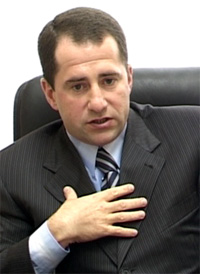
Duma Deputy Mikhail Babich

United Russia Duma deputy, and deputy chair of the Duma’s Defense Committee, Mikhail Babich believes that those who don’t agree with reforms in the armed forces are being pushed out.  NEWSru.com reports on what Babich told Interfaks

Babich says: 

“Changing military commanders–this is not a planned rotation.  This is an attempt to stop the possibility of a leak of any objective information from the troops.  Former Ground Troops CINC [Army] General Boldyrev, being a sufficiently professional military commander and understanding the hopelessness of what’s occurring, calculated it was better for him to go out on his pension than to continue putting today’s reforms into practice.  This also goes for the dismissal of very promising, well trained, and organized General [-Colonel] Sergey Makarov, but it’s only tied to the fact that the SKVO commander correctly, but very professionally established his position in relation to the negative consequences of transferring the district’s troops to the so-called new profile.  Rotating military commanders, undoubtedly, will continue to the point when those who don’t agree (with the conduct of reforms) or who have their own point of view no longer remain at all in the armed forces.” 

Babich sees General Staff Chief Nikolay Makarov appointing his SibVO loyalists to MD posts in these personnel changes. 

“The Genshtab chief is promoting people personally attached to him who owe him their military careers.  In this way, he’s trying to buy some time to cover up the negative consequences of the ongoing military reform, which are increasingly obvious today.” 

Babich said a just completed check of unit and formation combat readiness in the DVO “ended in complete failure.”   

“According to the results of the check, practically all units of the air-assault and motorized rifle brigades put on alert turned out to be not combat ready.  A complete zero–beginning from manning, ending with equipment readiness, its capability to exit the parking area, availability of mechanic-drivers and drivers, who are qualified to operate this equipment.  Despite the fact that they’ve already reported to the Supreme Commander-in-Chief [Medvedev] ten times about the fact that since 1 December 2009 all units and formations of the Russian Army have been transferred to the permanent combat readiness category and are fully combat ready, really not one of them is such.  The real situation is completely otherwise, but the Genshtab chief continues to mislead the Defense Minister and the country’s highest military-political leadership about the real state of affairs.” 

Why the Command Changes?

Writing in Grani.ru, Vladimir Temnyy reminds that Komsomolskaya pravda also indicated 58th CAA commander Anatoliy Khrulev would be retired.  This follows a theory that the Defense Ministry is cashiering all commanders from the five-day Georgian war.

But Temnyy says there are more serious reasons for the changes.  He says Serdyukov’s struggle to introduce the ‘new profile’ still has an ‘information-propaganda quality’ and real changes are coming with extreme difficulty, especially in the largest service, the Ground Troops.

According to Temnyy, here is where the greatest structural changes came–more than 20 combined arms divisions liquidated to make 80 brigades.  And although the Genshtab reported last month that all reform plans were fulfilled, today realistically not more than 10 percent of the troops entrusted to former CINC Boldyrev are ready to fulfill combat missions.  The rest are in a drawn out transitional state. 

Temnyy expects more retirements in other services.  He concludes that Serdyukov didn’t get to pick any [well, not many, certainly not most] of these military leaders.  Recent years of war, chaotic reforms, scandal, and intrigue have formed such a pack of military leaders that, if you grab any one of them, you get a real zero.

Some other thoughts…Utro.ru turned to one Yuriy Kotenok, who said the changes are a continuation of the army reforms.  He believes the departure of Boldyrev and Makarov is hard to explain since he calls them the ‘designers’ of victory in the five-day war.  They preserved the training and the units that fought, so in his opinion, their retirement won’t do anything to raise combat readiness or lead to anything good.  About the formula “retired on reaching the age limit” for service, one thing can be said, when the leadership needs it, it falls back on this method.  And considering that several [sic?] hundred thousand officers and warrants have fallen under it, the practice is sufficiently widespread.

Not terribly convincing…

One more try…Gzt.ru quotes a Defense Ministry spokesman, Aleksey Kuznetsov, who said that Postnikov is 53 and this is a good age for a Ground Troops CINC.  Kuznetsov said, in this reshuffling, the Defense Ministry’s desire for younger personnel and rotations is being pursued.  Commanders should get leadership experience in the central apparatus and then take it out ‘to the troops.’

Privately, a number of Defense Ministry sources told Gzt.ru that before the end of May chiefs of staff and deputy commanders would be changed in all MDs.  In the Genshtab, they’re expecting more high-level retirements.  By spring, Serdyukov may shed those generals who don’t agree with something in the reforms he’s introduced.  Vitaliy Shlykov hints that having new command teams in the MDs may not make the reform process easier in the short run, since they’ll need time to get oriented.