Category Archives: Serdyukov’s Reforms

The Year of Military Reform

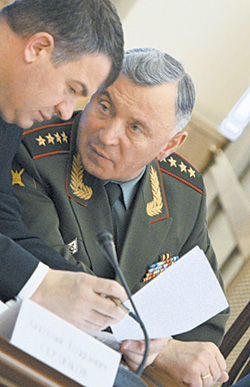
Defense Minister Serdyukov and General Staff Chief Makarov (photo: RIA Novosti)

Nezavisimaya gazeta’s number one military story of the year is the achievement of the ‘new profile.’  NG concludes not just anyone could have introduced this year’s changes.  Serdyukov succeeded where a line of others before him failed.  And he did it like Peter the Great; he didn’t consult the boyars, he didn’t pay attention to seething discontent among the troops and dismissed officers, and he completely ignored experts and the military community.

He turned the General Staff into an obedient instrument by sweeping out opponents, then proceeded to put all military units into permanent readiness.  He reduced the officer corps from 355,000 to 150,000 in one year, and established a command pyramid by reducing generals, colonels, and lieutenant colonels and adding to the lieutenant ranks.  According to Makarov, all 142,000 warrant officers were either dismissed or took another posts, often as sergeants.

Makarov says one-third of officers will receive premium pay in 2010–this will be up to 75,000 rubles for a platoon commander and 200,000 for a division commander.  He says all officers will be paid on this scale by 2012.

 The effectiveness of the reform was constantly criticized, especially when the year’s training results showed that 60 percent of the new brigades were rated only satisfactory.  Only 4 units got outstanding, and they were ships or submarines. 

Makarov says reequipping the armed forces is the next fundamental task.  He calls it the most labor-intensive, “Firstly, we have started to equip the southern districts.”  Toward 2016, the army is supposed to have 30 percent modern arms, and 70-100  percent by 2020.

The Genshtab says 37,000 officers were placed outside the TO&E (without duty posts and much of their pay) to await apartments and dismissal.  It promises they won’t be dismissed without housing, but officers don’t believe this too much.  It was promised that the Defense Ministry would get 45,000 apartments in 2009, but it really received less than 30,000 by year’s end.  Another 45,000 are promised in 2010, but these plans are being frustrated, and this is quite an important affair for dismissed officers.

Another View of the Year in Military Reform

Yaroslav Vyatkin has offered his view of the Russian military’s year in Argumenty nedeli.  He sees some of the same roadblocks as Stepanov below, but he also provides a list of what defense industry may have delivered to the armed forces this year.

He begins by describing how the five-day war with Georgia and unready Russian forces led to the decision to concentrate a large, but skeletal, ground force structure into 85 permanent readiness brigades.  He believes several years are needed to make these brigades more than ‘half-finished.’

However, not everything planned has been done.  Contract service failed, providing less than half of the soldiers promised, according to Vyatkin.  Likewise, the current professional sergeant corps program is slipping.  This year’s premium pay initiative had to be modified, because of dissension and jealousy in the ranks, to cover all officers in the best units.  Vyatkin also notes that, in the RVSN, Spetsnaz, and units stationed abroad, every officer will get the premium on a non-competitive basis.

Military reform has not been easy; there are unhappy officers and warrants who had to relocate or got dismissed, and personnel have often been treated like cogs in the military machine. 

On the positive side, Vyatkin expects Russia’s 5th generation fighter, the T-50, to fly in matter of days now.  He offers his count of the results of defense production for 2009:  6 mobile and 3 silo-based SS-27/Topol-M, a battalion’s worth of new RS-24 ICBMs, for a total of 20 strategic missiles, new aircraft including 3 Su-34SM (sic?), 9 Yak-130, 16 Mi-28N, and 2 Ka-52, 82 new T-90A1 tanks, 50 BMP-3, 200 other armored vehicles, 150 BMD-2 and BMD-4, and for the Navy, Neustrashimyy-class frigate Yaroslav Mudryy, and one submarine (maybe the Sankt-Peterburg, Nerpa, or Yuriy Dolgorukiy).  Who knows which one is being counted.

A View of a Year of Russian Military Reform

Nasha versiya’s Aleksandr Stepanov says the Russian military’s revolutionary changes in 2009 make Defense Minister Serdyukov the reformer of the year, but he’s looked a little closer to see a more mixed picture.

According to Stepanov, the Defense Ministry’s professional sergeant training program ran into problems because it lacked enough qualified candidates.  He reports more than half of them left Ryazan when they were housed in barracks rather than dorms.  Much like problems experienced by contract soldiers, there were disputes over their free time and days off, and whether they could leave the garrison. 

Unlike Serdyukov’s desire, warrant officers could not be eliminated in one stroke.  The Navy is keeping its michman schools in order to man the submarine fleet with the required number of technical specialists.  Warrants in the RVSN and VVS will also be allowed to serve to retirement if they choose. 

Stepanov calls officers who can’t be dismissed for lack of housing ‘dead souls.’  They don’t have duty posts, and are placed ‘at the disposal’ of their commanders.  They receive only basic pay, which can be difficult to obtain, and not other supplements and bonuses that provide most of an officer’s monthly salary.  Recall that General Staff Chief Makarov put the number of ‘dead souls’ outside the TO&E, but not dismissed, at 37,000.

He puts the military’s apartment deficit at 90,000, and most military men doubt the Defense Ministry will fulfill its housing promises.  The apparent dismissal of the military’s housing chief is a sign that things aren’t going well on this front.  Despite the budget money spent, the problem isn’t being solved.  The Defense Ministry can’t get the quantity of apartments it wants at an acceptable price, and many construction projects are frozen due to the effects of the economic downturn.  The military department has to buy or use land no one else wants, for instance, an allegedly contaminated former munitions dump where it is building thousands of apartments for servicemen in Vladivostok.  Given the unresolved military housing problem, the visit to Novaya Izhora and the possibility of building large single-family homes (cottages) seems a little strange. 

Serdyukov’s Order 400 which brought premium pay to the military brought not a little tension to servicemen and units.  It has been modified.  Now all officers in the best units will receive it.  For example, not just pilots but also officers working in ground crews.

The decision to add priests to the army officially was a new development for 2009.  Ninety percent of them will be Russian Orthodox, but other ‘traditional confessions’ will be represented later on a proportional basis.  These clergymen are supposed to fill the gaps left by ‘socialization work’ officers or zampolits that have been largely cut.  There is now only 1 indoctrination officer position authorized per battalion.

The armed services all look forward to new weapons systems, but the state of the OPK doesn’t inspire confidence that they will be delivered.  The Bulava SLBM debacle and the fact that the VVS won’t entertain buying Russian manufactured drone aircraft attest to this.

No one has talked much lately about Serdyukov’s new uniforms for the military.  Stepanov says fashion designer Yudashkin’s uniforms will cost three times more than the old ones.  But, from 2012, officers and contractees will no longer be issued uniforms; they’ll receive a 20-25,000 ruble stipend to pay for their uniforms.  However, a complete set of uniform items is expected to run from 130,000 to as much as 300,000 rubles.

The Defense Ministry had planned to outfit soldiers with more modern boots this year, but didn’t have the money.  So it appears that old footrags and woolen pullon boots can outlast even the greatest reformers, according to Stepanov.

Television Covers Plight of Former Garrison at Pereyaslavka-2

In recent days, TV Tsentr and REN TV have covered the situation of  civilians and military pensioners left in Pereyaslavka-2 when its unit relocated under Defense Minister Serdyukov’s ‘new profile’ reforms.  Pereyaslavka-2 is a military ‘monotown’ or garrison town that owed its existence to its unit.

Pereyaslavka-2 is located in Khabarovsk Kray, and its unit belonged to the Air Forces and Air Defense Army (AVVSPVO) in the Far East Military District.  Pilots and technicians went to their new base, but 400 civilian workers were dismissed.  When the unit left Pereyaslavka-2, 120 former military families were ordered to leave service apartments they long occupied.  These people did not move with the units and are deemed to lack any connection to the Defense Ministry and must surrender Defense Ministry housing.  Some of these former servicemen have been waiting ten years for a state housing certificate or a permanent apartment.  Their apartments are to be turned over to local civilian housing authorities. 

The Defense Ministry says these civilians must take their problems to civilian authorities.  Khabarovsk would like to take over Pereyaslavka-2, but it has not received the proper documents to do so.  Khabarovsk officials say it’s up to the Defense Ministry and the federal government to transfer responsibility for the garrison’s housing to local control.  Khabarovsk can’t take Pereyaslavka-2’s housing on its balance sheet until the garrison’s status as a closed town is lifted, but only the RF government can do this.  Meanwhile, the current inhabitants fear the local housing authorities will redistribute their apartments.

In November, Tikhookeanskaya zvezda said 2,500 families of the officers and civilians were left behind in Pereyaslavka-2.  They wrote the regional government asking who would be responsible for the normal functioning of housing, municipal services, and heating this winter in place of the Defense Ministry.  Regional officials said they were working with the military and everything was under control.  The region would retrain dismissed officers and make available some of the apartments needed for the military.

Recall this fall that former Air Forces personnel and civilians in the western Russian garrison town of Shatalovo put on their own mini-Pikalevo to protest their unit’s relocation to Voronezh.  The unit’s move left 3,000 residents in a town given up by the Defense Ministry, but not yet taken over by Smolensk Oblast.  See Kommersant for good coverage of the events in Shatalovo.

Serdyukov Says He Accomplished Everything Planned for 2009

Defense Minister Serdyukov (photo: Liliya Zlakazova)

In part one of his Rossiyskaya gazeta interview, Serdyukov said all Russian formations and units are now in permanent readiness status, practically all are manned at 98 percent or better, and no longer depend on the mobilization of men and equipment.  This is why they are now prepared for war in 1 hour.  Serdyukov said 2009 exercises showed problems with officer and soldier training, so this year the armed forces will focus on individual and battalion and lower level training.  He wants to give Russia’s Military District commanders real experience as interbranch and interservice commanders.

Serdyukov discussed the effort to introduce more physical training for soldiers and officers into the military’s day.  He believes a greater physical load on soldiers will leave less time and energy for disturbing legal order (i.e. for hazing, violence, and other crime) in the army.

Regarding next steps, Serdyukov says, “Undoubtedly, the most costly over time will be completing tasks in the systematic rearming of the army and navy.  We calculate that by 2012 in percentage terms we’ll have up to one-third, by 2020 from 70 to 100 percent modern types of equipment and armaments.”

Asked about arms procurement for 2010, Serdyukov said an increase in the volume was not bad given the economic crisis’ impact on Russia’s budget.  He emphasized the sharp cut in repairs in favor of buying new equipment.  The OPK is not ready for the task of modernizing the armed forces, and itself needs a modernization program which he expects in the first quarter of 2010.  Serdyukov defended the possibility of some arms purchases abroad as a way of catching up in areas where Russia lags.  He said there’s no final decision on the Mistral amphibious landing ship, but discussions are ongoing with France, and other countries.

Asked about unhappiness over his reforms in the officer ranks, Serdyukov said he’s aware of this, and his General Staff representatives are often out among the troops to observe situations, and report on them and possible changes.  For example, when it comes to premium pay, all officers in the best units now receive it.  In 2010, every third officer will get premium pay.  He says the Defense Ministry will try to start premium pay among contract soldiers in 2011.

Serdyukov admitted that he has absolutely not solved the military’s housing problem, but he thinks the Defense Ministry is moving out on its goal of 45,000 apartments in 2009, although he did not say how close it is to this goal.  He said that dismissed officers living in official apartments cannot be settled somewhere else at present.

In part two of his Rossiyskaya gazeta interview, Serdyukov said this year’s premium pay initiative will be the basis for military pay reform.  A lieutenant will make 45-50,000 rubles per month, a colonel 180,000, a large ship or submarine commander even more.  A contract soldier will earn 30,000 per month.  Basic pay will increase, supplements will be reduced in number, and pay for specialties will increase.  But the new system won’t be introduced any earlier than 2012.

Turning to law and order in the military, Serdyukov said the struggle against dedovshchina is not a temporary campaign.  He blames officers who are unprepared to deal with it.  He calls discipline in the ranks a major unresolved problem.

Makarov Declares Transition to ‘New Profile’ Basically Complete

According to Rossiyskaya gazeta, General Staff Chief Nikolay Makarov told a foreign military attache audience that Russia’s new military doctrine, with a reinforced emphasis on possible first nuclear use, has gone for President Medvedev’s signature.  Makarov has declared the military’s transition to a ‘new profile’ basically complete.  He says all remaining formations and units are now in a permanent readiness condition.  Although only 9 days remain in 2009, he insists the Defense Ministry will get 45,500 apartments for servicemen this year.  In line with planned cuts, Makarov said officers who have served their full careers and have housing were dismissed this year, but 37,000 were put outside the TO&E to await housing before being dismissed.  He says some 20,000 warrant officers were retained, but the rest were dismissed or transferred to sergeant positions.  General officers were cut from 1200 to 780, and Makarov claims the military is already down to only 150,000 officers.  Makarov called rearmament one of the most complex problems of reform, that will be costly and drawn out to 2020. He looks forward to a new strategic arms agreement with the U.S. that doesn’t harm Russia’s interests like START.

Defense Ministry’s Closed Session Unimpressive

General Staff Chief Nikolay Makarov

General Staff Chief Nikolay Makarov gave the main report at the 17 December session with Duma Defense Committee members.  Makarov talked about the military’s ‘new profile’ reorganization to include a reduction to three levels of command.  He talked about major exercises in 2009 and plans for the Vostok-2010 exercise to begin in late June.  Committee Chairman Viktor Zavarzin billed the topic as “The Course and Interim Results of the Realization of RF President Dmitriy Medvedev’s Decision on the Formation of a New Profile of the RF Armed Forces.”  Deputy defense ministers Nikolay Pankov and Vladimir Popovkin also reported. 

According to Gazeta, the session went 3 hours.  Committee members were unhappy because they either didn’t get an answer to their questions, or didn’t even get to pose a question.  There were not more than 15 questions.   The lengthy reports and long, drawn out answers used most of the time.  Pankov talked about officer and warrant officer cuts, but said nothing new.  Popovkin gave a secret report on arms acquisition for 2010.  He apparently indicated there aren’t, and won’t be, any alternatives to the troubled Bulava SLBM.  Deputy Committee Chairman Mikhail Babich managed to propose sharing Defense Minister Serdyukov’s Order No. 400 premium pay equally among officers of good units, rather than giving it to a few.  Someone also proposed postponing the elimination of warrant officers until the first professional sergeants appear in the ranks.

Sovetskaya Rossiya reported that Serdyukov didn’t have much to say and showed some irritation.  Makarov maintains everything’s great, but mid-ranking servicemen say otherwise; life is not like the Defense Ministry paints it.  The official answers to questions were unconvincing, and former Black Sea Fleet Commander Komoyedov says the speakers didn’t assess Russia’s combat capabilities.  For his part, he sees major problems in training personnel and rearmament.  Komoyedov concludes military men are becoming cringing and servile because they fear being put out of the Armed Forces.  N. V. Kolomeytsev wanted to know how exactly how many officers remain and how many have been put out.  Apparently, Pankov must have said only 59,000 were put out this year.  Kolomeytsev says the session was closed to keep information from getting out, but also to conceal that the Defense Ministry reforms are being introduced by incompetents.

Serdyukov’s Closed Session with Duma Defense Committee

Today’s Vremya novostey previewed Thursday’s closed Duma Defense Committee session with Serdyukov at the Defense Ministry.  A Just Russia motion to have Serdyukov appear at a Duma “government hour” on 23 December was defeated by United Russia deputies.  Just Russia wanted him to answer questions on “nonregulation relations,” including the deaths of 273 soldiers this year.  Committee Chairman Zavarzin has said Thursday’s closed session will cover hazing, discipline, and training issues.  Zavarzin also conducted the end-of-year meeting with foreign military attaches, but he talked more about a new strategic arms agreement with the U.S., Afghanistan, NATO in the Baltic, and missile defense than about the Russian military.

On 10 December, Rossiyskaya gazeta reported on Zavarzin’s meeting with the attaches and his words about Russia’s military procurement efforts.  Despite the financial crisis, Zavarzin asserted that money for arms purchases has not been cut.  Echoing Putin, he claims Russian forces will receive 30 ICBMs and SLBMs and 3 nuclear submarines next year.  Money will be concentrated on the 5th generation fighter, a new Long-Range Aviation aircraft, the S-500 air defense system, a new generation tank, an aircraft-carrying cruiser, and Project 955A nuclear submarines with the Bulava-30.  The article noted comments from RVSN Commander Shvaychenko to the effect that he hopes for a new land-based missile in 7-8 years.

Also on 10 December, Moskovskaya pravda indicated that Just Russia’s Vera Lekareva wanted Serdyukov to discuss this year’s reported 273 hazing deaths in an open session.  On 9 December, Lenta.ua quoted Just Russia faction deputy chairman Gudkov, “There’s no military secret here, the press has long ago written about everything.”

Stirrings in the Black Sea Fleet

IA Rosbalt has conjectured that Black Sea Fleet (BSF) Commander, Vice-Admiral Kletskov, might be replaced.  The outspoken Kletskov would take the hit for BSF officers’ anger over Serdyukov’s reforms.  The article says the BSF’s fundamental problem — illustrated by the 21 November submarine breakdown — is its aging order-of-battle and lack of combat capability.  Between Moscow and Kyiv, it doesn’t look like the BSF will get modernized either.  Serdyukov’s personnel cuts are hitting the BSF hard.  IA Rosbalt cites the 10,000 figure for personnel being cut loose there, and, although he’s not to blame, Kletskov could be the scapegoat for reductions. 

Dissatisfaction with Serdyukov’s reforms flows from the particular circumstances of the BSF.  Specifically, dismissed officers will not be able to privatize their service apartments, i.e. base housing.  Many of these apartments were built through the largesse of Moscow Mayor Luzhkov and his patronage of the fleet, and Moscow won’t allow them to be privatized.  But one also has to suspect the issue goes to whether ex-officers of the Russian BSF will be allowed to become permanent residents of Sevastopol.

IA Rosbalt thinks Vice-Admiral Menyaylo, who directed the amphibious assault of Abkhazia in August 2008, might succeed Kletskov, but no one in the BSF is commenting.  The rumors could just remain rumors.

The article finishes with a note about the BSF’s weakness vis-a-vis the Turkish Navy.  Can and whether Moscow wants to revive the BSF is the question.

On 10 December, ITAR-TASS said the Russian Navy Main Staff has asked the Moscow government to privatize nearly 300 service apartments for dismissed officers in the BSF.  Vice-Admiral Smuglin says 940 BSF officers are being dismissed without housing, 287 of whom want to remain in Crimea.  Smuglin notes that the BSF has 1,900 service apartments, 817 of which were built by the Moscow government.  When dismissed, officers have to leave these apartments and the situation is causing ‘social tension.’  The Moscow and Sevastopol governments are looking at whether these apartments can be transferred from the former to the latter.