Category Archives: Serdyukov’s Reforms

GRU Rumors

Moskovskiy komsomolets reported some rumors about the GRU yesterday.  But one may or may not want to put stock in them. 

MK reports that the country’s leadership is still working over a candidate for chief of the GRU.  General-Colonel Shlyakhturov’s request for retirement was given a month ago, and the president has signed it.  But MK claims the issue of GRU reform is also being decided.

The media’s widely reported that the retiring Shlyakhturov will become Chairman of the Board of the Defense Ministry’s Oboronservis corporation, which is consolidating, civilianizing, and outsourcing most of the military’s logistics and support services.  More recently, it’s been said he’ll occupy the same position with Russia’s lead ballistic missile design bureau, MIT.

MK claims Shlyakhturov isn’t retiring for failing to fulfill his mission, or for disputes with the leadership, or for age reasons (since he was already too old), or for poor health.  According to the paper’s Genshtab source, it’s because a reform awaits the GRU.

MK’s source reports there’s a plan to unify the GRU and SVR into one powerful intelligence center.  The GRU would be cut down to just an intelligence directorate with Russia’s military attaches and intelligence posts around the country, etc.

MK also reports a key appointment.  One general Vladimir Stepanovich Alekseyev has reportedly become First Deputy Chief of the GRU.  He was chief of intelligence for the former Moscow MD, then for the Far East MD.  He returned to Moscow to be chief of the GRU’s 14th Directorate (Spetsnaz), according to MK’s GRU source.  The paper says he could be chief of the GRU in the future.  Alekseyev is from GRU operational agent intelligence inside Russia and the “near abroad.”  Shlyakhturov was from strategic agent intelligence, that is, spies and operations in the “far abroad.”

OK, some of the odd stuff here . . . for one, there’s already been reform in the GRU, so wouldn’t this be more reform, or more radical reform?  MK makes the good point that it’s not clear why Shlyakhturov’s retiring — he’s been too old for a long time, so why now?  Maybe it is a much bigger restructuring that eliminates the “G” in GRU.  There’s long been talk of merging GRU and SVR, but the paper strangely refers to SVR being formally within the FSB’s structure (?!).  Now about Alekseyev . . . perhaps he’s the guy who would head an RU focused on Russia’s strategic approaches and the CIS (i.e. military opintel), while the GRU’s remaining “far abroad” assets chop to the SVR.  This makes some sense since RU-type work and opintel seems to be where the GRU failed in Georgia.  And then SVR gets swallowed by an even bigger fish, the FSB, in a grand reanimation of the KGB for Putin’s third presidential term.  But, as said at the top, one may not want to see too much in all this.
Not Proud

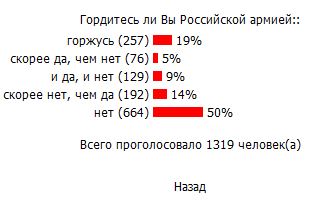
Another telling, albeit unscientific, Internet poll from Krasnaya zvezda . . . the Defense Ministry daily asks, “Are you proud of the Russian Army?”

Not Proud

The results current as of today:

  • Proud, or most likely proud — 24%.
  • Yes and no — 9%.
  • Most likely no, or not proud — 64%.

Based on more than 1,300 responses.

It’d be really interesting to see the results of an open question on what exactly leaves respondents feeling proud or not proud of the armed forces.
 
We can only guess who answers KZ’s electronic surveys.  They could be serving military men, ex-servicemen, or dependents who want to gripe, and clicking the appropriate radio button allows them to record their unhappiness.  But it’s particularly interesting that KZ and the Defense Ministry are either unconscious of these somewhat embarrassing results, or are willing to leave them out there as is.  It’d be pretty easy for them to stuff this virtual ballot box.
 

Serdyukov and Baranets

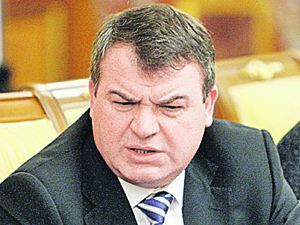
Anatoliy Serdyukov (photo: Vladimir Belengurin)

Komsomolskaya pravda’s Viktor Baranets got to prompt Defense Minister Anatoliy Serdyukov for a few statements on various topics in today’s paper.  It doesn’t seem like he really got to ask questions.

Serdyukov claims all but about 3% of GOZ-2011 has been placed, and 100% advances to the defense sector for 2012 will make for a smooth year of orders and production.  He “dodges the bullet” on not ordering Kalashnikovs.  He returns to the possibility of giving serving officers and contractees money to rent their own apartments, but this never worked well in the past.

Serdyukov says the first phase of military reform involved changing the Armed Forces’ org-shtat (TO&E) structure.  Now, he says, the second phase has begun, and it’s connected with rearming the troops.

On the state defense order (GOZ), Serdyukov says:

“During the formation of the Gosoboronzakaz, we had two issues with the defense sector — the price and quality of armaments.  We got them to open up their production “cost history.”  That is, they showed us everything transparently.  We needed to understand what they were getting and from where.  After long arguments, a compromise was found in the end.  We settled on quality criteria.  The Gosoboronzakaz is almost completely placed.  Of 580 billion rubles a little more than 20 billion was left ‘to settle.’  But we’ve also drawn conclusions from the lessons of this year.  Now the next Gosoboronzakaz will be formed in the Defense Ministry before December with such calculation that they will begin to fulfill it in January.  At the same time, we’re trying to make the Gosoboronzakaz 100% paid in advance to the defense sector.  Not another country in the world has such comfortable conditions for its VPK.”

Serdyukov says the Defense Ministry is still working on MPs, their regs, missions, training, structure, and size.  They’ll be responsible for discipline and order in garrisons and investigations.

The Defense Minister opines that Russia’s Israeli UAVs aren’t bad, but they are looking at Italian ones while domestic development continues.

Serdyukov confirmed that two new factories for producing the S-400 system will be built.  They are designed, and, he hopes, will begin production by 2015.

On tanks, the Defense Minister says they’ve taken the position that they can modernize T-72s to the level of a T-90 or better for 38 million rubles.  He believes it’s cost effective.

On the AK-74, Serdyukov claims they aren’t rejecting it, but they have depots overflowing with 17 million automatic rifles.  He says they’ll be used or modernized, some will be sold, and others transferred to other power ministries.

Serdyukov believes the draft military pay law now in the Duma will raise pensions by 50 or 60 percent.  Active military pay will be as advertised:  a lieutenant is supposed to get 50,000 or more rubles a month.  Contract enlisted will start at 25,000 or more depending on their duties.

Serdyukov hopes the problem of housing for retired servicemen will be concluded in 2013.  Then he can focus on service housing for contractees.  He proposes paying contractees to rent apartments while the Defense Ministry acquires or builds service housing.  “Apartment money” is a possibility but it has to be thought out.

The GRU and Other Siloviki

Yesterday a couple articles proved too interesting to pass up.  The first continued the theme of reorganization and reform in the GRU.  The second discussed generational change in the siloviki, and the GRU’s and the army’s place within the state security elite.

Stoletie.ru published an item on the “sad” reform of the GRU.  The article relays a couple lesser known stories of GRU history.  It covers most of the familiar story on General-Colonel Shlyakhturov [some lifted verbatim from elsewhere], but it includes a couple new details.

The author, Sergey Serov (ironically, same surname as the Beria henchman who headed the KGB, then the GRU before losing his post in the wake of the Penkovskiy case), claims with some merit:

“By the end of the 1980s, the GRU objectively had become the largest intelligence service in the world and one of the best informed.”

“But surprisingly, at the same time, it didn’t formally and doesn’t appear as a special service.  The Main Intelligence Directorate was and remains a purely army element, to which laws on special services don’t apply.  And the most outstanding GRU officer is less protected on a legal and social plane than a conscript serving in the FSB or SVR.”

“According to the current TO&E, the duty of director of the world’s largest intelligence service is a general-colonel.  And the Foreign Intelligence Service Director’s first deputies are also general-colonels.  Don’t even talk about pay, it’s not equivalent.  Also, agents like Anna Chapman in military intelligence, in contrast to foreign intelligence, have never been and could never be detected.  The GRU grew and got stronger in the years of global confrontation when large military actions by the USSR Armed Forces could have happened, and sometimes did, any place on Earth.”

“Why does a country which doesn’t have global interests requiring a military defense have the world’s largest military intelligence?  The question, sadly, sounds rhetorical today.”

“The reduction of the GRU’s intelligence and combat potential began even before General-Colonel Aleksandr Shlyakhturov.  As veterans of this intelligence service say, practically all foreign residencies were mothballed or completely eliminated, except those working in countries adjacent to Russia.  Really, why have an intelligence network in Latin America, Africa or Southeast Asia, if our country isn’t planning any kind of military action there even in the distant future?  For lack of need and with economizing in mind, they eliminated the largest intelligence center at Vietnam’s Cam Ranh.”

“But if you sort it out calmly, then it’s clear that Spetsnaz objectively became “a fifth wheel on the wagon” of the Main Intelligence Directorate.  And sending it under a foreign directorate had become unavoidable.  The problem is the fact that the Ground Troops, themselves being cut and reformed absolutely thoughtlessly, turned out unready to accept the Spetsnaz brigades, and now don’t know what to do with them.  So the future fate of Spetsnaz still has not been determined.”

“Today many assess the GRU reforms as the very destruction of an intelligence service.  I can’t believe the changes occurring fully correspond to Russia’s new foreign policy priorities.  If there are only friends around us now, how is it possible to suspect them of plots?”

Andrey Soldatov published the second article in Yezhednevnyy zhurnal

Soldatov contends a serious rift between the FSB’s generals and its rank-and-file officers developed over the rewards of service in the 2000s.  The former ensured riches for themselves, leaving the latter and those not serving in Moscow out in the cold.

More significantly for our purposes, Soldatov talks about serious divisions between Russia’s special services:

“In its turn, relations between the army and the FSB were decisively spoiled when the FSB was ordered to reinforce control over the army situation (the new Kvachkov affair, apparently, became one of the results).  In response, people close to Serdyukov started to become openly indignant at the special service’s interference in the affairs of the Armed Forces, and the idea of establishing a military internal investigations service which could replace osobisty in the units was given voice.”

So, Soldatov seems to ask, what does once-and-future President Putin do in his third term and beyond now that the siloviki, the security service chiefs he’s relied on, are near or over 60 and ready for retirement:

“Nikolay Patrushev, head of the Security Council, was born in 1951, FSO Director Yevgeniy Murov in 1945, Mikhail Fradkov (SVR) in 1950, Aleksandr Shlyakhturov (GRU) a 1947 birth, Aleksandr Tsarenko (GUSP) born in 1948, Viktor Ivanov, head of the FSKN in 1950 and, finally, Aleksandr Bortnikov, FSB Director, in November of this year will be 60.”

Soldatov suggests soon-to-be former President Medvedev knew someone like Shlyakhturov, and possibly other siloviki chiefs, would be willing to make unpopular cuts and reforms in his own fiefdom in return for a guarantee of a few extra years of service.

Soldatov’s point is to remind readers (once again) that the siloviki are far from monolithic.  They are divided along agency lines and within agencies.  Their biggest fights are among themselves.  But Soldatov also finishes with a warning that the mid-level siloviki are so passive, so resigned to their fate, that this could be dangerous when the country faces a real crisis.

New GOU Chief

General-Lieutenant Zarudnitskiy

President Medvedev’s decree today formally dismissed General-Lieutenant Andrey Tretyak, Chief of the Main Operations Directorate (GOU) and Deputy Chief of the General Staff, from military service. 

Recall 52-year-old two-star Tretyak was one of the “general troyka” whose early departure from the army was debated in the media this summer.

Taking Tretyak’s place at the GOU is General-Lieutenant Vladimir Borisovich Zarudnitskiy.  Here are some of his particulars courtesy of RIA Novosti.

The 53-year-old general-lieutenant was born on February 6, 1958 in the Abinsk, Krasnodar Kray. 

  • In 1979, he graduated the Ordzhonikidze Higher Combined Arms Command School in Vladikavkaz. 
  • He commanded a platoon and a recce company in the GSFG until 1985. 
  • In 1985-1987, he was recce chief in a GSFG regiment.
  • He attended and completed the mid-career Frunze Military Academy in 1988-1989.
  • In 1991-1994, he picked up his career in the Far East MD as chief of staff, then commander of a regiment.
  • In 1997-1999, he was chief of staff, then commander of an independent motorized rifle brigade in the North Caucasus MD. 
  • He graduated from the General Staff Academy in 2003, and commanded the 27th Guards Motorized Rifle Division in the Volga-Ural MD until early 2005.
  • Until early 2007, Zarudnitskiy was chief of staff, first deputy commander of an army in the Siberian MD, and then commanded the Siberian MD’s 36th Army based at Ulan-Ude until April 2009.
  • From 2009-2011, he was chief of staff, first deputy commander of the Moscow MD.  

When the six existing MDs were reformed into four, and the Moscow MD disappeared, Zarudnitskiy was assigned as deputy commander of the Southern MD until his appointment as GOU Chief today.

Zarudnitskiy’s a troop general, not a staff officer.  Like several other generals who’re moved upward, he served some time directly under General Staff Chief Nikolay Makarov in the Siberian MD.

Once larger in size and stature, the GOU must be a tough assignment these days.  Zarudnitskiy is the organization’s fourth chief in four years.

Russian Military Power

Finland’s National Defense University has published a study entitled Russian Politico-Military Development and Finland.  If the media reporting is accurate, it may read a little like a latter-day Soviet Military Power.

Now few have read the document since there’s only a two-page English precis to go with press accounts of its contents.  Perhaps the entire thing will appear in English soon.

But here’s the gist. 

NATO and other Western countries believe war is an outdated idea, and U.S. power and interest in Europe are waning.  Russia, meanwhile, is seeking to revise the verdict of the Cold War, restore its great power status, and regain the Soviet sphere of influence.

It’s modernizing its crumbling armed forces with increasing investments [i.e. the 19-trillion-ruble State Program of Armaments or GPV 2011-2020].  The formation of the Unified Strategic Command (OSK) West (aka the new Western MD) has shifted the Russian Army’s center of gravity from Western Europe to the Northwest [at Finland].  And:

“The Russian armed forces are being improved by forming high-readiness forces with a capability of achieving operational results directly from peacetime employment.”

Finally, the study’s authors seem to see a Russian military resurgence that needs to be met by reinvigorating Finland’s territorial defense system:

“A large military reserve force is an indication of the will to defend the country, and has a major preventative value.”

It’s worth challenging three central propositions here.

Russia’s “increasing investments” in its military.  The Finnish report is reacting a priori to plans for large outlays for defense procurement that may or may not happen.  They authors are concerned about Russia’s intention to modernize, and what its forces might look like after modernization.  The current GPV could go the way of its predecessors; the first annual state defense order (GOZ) to fulfill the GPV isn’t exactly proceeding smoothly.  It’s important also to consider what’s being modernized.  In many cases, Moscow plans to replace arms and equipment from the 1980s and earlier, and not everything will be a world-class fourth- or fifth-generation weapons system.  Lots of the “new” models will be based on late Soviet-era designs.  

The shift to the Northwest.  To some extent, there may be an effort to get forces closer to their likely theater of operations.  But hysterical assertions of vastly increased Russian forces shouldn’t be taken seriously.  It’s largely the same forces organized differently, and certainly not all opposite Finland.  The creation of OSK West or the Western MD was also an attempt to cut redundant command and staff echelons and get the Ground Troops out of the expensive environs of Moscow and Moscow Oblast.  One could easily argue the Defense Ministry’s placed a higher priority on forces in the Southern or Eastern MDs. 

The formation of high readiness units.  The report’s authors are quoted as saying Russia’s high readiness forces will be ready to leave garrison, and begin offensive operations in an hour, according to Vzglyad’s interpretation of a Russian-language media outlet in Estonia.  In reality, the forces are now more highly ready to depart the garrison and get combat orders.  No one can say what those orders will say.  Any combat missions will have to be carried out by troops who generally have less than six months in the army, and they’ll be lucky to execute a successful defensive operation.  Also, let’s hope the Finnish study says that this high readiness was really more about getting rid of useless, hollow, low readiness cadre units.

But, as Newsru cites a former deputy commander of the OGV(s) in the North Caucasus, it’s hardly possible to talk about Russian efforts to encircle anyone “in the condition which we’re in, and with those obvious army problems which we have.”

No one should misunderstand.  The Finns are to be admired for their perspicacity when it comes to Moscow.  They’re keen observers of what’s happening in Russia.  They have to be. 

But there’s obviously a huge issue of perspective.  Things look very different from Helsinki, Washington, Paris, London, and Berlin.  Russia’s capabilities are somewhat hyped in a public debate about what level of forces and readiness Finland needs to deter Russia.

But, all in all, it doesn’t help anyone in the long-term to inflate [re-inflate?] a Soviet-style military threat.  A realistic assessment of Russian capabilities and intentions will lead to practical, affordable measures to counter them.

The Military’s Most Authoritative

Russkiy reporter published its 2011 list of the 100 “most authoritative” Russian people — ten each in society, business, bureaucracy, academe, education, medicine, law, military, culture, and sports.

Avtoritetnyy, of course, isn’t just a cognate; it can mean influential, competent, trusted, reputable, respected, expert, etc.

You can read about last year’s picks in the military field here.  This year’s military list includes:

  • Deputy Defense Minister Anatoliy Antonov, for knowing how to talk to foreigners.
  • Western MD Commander, General-Colonel Arkadiy Bakhin, for housing officers.
  • Sukhoy test pilot Sergey Bogdan, for testing the fifth generation fighter.
  • General Staff Chief, Army General Nikolay Makarov, for disbanding the “Arbat Military District.”
  • State Secretary, Deputy Defense Minister Nikolay Pankov, for reforming military education.
  • President, General Director of RSK MiG, Chairman of the Board of Sukhoy, Mikhail Pogosyan, for developing the latest Russian weaponry.
  • Head of the Veteran-Military Chiefs Club, Marshal of the Soviet Union Sergey Sokolov, for 100 years in the ranks.
  • General Director, “Tactical Missile Armaments” Corporation, Boris Obnosov, for fast, accurate missiles.
  • Air Forces Senior Lieutenant Igor Sulim, for courage.
  • President, Academy of Military Sciences, Army General Makhmut Gareyev, for asserting the results of the Second World War.

It’s an interesting and eclectic list.  Clearly, many would dispute the names.  Some would say Pankov wrecked the military education system; others would say he implemented unavoidable reductions and consolidations.  Picking Makarov for breaking up the “Arbat Military District,” and sending more officers out to serve with the troops is also controversial, but he’s done something essential and long overdue.

Sokolov’s honored for his longevity. 

Obnosov’s interviewed in the lead article.  He talks about attracting and retaining young scientists and engineers in the defense sector, and about the OPK’s attempt to reach an understanding with the Defense Ministry on price formation.

Sulim’s a surprise, and a rather bold choice.

Only Makarov, Pogosyan, and Gareyev repeat from last year’s list.

RR picked Deputy Defense Minister, Army General Dmitriy Bulgakov as its goat of the year for the spate of deadly army arsenal explosions. 

The big “loser” Bulgakov’s in the same boat as some of the “winners.” 

He found himself in charge of a long-neglected and untenable situation, and he’s tried to fix it.  But many people will object and argue about his methods, the results, and consequences.

“Moor” GRU Changes

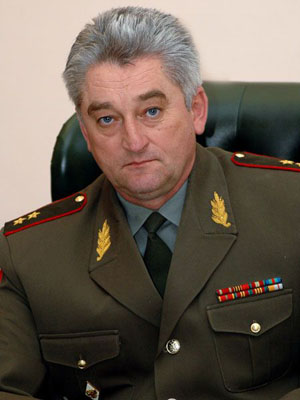
GRU Headquarters

Yesterday we got diametrically opposed views of the GRU.  Argumenty nedeli  argues the situation inside the GRU is a mess.  Rossiyskaya gazeta, however, defends the GRU’s exiting chief, General-Colonel Shlyakhturov and the reforms made in Russia’s military intelligence agency.

Argumenty writes that the Main Intelligence Directorate is being “optimized” into a simple directorate, and this is evidence that Russian military intelligence simply no longer exists.  To news about Shlyakhturov’s departure, the paper says GRU officers have Schiller’s reaction:  “The Moor has done his work, the Moor can leave.”  

A GRU officer tells Argumenty that the agent operations staff has been completely destroyed, and information “extraction” tasks are no longer levied.  “Radiotechnical” [SIGINT] and space reconnaissance sub-units that remain now take orders from more important armed services and branches.  Central staff and analytical sub-units have been cut to the minimum.  This month the General Staff Chief directed the GRU to dismiss personnel on age grounds where possible [maybe Shlyakhturov included], and rotate others to the military districts. 

And, the officer says, it’s been announced that in the next round of reforms in 2012 the GRU will become a simple directorate [rather than a main directorate] of the Genshtab, and relocate to the Genshtab building on the Arbat.  

President Putin Visiting the New GRU Headquarters in 2006

The officer tells Argumenty only rear support and cleaners will remain, and any of Anatoliy Serdyukov’s former tax inspectorate chiefs can manage them.  He says the majority of “the boys” actually prefer this turn of events, and have already found jobs in the civilian world.  He adds that the new GRU building on Khodynka will be sold, and it’s important not to leave secure comms and secret documents behind.  There were precedents for that, the officer joked bitterly.

If this officer’s version pans out, you can bet the GRU complex, and the Moscow real estate it sits on, will fetch a high price for the controllers of Defense Ministry coffers.

RG offers a more positive spin on what’s happening in the GRU.  Firstly, it says there’s no intrigue in Shlyakhturov’s exit.  It’s simply on age grounds.  The paper says the soon-to-be ex-GRU chief was well-respected, and implemented the reforms required of him. 

The fact is, it contends, the agency managed to avoid most of the changes that shook the rest of the country and Armed Forces in the past two decades.  It was organized in same way as when it was established in Soviet times [i.e. it was organized for the Cold War and World War III], and was naturally somewhat out-of-step with the state’s new “social-political structure” and needed to be changed.  And Shlyakhturov implemented changes that other chiefs [i.e. there was only one–Korabelnikov] couldn’t.

Instead of more than 100 GRU generals, according to RG, there are now only 20.  Spetsnaz brigades were cut and given over to Ground Troops reconnaissance.  And there were other changes either secret or understandable only to professionals [so much for civilian control].

Not all the transformations were palatable, RG writes:

“But the majority of cadre military intelligence men are sure that Aleksandr Vasilyevich conducted a completely unavoidable reform in the softest and most optimal form.  No one would have coped better with this mission than him.

RG indicates Shlyakhturov is in good health, and will likely take a post in a big business or serve as an advisor to the Defense Minister.

For good measure, the paper concludes:

“Intelligence men are sure that a competent reform of the Genshtab’s Main Directorate will be only beneficial, giving the GRU more mobility, and providing technical intelligence monitoring systems with the most modern equipment.”

All in all, it seems quite an apology for Shlyakhturov and the state of the GRU. 

Sunday on Pushkin Square

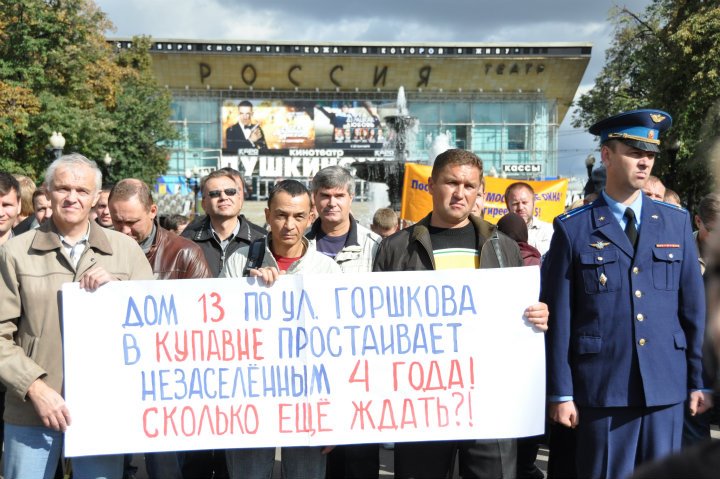
Waiting to Occupy Finished Apartments in Kupavna (photo: Mikhail Pavlenko)

Sunday’s “Army Against Serdyukov” demonstration took place as planned on Pushkin Square.  About 500 people attended, but organizers hoped for as many as 1,500.  The participants were orderly, and the police presence was light and relaxed compared with more overtly political protests.  Novyye izvestiya claimed there were similar meetings in Arkhangelsk, Murmansk, Severodvinsk, Stavropol, and Samara but the press reported only on protests in the latter city.

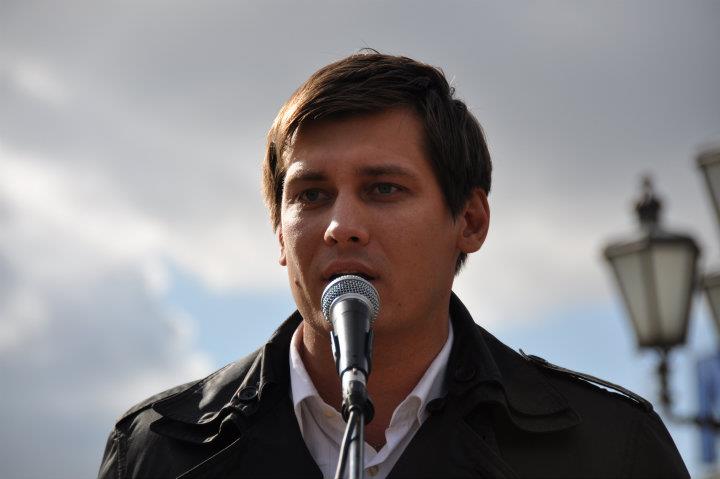
Dmitriy Gudkov used the occasion to publicize the Public Council for the Defense of Legal Rights of Servicemen’s appeal to President Medvedev.  Besides demanding Defense Minister Serdyukov’s resignation, the appeal calls for an end to violations of servicemen’s housing rights and to the collapse of the military education system and defense industry.

Dmitriy Gudkov (photo: Mikhail Pavlenko)

Gudkov told NI:

“We need to unite servicemen who today are dissatisfied with the state of affairs in the army.  There is a failure of all army reform, collapse of the defense sector . . . .  The breakdown of the military housing program.  Two hundred thousand officers’ families around the country who haven’t received apartments.  Military pensioners who today have a pitiful allowance.”

In remarks to Radio Svoboda, he said deceived servicemen may form their own, alternative list of those officers who are still waiting for their promised apartments.

Gudkov also claimed there were attempts to prevent the gathering:

“On the Internet, information was put out that the meeting would occur on Saturday.  Instructions went to all military units that anyone seen at the meeting would be dismissed.  The Defense Ministry did everything to disrupt this action.  But in vain.”

Hero of the Russian Federation, Cosmonaut Sergey Nefedov gave the introductory speech to the crowd on Pushkin Square.

Gudkov gave an account of Sunday’s event on his ЖЖ in which he said the protestors insist on their legal rights, and refuse to be silent although the authorities want to ignore them completely.  He called military reform not reform, but the collapse of the army.  Gudkov said the meeting wasn’t just against Serdyukov, but against all who don’t know how to manage the state in a professional manner, and those who are not up to their duties.  He concludes:

“Demonstrations, meetings – this is only the tip of the iceberg of the people’s agitation.  The number of those who’re ready to go in December to the polls and express their distrust in this government is growing larger.”

The Public Council is considering establishing a tent camp outside the Defense Ministry during the run-up to the elections, according to Gudkov.

Gudkov said television covered Sunday’s meeting, and cameras and microphones were visible in photos, but there were no TV news reports on the event.  There are, however, lots of videos and photos on Mikhail Pavlenko’s ЖЖ.

Two last items deserve mention.  Radio Svoboda talked to a retired Northern Fleet major, a military lawyer, named Igor Chuykov from Murmansk who spoke at Sunday’s anti-Serdyukov rally.  Chuykov described the situation among military men in his city:

“The movement in Murmansk is very serious.  Thanks just to this movement, those who participated in pickets in Murmansk, in Murmansk Oblast are now really getting apartments –those who were dismissed after 2005.  Those dismissed before 2005 are being given [state housing] certificates.  Somehow on these certificates it’s even possible to buy something.  The Kola Peninsula – this could be the only place where there are considerably more military men than MVD.  The smallest conflict between the military and police would lead simply to an uncontrollable escalation of violence.  The authorities quickly understood what this could lead to.  Therefore, the authorities’ priority task now is to pacify families.  People simply have no recourse.  It’s the fault of the state:  it forced people into open acts of disobedience by its own irresponsible, unprofessional actions.”

Radio Svoboda also quoted Viktor Baranets:

“In the army, there are many professionals who understand that military reform is going, to put it mildly, very badly.  Genshtab chief Makarov even attested to this when he honestly admitted at an officers’ assembly that we began military reform without any kind of scientific basis and calculations.  The most important social problem is housing.  They constantly fool the army, constantly change the rules of the game.  Here we need to observe a single very serious point – military men are beginning to organize.  The government must turn attention to this, but it stubbornly doesn’t want to do it.  I have the impression that they either are afraid of criticizing Serdyukov or afraid of openly recognizing that military reform has failed.  And just people who go to the demonstration, who announce their disagreement with Serdyukov’s methods of conducting reform, — they also want to get through to the Kremlin, to the government, to the state, to the Duma so that, in the end, some kind of decision will be made.”

Army Against Serdyukov

To a Wagner soundtrack, the video shows the miserable life of some military, or ex-military, men.

Dmitriy Gudkov and the Public Council for the Defense of the Legal Rights of Servicemen have organized what they believe will be a 1,000-person demonstration against Defense Minister Serdyukov’s reforms for Sunday afternoon on Pushkin Square.  The rally’s advertised as “The Army Against Serdyukov.”

Nakanune.ru provided some sound bites about the protest (although it also gave the wrong day).  The protest’s a reprise of a May 22 demonstration.  Gudkov claims it’s not a party action, and participants will be “average people and their family members.” 

The meeting organizers accuse Serdyukov of causing the collapse of the army, breakdown of the state defense order, genocide of military pensioners, and sabotage of the military housing program as a result of which 200,000 officers and their families remain without apartments.  They further allege that:

“The country’s defense capability level under Serdyukov has declined catastrophically, such that in the long-term it could bring a threat of the loss of Russia’s sovereignty.”

Participants will call on President Medvedev to fire the Defense Minister and his team.

Protests against Serdyukov will also be held in Murmansk, Yekaterinburg, Samara, and Kaliningrad.  The Naval Sailors’ Union, the Initiative Group of the Forum for Servicemen’s Mutual Legal Aid, and Deceived Shareholders from the Defense Ministry (i.e. servicemen whose housing rights have been violated) will join in the meeting.  Nakanune also listed the Airborne Union as a supporting organization.

Gudkov’s an interesting character.  He’s the son of Gennadiy Gudkov, a deputy leader of Just Russia (SR) and Duma member. 

Older Gudkov is Deputy Chairman of the Duma’s Security Committee, and member of Duma commissions overseeing budget expenditures on defense and state security, and legislative support for counteracting corruption.

Younger Gudkov leads the youth wing of SR, and he’s a member of the MVD’s Public Council.  His ЖЖ is here.   The September 15 entry announces the Sunday protest meeting.

It’ll be interesting to see what transpires Sunday — what kind of turnout, what kind of reaction, how much media coverage, etc. 

There’s a clear protest mood in the military, active and retired.  Vlast monitors it, and occasionally sees a need to assuage it. 

Recall the discontent from the VDV last fall over Serdyukov’s alleged high-handed treatment of a professional military officer at Seltsy.

There’s a new spate of promises recently to solve, once and for all, the military’s housing problems.  This time they come against a backdrop of fast-approaching elections and tighter budgets.

Other usual sore points for vlast will be winter heating in remote garrisons, and the ever-present headache of administering a still-large number of semi-derelict military towns (or monotowns) that regions don’t want.

Of course, unexpected sore points can appear too.