Category Archives: Training and Exercises

A Thoroughly Modern CINC

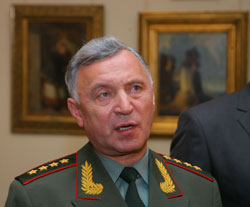
You have to like Air Forces CINC, General-Colonel Aleksandr Zelin. 

He’s open and candid about what Defense Minister Anatoliy Serdyukov’s ‘new profile’ reforms mean for him and his service.  He’s talked earlier, more often, and longer about it than his Ground Troops or Navy counterparts.  He’s matter of fact and accepting of the entire process. 

Serdyukov’s changes turned General-Colonel into a trainer and force provider, and he nonchalantly admits as much. 

At 57, Zelin understands he can be replaced at any time, or allowed to serve three more years or even longer. 

If he were a tad younger, he would have been the right kind of general to command one of the new military districts / unified strategic commands (OSK / ОСК), say the Western or Central.  An air or air defense officer would have been just the right choice for a potential future war on those axes.  Instead, the Kremlin has three Ground Troops generals and one admiral (a step in the right direction).  It’s hard to argue against Ground Troops leadership in Russia’s restive south.  But Air Forces (VVS or ВВС) would have been a really good choice in the Western or Central Military Districts . . . a missed opportunity for now.

But back to Zelin.  On Tuesday, he addressed a foreign military attaché audience (and the Russian media) about the future of the VVS.

According to Gzt.ru, Zelin said the VVS will be reduced by a third and spread among the four new  OSKs.  And its Main Command (Glavkomat) will be responsible only for combat training.  The OSKs are in charge of employing the VVS in their theaters.

The VVS now consist of the Glavkomat, 7 operational commands, 7 first-rank air bases, 8 second-rank air bases, and 13 aerospace defense (VKO) brigades.  Before the ‘new profile,’ the Air Forces consisted of 72 regiments, 14 air bases, and 12 independent squadrons and detachments, with a third more aircraft than the VVS now have.

Four of today’s 7 operational commands are subordinate to the new OSKs.  Army Aviation also falls under them.

According to Zelin, in the future, the VVS Main Command (Glavkomat or Главкомат) could become a “branch department” of the General Staff responsible for the combat training of the Air Forces and Air Defense, while the OSKs employ the trained forces.

Zelin says VVS personnel will number 170,000 with 40,000 officers, nearly 30,000 sergeants, and the balance conscripts or civilian specialists.  He says today’s personnel training system doesn’t satisfy him, and so he’ll probably change the system of flight schools.  Only four remain today.  Voronezh will be the main training center.  Flight training will also be conducted in Krasnodar and Lipetsk.  Yaroslavl will remain home to air defense officer training.

According to the CINC, the VVS airfield network won’t change.  Base airfields will be first priority for reconstruction and modernization.  Zelin says civilian airfields could be used for operational purposes in the future.

He noted the VVS plans to go to a fully automated command and control system in the future, and, of course, develop its VKO forces.

Lenta.ua quoted Zelin’s remarks to Interfaks.  Zelin said the VVS will renew 30 percent of its inventory by 2015, and 100 percent new in some areas and 80 percent new overall by 2020.  He doesn’t say where the VVS are today in this regard, but recall Defense Minister Serdyukov has said only 10 percent of equipment in the Armed Forces is modern.

Zelin said the VVS will get new aircraft, air defense, reconnaissance, and electronic warfare systems, but modernization of some existing systems is still part of the plan.  Although the State Armaments Program 2011-2020 and its 19 or 20 trillion rubles have to be finalized, Zelin repeated that 10 T-50 (PAK FA) will be acquired in 2013-2015, and 60 more from 2016.  He mentioned Military-Transport Aviation (VTA or ВТА) is a priority – including the An-124 Ruslan, Il-112, Il-476, Il-76M, and An-70 – but he doesn’t venture any numbers or dates for new production.  Zelin does give a target of 400 new and modernized helicopters in the inventory by 2015.

Who knows what was or wasn’t covered in these media contacts, but it seems odd there’s still no mention of more S-400 deliveries.  Zelin was still talking about getting 5-6 more battalions in 2010 earlier this year.  But no sign of them.  It’ll be a big deal when or if they appear.  Also, no mention of S-500 development.
Medvedev Inspects Strategic Forces

In Friday’s Nezavisimoye voyennoye obozreniye, Viktor Litovkin claimed, the day before, President Dmitriy Medvedev visited the inner sanctum of Russia’s Aerospace Defense (VKO or ВКО) – the Central Command Post (ЦКП) of the 3rd Independent Air Defense (Missile Warning) Army in Solnechnogorsk.  Now Litovkin admits VKO doesn’t technically exist yet.  But preparations are underway, and he suggests, besides PVO, SPRN, PRO, space monitoring, etc., it will even include the RVSN.  Litovkin maintains tests of this system are ongoing, and Medvedev came to inspect it.  He watched troops track all three of Thursday’s SLBM and ICBM launches, and saw the missiles’ warheads land on their respective targets.  And, according to Litovkin, the point was to demonstrate the reliability of Russia’s nuclear missile capability to Medvedev as new SNV treaty limits loom.

Could the shrinking RVSN be subsumed under VKO as a new service or branch?  Could this explain the fairly rapid command shifts from Solovtsov to Shvaychenko to Karakayev?

Strategic Forces Training

Russia fired two SLBMs and an ICBM today.  Pacific Fleet Delta III SSBN Saint Georgiy Pobedonosets launched an SS-N-18 (RSM-50) SLBM from the Sea of Okhotsk.  Northern Fleet Delta IV SSBN Bryansk fired a Sineva (RSM-54) SLBM from the Barents Sea. 

And a crew from the Vladimir Missile Army’s Bologoye Division launched an SS-25 (RS-12M/Topol) ICBM from Plesetsk.

An RVSN spokesman said this launch allows Russia to extend the service life of this grouping of SS-25s to 23 years or until about 2015, and to conduct a planned replacement of these missiles without overburdening the military’s budget.

Yesterday Tu-95MS and Tu-22M3 bombers launched weapons on ranges in Irkutsk and Komi as part of an Air Forces exercise.

According to some reports, the Navy may test fire the Bulava SLBM for the second time in 2010 tomorrow.

LRA Command-Staff Exercise

Today Russian Long-Range Aviation (LRA or ДА) began a large three-day command-staff exercise (CSX or КШУ) under Air Forces CINC General-Colonel Aleksandr Zelin’s direction.  The CSX involves units from Siberia, the Far East, but also Lipetsk, and 40 aircraft including the Tu-160, Tu-22M3, Tu-95MS, Il-78, A-50, MiG-29, MiG-31, and Su-27SM.  They will operate both from their home and temporary bases, and fly over central Russia, the Far East, and extreme northern parts of the Russian Federation.  A-50 crews will control the airspace for the exercise.  Il-78 tankers will conduct mid-air refueling, and ranges at Pemboy near Vorkuta and at Nogotay in Irkutsk Oblast will be used for missile launches and other weapons training.

Makarov Talks to Duma Defense Committee

Nikolay Makarov (photo: Rossiyskaya gazeta)

Last Thursday, General Staff Chief, Army General Nikolay Makarov spoke to a closed session of the Duma’s Defense Committee about the situation in the armed forces.  A few committee members were kind enough to inform the press about some of the discussion.

Rossiyskaya gazeta said it’s no secret the Defense Ministry wants more money in its 2011 budget.  And the generals’ arguments are well-known — the army needs to reequip, relocate, and raise officer pay.  Additional financial means are needed for this.  Makarov didn’t avoid this issue, and he had a lot of supporters.  Deputy committee chairman Yuriy Savenko had this to say on the issue of budget and rearmament:

“Today there isn’t just not enough money for this.  We have to recognize that our military industry has sagged a lot over the last two decades.”

Makarov apparently commented on Bulava, seeing the recent successful launch as opening the way for its quickest acceptance into the Navy arsenal.  But he said first it has to complete three [not two] more tests.  The next won’t come earlier than November, and the first from Yuriy Dolgorukiy possibly before year’s end.

The General Staff Chief talked about the country’s new military-administrative divisions, claiming the reduction to 4 MDs isn’t causing major troop relocations, but rather allowing the army to stand-up additional combined arms, reconnaissance, and airborne brigades on its strategic axes.

He apparently mentioned the introduction of information management systems into the troops is a priority.

Nezavisimaya gazeta’s Viktor Litovkin reports Makarov said Russia will hold just one operational-strategic exercise, Tsentr-2011, next year, and, after it, the focus will be on tactical platoon and company exercises.  Litovkin says the issue isn’t money, but the time it takes to train units from platoon to brigade in what they need to demonstrate in a big exercise.  And training time is too short with one-year soldiers.  He reports the army’s decided to put all officers from new lieutenants to generals through tactical retraining and improvement courses.

KPRF Deputy, Vladimir Komoyedov — former Black Sea Fleet commander — commented a little on what he heard.  He said Makarov mainly touted what’s been achieved the last two years.  Komoyedov said he heard about conventional forces, but not much about strategic ones, and when he asked specifically about naval strategic forces, Makarov’s answer didn’t satisfy him.  Komoyedov spoke to Tverskaya, 13, but he quickly spun off into his own commentary, rather than Makarov’s.

Perhaps the most press went to Makarov’s announcement that the Defense Ministry will go forward with military police units in the armed forces after all.  They’ll reportedly number about 20,000 personnel.  MP sub-units will be present from brigade to military district, and they could be manned by servicemen dismissed in the course of Serdyukov’s reforms.

Finally, Komsomolskaya pravda says Makarov has told it about various changes in the army coming in the next five years.  Some are not all together surprising, but there are new twists on others:

  1. A two-pipe Defense Ministry — military and civilian, with the latter handling money, personnel, and support.
  2. Hired cleaners, maintenance people, and security guards for the barracks.
  3. Military pay via bank cards to make it more difficult for older soldiers to extort money from new conscripts.
  4. Contractees will get 30-35 thousand rubles per month.
  5. Conscription will stay at one year (there are 156,000 men with deferments and 130,000 evaders).
  6. Specialty training time for soldiers needs to be cut from 6 to 2-3 months.
  7. Tsentr-2011 will occur, but other exercises will focus on the company-level and lower.
  8. There will be 8 aviation centers [bases?], but 4 would be ideal.  Air defense aviation will have 2 months on duty, and 2 months at home.
  9. Glavkomaty of services and branches will be cut from 1,000 personnel to about 150 or 200.  Generals’ duties will go out to the new MDs.  All the ‘glavki’ will relocate into the Ground Troop headquarters on the Frunzenskaya embankment.
  10. The Genshtab will keep its hands on strategic submarines, bombers, and the RVSN.
  11. The VDV will not be cut, and will continue to report through the Genshtab.  They are likely to be reinforced with new brigades.
  12. The Navy will get 1-2 nuclear-powered submarines each year.  New aircraft carriers are in development.  The fleet gets 23% of the defense budget, the RVSN 25%.

More Testing for YeSU TZ

RIA Novosti reports that, starting tomorrow, the Defense Ministry will test its developmental Unified Tactical Level Command and Control System (YeSU TZ or ЕСУ ТЗ) on its range at Alabino in Moscow Oblast until 23 October. 

This is not the first time the system’s been tested, but a Ground Troops spokesman says:

“In the course of the exercises for the first time the capability of the given system to support the work of sub-unit [battalion and below] command and control organs equipped with its command and control stations [YeSU TZ] will be tested in the course of combined arms combat.”

As is often the case, the 5th Independent Taman Motorized Rifle Brigade will be used in the testing.  Command and control for the brigade will also employ “new technical means.”

Proposals and recommendations on the use of the automated system will be made for combat regulations based on the results of the exercise.  Mi-24 helicopters, Su-25 aircraft, and Russian-produced UAVs will also participate.

Collegium on MDs and Antiterrorism

Last Thursday, Defense Minister Serdyukov conducted an extramural ‘board of directors’ meeting in St. Petersburg.  The agenda had two publicized items — forming the new Western Military District (MD) and antiterrorism.

Deputy Defense Minister, General-Colonel Dmitriy Bulgakov (effectively chief of material-technical support) and acting commander of the new Western MD (ZVO or ЗВО), General-Colonel Arkadiy Bakhin reported on the new district.  Genshtab GOU Chief, General-Lieutenant Andrey Tretyak reported “On the Condition of Antiterrorist Work in the RF Armed Forces and Measures to Neutralize Terrorist Threats.”

In its coverage, ITAR-TASS noted that recommendations from forming the ZVO will be applied to the new Southern, Central, and Eastern MDs. 

After the collegium, General Staff Chief Nikolay Makarov told journalists that work on the ZVO was being closely analyzed, and all issues had been resolved in the main.  But its command doesn’t fully recognize the importance of its tasks, and its combat training demands higher quality work.  Makarov called this a consequence of the fact that, for 15 to 20 years, almost 85 percent of officers in command and control organs didn’t command troops. 

Of course, Makarov considers himself a ‘troop general’ and that 85 percent figure makes it easy for him to oversee cutting the officer corps by 50 percent.

Makarov said the terrorist attack near Buynaksk was being closely analyzed, and noted that commanders didn’t take measures necessary to protect their people.  But the tasks essential to countering terrorist threats have been identified.

Krasnaya zvezda reported that Serdyukov met human rights organization representatives during a break in the collegium.  More on this later.

Air Forces News

A couple Air Forces items of interest today . . . .

A major live-fire exercise is taking place in the Far East today and tomorrow.  According to RIA Novosti, about 20 aircraft from the Far East Air Forces and Air Defense Army will fire more than 30 air-to-air missiles over the ‘Endurance Bay’ range on Sakhalin Island. 

A Defense Ministry spokesman said the aircraft are Dzemgi-based Su-27 fighters, and they’ll perform both day and night firings.  He emphasized that junior pilots will participate in the exercise.

There’s no readily available indication of the last time the Russian Air Forces conducted live-fire air-to-air training on this scale, so one presumes it’s been a while. 

Visiting Voronezh today, Air Forces CINC, General-Colonel Zelin said the city’s air base — soon to be one of Russia’s largest — will get four Su-34 bombers by year’s end.  The air base will be a first rank one, with 100 or more aircraft.

RIA Novosti reports the base’s expansion isn’t making nearby residents happy.  Those who object to it say its noise exceeds permissible levels, and causes headaches and sleeplessness.

On the Su-34s, Zelin said:

“I was recently at Novosibirsk aircraft plant.  One aircraft was already in flight test status.  The remainder are already in final assembly.”

BMD-4M Update

BMD-4M

An item on pending troop testing of the BMD-4M for VDV . . . .  No, they aren’t in the force yet.  Despite the optimism expressed below, it remains to be seen if the Defense Ministry will actually order the system upon completion of troop testing.  It sounds like the designers and builders have footed the bill — 200 million rubles — for the system’s development thus far.

From this week’s Voyenno-promyshlennyy kuryer:

“Troop testing of the modernized airborne combat vehicle BMD-4M is being conducted in the course of the 98th Airborne-Assault Division’s command-staff exercise (KShU), which will take place from 23 to 28 August near Ivanovo.”

“During the airdrop of military equipment, seven BMD crews will be inside the combat compartment of these vehicles.  Immediately on landing, the crews will move out to fulfill combat missions on unfamiliar terrain in the notional enemy’s rear area.”

“An airdrop of parachute troops and military equipment from aircraft of Military-Transport Aviation will occur in the course of the divisional KShU, which will be directed by VDV Commander General-Lieutenant Vladimir Shamanov.  In all, it’s planned to airdrop 15 pallets with military equipment, including the BMD-4M.”

“After the completion of troop testing of the modernized combat vehicle, development of which Kurganmashzavod, the Volgograd Tractor Plant and other enterprises of the ‘Tractor Plants’ Concern are engaged in, it will be accepted into the arms inventory of the ‘winged infantry’ and included in the state defense order.”

“Development and production of the BMD-4M is being conducted with the agreement of the Defense Ministry at the concern’s expense.  Expenditures on the first test models amounted to nearly 200 million rubles.”

Training Helo Pilots at Syzran


SVVAUL Cadet in a Simulator

Krasnaya zvezda often profiles parts of the Russian military, and on 30 July, it interviewed the Chief of the Syzran Higher Military Aviation School for Pilots (SVVAUL or СВВАУЛ), Colonel Nikolay Yartsev.  Yartsev is a 1984 graduate of the school, a Hero of the Russian Federation, an Honored Military Pilot of the RF, and Pilot-Sniper.

SVVAUL is Russia’s sole higher military educational institution for helicopter pilot training.  In its various incarnations, it’s existed for 70 years.  It trains helicopter pilots for the Air Forces, Navy, and other ‘power’ ministries and departments.  It’s a 5-year commissioning school, so some of the initial two years isn’t particularly specific to helicopter training. 

Asked if the current level of cadet training in the school meets the demands of the time, Yartsev points out that SVVAUL is accredited through 2012 and fulfills the ‘state order’ for military specialists in helicopter aviation.  It is fully staffed with professors and instructors; more than half have scholarly credentials.  All have great teaching experience, and many have not only years of service in operational forces, but also long combat experience.

Yartsev goes on to say SVVAUL can train 1,500 cadets simultaneously.  Its faculties have displays, mock-ups, and examples of weapons and equipment that support the practical direction of student training.

Yartsev says, thanks to the Air Forces, two years ago the school got a modern Mi-24 simulator, and this year an even more modern one.  It’s supposed to get two more simulators, a KT-24P and Mi-8.

The school has an 8-hectare field training base including 3 airfields for its 3 training-helicopter regiments.  In their third year, cadets learn to fly the Mi-2U, and SVVAUL is preparing to switch to the Ansat-U for primary training.

In their fourth and fifth years, students fly Mi-24 and Mi-8 helicopters.  They get 35 hours as pilot and 10 as pilot-navigator (operator) in this phase of training.  Yartsev says in 2009 the average cadet graduated with 135 flight hours, but a few got about 250 hours along with their third class pilot’s qualification.

Yartsev describes the Russian helicopter pilots’ experience in the Afghan war.  He says the USSR lost 333 helicopters and hundreds of pilots and crew members.  Twelve SVVAUL graduates became Heroes of the Soviet Union.  Thirty became Heroes of the Russian Federation while in combat in the North Caucasus.

Information available about Fort Rucker, home of the U.S. Army’s helicopter school, provides an interesting contrast.  Fort Rucker trains current officers and warrants to become rotary-wing pilots in as little as 9 months.  The program may train as many as 4,000 student pilots every year.  It looks like each student gets over 200 hours flying a TH-67 trainer and 70 hours in simulators, before even beginning many hours of advanced flight training in whichever specific combat helicopter they’ll eventually fly.  U.S. Army aviation has over 100 simulators in use and dozens in procurement.