Category Archives: VDV

Shamanov’s Press Conference

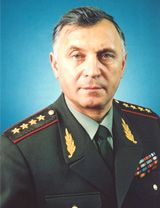
General-Lieutenant Shamanov

Ever-loquacious VDV Commander, General-Lieutenant Vladimir Shamanov held a wide-ranging press conference on Wednesday.  The Defense Ministry web site covered it hereITAR-TASS also published a number of short items on it. 

Shamanov detailed the work of five immediate deployment VDV battalions, lobbied again for a helicopter regiment, and discussed training issues and his procurement desires.  He joined the dogpile on top of the Russian OPK although he once seemed to defend it, and he credited Putin alone for the initiative to modernize the military’s arms and equipment.

He described his forces as combat ready, and manned and equipped at 100 percent.

Relative to combat readiness, Shamanov announced that the VDV has dedicated five battalions for immediate deployment which, if necessary, will be its first units sent into combat.  He said:

“By agreement with the General Staff, in the VDV we’ve dedicated five battalions for immediate deployment.  The uniqueness of service in these battalions is such that personnel from each of the battalions goes on leave for 45 days as a complete unit.  Therefore, at a minimum four battalions are always ready for combat deployment.  Today one of the sub-units of such a battalion from the 31st Airborne-Assault Brigade (Ulyanovsk) is fulfilling missions in Kyrgyzia [sic].”

Shamanov also gave voice to his desire, more modestly expressed than in April, for some aviation assets for VDV.  Speaking about the VDV’s future development, he said his troops must become airmobile.  To this end, he’s “given the Genshtab’s Main Operations Directorate [GOU] a request on the issue of forming a helicopter regiment in one of the three airborne-assault divisions [DShD or ДШД].”

Shamanov discussed VDV training at great length.  He started, of course, by speaking about jump training.  The parachute jump training plan was 70 percent fulfilled during the winter training period.  He blamed poor weather, saying troops often jumped in minus 30 degrees Celsius—the lowest acceptable temperature.  The plan for jumps from An-2 aircraft was fulfilled, but only 70 percent fulfilled from Il-76 aircraft.  He noted the VDV conducted its first-ever drop of a BMD-2 with its crew on-board, and said this hasn’t been done in 7 years, and then it was a BMD-1.  Use of the BMD-2 was significant, he said, because the BMD-2 represents 80 percent of VDV’s combat vehicle inventory.

Shamanov talked about large Spetsnaz assault group jump training in guided parachutes.  He said the use of guided parachutes allows reconnaissance troops to complete a horizontal flight of 20 kilometers, and:

“Our goal is to get so that such movements reach 40 kilometers, as they do in the Israeli Army.”

The VDV Commander noted that the multi-component Polet-K command and control system was tested for the first time in winter training.  He said: 

“It still isn’t the full suite envisioned in the future.  We are one-third through its introduction into the forces.  This process won’t happen in a year.”

Also for the first time, an artillery sub-unit of the 98th Airborne-Assault Division used Russian-made ‘Eleron’ UAVs for target designation on the Luga training grounds.  Shamanov said five ‘Eleron’ UAVs were employed in the training, and they conducted supplemental reconnaissance to a range of 10 kilometers in advance of fire missions.  This summer, 12 VDV crews will train on Israeli-made UAVs in Moscow Oblast.  Shamanov said:

“Unfortunately, our representatives did not go to Israel where they produce the ‘Hermes’ UAV which has been bought by Russia.”

Shamanov noted more attention to air defense training in the VDV this winter.  There were 40 firings of manportable ‘Strela-10’ and ‘Igla’ SAMs.

For the summer training period, Shamanov noted the VDV has 9,300 conscripts to get through three jumps in the course of 1.5 months.  The VDV will participate in ‘Vostok-2010’ and the CSTO’s ‘Cooperation-2010.’  There will be a VDV-level CSX (КШУ), as well as a CSX involving the 98th VDD (or ВДД).

Following the lessons of the Georgian war, the VDV is periodically training on the Navy’s large assault ships (BDK or БДК).  Shamanov says:

“In the winter training period we transported the 108th Regiment on large assault ships three times.  The exercises ended with a naval assault landing by a reinforced assault-landing battalion (ДШБ).

Last but not least, Shamanov commented on VDV procurement, and transport aircraft in particular:

“Work on the State Armaments Program for 2011-2020 is being completed.  According to our requests, in it there is the modernization of Il-76 aircraft, renewal of production and modernization of An-124 aircraft, the purchase of 30-40 An-70 aircraft.”

An-70

But the VDV Commander stressed these were his requests, and the final say isn’t his.  Utro.ru quoted him:

“In the development of the state [armaments] program, we gave our proposals, whether they’ll be realized in the confirmed version of the state program, I can’t say yet.”

Gzt.ru and Lenta.ru covered the An-70 and An-124 story in detail.

Shamanov said troop testing of the ‘Shakhin’ thermal sight for infantry weapons is complete.  He said:

“There has to be one approach for weapons—they have to be all-weather.  Not long ago the thermal sight ‘Shakhin’ went through troop testing.  After the testing we returned it to the designers for reworking.  We’ve given the task that our weapons work according to the aviation principle—turn your head and firing systems turn after it.”

He commented on air-dropping the BMD-4M, and added that, “The BMD-4M has every chance in the future, owing to its qualities, to be the forces’ main infantry combat vehicle.”

Although he seemed more like a supporter of Russian-made weapons six months ago, Shamanov now applauds Prime Minister Putin [not President Medvedev?] for searching for good weapons and equipment abroad.  Shamanov said the prospect of foreign competitors has forced “the domestic OPK to move,” as reported by Utro.ru.  He continued:

“Last year when industry was told that we’d look for alternatives abroad, they began to move.  In particular, the atmosphere around Mistral is creating a significant context for the domestic OPK.  When people declare that they’re ready to produce 21st century weapons but their equipment is from the 30s and 40s [of the 20th century], how can you talk about the 21st century?  Therefore, every official supports Vladimir Vladimirovich Putin’s initiative on the requirement to renew our armaments.  As long as this doesn’t happen, we’ll being shifting in place, and this won’t be just a lament of Yaroslav’s daughter [reference to the Prince Igor’s wife in the Lay of the Host of Igor after his defeat by the Turkic Polovtsy in 1185].”

At the same time, Shamanov concluded that GAZ and Izhevsk vehicles perform better for the VDV in the snow that equivalent Italian and Canadian ones.

Shamanov also said it’s essential to decide what to buy without any kind of lobbying, and for his part, he bases his decisions on saving soldiers’ lives and fulfilling missions.
Poor Health of Potential Conscripts

The Defense Ministry press service today revealed some scarcely concealed official irritation with the poor health of its pool of potential conscripts.

ITAR-TASS reported that almost half the men called to draft commissions have been sent for medical observation.  The press service source told ITAR-TASS:

“As of 21 May draft commissions have made decisions on 155,300 of those called up, more than 70,800 men have been sent to places of service.  Since the beginning of the call-up, military commissariats have sent nearly 67,000 young men for medical observation.”

The draft campaign which began 1 April will call 270,000 men into the armed forces and other militarized structures.  The largest numbers of conscripts thus far have come from the Volga-Ural region and Siberia.  In last year’s competition for citizens best prepared for military service, Tatarstan was first, Stavropol second, and Arkhangelsk third.

ITAR-TASS concludes, in the Defense Ministry, they remained worried as before by the weak health of Russian conscripts.  In the 2009 call-up [not clear if this means spring, fall, or both draft campaigns taken together], 68 percent of those appearing at draft commissions were found fit for military service without limitations or with insignificant limitations, but of the number actually inducted into the service, more than half had various limitations because of their health.  This prevented sending them to military units with high demands on servicemen–the VDV, VMF, MVD VV, and others.

ITAR-TASS reports doctors were forced [spring, fall, all of 2009?] to send nearly 86,400 of those called-up to ambulatory or in-patient observation in medical facilities because of unsatisfactory health indicators.  And their fitness for service can only be determined once they complete medical observation.  The item notes that, over time, 1-3 percent of young guys go ‘AWOL’ from observation and don’t complete it.  The fact that young men manifest health problems for the first time when they’re in front of the draft commission shows the weaknesses of the health care system.  The Defense Ministry also believes this shows that medical prophylactic measures for young people are poorly organized in the regions.

VDV Rotation at Kant

Last Friday ITAR-TASS indicated that two companies from the VDV’s 45th Independent Reconnaissance Regiment of Special Designation (Spetsnaz), based at Kubinka near Moscow, were the units sent to reinforce Russian military facilities in Kyrgyzstan on 8 April.

Two companies from the VDV’s Ulyanovsk-based 31st Independent Air-Assault Brigade rotated in on Friday to relieve those from the 45th.  The VDV’s spokesman has said the contingent numbers 160 contract personnel.

Moscow has been low-key on the deployment of extra troops, denying plans to evacuate dependents, and downplaying threats posed by the political unrest there.

But the Russians must have taken the situation seriously, sending the ‘elite of the elite’ to Kant in the first days of unrest in Kyrgyzstan.

Shamanov Wants Aviation Back

VDV Commander General-Lieutenant Vladimir Shamanov told ITAR-TASS today that the airborne troops need their organic light transport aviation back because its absence is complicating their training.  He says:

“The results of the air-assault training of the VDV in the first quarter of this year show that the transfer of light aviation to the Air Forces is stalling the system.”

As an example of this, Shamanov said light aviation fulfilled only 60 percent of planned jump training at the VDV’s Omsk Training Center.  He said its commander has asked to continue jumps until 7 May.

Shamanov said the VVS ban on Saturday, Sunday, and Monday flights was making the VDV a hostage.  He continues:

“We’ve already had cases.  The VVS command allocated one helicopter each for jumps by our Spetsnaz and communications regiments near Moscow.  However in practice it turned out that the regiment having clear priority, the Spetsnaz regiment, could use the helicopter coming from Levashovo in Leningrad Oblast for jumps in all for only a half day out of five for purely aviation reasons, at the same time as the second, communications regiment, with the other helicopter coming from Ryazan, jumped for a full week.”

“We’ve sent the Genshtab our proposals to create organic sub-units of light aviation in the VDV.  Unfortunately, there’s no hope for them since no answer has been received from the  Genshtab, but we will continue to assert our position.” 

A VDV spokesman said last year, when they still belonged to the VDV, An-2s supported 140,000 jumps in combat training, and the VVS’ Il-76 medium military transport aircraft only 35,000.

The VDV’s light transport force had 7 squadrons of Mi-8 helicopters and An-2 and An-3 aircraft and three airfields until the General Staff Chief’s 1 January directive transferred them to the VVS.

Shamanov also repeated his past calls for each of his three air-assault formations to have its own regiment of 20 combat and 40 transport helicopters.  He said a proposal to this effect is being prepared.  An interlocutor told ITAR-TASS:

“Having organic helicopter regiments in the VDV’s air-assault formations undoubtedly would raise their air-mobility, fire power, responsiveness of command and control in combat conditions, and in the course of combat training.  So the formation commander, who gets a helicopter regiment, could independently, when he considers it necessary, without turning to the VVS command, decide to have air-assault training for personnel including helicopter jumps.”  

Recall the early January Genshtab directive that transferred all aviation units in other services and arms, with the exception of RVSN, to the VVS. 

Shamanov’s complaint and appeal for a change is interesting.  He isn’t one to be afraid to demand special treatment.  He warded off the change from divisions to brigades in 2009.  

Shamanov last publicly lobbied for an upgraded VDV rotary wing component, both attack and transport helicopters, in late 2009.  The Ground Troops would also like army aviation, which they lost to the VVS in 2002, returned to them.  ITAR-TASS noted that former Ground Troops CINC Army General Boldyrev said as much last September.  He wanted helicopter regiments for air-assault brigades that belong to the military districts.

The organic aviation issue will be another place to watch for a possible policy about-face.

Makarov Meets the Press

Chief of the General Staff Nikolay Makarov

General Staff Chief Nikolay Makarov spoke at length to the press yesterday. In no particular order, here are some of the impressions and reports that followed in his wake.

RBCdaily quoted Makarov on the possible Mistral purchase:  “Ships of the Mistral type have very great multifunctionality, and they surpass our ships in all parameters by three times.”  He went on to say that Russian shipbuilders would only be able to produce helicopter carriers of this quality in 5-10 years.  Aleksandr Khramchikhin commented that, in the first place, Russia doesn’t currently have comparable ships and, in the second, it will take 50 years.

Makarov said the final decision on buying the Mistral had not been made.

According to Rossiyskaya gazeta, Makarov said the Russian Army went to brigades vice divisions to avoid the previous need to flesh out units with reservists and take days to bring them to combat readiness.  ‘Modular’ battalions by contrast are permanently ready for battle in an hour.

Makarov didn’t rule out establishment of some type of ‘rapid reaction forces,’ though these are closest in nature to today’s VDV.  And this wouldn’t mean VDV would simply change its name. And other services need rapid reaction capabilities too for action in the air, on the sea, etc.  Aren’t permanently ready brigades rapid reaction forces already?

On the Navy headquarters move to St. Petersburg, Makarov claimed Moscow is overflowing with army and navy leadership [but haven’t they just cut 200,000 officers and lots of excess command structures to create a personnel pyramid?].  And with today’s networks the fleet can be commanded from thousands of kilometers away from the Genshtab and other main commands.

Makarov doesn’t foresee any change to the one-year conscription policy, but there may be changes in NCO acquisition.  Instead of six months training in MD training centers, they may only get 3, so they can serve 9 months in troop units.  Makarov thinks they’ll cut back on conscript sergeants once their professional ones start to appear.

Moskovskiy komsomolets quoted Makarov on the new strategic arms agreement with the U.S. to the effect that it’s 97 percent complete, and it only remains to agree on the relationship between offensive and defensive weapons, and there will not be anything in the treaty to Russia’s detriment in this regard.

On Mistral, Makarov said, after study, we’ve concluded we need this type of ship, which can be an amphibious assault ship, hospital, command ship, and helicopter carrier.

On the Navy and Piter, MK notes Makarov wanted to avoid Baluyevskiy’s fate and didn’t contradict his superiors.  He expounded on his vision (perhaps dream) of Russian netcentric warfare:

“Earlier it was like this:  the closer to subordinates, the more reliable the command and control.  Now all leading countries, including us also, are going to netcentric command and control systems.  This allows completely remote means of reconnaissance, command and control, electronic warfare, fire, command posts–all spread over an enormous distance, but located in a single information-communications space and capable of solving tasks in real time.”

On a related note, Makarov said the new Sozvezdiye tactical level command and control system will be part of the netcentric structure toward the end of the year.

Gazeta’s coverage focused on Makarov’s comments about establishing the personnel pyramid, i.e. going from armed forces with about 500,000 officers and warrants to one of 150,000 officers and 720,000 soldiers in the space of a year.  It also noted Makarov’s remark that brigade commanders in their training assembly at the General Staff Academy are learning new warfare and command and control principles.

Izvestiya quoted Makarov at length on the Navy Main Staff’s move to Piter.

“Presently all command and control organs are concentrated in Moscow, but we want these command and control organs to be as close as possible to the troops they control [didn’t he also call this the old way of doing business?].  The dispersal of command and control and fire means at great distances doesn’t have any great significance, what’s important is maintaining uninterrupted and clear command and control of troops and weapons.  Therefore, the transfer of the Navy Main Staff to St. Petersburg won’t place any kind of extra burden on the command and control system, with the exception perhaps, only in the initial period of its functioning in a new place.”

Viktor Baranets in Komsomolskaya pravda focused on Makarov’s words on the U.S. and Iran, noting his statements that the U.S. has a plan to strike Iran, and, if it occurs, it’ll be terrible for Iran, the region, and the U.S.

Krasnaya zvezda covered the Iran issue.  It noted that Russia’s need for ready units forced the shift to brigades.  It also covered Makarov’s comment that the Voronezh conference agreed on changes needed in the Sozvezdiye C2 system, and that it would be received this July and fielded in November.  KZ also quoted Makarov at length on the capabilities of the 5th generation fighter aircraft.

KZ also indicated that Makarov noted the U.S. as an example where units and commands are often separated by great distances when he talked about the Navy Main Staff and Piter.

Generally, it seems those invited to this press availability only asked Makarov ‘soft ball’ questions.

Chief of Staff’s and Shamanov’s VDV Year Enders

General-Lieutenant Nikolay Ignatov

In an interview today, the VDV’s Chief of Staff summarized 2009 and plans for 2010 in Russia’s airborne forces.  

General-Lieutenant Ignatov said 90 percent of the VDV was outfitted with individual soldier radios based on the Akveduk system in 2009, and the remainder will get it in 2010.  The Akveduk-5UNE is the basic UHF transceiver, and Akveduk-5UNVE and Akveduk-50UNVE are the individual radios.  

The VDV also took delivery of 100 modernized BMD-2, 18 Nona self-propelled artillery systems, and 600 KamAZ vehicles.  It got communications vehicles including 14 R-149 KShM and 23 radio stations mounted on KamAZ high mobility vehicles.  

Ignatov said 80 percent of the VDV’s fall 2009 conscripts have already completed their first jump.  In all, 10,000 conscripts are joining the VDV ranks from the fall draft.  Another VDV spokesman said the airborne made 189,000 jumps in 2009, 29,000 more than the year before.  

Stepping back a bit, in mid-December, VDV commander Shamanov told NVO that the airborne received 150 combat vehicles in 2009, including modernized BMD-2 and BMD-3.  He hopes to get more BMD-4M vehicles for field testing in 2010.  He wants 200 of them eventually.  Unlike the VVS, he emphasized that he likes domestically produced UAVs, thermal sights, and sniper rifles.  Shamanov noted that 15-20 percent of the VDV’s armored vehicles might be wheeled in the future, and he plans to obtain some GAZ-2330 Tigr vehicles for recce and Spetsnaz subunits.   

Shamanov essentially said the VDV intends to lobby for control of helicopter units, presumably from the VVS where they’ve been since 2002, to transport and support its air assault elements.  Specifically, he’s talking about the Mi-28N, Ka-52, Mi-8MTV, and Mi-26.  The Ground Troops would also like to get army aviation back; perhaps both are ganging up on VVS. 

On 10 December, Shamanov called for a simple, functional approach to equipping the VDV.  Unhappy with defense industries, he said he won’t buy anything that doesn’t suit the VDV.  He wants better stuff than he already has in his stockpiles.  As an example, he wondered when he’ll get a mine detector that works on rocky terrain.  So, to some degree, Shamanov has joined the list of military leaders lambasting defense industries for poor products.