GRU Turnover Coming

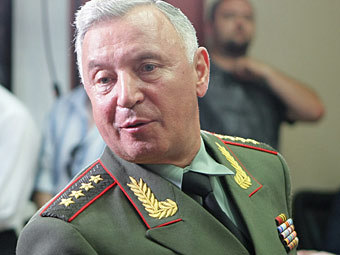
Izvestiya’s Denis Telmanov reported yesterday that 64-year-old General-Lieutenant Aleksandr Shlyakhturov is set to retire from his post as Deputy Chief of the General Staff, and Chief of the Main Intelligence Directorate (GRU).

Shlyakhturov went to the hospital at the end of last month [probably for his military discharge exam], and hasn’t returned to his office.

Genshtab sources tell Izvestiya that Shlyakhturov did his job – making “severe” cuts in the GRU, dismissing 1,000 officers, cutting from eight Spetsnaz brigades to five and resubordinating them to MD commanders, and making other cadre changes that can’t be discussed publicly.

In short, according to the paper’s source, Shlyakhturov implemented the reorganization his predecessor Valentin Korabelnikov reportedly wouldn’t two years ago.

One military official called Shlyakhturov a taciturn executive, who never once argued with Defense Minister Serdyukov and fulfilled all his orders.

The GRU Chief was also allegedly given his third star to up his pension as a reward at the end of August.

Ex-GRU Colonel Vitaliy Shlykov told Izvestiya the GRU needs a fresh face for its leadership:

“If the military leadership wants serious reforms in the GRU, it has to attract a person from outside.  But I still don’t see real contenders for this duty.  They’ve already searched several years for a worthy candidate.”

Typically, at this point, the press usually raises the possibility that the GRU might be headed by someone from the SVR, or even subsumed in the civilian foreign intelligence agency.  But Serdyukov was willing to appoint a caretaker from inside to replace Korabelnikov in 2009.  And the GRU falls on the uniformed side of the Defense Ministry where Serdyukov hasn’t replaced generals with his cronies from the tax service.

But let’s return to Izvestiya . . .

An unnamed GRU veteran told the paper the situation in the agency is close to critical:   

“The collapse of military intelligence, which has long since been the eyes and ears of the military command, is occurring.  The Spetsnaz brigades were cut, new equipment isn’t arriving, experienced specialists are being dismissed, only the young who clearly don’t know how to do anything remain.  Therefore, the new head of the directorate will have a lot of work.”

Surprisingly, the wire services got General Staff Chief Nikolay Makarov to react to the Shlyakhturov retirement story.  He did little to damp it down.  He said:

“I still can’t say anything about this.  Shlyakhturov is our chief of the intel directorate and remains so.”

“We’re all old, and I can’t foretell anything.”

“There are still no decisions.  The president makes the decision.”

It may be, in fact, that President Medvedev hasn’t signed the papers yet.  He’s just a little busy after all.

Fact is, Shlyakhturov’s been beyond statutory retirement age for a two-star general (60) for some time.  This isn’t just a routine retirement on reaching the service age limit.  There are a few possibilities:  (a) Shlyakhturov has asked to be dismissed; (b) Shlyakhturov has to be dismissed for health reasons; or (c) the leadership is dismissing Shlyakhturov because it’s got a replacement. 

Unlike (c), (a) and (b) imply that (as the well-connected Shlykov intimated above) the leadership may not have a good candidate ready.  But another short-timer can always be found.
More Cadre Changes

President Medvedev’s decree on Armed Forces personnel from September 15.  Now we know he won’t be signing out many more. 

Appoint:

  • Rear-Admiral Valeriy Ivanovich Miron, Deputy Commander for Material-Technical Support, Pacific Fleet, relieved as Chief, Military Training-Scientific Center of the Navy “Naval Academy” Branch (St. Petersburg-Petrodvorets).

Relieve:

  • Colonel Andrey Vladimirovich Kuzmenko, Commander, 17th Guards Independent Motorized Rifle Brigade, North Caucasus MD.
  • Mr. Nikolay Ivanovich Ludchenko, Chief, Military Academy of Rear Services and Transport Branch (St. Petersburg).
  • Colonel Yevgeniy Viktorovich Tubol, Commander, 59th Independent Motorized Rifle Brigade, 5th Army.
  • General-Major Sergey Valeryevich Chebotarev, Deputy Commander, 29th Army.
  • Colonel Roman Valeryevich Sheremet, Commander, 8th Aerospace Defense (VKO) Brigade.

Dismiss from military service:

  • Rear-Admiral Sergey Nikolayevich Barannikov.
  • Vice-Admiral Fedor Savelyevich Smuglin.

Rossiyskaya gazeta covered these changes.  Among other things, the paper noted Smuglin will head the external relations directorate of the Central Electoral Commission.  This had already been reported by ITAR-TASS in mid-August.

A Kick On the Way Out

We may see more stories of this type, the kind you see when the president is a lame duck.

Novoye vremya has an article  this week about what various observers expect from Putin III — reformer or dictator.  Military men see the question as a little off-the-mark for them.  The magazine quotes two of them. 

A General-Major S. from the staff of the Ground Troops CINC says: 

“We don’t discuss it in categories of dictator-reformer.  It’s important for us to know who is tsar in the country!  Putin is clarity.”

General-Lieutenant N. from the Genshtab agrees that Medvedev couldn’t be such a tsar:

“Personally, I always knew that we have one Commander-in-Chief.  And it wasn’t Dmitriy Anatolyevich.  In the midst of the Georgian events I tried to report to the president on the situation in South Ossetia.  So he interrupted me, he says, this isn’t for me.  Go report to the Chief.  From that point, in the Genshtab there was never confusion over subordination:  the VPK and Defense Ministry churn in a triangle Serdyukov — Chemezov — Putin.  The name Medvedev wasn’t discussed here and isn’t discussed.”

Interesting vignettes, especially the latter.  Such a state of affairs was generally suspected.  Then again, it’s safer and easier to say such a thing this week than last.

Su-34 Completes State Testing

Su-34

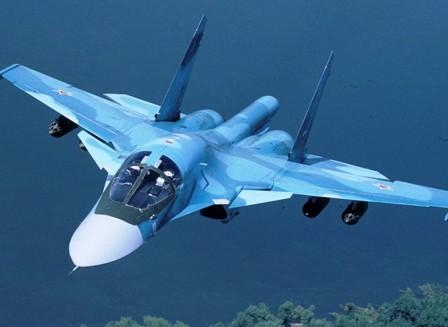
This week an aviation industry source told Interfaks-AVN that the Su-34 fighter-bomber completed state joint testing, and Air Forces CINC, General-Colonel Zelin signed off recommending state acceptance of the aircraft.  The Russian government is preparing the paperwork to this effect for release in 2012.

AVN also said the Su-34 will undergo additional special testing “conducted with the goal of broadening the Su-34’s combat potential.”  The report noted, in testing thus far, the aircraft employed 20 different weapons – including practically all Russian laser-, television-, and satellite-guided precision munitions.

One wonders if this “broadening combat potential” relates to outfitting the Su-34 with cruise missiles.  Lenta.ru’s Vasiliy Sychev recalled General-Colonel Zelin’s words:

“In its maneuver capabilities and missions it can conduct, it is close to Long-Range Aviation’s aircraft inventory.  If it carries a cruise missile, it belongs in a different class.”

According to Izvestiya’s Ilya Kramnik, there are 16 Su-34s in the inventory at present.  They first arrived in 2006.  The VVS are supposed to add six in 2011, get 12 in 2012, and reach 70 in 2015 and 120 by 2020, according to Zelin’s announcement at MAKS in August. 

Let’s recall a couple past promises . . . when Sergey Ivanov was Defense Minister, there were supposed to be 50 Su-34s by 2010, and 200 by 2015.

Kramnik writes that 120 Su-34s will be 70 percent of the fighter-bomber inventory, and some 50 modernized Su-24s will make up the balance.  Right now, there are about 160 Su-24M and 40 Su-24M2 in the force with their average ages in the 25-27 year range.  It sounds like about 10 of these aircraft can be modernized each year.

Lenta reviewed a little Su-34 history.  Conceived in the 1980s as a generation 4+ modification of the Su-27, it had its first prototype flight in 1990 as the T-10V-1.  It’s survived to this day, and been through many convolutions.

Henceforth the Su-34 will have a modernized AL-31F engine, the AL-31FM1 or AL-31F-M1.  See Aviaport.ru on it.  The Su-34 will carry new air-to-air and air-to-surface missiles on its 12 hardpoints.  It has new electronics, a Sh141 phased array radar, aerial refueling capability, and an updated L-150 “Pastel” radar warning system.  It also features an auxiliary power unit so it can use airfields without ground support equipment.

Lenta says the factory in Novosibirsk (NAPO) is modernizing its production lines to the tune of 2 billion rubles with some of the money reportedly coming from the state program of OPK modernization, about which we’ve heard little.  Putin talked about 3 trillion rubles for this over 2011-2020 back in April.

NAPO will give half its capacity to the Su-34, and will allegedly be capable of assembling 20 of them simultaneously, while cutting the time for repairs on other aircraft in half.

The news outlet lauds the Su-34 (rather obviously) as a new aircraft rather than a modernization of an aged one.  But then again one could argue it’s not completely new given that it’s been around, in one form or another, since the 1980s.

Kramnik, citing Konstantin Makiyenko, writes that a multirole fighter like the  Su-30 could perform the Su-34’s missions, but there’s some desire to send NAPO orders.  And the VVS, for their part, will take everything new that the aviation industry can give them.

Military Prestige

Russia experienced a drastic decline in the prestige of military service in the 1990s.  Generals, officers, and politicians have debated efforts and initiatives to resurrect it ever since.

The military’s prestige is represented or reflected in many things:  pay,  living conditions, budget resources, political emphasis, applications for VVUZ admission, etc.  But it’s still a slippery notion not easy to quantify.  One even occasionally reads that, in Soviet times, every girl wanted to marry an officer.  Not so today.

On February 23, 2000 [Defenders Day], acting RF President Vladimir Putin saw it this way:

“The prestige of military service has started to be reestablished.  The confidence and personal worth of people in shoulderboards has been reborn.”

“It’s not simple for our army today.  Perhaps harder than for other state structures.  Much depends today on the understanding and patience, on the continued patience of soldiers and officers.  And their wives.  On the feeling of responsibility for the state inherent in the military man from time immemorial.”

“I am absolutely convinced of the fact that we together will without fail restore the prestige of the Armed Forces, the prestige of the Armed Forces as civic-mindedness and patriotism!”

“I very much would like for our boys just as in former times to begin dreaming again of the profession of military pilot, military engineer, tanker, artilleryman, missileman, and for their parents to be sure that their sons made the correct choice.”

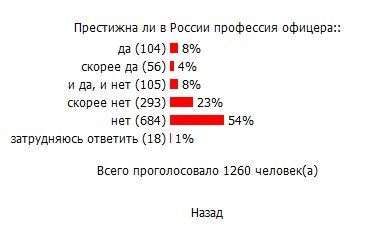
In late 2011, we’ve found out how Krasnaya zvezda’s readers see it.  The homepage of the Defense Ministry daily’s website has been asking its visitors about the prestige of the military for some time now. 

Is the Profession of Officer Prestigious in Russia?

And the results . . .

It's Not

Only 8 percent of 1,260 respondents say yes.  Only 12 percent say yes or probably yes.  Fifty-four percent say no, and 77 percent — three of every four — say no or probably no.

Not much progress in rebuilding the military’s prestige over the last 11 years.

Of course, it’s an Internet poll, it’s not random sampling, and it wouldn’t stand scientific scrutiny.  Nevertheless, it’s very revealing because it’s right on the [electronic] front page of the Defense Ministry’s newspaper.

Levada’s reported for some time on sagging esteem for the officer’s profession.  Last month only 6 percent of respondents picked army officer as the most respected profession in society.  Five percent picked criminal авторитет.  Only 2 percent considered army officer the most profitable career.

If it’s this difficult to make officer a prestigious profession, imagine how hard it is to make professional enlisted service in the Russian military a respected job.

Sunday on Pushkin Square

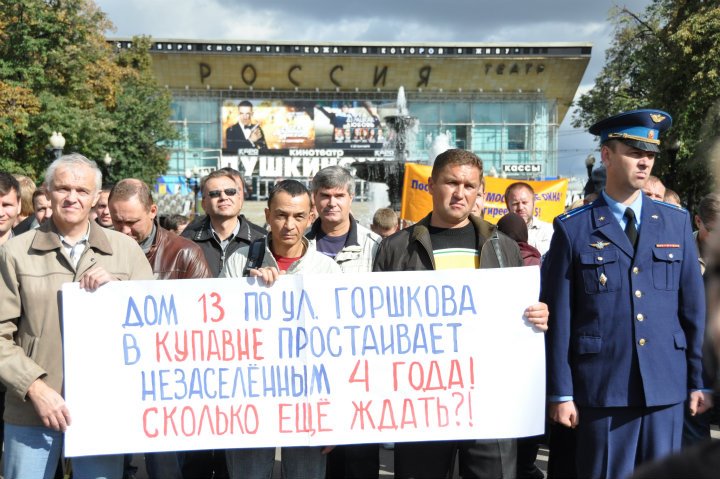
Waiting to Occupy Finished Apartments in Kupavna (photo: Mikhail Pavlenko)

Sunday’s “Army Against Serdyukov” demonstration took place as planned on Pushkin Square.  About 500 people attended, but organizers hoped for as many as 1,500.  The participants were orderly, and the police presence was light and relaxed compared with more overtly political protests.  Novyye izvestiya claimed there were similar meetings in Arkhangelsk, Murmansk, Severodvinsk, Stavropol, and Samara but the press reported only on protests in the latter city.

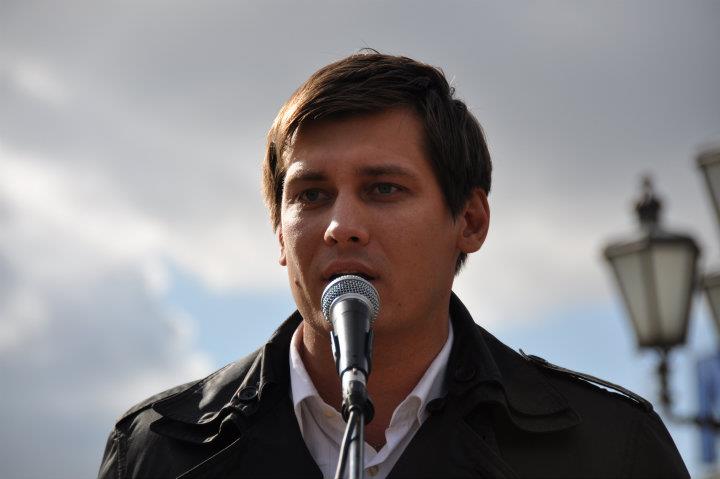
Dmitriy Gudkov used the occasion to publicize the Public Council for the Defense of Legal Rights of Servicemen’s appeal to President Medvedev.  Besides demanding Defense Minister Serdyukov’s resignation, the appeal calls for an end to violations of servicemen’s housing rights and to the collapse of the military education system and defense industry.

Dmitriy Gudkov (photo: Mikhail Pavlenko)

Gudkov told NI:

“We need to unite servicemen who today are dissatisfied with the state of affairs in the army.  There is a failure of all army reform, collapse of the defense sector . . . .  The breakdown of the military housing program.  Two hundred thousand officers’ families around the country who haven’t received apartments.  Military pensioners who today have a pitiful allowance.”

In remarks to Radio Svoboda, he said deceived servicemen may form their own, alternative list of those officers who are still waiting for their promised apartments.

Gudkov also claimed there were attempts to prevent the gathering:

“On the Internet, information was put out that the meeting would occur on Saturday.  Instructions went to all military units that anyone seen at the meeting would be dismissed.  The Defense Ministry did everything to disrupt this action.  But in vain.”

Hero of the Russian Federation, Cosmonaut Sergey Nefedov gave the introductory speech to the crowd on Pushkin Square.

Gudkov gave an account of Sunday’s event on his ЖЖ in which he said the protestors insist on their legal rights, and refuse to be silent although the authorities want to ignore them completely.  He called military reform not reform, but the collapse of the army.  Gudkov said the meeting wasn’t just against Serdyukov, but against all who don’t know how to manage the state in a professional manner, and those who are not up to their duties.  He concludes:

“Demonstrations, meetings – this is only the tip of the iceberg of the people’s agitation.  The number of those who’re ready to go in December to the polls and express their distrust in this government is growing larger.”

The Public Council is considering establishing a tent camp outside the Defense Ministry during the run-up to the elections, according to Gudkov.

Gudkov said television covered Sunday’s meeting, and cameras and microphones were visible in photos, but there were no TV news reports on the event.  There are, however, lots of videos and photos on Mikhail Pavlenko’s ЖЖ.

Two last items deserve mention.  Radio Svoboda talked to a retired Northern Fleet major, a military lawyer, named Igor Chuykov from Murmansk who spoke at Sunday’s anti-Serdyukov rally.  Chuykov described the situation among military men in his city:

“The movement in Murmansk is very serious.  Thanks just to this movement, those who participated in pickets in Murmansk, in Murmansk Oblast are now really getting apartments –those who were dismissed after 2005.  Those dismissed before 2005 are being given [state housing] certificates.  Somehow on these certificates it’s even possible to buy something.  The Kola Peninsula – this could be the only place where there are considerably more military men than MVD.  The smallest conflict between the military and police would lead simply to an uncontrollable escalation of violence.  The authorities quickly understood what this could lead to.  Therefore, the authorities’ priority task now is to pacify families.  People simply have no recourse.  It’s the fault of the state:  it forced people into open acts of disobedience by its own irresponsible, unprofessional actions.”

Radio Svoboda also quoted Viktor Baranets:

“In the army, there are many professionals who understand that military reform is going, to put it mildly, very badly.  Genshtab chief Makarov even attested to this when he honestly admitted at an officers’ assembly that we began military reform without any kind of scientific basis and calculations.  The most important social problem is housing.  They constantly fool the army, constantly change the rules of the game.  Here we need to observe a single very serious point – military men are beginning to organize.  The government must turn attention to this, but it stubbornly doesn’t want to do it.  I have the impression that they either are afraid of criticizing Serdyukov or afraid of openly recognizing that military reform has failed.  And just people who go to the demonstration, who announce their disagreement with Serdyukov’s methods of conducting reform, — they also want to get through to the Kremlin, to the government, to the state, to the Duma so that, in the end, some kind of decision will be made.”

Tsentr-2011

Tsentr-2011

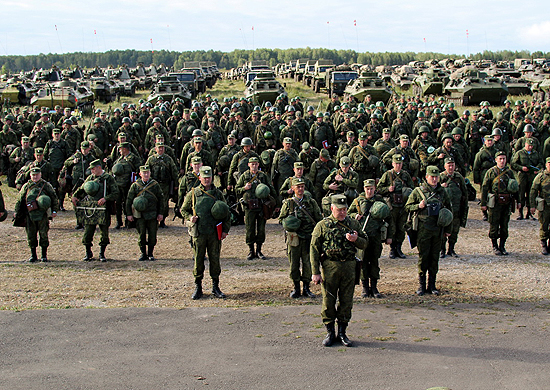
Yesterday Russia and allied military forces in the Collective Security Treaty Organization (CSTO or ODKB) began a series of exercise events which will run until the beginning of October.

Operational-strategic exercise Tsentr-2011 will involve Russian forces and Belorussian, Kyrgyz, Kazakh, and Armenian sub-units in different training scenarios focused on ensuring security on the Central Asian axis, according to Nezavisimaya gazeta.

Twelve thousand personnel, 50 aircraft, 1,000 vehicles and other equipment, and ten combat and support ships will participate under the direction of Russian General Staff Chief, Army General Nikolay Makarov, according to Mil.ru.  Russian forces will include one army brigade as well as operational groups from other militarized agencies — the MVD, FSB, FSO, and MChS.    

Mil.ru said the exercise theme is “Preparation and Employment of Inter-Service Troop (Force) Groupings in the Stabilization of a Situation and Conduct of Military Actions on the Central Asian Strategic Axis.”

NG cites Makarov who said the exercise will focus on “localizing internal as well as external conflicts.” Extrapolating from his earlier comments about North Africa and the Middle East, the paper claims he wants the army to be ready to perform internal police functions like the Syrian Army.

Mil.ru puts it more technically saying the exercise will improve command and staff skills in controlling troops in the transition to wartime, in planning special operations, and in organizing long-distance troop regroupings.  Exercise phases will include special operations to localize an armed conflict in a crisis region, and joint actions by ground and naval force groupings, according to the Defense Ministry website.

The exercise will consist of different evolutions, with different partners, in various locations:

  • The Ground Troops, MVD, and FSB Spetsnaz, writes NG, will practice liberating a town from terrorists and rebels on the Chebarkul training range. 
  • At Gorokhovets, Russia’s 20th Army and Belorussian forces are playing a series of tactical actions against enemy airborne assaults, specops, and “illegal armed formations” in their rear areas [under a separate exercise called Union Shield-2011 or Shchit Soyuza-2011]. 
  • Russian forces are training with Kazakhs on the Caspian, and at Kazakhstan’s Oymasha range.
  • A command-staff exercise of the ODKB’s Collective Rapid Reaction Forces (KSOR) will be conducted at the Lyaur range in Tajikistan.
  • In Kyrgyzstan, the ODKB’s Central Asian Region Collective Rapid Deployment Forces (KSBR TsAR) will conduct a tactical exercise against “illegal armed formations.”

NG sums Tsentr-2011 up with a quote from Vladimir Popov:

“The Russian leadership, although late, has come to the conclusion that the successful resolution of military security issues, including the internal security of allied countries, is possible only through the creation and use of coalition troop groupings in the post-Soviet space.   This is correct, and there’s no need to fear this.”

Developing some collective military intervention capability doesn’t answer questions about real-world conditions where it might be employed.  The questions proceed mainly (but not entirely) from Kyrgyzstan’s experience.  First, will a threatened regime ask for ODKB assistance and under what circumstances?  Second, will the alliance or any allies answer a member-state’s call?  Training and exercises are good, but ultimately not much use unless such political issues are resolved.

GOZ War Winding Down?

Vedomosti’s Aleksey Nikolskiy sees a possible end to the conflict between the Defense Ministry and industry over the production of strategic nuclear systems.  His OSK source claims a multiyear Defense Ministry contract with Sevmash for proyekt 955 Borey-class SSBNs will be concluded in the coming week.  This would reportedly leave OSK with just one contract remaining to be completed.

Conclusion of a 40-billion-ruble contract for three proyekt 11356M frigates was announced Wednesday.

Vedomosti’s source said the Defense Ministry and OSK also finished a deal for proyekt 885 Yasen-class SSNs several days ago.  The paper once again cites Konstantin Makiyenko’s 500 billion ruble price tag for the new SSBNs and SSNs.

An industry source tells Vedomosti that all MIT’s ballistic missile contracts are complete.

While deals for renovating Russia’s strategic forces are apparently done at last, not all contracts for conventional armaments are finished, particularly those involving Rostekhnologii and its enterprises, according to the director of one of them.

What’s this mean?

The conclusion of submarine / SLBM / ICBM production contracts would be a relief to both sides since their absence has been the biggest GOZ news story.  If all this is done, or almost done, one would expect a major government or Defense Ministry press announcement soon.

If the submarine deals are worth 500 billion rubles, that is, once again, apparently closer to Defense Minister Serdyukov’s price than to OSK’s.

The proyekt 11356M frigates are updated Krivaks (or Talwars for India), and they aren’t exactly cheap.

The issue of incomplete contracts with Rostekhnologii’s enterprises is significant given the size and breadth of their work on weapons and military equipment.  People will ask which enterprises and systems are in question.  It also contradicts Serdyukov’s recent claims that only OSK deals needed to be inked, and implies there are lingering problems and issues in areas other than shipbuilding.

Army Against Serdyukov

To a Wagner soundtrack, the video shows the miserable life of some military, or ex-military, men.

Dmitriy Gudkov and the Public Council for the Defense of the Legal Rights of Servicemen have organized what they believe will be a 1,000-person demonstration against Defense Minister Serdyukov’s reforms for Sunday afternoon on Pushkin Square.  The rally’s advertised as “The Army Against Serdyukov.”

Nakanune.ru provided some sound bites about the protest (although it also gave the wrong day).  The protest’s a reprise of a May 22 demonstration.  Gudkov claims it’s not a party action, and participants will be “average people and their family members.” 

The meeting organizers accuse Serdyukov of causing the collapse of the army, breakdown of the state defense order, genocide of military pensioners, and sabotage of the military housing program as a result of which 200,000 officers and their families remain without apartments.  They further allege that:

“The country’s defense capability level under Serdyukov has declined catastrophically, such that in the long-term it could bring a threat of the loss of Russia’s sovereignty.”

Participants will call on President Medvedev to fire the Defense Minister and his team.

Protests against Serdyukov will also be held in Murmansk, Yekaterinburg, Samara, and Kaliningrad.  The Naval Sailors’ Union, the Initiative Group of the Forum for Servicemen’s Mutual Legal Aid, and Deceived Shareholders from the Defense Ministry (i.e. servicemen whose housing rights have been violated) will join in the meeting.  Nakanune also listed the Airborne Union as a supporting organization.

Gudkov’s an interesting character.  He’s the son of Gennadiy Gudkov, a deputy leader of Just Russia (SR) and Duma member. 

Older Gudkov is Deputy Chairman of the Duma’s Security Committee, and member of Duma commissions overseeing budget expenditures on defense and state security, and legislative support for counteracting corruption.

Younger Gudkov leads the youth wing of SR, and he’s a member of the MVD’s Public Council.  His ЖЖ is here.   The September 15 entry announces the Sunday protest meeting.

It’ll be interesting to see what transpires Sunday — what kind of turnout, what kind of reaction, how much media coverage, etc. 

There’s a clear protest mood in the military, active and retired.  Vlast monitors it, and occasionally sees a need to assuage it. 

Recall the discontent from the VDV last fall over Serdyukov’s alleged high-handed treatment of a professional military officer at Seltsy.

There’s a new spate of promises recently to solve, once and for all, the military’s housing problems.  This time they come against a backdrop of fast-approaching elections and tighter budgets.

Other usual sore points for vlast will be winter heating in remote garrisons, and the ever-present headache of administering a still-large number of semi-derelict military towns (or monotowns) that regions don’t want.

Of course, unexpected sore points can appear too.

Makarov’s Press-Conference (Part III)

Army General Makarov (photo: RIA Novosti / Aleksey Nikolskiy)

Still plumbing General Staff Chief Makarov’s Monday press-conference . . .

Makarov indicated Russia’s Israeli-made UAVs will be used in the Tsentr-2011 exercise.  According to Krasnaya zvezda, he once again worked Vega over for wasting years and money without meeting the military’s requirements, forcing it to turn to Israel to obtain unmanned aircraft.

According to Interfaks, the General Staff Chief asserted Russia won’t buy anything but PGMs for its combat aircraft:

“The purchase of conventional [unguided] means has stopped.  We are buying only highly-accurate means.”

“Western countries conduct military operations almost without ground forces.  Aircraft operate outside the air defense zone and sustain minimal losses.”

Izvestiya noted, however, replacing Russia’s dumb bombs with smart weapons won’t be cheap.  Tens of thousands of rubles versus millions.  But one of the paper’s interlocutors concluded:

“The Defense Ministry believes there’s money for buying them, contracts for the first deliveries of new munitions have already been concluded.”

He estimates they will comprise perhaps half of Russia’s aviation weapons inventory by 2020.

Izvestiya quoted Ruslan Pukhov to the effect that guided ASMs made up only 1 percent of Russia’s stockpile in the five-day war with Georgia, and Russian aircraft had to brave Georgia’s air defenses on most missions, losing four Su-25, two Su-24, and a Tu-22M3.  He added, however, that a Su-34 employed an anti-radar Kh-31P to destroy a radar in Gori.

Lenta.ru recalled General-Lieutenant Igor Sadofyev’s late 2010 comments about plans for a radical increase in PGMs and UAVs in the Air Forces by 2020.  You can refresh your memory here.

Some military commentators and news outlets managed to tie together Makarov’s comments on Arab revolutions, Central Asian exercises, snipers, and sniper rifles in interesting, but not always accurate, ways.

KZ summarized Makarov pretty simply as saying the armed conflicts in Arab countries were difficult to predict, and similar events can’t be ruled out in Central Asia.  In its replay of his remarks, he said:

“. . . we should be ready for everything, therefore we are working on this in the exercises.”

So, Moscow’s pretty obviously looking at the possible repetition of a Libyan or Syrian scenario somewhere in Central Asia . . . no surprise there . . . makes sense.

Komsomolskaya pravda said:

“Our military isn’t hiding the fact that current exercises are directly linked to the probable export of military aggression from Afghanistan into the Central Asian republics after NATO troops withdraw from there.”

It cites Makarov:

“[The exercises] envision developing variants for localizing armed conflicts on the territory of these countries.”

That doesn’t really sound Libyan or Syrian, does it?  It’s not internal.  It’s good old external spillover.  Oh well, as long as it’s “localized” on someone else’s territory, and doesn’t cross Russia’s borders.

ITAR-TASS’s version of Makarov got people more spun up:

“The world situation is complex, quickly changing, particularly in North Africa and the Middle East.  It was difficult to forecast what happened in a number of countries of this region, events developed with great speed.  Now no one can say what will happen next.  But this is a signal for all states.  We military men need to be prepared for the worst scenarios.”

This led a few outlets to take the next step on their own, i.e. a repeat of the Arab scenario inside Russia.

You can read likely exaggerations of what Makarov really said in Gazeta.ru or Rbcdaily.ru.  In its version, the latter claimed Makarov didn’t exclude internal unrest following the Arab example in Russia, and the army has to be ready for the worst case scenario of political developments inside the country.

Pouring gas on the fire it lit, Rbcdaily introduced the sniper issue here.

Of course, snipers are great for urban warfare or urban unrest.  Rbcdaily’s Defense Ministry source says Makarov plans to put independent sniper platoons in every brigade.  They’ll be armed with British rifles, of course.  And the snipers themselves will have to be long-term professionals – contractees, so that’ll have to wait until the middle of next year.

Igor Korotchenko tells Rbcdaily:

“A sniper is a piece of work, he can’t be trained in a year, therefore they must absolutely be professional contractees.  We can’t count on conscript soldiers here, like in the old days when there were enough gifted guys who learned to fire the SVD well among the conscripts.”

KZ didn’t mention Makarov talking about snipers.

Just to finish this off, Makarov’s Syrian comments weren’t construed or misconstrued as much.  KZ said simply that he said Russia is not planning a military presence in Syria, nor the introduction of extra security measures at its material-technical support base in Tartus.

ITAR-TASS put it this way:

“This base remains in our hands.  Besides it, our advisors work in Syria.  That’s enough.  We don’t intend to adopt any preventative measures.  . . . we have to watch closely those forces opposing the government.  There are legal demands, and there are opposition demands which, in our view, need to be ignored because they are illegal.”