46 Percent More or 47 Percent Short?

On Sunday, Defense Minister Anatoliy Serdyukov apparently told Bloomberg that Russia plans to spend 19 trillion rubles on its State Armaments Program 2011-2020.  Recall not long ago Finance Minister Kudrin said a final number had been worked out with the Defense Ministry, but he didn’t release it.

Bloomberg let Serdyukov advertise the plan [repeat, plan — the money has to be allocated in every annual budget] to spend 19 trillion rubles over the next 10 years as 46 percent more than Kudrin’s original offer of 13 trillion.

Serdyukov didn’t describe 19 trillion as 47 percent short of what the uniformed military says it needs to rearm.  Recall Deputy Armaments Chief, General-Lieutenant Frolov told the press 36 trillion was required to rearm all services and branches fully.

In fairness, Serdyukov admitted:

“This is the minimum we need to equip our armed forces with modern weaponry.  We could ask for a bigger number, but we need to understand that the budget cannot afford such spending, so 19 trillion is a serious amount of money that will provide considerable orders for our defense industry.”

OK, good.  There are limits on what the military can have, and this shows civilian control over the armed forces.  But what about saying this “will provide considerable orders for our defense industry.”  Isn’t the point for the armed forces to get some, or most, of what they need from industry, not simply ensuring the OPK has defense orders?

The 19 trillion rubles is not trivial.  If (a very big if) . . . if this gets approved and executed every year, it’s almost 4 times the amount in GPV 2007-2015.  But we know the GPV is always rewritten before it’s completed, so it’s very difficult to say what has or hasn’t been, or can be accomplished with any given amount of funding.

With Russia borrowing abroad to plug deficits, it’s not surprising the amount wasn’t what the military wanted.  And the state of its economy over the next couple years will determine if it actually gets this planned amount for procurement.

New 33rd Missile Army Commander

The RVSN yesterday also announced General-Major Aleksandr Ponomarenko as the new commander of its 33rd (Omsk) Missile Army.  He had been chief of staff, first deputy commander of the 27th (Vladimir) Missile Army from 2006 until now.  He served under current RVSN Commander General-Lieutenant Karakayev when he commanded the 27th Missile Army in 2006-2008.

Ponomarenko’s predecessor in the 33rd Missile Army, General-Lieutenant Gennadiy Privalov recently retired.

Ponomarenko commanded the 31st (Orenburg) Missile Army’s 42nd (Nizhniy Tagil) Missile Division in 2000-2003.

In mid-1998, he was a lieutenant colonel commanding a regiment in the Vladimir Missile Army’s 54th (Teykovo) Missile Division.

New 31st Missile Army Commander

The RVSN today announced General-Major Anatoliy Grigoryevich Kulay as the new commander of its 31st (Orenburg) Missile Army.  Kulay had been its chief of staff and first deputy commander since early 2010.  He replaced General-Lieutenant Ivan Reva, who not long ago became the RVSN’s chief of staff and first deputy commander.

Kulay commanded the 33rd (Omsk) Missile Army’s  29th Guards Vitebsk Order of Lenin Red Banner Missile Division (aka the Irkutsk Missile Division), and its three regiments of RT-2PM ‘Topol’ (SS-25) ICBMs between 2006 and 2010.  His division was one of Russia’s two best mobile ICBM divisions based on the results of the 2006 training year.  It was one of Russia’s best again in 2007.  In early 2008, Kulay made one-star.  Prior to 2006, Kulay was an SS-25 missile regiment commander in the former 8th (Yurya or Pervomayskiy) Missile Division, Orenburg Missile Army.

He’s 44, and was commissioned from the Serpukhov Higher Military-Command-Engineering School of Missile Troops.  He’s a graduate of both his senior service school – the Peter the Great Military Academy of the RVSN – and the General Staff Academy.

The RVSN also appointed General-Major Aleksandr Ponomarenko commander of the Omsk Missile Army.  He had been chief of staff and first deputy commander of the Vladimir Missile Army.  More on him later.

What Serdyukov Said About Piter

Late, but worth capturing for future reference . . . .

By way of recap, on 3 September, Vice-Admiral Burtsev told the press the Navy headquarters move to St. Petersburg was off, and this was decided over a year ago.  But later the same day, he claimed he’d been misunderstood.

Then, on 8 September, Defense Minister Serdyukov took up the issue . . . whether he was asked or just elected to address this, we don’t know.

ITAR-TASS claims he put an end to recent media speculation about the Main Staff’s eventual move to Piter.

Serdyukov said:

 “No one has cancelled the decision to transfer the Navy Main Staff.  The planned work is on-going.  We said from the beginning that we didn’t intend to do this in the course of any short period of time, for example, in a year.  This is happening not quickly, but according to readiness.  At Admiralty in St. Petersburg, the place where the Main Staff will be located, renovation is on-going.  Within the limits of the work’s completion, we will move.     

“As far as the Command and Control Post (KPU or КПУ) goes, it won’t be transferred quickly, not even in the coming one-two years.  We will outfit it with absolutely new equipment, new resources.  There will be an absolutely new KPU.  The old KPU, most likely, will be mothballed.  Transferring it wouldn’t make any sense.  So there aren’t any changes in our plans.”

Be all this as it may, it seems like a sign that the Defense Ministry, Serdyukov, or someone else, and the Navy were (or are) still at odds over moving its headquarters to the northern capital.

Serdyukov on Changing Bulava Production

According to RIA Novosti, Defense Secretary Serdyukov told Russian journalists in Washington Friday that, if the next Bulava launches fail for different reasons, Russia will have to change its system of production and quality control. 

Serdyukov said, if the missiles fail for the same reason, the cause of the failures will be found.   But if the causes turn out to be different, we “have to change the entire production and quality control system for these missiles.”

According to ITAR-TASS, Serdyukov said:

“In the assembly of these missiles we tried to make them fully identical so that they would be like twins [triplets?].” 

“We can’t hurry the testing.  The main thing is that in every assembly cycle there were strict guarantees that we made the missiles absolutely identically and all procedures were followed.”

“The possible defects will be the same, then we will eliminate them, but if they are different, then we have to break down the entire system and find out what is happening in production and quality control. Then it will be clear that the production monitoring is incorrect and it’s absolutely necessary to change it.”

Serdyukov and Gates ‘Reload’

Gates and Serdyukov (photo: Reuters / Larry Downing)

Defense Minister Serdyukov and Defense Secretary Gates signed two documents yesterday.  RIA Novosti covered the event.  The first document was a memorandum of understanding on bilateral military cooperation replacing an old one from 1993.  The second, more important one established a ministerial-level working group on defense relations under the aegis of the U.S.-Russian Bilateral Presidential Commission established in July 2009.

A joint statement from the two defense chiefs said:

“The following issues will be at the center of attention of the U.S.-Russian working group on defense relations:  armed forces reform and transformation, high-priority defense and national security policy issues, transparency and strengthening trust to improve mutual understanding, regional and global security, new challenges and threats, and cooperation in areas of mutual interest.”  

The document apparently says, as co-chairmen of the working group, the Defense Minister and Defense Secretary will meet at least once a year.  And Serdyukov has invited Gates to Moscow.

In his remarks on their talks yesterday, Serdyukov said:

“The transformations occurring in the Russian and U.S. armies are very large-scale and very painful.  But they are absolutely necessary to create a modern army, a 21st century army.”

Gates said both men face similar problems in reforming their armed forces:

“Mr. Serdyukov and I are making great efforts to implement broad reforms which are painful but necessary.”

An unnamed U.S. official explained:

“The Minister and Secretary are trying to introduce new thinking into the military system.  The visit of the Russian minister was a chance to learn more about Russian military reform, and understand issues on which we can be useful.  So the first session of the talks concerned only military reform.”

However, Kommersant picked the pithy winner of the day when it quoted former NSC staffer Steven Pifer: 

“Yesterday Robert Gates presented his plan for reducing military expenditures under which the budget of the Defense Department will be cut by $100 billion over five years.  It’s possible this experience will be interesting to Defense Minister Serdyukov, but I’m not sure it applies to reforming the Russian Armed Forces.”

Right on, brother.  Mr. Gates surely knows the $20 billion of chump change he wants to trim each year is not a lot less than what annual Russian defense budgets have been, give or take some, in recent years.  That $20 billion isn’t far off what the Russian government initially proposed to spend for arms procurement each year until 2020.   

Saying the U.S. and Russian militaries are in the same boat when it comes to their reform efforts certainly makes for good feelings and good press in the midst of an important high-level visit.  But it’s a great exaggeration that doesn’t really help anyone in the longer run.

The U.S. already has full-fledged, albeit overstretched, 21st century military forces; ones that are constantly and painfully reinvented to meet the threats and demands of the future.  It’s painful all right.

Russia, on the other hand, is 18 years into attempts to reshape its Soviet-era Armed Forces into a modern military.  It still has a fundamentally 20th century force, and not a late 20th one at that.  It’s true to say that Serdyukov has ushered in Russia’s first comprehensive reform effort, and it’s very painful.  But he’s hurt more by the fact that his predecessors didn’t do enough, fast enough. However, he may be doing too much, too fast.  And the ultimate results may not be what Putin, Medvedev, and Serdyukov intended.

But the main point remains it’s naïve to suggest the two military establishments are in anything like the same place.

Similarly, it wouldn’t pay to get excited about the new framework for defense consultations and cooperation.  We’ve been here several times.  Like U.S.-Russian relations as a whole, over time these frameworks are driven off-track by Russian actions and U.S. overreactions.  But they never die.  They just get reloaded.

Serdyukov Meets Gates at Pentagon

Mr. Serdyukov Goes to Washington (photo: ITAR-TASS)

ITAR-TASS reports Defense Minister Anatoliy Serdyukov and his U.S. counterpart Robert Gates will meet for a total of 5 hours today.  And the Russian press service concludes: 

“This is highly unusual and attests to the great significance the U.S. Defense Department attaches to the visit.” 

Aside from all the customary ceremonies, there will be three sets of talks today.  The morning session is dedicated to discussing military reform plans and defense spending on both sides.  ITAR-TASS says the Americans consider this the most important topic from their viewpoint. 

The press service quotes The New York Times saying the two men “simultaneously declared war on longstanding and ineffective bureaucratic organizations,” adding that they’ll find a common language as they compare their efforts. 

A working lunch will be devoted to nuclear arms control and missile defense.  RIA Novosti quoted a Defense Department spokesman who said you can’t meet Russians without discussing missile defense, but it won’t be the main topic of the visit.  Today’s afternoon session will cover a variety of regional and global security problems.  Serdyukov will visit an unspecified U.S. Army base as well as the Naval Academy. 

In an interview published in today’s Kommersant, Gates said: 

“I’ve attentively followed Defense Minister Serdyukov’s reform efforts.  I have the impression that the scale and depth of the reforms he’s conducting correspond to what I’m trying to do in the U.S.  The thing is in the coming years we don’t expect significant budget increases.  Therefore, we have to decide how best to use the resources we have.” 

“I know the Russian Defense Minister has an interest in how to select highly professional soldiers and how to keep them in the armed forces, how to exert command and control of the armed forces in order to strengthen national security.  This is especially complicated in the face of economic problems standing before each of our countries.” 

Apparently, Gates doesn’t understand precisely.  The Defense Ministry already has an answer — to jettison its failed professional contract service program, return to reliance on conscripted soldiers, and see if they can train and retain some professional NCOs. 

Asked if Russia’s a threat to the U.S. and about its new ballistic missiles, Gates replied:  

“No.  I don’t view Russia as a threat.  We are partners in some areas and competitors in others.  But we cooperate on important issues.” 

Good answer. 

“From the viewpoint of our program modernization the new SOA agreement is a great achievement.  Just as the agreements which preceded it.  They establish rules of the game which provide transparency and predictability.  Modernization programs within the bounds of the new SOA agreement are absolutely normal.  We’ll conduct our own modernization. 

Asked about cooperation on missile defense and the Gabala radar specifically, Gates said the U.S. is interested in Gabala and in the possibility of establishing a missile launch data exchange center [JDEC] in Moscow.

State of Play on Mistral

Let’s review recent play in Russia’s possible purchase of French Mistral amphibious ships.

In yesterday’s Nezavisimaya gazeta, Viktor Litovkin said, despite reports Russian-French negotiations are going well, Russia’s announcement of an international tender for construction of large amphibious ships disrupted their exclusive talks.  But Litovkin thinks Russia will ultimately buy Mistral because (he believes) President Medvedev has promised French President Sarkozy.  So, the tender is really only about where to build two Russian-made ships (units 3 and 4), and the answer is Kaliningrad’s Yantar shipyard, according to Litovkin. 

To Litovkin, the remaining issues are the electronic fit on Mistral, and the final price of the deal.  He goes back to General Staff Chief Makarov’s comment that the Russian ships will be exactly like the French ones, down to their comms systems.  The only exception being Russian ones won’t have codes linking French ships into NATO’s command and control network.

On 9 September, Nezavisimaya gazeta picked up on a Le Figaro article concluding that Russia’s tender, coming after six months of negotiations with France, signified trouble.  It wrote that there is more than a little question whether they will remain exclusive talks, even if they continue. 

Technology transfer in the Mistral deal is Moscow’s sine qua non, but this issue may not be resolved on the French side.  Le Figaro believes the U.S. may be able to restrict the export of American-made electronic equipment on Mistral.

Also on 9 September, Rossiyskaya gazeta wrote that cost is the main unresolved issue in Moscow’s negotiations with Paris.  The paper also focused on the Defense Ministry’s insistence on receiving technologies, not just weapons systems and platforms from abroad.

ITAR-TASS reported Defense Minister Serdyukov’s 8 September statement that French cooperation on Mistral might open the way for more bilateral military-technical cooperation, possibly on UAVs.  At the conclusion of his visit to Paris, Serdyukov announced:

“The French side has expressed a desire to work in this area.  We proposed to do this in the form of joint ventures on the basis of our repair plants.  If we succeed on Mistral and we build on such experience, then in the future everything will go in other directions, including in unmanned aerial vehicles.  We have such a proposal from them.”

Also from 8 September, Newsru.com reported Serdyukov saying “we are now waiting on a price” from the French.  He apparently said the French offer would be evaluated with the help of both Russian and foreign experts.

After Serdyukov’s tender announcement, Sarkozy dispatched his military adviser, and former DRM chief, Benoit Puga to meet with Russian Deputy Prime Minister Igor Sechin on 26 August.  Of course, Sechin is Chairman of Russia’s United Shipbuilding Corporation and point man in dealing with the French on Mistral.  They met at Yantar in Kaliningrad.  Puga reportedly told Sechin that ‘2+2’ was acceptable; the first Mistral would be built in a French shipyard in 36 months, the second following 12 months after.  And the third and fourth would be built in a Russian yard.

The French have stayed fairly confident in public about winning the contract.  And most Russian defense commentators still see Mistral as the favorite even if there is competitive bidding for the work.

Creating ‘New Profile’ Army Not Easy in Far East

A variety of press reports indicate establishing a ‘new profile’ army in the Far East is a difficult and increasingly protracted process.

On 7 September, ITAR-TASS said General Staff Chief, Army General Nikolay Makarov was in Chita to resolve a number of army problems.  The press service noted Makarov was accompanied by new Eastern Military District (MD) Commander, Vice-Admiral Konstantin Sidenko.

Specifically, Makarov was in eastern Siberia (now part of the Eastern MD) working on ‘military organizational development [строительство]’ – a Russian euphemism for TO&E changes and force restructuring – and development of base military towns and their social infrastructure.  In plain English, the General Staff Chief was in the Transbaykal sticks sorting out which units go into this or that brigade, or get disbanded, and how to provide housing and a modicum of other basic services for their soldiers, officers, and families.

But Makarov and Sidenko may have worse problems further east.

On 8 September, ITAR-TASS published a small, but significant report claiming that Khabarovsk Kray’s military garrisons and towns are not ready for winter.

Preparation for heating season in the majority of military buildings in Khabarovsk Kray is breaking down, according to the Kray’s emergency situations commission.  The poor state of preparation of communal infrastructure (i.e. boilers, coal supplies, steam pipes, etc.) and apartment blocks in Lazo, Bikin, and Vanino Rayons is alarming.

A Kray official said, “. . . supplies of winter fuel haven’t been established, boiler equipment hasn’t been repaired, facilities don’t have personnel.”  In Vanino, workers repairing a major boiler received layoff notices.  Days before the start of heating season, several boilers have been completely dismantled and there are no supplies of coal, according to the news agency.

 The emergency situations commission noted that:

“The Defense Ministry has begun transferring housing-communal servicing functions for its garrisons to private organizations, but this process has bogged down.”

The military’s Housing Management Directorate (KEU) representatives in the Far East didn’t deny the problems, but blamed them on a catastrophic lack of financing.  The military’s indebtedness to Far East communal services providers over the first 7 months of the year is 181.6 million rubles, and Khabarovsk Kray accounts for more than 88 million of this amount.

The first deputy chairman of the Khabarovsk Kray government has asked military prosecutors to intervene and force the army to prepare the region’s military towns and villages adequately and forestall emergency situations this winter.

All this comes on top of reports of similar problems last fall.  

Half of Russia’s 85 new army brigades had to move units and construct new barracks, housing, and other essential infrastructure for them, and this was proving especially difficult in the Far East. 

Almost a year ago, Vladivostok’s largest newspaper Zolotoy rog reported that officers in two newly organized brigades in the Far East were in danger of being stranded in ‘open fields,’ or field conditions, because they lacked materials and funding to prepare their garrisons.  However, the deputy commander of 5th Combined Arms Army assured the media that barracks and other buildings were being repaired for brigades at Barabash and Sibirtsevo.

Zolotoy rog reported that one battalion commander took out a private loan to repair barracks for his men.  Some officers who arrived at Barabash left after seeing the condition of their new garrison, and the brigade also had trouble keeping battalion commanders for the same reason.  The brigades reportedly turned to Primorskiy Kray’s governor for help.

So what are we to make of all this?

First, having Makarov travel out east to straighten up a mess is something of a no-confidence vote in new Eastern MD Commander Sidenko.  It’s a particularly inauspicious start since many eyes are on Sidenko to see how he performs as the first naval officer to lead this major ground-oriented command.

Second, Khabarovsk Kray had some pretty stark criticism for Defense Minister Serdyukov’s policy of privatizing logistics support functions for the army.  What might work in the new Western or Southern MDs may not work well in the remote reaches of the Eastern MD.

Third, this early warning of problems may be an attempt to prevent another ‘Steppe’ garrison crisis in Transbaykal this winter.  And the problems are not confined to active military garrisons.  Lots of remote former garrisons – with real living retirees – are caught in limbo between military and civilian municipal services.  Pereyaslavka’s problems last winter are just one case of this.  Pereyaslavka happens to be the administrative center of Lazo Rayon, cited this year as the scene of potential problems this winter.

So while the Defense Ministry and media focus almost exclusively on the attractive leading edge of the army’s ‘new profile,’ it pays to remember that Russian military reform has a large, messy trailing edge that’s found in places like Lazo, Bikin, Vanino, Barabash, Sibirtsevo, and Pereyaslavka.

Bulava Test Postponed At Last Minute?

Dmitriy Donskoy Underway (photo: Sevmash)

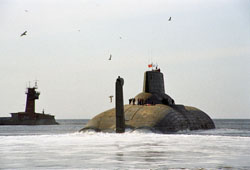
According to Rossiyskaya gazeta’s sources, Bulava SLBM test platform Dmitriy Donskoy was on-station in the White Sea for a launch last week, and all test arrangements were laid on — command and control, international notifications, ground and space tracking, telemetry, support and rescue ships, but the launch was put off at the last minute. 

The paper’s space and OPK sources said the Bulava commission had concluded the missile and boat were ready for the launch, and “today there is no reason whatsoever to put it off to a later time.” 

But, Rossiyskaya concludes, it turns out there was a reason serious enough to return the submarine to base.  

So it comes to nothing, and Defense Minister Serdyukov’s 8 September comments added no clarity to the situation, according to the paper’s account. 

So, we don’t know the reason why a launch was prepared, drew close, and didn’t happen.  It suggests some continuing problem or doubt about Bulava’s performance, or continuing disagreement over the system’s readiness for its next test.