Mr. Serdyukov’s Restrained Smile

Defense Minister Serdyukov (photo: Reuters)

 On 31 August, Sobesednik offered a not-altogether-serious, but nonetheless-interesting psychological portrait of Defense Minister Anatoliy Serdyukov . . . the magazine interviewed an expert in nonverbal  communication and microfacial expressions, a specialist in physiognomy, a professional image consultant, a handwriting analyst, and, yes, a numerologist. 

Of course, these observers had the advantage (or perhaps disadvantage) of knowing at least a little something about their subject, his reputation, and style beforehand. 

The nonverbal and microfacial expert said Serdyukov’s restrained smile and concentration are most characteristic of his expression.  He looks as if he’s suffering over the resolution of some problem with knitted brows, and he’s a man of few words.  His external appearance and pudginess suggest he senses and feels more than he hears or sees, and he likes both physical and psychological comfort. 

According to this observer, there’s nothing that bespeaks talent or charisma in Serdyukov, but he does exude efficiency and discipline. 

Finally, he concludes: 

“Anatoliy Serdyukov is a man capable of resolving problems on the orders of those who appointed him to this position.  His entire external appearance, his restrained gestures, constant concentration on business, and small number of public speeches speak exactly to this.”  

The physiognomy expert says Serdyukov’s round and soft appearance are characteristic of a peacetime military man.  A man occupied with logistical issues, who knows how to set goals and achieve them.  A businessman or administrator, not a wartime leader. 

His crooked brows and wrinkled forehead attest to difficulties in government service; it would have been easier for him in business.  A sharp visage compensates for his external softness.  His mouth is narrow; he is no orator.  However, his correctly formed ears connote someone who listens to information and the opinions of others. 

The image consultant notes Serdyukov practically never wears military attire.  He prefers his civilian clothing, and avoids ingratiating himself with the uniformed military.  His suits are conservative and classic.  He’s a restrained and severe man.  He can be somewhat aggressive (shown by the broad contrasting stripes on his ties).  Such people are usually burning to reform things and implement their ideas and goals, no matter what. 

The handwriting analyst says Serdyukov’s handwriting indicates his concrete way of thinking, and tactical planning.  He has a great sense of his own importance.  The pinching, arc, and intricacy of his letters show palpable internal emotion and willfulness, but other features indicate he’s inclined to self-control.  The constant requirement to control himself and hold his emotions is externally expressed as tension and restraint. 

Using Serdyukov’s birth date, the numerologist produced a number to reveal his character — 811962279112.  Four 1’s means he’s likely to be military, severe, and direct.  But the absence of 5’s means he has weak intuition and his actions are sometimes illogical. 

In all seriousness, it’s pretty easy to laugh all this off since Serdyukov’s a well-known public figure, but recall The Atlantic article describing Brenda Connors’ analysis of then-President Vladimir Putin’s gait, and how it explains his character and behavior. 

So Serdyukov’s a bit repressed.  In fairness, one probably shouldn’t expect any Defense Minister (or any minister for that matter) to be a happy man or woman.

Bulava Test in Second Half of September

Defense Minister Anatoliy Serdyukov talked to the press today about the next Bulava SLBM test:

“The next test launch of the Bulava could happen, most likely, in September, but not in the first half of the month.  Definitely.”

“We’ve tried to control the entire process of assembling these missiles as precisely as possible to produce the same parameters. There will be three missiles at a minimum, we need to understand that if failures are repeated in the launches, we’ll learn the cause of unsuccessful launches.”

After reiterating how previous failures had different causes, Serdyukov continued:

“Now at every level and phase of assembly of the missile there was strict control and analysis.  Moreover the commission established to explore the results of the last unsuccessful launch also worked here.  It gave recommendations, we incorporated all of them in preparing for new tests.”

“I believe that launches will be conducted most likely in September according to their readiness.”

Flip-Flopping on Navy Move to Piter

Late Friday, First Deputy Chief of the Navy Main Staff, Vice-Admiral Burtsev claimed the entire Russian media misinterpreted his remarks about the cancellation of the Navy headquarters move to St. Petersburg. 

That’s quite a feat . . . making everyone misunderstand what you’ve said . . . and this from a guy who’s pretty much an official Navy spokesman.  It sounds more like the flip-flopping on this issue continues . . . ‘bulldogs still fighting under the rug,’ so to speak.  And someone made Burtsev retract his comments by way of claiming no one managed to understand what he was saying.

According to ITAR-TASS, Burtsev now says:

“I believe it’s necessary to make several substantial adjustments in information linked to me disseminated yesterday about the terms of the transfer of the Navy Main Staff to St. Petersburg.  There has not been any suspension of the decision on such a transfer.”

“The mass media incorrectly interpreted my words about work toward the full transfer of the Navy Main Staff not being completed in 2010.”

He says the transfer:

“. . . is happening on schedule, a number of structural sub-units and units of the Main Command are already fully working in St. Petersburg.”

“First of all, these are the auxiliary command and control post, supporting peacetime command and control of forces, and also sub-units of military acceptance [voyenpredy], shipbuilding and radioelectronic warfare, and a number of organs of the naval scientific committee.”

“The full-scale transfer of the Main Command to St. Petersburg requires establishment of a qualitatively new infrastructural foundation, which is being laid down at the present time.  This concerns primarily sub-units responsible for command and control of naval strategic nuclear forces, groupings at sea, but also some other operational sub-units which, incidentally, are located not just in Moscow, but in other territorial components of the RF.”

“I want to note again:  the transfer of the Navy Main Command to St. Petersburg is occurring on schedule, in accordance with decisions taken earlier, in the bounds of the plan for reform of Russia’s Armed Forces.”

More Talk of Raising Draft Age to 30

Appearing on Thursday’s RIA Novosti talk show ‘Civil Defense,’ Deputy Defense Minister, State Secretary Nikolay Pankov claimed raising the upper age limit for conscription would benefit the army, and Russian society as a whole.

Under Russian law, men aged 18 to 27 are subject to the draft.  In April, GOMU Chief Vasiliy Smirnov floated the possibility of increasing the age to 30 as a way to help fill the army’s ranks at a time when 270,000 new conscripts are needed every six months, and contract service has failed to produce sufficient numbers of professional soldiers.

Pankov told his interviewer:

“I think this question [of raising the draft age limit] is very productive, and I wouldn’t reject this idea.”

But he admitted it needs more study.

After Smirnov’s April trial balloon, Defense Minister Serdyukov and General Staff Chief Makarov backed awayfrom raising the draft age, saying they were only ‘reviewing options.’

The issue really boils down to this:  how many 27-year-olds are the Russians currently drafting, and how much would drafting 28-, 29-, and 30-year-olds really help fill gaps in the ranks?

One has to conclude the return on conscription greatly diminishes at the outer edge, while resistance to it increases.  Forum.msk editor Anatoliy Baranov commented that raising the draft age limit to 30 is unpopular because average life expectancy for men is less than 60.  He continues:

“Of course, against the background of a general decline in the draft contingent by almost 2 times for social and demographic reasons, there are no and can’t be solutions fully compensating for this ‘demographic hole.’”

“How do you keep general military training and not draft everyone into the army at the same time?  There are, of course, solutions, but the current Defense Ministry leadership, it seems, consciously ‘overlooks’ them.”

Baranov seems to be saying, if the military wants a million-man army, with 600,000-700,000 conscripts, it’ll have to increase, not the draft age, but the draft term from one year back to 18-months or two years.

Western MD Opens for Business

According to ITAR-TASS, General-Colonel Valeriy Gerasimov told journalists yesterday that the new Western Military District (MD) was fully formed and functional on 1 September.  Gerasimov said:

“The Western Military District started functioning on 1 September.  Command and control organs of the former Leningrad and Moscow Military Districts, Northern and Baltic Fleets, and also the 1st Air Forces and Air Defense Command went into the composition of the staff located in St. Petersburg.”

Gerasimov said the majority of Moscow MD staff officers:

“. . . were appointed to positions in the staff of the Western Military District and other organs of military command and control.  Part of the officers, having served out their prescribed terms, were dismissed, but those who have a half-year to a year remaining to serve are at the disposition [of their commanding officers].”

Gerasimov himself went from Commander, Moscow MD to become a deputy chief of the General Staff.

The Defense Ministry now wants the other three new MDs / OSKs to be functional by 1 October.

Bad News for Would-Be Officers

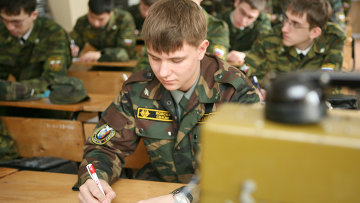
Future Officer, or Sergeant? (photo: RIA Novosti / Valeriy Titiyevskiy)

There’s no better time for bad news about changes in military education than the beginning of Russia’s academic year.

The Defense Ministry said Monday it’s stopping induction of cadets into military higher educational institutions (VVUZy or ВВУЗы).  And new students will not matriculate next year either.

There’s no doubt there’s lots of excess capacity that needs to be cut from Russia’s military education system, but, as usual, there seems to be more angst about the way the process is being managed than about the need for some kind of change itself.  The Defense Ministry is trying to ram many young men who signed up to be officers into sergeant’s billets, and generally changing the rules in the middle of the game.  There’s no doubt large numbers of VVUZ professors and other teaching staff will be pushed out of the service, but the Defense Ministry is denying this for now.  Perhaps most interesting, RIA Novosti elected to editorialize on this issue, saying it exemplifies the Defense Ministry’s, and the Defense Minister’s, poor way of dealing with the public and presenting its initiatives.

Deputy Chief of the Defense Ministry’s Main Personnel Directorate (GUK or ГУК), Tamara Fraltsova (who doubles as Chief of the Military Education Directorate) made the announcement during a video conference marking the opening of the Presidential Cadet Corps in Orenburg.  Specifically, she said:

“In the course of this year and next, the Defense Ministry is refraining from selecting cadets for its VUZy.”

“This is connected to an overabundance of officer personnel and a deficit of officer positions in the Armed Forces.”

“At present, graduation of cadets exceeds the officer positions we have in the Armed Forces by four times.”

In other words, the military educational system is still too big, and needs more cuts.  There are 56 teaching institutions in all – VVUZy and their branches (filialy). 

The ‘overabundance’ of officers is part and parcel of Defense Minister Serdyukov’s ‘new profile’ reforms in which officers are being reduced to 150,000 from well in excess of 300,000 in late 2008. 

Fraltsova has previously indicated VVUZy would be cut further and unified into ten ‘inter-service scientific-training centers.’  Duplicative or overlapping specialty training will also be eliminated.

Izvestiya reported that Fraltsova said the military education system is still configured to support a 4-million-man, rather than a 1-million-man, army.

Nevertheless, Fraltsova maintained that all 15,000 VVUZ graduates were placed in military billets last year.  But she didn’t say what kind of billets.

Krasnaya zvezda quoted her:

“. . . there is a chance for higher quality manning of the Armed Forces.  So, the requirements for future officers must be stricter.”

“There is a need for a review and selection of military specialties, according to which education in military VUZy is provided.  Part of [these specialties] will be transferred to the civilian ranks, part will go into to the duty category of sergeant personnel.”

There’s been media reporting for months that any cadet receiving even a single ‘2’ – an unsatisfactory mark – is now drummed out.  But this doesn’t eliminate many – 70 percent of cadets graduate without ever getting even a ‘3,’ according to the Defense Ministry.

Writing in Komsomolskaya pravda, Viktor Baranets indicated that only 100 of 600 lieutenants who arrived in the Pacific Fleet got officer jobs, and, in Voronezh, only the very top-ranked graduates found officer posts in the Air Forces.  About 20 percent of cadets normally graduate ‘with distinction.’  So the remaining 80 percent either accepted a sergeant position, or immediate dismissal into the reserves and the civilian world.  

Grani.ru reported that most graduates of the Defense Ministry’s Military University – a social sciences institution located in Moscow – got a ‘free diploma’ and an immediate discharge.   

According to Izvestiya, Fraltsova said there are only 5,000 command positions in the Armed Forces against an influx of 15,000 newly-commissioned junior officers.  The paper quotes her:

“Let them compete for what they will get.  The rest simply received a free higher education.  In my opinion, this is fair.”

She claims these changes are improving student performance, and she wants to use competitive ratings to make initial officer assignments.

She dismisses worries about the impact of cadet reductions on VVUZy teaching staffs because, in many cases, they’ll be busy teaching noncommissioned officers.  Some will be one-year conscript sergeants, and others three-year contractees getting nearly 3 years of post-secondary schooling.

Fraltsova revealed that 60 percent of VVUZy already teach on a ‘for-profit’ basis, and this will fully employ their instructors.

The effects of officer corps cuts, and VVUZy cuts, have rippled down to Russia’s venerable Suvorov and Nakhimov schools.  Without places in VVUZy, these young men will have to seek spots in other power ministry academies, if they want to be officers.  Premilitary Suvorov and Nakhimov schools now have to compete for students with the new Presidential Cadet Corps, which are supposed to train youth for the civil service in each federal district.

Forum.msk’s Anatoliy Baranov remarked that Fraltsova and her ilk “will suddenly observe in 10-15 years that everyone in higher military institutions has died, and there is no one and no way to teach new officers.”  Leonid Ivashov told Gzt.ru simply, “We are witnessing the destruction of Russian military education.”

RIA Novosti published surprisingly stark criticism of Fraltsova’s (and Serdyukov’s) performance. 

First, it quoted her:

“. . . not everyone in Russian society is sympathetic to this initiative.  Yes, these are very severe measures, not many like them, and we are being subjected to criticism for this decision.”

The news agency said Fraltsova’s press conference left the media with the impression that the Defense Ministry still doesn’t know what to do about the military education system.

It called the halt in VVUZ induction a ‘radical step,’ which calls attention to the Defense Ministry’s secretiveness in making important decisions.  The agency complains that, since 2008, when the ‘new profile’ started, the media and society have learned about most changes after the fact.  Veterans and other social groups have written to Serdyukov asking to give input, but it’s not clear their letters are even answered.  RIA Novosti concludes, in this case, the military department has once again ‘stepped on a rake.’

Yesterday Deputy Defense Minister, State Secretary Nikolay Pankov went on TV in damage control mode, saying these changes are intended to improve military education as well as to save money.  He intimated there will be lots more pain in going from 56 to 10 institutions.  Pankov said 20 percent of this year’s 10,000 VVUZ graduates will become sergeants instead of officers, but the Defense Ministry will keep these reluctant NCOs in mind if officer billets come open.

No Navy Headquarters Move to Piter

First Deputy Chief of the Navy Main Staff, Vice-Admiral Oleg Burtsev told journalists today the Navy headquarters will not move from Moscow to St. Petersburg.  He says the decision not to move was taken a year ago.  He declined to say whether the Main Staff will remain in its current location in Moscow.  But he added:

“Two variants for the location of the staff are being reviewed, but the decision about which of them to choose has not been made.”

The Main Staff won’t remain on Bolshoy Kozlovskiy Lane, near the Krasnyye Borota Metro, and media sources are saying it will either move into the Genshtab’s building on Znamenka, or into the Frunze Military Academy (Combined Arms Academy) building.

The idea for the move came from Putin ally and Duma Speaker Boris Gryzlov in 2007, and received support, not surprisingly, from St. Petersburg politicos.  Affected naval officers actively opposed the move, and their seniors were ambivalent at best.  It looks like Serdyukov’s Defense Ministry slow-rolled until the decision was reversed.  Not that it opposed the idea of freeing up expensive property for sale, but the cost and disruption of moving the Navy headquarters was prohibitive.

Russia is Priority for Mi-28N Deliveries

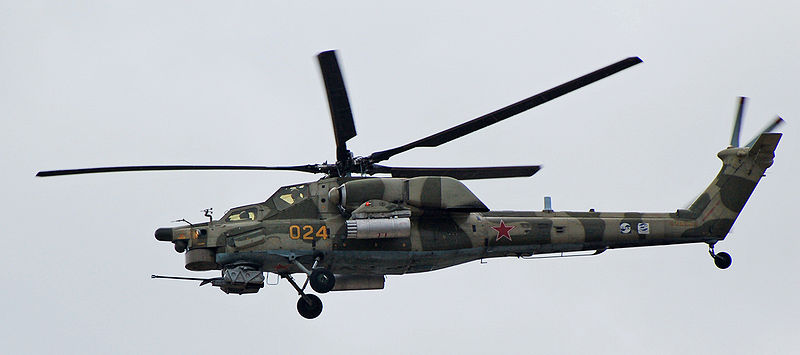
Mi-28N (photo: Denis Rossin)

Yesterday Rostov Helicopter Plant (‘Rosvertol’) General Director Boris Slyusar said the Russian Armed Forces are the priority for Mi-28N ‘Night Hunter’ deliveries, despite what he claims are many profitable offers from abroad.  According to ITAR-TASS, he said:

“We have many requests for the Mi-28N, but the RF Defense Ministry still doesn’t have these systems in sufficient quantity, and we will take its interests into account first.”

Slyusar didn’t give the number of Mi-28N helicopters in Russian forces, but he said the North Caucasus Military District (NCMD) has about 20 ‘Night Hunters,’ and there will be more.  He added:

“Our task is to create in the district’s [NCMD’s] troops in 2011 two groupings of Mi-28N.”

Who knows what he means by groupings.  Squadrons?  A second squadron or two additional squadrons?  The information on the number of Mi-28N delivered is unclear and contradictory.  In late 2009, Deputy Prime Minister Sergey Ivanov rather dubiously claimed Russia had already procured 27.

In May, a ‘Rosvertol’ marketing official said Russia would receive two squadrons of Mi-28N helicopters before 2011.  She said two Mi-28N went to the pilot training center at Torzhok in early 2008, and ten more — apparently for the NCMD’s Budennovsk-based 487th Helicopter Regiment — were delivered in 2009.  In mid-2009, ‘Helicopters of Russia’ General Director Andrey Shibitov also told Interfaks-AVN the Russian military had 12 Mi-28N helicopters.

So the question still stands:  a second squadron of maybe 10 helicopters, or two additional squadrons?  One thing’s certain, this goal’s been pushed from 2010 to 2011.

‘Rosvertol’ General Director Slyusar indicated his company sold 10 billion rubles of products in 2009,  and this year sales are more than 15 billion rubles.  Receipts from domestic and export sales are about equal.  By 2015, the company has an ambitious goal of $1 billion in sales.  Slyusar says the company is moving on this plan with modernization, equipment purchases, and people.

Air Forces News

A couple Air Forces items of interest today . . . .

A major live-fire exercise is taking place in the Far East today and tomorrow.  According to RIA Novosti, about 20 aircraft from the Far East Air Forces and Air Defense Army will fire more than 30 air-to-air missiles over the ‘Endurance Bay’ range on Sakhalin Island. 

A Defense Ministry spokesman said the aircraft are Dzemgi-based Su-27 fighters, and they’ll perform both day and night firings.  He emphasized that junior pilots will participate in the exercise.

There’s no readily available indication of the last time the Russian Air Forces conducted live-fire air-to-air training on this scale, so one presumes it’s been a while. 

Visiting Voronezh today, Air Forces CINC, General-Colonel Zelin said the city’s air base — soon to be one of Russia’s largest — will get four Su-34 bombers by year’s end.  The air base will be a first rank one, with 100 or more aircraft.

RIA Novosti reports the base’s expansion isn’t making nearby residents happy.  Those who object to it say its noise exceeds permissible levels, and causes headaches and sleeplessness.

On the Su-34s, Zelin said:

“I was recently at Novosibirsk aircraft plant.  One aircraft was already in flight test status.  The remainder are already in final assembly.”

State Tests of Su-35 Pending

Su-35

Krasnaya zvezda on 13 August ran a brief item updating Su-35 developments.

Sukhoy is completing its preliminary testing of the Su-35 multirole fighter, and plans to present it for state testing this fall.  Sukhoy chief designer Igor Demin [Dyomin or Дёмин] told Interfaks-AVN to expect this in September or October.  He said there are two Su-35 prototypes currently in flight testing, and this number will increase to 6 for state testing.  The third Su-35 will reportedly fly at some point in the fourth quarter of this year.

Demin says the Su-35 is receiving lots of testing because it has many new systems and components.  Preliminary testing substantiated its advertised characteristics — low and high altitude maximum speeds of 1,400 and 2,500 kph respectively, and a ceiling of 19,000 meters.

Sukhoy has a mid-2009 state order for 48 Su-35 for delivery by 2015, and serial production of the fighter has been arranged at Sukhoy’s KnAAPO.  The first aircraft might be delivered in late 2010, and serial production will start next year.  Export deliveries are planned for 2012, according to this report.

The Su-35’s designers say this fighter will allow for a partial rearmament of the Air Forces, and facilitate assimilation of ‘new generation equipment.’  They describe the Su-35 as a deeply modernized, highly-maneuverable ‘4++’ generation aircraft, which already uses some 5th generation technologies.

According to this article, the Su-35 sports digital avionics and instrumentation, a new phased array radar capable of long-range target detection and tracking and engaging more targets simultaneously, and new engines with greater thrust and variable thrust vectoring.  Its radar signature has been reduced several times over 4th generation aircraft by using an electroconductive coverings for cabin lighting,  radar-absorbent materials, and a reduced number of antennas.

The Su-35 is reportedly designed for a service life of 6,000 flying hours, and its controllable-nozzle engines 4,000 hours.

According to ITAR-TASS, Sukhoy reported in July that Air Forces pilots were beginning to prepare to fly the Su-35S [supposedly the nomenclature for the domestic version] in state trials.

Infomercials aside, the Su-35 is intended to be a gap-filler for PAK FA, but no one can say how long the gap will be.  Long in development and repeated modernizations, it will likely be a solid aircraft, evolved as it is from pretty good stock.  There’s foreign interest, but, of course, no firm purchases yet.