NATO Exercise in Baltic Region

People apparently love this issue, almost as much as information and netcentric warfare . . . .  So, give the people want they want.

Today’s Kommersant says, “They’ve Decided to Have Maneuvers on Russia’s Doorstep.”

The NATO leadership has decided to exercise in the airspace over Lithuania, Latvia, and Estonia, with forces from those countries plus the U.S., France, and Poland.  Kommersant calls it a symbolic start to a large-scale program with the Baltic member-states that will continue through this year.

The staff of NATO’s joint air forces command is quoted as calling the exercises ‘routine’ and having a strictly ‘organizational character.’  But they will also be “a demonstration of alliance solidarity with the countries of the Baltic region that have joined it.”

Participants intend to give special attention to increased coordination between NATO air forces and to patrolling air space.  It will give NATO a great opportunity to use regional air forces and evaluate their readiness.

The Baltic Region Training Event scheduled for 17-20 March was developed at the end of 2008.  France will use its Mirage 2000C, Lithuania its L-39 Albatros, Poland F-16, and the U.S. tanker aircraft.  Latvia and Estonia will provide ground control.  Fighters will land at Tallinn airport for refueling and simulated maintenance.

Kommersant says the issue of serious exercises with the Baltic members came up after Russia’s short war with Georgia in August 2008.  Baltic concerns were reinforced after Moscow’s Zapad-2009 exercise with Belorussia.  According to the paper, Baltic leaders saw in this exercise work on various scenarios for seizing the Baltic countries.  It notes that Russia’s possible purchase of France’s Mistral has also caused a stir in the Baltics and Poland.  Leaders of the former Soviet republics have asked the U.S. to press Paris not to sell it, according to Kommersant.

Washington and Brussels have heard Baltic concerns and planned a series of political and military steps to calm them.  Kommersant names the agreement to place Patriot air defense missiles in Morong, Poland, 75 km from Kaliningrad’s border in April as one of the steps.  NATO’s Parliamentary Assembly will meet in Riga in May.  Also noted is the June amphibious exercise in Estonia in which 500 U.S. Marines will participate.  Kommersant says Estonian officers will command the exercise.

The steps will culminate this fall in a joint ground exercise involving 2,000 U.S., Lithuanian, Latvian, and Estonian troops as well as transport ships.

Newsru.com added a comment from Fedor Lukyanov, chief editor of the foreign affairs journal ‘Russia in Global Politics.’  He noted that the Baltics don’t trust NATO completely, and European members of the alliance most of all, and suspect that they won’t risk relations with Russia in a crisis.  The fact that these will be the first on-the-ground exercises in the Baltics since the countries joined the alliance 6 years ago just serves as extra confirmation of this.

Golts on Makarov, Postnikov, and Contract Service

In Yezhednevnyy zhural on 1 March, Aleksandr Golts says Makarov’s and Postnikov’s pronouncements on the failure of contract service were, of course, an open secret.  Analysts and journalists had been writing about its failure for two years [much longer actually].  He recalled being at a December roundtable including GOMU generals, who had implemented contract service, who railed against slanderers who dared describe things as they are, including the failure of the contract program.  And now Defense Ministry chiefs have also acknowledged the obvious.

Golts concludes that Makarov and company also finally recognized something known to ‘liberal experts’ seven years ago–it was senseless to try to go to volunteer service without first creating a professional NCO corps.

Then Golts describes a Defense Ministry propensity for lying–GOMU Chief Smirnov gives one figure on the number of draft evaders, his deputy gives a different figure; Deputy Defense Minister Pankov says the 85 permanent readiness brigades are ready for battle in one hour, Ground Troops CINC Postnikov says actually they are ready only to depart their garrisons in one hour; Armaments Chief Popovkin says 5-6,000 tanks are needed, Postnikov says 10,000, or maybe only 2,000 are needed.

This irresponsible and unpunished lying pervades the army, it’s an everyday automatic reflex, and it’s not harmless.  The country’s leadership takes decisions on it.  God forbid they should trust GOMU when it says it’s possible to provide for conscription just by stopping draft evasion.  This would indicate that the complete collapse of the military manning system is near.  And the generals would use this as an argument to overturn the current reforms.

GOMU Chief Smirnov Denies Plans to Increase Draft Term

Reacting to spreading rumors that the Defense Ministry intends to increase the current one-year draft term to 18 months, 2 years, or more, GOMU Chief Vasiliy Smirnov said Monday, “There’s no plan to increase the term of conscripted military service in the Russian Army.”

His denial came hard on the heels of General Staff Chief Makarov’s sudden public declaration that professional contract service has failed, at least for enlisted soldiers if not future sergeants, and the army will redouble its emphasis on drafted manpower.

Commenting in today’s Novaya gazeta, the chairwoman of Mother’s Right Veronika Marchenko says:

“If the Genshtab Chief is acknowledging the fact that the Genshtab is not capable of transferring the army to contract service, even though a corresponding [Federal] goal program was adopted, this is not cause to return to the draft system and increase the number of conscripts.  This is a reason to dismiss all the inept generals.”

That is a quaint sentiment, but it doesn’t work that way.  The generals always muttered that contractees wouldn’t work, and men inclined to evade simply had to be herded in.  They’ll say they were right all along.  The chiefs won’t suffer, only the indians.

More interesting, however, Marchenko thinks the rumors could be a trial balloon to gauge society’s reaction–if there’s no reaction, they might try to increase the service term again.

Another human rights organizer claims every 10th conscript is abused in some dehumanizing fashion.  She compares army service to life in a leper colony:

“It’s possible to live [there] ten years and not contract leprosy, or it’s possible for the irreparable to happen in one day.  The army today is potentially dangerous for the human system.”

Komsomolskaya pravda’s Viktor Baranets writes today that he’s amazed that it’s taken 20 years for generals like Makarov, Postnikov, and Chirkin to acknowledge that contract service is doomed.  He goes on:

“And how here can’t you believe that in the same manner in a year or two the Defense Ministry and Genshtab again will publicly ‘scratch their noodles’ and with a funereal sigh announce to us that the transfer of troops to the brigade system, and the transfer of the Navy Main Staff to Piter, and getting rid of warrant officers, and the reduction of almost 200 thousand officers were also mistakes?  But the strategists who reformed the army for no reason will by that time will be wearing pensioners’ slippers and courageously scribbling out their memoirs.”

This Russian (maybe even universal, bureaucratic) penchant for back-to-forth reform, reforms where process is everything and results are nothing is truly amazing and very evident in the armed forces.  But it’s everywhere even on the very same day.  Witness please Putin’s solemn announcement that he’s slashing the rolls of strategically important enterprises after many years of just as solemnly building up their ranks . . . what was the point?  What did they gain, what was accomplished?  Nothing.  It was a political drill to fend off clients desperate for money and bureaucratic attention, and their strategic status was, by and large, a sop.  End of digression.

What else on the topic of the moment?

Baranets.  He speculates the ‘death notice’ for contract service could be a first step backward on Serdyukov’s reforms.  He says there are now 70,000 contractees and contract-sergeants.  He believes in a year the Genshtab will increase conscription to 700-750 thousand guys annually, and they won’t become specialists in anything with demob always just around the corner.  So, he concludes, the rumors about a return to longer conscript service ain’t a coincidence.

Versiya has interesting coverage of the issue.  So Makarov says contract has failed, all sorts of other innovations in army service similarly haven’t brought the desired results.  Dedovshchina didn’t decrease, collecting the requisite quantity of servicemen will now be more complicated, the quality of soldier training has sharply declined.  And the number of conscripts in the ranks will grow.  Versiya asks:

“Can it be we’ll return to the Soviet model of an army which has been publicly declared ineffective in modern conditions?”

One-year service was supposed to eliminate dedovshchina, but General-Lieutenant Chirkin admits it didn’t.

Versiya’s versions:

  • First Version:  Return to Soviet-style manning.  Probability:  50 percent.
  • Second Version:  No alternative but contractees, this is just a pause.  Probability:  30 percent.
  • Third Version:  Course will be unchanged despite Makarov’s announcement.  Probability:  20 percent.

It sounds like Versiya really puts the odds of largely diverting from contract service at 50:50.

One-Year Conscription Hasn’t Stopped Dedovshchina

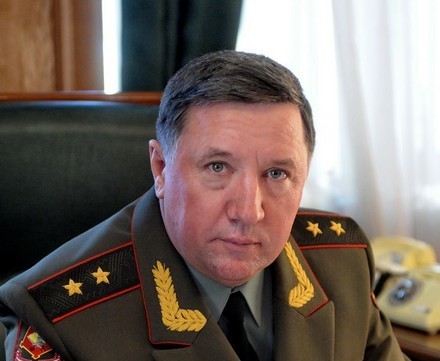
General-Lieutenant Chirkin (photo: IA Regnum)

On Thursday, SibVO Commander, General-Lieutenant Vladimir Chirkin told reporters:

“The military expected a dramatic decrease in this type of offenses, but, regrettably, hazing remains an acute problem. The conscripts, who now have to serve 12 months, regard themselves as ‘old timers’ after serving 6 months, and the same thing continues.  Apparently, this virus is transmissible.”

“We now know that we should search for the causes of bullying not in the duration of service but, it seems, deeper.  We now have to work harder with detachment commanders.  This year issues of discipline will be even more important for us than those of combat readiness.”

Chirkin said several high-profile abuse cases are currently under investigation in the SibVO.

Introduced in 2008, the one-year draft was intended to reduce conflict between conscripts from different draft campaigns.  The ‘dedy’ or ‘grandfathers’ about to demobilize would often abuse, haze, or otherwise mistreat brand-new inductees.  But as Veronika Marchenko from Mother’s Right says, it hasn’t been enough to stop dedovshchina:

“In the army then and now they beat people on the third day of service, in two weeks, and in the first months.”

Marchenko believes ending conscription completely is the only way to curb dedovshchina, but that’s not likely now with the virtually complete failure of professionalization through contract service.

The Contractees Are Dead, Long Live the Contractees!

Asked about professional soldiers and contract service last week, General Staff Chief Nikolay Makarov said: 

“We are not switching to a contract basis.  Many mistakes were allowed, and that task which was given—construction of a professional army—was not completed.  Therefore a decision was made that conscript service needed to remain in the army.  Moreover, we are increasing the draft , and decreasing the contract part.  We’ve come to understand that a contractee has to be trained by altogether different methods than there were earlier.  Therefore now we’re taking on contract only sergeants who are studying for 2 and a half years.  We plan to reach a contract army through this.  Many people talked even in the Soviet Army about the need to train sergeants, but now we’ve thought everything through well and we’re promptly moving forward, so that in 2.5 years in our army there will be a sergeant, an assistant commander who’s capable of independently resolving an entire complex of tasks that are now resolved by officers.”

The effort to build a professional NCO corps will continue, but the experiment in recruiting career enlisted personnel—a main line of the army’s development since 2003—has failed.  The tenor of Makarov’s statement almost makes it sound as if he didn’t think or know a mixed manning system with conscripts predominating was the plan all along.  The Russian Army was always going to remain mixed, but now it will be much more one-sided in favor of conscripts.  A Vedomosti editorial pointed out that Russia’s generalitet (what remains of it) never supported contract service anyway.  The training of professional NCOs begun on a very small scale last fall will continue, but how long will it be before that effort too is abandoned?

Makarov’s announcement will only add to pressure on Russia’s dwindling manpower resources.  The start of one-year service basically doubled the semi-annual requirement for draftees from 133,000 to 270,000 or so.  Now it’s clear that conscripts are needed to fill spots contract enlisted were supposed to occupy.

Rossiyskaya gazeta and Krasnaya zvezda covered similar comments last week from new Ground Troops CINC Postnikov.  Both papers concluded that, while the effort with professional NCOs will continue, the army’s priority will be on meeting its manpower requirements through conscription.

Vremya novostey quoted Postnikov:

“The federal program to transfer permanent readiness units to manning with contractees did not achieve its intended goals.”

It didn’t succeed in making contract service prestigious, they didn’t select those who could be true professionals, they fully manned units with contractees to the detriment of quality.  Now corrections have been made in the troop manning plans.  Only those positions that determine the combat capability of units and formation will be contract.  There both pay and social conditions will be fitting – just like officers.  They will train contractees for the positions of professional sergeants, just as in the U.S.

And Izvestiya:

“. . . we can’t say that we have precisely those contractees which we wanted to have ideally.  We understood that we had to change the system of training contractees.  It’s planned to do this through the institution of sergeants – an assistant commander capable of independently resolving a whole block of tasks which officers now resolve.  For this reason they have to occupy positions directly answering for the combat readiness of army units and sub-units.  We have to increase their pay, create social conditions for living at the level of officers.”

But one basic problem has always been the jealousy of officers (who rarely get all their pay and benefits) toward contractees or NCOs who might possibly get almost as much as them. 

Novyye izvestiya quoted Sergey Krivenko, a member of the RF President’s Human Rights Council:

“Contractees were not provided housing or normal pay, or even timely indexing of their wages . . . .  Instead huge sums were invested in construction of housing, reequipping ranges and other facilities where the money could easily be hidden and stolen.”

Krivenko adds that contractees didn’t experience a change in their status, were often forced to sign contracts, and were not allowed to leave the garrison or live a normal life with their families outside the garrison.  So there was nothing to distinguish them from conscripts.

To sum Krivenko up, the army failed to find the right candidates and deliver the benefits it promised them.  So one has to be skeptical that the selections and Defense Ministry follow through on the professional NCO effort will be any better.

Krivenko believes that the army has virtually no choice but to increase the conscription term from one year to cover the lack of contract soldiers.  But simply allowing undermanning of units would have the same effect, but that might impinge on Makarov’s claims that most units are now fully manned and permanently ready.

More on Carriers from Gorshkov Conference

Navy CINC Vysotskiy (photo: RIA Novosti)

RIA Novosti has more coverage of Navy CINC Vysotskiy’s carrier comments from yesterday.  Vysotskiy said there’s a plan to build and launch an aircraft carrier by 2020, and the technical proposal for it has to be developed and ready by the end of 2010.

“According to the plan, by year’s end we’ll receive the technical proposal for a future aircraft carrier with the basic tactical-technical characteristics.  Then development of the working documentation will begin.” 

He said experimental-design work (OKR) was already under way.

Vysotskiy noted that a Federal Goal Program (FTsP) was needed to construct an aircraft carrier, because financing to do it in the State Defense Order (GOZ) would be very complex.

Former Navy CINC, now advisor to the Defense Minister, Vladimir Masorin, remarked that carriers make it possible to influence the situation in the world, and its different regions.  He added that, if Russia wants to become a great naval power, it has to have carriers and they will have to be nuclear-powered.  He believes the main thing is preserving Russia’s scientific potential and carrier pilot skills:

“Aircraft carriers can’t be built in a short period.  We have to preserve our scientists, designers, and pilots.”

Navy CINC Vysotskiy on Parity, Space, Carriers

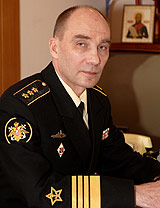
Navy CINC Vysotskiy

ITAR-TASS reported Navy CINC Vladimir Vysotskiy’s remarks at a military-historical conference dedicated to the 100th anniversary of the birth of long-time Soviet Navy CINC Sergey Gorshkov.  Vysotskiy said: 

“For the first time in history Russia threw down the gauntlet to old naval powers.  Having achieved nuclear parity with the U.S. Navy, the [Soviet] Navy became a strategic service of the armed forces.  Thanks to this we are developing many of the most serious goals to ensure keeping this parity, and we are correcting all approaches which were laid down in the ‘unforgettable’ 1990s.  Russia is the inheritor of a great state that has to possess an oceanic fleet capable of defending national interests wherever they are.  And they are everywhere in the world’s oceans.” 

In Vysotskiy’s estimation, “putting the fleet into operationally important areas of the world’s oceans allows us to look with certainty into the future, with the support of the Supreme CINC.”

Vysotskiy pointed to Gorshkov’s emphasis on nuclear weapons, submarines, and naval aviation, and noted that, “The memory of Gorshkov allows us to stand not on a crude defense, but to move forward.” 

RIA Novosti’s account quoted Vysotskiy on space and aircraft carriers:

“Without air supremacy it’s impossible to conquer space.  The one who understands this is on the right path.” 

He observed that space and air forces are the main danger even for submarines.  And submarines have to rely on space-based comms.  Vysotskiy said it’s essential for Russia to build ‘aviation-carrying systems’ which are very similar to space systems in their own way. 

“Today it’s necessary to understand the significance of these systems, it’s necessary to do this today, this must be a collective work of the state.” 

In other words, he wants the state to see things the same way and pay for it. 

He said today 9 countries have ‘aviation-carrying fleets,’ and 14 will by 2014. 

“If China intends to have one, this is understood, and if even Thailand intends to have one, then we also need to understand this in Russia today.” 

He also noted that costly investment in [naval] construction is justified even in a time of crisis since 90 percent of the world’s cargo is delivered by ships which need to be protected.  But one wonders how much of Russia’s is.  All in all, a weak justification.

Happy Defender’s Day

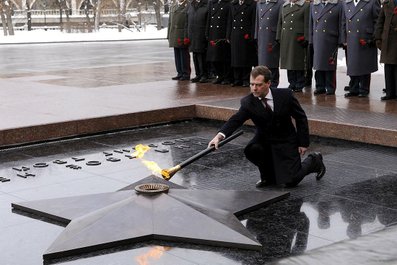
Medvedev Lights Flame at Tomb of the Unknown Along Kremlin Wall

In his Defender’s Day eve address on Monday, President Dmitriy Medvedev said:

“The defense of native land, service in the army and fleet has always been considered our holy duty.  And those who chose the military profession as the business of their entire lives command great respect among our people.”

Apparently, not too holy since Medvedev didn’t serve, even though he would have been due for conscription at the zenith of the mass mobilization Soviet Army and one of the coldest points of the Cold War [1983].  Of course, there are lots of presidents who didn’t serve in their countries’ armed forces.

Medvedev went on to thank Russia’s veterans with the 65th anniversary of the Great Victory fast approaching [9 May].

Then he noted:

“. . . strengthening the defense capability of our country–this, absolutely, is the fundamental basis for our development.  Our strategic goal is the formation of an effective army and navy, adequate for the level of modern threats, capable of withstanding any level of aggression and being a real factor in guaranteeing international stability.”

“Before us stands the main mission–to reequip the army and fleet with the newest armaments.  It is essential to concentrate resources, all our best forces, and our country has done this more than once, in order to create new quality types of military equipment and finally escape from a system of “patching holes” in old armaments.  Some has already been accomplished here, but this is a basic task for the near future.”

“Strengthening Armed Forces personnel will also remain a priority.  People who have received a modern quality education answering the demands of the time need to be occupied with military affairs.  People who are prepared to complete contemporary combat missions, to complete them in the most effective way and, absolutely, physically and morally prepared.”

“The most important condition for the successful modernization of the Armed Forces–this is increasing the quality of life for servicemen.  The current military labor stimulus system (I have in mind the so-called order 400) is already giving positive results today.  From 2012 new salaries will be paid to all our country’s officers.”

“Everything necessary is being done so that this year all military men needing permanent housing will receive it.  I am keeping this issue under my personal control.”

“By the end of 2012 the issue of providing servicemen with service housing will be fully resolved.  I am sure that such guarantees will increase the wellbeing of your families and the prestige of military service as a whole.”

“Next it is important also that all measures to transfer the army and fleet to a new quality should be fulfilled efficiently and on schedule.  I am expecting precisely this from the Defense Ministry.”

On Tuesday, Medvedev participated in reigniting the eternal flame on the grave of the unknown soldier below the Kremlin wall.  The flame had been moved temporarily to Victory Park on Poklonnaya gora during the renovation of the tomb of the unknown.

Medvedev also visited a military unit in the Moscow suburbs and had tea with a senior lieutenant and his family in their new apartment.

The KPRF and its leader, Gennadiy Zyuganov, played the lead in presenting an opposite point of view on Defender’s Day.  The KPRF faithful marched from Triumfalnaya ploshchad to Teatralnaya ploshchad for a rally.  The party predicted 10,000 attendees, the police said there were 1,500, and Ekho Moskvy reported 4,000.

One KPRF leader said his party was coming out in defense of the army and fleet, their history, their power and against this senseless reform which Defense Minister Anatoliy Serdyukov is conducting.  He said the KPRF would hold rallies in 8 regions where elections are being held on 14 March.  Those demonstrations, however, were focused on more ‘bread and butter’ issues like communal service rate increases.

Zyuganov himself was in vintage form, saying:

“The army is currently in an exceptionally poor state.  A totally useless man is today in charge of the army.  He has no right to hold this office.  Not a single military man would want to pronounce the family name of Serdyukov properly, without adding some insult.  This means that Mr Putin and Mr Medvedev have put in charge of the army a man who is incapable of teaching servicemen, rallying them together or setting key objectives concerning military security and army training and equipment of our armed forces.”

He continued, saying Russia has “no possibility not only to produce, but even to reform its existing military complex.”  He claimed Russia is 10 years behind NATO in military potential, and he said Russia’s strategic forces are “on their last legs.”  Addressing Prime Minister Putin, he asked why a minister like Serdyukov was being retained.

IA Regnum reported on a rally in support of army reform and modernization led by United Russia youth wing Molodaya gvardiya and the local branch of veteran’s organization Combat Brotherhood in Ulyanovsk.  Press reports said attendees were looking forward to restarting An-124 transport aircraft production at Aviastar, and having OPK enterprises serve as a locomotive for the rebirth of local industry.

Limited Productive Capacity, High Demand for Arms and Equipment

Surprisingly little attention, beyond routine press service reports, went to last Tuesday’s (16 February) government conference on the State Armaments Program, 2011-2020 (GPV-2020).  RIAN and older media reporting indicates the GPV-2020 will be adopted next month.

Prime Minister Putin told the attendees, “We are talking about the time frames and kinds of weapons systems we need to provide to our army and fleet, that have to be put into the arms inventory.”  Noting that nuclear deterrence forces, space, and air defense would be emphasized, Putin also said:

“We have to satisfy, as I already said, the troops’ need for modern communications, command and control, reconnaissance and, of course, complete the fifth generation aircraft, new combatant designs for the Navy.”

He reiterated earlier declarations that modern armaments in the forces must be 30 percent by 2015, and 70 percent by 2020.

Other Putin sound bytes:

“We have to provide essential financial resources for this task.  The Finance Ministry, the Economic Development Ministry have made the necessary calculations, and today we’ll need to analyze them.  Right off I want to note that we can’t allow any inflated estimates, ineffective expenditures.”

“The State Armaments Program has to give long-term guidance for developing the defense-industrial complex itself.  This must enable our enterprises to embark on a corresponding modernization.”

“We’ve conducted a whole series of meetings on these issues, but the Defense Ministry must provide the corresponding technical parameters.  We have to support the technological equipping of our defense-industrial complex exactly under these parameters.”

Finally, Putin indicated defense orders will go to enterprises that will be in a condition to produce truly competitive systems in terms of combat power, range, and protection.

Participants in the conference also reportedly discussed a new draft Federal Targeted Program (FTP or ФЦП) on the Development of the OPK.

On 15 February, Putin met with Industry Minister Khristenko and Director of the Federal Service for Military-Technical Cooperation (FSMTС or ФСВТС) Mikhail Dmitriyev.  Khristenko told Putin last year OPK enterprises received 148 billion rubles in state support (6 billion in credits, 60 billion in capital injections, 76 billion in state-guaranteed credits, and 6 billion in subsidized interest rates on export credits).  According to Khristenko, this support allowed the OPK to increase its production 10 percent.

Unnamed Defense Ministry sources said the 76 billion rubles in state-guaranteed credits are difficult to use, and not all were used.  The 60 billion rubles in capital injections were basically a direct budgetary grant, and, according to one aviation plant manager, 20 billion of it went (get this!) to compensate RSK MiG and other producers for the fiasco with their 34 faulty MiG-29s sold to, and returned by, Algeria.

FSMTC Director Dmitriyev told Putin the volume of Russia’s current arms export contracts is $34 billion, and exports will be $9-10 billion over the next two years.

Aleksey Nikolskiy writing for Vedomosti indicated Dmitriyev said several enterprises have orders for some systems scheduled out to 2017, and some foreign customers have raised the issue of quicker deliveries.  He argued that additional production capacity is needed, but Putin proposed only to review the issue of synchronizing domestic and export orders for arms.  He said, “We have to understand in what time frame we can and have to produce for ourselves and our foreign partners.”

A source close to Rosoboroneksport said the issue concerned limitations in production capacity for the S-300PMU2 and S-400 air defense systems, the Su-35 fighter, and surface-to-surface missiles that don’t allow for simultaneously meeting the demands of foreign customers and the Russian Armed Forces.  Vedomosti noted that VVS CINC Zelin already complained about limited productive capacity for the S-400.  A similar jam exists with the Su-35, which is supposed to enter the VVS and some foreign air forces by the end of 2011.  A Defense Ministry source said there’s a proposal to build two new factories for air defense systems, and to enlarge existing enterprises producing critical equipment, and the government might soon adopt the proposal.

Konstantin Makiyenko of CAST (ЦАСТ) told Vedomosti, for the past 2 years, Rosoboroneksport has received more orders than what it has supplied abroad, and the lack of sufficient productive capacity has become the main limiting factor on the growth of arms exports.  He says either increase the capacity or the army will have to wait for arms it doesn’t need too much, but air defense systems and fighters don’t fall into the category of things not urgently needed.

As Mikhail Rastopshin and others have been so kind to note, there have been a raft of OPK development and armaments programs over the years, but they don’t seem to get completed, each melding into the next albeit under a longer deadline.   In early 2009, Dmitriy Litovkin estimated no more than 20 percent of any arms program has ever been accomplished, even during the years of high oil revenues.

And you can’t do an armaments program without OPK development, and Russia’s defense-industrial base has been increasingly poorly positioned to support the arms program in recent years, according to Rastopshin and others.  And don’t forget about declining RDT&E.  Hard times for research institutes and design bureaus could mean that, rather than modern or futuristic weapons based on ‘new physical principles,’ new units of obsolete designs could be produced under an armaments program.

Here’s a telling reminder.  The  much-vaunted 2003 Urgent Tasks of the Development of the Russian Armed Forces document called for modern weapons at the level of 35 percent in 2010, 40-45 percent in 2015, and 100 percent by 2020-2025.  And now Moscow’s talking 30 percent by 2015 and only 70 percent by 2020.

As recently as 2006, the Russian military claimed 20 percent of its weapons inventory was modern.  But in March 2009, Defense Minister Serdyukov admitted the starting point was actually lower:

“. . . the bulk of [arms and equipment] are physically and morally obsolete. Natural loss is not being compensated by procurement.  As a result, the proportion of modern arms and military equipment is around 10 percent.”

This was when President Medvedev said large-scale rearmament would begin in 2011.

Nevertheless, in his November 2009 address to the Federal Assembly, Medvedev said:

“One of the most difficult yet fundamental tasks is reequipping the troops with new systems and models of armaments and military hardware.  There is no need to discuss some abstract notions here: one needs to obtain these weapons.  Next year, more than 30 land and sea-based ballistic missiles, five Iskander missile systems, about 300 modern armored vehicles, 30 helicopters, 28 warplanes, three nuclear submarines, and one corvette-class combatant must be delivered to the troops, as well as 11 spacecraft.  All this has to be done.”

A pretty daunting list when foreign customers are asking for their weapons too.

Retired Officer Rails Against Army’s ‘Sergeantization’

One retired Colonel A. A. Karasev, deputy of the Saratov city duma and chairman of the Saratov branch of the Union of Soviet Officers, has written in KPRF.ru about communists and former servicemen picketing Prime Minister Putin’s reception office in Saratov on 17 February.

According to him, they demonstrated their concern about ruinous army reforms and carried signs saying “Putin!  Return Serdyukov to the Furniture Store.”  And, of course, they addressed an open letter to Putin.

Their letter said they’d taken to the streets before what used to be Soviet Army and Navy Day to make their woes, pains, and demands known to the head of government, and to defend the army, OPK, veterans, and their families from the outrages committed by bureaucrats and Duma deputies.

Their particulars included:

  • The U.S.-Russian balance of strategic forces is broken.  The leadership’s rush to a new strategic arms agreement is only reducing Russia’s security.
  • The OPK continues to be destroyed.  Defense factories in Saratov have closed.  Remaining plants get financing only in late spring or summer each year.
  • The Defense Ministry has not thought out its reforms of the army in the American mold.  The combat possibilities of Russia’s brigades are less than those of the formations and units of the ‘probable enemy’ [they really think the U.S. and Russia will go head-to-head?].
  • ‘Sergeantization’ [i.e. officer cuts and efforts to create professional NCOs] of the army means its enfeeblement.  There isn’t a sergeant with an intermediate specialized education [i.e. vocational high school diploma] who can replace an officer from a higher command or engineering school.  Promising contract-sergeants 20-30,000 ruble pay after training only adds extra tension to their relations with officers.
  • Military pensions have fallen to the level of pay for the least qualified workers, and below the subsistence minimum in many cases.
  • Military wives have not received social guarantees to compensate for their inability to work in many garrisons.

They want all these problems rectified, of course, but want to start with firing Serdyukov and his team.

The tension over what they’ve termed ‘sergeantization’ is interesting. 

In the Defense Ministry’s view, officers who’ve been cut, or turned into sergeants themselves, either weren’t needed or weren’t performing officer work or supervising troops.  So officers have been cut, and those that remain will really be officers with real units to command.  Some of them will get premium pay to reward them for now, and, from 2012, much higher base pay, for example, maybe 60,000 rubles for a lieutenant.  Meanwhile, as the Defense Ministry sees it, there won’t be any problem with newly-minted professional sergeants entering the ranks and earning higher pay [which still won’t approach that of officers].

The KPRF has an alternate scenario for the future.  It sees many officers, who were needed, put out of the service and replaced by some poorly trained contract sergeants who will earn more than before.  Two-thirds of officers don’t get premium pay for now, and the KPRF is probably skeptical that greatly increased pay for all remaining officers will be actually be delivered in 2012.  The future it sees has a mass of officers and sergeants, not differentiated by much of anything, including pay.  While the officer-NCO interaction was long ago worked out in Western armies, it’s still a troubling vision for an army in the throes of major structural changes and lacking a professional NCO tradition.