Tag Archives: Dmitriy Medvedev

Medvedev Speaks at Defense Ministry Collegium

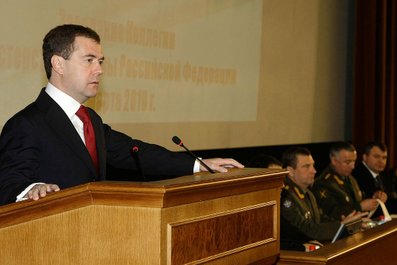
President Medvedev (photo: kremlin.ru)

In his remarks [text and video], President Dmitriy Medvedev reviewed the results of 2009 and talked about future plans for the armed forces.

He focused first on the international situation, noting that, “. . . today we have no requirement to increase further our strategic deterrence potential,” although it remains a determining factor in Russia’s conduct of independent policies and the preservation of its sovereignty.

He noted Moscow’s new law authorizing the use of force to protect Russian citizens abroad, and he pointed to unresolved conflicts on Russia’s borders [where presumably the new law could be used].

Medvedev acknowledged some positive tendencies such as work on a new strategic arms control agreement and renewed Russia-NATO contacts.  But he called the West’s reaction to Russia’s draft treaty on European security a barometer of relations with the U.S. and NATO.  He said it could prevent conflicts like Georgia-South Ossetia.  Medvedev asserted that, unfortunately, far from all countries and politicians drew the correct lessons from the August 2008 events.  And, unfortunately, he said the reestablishment of Georgia’s military potential continues with external assistance.

Then Medvedev turned more to the exact points of his speech.

He said the main goal is the qualitative improvement of the armed forces, the creation of a modern army and fleet equipped with the newest weapons.  He said last year the organizational base for this was established, as planned, without expending additonal resources.

In 2009, Moscow got its authorized personnel down to 1 million, and, according to the President, the Defense Ministry largely achieved its task of getting to the military’s future combat composition.  Medvedev said the results of Osen-2009 confrmed this, and more exercises like it are needed and need to have a ‘systematic character.’  Because, “Without this there simply are no armed forces.”

Medvedev called the training of officers the ‘most important task. Motivated, high-class specialists are needed, but the recently degraded military educational system and its material base need improvement. Medvedev said particular attention also needs to go to sergeants.  They need to be capable of replacing front-line officers when needed, according to the Supreme CINC.

On to rearmament . . .

Medvedev called the task of reequipping the troops with new armaments ‘extremely complex and very important.’  He said last year Russia stabilized the condition of its arms and equipment, despite the financial crisis, and fulfilled the GOZ, although not without problems.

He called the contracting mechanism for arms purchases ‘not effective enough,’ and said we are  working on this, but it’s slow.  This year the State Armaments Program, 2011-2020 will be written.  Medvedev gave the government the task of renewing arms and equipment at an average rate of 9-11 percent annually to allow Moscow to reach 70 percent modern armaments by 2020.  Reequipping has to be supported by full and timely financing.  He referred to his Poslaniye list of  priority systems and arms to be acquired.  He said this task will not be adjusted, and old weapons need to be decommissioned [He seems to have gotten it into his head that new means good and old bad which is not necessarily the case with Russian weapons.  What happens if you scrap lots of stuff, but you don’t succeed in producing new stuff?]. 

Medvedev said, as he’s already said more than once, steps are needed to bring order to the use, storage, and upkeep of missiles, ammunition, and explosives.  The events of the last year have shown there are problems here [alluding to Ulyanovsk, Karabash, etc.].

Medvedev noted another issue, providing the armed forces with automated command and control, and information systems, and transferring the military to digital comms by 2012, as put forth in the Poslaniye.  He said Zapad-2009 worked on mobile automated C2, but this was only a beginning to the work, which needs to be intensified, because “the communications situation is problematic.”

The President said forces will increase their combat readiness in their new TO&E structures [aren’t they 95 or 98 percent combat ready already?].  The main effort will be forming and training inter-service troop and force groupings, and supporting nuclear deterrence forces.  Medvedev said he’ll attend the main, key phases the coming Vostok-2010 operational-strategic exercise.

Medvedev obligatorily cited increasing the prestige of military service and improving the social defense of servicemen as a priority task.  

“I’d like to note that all obligations of the state to current and released servicemen will be fulfilled unconditionally, I will not accept any amendments for budget changes, or for other reasons.”

Medvedev said the government has the clear task to guarantee that all servicemen needing permanent housing have it by the end of this year, and service housing by the end of 2012.

“The realization of this task is not going badly, I will also take this under my personal control.”

Finally, Medvedev spoke for a moment to pay issues.  Increasing pay, and instituting a new pay system for active duty troops from the beginning of 2012, and increasing pensions to retired military men [but nothing specific promised].

He said he thinks premium pay or the well-known Order 400 brought respectable results, and it will be important to preserve ways of rewarding servicemen with extra money under the new pay system, and he expects proposals on doing this.

Defense Minister Serdyukov had some comments after Medvedev’s speech, but they’ll have to wait until tomorrow.
Happy Defender’s Day

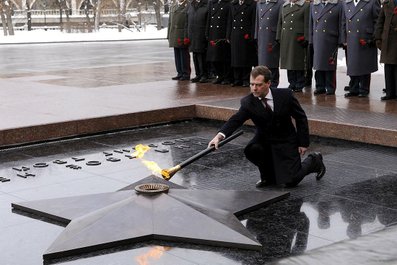
Medvedev Lights Flame at Tomb of the Unknown Along Kremlin Wall

In his Defender’s Day eve address on Monday, President Dmitriy Medvedev said:

“The defense of native land, service in the army and fleet has always been considered our holy duty.  And those who chose the military profession as the business of their entire lives command great respect among our people.”

Apparently, not too holy since Medvedev didn’t serve, even though he would have been due for conscription at the zenith of the mass mobilization Soviet Army and one of the coldest points of the Cold War [1983].  Of course, there are lots of presidents who didn’t serve in their countries’ armed forces.

Medvedev went on to thank Russia’s veterans with the 65th anniversary of the Great Victory fast approaching [9 May].

Then he noted:

“. . . strengthening the defense capability of our country–this, absolutely, is the fundamental basis for our development.  Our strategic goal is the formation of an effective army and navy, adequate for the level of modern threats, capable of withstanding any level of aggression and being a real factor in guaranteeing international stability.”

“Before us stands the main mission–to reequip the army and fleet with the newest armaments.  It is essential to concentrate resources, all our best forces, and our country has done this more than once, in order to create new quality types of military equipment and finally escape from a system of “patching holes” in old armaments.  Some has already been accomplished here, but this is a basic task for the near future.”

“Strengthening Armed Forces personnel will also remain a priority.  People who have received a modern quality education answering the demands of the time need to be occupied with military affairs.  People who are prepared to complete contemporary combat missions, to complete them in the most effective way and, absolutely, physically and morally prepared.”

“The most important condition for the successful modernization of the Armed Forces–this is increasing the quality of life for servicemen.  The current military labor stimulus system (I have in mind the so-called order 400) is already giving positive results today.  From 2012 new salaries will be paid to all our country’s officers.”

“Everything necessary is being done so that this year all military men needing permanent housing will receive it.  I am keeping this issue under my personal control.”

“By the end of 2012 the issue of providing servicemen with service housing will be fully resolved.  I am sure that such guarantees will increase the wellbeing of your families and the prestige of military service as a whole.”

“Next it is important also that all measures to transfer the army and fleet to a new quality should be fulfilled efficiently and on schedule.  I am expecting precisely this from the Defense Ministry.”

On Tuesday, Medvedev participated in reigniting the eternal flame on the grave of the unknown soldier below the Kremlin wall.  The flame had been moved temporarily to Victory Park on Poklonnaya gora during the renovation of the tomb of the unknown.

Medvedev also visited a military unit in the Moscow suburbs and had tea with a senior lieutenant and his family in their new apartment.

The KPRF and its leader, Gennadiy Zyuganov, played the lead in presenting an opposite point of view on Defender’s Day.  The KPRF faithful marched from Triumfalnaya ploshchad to Teatralnaya ploshchad for a rally.  The party predicted 10,000 attendees, the police said there were 1,500, and Ekho Moskvy reported 4,000.

One KPRF leader said his party was coming out in defense of the army and fleet, their history, their power and against this senseless reform which Defense Minister Anatoliy Serdyukov is conducting.  He said the KPRF would hold rallies in 8 regions where elections are being held on 14 March.  Those demonstrations, however, were focused on more ‘bread and butter’ issues like communal service rate increases.

Zyuganov himself was in vintage form, saying:

“The army is currently in an exceptionally poor state.  A totally useless man is today in charge of the army.  He has no right to hold this office.  Not a single military man would want to pronounce the family name of Serdyukov properly, without adding some insult.  This means that Mr Putin and Mr Medvedev have put in charge of the army a man who is incapable of teaching servicemen, rallying them together or setting key objectives concerning military security and army training and equipment of our armed forces.”

He continued, saying Russia has “no possibility not only to produce, but even to reform its existing military complex.”  He claimed Russia is 10 years behind NATO in military potential, and he said Russia’s strategic forces are “on their last legs.”  Addressing Prime Minister Putin, he asked why a minister like Serdyukov was being retained.

IA Regnum reported on a rally in support of army reform and modernization led by United Russia youth wing Molodaya gvardiya and the local branch of veteran’s organization Combat Brotherhood in Ulyanovsk.  Press reports said attendees were looking forward to restarting An-124 transport aircraft production at Aviastar, and having OPK enterprises serve as a locomotive for the rebirth of local industry.

Medvedev’s Take on Combat Capability

RF President Dmitriy Medvedev

 You may recall after the five-day war with Georgia, and before Serdyukov’s reform announcement, President Medvedev issued his own theses on combat capability.  

Though he’s not a learned military theoretician, Medvedev’s statement is obviously important.  Find coverage at Rosbalt.  

Medvedev said:  

“The development of five factors is necessary for the effective resolution of combat missions.  We are talking about improving the TO&E structure of the troop basing system.  If we speak plainly and directly, all combat formations must be transferred into the permanent combat readiness category.  Second is increasing the effectiveness of the armed forces command and control system.  It’s impossible to count on success in modern combat without this.  Third is the improvement of the personnel training system, military education and military science.  We need an army equipped with the most modern weapons–the fourth factor.  We’ll give first priority attention to this issue, but fundamentally new high-technology weapons types will have special significance.  The fifth factor is improving the social condition of servicemen.  These five factors will determine the combat capability of our armed forces.”  

This is fairly close to what our military scholar published in Voyennaya mysl.  

Medvedev went on to add that, by 2020, Russia will add to its nuclear deterrence, intelligence, air superiority, ground and naval strike, and operational troop redeployment capabilities.  Russia has planned for serial ship and submarine construction, and establishment of an aerospace defense system, according to Medvedev. 

Before becoming president, Medvedev traveled to Kaliningrad in January 2008.  He was still a first deputy prime minister in charge of ‘priority national projects,’ of which housing is (was?) one.  On that occasion, he noted that the resolution of the social problems of servicemen directly influenced the combat capability of the armed forces.  He said it was necessary to solve their housing problems, “otherwise combat capable armed forces won’t exist.” 

Next, there should be some interesting Putin comments on combat capability, also questions in many public polls on the armed forces are couched in terms of what people think about their combat capability.