Tag Archives: GVP

High-Level Corruption Up, Crime Down in Military

A little more news on the military crime and corruption front.  Corruption is up at least 26 percent year-on-year for the first half of 2010.  General military crime, however, is down more than 10 percent.  Officer crime is down 11 percent.  And draft evasion declined by a factor of two.  Without reciting his recent figures on a 50 percent increase in dedovshchina, GVP Sergey Fridinskiy noted that prosecutors need to ‘activate their work’ against ‘nonregulation events,’ now that there’s a much larger number of conscripts in the ranks.

How do these numbers track with the past?  Just a few days ago, the GVP said general crime was down by 12 percent in all military units and by 15 percent in the Armed Forces.  The decline in general crime follows a reported decline in 2009 as well.  Corruption has accelerated in 2010 apparently.  In January and February, it was only up by 10 percent.  The number of officers convicted in corruption cases looks to be about the same this year as last, but the GVP may be on a pace to convict more generals in 2010.

“More Than 250 Officers Convicted for Corruption Offenses Since Beginning of Year — GVP”

“MOSCOW, 27 July – RIA Novosti. More than 250 officers, including seven higher ranks [general or flag officers], have been convicted for crimes of a corruption nature in the first half of 2010, the RF Main Military Prosecutor Sergey Fridinskiy announced Tuesday at an expanded session of the department’s collegium.”

“‘The quantity of offenses in the given (corruption) area for the first six months of 2010 increased by almost 26 percent.  The quantity of misappropriations, embezzlement, and exceeding duty authority grew.  270 officers, including seven higher ranks [general or flag officers], were convicted for such crimes in the indicated period,’ – the press-service announcement quoted Fridinskiy.”

“According to him, military prosecutors uncovered more than 128 thousand legal violations, nearly 17 thousand officials were brought to account, more than 4.6 thousand people were convicted for various crimes, and the rights of more than 270 thousand servicemen were restored.  And 3.3 billion rubles were returned to the state as a result of prosecutorial investigations.”

“At the same time, the prosecutor noted a tendency toward a reduced number of crimes in the RF Armed Forces.”

“For the first half year in the RF Armed Forces, other troops, military formations and organs 10.5% fewer crimes were committed than in the same period of 2009.  The quantity of grave and particularly grave crimes, including those causing grave bodily harm, declined.  The quantity of  military service evaders declined almost two times.  In the current half year a decline – almost by 11% – was registered in the number of crimes committed by officers,” – Fridinskiy was quoted in the statement.”

“Taking note of the increased number of conscripts, the Main Military Prosecutor directed his subordinates to activate their work to uncover nonregulation events in military collectives, the announcement said.  Fridinskiy noted that ‘in connection with the continued growth of these legal violations we must, together with commands, come up with steps to more effectively implement systematic measures to prevent and interdict them.'”

Fridinskiy enumerated some predictable priorities for the GVP’s work during the balance of 2010 — struggle against corruption and misuse of budget resources, oversight of military reform, fulfilling legislation on the State Defense Order (GOZ), and ensuring housing and other social benefits for servicemen.

Dedovshchina in RF Army Up 50 Percent — GVP

A translation, no commentary . . .

“MOSCOW, 21 Jul – RIA Novosti.  The level of dedovshchina [violent hazing usually perpetrated by senior soldiers] in the Russian Army grew 1.5 times for the first five months of this year compared with the same period in 2009, according to analytical information provided to the RF Federation Council by the Main Military Prosecutor (GVP).  1,167 servicemen have suffered from nonregulation manifestations in 2010, four have died, and more than 90% of offenses were committed by conscript servicemen.”

“As the GVP notes, the number of corruption-related crimes is also growing.  Material losses from them amount to almost a billion rubles this year.” 

“At the same time, the GVP notes that the general crime level in the state’s military organization has declined by more than 12% over five months this year compared with the same period of 2009, and by almost 15% in the armed forces.”

“In particular, the amount of evasion of military service declined by almost two-fold.”

More Drugs, Extremism in the Army

According to ITAR-TASS, Main Military Prosecutor Sergey Fridinskiy today warned colleagues at an inter-governmental meeting on military-patriotic indoctrination that anti-drug measures among minors are not having the intended effect, and: 

“Based on last year’s results, the growth of crime connected with illegal trade in narcotic and dangerous substances in the troops (of all power structures) exceeded 70 percent.” 

For his part, Deputy Defense Minister, State Secretary Nikolay Pankov agreed that drug-addicted youth pose a threat not just to the army, but the whole country.  He added: 

“The ‘drug addiction’ diagnosis is becoming customary for draft commissions.” 

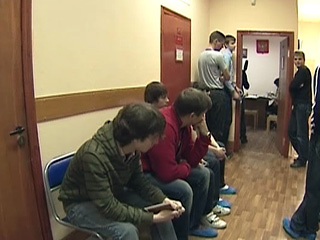
At the Draft Board (photo: Newsru.com)

And as if on cue, today from a Ural region draftee assembly point in Yegorshino came the story of 100 young men who arrived recently high on marijuana in hopes of being deferred from conscript service for dependence on narcotics. 

The voyenkomat reported nothing like 100 guys showing up before the draft board in a state of ‘narcotic intoxication’ has previously happened. 

A voyenkomat representative said: 

“There’s never been such a thing, we are sure this is a particular feature of the current draft.  The young guys intentionally used narcotics in order not to end up in the army.” 

According to Newsru.com, a State Narcotics Control officer for Sverdlovsk Oblast is investigating the ‘stoners’ who came from Nizhniy Tagil, Yekaterinburg, and Pervouralsk.  The voyenkomat said these men would be returned to their towns for additional medical observation and rehabilitation. 

ITAR-TASS reported more of Pankov’s comments on a different subject.  He said: 

“In Russia, nearly 150 extremist youth groups are active, the participants in them live mainly in big cities.” 

Pankov didn’t rule out that young extremists could spread from large cities to small towns and lightly populated areas, saying: 

“This is highly probable.  All this comes into military collectives and leads to the growth of nonregulation relations, so-called ‘dedovshchina.'”  

This is just one reason the army’s always preferred country boys from the ‘sticks’ rather than city guys.

The topics of drugs and nationalism in the army, if not taboo outright, have been little discussed.  Some honest talk about these problems might be the first step in solving them.

German Armor

Serdyukov Wants Troops to Ride Inside

Reports about Russia looking abroad for light armored vehicles and not buying BTR-80s and BMP-3s in GVP 2011-2020 came into better focus this week . . .

On Tuesday Defense Minister Serdyukov announced Russia will buy armor for vehicles and light armored equipment from Germany.  In his meeting with representatives of public organizations, he said:

“The RF Defense Ministry will proceed from the need to guarantee the protection of personnel.”

“We have forced KamAZ and other Russian companies to enter into contacts with foreign firms.  They’ve already begun to make contact in order to buy light armor and use it in reconnaissance vehicles, BTRs, BMPs and other transport means.”

Kommersant talked to KamAZ officials who didn’t know anything about buying armor for vehicles abroad.

Serdyukov said, in particular, they were talking about purchasing light armor from one German company (reportedly Rheinmetall).

ITAR-TASS said Serdyukov was referring to poor protection of personnel inside Russian armored vehicles when he warned:

“We, of course, won’t buy Russian vehicles and armored equipment in the condition they are in.”

“We want Russian industry to produce what we need and what the times demand, so that they (OPK enterprises) will modernize their production and create quality equipment.”

In Stoletiye.ru, Sergey Ptichkin writes that Rostekhnologiya’s Sergey Chemezov and FSVTS’ Mikhail Dmitriyev have concluded that the purchase of foreign arms for the Russian Army is a ‘done deal’ at this point.  Dmitriyev said in particular that the political decision to buy Mistral has been made, and the contract will be signed this fall.

Ptichkin concludes:

“In connection with this, by all appearances, a large number of domestic military programs are being rolled up.  Billions are needed to support the import of ships and weapons.”

Chemezov also said, reluctantly, that Russian armor really doesn’t meet the Defense Ministry’s sharply increased requirements, therefore purchases from Germany are justified.  Ptichkin wonders what Rostekhnologiya’s [Chemezov’s] specialty steel holding will do if Germany supplies Russia’s defense industries.

Media sources alluded to past statements by Deputy Defense Minister, Chief of Armaments, Vladimir Popovkin to the effect that foreign purchases would only be to ‘patch holes’ in the Russian Army and OPK.  They imply that either arms imports have expanded beyond ‘hole patching,’ or the ‘holes’ are bigger than originally thought.

Nezavisimaya gazeta writes that buying armor abroad will be catastrophic for Russian metallurgy.  Without part of the GOZ, they reportedly won’t be able to modernize.  Uralsib metals analyst Nikolay Sosnovskiy said, without state orders, enterprises which still produce something won’t be able to survive.  He said buying foreign armor for BTRs and BMPs will lead to buying it for tanks, which is much more costly.  Sosnovskiy says armor orders were ‘second tier’ for the past 20 years, so no one was working on new types.  On the other hand, Aleksandr Khramchikhin thinks the competition posed by foreign armor will force the Russian industry to improve.

Despite this little uproar, it seems unlikely that the Defense Ministry or Russian government are suddenly ardent fans of free trade in all things.  Moscow’s economic management remains more paternalistic and state-directed than that.  Rather purchases abroad are probably viewed as the only way to:  (a) rearm Russian forces quickly with badly needed high-quality arms and equipment; and (b) shake the OPK enough to get it started on the road to competitiveness.

Policy To-and-Fro on Military Police

State Secretary and Deputy Defense Minister Nikolay Pankov probably didn’t surprise a lot of people when he announced the latest Defense Ministry flip (or flop this time?) on the military police issue last week.

 Pankov announced that:

 “The Defense Ministry has found the establishment of military police inexpedient at this stage of Army and Navy reform.  Directive documents on the establishment of military police in the Russian Army have been suspended, and orders on the formation of these structures in the military districts and the fleets have lost force.”

 Later, the press quoted Pankov differently:

 “I wouldn’t say it so categorically – this work is suspended for now.”

But he didn’t elaborate on the Defense Ministry’s reasons for stopping or suspending the effort at this moment.

Military police units are, or were, supposed to stand up in 2010.  Their mission was to maintain order and discipline, and prevent hazing and other barracks violence and crime, primarily thefts of military property.  A military police department started working in the Defense Ministry’s Main Combat Training and Troop Service Directorate last December, drawing up plans and training programs for the new MP units.

In early February, a Defense Ministry representative denied press reports that Defense Minister Serdyukov had suspended work on the military police force.  But a source in the Defense Ministry’s press service told the media that “the documents establishing it have been sent to the appropriate legal directorates for reworking.”  He said that forming the military police would require amendments in federal legislation beyond the Defense Minister’s purview.

The back-and-forth, on-and-off nature of Russia’s yet-to-be created military police calls into question the Defense Ministry’s capacity to formulate and implement policies, or at least to do it so its doesn’t  look foolish.  Why would any military district commander or brigade chief of staff hurry to introduce any new policy or regulation that might just be overturned 6 months from now, or never implemented at all? 

As with the rumored halt in February, the latest stop may in fact be related to legal issues, but they usually only become an obstacle when they’re really protecting someone’s bureaucratic empire.  In this case, the military prosecutor and MVD are obviously very interested parties when it comes to devising a military police policy.  And they are pretty big hitters vis-à-vis the Defense Ministry.

The Defense Ministry already has plenty of people and organizations involved in military law enforcement, but they seem unable or unwilling to organize and cooperate to do the job.  Existing military law enforcement mechanisms could be made to work properly. 

Another sticking point may continue to be who will be in charge of a new military police force.  The prosecutor and MVD probably don’t want military police to answer to the Defense Ministry.  Military commanders could misuse or corrupt military police who would be enforcing laws on those commanders as well as ordinary servicemen.

Svpressa.ru talked to Anatoliy Tsyganok in this vein.  He said:

 “It once again attests to poorly thought-out reforms, zigzagging from side to side, senseless expenditure of resources needed for reequipping the army, and social programs.”

From the get-go, Tsyganok was against spending a ‘not small’ amount of money on a new structure seen as a panacea for all the army’s ills, at a time when the existing military command structure should be able to handle military police functions.

Tsyganok continues:

“. . . I came out not against military police per se, but against the dissipation of resources allocated for army reform:  the fact that they change conscripts for contractees, but then reverse this, the fact that they bring Yudashkin to design uniforms, but then chuck it, now here’s the confusion with military police.  It’d be better to use these resources on weapons for the army.  Russia’s military-industrial complex exports 90 percent of its production.  Aircraft to China and India, helicopters to Latin America and Middle Eastern countries.  Automatic weapons to Venezuela.  But the Russian Army scrapes by with old weapons.  At the same time money is invested in not well thought-out projects.”

“At present our servicemen who have violated order or broken the law are sent to do their time in basements, in special trenches, in storage areas.  Serdyukov doesn’t have financial resources even to build apartments for officers, there can’t even be talk about guardhouses.”

 “Now order among the troops is controlled by commandant (komendatura) forces, commandant patrols, commandant platoons and regiments, internal details; military traffic police structures are active.  This is a huge force.  For example, in Moscow there are 10 districts.  An integral commandant regiment patrols every district.  And is this little?  But military prosecutors, special departments [OO – FSB men—особисты or osobisty, embedded in large military groupings, units, and garrisons] also exist to maintain legal order in the army.  We need to force all this organizational and personnel mass to work effectively.  But for this the Defense Ministry itself needs to work effectively, and not spend money on schemes.”

 “The Defense Ministry leadership in answer to criticism about rampant crime in the army created nothing but the appearance of vigorous activity.  It’s hard to keep order, but forming something else at the expense of budget resources is easy.”

 “The failure of the project was sealed in its very organizational basis.  They proposed to subordinate the military police to the Defense Ministry in the person of the first deputy minister.  The fact is the very same operational structure of military control and repression would wind up in the hands of military leaders themselves.  This is a criminally corrupt thing.  Any Defense Minister, major troop commander, or independent unit commander could arrest on any pretext and end the contract of any inconvenient serviceman.”

Tsyganok kind of skirts around the issue without saying so, but it may be there’s not enough money to pay for building a military police force.

 Interfaks cited Duma Defense Committee Deputy Chairman Mikhail Babich, who called on the Defense Ministry to be more cautious about making changes in the armed forces and to avoid revoking its own decisions, as may be happening in the case of military police.  Babich is a somewhat critical and independent-minded member of Putin’s United Russia party.  He also said armed forces reforms require serious budget expenditures, so every time this or that program is dropped, the reasons should be closely studied and analyzed.  He concludes:

“I think the Defense Minister should hold to account those who were responsible for drawing up and implementing programs deemed unsuccessful.  First of all, this means the federal targeted program for recruiting professional sergeants in 2009-2015, which has not really started and the allocated money was spent on different purposes.”

Babich goes on to note that it’s still unclear what’s happening with Russia’s 85 permanent readiness combined arms brigades that replaced divisions in the Ground Troops.

“The Defense Ministry is keeping silent about this but it’s already clear that plans to establish permanent readiness combined arms brigades have fallen through.  As a result, it’s been decided to divide them into three types:  heavy, medium, and light.  Yet again everything is being done by rule of thumb.”

Update on Military Corruption, State Losses, and Crime

Main Military Prosecutor (GVP) Sergey Fridinskiy observed last week that it will only be possible to deal with corruption when not just the law enforcement organs, but also responsible officials in the military command hierarchy become involved in fighting it.

At last week’s coordinating conference on fighting corruption in the armed forces and other armed formations, Fridinskiy reported that, in January and February, military corruption cases increased by 10 percent over year ago figures, and material losses to the state in those first months of 2010 were 5 times greater than in 2009.  Inflation and an increased volume of arms purchases were cited as contributing to the spike. 

In 2009, corruption cases increased 5 percent in military units.  Fraud and forgery cases increased 50 percent, but misappropriation, embezzlement, bribery, misuse, and abuse of authority also grew. 

Fridinskiy said:

“For such crimes, 543 officers, including some higher officials, were convicted last year.  Last year military prosecutors uncovered nearly 7,500 violations of the law in this area, more than 2,000 responsible individuals were held to varying degrees of accountability in connection with 540 warnings delivered about unacceptable legal violations.”

Fridinskiy maintains that corruption doesn’t just have a negative economic impact, it also has an extremely demoralizing effect on military units.  He noted that the State Defense Order (GOZ) and the provision of social benefits to servicemen are trouble areas for military corruption.  He said:

“Placing a barrier against incidents of illegal and mismanaged expenditure of budget resources allocated for reequipping troops with new arms and military equipment, but also providing housing to servicemen, people discharged from military service, and family members is one of the complex, but principle tasks.”

Fridinskiy said a systemic fight against corruption was particularly important at a time of rising expenditures on the defense budget and rearmament.  He cited improved legislation, departmental regulations, reduced opportunities for misappropriation, guaranteed transparency and competition in tenders and state contracting as possible measures.  He continued:

“It’s also important to strengthen the role of control-auditing organs at all levels, to raise the level of inter-departmental  coordination, to conduct active propaganda work necessary to create an atmosphere where corruption is unacceptable.”

Fridinskiy reportedly proposed changing the existing GOZ system:

“We’re now working in the first place on putting systematic changes into the purchasing system so that prices will be down to earth, and not astronomical, so that it will be possible to organize this work in the bounds of current demand for purchases, and in order that not only the purchaser, but also those performing the work will bear responsibility for what they are doing.”

Representing the Defense Ministry, State Secretary and Deputy Defense Minister Nikolay Pankov reported that his department has created a special financial inspectorate sub-unit to exercise control on the use of its resources:

“Finance specialists, economists, mostly not from the armed forces, have been asked to join the financial inspectorate, and my presentation today concerned the effectiveness of the work of the financial inspectorate.  All the results that the financial inspectorate turn up are given to the organs of the military prosecutor.”

Recall, of course, that the Defense Ministry claimed it had a major anticorruption drive in progress this winter.  Maybe these are some of the results.

Attendees at GVP conference included representatives of the Federation Council, Duma, Military Collegium of the RF Supreme Court, Military-Investigative Directorate of the RF Prosecutor’s Investigative Committee, Ministry of Defense, MVD’s Main Command of Internal Troops, Ministry of Emergency Situations, and the FSB’s Border Service and Department [once Directorate?] of Military Counterintelligence.

Chief of the GVP’s Oversight Directorate Aleksandr Nikitin  repeated an earlier publicized statistic on a 16 percent reduction in military crime last year.  Nikitin credited widespread GVP preventative measures for the decline in crime.  He also noted the induction of more conscripts with higher education and supplementary performance pay for commanders as positive factors.  According to him, with the extra money, young commanders have started to pay more attention to ensuring order in their units.  Nikitin also says the overwhelming majority of the country’s military units generally function without crime or other incidents.

Rastopshin on OPK’s Problems

In yesterday’s Vremya novostey, Mikhail Rastopshin recalled how President Medvedev reproached the OPK last year for lagging in the production of new types of weapons to rearm Russia’s military. Medvedev said, if Moscow’s enemies possess superior weapons, no strategy or tactics will help Russia.

Rastopshin asks why the rearmament tasks laid down in documents like the National Security Concept and Military Doctrine remain unfulfilled? These documents seem like they did nothing to slow the degradation of the OPK and the army.

Among other basic state documents, Rastopshin mentions the Federal Goal Program (FTsP or ФЦП) Reform and Development of the Defense-Industrial Complex (2002-2006), but it didn’t bring the desired results. The first Russian State Armaments Program for 1996-2005 (GPV-2005) was in ruins a year after it was adopted. The second, the GPV for 2001-2010 (GPV-2010), and the current GPV for 2007-2015 (GVP-2015) are coming to naught.

According to Rastopshin, this attests to an inability to forecast arms and equipment development tens year out. There’s not only a lag of technological generations in traditional armaments, but an absence of entire classes of new weapons based on different physical principles.

After the Georgian war, Medvedev apparently ordered Serdyukov to prepared proposals on outfitting the army with modern combat support equipment. This amounted to ‘reloading’ the GVP. One can suppose that serious proposals didn’t ensue since Medvedev had to return to this problem in late 2009.

Weapons from yesterday are not infrequently put forth as our modern armaments. But there’s no other place to get them since military science and design bureaus are in a steep decline. The insolvency of the domestic defense system can be followed in the munitions sector, which hasn’t produced artillery shells since 2005. Russia lacks war reserves of ammunition, and an army without munitions is no longer an army. The sector has been producing poor quality powder, making it likely that fragmentation shells won’t reach their targets and armor-piercing ones will lose their penetration capability.

Taken as a whole, the existing armaments development system can’t provide a high tempo of rearmament, nor quality which continues to drop in both domestic and export orders. Complaints from foreign buyers are increasing, but domestic complaints are concealed. The fall in quality places doubt over future weapons. And there’s a huge divergence between the army’s demand for new weapons and the OPK’s ability to provide them, according to Rastopshin.

The quality problem won’t be resolved because OPK management is so complicated. The OPK has been reformed 8 times in the past 15 years. The lack of quality restructuring at the top exacerbated problems at the bottom. Management could not bring order to NIIs, KBs, or factories, failure above gave birth to technical breakdowns below. Rastopshin says in today’s RF Government, the Department for OPK Industries has the same status as the Communal Services Department, a situation tantamount to simply ignoring the country’s defense capability.

The creation of industrial holdings was chosen as the path to improved OPK management. Uniting in these holdings enterprises that use old production equipment, lack sufficiently qualified personnel, have eliminated quality control, testing, standardization, and military acceptance offices cannot bring the desired results.  It results only in old weapons unsuited for combat in today’s conflicts.  Rastopshin recommends returning to a Ministry of Defense Industry [sounds a little like one more reform at the top that doesn’t influence the situation below].

Rastopshin sees a gulf between the army’s ‘new profile’ structure and supplying it with new arms.  For this reason, he says, the combat readiness of the new TO&E brigade with old armaments remains extremely low.

He points to NATO’s superiority in conventional arms to say that Russia couldn’t hold out two weeks.  Russia would have to resort not only to strategic, but also tactical nuclear weapons.  So Rastopshin concludes Russia needs to revisit the issue of producing nuclear-armed intermediate and shorter range missiles, and leaving the INF Treaty.  He sees Moscow as having little choice since it’s left choosing between conventional defeat or strategic nuclear conflict.

Rastopshin sums up, it’s time to stop giving the army old, ‘modernized’ weapons, the life cycle of which was long ago used up.  Medvedev himself has said this more than once.

Sadly, Rastopshin offers more criticism than solid answers (except for seeing an INF withdrawal as one path for Russia).  Science and applied science need to be improved as does personnel training for the OPK.  New requirements need to be put on the OPK.  He’d also like to see some of those who have reorganized the OPK punished for irresponsible actions that have damaged the country’s defense capability.

Military Housing-Corruption Nexus

Grani.ru has connected the dots between–on the one hand–former Defense Ministry housing chief General-Colonel Filippov’s sudden retirement on health grounds late in triumphant 2009 just as military men were receiving more than 45,000 apartments, and–on the other hand–GVP Sergey Fridinskiy’s announcement yesterday that military housing is one of the three largest military corruption problems and that an SU-155 affiliate is under investigation for not fulfilling state contracts to provide apartments to Defense Ministry servicemen. 

But hold this thought for a moment.  First, remember the Defense Ministry’s end-of-year housing claims:

“The RF Defense Ministry, continuing implementation of decisions of the country’s leadership regarding providing servicemen permanent housing, planned in the course of 2009 to acquire from all sources 45,400 apartments.  Updated data on last year’s results allows us to talk about overfulfillment of the planned tasks.”

The Defense Ministry’s Press-Service and Information Directorate went on to specify:  45,614 permanent apartments, of which the Defense Ministry built 5,117, bought 19,147, and used GZhS for 7,050.  Another 14,300 were obtained from other sources, specifically through investment contracts and resettling apartments [i.e. moving new residents into existing Defense Ministry apartments].

From what Fridinskiy said in his interview yesterday, Grani.ru concludes that Filippov was dismissed for violating laws concerning housing for servicemen, including signing occupancy documents for nonexistent apartment blocks:

“Filippov signed an order for the distribution of apartments in eight buildings in the Moscow suburb of Chekhov.  However these buildings exist only on paper.  Their construction isn’t really under way, having stopped at the foundation.  The Defense Ministry contract was grossly violated by the contracting firm.”

Here’s what Fridinskiy said:

“…instances of the distribution of living space in buildings which not only haven’t been put into use, but actually aren’t even built, are being brought to us.  We’re investigating violations in housing construction for servicemen in Chekhov, where through the fault of the contractor ZAO ‘Moscow Oblast Investment-Construction Company,’ which is part of ZAO ‘SU-155,’ not one of 8 signed state contracts has been fulfilled.  Construction of apartment buildings to this point ranges in states from ‘installing pilings’–simply put,  digging the foundation–to ‘framing the building.’  Despite this, in August 2009, former Defense Ministry chief of housing and installations, Deputy RF Defense Minister General-Colonel Filippov approved the plan for distributing apartments to servicemen in these, if you’ll permit me to say, buildings.”

Were the ‘apartments’ in these 8 unfinished ‘buildings’ counted as part of the 45,614 supposedly acquired in 2009?  Of the 14,300 supposedly obtained through other means, including investment contracts?  Doesn’t look like these contracts panned out too well.  One wonders how much farther the Defense Ministry’s claim of success in meeting Putin’s task will unravel.  As it was storming to try and finish late in the year, many respected sources claimed something less than 30,000 apartments had actually been acquired.

But a scapegoat has been found in Filippov; he can take any other blame that needs to be assigned.  Perhaps he can borrow General-Colonel Vlasov’s sidearm.

Grani.ru reminds that Fridinskiy didn’t say anything about charges against Filippov; he could get off with just a scare.  But, with Filippov’s signature, state funds could move along the chain to the contracting firm.  So billions are thrown at military housing, but the problem is never solved.  Now one of Serdyukov’s Petersburg comrades is responsible for housing, but rather than say anything about how he plans to clean up the housing and installation service, he just had polite words to say about his predecessor.

Fridinskiy’s Latest Military Corruption Report

Sergey Fridinskiy (photo: photoxpress)

An Interfaks reporter has interviewed Main Military Prosecutor (GVP) Sergey Fridinskiy for the pages of today’s Izvestiya

Not surprisingly, Fridinskiy didn’t really bite when asked if the GVP had any hand in the recent Defense Ministry cadre ‘revolution.’  He said the GVP keeps its hands on its part [i.e. law enforcement]. 

Fridinskiy says the GVP monitored the implementation of the ‘new profile.’  In some places, it went more or less normally, but in others, it got out of hand and there were mass violations of servicemen’s rights, like putting 600 men in a barracks for 300.  So the prosecutor reacts to such a situation.  Fridinskiy said the GVP gave quarterly reports on violations to the Defense Minister. 

Asked about the military’s involvement in the tragic ‘Lame Horse’ club fire in Perm, Fridinskiy said the chief and chief engineer of the KECh which was responsible for the property were aware of what was going on there and might have been getting a cut, but the fact that they allowed gross fire safety violations resulting in a tragedy with many victims is what resulted in the investigation and criminal case against them.  He indicated the KECh chief died in the fire, and they are investigating whether the chief engineer got bribes.  Fridinskiy noted other responsible military officials in the district got disciplinary punishment. 

On the ‘Steppe’ garrison boiler house case, Fridinskiy revealed that state inspectors looked at it in May or June and declared it unfit for use, but the locals did cosmetic repairs and used it anyway.  He says other districts and garrisons, especially Kostroma, are being inspected.  He believes old equipment is largely to blame, but it’s up to the GVP to force people to do their jobs and not let the situation reach the point of an accident. 

Fridinskiy termed the general crime situation in the armed forces as stable, with some favorable points.  Registered offenses were down 16 percent in 2009 against the year before.  The numbers of grievous and especially grievous crimes were down.  These figures were for all uniformed power ministries, not just the armed forces.  Dedovshchina looked like it would continue a significant decline, but actually ended up increasing by 2 percent.

Asked to address the reported interethnic Baltic Fleet incident, involving Slavs and Caucasians, Fridinskiy said:

“As a rule, we’re talking not about interethnic fights, but interpersonal conflicts.  For us it’s just accepted:  if a Slav gives it to another Slav based on appearance, then this is simply a fight.  But if the very same thing happens with a Caucasian participating, then another hue appears here, even though the fight is based, as a rule, on a normal everyday situation.  However taking into account the mentality of southerners, who’re inclined to stick together, a fight between two guys grows into a group fight, and the appearance of an interethnic conflict comes up.  When the affair goes to criminal responsibility for nonregulation relations, an ethnic motive doesn’t figure in.  But rumors continue to pressurize the circumstances.”

Fridinskiy claims that in the group of ‘barracks hooligans’ in the Kaliningrad garrison there were both North Caucasians and Slavs [but were they part of the same group or in different groups?].  He said 8 were charged in the incident, and some have already been convicted.

Asked about crime among higher officers, Fridinskiy says malfeasance, exceeding authority, and fraud were the biggest offenses.  Eight generals [probably from all power ministries] were convicted and six got prison terms from 3 to 5 years.  He said the theft of state money was greatest in the GOZ, RDT&E, and housing programs.  He indicates he’s investigating 8 cases where apartments didn’t get built by the SU-155 construction firm, despite the fact there were state contracts in place for them.

Fridinskiy seems to indicate he registered 1,500 crimes among senior officers in 2009 [as of late October, he had this number at a little less than 900].

As for how to fix the crime situation in the military, Fridinskiy doesn’t offer much advice beyond using the law.  Of course, that gives him lots of business.