Tag Archives: Mistral

Serdyukov’s Post-Collegium TV Interview

After last Friday’s Defense Ministry collegium, Serdyukov was interviewed on Rossiya 24.

He probably fielded more pointed questions than normal, but he easily navigated them.  At times, he answered partially and the interviewer didn’t follow up with the next logical question.

Asked about officers dismissed in 2009, he said the armed forces shed 65,000 of them, who retired on age or health grounds, requested dismissal, or violated their contracts.  There was no mention of those put in limbo outside the TO&E, without duty posts and only their rank pay to live on.  These are the officers who can’t formally be dismissed because they don’t have housing, and are living at their ‘commander’s disposal.’  There was also no mention of how many warrant officers were put out in 2009.

Serdyukov said some officers accepted civilianized posts, and 4,000 received job retraining–a pretty small number against the large need for it.

The Defense Minister said dedovshchina was officially down 15 percent, and he doesn’t want only platoon and company commanders punished when it happens in their units.  He wants to see all levels of command take more responsibility for the problem.  Not sure what he’s insinuating, but it could be a warning to higher ups that they could suffer too when big time violence cases hit the news and make the Arbat military district look bad.

Serdyukov talked about higher officer training and appraisals, mentioning the assembly for 550 officers from the military districts and army commands.  He said we tried to make them understand what it is we’re trying to do.  But many lacked the knowledge and necessary skills–presumably to continue in the service.  See today’s Nezavisimaya gazeta.  Viktor Litovkin writes about generals and senior officers dismissed under Serdyukov.  Military district and fleet staffs which used to number 500-700 officers have been cut to 300.  Trimming the ‘bloated egg’ is generally a good idea, but as Litovkin says, it really depends on the quality of those left behind.

Back to Serdyukov’s interview . . . in cutting the military educational establishment from 65 to 10 mega-institutions, he said fewer officers will be needed but the quality of their training must be improved.  The 10 left standing have or will have their faculty members assessed for fitness to serve and they’ll get facility improvements.

On contract service which General Staff Chief Makarov has pronounced dead, Serdyukov said:

“The results of the program were not satisfactory.  In reality, we underestimated the situation somewhat, as regards who should switch to contract service and on what terms, or with what pay.”

“. . . the next program should be revised in an attempt after all to think it out regarding what specific positions should be filled by contract service personnel.  Of course, this applies to complex skills, where expensive equipment is operated.”

Nevertheless, he noted that he expects the contract sergeant program [albeit small-scale and apparently no longer funded] to succeed.

He said the army borrowed from foreign military experience in deciding on the shift from divisions to brigades.  He said the latter’s potential is virtually the same or even greater in some cases than that of the former.

Serdyukov said the Defense Ministry has reported to the Supreme CINC on its view of how it would like to reequip over the next 5-10 years.  He repeated that cuts to R&D and maintenance had allowed for bigger buys of new arms in 2008 and 2009.

He admitted Bulava hasn’t been successful, but he expects this system to be put right and completed.

He addressed possible foreign arms purchases:

“. . . in some areas we are lagging behind quite badly.  This relates not just to the Navy but also other services.  We are buying things in single numbers right now.  They are things like UAVs, all kinds of sights, night vision equipment–it is a very broad spectrum where we are specifically lagging.”

Despite reports that Moscow would be negotiating only with Paris on Mistral, Serdyukov claimed Russia is talking to the Netherlands and Spain.  He denied it was no more than a glorified cruise ship, saying it could perform many roles and had many different capabilities.
Moscow Considering Italian Light Armored Vehicles?

Russkiy Newsweek yesterday said a source close to the Defense Ministry claims Moscow is considering buying Italian IVECO M65 vehicles, also known  as the LMV (Light Multirole Vehicle).  The source said negotiations are in the final stage, and LMVs are reportedly being tested in Russia, but opinions on their suitability for Russian conditions are varied.

Another problem–the LMV is basically an analogue of Russia’s Tigr, produced by Arzamas Machinebuilding Plant, a company belonging ultimately to Oleg Deripaska.  The LMV is 1.5 or 2 times more expensive than Tigr and carries fewer personnel.  But it is considered more explosion resistant.  Deripaska’s people dispute this, however, saying it depends on how close the vehicles are to the explosion.

Russkiy Newsweek says the LMV was shown to Putin last year, and Medvedev this year.  It adds LMV to a list of proposed or actual Russian arms buys abroad, including British sniper rifles, Israeli UAVs, and French Mistral helicopter carriers.  The possibility that United Shipbuilding Corporation (OSK or ОСК) chairman and Deputy PM Igor Sechin (a long-time Kremlin insider and Putin crony) could still derail the Mistral deal is raised, but somehow this seems unlikely now for many reasons.  Why wreck a lucrative deal when you can get a piece of it instead?

The article concludes noting that this is the logical continuation of a new Russian military-technical policy–Russia can no longer be considered a closed market and soon Russian companies will have to compete with foreign producers for this internal market, according to CAST’s Ruslan Pukhov.

But there’s more to this story than that . . . some foreign samples are always good if you can get them, some palms might get greased in the process too.  It’s not a bad idea to scare the domestic defense industries, but are they really in a condition to compete with foreign producers?  Rather than stimulate them to get better and more efficient, they could just collapse in the face of a real competition for sales.  And it really goes against everything Russian to rely on foreigners, especially when they’re part of an allegedly hostile NATO.  But mucking about in NATO’s Old European rear area isn’t bad for stirring a little alliance discord.  Just weeks ago too the Russian press had stories featuring President Medvedev with the Tigr and the VDV seems pretty committed to the vehicle.  Let’s just say many factors are in play, which will be the critical ones?

Makarov Meets the Press

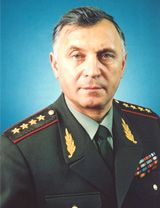
Chief of the General Staff Nikolay Makarov

General Staff Chief Nikolay Makarov spoke at length to the press yesterday. In no particular order, here are some of the impressions and reports that followed in his wake.

RBCdaily quoted Makarov on the possible Mistral purchase:  “Ships of the Mistral type have very great multifunctionality, and they surpass our ships in all parameters by three times.”  He went on to say that Russian shipbuilders would only be able to produce helicopter carriers of this quality in 5-10 years.  Aleksandr Khramchikhin commented that, in the first place, Russia doesn’t currently have comparable ships and, in the second, it will take 50 years.

Makarov said the final decision on buying the Mistral had not been made.

According to Rossiyskaya gazeta, Makarov said the Russian Army went to brigades vice divisions to avoid the previous need to flesh out units with reservists and take days to bring them to combat readiness.  ‘Modular’ battalions by contrast are permanently ready for battle in an hour.

Makarov didn’t rule out establishment of some type of ‘rapid reaction forces,’ though these are closest in nature to today’s VDV.  And this wouldn’t mean VDV would simply change its name. And other services need rapid reaction capabilities too for action in the air, on the sea, etc.  Aren’t permanently ready brigades rapid reaction forces already?

On the Navy headquarters move to St. Petersburg, Makarov claimed Moscow is overflowing with army and navy leadership [but haven’t they just cut 200,000 officers and lots of excess command structures to create a personnel pyramid?].  And with today’s networks the fleet can be commanded from thousands of kilometers away from the Genshtab and other main commands.

Makarov doesn’t foresee any change to the one-year conscription policy, but there may be changes in NCO acquisition.  Instead of six months training in MD training centers, they may only get 3, so they can serve 9 months in troop units.  Makarov thinks they’ll cut back on conscript sergeants once their professional ones start to appear.

Moskovskiy komsomolets quoted Makarov on the new strategic arms agreement with the U.S. to the effect that it’s 97 percent complete, and it only remains to agree on the relationship between offensive and defensive weapons, and there will not be anything in the treaty to Russia’s detriment in this regard.

On Mistral, Makarov said, after study, we’ve concluded we need this type of ship, which can be an amphibious assault ship, hospital, command ship, and helicopter carrier.

On the Navy and Piter, MK notes Makarov wanted to avoid Baluyevskiy’s fate and didn’t contradict his superiors.  He expounded on his vision (perhaps dream) of Russian netcentric warfare:

“Earlier it was like this:  the closer to subordinates, the more reliable the command and control.  Now all leading countries, including us also, are going to netcentric command and control systems.  This allows completely remote means of reconnaissance, command and control, electronic warfare, fire, command posts–all spread over an enormous distance, but located in a single information-communications space and capable of solving tasks in real time.”

On a related note, Makarov said the new Sozvezdiye tactical level command and control system will be part of the netcentric structure toward the end of the year.

Gazeta’s coverage focused on Makarov’s comments about establishing the personnel pyramid, i.e. going from armed forces with about 500,000 officers and warrants to one of 150,000 officers and 720,000 soldiers in the space of a year.  It also noted Makarov’s remark that brigade commanders in their training assembly at the General Staff Academy are learning new warfare and command and control principles.

Izvestiya quoted Makarov at length on the Navy Main Staff’s move to Piter.

“Presently all command and control organs are concentrated in Moscow, but we want these command and control organs to be as close as possible to the troops they control [didn’t he also call this the old way of doing business?].  The dispersal of command and control and fire means at great distances doesn’t have any great significance, what’s important is maintaining uninterrupted and clear command and control of troops and weapons.  Therefore, the transfer of the Navy Main Staff to St. Petersburg won’t place any kind of extra burden on the command and control system, with the exception perhaps, only in the initial period of its functioning in a new place.”

Viktor Baranets in Komsomolskaya pravda focused on Makarov’s words on the U.S. and Iran, noting his statements that the U.S. has a plan to strike Iran, and, if it occurs, it’ll be terrible for Iran, the region, and the U.S.

Krasnaya zvezda covered the Iran issue.  It noted that Russia’s need for ready units forced the shift to brigades.  It also covered Makarov’s comment that the Voronezh conference agreed on changes needed in the Sozvezdiye C2 system, and that it would be received this July and fielded in November.  KZ also quoted Makarov at length on the capabilities of the 5th generation fighter aircraft.

KZ also indicated that Makarov noted the U.S. as an example where units and commands are often separated by great distances when he talked about the Navy Main Staff and Piter.

Generally, it seems those invited to this press availability only asked Makarov ‘soft ball’ questions.