Tag Archives: Sergey Shoygu

Golts on Shoygu’s Tenure (Part II)

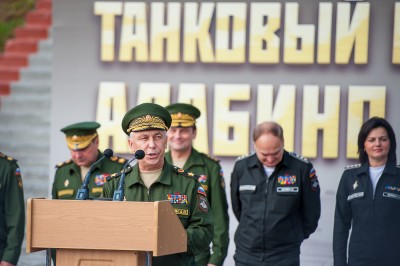
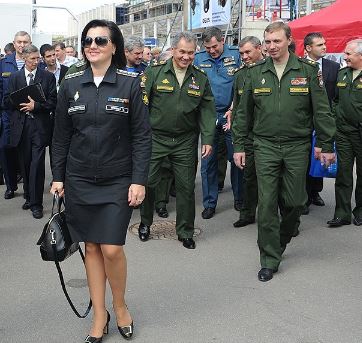
Shevtsova Sporting the "Office Suit" with Four General's Stars

Shevtsova Sporting the “Office Suit” with Four General’s Stars

Continuing with Golts’ Ogonek article, “From Reforms to Uniforms.”

“XXI century style”

“It stands to reason that deeply patriotic content received as a result of regular and repeated performances of the anthem require corresponding forms. Uniforms that is. Shoygu decided to dress all MOD, other staff and management employees in so-called office suits. The minister, his subordinates say, came to the conclusion that wearing a woolen jacket in summer is uncomfortable. So it was decided to sew a uniform reminiscent of the one MChS officers wear.”

“And so now not only the military, but civilian employees of the MOD will have to wear the office suit. Not only that, these same office suits come with shoulderboards. Now every civilian worker has to wear shoulderboards with stars corresponding to his bureaucratic rank. So, at the tank ‘biathlon’ competitions (incidentally, yet another of the minister’s well-known inventions) Deputy Defense Minister Tatyana Shevtsova appeared with four stars on her shoulderboards corresponding to army general rank. And Deputy Minister Anatoliy Antonov, who’s spent his entire life in the diplomatic arena, currently sports general-colonel’s shoulderboards.”

“This redressing is hardly the innocent whim it might appear to be. Really it’s a continuation of that line which began when Shoygu himself donned a general’s uniform at the moment of his appointment as minister of defense. In this logic the Ministry of Defense is not simply the military department, it’s the department where military men command and give orders. And civilian officials turn up there only in the extreme case when they can’t get along without them or there is reluctance to spend money on big salaries to officers. As a result they let civilian employees know that they are not quite military. But cadre officers can’t but experience irritation when civilian bureaucrats receive ‘for nothing’ stars very similar to those which they earned through blood and long years of service.”

“Behind all this is an obvious unwillingness to understand that civilian bureaucrats and servicemen have principally different missions. Civilian bureaucrats are needed to translate the political will of the country’s leadership into the language of military orders, to give the army its missions, to provide the Armed Forces essential financial and material resources, and also armaments. The military themselves have to be occupied with strategic planning and organizing combat training. If those same military men determine threats and missions and are also occupied with material support and financing, this unavoidably will lead to threats multiplying several fold.”

“It seems Sergey Shoygu, an outstanding administrator, to his misfortune ended up somewhere with Dmitriy Rogozin and caught a virus from him which leads the ill person to flamboyant initiatives. Remember the proposals about producing military toys at OPK enterprises, the advertisement of weapons by aged Hollywood stars, and the merger of space and aviation industries? It seems the chief of the military department has set off along the same road.”

“It occurs that the nation’s most popular minister turned up today in a complex situation, from which some organizer talents are clearly not enough to escape. The development of the Armed Forces has gotten to the point of bifurcation. It’s more or less obvious that the missions set down by Serdyukov’s reformers were not fulfilled. Permanent readiness formations exist, it seems, only in the victorious reports of military leaders. Due to the shortage of servicemen in brigades they’re forced to form only permanent readiness battalions which are fully manned. It’s obvious that manning the Armed Forces to one million servicemen in six months as the [supreme] commander-in-chief has demanded is impossible in principle (the single rational explanation for joining MChS to the MOD — an attempt to fulfill the president’s order by bureaucratic means).”

“It’s just as obvious that we aren’t getting any kind of rearmament — the conclusion of a large contract for the production of 37 MiG-35 fighters was just put off to 2016. The main reason is that industry is incapable of meeting a contract. Not everything is OK with the resolution of social problems. Despite promises, the housing line grows, and those who have the right to receive it are not at all in rapture at the idea of being given money instead of apartments.”

“There’s a complex choice in front of Shoygu. It’s possible to go along the path of Serdyukov’s reforms. It would mean honestly announcing that forming million-man Armed Forces is impossible in principle, and attempting to convince the political leadership of the necessity of limiting the army’s size to 600-700 thousand servicemen. And then concentrating on the selection of the quantity of contractees necessary to form fully volunteer Armed Forces. Meanwhile, it’s necessary to engage the defense industry in grievous battles to force it to produce what the army needs and not what it wants. However, all this would place Army General Shoygu in opposition to the Russian military lobby, exactly as it did Serdyukov who is reviled by everyone.”

“The other path is counter-reformation. Agree with the generals’ demands for the return of two-, or better three-year conscript service, return to the mass mobilization army concept, allow VPK [the government’s Military-Industrial Commission] directors to waste the defense budget. But in this case too it’s necessary to grapple with serious conflicts. Not with generals, but with society.”

“Shoygu, however, doesn’t want to lose his ratings. Therefore he’s trying to avoid any conflict. But how do you remain the center of public attention and visible while avoiding fundamental decisions? Here the initiatives about office suits, demob albums and anthem performances go into motion. The danger is the achievements of Serdyukov’s reforms, attained with such difficulty, will go away… in anthem singing.”
Golts on Shoygu’s Tenure (Part I)

Aleksandr Golts is a formidable critic of Russia’s Defense Ministry.  If only the  MOD had a proponent to match wits with him.

Sergey Shoygu

Sergey Shoygu

Golts’ latest appeared in Ogonek on 2 September.  He gives his view on what is getting Defense Minister Sergey Shoygu’s attention.

Nothing else added or explained.  Just translated:

“From Reforms to Uniforms”

“Aleksandr Golts: The Defense Ministry is overgrown with shoulderboards”

“A series of recent Defense Ministry initiatives occasions more and more questions”

“Aleksandr Golts, Daily Journal observer”

“Recently one of the Moscow papers announced sensational news: Defense Minister Sergey Shoygu proposed that the president subordinate the Ministry of Emergency Situations to the military department. It’s all the same, they say, MOD troops by necessity participate, like now in the Far East, in any large-scale rescue operation. Experts, whom journalists rushed to interrogate, shrugged their shoulders: stupidity, of course. Some, who are older, remembered perfectly how in the beginning of the 90s Sergey Shoygu himself and his associates argued: it was essential to remove the civil defense troops from the Armed Forces to establish MChS on the basis of them. They, the rescuers, really have a completely different mission than the army, which, however you look at it, is concentrated on organizing armed force. Everyone knows: Shoygu resolved this problem perfectly. And so in place of civil defense troops, where they sent all army disciplinary offenders, soon appeared MChS, one of the departments most respected by the public. Moreover, the Armed Forces just went through the very painful Serdyukov reforms which, besides everything else consisted of changing structures and missions, redeployments and resubordinations. In the event of uniting MChS [to the MOD] this bureaucratic wheel would be doomed to turn again, really stopping combat training for another 1-2 years. It was impossible to believe that Shoygu, one of the not numerous talented Russian administrators, could come forth with similar initiatives. However in answer to the question are similar things possible, the experts began to hem and haw and in the end said now everything is possible in Russia.”

“Let’s sing friends”

“The fact is recently news has come from the military department, which, putting it mildly, is ‘more and more wonderful.’  Not long ago they decided to be seriously occupied there with the patriotic indoctrination of Armed Forces personnel. Sergey Shoygu ordered: ‘I ask commanding generals and commanders to ensure that the Anthem of Russia is performed. I order that in military collectives every morning should begin with the singing of the Anthem, no matter what the servicemen are doing.’ And later he ordered the famous Aleksandrov Russian Army ensemble to arrange immediately two versions of the anthem — a model, so to say, strict one, for performance exclusively by a choir and orchestra ensemble, and a pop one, for the military-patriotic indoctrination of the young. Stage stars including Lev Leshchenko and the group ‘Lyubeh’ will be invited to perform it. And this despite the fact that according to the Internal Service Regulations the Russian anthem is performed every day at evening roll call in every military unit. But, apparently, one performance of the anthem isn’t sufficient to achieve the necessary degree of patriotism in servicemen. It seems the degree of patriotism is directly dependent on the frequency of its performance. If so, then it shouldn’t stop at two performances a day, they could sing the anthem every hour. They could, in the end, make the army like a monastery and stand several hours for patriotic morning service. The main thing is results you know.”

“The issue of patriotic indoctrination isn’t exhausted by the performance of the anthem. ‘I’m inclined to have commanders lead the process of preparing demobilization albums¹, since every military unit has its own history,’ said Shoygu. It’s proposed to prepare this, more recently strictly individual, product of the soldierly creativity centrally using modern printing and photographic equipment. It’s curious, will the more recently obligatory element of creating such an album — photos depicting precisely what the demob dreams of doing when he leaves his military unit be centrally produced… Obviously, army political workers believe he intends to sing the state anthem again. But this isn’t all. ‘If we aren’t able to prepare a single history course for the country, we need to prepare such a textbook for the army and introduce it into all courses of instruction for servicemen,’ said the minister. If everything is understood with the performance of the anthem, then the authors of this separate army, strictly correct and patriotic history textbook still haven’t been determined. Nevertheless, it’s possible to guess both the authors and the content.”

¹Not necessarily reverent scrapbooks conscripts have traditionally assembled about their service time.

Everyone in Uniform

Under Sergey Shoygu, the Ministry of Defense looks more and more like MChS.

Shoygu’s apparently decided to put his senior civilian officials in uniform.

Tsalikov and Borisov Sport New Civilian Uniforms With Light Colored Epaulettes (photo: Mil.ru)

Tsalikov and Borisov Sport New Civilian Uniforms With Light Colored Epaulettes (photo: Mil.ru)

Deputy Defense Ministers Ruslan Tsalikov and Yuriy Borisov were photographed in their new apparel during last week’s conference on the results of the most recent surprise readiness evaluation.

Tsalikov gets to wear four army general stars given his title as “Actual Privy Councillor 1st Class.”

At the tank biathlon in Alabino, Tatyana Shevtsova and Anatoliy Antonov were caught wearing theirs at the right edge of this photo.

Antonov and Shevtsova in Uniform (photo: Rbc.ru)

Antonov and Shevtsova in Uniform (photo: Rbc.ru)

Like Tsalikov, Shevtsova (who somehow managed to hang on after Serdyukov’s demise) also wears four stars based on her civilian rank.

It looks a bit like either the USAF or the starship Enterprise has come to visit.

At any rate, Izvestia wrote about the new uniforms.  It notes the zippered jackets look like MChS, and are supposed to be more comfortable work-a-day attire for civilians and military men alike.  But one anonymous senior officer said the material feels like overalls, and he’s generally not won over at this point.

GURLS

So, Do You Have a Girlfriend? (photo: Izvestiya / Gleb Shchelkunov)

So, Do You Have a Girlfriend? (photo: Izvestiya / Gleb Shchelkunov)

A strange and ironic title.  “Do Ask, Do Tell” might be appropriate too.

By chance, two recent articles focused on the Main Directorate for Personnel Work (GURLS or ГУРЛС).

Information at Nezavisimoye voyennoye obozreniye’s disposal indicates Defense Minister Shoygu will reorganize GURLS into a Cadre Policy Department (DKP or ДКП), like what he had at MChS.  The change would encompass everyone working with personnel issues, military education, and psychological evaluation and treatment.

Author Vladimir Mukhin concludes the Defense Ministry’s personnel structures haven’t been effective during the entire post-Soviet period.  But former Defense Minister Serdyukov, in particular, had little use for personnel work.  He dismissed the last chief of GURLS, and left the post vacant.  The chief before was convicted for bribery and sent to jail for seven years. 

Serdyukov cut personnel work officers by a factor of three, sold off cultural-educational institutions in large garrisons, and was prepared to privatize major facilities reportedly worth “several billion dollars” — the Central Academic Theater of the Russian Army, the Cultural Center and Museum of the Armed Forces.

The article in Izvestiya is much more interesting. 

Its headline says Russian officers are obligated to determine the sexual orientation of their soldiers (among other things).

This comes from “methodological recommendations” codified by GURLS at the end of last year.  They cover the spectrum of psychological work with young soldiers, from counteracting “barracks rackets” to national [ethnic] and religious issues.

As they put it, “disorderly sexual relations” qualify as a sign of nervous-psychological instability on par with alcohol addiction, running away from home, suicidal tendencies, and stealing.

Officer-educators (officer-indoctrinators) should get to know a soldier, ask about his sexual experience, if he has a girlfriend, and whether her fidelity is important to him.

A physical inspection of the soldier to look for tattoos is recommended:

“The reasons for having tattoos could attest to a low cultural and educational level.  If the influence of external motivations is established, for example persuasion, coercion, then this will attest to the compliance of the young man, his inclination to submit to another’s will.”

“. . . knowledge of tattoo symbols will help the officer best organize work with a specific individual.  Special attention should go to tattoos on areas of the face, the genitals, the buttocks.  They can attest not only to specific personal attitudes, but also to possible sexual deviations.”

A military psychologist from GURLS tells the paper the army remains a bastion of traditional views on sexuality:

“In closed military collectives, sexual minorities introduce unnecessary tension, negatively influence the moral atmosphere.  Soldiers begin thinking not about their service, but about extraneous things.”

An assistant battalion commander for personnel work says he can’t talk with every young soldier; this is up to company and platoon commanders.  But the perplexed officer asked rhetorically:

“Will they inspect genitals for tattoos?  And how do you ask about the first sexual experience?  ‘When did you try a woman for the first time, greenhorn?  Answer straight, don’t weasel.'”

He claimed he had one gay contractee who came to the army looking for more partners.

Other officers told Izvestiya they aren’t in a hurry to follow GURLS’ guidance. 

Before Serdyukov introduced the “new profile” reforms, companies had deputy commanders for indoctrination work, and battalions still had a staff psychologist.  Now there’s only the deputy battalion commander for personnel work, and companies have four officers — the company commander and three platoon commanders.

Big Consequences of Small Steps

Defense Minister Shoygu

Defense Minister Shoygu

A couple weeks ago, Aleksandr Golts wrote in Ogonek about the situation in which Defense Minister Shoygu finds himself.  Golts has two main points.  First,  small policy changes can lead to big ones which unravel former Defense Minister Serdyukov’s positive reforms.  Second, Shoygu in uniform is a setback to real civilian political control of Russia’s Armed Forces.

Golts says that, although officers had their pay raised 2-3 times and tens of thousands received apartments thanks to former Defense Minister Serdyukov, the military still clamored immediately for Shoygu to change every decision made by his predecessor.  Chairman of the Duma Defense Committee, KPRF member, ex-admiral Vladimir Komoyedov called for lengthening the conscript service term.  Generals associated with retired Marshal Dmitriy Yazov demanded an expert review of the results of Serdyukov’s tenure.

However, Golts notes both President Putin and Prime Minister Medvedev gave Serdyukov’s painful reforms high marks (Smirnov in Gazeta made the same observation).  So, concludes Golts, it was a signal to Shoygu that no fundamental review of them is needed.  This left Shoygu in a complicated situation.

So Shoygu has taken some minor decisions to placate those seeking the pre-Serdyukov status quo.  But these small steps, writes Golts, can have big consequences.  Reestablishing the Main Directorate for Combat Training (GUBP or ГУБП), for example, will ultimately undercut the authority of the main commands of the services and branches as well as (and more importantly) of the four new MD / OSK commanders.

Reversing Serdyukov’s significant cuts in the Russian military educational establishment will put unneeded officers in the ranks to reanimate cadre units and the mass mobilization system.

Lastly, Golts is critical of the president for deciding to “return” the rank (and uniform) of Army General to the Defense Minister.  Observers commented this was done to give Shoygu “authority” within the military which his predecessor sorely lacked.  But Golts says the army has a way of ensnaring a Defense Minister, drawing him into the military “clan” or “corporation.”

The Defense Minister’s civilian status, Golts continues, was the very first step in establishing if not civilian, then at least political control over the military.  But establishment of civilian control takes more than one civilian minister.  It takes civilians who formulate decisions for military men to execute.  He points to Serdyukov’s attempt to separate civilian and military functions and competencies in the Defense Ministry.

But now Serdyukov’s “skirt battalion,” which so irritated military men, is gone.  Golts concludes:

“Now the generals will return to their places, and the minister himself will be doomed to make not political, but purely technical decisions and bear responsibility for them.  In essence, he is returning to be the hostage of the military who prepares these decisions…”

One has to agree that Shoygu’s three-month tenure consists of little more than examining and questioning every decision made by Serdyukov. 

Shoygu’s status as civilian or military is more interesting. 

He passed through the general’s ranks to four stars between the early 1990s and early 2000s.  More unclear is how or why he got the first star.  He had been a strictly civilian and party figure.  Many readers may not realize Shoygu’s MChS is a “military” (militarized or paramilitary) ministry where servicemen and officers with ranks serve like in the Armed Forces, MVD, or FSB.  So, at some level, it may not be fair to claim anyone “returned” his rank, or forced him to wear a uniform. 

The question is does an MChS rank carry any weight or “authority” in the Defense Ministry?  Recall Sergey Ivanov never wore his SVR or FSB General-Colonel’s uniform as Defense Minister. 

Shoygu remains an inherently civilian and political figure whom President Putin turned to in a pinch and trusts to keep the lid on at the Defense Ministry.  Russians joked in November that the old Minister of Emergency Situations was clearly the right guy for the job when the Oboronservis scandal broke and Serdyukov had to go.

One shouldn’t worry about Shoygu and civilian and political control of the military.  The slippery slope of undoing Serdyukov’s positive efforts, on the other hand, is concerning.

Shoygu’s Inherited Dilemmas

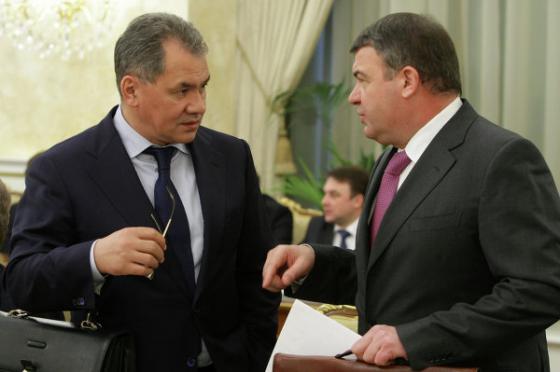
Shoygu and Serdyukov

Shoygu and Serdyukov

Before Russia’s holiday topor fully enshrouded military commentators, Gazeta’s Sergey Smirnov published an interesting piece on the situation in which Defense Minister Shoygu finds himself.  There isn’t a lot of great comment on Shoygu yet, but it might be cranking up.  Smirnov looks at how the popular Shoygu could mar his well-regarded career while tackling the same accumulated military structural problems that faced his predecessor.  He writes about possible bureaucratic and personal conflicts with Sergey Ivanov, Sergey Chemezov, and Dmitriy Rogozin.

Leftover Problem One:  Contract Service

According to Smirnov, Russia’s military added virtually no contractees in 2012, but still has to recruit 50,000 of them every year until 2017 to reach its assigned target of 425,000.  The obstacles are the same.  Eighty percent of them don’t sign a second contract because the army doesn’t offer living conditions more attractive than barracks.  Undermanning is a related problem.  Smirnov says the military’s manpower is certainly below 800,000.  And Shoygu may have to acknowledge this problem.

Leftover Problem Two:  Bureaucratic Competitors

Smirnov describes Serdyukov’s conflict with Rogozin over the OPK and its production for the military.  He claims the “Petersburg group” of Sergey Ivanov, Chemezov, and Viktor Ivanov wanted one of its guys to take Serdyukov’s place at the Defense Ministry.  But Putin didn’t want to strengthen them, so he took the neutral figure Shoygu.

According to Smirnov, Serdyukov wanted out, and wanted to head a new arms exporting corporation to replace Rosoboroneksport.  That, of course, conflicted directly with Chemezov and the interests of the “Petersburgers.”  And Smirnov makes the interesting comment:

“But that appointment [Serdyukov to head a new arms exporter] didn’t happen precisely because of the big criminal cases which arose not by accident.”

Was Serdyukov done in for overreaching rather than for corruption scandals in the Defense Ministry?

Shoygu, writes Smirnov, was not thrilled at the prospect of continuing the “not very popular” army reforms.  Smirnov is left at the same point as everyone else:  will it be a “serious revision” of Serdyukov’s reforms or a “course correction?”

There’s lots of talk to indicate the former rather than the latter.  The new VVS CINC has bloviated about returning to one regiment per airfield instead of large, consolidated air bases.  He claims the Krasnodar, Syzran, and Chelyabinsk Aviation Schools will be reestablished.  He babbles about going to a three-service structure and retaking VVKO.  Shoygu will allow Suvorov and Nakhimov cadets to march in the May 9 Victory Parade.  He stopped the Military-Medical Academy’s move out of the center of Piter.  Other commonly mentioned possible revisions are returning to six MDs and transferring the Main Navy Staff back to Moscow.

Leftover Problem Three:  Outsourcing

Serdyukov’s outsourcing policy led to scandals, and didn’t work for the Russian military’s remote bases.  Gazeta’s Defense Ministry sources say the structure and activity of Oboronservis will likely be greatly modified or, less likely, Oboronservis will be completely disbanded if some workable entity can take its place.

Leftover Problem Four:  Military Towns

The military wants municipal authorities to take over the vast majority (70-90 percent) of a huge number of old military towns (that once numbered 23,000) no longer needed by Armed Forces units.  The army only wants some 200 of them now.

The local government wants the military to provide compensation to restore and support these towns, but the latter doesn’t have the funds.  The army is laying out billions of rubles in the next three years, but only to outfit 100 military towns it wants to use.  There is also the problem of who gets, or has the power to give away, legal title to this military property.

Leftover Problem Five:  Officer Housing

Shoygu, says Smirnov, has to solve the unresolved problem of officer housing, especially for officers “left at disposition” of their commanders (i.e. not retired but lacking duty posts and apartments).  The Defense Ministry still doesn’t know how many need housing.  Smirnov writes:

“Despite the fact that the military department daily reports on the handover of apartments, the line of officers retired from the army who are awaiting receipt of living space is not becoming smaller.  At present from 80 to 150 [thousand] former officers are awaiting the presentation of housing.”

More than enough lingering headaches for one Defense Minister.

Gerasimov Says No Sharp Course Change

General-Colonel Gerasimov (photo: RIA Novosti / Sergey Pyatikov)

General-Colonel Gerasimov (photo: RIA Novosti / Sergey Pyatikov)

Gazeta.ru pieced together RIA Novosti clips of General Staff Chief Valeriy Gerasimov’s session with foreign military attaches yesterday.

Gerasimov said army reforms begun by former Defense Minister Anatoliy Serdyukov will be “corrected,” not radically altered:

“Anticipating your questions on the possibility of a sharp course change in military organizational development, I would note there won’t be one.  In 2008, the Russian Federation President clearly indicated development tasks for our army, they will be fulfilled.  Naturally, some issues are being subjected to certain correction accounting for deficiencies revealed.”

“Organizational development” is primarily (but not entirely) TO&E and force structure.

Gazeta reports Gerasimov said mixed conscript and contract manning will be preserved, and the one-year conscript service term won’t be increased as some would like.

The new NGSh said the Defense Ministry is creating its own element to track fulfillment of the state defense order (GOZ):

“And by the minister’s decision, a structure will be created in the Defense Ministry which allows for controlling not only the completion of contracts, but work in all phases of the production cycle.”

Serdyukov’s Defense Ministry had various organs with this responsibility, including Rosoboronzakaz, Rosoboronpostavka, etc.  How will the new structure be better?

Gazeta closes with expert opinions on the fate of reforms introduced by Serdyukov.  Igor Korotchenko says:

“We didn’t have Anatoliy Serdyukov’s reform, but a reform the main parameters of which were set by the president.  That is the military reform course will continue fully with the exception of some cases of deficiencies revealed in the military education system, military medicine, and the reinforcement of control procedures over the activity of those structures involved in armed forces outsourcing.”

Ever-skeptical Aleksandr Khramchikhin doesn’t think there was a coherent course to be changed:

“In the army reform, there wasn’t a clear plan of action, one won’t appear under the new defense minister.”

“I don’t think Shoygu’s Defense Ministry will try to correct the course of reform or introduce some fixes.  There is nothing to correct.  Serdyukov’s reform had no kind of course, it went by the trial and error method.  There are grounds to believe that Shoygu will act according to the same principle.”

There’s a long list of policies commentators think will or might be changed, but little so far officially.  A new category to replace Serdyukov’s Reforms is needed.  Maybe Shoygu’s Nuanced Corrections?

The New Face of Russian Defense Policy

Sergey Kuzhugetovich Shoygu

Quite a surprise, a shock.  An interesting choice.  An ethnic Tuvan, an engineer who spent his post-Soviet life heading MChS — the Ministry of Emergency Situations, who was Governor of Moscow Oblast for just six months.

It’s a hard to imagine Shoygu advancing change and reform in the military to the degree Serdyukov did.

Despite his successes, Anatoliy Eduardovich was done in by offending his estranged mentor, father-in-law, and close Putin confidant, Viktor Zubkov.  The straw that broke the camel’s back was when police found the Defense Minister at Vasilyeva’s apartment, just below his own (how convenient), at 0600.

Ironically, Serdyukov wasn’t done in by the corruption of his young, largely female team of civilian administrators and former tax service officials.  And perhaps he wasn’t done in by his own corruption.  We’ll have to see what fate awaits him.

Serdyukov came close but didn’t match Sergey Ivanov.  Serdyukov spent 2,091 days as defense minister to the latter’s 2,150.

Can’t help but feel Shoygu won’t come close to either number.