Tag Archives: SLBM

Bulava Launch This Week?

Today Navy CINC, Admiral Vysotskiy told an ITAR-TASS correspondent a Bulava SLBM test is planned this week.  Asked whether the missile would fly, Vysotskiy said he hopes it will:

“If I wasn’t confident, I wouldn’t have made these plans.  Nothing can be ruled out, we aren’t giving guarantees.  But we hope it will fly.”

Vysotskiy noted that preparations for the next launches have been conducted very seriously, and state acceptance made much tighter.

He said Bulava won’t be fired from Borey-class SSBN Yuriy Dolgorukiy until there are successful tests from Dmitriy Donskoy, adding that Dolgorukiy will be ready to launch Bulava in about a month or six weeks.

Dolgorukiy Factory Testing Complete

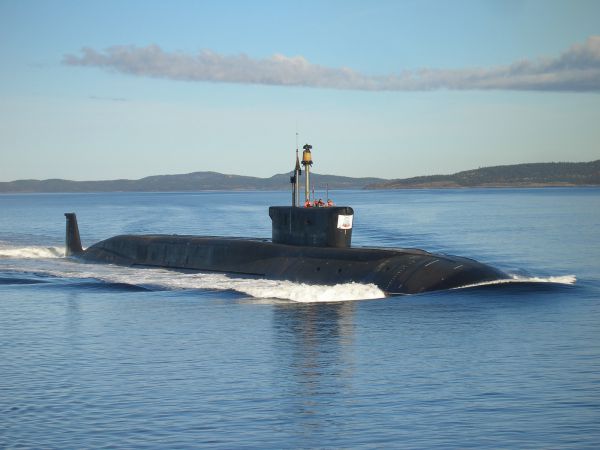
Borey-class SSBN Yuriy Dolgorukiy

Not a huge news story, but worth keeping continuity on . . . and there are interesting questions — has the fourth Borey really been laid down, and how many launch tubes will be on unit 2, 3, etc.? 

Borey-class SSBN Yuriy Dolgorukiy completed its factory underway testing by 24 September, according to the official Russian news services.  A spokeswoman for Sevmash said the current testing plan was fulfilled, and all established tasks were completed.  Captain First Rank Vladimir Shirin called the last at-sea period ‘excellent.’  All systems reportedly worked well, and minor issues noted during previous cruises were resolved.  The Sevmash delivery team and Dolgorukiy crew are preparing to present the submarine to the state acceptance commission.  But according to Grani.ru, a United Shipbuilding Corporation (OSK) source told Interfaks the obvious – acceptance of Dolgorukiy into the Navy inventory is not being considered since its main weapon – the Bulava SLBM – is not ready.  The Defense Ministry is still hoping that the new SSBN will be the launch platform for one of the next three Bulava tests.

The news services noted there are two additional Boreys, not three, on Sevmash’s buildingways.  So one supposes number four, Saint Nikolay, hasn’t been laid down yet.

The news services maintain the line that the Borey-class boats will have 12 launch tubes each, but Grani.ru, like other media outlets, claims Aleksandr Nevskiy and Vladimir Monomakh are proyekt 955A units and will have 16 tubes, while Saint Nikolay will be a proyekt 955U boat, possibly with 20 tubes.

Makarov on Iran, Lasers, Deferments, and Bulava

Attending today’s OPK modernization meeting in Ramenskoye, General Staff Chief, Army General Nikolay Makarov talked to the press, and said:

“A decision not to supply Iran with the S-300 was made, it, of course, falls under the sanctions.  The leadership made a decision to stop the supply process, we are fulfilling it.”   

He wouldn’t say the contract to supply them has been broken.  Apparently asked if the missiles could be provided in the future, Makarov said:

“We’ll see, this will depend on Iran’s conduct.”

Unnamed official sources put the price of the Iranian S-300 contract at hundreds of millions of dollars.

ITAR-TASS reiterated Defense Minister Serdyukov’s 20 August comment on providing Iran the S-300:

“We aren’t supplying anything.  There’s no decision on supplying them.”

Makarov’s comments coincided with President Medvedev’s ukaz implementing UNSCR 1929 from 9 June.  The ukaz expressly listed the S-300 as an item not to be transferred from Russia to Iran. 

Asked about Russia’s military laser program, Army General Makarov said development is on-going:

“Work on a combat laser goes on throughout the world, including here.”

He added that it was premature to talk about the characteristics of Russia’s laser system.

Answering another question, Makarov said student draft deferments won’t be abolished:

“The possibility of ending deferments for students is not being considered.  This issue is too socially significant.”

“There are many other measures which will allow us to resolve the situation [with the draft].”

He added that he expects Serdyukov to talk about the draft at Friday’s Defense Ministry collegium.

Asked if compulsory military service will be increased from 12 months, he said, “I don’t know if there’s sense in this.”

But Makarov went on to vent his frustration about conscription:

“Today not more than 13 percent of young people are called up, the rest aren’t called up for health reasons.  We need to understand what is happening .  It can’t be that only 13 percent of our young people are healthy.  Among people getting a deferment or exemption from the army on health grounds, 40 percent of them had documents either purchased or manufactured in some way.  In other words, there’s an issue, and we need to toughen monitoring in this area.”

Thirteen percent is really low.  And the corruption rate when it comes to health exams in commissariats is at least 40 percent.  We need to explore his numbers and math.  These are startling figures.

Makarov paid a little respect to Serdyukov’s fledgling effort to ‘humanize’ conscript service:

“A number of measures to reduce the load on prospective conscripts are being reviewed.”

Finally, press questions turned to the pending Bulava SLBM tests.  Makarov said:

“The missiles which we’re preparing to launch were produced from beginning to end under strict monitoring by military acceptance, the Defense Ministry, and the Military-Industrial Commission.  A great deal will depend on these launches.  If the launches are unsuccessful, then we have to shake up fundamentally the entire cycle of missile production.”

On the timing of the next Bulava test, Makarov contradicted Serdyukov’s last statement by saying:

“It’s doubtful this will happen in September.”

Serdyukov on Changing Bulava Production

According to RIA Novosti, Defense Secretary Serdyukov told Russian journalists in Washington Friday that, if the next Bulava launches fail for different reasons, Russia will have to change its system of production and quality control. 

Serdyukov said, if the missiles fail for the same reason, the cause of the failures will be found.   But if the causes turn out to be different, we “have to change the entire production and quality control system for these missiles.”

According to ITAR-TASS, Serdyukov said:

“In the assembly of these missiles we tried to make them fully identical so that they would be like twins [triplets?].” 

“We can’t hurry the testing.  The main thing is that in every assembly cycle there were strict guarantees that we made the missiles absolutely identically and all procedures were followed.”

“The possible defects will be the same, then we will eliminate them, but if they are different, then we have to break down the entire system and find out what is happening in production and quality control. Then it will be clear that the production monitoring is incorrect and it’s absolutely necessary to change it.”

Bulava Test Postponed At Last Minute?

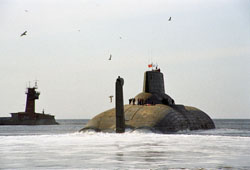
Dmitriy Donskoy Underway (photo: Sevmash)

According to Rossiyskaya gazeta’s sources, Bulava SLBM test platform Dmitriy Donskoy was on-station in the White Sea for a launch last week, and all test arrangements were laid on — command and control, international notifications, ground and space tracking, telemetry, support and rescue ships, but the launch was put off at the last minute. 

The paper’s space and OPK sources said the Bulava commission had concluded the missile and boat were ready for the launch, and “today there is no reason whatsoever to put it off to a later time.” 

But, Rossiyskaya concludes, it turns out there was a reason serious enough to return the submarine to base.  

So it comes to nothing, and Defense Minister Serdyukov’s 8 September comments added no clarity to the situation, according to the paper’s account. 

So, we don’t know the reason why a launch was prepared, drew close, and didn’t happen.  It suggests some continuing problem or doubt about Bulava’s performance, or continuing disagreement over the system’s readiness for its next test.

Bulava Test in Second Half of September

Defense Minister Anatoliy Serdyukov talked to the press today about the next Bulava SLBM test:

“The next test launch of the Bulava could happen, most likely, in September, but not in the first half of the month.  Definitely.”

“We’ve tried to control the entire process of assembling these missiles as precisely as possible to produce the same parameters. There will be three missiles at a minimum, we need to understand that if failures are repeated in the launches, we’ll learn the cause of unsuccessful launches.”

After reiterating how previous failures had different causes, Serdyukov continued:

“Now at every level and phase of assembly of the missile there was strict control and analysis.  Moreover the commission established to explore the results of the last unsuccessful launch also worked here.  It gave recommendations, we incorporated all of them in preparing for new tests.”

“I believe that launches will be conducted most likely in September according to their readiness.”

Possible Bulava Test By Mid-September

Bulava (photo: Newsru.com)

An OPK source has told ITAR-TASS the next Bulava SLBM test is expected in the first half of September.  The source said the state commission investigating the last Bulava failure is scheduled to meet 6 September, and the launch window for the next test opens on 9 September.

A missile industry source told Interfaks the commission will meet in the 5-7 September timeframe, and it could fix a launch date sometime at the end of the first ten days of September.

Newsru.com recalled that three tests are planned for 2010:  two from Dmitriy Donskoy and one from Borey-class SSBN Yuriy Dolgorukiy.  The website’s Defense Ministry source unofficially repeated claims that, if all three firings are successful, the Bulava will be accepted into the armaments inventory next year.

ITAR-TASS also reported today that Dolgorukiy successfully completed its latest phase of factory underway trials, and is preparing to go sea again next month.  Sevmash reports the new SSBN completed its cruise program, showing “good performance characteristics and reliable working of all onboard systems.”

Update on Next Bulava Test

Today’s Kommersant cites Interfaks saying a session of the state commission deciding on the next Bulava SLBM test will happen during the next week.  Kommersant’s own OPK source confirmed this, calling the session a formality since the commission’s already announced that testing needs to continue in the near future.  The source says, after the commission meets, another week is needed to prepare for a launch, so look for the next test in late August or early September.

Kommersant quotes an unnamed OPK official who said the planned launch in the 11-13 August timeframe was postponed because “additional stand tests of the system were conducted with the goal of more rigorous preparation for the launches.”

Kommersant reminds readers three launches are planned before year’s end — two from Dmitriy Donskoy (proyekt 941U Akula) and one from Yuriy Dolgorukiy (proyekt 955 Borey).

The paper’s OPK source claims, in view of Bulava’s failures, “this strategic missile system will only be accepted into the inventory after a minimum of five consecutive successful tests.”

Bulava Test Delayed Two or Three Weeks

ITAR-TASS reported this morning that the expected Bulava SLBM test has been put off for two or three weeks.  The state commission looking at the December 2009 Bulava failure apparently made the decision today ahead of an anticipated launch between 11 and 14 August.  A defense industry source didn’t give a reason for the postponement.

Vysotskiy’s Navy Day Interview

Press coverage of Navy Day (25 July) was replete with interesting stories of plans to revivify Russia’s Kirov-class CGNs and even the Orlan-class wing-in-ground effect vehicle.  There was more talk about moving the Neustrashimyy and Yaroslav Mudryy to the BSF.  Navy CINC Admiral Vladimir Vysotskiy’s interview with Ekho Moskvy, however, didn’t get a lot of attention beyond a couple RIA Novosti and ITAR-TASS sound bytes.

Discussing development of Russia’s fleet of the future, Vysotskiy emphasized the long lead time required to get it:

“Today it takes 10-12 years to get some kind of definite design.  We understand that we have to go according to some operational-tactical requirements, perhaps even operational-strategic ones in this design, of course.  So, it means the development or construction of a series is approximately another 5-7 years, up to 10 years.  Perhaps more, the service life of the design is 20 to 25 years.  In other words, if today we make a decision on constructing some full-scale fleet, then we have to understand we’ll receive this fleet in about 50 years.  Well, at a minimum, beginning from the main component in 35 years.”

Vysotskiy’s comments on Bulava were also captured by the wire services:

“Well, the question which we, military men bearing certain responsibility for this, of course, well, honestly speaking, we are already tired of answering because there is one cause — a deep, I underscore, failure of primary production technology for such expensive missile systems.”  

“We all very simply understand well:  when we began to arrange the process of our work incorrectly from the beginning, and here everything was not done as it needed to be.  Here, of course, we’ll get big problems in the process of the work itself.  This means, in my view, in the last 2 years, a serious move in the direction of us receiving this system has been made nonetheless.  But we need to understand that getting this system in its current form is not the final step of the work.  But we have a fair chance all the same to complete this work successfully, well, so we’ll say, in the course of the coming year.”

“When a systemic mistake is found, it’s simpler,  In this instance, an entire systemic mistake was found precisely in the lack of a system.  That is, to put it properly, forgive such a tautology or, on the other hand, a paradox.  But, what we’ve got is what we’ve got.”

And Vysotskiy said lots of other interesting things that went unnoticed.

He naturally supported Vice-Admiral Sidenko as Far East OSK Commander, saying it made sense and reflected the country’s maritime interests in the Pacific and Indian Oceans. 

He connected the acquisition of the Mistral to drawing down mobilization resources in favor of permanent readiness.  He said PR units could be put on Mistral and the ship could be a mobile command point for an OSK’s inter-service grouping.  He defended turning abroad by saying it would take Russian yards 1.5 to 3 years to even prepare to make such a ship if they started today.

Vysotskiy wants the BSF to pick up the antipiracy load so the distant fleets don’t have to send their ships.

He discussed Russia’s long-term search and rescue support program, and he emphasized rapid information transfer and international cooperation and combined training, like NATO’s Bold Monarch exercise, as essential ingredients for success.

On the loss of the Kursk ten years ago, Vysotskiy said the accident started with a technical cause — errors in handling a peroxide-fueled torpedo — but there was an accumulation of mistakes, including organizational and command ones, that led to the tragedy.

Russia is working on its organizational and technical problems in SAR, both buying equipment and learning to use it abroad.  Vysotskiy cited an ‘absolute understanding’ on cooperation with foreign partners.

He was evasive on moving the Navy’s headquarters to St. Petersburg, saying a remote command and control point is there, and other steps in this direction are being taken.  But the overall military C2 reform has to be completed this year before he can really answer questions.

Lastly, on foreign bases for the Navy.  He’d like to have them, and there’s movement in this direction, at least compared with the recent past.  The Navy is working with a number of states to arrange for simplified port access for its ships in some strategic places, and it’s almost like having a base.