Tag Archives: Vladimir Putin

Thickening Clouds

Deputy PM Rogozin and Serdyukov (photo: Yuriy Magas)

Anatoliy Serdyukov completed his fifth year as Russia’s Defense Minister on Wednesday (February 15).

But the inimitable Argumenty nedeli concludes “clouds are thickening” around him. 

AN says Serdyukov’s in the “eye of a storm” of PA cadre changes, and he’s begun sacrificing subordinates to save himself.

The paper’s Defense Ministry source claims there will be a large number of resignations from “support structures controlled by the military department,” i.e. the quasi-commercialized, civilianized logistic agencies established to outsource “non-core” military functions.

OAO Slavyanka — responsible for housing and communal services in military towns — will lose its general director, Aleksandr Yelkin, over poor winter preparations and boiler breakdowns in Murmansk, Kaliningrad, and the Far East. 

Not surprisingly, the source says this decision followed Prime Minister Putin’s harsh criticism of Serdyukov on February 9.  See Kommersant, Komsomolskaya pravda, Nezavisimaya gazeta, or Newsru.com for more on this.

The general director of Agroprom — an affiliate of OAO Oboronservis — Natalya Dynkova, lost her position for “redistributing” the military food procurement market.  Agroprom declined an AN request for comment on Dynkova’s situation.

AN’s source also says Serdyukov’s apparat chief [chief of staff] Yelena Vasilyeva is also “hanging by a thread.”  From detention, the indicted former chief of GVMU, General-Major Aleksandr Belevitin has given evidence against her. 

Several months ago, AN claimed dustups with Vasilyeva led to former Deputy Defense Minister Mokretsov’s departure as well as complaints from high-ranking civilians and officers.

Finally, AN’s officer source says the FSB is investigating and arresting some people connected to the Defense Ministry’s commercial structures.  He concludes Serdyukov is ridding himself of people who could compromise him or interfere with him finding a place in once-and-future president Putin’s new government this spring.

BFM.ru sounded a separate but similar note reporting that the chief of a firm entrusted with selling excess Defense Ministry property is suspected of fraud. 

General director of the “Expert” Legal Support Center, Ye. F. Smetanova  allegedly sold military property for reduced prices in exchange for kickbacks ranging from 5 to 25 percent of the transaction, according to the MVD.  She reportedly received 18 million rubles for endorsing the sale of four Samara Voyentorgy for 147 million. 

Investigators are trying to identify other Defense Ministry properties sold with kickbacks as well as possible co-conspirators in the schemes.

In 2011, the Defense Ministry conducted 43 auctions and sold real estate for 4.7 billion rubles.  Movable military property was sold to the tune of 560 million.

It’s worth recalling the Main Military Prosecutor’s words about the scale of Defense Ministry corruption in 2011.  He singled out commercial firms outsourcing for the military and violations of auction rules as particular problems, along with routine kickbacks and bribery.

Where does this leave us?

Things aren’t so rosy for Serdyukov right now. 

For one thing, Rogozin’s replacement of the virtually invisible Sergey Ivanov has probably been a near-daily irritation for the Defense Minister.

Even after five years, it’s still hard to get a handle on all the military’s “financial flows.” 

And resignations and reports of corruption don’t reflect well on Serdyukov.

Still, Serdyukov remains a member of Team Putin, and he’s probably secure.  The election season makes everyone nervous, and it’s hard to say who’s driving corruption charges.  Shaking out some incompetent or corrupt defense officials might serve to create the impression that Prime Minister Putin’s on top of things.
Another Angle on Apartments

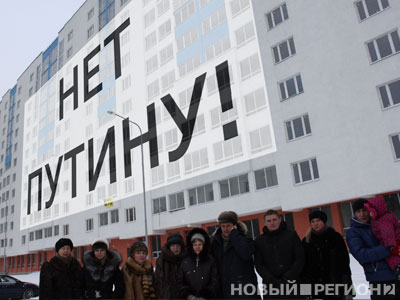
Apartment Owners Say No to Putin (Photo: Novyy region -- Yekaterinburg)

Here’s a different angle on why finished military apartments are unoccupied.  Last week Novyy region told the story of how apartments for military men in Yekaterinburg got tangled up with apartments for private buyers, leaving the latter standing in front of a huge sign saying “No to Putin!” and vowing not to vote for him on March 4.

The tale goes like this.  In 2005, the Defense Ministry engaged the Megapolis construction-investment company to build a 254-unit apartment building for military unit 61207, which looks to be a nearby Railroad Troops brigade. 

The building was supposed to be ready in 2008, but construction dragged out, reportedly as a result of rising costs.  To complete its work, Megapolis said it needed to sell some of the apartments which it did.  These civilian owners, however, have keys to apartments they can’t occupy.

As a result of the dispute with the company, the Defense Ministry has refused to sign commissioning papers for the building, or turn on the electricity and gas.  The private owners have appealed for help at every possible level, and are now demanding that Defense Minister Serdyukov and Prime Minister Putin intervene.  In a statement to the media, the frustrated owners said:

“We shareholders, as consumers, legally paid for our apartments several years ago.  We don’t have any relationship to the Defense Ministry or the Megapolis company, but because of their dispute we can’t get into our own homes.”

“It seems the building was fully constructed in December 2011, live it up, rejoice.  But the bureaucratic procrastination arises.  That is the system developed, among others, by Vladimir Putin simply doesn’t want to work for the good of the people.  So the question arises — why should we vote for Putin?”

This scenario of Defense Ministry contractors selling some apartments on the open market has produced similar confrontations in several cities.

No word on how the servicemen are faring in the wait for their apartments.  Presumably they’ve remained in whatever service housing they had, and can’t be dismissed until they take delivery of their apartments.

VDV Vets Rock Against Putin

The disparate parts of the anti-Putin movement probably couldn’t agree on much except their common desire to see the once-and-future president not win the election and a third term on March 4.

Yesterday VDV veterans from Moscow’s Akademicheskiy rayon appeared on the Internet rocking with hard-edged lyrics against Putin.  Livejournal comments indicate these guys are for real.  They were at Sakharov Square, and someone’s suggested they be on-stage at the February 4 demonstration.

Someone was kind enough to transcribe the lyrics here, and here are some English ones:

If you’re a citizen, if you’re president
There’s a law for you, there’s a prohibition for you
Don’t steal from the treasury and never lie
Be open for all, answer for your words
Eight years president and again a candidate
Look us in the eye and surrender your mandate
We believed you, but you lied many years
Employing in everything your KGB secret

You’re just like me, a man not God
I’m just like you, a man not a lout
Let’s not lie more, let’s not steal
We’re a freedom assault, the Motherland is with us
You’re a typical official, not tsar or God
For you a man is a stupid monkey
The ribbon’s color is freedom, for all positive
And only for you…a condom

I’m looking at you, at your portraits
You’re still lying to us just like your bears
We’re tired of looking at the shame of the entire country
With village poverty next to your castles
You destroyed the defense sector, and retired the army
You put it on soldiers, sent officers away
We won’t forgive all your services
We are demanding peacefully – go away tyrant

You’re just like me, a man not God
I’m just like you, a man not a lout
Let’s not lie more, let’s not steal
We’re a freedom assault, the Motherland is with us
You’re a typical official, not tsar or God
For you a man is a stupid monkey
The ribbon’s color is freedom, for all positive
And only for you…a condom

We remember our granddads who fought the SS
We remember our Guards who jumped from the sky
Berlin and Afghan remain in our heart
But the heart of One Russians is their own pocket
Nowadays honor’s not in respect, there’s no virtue
And only the systemic gleam of coins
Global materialism of machines and wimps
This is rotten systemic cynicism
They’ve forgotten culture in YeGE schools
Diplomas for money and bribes everywhere
An old man can’t be treated for free
This is the deadend of a rotten system

You’re just like me, a man not God
I’m just like you, a man not a lout
Let’s not lie more, let’s not steal
We’re a freedom assault, the Motherland is with us
You’re a typical official, not tsar or God
For you a man is a stupid monkey
The ribbon’s color is freedom, for all positive
And only for you…a condom

Of course, it loses a lot in translation.  But even if you can’t follow the original, its anger and power is palpable.

It seems to this author very unlikely Vladimir Putin will depart the scene any time soon.  But the demonstrations and the protest movement (even this song) signify that politics and activism are returning to Russia.

Will Serdyukov Go?

Pavel Baev

Back to a familiar topic . . . is it possible or likely Defense Minister Anatoliy Serdyukov will resign or be dismissed from his post prior to the March 4 presidential election?  It is, of course, a topic that won’t quit.  At least not for the next two months. 

Pavel Baev discussed this with BFM.ru over the holiday. 
 
We looked at Baev’s view of Serdyukov’s reforms back in the spring.  He was neither sanguine about them nor forgiving of mistakes made.
 
We also looked earlier at a couple considerations of whether Serdyukov might leave or be forced out of the Defense Ministry. 
 
In August, Mikhail Rostovskiy thought Serdyukov’s position pretty secure, and this author postulated, with once-and-future president Vladimir Putin secure in the Kremlin again, Anatoliy Eduardovich might find relief from the defense portfolio in a job both cushier and more to his liking.
 
In April, Aleksey Makarkin also thought Serdyukov was pretty safe.
 
It’s obvious that the aftermath of the December 4 Duma elections changed a lot of things.
 
Now Oslo-based Professor Baev thinks Serdyukov could be sacrificed in the election run-up for nothing other than loyal performance of the tasks Putin set him to in February 2007.
 
Baev says Putin believes his regime faces an old-fashioned Cold War-style political threat.  Various Western “circles” (NATO, NGOs, CIA) think the regime’s exhausted itself.  Any possible replacement would be welcome to them.
 
Then we get to the essence of Baev’s argument — the fact that the Defense Minister has generated great dissatisfaction and irritation among Russia’s defense factory directors.  Without a serious go-between in the Military-Industrial Commission, Serdyukov’s become the focus of their ire.  They blame him and his subordinates for rejecting Russian weapons and equipment, and claim they’ve hurt Russia’s reputation as an arms exporter.
 
His case in point is the complaint from railcar and armor producer Uralvagonzavod during Putin’s December 15 “direct broadcast” Q and A with citizens.  A caller asked Putin to take Serdyukov and General Staff Chief Makarov by the neck, and replace the former with a “clearheaded Defense Minister.”
 

Baev’s interviewer asks whether Serdyukov will keep his current seat under Putin 2.0:

“. . . I think that the Defense Minister will be replaced even before the election.  The Armed Forces and military enterprises are a large and serious part of the electorate.  It was possible to extinguish accumulated irritation with the promise of money since after long promises they raised pay for officers, although not as substantially as was said.  It’s also possible to give money to OPK enterprises and sacrifice an unliked minister.”

But a resignation won’t be enough:

“I don’t think so because the problems have gone too far.  It’s hardly possible to put the protest mood just on one minister.  Everyone understands perfectly that it’s not the minister who started all this and carried all this out, no one suspects Serdyukov of being a confirmed reformer, having a program, or being a man motivated by a sense of his own mission.  He is a manager, an executive, and extremely stubborn, but he didn’t start this, and that’s clear.  And I don’t think Serdyukov will hold onto the minister’s chair.  The problems and conflicts have become so acute that it’s becoming costly to him.  I think they’ve had enough of him.”

Baev concludes that another civilian should take over the Defense Ministry, and continue separating its intertwined military and civilian functions.  He doubts Serdyukov’s replacement will reverse anything, but simply move forward on the problems reforms have created.

Serdyukov’s departure seems like more of a possibility now than before the Duma elections.  As Baev suggests, Putin could sacrifice his Defense Minister to appease his numerous unhappy defense industrial constituents.  Serdyukov’s fate may hinge on how badly Putin needs a boost for March 4. 

The Defense Minister’s 5-year anniversary comes next month and provides an opportunity for a change short of dismissal.  This author gets the impression Serdyukov’s energy for his difficult job has declined lately.

As for Uralvagonzavod, its workers are unlikely to quit sniping at the Defense Minister.  They, along with other military vehicle makers, have reportedly learned their defense order for 2012 has been drastically cut in favor of procurement in 3-5 years.

A Promise That Can’t Be Kept

Shevtsova Holds the Military Housing Portfolio

Yesterday a number of media sources picked up an Interfaks story in which a Defense Ministry source alleges the military’s program of permanent housing construction for servicemen has broken down because a whopping 78,000 new apartments remain unoccupied. 

Yes, that’s not 33,000 as announced a couple weeks ago, but a reported 78,000.

Moreover, the Interfaks source says 30,000 service apartments are currently in a dilapidated condition.

The source concludes:

“It’s possible to state that the program to provide service housing to servicemen before the end of 2012 will collapse.”

The Interfaks interlocutor adds that inside the Defense Ministry they’re currently trying to determine who’s to blame for the housing mess.

Actually, the service housing deadline is now the end of 2013 according to Prime Minister Putin.  The permanent apartment suspense is the end of 2012.  But perhaps these are mere details.  The larger point is that the entire effort to furnish servicemen — active and retired — with apartments owed them under the law looks like it’s set to fail next year.

On the heels of yesterday’s very significant stat, Deputy Defense Minister Tatyana Shevtsova talked to ITAR-TASS today about putting off permanent apartments for servicemen and retirees until 2013.  She also said the 134,000 apartments (that both Putin and Defense Minister Serdyukov have cited) acquired between 2009 and 2011 is actually 116,000 plus 18,000 to be acquired in the next three days (by the end of 2011)!

Bottom line:  The political leadership’s 2010 and 2012 military housing promises weren’t kept.  The 2012 and 2013 promises can’t be kept given severe problems with apartments already built and rejected by military men.  In sum, the military apartment imbroglio may introduce its share of complications into Prime Minister Putin’s plan to return to the Kremlin in the spring. 

Somebody Finally Went There

Komsomolskaya pravda's Viktor Baranets

Yes, somebody finally went to a very obvious place — during this week’s “live broadcast,” Viktor Baranets called Vladimir Putin on his failure to solve the military housing problem.  You may recall this recent post lamented Putin’s “free pass” on the unfulfilled promise of apartments for servicemen.

Gov.ru printed the transcript of Putin’s on-air session with reporters.  In a friendly manner, Baranets warned Putin he was about to ask an uncomfortable question.  And he couched his question like this:

“Vladimir Vladimirovich Putin many times said to the army and Russia that the housing problem for dismissed servicemen would be resolved by 2010.  The problem is not resolved.  Not one minister has apologized to the dozens of essentially deceived people, and you have not apologized.”

“Don’t you believe it’s necessary to give some apologies to the people and tell them the honest, objective time when this problem will really be resolved?”

Baranets continues:

“I’m addressing you as a candidate for Russian Federation President.”

“Vladimir Vladimirovich, it’s perfectly obvious that a number of ministers have failed in their work in strategic areas.  This concerns the economy, and health care, and the army.  Nevertheless, Vladimir Vladimirovich, you still to this time haven’t given a very sharp critical evaluation of the work of these ministers.  Why are you afraid to replace them?”

“Vladimir Vladimirovich, if you will dispose of the untalented and throw talented, principled ministers into the battle, you can believe, the people will be drawn to you, reforms will go forward.”

“Vladimir Vladimirovich, I am finishing my long speech and I want to tell you, you’ve already been told many times, why don’t you replace talentless, unprincipled ministers, who, by the way, are deceiving you.  They have really set you up when you talked about how the problem for housing the dismissed would be resolved.  They set you up.  This is a state crime, not just a crime against you, Vladimir Vladimirovich.  You need to make conclusions from this.”

“But if you have problems with selecting personnel, turn to us, we will help, including even me.”

Vladimir Putin Answers Baranets

After a little banter, Putin got to his answer.
 
Putin said his predecessor didn’t deal with the military housing problem, and, starting with those dismissed in the 1990s, the line for apartments just grew. 
 
His administration counted 70,000 ex-servicemen in need of housing, and handed out 111,000 apartments in 2008-2010.  But, said Putin, the Defense Ministry undercounted, and there were actually 150,000 men in the housing queue.
 
According to the Prime Minister, even though funds were available, the construction industry just didn’t have the capacity to build faster. 
 
In 2008, the dismissal of excess officers from the Armed Forces and the global financial crisis made housing military men more difficult.
 
But Putin concluded he still thinks the permanent apartment problem will be resolved by the end of 2012, and service apartment problem a year later.  He noted, however, that the line may get longer since there’s an issue of servicemen still waiting in municipal housing queues.
 
Then Putin turned to Baranets’ point about ministers.  Putin said he didn’t want to make them scapegoats since he is ultimately responsible, and cadre reshuffles mean lost months of work.  He said he prefers to straighten ministers out so they avoid mistakes.  Putin ended his answer by saying a time for renewing the government line-up is coming, and this will happen.
 
KP’s video of the Q and A is hereTV Zvezda’s is on Mil.ru.
 
So Putin’s defense against Baranets’ accusations of failure on the military housing problem boils down to claiming it’s a hard issue.  If able to follow up, Baranets might have asked why the Defense Ministry didn’t accurately figure the number of apartments needed or investigate the chances of getting them from Russia’s housing market.  Ultimately, this little repartee between once-and-future president and military correspondent is a small sign of how fear of Vladimir Putin has diminished.  It’s hard to imagine the same exchange five years ago.  Perhaps even five months ago.
 

Farewell Russian Arms and Russian Army

Does it matter what old soldiers think?  It doesn’t seem to right now.  Maybe they’re just bitter old dudes whose time has passed. 

But they certainly provide interesting and frank commentary on the state of the OPK, the Armed Forces, and Serdyukov’s reforms at odds with official pronouncements from the Kremlin, White House, and Defense Ministry.

Former 58th Army Commander, retired General-Lieutenant Viktor Sobolev wrote recently for Pravda.  He reacted to a program on the army on NTV from October 9.  It apparently wasn’t posted on NTV’s site. 

Sobolev says this right up front:

“On the eve of elections, our president and Supreme Commander-in-Chief Dmitriy Medvedev and ‘national leader’ Vladimir Putin have been worried in turn by the condition of the country’s army and military-industrial complex and are assuring gullible Russian citizens that they will do everything so that our Armed Forces meet modern requirements and receive new types of armaments and military equipment in a timely manner.”

“The Russian mass media [SMI] under the government’s and president’s control have been actively used in making these assurances.”

The ex-general-lieutenant is critical of just about everyone:  Serdyukov and his “effective” managers, people who haven’t served in the army, former First Deputy Defense Minister Popovkin who wanted to buy more arms abroad, his successor Sukhorukov who dares insist that defense enterprises substantiate their prices, independent defense commentators like Litovkin and Pukhov, interest-hungry banks, corrupt middlemen.

He points only to Tactical Missile Armaments Corporation General Director Boris Obnosov in a positive light for recognizing that other countries won’t sell Russia their best weaponry. 

Still, Sobolev’s under a bit of a misimpression thinking that Moscow is really buying lots abroad.  In fact, a cynical observer might conclude the whole situation over the last year was designed to let Putin be the champion of the domestic defense sector vs. Medvedev the Westernizer.  But we digress . . . 

For Sobolev, this all sums to an OPK with a broken GOZ, that’s chronically underfinanced and losing its capability to produce modern arms and equipment. 

Again, the cynic might say this was already lost a number of years ago.

But, says Sobolev, when compared with the OPK:

“Even worse is the situation in the Armed Forces.  It’s believed we have a million-man army which Mr. Sukhorukov recalled on this program.  Let’s calculate it together.  According to TO&E, there are 150 thousand officers in the army, no warrants at all, they were liquidated.  According to civilian [but he still wears his uniform] GOMU Chief V. Smirnov, 184 thousand contractees are serving in the army and navy.  In all 334 thousand, the remaining 666 thousand are conscript servicemen.  But they simply couldn’t have called up so many.  Moreover, conscripts serve not only in the army and navy, of the number called up, up to 30% serve in the Internal Troops, Border Guards, MChS units, presidential regiment, and so forth.  This means in the army and navy huge undermanning exists, and it will only get bigger.  It’s planned to reduce the fall callup by 2 times.  More than 200 thousand citizens, according to Smirnov, are evading military service.  The spring callup stretches out to September, and the fall until March.  In the troops, they’re occupied with it constantly, in the course of the entire year, they take young soldiers into their ranks in small groups, organize individual training for them and try to man sub-units.  At the same time, the process of dismissal also goes on without interruption.  In these conditions, you can’t talk about any kind of quality manning of sub-units.  What kind of units of permanent combat readiness are these?”

“Therefore NATO’s military analysts note with satisfaction that, as a result of the reforms conducted, Russia’s Armed Forces aren’t capable of completing missions even in local conflicts, ‘The Russian Army does not have a sufficient quantity of transport resources for redeploying troops over great distances, does not have a sufficient quantity of aircraft and pilots who know how to fly in any weather, no unified information system.  There are not enough soldiers in the army . . .’”

“In NATO, they understand the Russian Army’s fallen apart, but how about our country’s leadership?”

Whoa. 

Sobolev’s no crank, and he’s not to be taken lightly.  Born and schooled in southern Russia, he probably has combat experience whereas the current General Staff Chief and Ground Troops CINC probably don’t.  Sobolev served as Deputy Commander of the OGV(s) in Chechnya in 2002, before taking over the NCMD’s 58th Army in 2003.  He ended his career as the chief military advisor in Russia’s Indian embassy in late 2010.

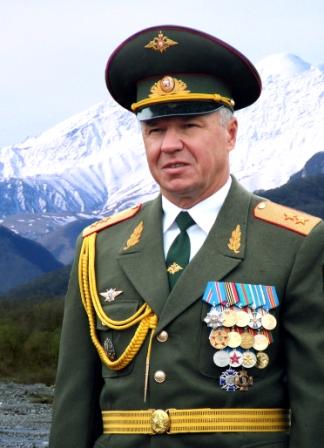
General-Lieutenant Sobolev

A more recent photo shows him looking just about as fit in retirement at age 61.

One wonders if a conservative like Sobolev realizes how much his thinking coincides with that of more liberal critics he seems to detest.

Army’s Protest Mood (Follow Up)

You may recall Prime Minister Putin’s February trip to Kaliningrad, where he heard complaints about the lack of apartments and low pensions for ex-servicemen.  Today Besttoday.ru publicized video of the once-and-future president’s meeting with Kaliningrad veterans’ organization representative General-Major Kosenkov. 

Who knows where this clip’s been until now.  But, at the time, Putin’s handlers apparently decided it wouldn’t be good PR, and kept it under wraps.

The video’s become a minor sensation because it shows Putin dismissively ripping an appeal from former officers and soldiers.  Besttoday shows both a more inflammatory short clip, ending with Putin tearing the paper, and the longer clip above where Putin talks about raising pensions this year. 

As one blogger sees it:

“For the edification of those still expecting something from Putin.  You think someone is reading your complaint letters, petitions, etc.?  Then watch the video closely once more.”

“Enough with sitting by the TV and listening to cheap stories!!!”

A little context is needed . . . Kosenkov doesn’t associate himself with the paper he shows Putin.  It’s just an example, a warning about what’s being said and circulated.  We don’t even know exactly what it said.

Kosenkov represents a domesticated, acceptable group deserving of an audience with the prime minister.  Hence, the former general-major doesn’t bat an eye when Putin tears the paper.  But perhaps Putin’s just a little too quick to take offense at this appeal.  He didn’t have to look at it, or he could’ve just put it down without reacting.

At any rate, the Russian blogosphere is abuzz today because tearing the paper exemplifies and personifies Putin’s disdain for his uncontrolled, noncompliant opponents who are impudent enough to offend him with their manifestoes, placards, demonstrations, and disobedience.

But back to the army writ large . . . yes, parts of it are oozing some discontent, but they still generally don’t fall into the same category as political opponents of Putin’s quasi-authoritarian regime.  They just don’t have much in common with anti-Putin forces.

And Putin’s delivering on his promise to raise military pensions.  The new pay law just passed its third Duma reading.  It reportedly contains, on average, a 60 percent increase for retired servicemen.  This is supposed to take the average military pension from about 10,000 rubles per month (about the same as the average labor pension) to about 17,000.  And retirees have been promised semiannual indexation for inflation in the new pay law.

But one could point out that the new pay system will increase active duty pay by 200 and 300 percent, and will divide former and current servicemen financially, socially, and politically.  But suffice it to say that Vladimir Mukhin’s original article on “candy for the military electorate” was on-the-money.  

Parts of a couple quotes he provided bear repeating:

“‘In 2000, when Vladimir Putin became President, military pensions were on average three times more than civilian ones.  Now they are much lower.  Who stopped the current authorities from keeping our pensions at the previous level?'”

“‘[Increased defense expenditures] will lead to increased problems in the economy.  Or is there a possibility that militarization [i.e. rearmament] simply won’t occur, and this means the military’s negative attitude in society will exacerbate further.'”

A Kick On the Way Out

We may see more stories of this type, the kind you see when the president is a lame duck.

Novoye vremya has an article  this week about what various observers expect from Putin III — reformer or dictator.  Military men see the question as a little off-the-mark for them.  The magazine quotes two of them. 

A General-Major S. from the staff of the Ground Troops CINC says: 

“We don’t discuss it in categories of dictator-reformer.  It’s important for us to know who is tsar in the country!  Putin is clarity.”

General-Lieutenant N. from the Genshtab agrees that Medvedev couldn’t be such a tsar:

“Personally, I always knew that we have one Commander-in-Chief.  And it wasn’t Dmitriy Anatolyevich.  In the midst of the Georgian events I tried to report to the president on the situation in South Ossetia.  So he interrupted me, he says, this isn’t for me.  Go report to the Chief.  From that point, in the Genshtab there was never confusion over subordination:  the VPK and Defense Ministry churn in a triangle Serdyukov — Chemezov — Putin.  The name Medvedev wasn’t discussed here and isn’t discussed.”

Interesting vignettes, especially the latter.  Such a state of affairs was generally suspected.  Then again, it’s safer and easier to say such a thing this week than last.

Military Prestige

Russia experienced a drastic decline in the prestige of military service in the 1990s.  Generals, officers, and politicians have debated efforts and initiatives to resurrect it ever since.

The military’s prestige is represented or reflected in many things:  pay,  living conditions, budget resources, political emphasis, applications for VVUZ admission, etc.  But it’s still a slippery notion not easy to quantify.  One even occasionally reads that, in Soviet times, every girl wanted to marry an officer.  Not so today.

On February 23, 2000 [Defenders Day], acting RF President Vladimir Putin saw it this way:

“The prestige of military service has started to be reestablished.  The confidence and personal worth of people in shoulderboards has been reborn.”

“It’s not simple for our army today.  Perhaps harder than for other state structures.  Much depends today on the understanding and patience, on the continued patience of soldiers and officers.  And their wives.  On the feeling of responsibility for the state inherent in the military man from time immemorial.”

“I am absolutely convinced of the fact that we together will without fail restore the prestige of the Armed Forces, the prestige of the Armed Forces as civic-mindedness and patriotism!”

“I very much would like for our boys just as in former times to begin dreaming again of the profession of military pilot, military engineer, tanker, artilleryman, missileman, and for their parents to be sure that their sons made the correct choice.”

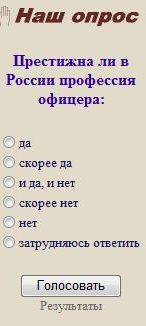
In late 2011, we’ve found out how Krasnaya zvezda’s readers see it.  The homepage of the Defense Ministry daily’s website has been asking its visitors about the prestige of the military for some time now. 

Is the Profession of Officer Prestigious in Russia?

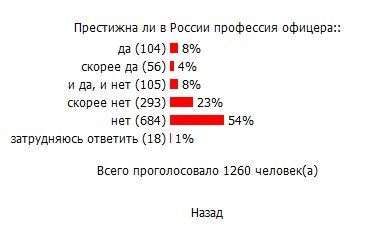
And the results . . .

It's Not

Only 8 percent of 1,260 respondents say yes.  Only 12 percent say yes or probably yes.  Fifty-four percent say no, and 77 percent — three of every four — say no or probably no.

Not much progress in rebuilding the military’s prestige over the last 11 years.

Of course, it’s an Internet poll, it’s not random sampling, and it wouldn’t stand scientific scrutiny.  Nevertheless, it’s very revealing because it’s right on the [electronic] front page of the Defense Ministry’s newspaper.

Levada’s reported for some time on sagging esteem for the officer’s profession.  Last month only 6 percent of respondents picked army officer as the most respected profession in society.  Five percent picked criminal авторитет.  Only 2 percent considered army officer the most profitable career.

If it’s this difficult to make officer a prestigious profession, imagine how hard it is to make professional enlisted service in the Russian military a respected job.