Tag Archives: Vladimir Putin

Shamanov Update

Shamanov's BMW 525 (photo: Lifenews.ru)

If we needed reminding, the extent of media coverage of Shamanov’s narrow escape from Saturday’s horrific head-on collision proves again that this two-star general is a national figure.

So what happened?  Shamanov’s warrant officer driver was killed; some press is saying he turned the car to take the blow himself and protect the boss.

Shamanov was in serious, but stable condition, and was moved from Tula to Moscow’s Burdenko Main Military Clinical Hospital.  Also injured were the acting commander of the VDV’s 106th Division, Colonel Aleksey Naumets, and Shamanov’s assistant Colonel Oleg Chernous.  Naumets’ condition is serious, but Chernous has improved a little. 

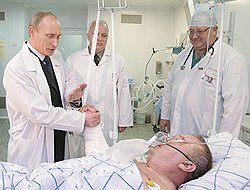
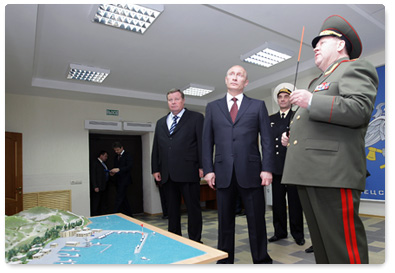
Putin Visits Shamanov (photo: RIA Novosti)

Prime Minister Putin and Defense Minister Serdyukov visited his bedside.  Izvestiya reported Putin said Shamanov was in a good mood despite what happened to him.  Serdyukov said:

“Vladimir Shamanov is real airborne, and airborne, as is well-known, are spiritually strong and physically powerful people.  Therefore I’m sure that he’ll get right and return to the line.”

Shamanov was in satisfactory condition this morning, and he went into surgery at 1200 MSK.  The focus of today’s operation was the general’s left leg.  Reports say Shamanov suffered a concussion and unspecified fractures to his arms and legs.

One has to wonder if Shamanov can rebound from this.  He might, but he might not be the same.  It would be surprising if he’s able to resume his regimen of jumping with the troops, etc.  He’s 53 and faces retirement on age grounds in a couple years unless he adds another star.  If he emerges from this accident with any kind of disability, he could be put out for that reason.  Of course, it all comes down to whether the powers-that-be want him in or out.

And this story wouldn’t be complete without possible conspiracy.  More than a couple commentators wonder if someone isn’t out to eliminate Shamanov . . . could be his son-in-law Glyba’s enemies . . . could be airborne veterans who might object to his slavish support for Serdyukov.  The Defense Ministry denies that anyone was out to get the VDV Commander.  It might just be an accident.

Kremlin Source Denies Serdyukov Resignation

According to Moscow News , an unnamed Kremlin source denies Prime Minister Putin asked for Defense Minister Serdyukov’s resignation in the wake of the storm over his harsh words for the chief of the VDV’s Ryazan Higher Command School on 30 September.

The report of Putin asking for Serdyukov to resign originally appeared in Argumeny nedeli.  And it’s being echoed elsewhere.

Titillating, yes, but virtually certainly just a rumor.  Even if Putin’s the power behind President Medvedev’s ceremonial throne, the former president probably wouldn’t try to fire a run-of-the-mill minister, much less Serdyukov, without thoroughly coordinating with Medvedev first. 

The Defense Ministry, like the other power ministries, is part of Putin’s cabinet, but it also reports directly to the President, unlike ordinary ministries. 

Of course, we remember Putin’s the one who put Serdyukov in charge of the Arbat MD in the first place.  It’s at least conceivable he could suggest to Serdyukov that maybe it’s time for him to go.

President’s Tough Talk to Defense Minister Serdyukov

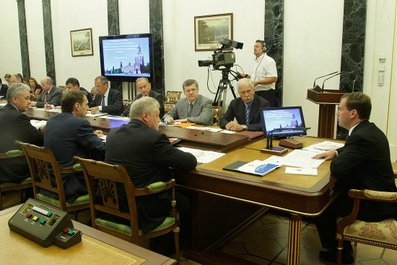
Medvedev at Security Council Meeting

Let’s look at President Dmitriy Medvedev’s criticism of the Navy and the Defense Ministry, his warnings and dismissals of some Navy officers.  It looks somewhat like a script torn from Vladimir Putin’s ‘tough guy’ handbook. 

Kommersant recounted the details of what sparked the President’s ire.  On 29 July, a fire burned the 2512th Central Aviation-Equipment Base of Naval Aviation and Air Defense near Kolomna, several dozen kilometers southeast of Moscow.  The Prosecutor’s Investigative Committee (SK) said the blaze destroyed the staff headquarters, finance unit, club, two bays of vehicle parking, 13 warehouses with various items of aviation equipment, and 17 open equipment storage stands with vehicles on them. 

Medvedev addressed yesterday’s Security Council meeting: 

“I instructed the Defense Ministry to take part in the firefighting effort and help to protect the civilian population, but sadly, in a number of cases, the ministry has proved unable to protect itself.  A fire took place in Moscow Oblast that has caused very serious damage.  The ministry has already carried out a preliminary internal investigation, and the investigation will continue of course.  The evidence so far indicates that this is quite simply a case of neglect of duty and criminal negligence, when personnel failed to bring under control a fire that was not spreading particularly fast, and no one even knew where the base’s commanders had gone.  I have therefore taken the following decision.”      

“Regarding the Navy’s senior command:  Navy CINC Admiral Vysotskiy has been warned about not fulfilling his duties; Chief of the Navy Main Staff and First Deputy CINC  Tatarinov has been warned about not fulfilling his duties; Deputy Chief of Navy Rear Services Sergeyev is dismissed; Chief of Naval Aviation Kuklev is dismissed; Deputy Chief of Naval Aviation Colonel Rasskazov is dismissed; Acting Deputy Chief of Naval Aviation Rear Services Monakov is dismissed; the chief of base 2512 is dismissed.”  

“I am also instructing the Defense Ministry to dismiss a number of other officers and personnel for disciplinary violations.  If anything similar happens in other places and other departments I will do exactly the same again, and without the slightest regret.” 

After discussing the fire situation with other ministers, Medvedev turned back to Defense Minister Serdyukov later in the meeting: 

“Now the Defense Ministry.  I already announced certain decisions.  The Minister needs to take everything under direct control.  Conduct a meeting today with the Ministry’s leadership and say that, if anything else like this burns, everyone will answer for it.” 

“Are there any concerns about the current situation?” 

Serdyukov responded saying plans have been made, operational groups established at all command levels.  Personnel and equipment have been put at the disposal of MChS and regional authorities.  And he noted that Deputy Defense Minister, General-Colonel Dmitriy Bulgakov is his point man for the fire emergency. 

Medvedev chided Serdyukov because the Vladimir Oblast governor had to go to the Defense Ministry for help instead of suitably empowered local commanders. 

Serdyukov said ‘corresponding’ orders have gone to all commanders and garrisons.  He continued with the Defense Ministry’s support of MChS — 11,000 servicemen, thousands of pieces of equipment, 33 kilometers of water pipelines laid in four rayons.  After Bulgakov’s visit to the Federal Nuclear Research Center in Sarov yesterday, another two battalions and special equipment were allocated to efforts there.  Serdyukov said another 28,000 troops can be brought into firefighting in the Central Federal District within 3-12 days. 

Serdyukov concluded: 

“We are taking all steps in full measure, we reinforced all facilities (there are 164 of them, but in immediate areas where there are fires there are 22) behind every responsible commander.  We are conducting all measures there:  increased volumes of water reserves for extinguishing fires, equipment has been brought in, extra personnel, everything literally transferred into a barracks condition, therefore all necessary steps for this, in fact, have been accomplished.  Therefore I submit that this sad incident that happened at base 2512 will not be repeated.” 

Kommersant helped out with a full run-down on the ranks and names of the lesser known Navy officers:  Rear-Admiral Sergey Sergeyev, General-Major Nikolay Kuklev, Colonel Sergey Rasskazov, Colonel Sergey Monakov, and Base Chief Colonel Viktor Biront. 

RIA Novosti covered Serdyukov’s firing of other officers at the base.  They included:  Deputy Base Chief Major R. Gidayatov; Deputy Chief Main Engineer Lieutenant Colonel V. Marchenko; Support and Security Company Commander Major A. Yermolov; Chief of the Material-Technical Support Department V. Karandak; and Chief of the 7th Storage Department V. Melsisidenkov. 

Today the SK said a criminal negligence case has been initiated.  Gazeta ru said, per usual Russian practice, top officials have blamed lower-ranking ones, in this case Navy officers, allowing the ‘untouchables’ to demonstrate their toughness and avoid responsibility.  Kommersant noted that the warnings for Vysotskiy and Tatarinov are just a step from dismissal.  But history shows other general and flag officers have gotten such warnings and still moved forward in their careers. 

Gzt.ru broached the subject of whether this could provide Medvedev an occasion to purge the Defense Ministry and fill it with his ‘own people.’ Konstantin Sivkov and Aleksandr Konovalov agree that he could use this opportunity.  But one has to ask, does this make sense in the scheme of tandem politics?  Medvedev has changed few in the cast inherited from Putin, and he’s very unlikely to start with a stolid Team Putin guy like Serdyukov.  Especially when he appears to be the first man to make some real headway in fixing the post-Soviet military.

TsOPI Critiques Serdyukov’s Reforms

In last week’s Nezavisimoye voyennoye obozreniye, IMEMO’s Vladimir Yevseyev presented the results of a recent round table on reform in the RF Armed Forces. The Center for Social-Political Initiatives (TsOPI or ЦОПИ), with support from Germany’s Rosa Luxemburg Foundation, sponsored the event.

Yevseyev described early reform as cutting personnel without changing the army’s structures during a time of political paralysis in the 1990s.  In the Putin era, he says there were still failures and the army’s equipment levels dropped, but the army began to believe it could still fight.

At this time, former Defense Minister Ivanov more than once declared the end of army reform, the troops started to get limited quantities of new weapons, and there was an unsuccessful attempt to move to professional enlisted force.  Yevseyev tries unconvincingly to point out successes in the Putin-Ivanov period.  His leading examples are especially dubious:

“— the elimination of cadre units and formations and forming of permanent readiness units numbering nearly 200 thousand servicemen on a contract basis.”

“— partial fulfillment of the federal targeted program of transition to manning with servicemen conducting military service on contract in a number of formations and military units in 2004-2007 that as a whole with a corresponding change in legislation in 2008 allowed a reduction in the conscripted service term to one year.”

The hollow unit problem wasn’t tackled until late in 2008, and Yevseyev has already labeled contract service a failure.  Moreover, the contract service program probably didn’t attract more than 80,000 soldiers.

And contract service didn’t have anything to do with one-year conscript service.  That change was made to try to encourage more young Russian men to serve rather than avoid serving.  Professional enlisted service, had it worked, would have allowed Moscow to continue drafting only 260,000 men per year for two years, rather than 540,000 per year to serve for a year as it is now.

But Yevseyev comes to the right conclusion:

“. . . radical change in the reform of the Armed Forces did not happen.  The main reason for this was that the Russian leadership could not take the fundamentally important decision on bringing the size of the Armed Forces into correspondence with the economic possibilities we have and with observable (future) external threats.”

Yevseyev writes that the most acute phase of military reform came with Defense Minister Serdyukov, and the war with Georgia, which revealed the army’s shortcomings.
 
But, says Yevseyev, Serdyukov’s initiatives like reducing officers and cutting warrants ran into difficulties.  Forty thousand officers placed outside the TO&E couldn’t be retired because they still lack permanent housing.  And many would-be officer graduates in 2009 and 2010 were forced into sergeant’s duties.

Yevseyev says Serdyukov’s reform is bringing an increased flow of negative consequences as shown in the results of TsOPI’s polling. It surveyed more than 2,500 people, including nearly 1,700 servicemen, in nine major cities.  According to 61 percent of respondents, reform has degraded the entire military command and control system.  Sixty-four percent said the army’s ‘new profile’ has seriously reduced their social status.  Thirty-two percent are not sure their housing, pension, and pay rights will be observed during Serdyukov’s reform.  Twenty-three percent are worried about their outplacement rights, and 8 percent about their medical benefits.

Yevseyev and his colleagues discussed three major problems for the Armed Forces:  rearmament, infrastructure, and manning.

They say 40 percent of Soviet arms and equipment were modern at the end of the 1980s, with the percentage declining to only 10-12 percent by 2005, and 5 percent at present.  They give a useful rundown of what’s been produced over recent years.

In 2004-2008:

  • 36 ‘Topol-M’ ICBMs;
  • 2 battalions of Iskander SSMs;
  • 2 battalions of S-400 SAMs;
  • 150 T-90 tanks;
  • 700 armored combat vehicles;
  • 20 self-propelled artillery systems;
  • 1 Tu-160 strategic bomber;
  • 3 Su-34 bombers;
  • 30 helicopters;
  • 1 diesel submarine;
  • 2 corvettes; and
  • 13 smaller ships and auxiliaries.

In 2009:

  • 49 new or modernized aircraft;
  • 31 helicopters;
  • 304 armored combat vehicles; and
  • 20 artillery systems.

Yevseyev and company conclude:

“It would seem that the situation with equipping the country’s Armed Forces is beginning to be corrected.  But in reality such rates of military equipment supply allow full rearmament across 30-50 years, which significantly exceeds the length of its service life.”

So this will make it difficult to increase the share of new weapons and equipment to 30 percent by 2015, even for permanent readiness units and formations.

They point next to the massive lingering Russian military structure.  Four years ago there were 26,000 military organizations of one type or another, and now only 6,000.  And that will be reduced to 2,500.  But they say, instead of consolidating and realizing cost savings, some of this process was fake, and some organizations were just named as subsidiaries [filialy] of larger ones.  As an example, they cite the shift from regiments to brigades and 1,000 reported TO&E changes, of which only 30 actually involved a physical unit relocation.

Finally, Yevseyev and the round table participants point to a potential unit leadership void when officers and professional enlisted are being cut (or not recruited) at the same time.  They say, given the training time they need, conscripts shouldn’t comprise more than 30 percent of a permanent readiness unit.

Yevseyev sums up:

“. . . the process of implementing military reform in the Russian Armed Forces now prompts the most serious misgivings.  In essence, the military personnel training system is being destroyed, the decline in the Armed Forces’ equipping continues, their system of manning and command and control is being broken.  All this leads to the weakening of the country’s defense capability and requires taking immediate measures to eliminate the negative consequences we are already experiencing.”

Bulgakov Adds More to His Portfolio?

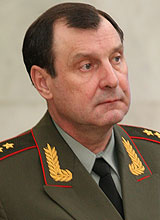
General-Colonel Bulgakov

In addition to his new title Deputy Defense Minister for Material-Technical Support and his responsibility for arms and equipment supplies, General-Colonel Dmitriy Bulgakov has apparently also picked up Grigoriy Naginskiy’s duties as Chief of Housing and Construction. 

Bulgakov accompanied Prime Minister Putin on a tour of military apartments under construction in Volgograd today.  The contractor told Putin the land was acquired three years ago, but delays in installing utilities held up construction until this year.  They also complicated the process and added 5,000 rubles to the per-square-meter cost of the apartments. 

Bulgakov was quoted saying the first batch of apartments in the new mikrorayon for servicemen (739 apartments) will be turned over in December.  He also said 1,978 servicemen need housing in the city.

Shamanov’s Press Conference

General-Lieutenant Shamanov

Ever-loquacious VDV Commander, General-Lieutenant Vladimir Shamanov held a wide-ranging press conference on Wednesday.  The Defense Ministry web site covered it hereITAR-TASS also published a number of short items on it. 

Shamanov detailed the work of five immediate deployment VDV battalions, lobbied again for a helicopter regiment, and discussed training issues and his procurement desires.  He joined the dogpile on top of the Russian OPK although he once seemed to defend it, and he credited Putin alone for the initiative to modernize the military’s arms and equipment.

He described his forces as combat ready, and manned and equipped at 100 percent.

Relative to combat readiness, Shamanov announced that the VDV has dedicated five battalions for immediate deployment which, if necessary, will be its first units sent into combat.  He said:

“By agreement with the General Staff, in the VDV we’ve dedicated five battalions for immediate deployment.  The uniqueness of service in these battalions is such that personnel from each of the battalions goes on leave for 45 days as a complete unit.  Therefore, at a minimum four battalions are always ready for combat deployment.  Today one of the sub-units of such a battalion from the 31st Airborne-Assault Brigade (Ulyanovsk) is fulfilling missions in Kyrgyzia [sic].”

Shamanov also gave voice to his desire, more modestly expressed than in April, for some aviation assets for VDV.  Speaking about the VDV’s future development, he said his troops must become airmobile.  To this end, he’s “given the Genshtab’s Main Operations Directorate [GOU] a request on the issue of forming a helicopter regiment in one of the three airborne-assault divisions [DShD or ДШД].”

Shamanov discussed VDV training at great length.  He started, of course, by speaking about jump training.  The parachute jump training plan was 70 percent fulfilled during the winter training period.  He blamed poor weather, saying troops often jumped in minus 30 degrees Celsius—the lowest acceptable temperature.  The plan for jumps from An-2 aircraft was fulfilled, but only 70 percent fulfilled from Il-76 aircraft.  He noted the VDV conducted its first-ever drop of a BMD-2 with its crew on-board, and said this hasn’t been done in 7 years, and then it was a BMD-1.  Use of the BMD-2 was significant, he said, because the BMD-2 represents 80 percent of VDV’s combat vehicle inventory.

Shamanov talked about large Spetsnaz assault group jump training in guided parachutes.  He said the use of guided parachutes allows reconnaissance troops to complete a horizontal flight of 20 kilometers, and:

“Our goal is to get so that such movements reach 40 kilometers, as they do in the Israeli Army.”

The VDV Commander noted that the multi-component Polet-K command and control system was tested for the first time in winter training.  He said: 

“It still isn’t the full suite envisioned in the future.  We are one-third through its introduction into the forces.  This process won’t happen in a year.”

Also for the first time, an artillery sub-unit of the 98th Airborne-Assault Division used Russian-made ‘Eleron’ UAVs for target designation on the Luga training grounds.  Shamanov said five ‘Eleron’ UAVs were employed in the training, and they conducted supplemental reconnaissance to a range of 10 kilometers in advance of fire missions.  This summer, 12 VDV crews will train on Israeli-made UAVs in Moscow Oblast.  Shamanov said:

“Unfortunately, our representatives did not go to Israel where they produce the ‘Hermes’ UAV which has been bought by Russia.”

Shamanov noted more attention to air defense training in the VDV this winter.  There were 40 firings of manportable ‘Strela-10’ and ‘Igla’ SAMs.

For the summer training period, Shamanov noted the VDV has 9,300 conscripts to get through three jumps in the course of 1.5 months.  The VDV will participate in ‘Vostok-2010’ and the CSTO’s ‘Cooperation-2010.’  There will be a VDV-level CSX (КШУ), as well as a CSX involving the 98th VDD (or ВДД).

Following the lessons of the Georgian war, the VDV is periodically training on the Navy’s large assault ships (BDK or БДК).  Shamanov says:

“In the winter training period we transported the 108th Regiment on large assault ships three times.  The exercises ended with a naval assault landing by a reinforced assault-landing battalion (ДШБ).

Last but not least, Shamanov commented on VDV procurement, and transport aircraft in particular:

“Work on the State Armaments Program for 2011-2020 is being completed.  According to our requests, in it there is the modernization of Il-76 aircraft, renewal of production and modernization of An-124 aircraft, the purchase of 30-40 An-70 aircraft.”

An-70

But the VDV Commander stressed these were his requests, and the final say isn’t his.  Utro.ru quoted him:

“In the development of the state [armaments] program, we gave our proposals, whether they’ll be realized in the confirmed version of the state program, I can’t say yet.”

Gzt.ru and Lenta.ru covered the An-70 and An-124 story in detail.

Shamanov said troop testing of the ‘Shakhin’ thermal sight for infantry weapons is complete.  He said:

“There has to be one approach for weapons—they have to be all-weather.  Not long ago the thermal sight ‘Shakhin’ went through troop testing.  After the testing we returned it to the designers for reworking.  We’ve given the task that our weapons work according to the aviation principle—turn your head and firing systems turn after it.”

He commented on air-dropping the BMD-4M, and added that, “The BMD-4M has every chance in the future, owing to its qualities, to be the forces’ main infantry combat vehicle.”

Although he seemed more like a supporter of Russian-made weapons six months ago, Shamanov now applauds Prime Minister Putin [not President Medvedev?] for searching for good weapons and equipment abroad.  Shamanov said the prospect of foreign competitors has forced “the domestic OPK to move,” as reported by Utro.ru.  He continued:

“Last year when industry was told that we’d look for alternatives abroad, they began to move.  In particular, the atmosphere around Mistral is creating a significant context for the domestic OPK.  When people declare that they’re ready to produce 21st century weapons but their equipment is from the 30s and 40s [of the 20th century], how can you talk about the 21st century?  Therefore, every official supports Vladimir Vladimirovich Putin’s initiative on the requirement to renew our armaments.  As long as this doesn’t happen, we’ll being shifting in place, and this won’t be just a lament of Yaroslav’s daughter [reference to the Prince Igor’s wife in the Lay of the Host of Igor after his defeat by the Turkic Polovtsy in 1185].”

At the same time, Shamanov concluded that GAZ and Izhevsk vehicles perform better for the VDV in the snow that equivalent Italian and Canadian ones.

Shamanov also said it’s essential to decide what to buy without any kind of lobbying, and for his part, he bases his decisions on saving soldiers’ lives and fulfilling missions.

Medvedev Can Wait for His BSF Basing Report

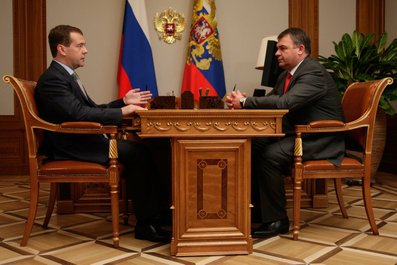
Medvedev and Serdyukov Meeting on 1 May

Whatever the complaints of some Ukrainians, the 21 April deal extending Russia’s basing privileges in Sevastopol is a good deal for Kyiv.  It’s now using the relatively meaningless Russian Black Sea Fleet (BSF) presence to secure a valuable 30 percent discount on Russian natural gas supplies.  

Moreover, in one suited for the ‘be careful what you wish for’ file, Moscow is also left holding the bag when it comes to the economy and infrastructure of Sevastopol, and much of Crimea as well, instead of Kyiv having to worry about assuming responsibility in a few short years. 

On 1 May, President Medvedev ordered Defense Minister Serdyukov to prepare a plan for developing the BSF’s naval base in Sevastopol, and to conclude an agreement with Ukraine on its social infrastructure.  According to Kremlin.ru, Medvedev said: 

“. . . today I want to touch on an issue with you which has taken on particular acuteness for our country in recent times.” 

“We need to think about the social arrangements for this base, that is very important to us, so that our sailors live in modern, full-fledged human conditions, have the chance for recreation and other opportunities a base is supposed to provide.” 

“So we’re agreed that our base will conclude a corresponding agreement with the Ukrainian side, with Sevastopol.  In accordance with this agreement, special support, social-economic support will be rendered to a series of Sevastopol city programs.” 

“This city is really not foreign to us and we need to think in what way to participate in these programs both along Defense Ministry lines and along the lines of other executive organs and business structures.  That’s the task.” 

Medvedev said Serdyukov should present his plan for approval in a month, and the latter responded that he would. 

Curiously, on 7 May, General Staff Chief Nikolay Makarov told RIA Novosti

“A working group’s been created which will evaluate the real condition of the basing point in Sevastopol and make its proposals.  I think this will take not less than two months.” 

“Practically nothing’s been invested there in recent years.” 

One wonders, would Makarov have unilaterally announced that Putin, when he was president, would have to wait an extra month or longer for the plan he ordered? 

Makarov said the Genshtab has no plans to freeze development of other basing points:   

“The fleet has to be.  The more basing points, the better.  And Novorossiysk is one of the key basing points.  And we intend to develop it.” 

Without elaboration, he said the Defense Ministry has modernization plans for the fleet’s ships, submarines, and aircraft to 2020.  Makarov was with Prime Minister Putin visiting the construction work at Novorossiysk.  

Putin Briefed on Novorossiysk

On 24 April, Anatoliy Tsyganok told RIA Novosti conditions at Novorossiysk are not particularly well suited for major base.  He noted it’s only 25 percent complete, and its price tag is continuously rising. 

Nevertheless, Putin reaffirmed Moscow’s commitment to Novorossiysk.  He acknowledged only 13 billions rubles have been spent, and he’s looking at an ultimate cost of 92 billion.  The base is slated for completion by 2020. 

But Moscow, Medvedev, and Putin may need to worry more about new ships and submarines than about infrastructure when it comes to the BSF. 

On 2 May, Anatoliy Baranov in Forum.msk pointed out that there’s practically no fleet there; a minimum of 2 more first rank ships and a submarine are needed for an adequate order-of-battle.  He says the social infrastructure’s not so bad, but 40- and 50-year-old civilian engineers and technicians have to go out with fleet units to conduct training.  What will the Navy do when they retire?  

Rosbalt.ru described a wave of new officer and civilian dismissals in the BSF, which occurred simultaneously with the new agreement with Kyiv.  The fleet, it says, is nothing more than a mixed force division’s worth of units and personnel.   Viktor Yadukha concludes: 

“NATO’s gracious reaction to the BSF lease extension didn’t surprise politicians more.  But if Western special services knew about real plans for its reinforcement, the reaction would have been very severe.” 

Lastly, in today’s Nezavisimaya gazeta, Aleksandr Khramchikhin says: 

“. . . renting empty piers for a great amount of money is not a mistake, but thoughtless, considering how many ships and how well-outfitted a base in Novorossiysk this money could build.” 

He calls today’s BSF a unique collection of floating antiques.  Even if the oldest units were dropped, most BSF ships would still be 20- to 25-years-old.  It will be impossible to avoid sending ships from the 1960s and 1970s off for scrap soon, as has been officially acknowledged.  Khramchikhin recommends placing what’s left at Novorossiysk as a ‘water area security’ (OVR or ОВР) brigade.

Of Foreign Arms and Furniture

Defense Minister Serdyukov

Defense Minister Serdyukov is looking at a mini-scandal over a tender for new office furniture for the military’s headquarters.  The 14 April tender called for 125 pieces of furniture worth 18.3 million rubles to be delivered in 15 days, but also included agonizingly detailed specifications for each item, leading Russian furniture industry representatives to conclude a specific supplier has been picked in advance.  Moreover, the list of acceptable models, fabrics, and materials makes them assume the furniture will be Italian-made.

Of course, Defense Minister Serdyukov knows the furniture business.  He started in it in 1985, working his way from a department manager of a Lenmebeltorg store to general director of the St. Petersburg ‘Furniture Market’ company, before entering the federal tax service in 2000.  And for his past employment, he’s still derided as mebelshchik—‘furniture man.’

For now the mini-scandal is confined to more liberal papers and websites, and hasn’t resonated in other media.  It is a handy opportunity to take a shot at Serdyukov, but, ironically, it results from the Defense Ministry’s effort to be more transparent about defense procurement by publishing tenders. 

Still, none of this makes the story is insignificant.  It’s emblematic and may foreshadow more serious criticism to come in the burgeoning area of arms imports.  If this is how the management operates when the issue is minor, not affecting anything the least important or serious, how will it operate when turning abroad to buy Mistral, UAVs, armored vehicles, submarines, sniper rifles, or soldier systems?  A little malfeasance, or even just the appearance of something wrong, can spoil even the most sensible policy.

At any rate, more to the story itself . . .  Svpressa.ru says Russia’s furniture manufacturers are offended that the Defense Ministry leadership decided to furnish its offices with Italian cabinets and tables.  

Aleksandr Gordeyev, director of the ‘TNP Furniture World’ factory group, says:

“We regard the striving of such a large and influential state structure to buy furniture abroad as a sign of disrespect toward Russian furniture makers.  Why then all these declarations and announcements of the authorities about the need to support the domestic manufacturer, that is the most real sector, the real taxpayer, particularly in the crisis period?”

Rbcdaily.ru says domestic furniture makers are launching their own organization—the “All-Russian Furniture Union”—to represent 200 manufacturers in 40 regions.  Its first step will be an appeal to Prime Minister Putin on the unacceptability of placing state orders with foreign producers.

According to Novyye izvestiya, the appeal says:

“At this moment, when Russian furniture manufacturers are struggling with the consequences of the difficult economic crisis, the decision of the state’s representatives to make a unilateral financial gesture to foreign competitors looks, at the very least, illogical.”

Gordeyev continues:

“We aren’t insisting on having some kind of preference over foreign competitors, but rights and chances need to be equal for all.  But in effect, in essence, they aren’t even allowing Russian producers access to the competition.”

He tells Rbcdaily.ru, “In Russia, there is a big real sector ready to fulfill similar orders, however, all the big orders from state structures go past us.”  The Defense Ministry’s order is a month’s production for a medium sized furniture factory.

Novyye izvestiya points out that Russian furniture is the equal of Italian models and the Russian furniture market was bigger than Italy’s, at least before the economic downturn.

It also points out, in fairness, that it inspected the tender at http://www.zakupki.gov.ru/ and saw nothing specifically about Italian manufacture, but concluded that, since many of the specs insisted on certain models and fabrics, what domestic furniture makers are saying is not exactly far from the truth.

Andrey Radukhin, General Director of the RF Association of Furniture and Woodworking Industry, said:

“A serious specified supplier made these specifications and, most likely, the furniture is already in Moscow.  It’s a shame such an order passes over our office furniture producers.  Their labor utilization is a minimum of 30 percent, to at most 50.”

Another industry figure told Novyye izvestiya, it would take a Russian firm 3 months rather than 15 days, as specified in the tender, to make the furniture order to specification.

Then he added:

“No one in Italy could take such an order for half a month.  This was all arranged for a specific supplier, most likely, Italian.”

Gordeyev and another industry source were quoted in Newsru.com to the effect that the Defense Ministry’s order must be for the delivery of furniture already made and in-stock.  Russian producers could not meet such a specific order on short notice, so this effectively froze them out of the competition.

Viktor Ilyukhin, head of the KPRF faction in the Duma, told Svpressa.ru:

“Furniture-mania turns out to be characteristic of many ministries, not just the Defense Ministry.  So acts the Internal Affairs Ministry as well as the Finance Ministry:  expensive cars, offices, furniture, hotels, service staff.”

“I’m not surprised at the situation around the military department.  Our Defense Minister Serdyukov has the mentality of a businessman, a big bureaucrat, who is accustomed to good service, luxury, expensive furniture.  He brought this style to the armed forces.  In fact, the armed forces have become a platform for big business.”

“Today practically all military unit and sub-unit commanders are occupied with business.  This gets done proceeding from the Defense Minister’s guidelines:  sell everything you don’t need.  It’s a misfortune for Russia that such a Minister heads the Defense Ministry.”

“Among the military there is great dissatisfaction with Serdyukov’s policy.  Only because of this one thing, the country’s political leadership should think carefully where Serdyukov should be.  Whatever brilliant ideas he’s put forward, his proposals won’t be accepted because of his insignificance and lack of authority in the military.”

“Today the army needs a sufficient quantity of modern military equipment and arms, in management, [it needs] discipline and organization.  Finally, as never it needs to resolve issues of social protection of servicemen.  Today military men are socially protected less than civilians and government officials.  Minister Serdyukov needs to concentrate here on these areas.  And not on buying Italian tables and chairs.”

Gennadiy Gudkov, deputy chairman of the Just Russia faction in the Duma, commented:

“The Defense Ministry tender, in my view is a direct violation of the law on state procurement. I recall the law prohibits excessive detail in the order which narrows the boundaries of the tender.  Only general requirements should appear in the technical specifications.”

“I have seen similar tenders for the purchase of luxury cars that were tailored specifically for one model of Mercedes. All this says that no tender is really being conducted, that there, possibly, we may have a serious corruption incident in the form of a large kickback.  If I were the Prosecutor General and the SKP [Prosecutor’s Investigative Committee], I would conduct an anticorruption analysis of this tender.

“If I were Serdyukov, I would launch a serious investigation, because this tender, by the highest standard, casts a shadow personally on the Defense Minister.”

The editor-in-chief of Kompaniya writes:

“A greedy man with poor taste would not spend 18.3 million budget rubles for 125 pieces of furniture for the offices of the Motherland’s defenders (approximately 146,000 rubles each).  Behind a solid-beech table with natural olive-wood veneer with a top upholstered with natural dark-green buffalo leather sits an intelligent and refined man.  Such a man, for example, as Defense Minister Anatoliy Serdyukov, who’s proposed a new variant of army reform.  The Minister plans to optimize the military’s service time, liberating them from noncore housekeeping functions.  Soldiers will receive weekends off, and contractees—officer’s pay.  Anatoliy Serdyukov’s words are like ‘drinking honey’ in a kitchen ‘of solid maple and cherry veneer with an individually soldered stained-glass ‘Beatrice’ by Arte del Vetro (Italy).’  But it won’t happen.  Generals and bureaucrats still don’t share such things as ‘the beautiful life’ and it doesn’t due to hope for more than ‘serving.’”

Plug Pulled on Contract Service

On Friday, Interfaks said a source in the Federation Council’s Defense and Security Committee indicated the latest contract service program (the Federal Targeted Program (FTsP) for Manning Sergeant (Petty Officer) and Soldier (Sailor) Ranks with Contract Servicemen) has been scrapped.  The program was supposed to produce 64,000 contract NCOs by 2015. 

The financial resources for this 2009-2015 program have been slashed by 86 percent according to an Audit Chamber report given to the upper house of the Russian legislature.  A Defense and Security Committee representative says 22.4 billion rubles of the 26.6 billion ruble program were slashed.

This certainly sounds like losses have been cut to what’s already been spent on selecting and beginning to train a little more than 200 future sergeants at Ryazan.  The program was slow in starting, and of 2,700 candidates who came to Ryazan, only 239 were ultimately accepted.

General Staff Chief Makarov and Ground Troops CINC Postnikov recently admitted contract service had failed, but said the contract sergeant program would continue.  They didn’t say it would basically be limited to its current very small scale.

Infox.ru on Friday quoted Prime Minister Putin who, in 2008, called the contract sergeant program “the logical development of plans for the organizational development of a modern and highly professional Russian Army.”

On cutting conscription to 12 months, Putin said, “For this decision we went logically over the course of the last six years, developing a system to attract citizens to military service in a voluntary manner, on contract.”

He continued, “. . . the main load of servicing new weapons systems will be on contract-sergeants in coming years” and “forming the professional sergeant corps is an important step toward a more modern organization of combat training.”

Apparently, none of this will happen now, and the army will rely more on its conscripts and traditional conscript-sergeants with six, or more likely three, months of training.

Putin’s Voronezh Trip and Military C3

It takes a while to digest the press devoted to Prime Minister Vladimir Putin’s 18 January trip to Voronezh and Sozvezdiye, or the state-owned communications conglomerate based on the Voronezh Scientific-Research Institute of Military Communications.  Sozvezdiye is the holding which encompasses 16 other enterprises involved in C3, radio, and electronics.

Watch this NTV coverage of Putin at Sozvezdiye.

Sozvezdiye had a big demo set up outside for Putin.  But as the video shows, Putin was wearing his supremely bored look.  Moskovskiy komsomolets picked up on this, noting that Putin gave a cursory look at everything, and inside the display tent, he apparently picked up the mic on a video link system and tried to use it, but the soldier on the other end couldn’t hear the Prime Minister.

The Voronezh trip was the latest in a series of meetings on the state of the OPK.  Putin started by stating the obvious, noting that C3I is a decisive factor in the combat capability of a modern army, and a precondition for the use of highly accurate weapons.  He said it’s difficult to imagine an effective transition to a modern organizational structure without the right C3.  He called C3 a key priority for defense and noted that significant budget money will be spent on them.

Putin proceeded to chide his C3 producer audience, saying that Russia can’t modernize what it’s got; it needs an entirely new generation of systems.  He said C3 producers suffered from poor leadership, organization, and coordination of efforts.  Finally, he had to admit that they basically ignored his 2000 presidential decree on development of a new C3 system.

Specifically, Putin said:

“…we need not only to conduct a fundamental modernization of existing complexes and systems.  We have to say plainly that they unfortunately have already aged greatly.  And become obsolete, and even their technical condition often leaves much to be desired.  Therefore our focus for the coming years is to give the troops new generation equipment, to take a qualitative step forward.  It is precisely on this that I ask you to focus.”

“Our enterprises have a good scientific-technical pool for resolving this task, we need to use it wisely.”

Noting that dozens of OPK organizations work on C3I, he said:

“I ask that you turn attention to precise coordination of their activity, and also concentrate on working out agreed approaches and requirements for product development.”

“Besides this, I would like to turn attention to this, to this time a number of decisions adopted earlier have not been carried out.  So, to the present day, a general designer for development of an automated C2 system for the armed forces has not been appointed.  An integrated structure which would develop and implement a unified scientific-technical policy in this sphere has not been formed.  A special comprehensive program which would allow us to concentrate resources, to reduce and to optimize, to increase the effectiveness of budget expenditures has not been developed.”

Find the text of Putin’s address here.

Different media outlets reached the same conclusion about Putin’s Sozvezdiye visit and whether his words can fix the OPK’s problems and increase the sluggish pace of military modernization.  Segodnya.ru concluded:

“…the fact that Vladimir Putin directly participates in the problem of modernizing the technical outfitting of the army and promises to give the troops new generation equipment in coming years, inspires some optimisim.  Although the sensation remains that loud pronouncements about modernization traditionally hang in the air.”

Writing in Nezavisimaya gazeta, Viktor Myasnikov called it Putin’s “latest attempt to mobilize the military-industrial complex to equip the armed forces with quality modern products.”  Making note of Putin’s exhortations to the C3 producers, Tribuna said, “We’d like to believe they heard him.”  Newsru.com summed it up simply, Putin demanded that they modernize C3, but how to do it is not clear to anyone.

What exactly did Putin order in 2000?  According to Denis Telmanov writing for Gzt.ru before the Voronezh visit, Putin ordered the development of the Unified Tactical Level Command and Control System [ЕСУ ТЗ or YeSU TZ]. 

What’s it supposed to do?  It is supposed to be a large part of a system tying the armed forces together in one modern C2 network, and enabling them operate in a netcentric fashion.  Several media items reported that the Defense Ministry believes YeSU TZ will provide 2 or 3 times the capability of its predecessor. 

Tribuna noted that the Russians have the individual pieces of equipment, bought with a considerable allocation of money, but they haven’t managed to pull them together into one, integrated and modern C2 system.  According to Segodnya.ru, experts believe only Russia’s strategic forces possess a functioning, albeit increasingly obsolete, C2 system.  The armed services and branches, MDs, fleets, and armies have local automated C2 that isn’t necessarily integrated or compatible with other commands.

At the operational-tactical (battalion-brigade) level, Russia has reportedly fallen 20 years behind Western armies in C2.

Testing of YeSU TZ began in 2006 and continues.  In December, troops at Alabino used the equipment in a battalion tactical exercise.  But Telmanov concludes the military is in no hurry to adopt the system because it’s problem plagued and has obsolete elements.  It’s also hard to integrate with the army’s old comms gear. 

Izvestiya on 20 January reported that the system may be too complex for soldiers and sergeants, but even for some officers.  Myasnikov noted that the equipment suffered a lot of breakdowns at Alabino. 

But Sozvezdiye denies the criticism, saying YeSU TZ is reliable and no more difficult to use than a mobile phone.

Nikolay Khorunzhiy writing in Vremya novostey had said back in November that the Akatsiya system was tested during Kavkaz-2009 but could not be fully employed because operator training was deficient.  Combat situation data had to be input by hand and orders sent out by voice radio, defeating the purpose of automation.  Myasnikov also wrote that Akatsiya isn’t working out.

A little nomenclature is in order here.  It’s difficult to square all the press, but it seems Akatsiya is a name for YeSU TZ, but it’s also known by the name Sozvezdiye, a little confusing since this is the C3 production conglomerate’s name as well.  Apparently, Akatsiya is either based on or relies on the Akveduk satellite radio [?] system as one of its component parts.  These in turn evolved out of Polet-K and Manevr before them.  A couple press pieces said one problem with the system is what was basically a radio comms enterprise was put in charge of the broader C2 system effort which required other expertise as well.

A few other issues from the Voronezh visit bear mentioning…

Many press items cited the 2008 five-day war with Georgia as putting attention on C3 weaknesses.  Vremya novostey recalled the image of a wounded 58th Army commander, the recently dismissed, Khrulev borrowing a satellite phone from a journalist to communicate with Moscow.  Several papers cited a Sozvezdiye deputy director saying the holding ‘got raked over the coals’ for South Ossetia and Abkhazia.  He noted that Georgian forces used Harris equipment from the U.S. and it was better than Russian analogues in a number of ways.

Regarding this technological lag, there’s some dispute.  Moskovskiy komsomolets indicated Putin was told “we’ve approached NATO standards” in computerized C2.  Izvestiya, however, cited an industry source saying that there’s no appreciable lag between Russian and U.S. and Israeli systems.

Nezavisimaya gazeta and Izvestiya tackled the cost issue.  First Deputy Sozvezdiye Director Vasiliy Borisov was widely quoted to the effect that equipping one brigade with the new C2 system will cost 8 billion rubles.  Nezavisimaya multiplied this by 85 ‘new profile’ brigades for a price of 680 billion rubles, or when higher echelons have to outfitted as well, the total cost is probably more like 1 trillion rubles, or the price of one complete year of the State Defense Order (GOZ).  Izvestiya quoted Borisov saying the price to outfit a company commander would be 150,000 rubles, and 50,000 for individual soldiers.  The paper concluded that the new equipment won’t be replacing mobile phones any time soon at these prices.

Nezavisimaya also noted that one can’t do C2 properly without the right navigation system, and GLONASS is not up to the job.  It cited 17 operational GLONASS satellites, but press services today noted that 18 are now functioning.  Still, not enough.  Nezavisimaya compares work on C2 to Bulava and GLONASS–other military programs that defense industry is having a hard time bringing to fruition.  Tribuna makes the same point that a fully functioning and reliable GLONASS system is a ‘sine qua non’ for effective C2.