Monthly Archives: February 2010

Navy Main Staff Move to Piter Back On

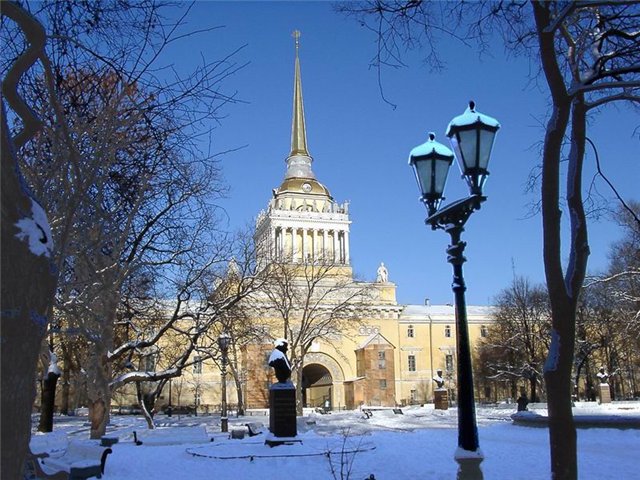
Admiralty

Unnamed Navy sources told the media this week that the Navy Main Staff’s postponed transfer to Admiralty in St. Petersburg is back on, and will begin in July.  But the Navy has not commented officially.  

The Leningrad Naval Base left Admiralty for Kronshtadt, leaving space for the Navy Main Staff in the former.  The Naval Engineering Institute may or may not have left Admiralty for Pushkin. 

The first elements to move could be administrative elements not bearing on the fleet’s combat readiness, while the Navy’s ‘operational services’ remain on Bolshoy Kozlovskiy Lane providing uninterrupted command and control of the fleet, and naval strategic forces in particular.  Some press pieces have said the transfer process could stretch out into 2012. 

A radical ‘optimization’ [i.e. personnel cut] in the Navy’s command and control structures, beginning 1 March, will reportedly precede the move to Admiralty.  Some press sources say the cut will focus on the Navy’s Central Command Post (ЦКП).   

Cutting Navy headquarters personnel may not be all that hard.  Izvestiya notes that, according to some sources, 300 Navy staff officers came out against the transfer to Petersburg when the story first broke in 2007.  Nezavisimaya gazeta has repeated the rumor that  only 10-15 percent of current staff officers will move to Piter and Grani.ru claims most are already looking for other work in Moscow. 

Recall that Duma Speaker Boris Gryzlov first ‘suggested’ the move to Defense Minister Serdyukov in fall 2007, saying that the Navy should return to Russia’s ‘naval capital’ already replete with naval educational institutions and shipbuilding enterprises, and lighten Moscow’s heavy load of governmental organs.  

The plan called forth the late 2007 protest letter signed by many retired admirals, asserting that moving the Navy Main Staff  would “not only lack common sense, but actually undermine the country’s defense capability.”  

Former General Staff Chief Yuriy Baluyevskiy was publicly ambivalent about the wisdom of the transfer.  In early 2009, Navy CINC Vysotskiy told the press he had no orders on the move.  However, new General Staff Chief Nikolay Makarov was quick to remind Vysotskiy: 

“Now command and control organs of the armed forces can be located anywhere.  The main thing is a reliable command and control system should be created which allows for carrying out missions in peace and wartime.” 

But can it really be located anywhere?  

Retired General-Major Vladimir Belous of IMEMO’s International Security Center has been quoted everywhere saying that, in St. Petersburg, the Navy headquarters could come under a devastating enemy air attack in as little as 15-20 minutes. 

Some have guessed the price tag for relocating to Piter at between 26 and 50 billion rubles, Grani.ru guesses 80 billion, and still others say completely rebuilding the Navy’s Moscow infrastructure in the country’s second capital would cost up to 1 trillion rubles.  In any event, a gigantic sum forcing the Defense Ministry to forego lots of other good uses for its money.   

Many experts believe the Navy’s command posts, comms, and underground bunkers will remain in Moscow and Moscow suburbs, since relocating them to Piter will be physically or financially impossible.  Former First Deputy Navy CINC Igor Kasatonov has been widely quoted saying that Piter will be no more than an alternate headquarters for the Navy CINC, from which it will be possible only to exert tactical control over the fleet. 

IA Regnum concludes that, although military experts unanimously believe a Moscow-to-Petersburg move will undermine the Navy’s combat readiness, it’s not clear it matters given the other things [i.e. political considerations, business interests] that are in play. 

Vladimir Temnyy writing for Grani.ru makes the point that old admirals’ alarmist rumblings about disrupting the Navy’s command and control are unimportant to those who want to build a business center and expensive apartments in place of the Navy Main Staff building near the Krasnyye Vorota metro station. 

In Stoletie.ru, Sergey Ptichkin calls the possible move ‘administrative caprice,’ adding that there’s profit motive in this caprice since the Navy headquarter’s building is valuable central Moscow property.  He says not a single expert or Navy leader can justify the move, and brands Gryzlov’s talk of returning the Navy to Russia’s ‘naval capital’ the height of naivete.  He makes the point that the Navy was only in Piter because Piter was the capital of the Russian Empire.  Otherwise, the Navy’s headquarters should be with the rest of the nation’s leadership.  Ptichkin concludes the modern Russian Navy can only be commanded from Moscow’s infrastructure and to replicate it in Piter is, if not impossible, then insanely expensive, especially at a time when there are questions about what kind of Navy will remains to be commanded.

An editorial in Friday’s Nezavisimoye voyennoye obozreniye concluded that the “ambitions of the powers-that-be trump common sense” and “the fact that arguments ‘against’ are clearly superior doesn’t bother them.”

Trouble Building Submarines at Sevmash

Northern Machinebuilding Enterprise (Sevmash)

Here is 9 February RIA Novosti verbatim:

“Sevmash” Will Not Meet Schedules for Nuclear Submarine Construction Due to Insufficient Personnel

SEVERODVINSK, 9 Feb – RIA Novosti.  The “Sevmash” enterprise in Severodvinsk, Arkhangelsk Oblast will fall behind schedule in constructing nuclear submarines, it was announced to RIA Novosti on Tuesday in the enterprise’s press service.

Information about the lag in the schedule was heard in the session of the interdepartmental coordinating council which took place under the leadership of RF Government Military-Industrial Commission member Vladimir Pospelov and Deputy Navy Commander-in-Chief for Armaments Nikolay Borisov.

Members of the coordinating council discussed the state of affairs in producing nuclear submarines at “Sevmash” – “Yuriy Dolgorukiy,” “Aleksandr Nevskiy,” “Vladimir Monomakh” (project 955 “Borey”), and also “Severodvinsk” and “Kazan.”

“Today, as noted in the session, there is some lag from the construction schedule acknowledged by Sevmash and its partner-enterprises,” stated the press service’s announcement.

Factory General Director Nikolay Kalistratov explained the delay was caused by a lack of qualified personnel.

“It’s essential to apply maximum effort to realize the outlined plans and complete orders on time.  In the near future, we have to attract an additional 500 qualified production workers in the specialties pipefitter, machinist-fitter, ship finisher.  It should also be noted that over two years we’ve increased the number of basic production workers by 2,000 people, but this force is still insufficient,” said the director of the enterprise’s press service.

The directors of TsKB MT [Central Design Bureau of Naval Technology] “Rubin,” SPMBM [St. Petersburg Naval Machinebuilding Bureau] “Malakhit,” “Rosatom” state corporation, RF Ministry of Industry and Trade and other departments also attended the session.

Now at the “Sevmash” factory in various degrees of completion are three strategic nuclear submarines of project 955 “Borey” – “Yuriy Dolgorukiy,” “Aleksandr Nevskiy” and “Vladimir Monomakh.”  Work on construction of the fourth strategic nuclear submarine of this project, with the provisional name “Saint Nikolay” began in December 2009.  In all by 2015 it is planned to build eight nuclear submarines of this class.

This statement seems to imply there’s no problem with money, but, at a certain point, more workers equal money because higher wages should attract them, the northern climate notwithstanding.  So to some degree, this is a Sevmash call for more resources to do the work already on its order books.  Although these Sevmash officials said work’s begun on the fourth 955, RIA Novosti from 8 February made it clear there’s no firm idea of when its keel-laying ceremony would occur.  And Navy CINC Vysotskiy said the problem was “technological,” not related to the fate of the Bulava SLBM or to funding.  So maybe he meant a labor shortage, but, as noted, a lack of labor  is an inability or unwillingness to pay what it costs to do the work.

Yuriy Dolgorukiy SSBN has more sea trials before handover to the Navy. Sevmash says Aleksandr Nevskiy will be launched in 2010 (it was laid down in early 2004).  Vladimir Monomakh is about two years behind it.  The big question for these boats is when and if they’ll have a missile.  Late last year, a number of Russian media outlets claimed SSBN production was frozen due to Bulava’s problems.  But Sevmash’s call for more workers doesn’t track with that.  In October, the Russian government also announced Sevmash would receive 4 billion rubles to add to its working capital for modernization, along with a 6 billion ruble credit from VEB.

When Will the Air Forces Get More S-400s?

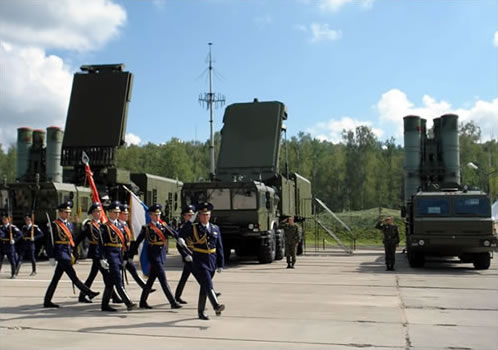
First S-400 Battalion on Duty in 2007 (photo: Leonid Yakutin)

On 9 February, RIA Novosti quoted Air Forces CINC Aleksandr Zelin:

“All that has been planned and must be supplied in the coming years, has been agreed with Almaz-Antey, will be fulfilled on time.  The S-400 antiaircraft missile system is fully entering the Air Forces’ weapons inventory.  The shift in the schedule for its supply has some organizational but mainly a technical character.”

Reminding the press that he’s member of the Almaz-Antey board of directors, Zelin said, “At the last session, we talked over all issues connected with planned supplies of the S-400 to the Air Forces.”

It sounds like Zelin is admitting the S-400 has been delayed, and the reasons are technical in nature.  Maybe there’s been some problem in the S-400’s operations or capabilities. 

So where does the S-400 stand?  Two battalions were fielded at Elektrostal near Moscow in 2007 and 2008, and Air Forces spokesmen have said repeatedly that 5 additional battalions will be delivered this year. The State Armaments Program, 2007-2015, called for 18 battalions by 2015.  But, as Mikhail Rastopshin has said, 18 battalions don’t cover Russia’s main administrative and industrial centers or support its strategic nuclear forces. 

In the midst of his late November criticism of Russian defense industry’s inability to provide the VVS with the UAVs it needs, Zelin also said Russian needs a second factory to produce the S-400 Triumf and other future air defense systems.  According to him, Almaz-Antey cannot fully satisfy the country’s demand for S-400 systems.  Not sounding too sure, he added that, “In 2010, we need to receive another five battalions, but everything depends on the industry and financing.”

Commenting on the S-400 tests at Ashuluk, Zelin said he was satisfied with the results, but the tactical-technical characteristics in the system are “still less than we wanted.”  He may be referring to lingering, well-known problems with the S-400’s long-range missiles.

VVS CINC General-Colonel Aleksandr Zelin

Zelin went on to criticize the pace of development of the next generation S-500:

“Development of this system doesn’t satisfy me.  We would like for the existing potential in the Almaz-Antey concern to be doubled or even tripled.”

He said he planned to raise the S-500 development issue at the December board meeting.

More recently, on 28 January, Rosoboroneksport General Director Isaykin indicated that, although he has foreign orders for the S-400, Russia’s requirements would be met first.

On 17 September, Almaz General Director Ashurbeyli told ITAR-TASS that the S-500 would need 4-5 years to complete.  On possible S-400 export orders, he said he could only say two countries had signed large agreements for more than 10 battalions, but contracts remained to be finalized.  But Zelin made another statement this day that the system would go first to Russia’s armed forces.

So to recap.  The S-400 supply schedule has shifted for technical reasons.  The VVS hasn’t gotten a battalion since 2008.  Zelin admits he’s not fully happy with the S-400’s capabilities.  He says everything depends on the manufacturer, with whom he’s unhappy.  Meanwhile, foreign customers are already lined up for the S-400 that Russia can’t get and Almaz-Antey is marching off on the new S-500.

Industry More Important Than Army

Konstantin Makiyenko (photo: Dmitriy Lebedev/Kommersant)

Commenting in today’s Vedomosti, Konstantin Makiyenko of Moscow’s Center for the Analysis of Strategies and Technologies (ЦАСТ), also a member of the Duma Defense Committee’s Scientific-Expert Council, addresses the recent tendency of Russian military leaders, especially Air Forces and Navy, to criticize and even reject the OPK’s homegrown products.

He notes VVS CINC Zelin’s publicly expressed dissatisfaction with the pace of work on the S-500, and the Navy’s ‘slap in the face’ to Russian shipbuilding over consideration of the Mistral and German conventional subs.  He claims the oboronki themselves sensed Defense Minister Serdyukov’s bias against them and rushed to confess their problems.

And Makiyenko concludes the criticism is well-founded, as many OPK enterprises and companies are in pitiful shape, and the management of a number them leaves a lot to be desired.  However, he asserts, the OPK’s post-Soviet decline is not as great as that of the armed forces.  And restoring Russia’s ‘normal’ military potential is a higher priority task than preserving or adding to the OPK’s scientific-industrial potential.

Makiyenko believes Russia’s place as the number 2 or 3 arms exporter in the world indicates the OPK’s real potential.  Even more so since the economic conditions in which the OPK operates are worse than those of its competitors.  So, for all its problems, the OPK is still number 2 or 3 in the world, according to Makiyenko, while the army, nuclear weapons aside, is capable only of defeating the lilliputian armies of the former Soviet republics.

Makiyenko believes the degradation of the Soviet Armed Forces was occurring as early as the 1970s, while the Soviet OPK was reaching the peak of its capabilities at the end of the Soviet epoch.  It had practically overcome any lag with the U.S. and was building competitive products.  So, Makiyenko concludes, the OPK, rather than the Soviet Army, was the advanced guard in the last stage of the Cold War.  And Russia’s arms market successes would have been impossible without the Soviet OPK legacy.

Makiyenko suggests that the OPK should have priority over the army because, not only can it play a role in national development, but, with some effort, it can be restored in 5-10 years, while if it is [completely?] lost, it could take one or two generations to rebuild.  And even if Serdyukov builds the best army in the world, it won’t be able to provide for the country’s security without the basis of national defense–Russian industry.

So, without orders from its own army, without financing for basic research or RDT&E for the last 15 years, the OPK isn’t always able to meet demands for low priced, high technology goods on tight schedules to help Serdyukov rearm the armed forces quickly and effectively.  But this is no reason to call oboronki thieves and junk dealers.  Makiyenko calls for a long-term perspective and systematic evaluation of the situation instead of nearsightedness.

This is all well and good.  Makiyenko’s a smart guy and makes valid points, and he’s done an admirable job of defending the OPK.  But let’s remember that he tends to shill for arms sales.  Russian weapons sold abroad have had more than their share of problems in recent years.  And the Soviet technology in them grows older and older.  Also, there appears to be no cogent program for fixing the OPK anywhere in sight.  Nor is there even any clear analysis of how buying arms abroad will affect the OPK.

Realities of Military Housing

Too much doctrine makes Jack a dull (ok, duller) boy.

Writing in Moskovskiy komsomolets, Olga Bozhyeva again puts reality and faces on Russia’s military housing problems.

Colonel Valeriy Ananyev (photo: Gennadiy Cherkasov)

Bozhyeva contrasts the announcement of a major aerial portion of the upcoming 9 May Victory Parade, featuring Long-Range Aviation among other Air Forces aircraft, with the living conditions of LRA officers:

“Homeless [apartmentless, if you will] bums from dormitories declared unfit 9 years ago will demonstrate the power of our strategic aviation on this holiday.”

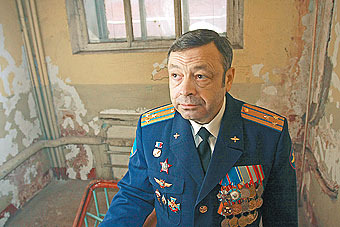
Thirty-nine families of command personnel from LRA live in 14 communal apartments in the building on 41 Myasnitskaya Street.  Thirty-two of the officers are Honored Pilots or Navigators of the RF.  Their apartment block was built in 1891.

Colonel Ananyev says they’ve talked about relocating these officers since 2002, so they didn’t do any capital repairs.  An inspection showed that living in the building was dangerous.  Bozhyeva thinks maybe Defense Ministry officials thought this was ok since LRA officers are accustomed to danger.

Ananyev himself wears three military orders–the Red Star for Afghanistan, For Military Services for Chechnya, and For Honor for planning and participating in the LRA part of the 2008 parade over Red Square.

So, Bozhyeva asks, why didn’t Ananyev and his LRA neighbors in this dangerous building get some of the 45,000 military apartments reportedly acquired last year?  Because 44 apartments in Kozhukhovo intended for them are caught up in an investment contract dispute.

The State Property Committee (Goskomimushchestvo) was originally involved in preparing the paperwork so an investor could build an office building on the site of the ruined dormitory and the new Kozhukhovo apartments could be occupied by the LRA men.  However, Defense Minister Serdyukov squeezed Goskomimushchestvo out of the Defense Ministry’s property business in 2008 and the whole deal had to restart.  But it was forgotten until May 2009 when the Defense Ministry and the investor each blamed the other for not fulfilling the contract.

Apparently, under the contract, the Defense Ministry was supposed to move the LRA officers and their families out of the old building, so the investor could start work, and the LRA men would move into temporary quarters, then on to the new apartments when the investor finished them.  The company even offered to settle them directly in the new apartments, albeit on a provisional basis.  But the Defense Ministry didn’t accept, and the investor has empty apartments for which it pays communal fees and provides security.

So what led Ananyev to become a poster boy for the military housing problem?  He wrote twice to Serdyukov without receiving an answer.  Then he wrote to President Medvedev, and he got an answer, only from the Defense Ministry–no one would be allowed to occupy the Kozhukhovo apartments directly before the Defense Ministry took ownership of them.

No one can say when this will happen, but it’s only a matter of signing documents, according to Ananyev.

But it’s not so simple according to a Defense Ministry source familiar with the housing issue who spoke with Bozhyeva.

The source indicated there is a financial motive in this situation, but not corruption or bribery.  The Defense Ministry is operating according to an unwritten order–don’t give any more housing to officers in Moscow.  Kozhukhovo is the same as Moscow.  But in the outlying suburbs and Moscow Oblast housing is cheaper and the Defense Ministry can buy more apartments faster. 

Apparently, some officers have gone to court to get apartments in Moscow, but the courts, while backing their claims to apartments, are not enforcing their legal right to choose Moscow as the location.

Bozhyeva thinks this is a plausible explanation in the case of the LRA officers on Myasnitskaya Street.

She wrote a similar piece on the plight of PVO officers this summer, find it here.  They live at 37 Myasnitskaya.

Military Security and Military Policy

These are the next areas of the old and new military doctrines that require comparison.  The old is written in terms of military security, and the new–military policy.  Six of one, a half dozen of the other.  The new doctrine defines military policy as what the state does to ensure the country’s military security.

The old doctrine starts with a long section basically dedicated to a description of how Russia relies on diplomacy, international organizations, and international law to neutralize threats and safeguard its security.  It mentions its joint defense policy with Belarus, the CIS, the CSTO, strategic nuclear arms control agreements with the U.S., confidence-building measure, and nonproliferation.

Then the old doctrine proceeds to military means of ensuring Russia’s security, first and foremost, nuclear means, stating that “the Russian Federation proceeds on the basis of the need to have a nuclear potential capable of guaranteeing a set level of damage to any aggressor (state or coalition of states) under any circumstances.”

“The Russian Federation reserves the right to use nuclear weapons in response to the use of nuclear and other types of weapons of mass destruction against it and (or) its allies, as well as in response to large-scale aggression utilizing conventional weapons in situations critical to the national security of the Russian Federation.”

The new doctrine’s military policy section also says the RF’s policy is to  deter and prevent conflicts and safeguard the country’s security.  No surprise.  It does this by maintaining its armed forces in a state of permanent readiness to protect the country and its allies, in accordance with international law and treaties of course.  The new doctrine is generally more concise in most of its points.

Both doctrines now list main principles for safeguarding security (old) or main tasks for deterring and preventing military conflicts (new).  The old list is actually shorter and more general:

  1. Firm leadership and civilian control over the state’s military organization.
  2. Effective forecasting, identification, and classification of military threats.
  3. Sufficient military forces, means, and resources, and their rational utilization.
  4. Correspondence between readiness, training, and support for the state’s military organization and military security requirements.
  5. Refusal to harm international security and the national security of other countries.

The new doctrine’s longer list captures some of what was in the old and it includes:

  1. Predict the global and regional military-political situation using modern technical systems and information technologies.
  2. Neutralize possible dangers and threats using political, diplomatic, and other nonmilitary means.
  3. Maintain strategic stability and the nuclear deterrence potential at an adequate level.
  4. Maintain the armed forces and other troops at the prescribed level of readiness for combat employment.
  5. Strengthen the collective security system, including the CSTO, CIS, OSCE, and SCO, and to develop relations with the EU and NATO.
  6. Expand the circle of partner states and develop cooperation with them to strengthen international security.
  7. Comply with international treaties for the limitation and reduction of strategic offensive arms.
  8. Conclude and implement arms control agreements and measures to strengthen mutual trust.
  9. Create mechanisms for the regulation of bilateral and multilateral  cooperation in the sphere of missile defense.
  10. Conclude an international treaty prohibiting the deployment of any types of weapons in outer space.
  11. Participate in international peacekeeping activity.
  12. Participate in combating international terrorism.

Then both doctrines move into their use of the armed forces provisions and tasks, in peacetime and wartime.  It’s useful here to start with the new doctrine, since here’s where its nuclear use provisions appear.

The new doctrine says the Russian Federation can use the armed forces to repulse aggression against it or its allies, or in accordance with a U.N. Security Council or other collective security structure decision, or to protect its citizens beyond the borders of the RF in accordance with the norms of international law.

The new doctrine says the “Russian Federation reserves the right to utilize nuclear weapons in response to the utilization of nuclear and other types of weapons of mass destruction against it or its allies, and also in the event of aggression against the Russian Federation involving the use of conventional weapons when the very existence of the state is under threat.” And the decision to utilize nuclear weapons is made by the Russian Federation president.

The new doctrine notes that the RF assigns troop contingents to CSTO peacekeeping forces to participate in peacekeeping operations in accordance with CSTO Collective Security Council decisions.  And to the CSTO Collective Rapid Response forces to resolve tasks determined by the CSTO Collective Security Council.

The new doctrine’s list of the military’s peacetime and wartime tasks:

  1. Defend the RF’s sovereignty and territorial integrity.
  2. Ensure strategic deterrence.
  3. Maintain combat and mobilizational readiness, and training of the strategic nuclear forces, forces and resources that support their functioning, and command and control systems at a level to guarantee infliction of the required damage on an aggressor whatever the conditions of the situation.
  4. Provide timely warning to the supreme commander in chief of the RF armed forces of an air or space attack, and notify state and military leadership about military dangers and military threats.
  5. Maintain the capability of the armed forces for timely deployment on strategic axes, and maintain their readiness for combat use.
  6. Ensure the air defense of the RF’s most important facilities and readiness to rebuff air and space attacks.
  7. Deploy and maintain orbital groupings of space devices supporting the RF armed forces activities.
  8. Protect state and military facilities, lines of communication, and special cargoes.
  9. Maintain infrastructure, and prepare lines of communication for defense purposes, including special-purpose facilities and highways of defense significance.
  10. Protect RF citizens outside the RF from armed attack.
  11. Participate in operations to maintain or restore international peace or suppress aggression on the basis of decisions of the U.N. Security Council or other bodies.
  12. Combat piracy and ensure the safety of shipping.
  13. Ensure the security of the RF economic activities on the high seas.
  14. Combat terrorism.
  15. Prepare for territorial defense and civil defense.
  16. Participate in protection of public order and safeguarding public security.
  17. Participate in eliminating emergency situations and restoring special-purpose facilities.
  18. Participate in securing a state of emergency.
  19. In a period of direct threat of aggression, implement measures to increase combat and mobilization readiness, with a view to carrying out mobilizational and strategic deployment.
  20. Maintain nuclear deterrence potential at the established degree of readiness.
  21. Participate in maintaining a martial law regime.
  22. Fulfill RF international commitments with regard to collective defense and preventing an armed attack on another state that has made a request to the RF.
  23. In wartime, repulse aggression against the RF and its allies, inflict defeat on aggressor forces on terms that meet RF interests.

The old doctrine’s list of peacetime and wartime tasks isn’t as specific as the new:

  1. Form and implement a single state policy to safeguard military security.
  2. Maintain domestic political stability and protect the constitutional system and the RF’s territorial integrity.
  3. Strengthen friendly (allied) relations with other states.
  4. Improve the RF’s defense system.
  5. Support and improve the armed forces and other troops, military formations, and organs, and maintain their readiness.
  6. Prepare measures to transfer the armed forces to a wartime footing (including mobilization deployment).
  7. Improve the economic, technological, and defense industry base, and enhance the mobilization readiness of the economy.
  8. Protect RF facilities and installations on the high seas, in space, and on the territory of foreign states, including activities in the adjacent maritime zone and distant ocean regions.
  9. Protect and defend the RF state border, airspace, underwater environment, and EEZ and continental shelf, and their natural resources.
  10. Support RF political acts by implementing measures of a military nature and by means of a naval presence.
  11. Prepare territorial and civil defense.
  12. Develop necessary military infrastructure.
  13. Safeguard the security of RF citizens and protect them from military threats.
  14. Develop a conscious attitude among the population toward safeguarding the country’s military security.
  15. Monitor mutual fulfillment of arms limitation treaties and CBMs.
  16. Ensure readiness to participate in peacekeeping activities.
  17. In a period of threat and on the commencement of a war, strategic deployment of the armed forces and bringing them into readiness to perform their missions.
  18. Coordinate federal and local efforts to repulse aggression.
  19. Organize and implement armed, political, diplomatic, information, economic, and other forms of struggle.
  20. Adopt and implement decisions on military operations.
  21. Switch the country’s economy and sectors of it onto a war footing.
  22. Organize territorial and civil defense measures.
  23. Aid RF allies to realize their potential for achieving joint objectives. 
  24. Prevent other states from joining the war on the side of the aggressor.
  25. Use the U.N. and other international organizations to prevent aggression, or force the aggressor to end the war at an early stage.

One can also delve further into the old doctrine on the use of the armed forces in its Military-Strategic Principles section on wars and armed conflicts.  It describes in detail the use and tasks of the armed forces in different types of war and conflict.

Perhaps, however, it’s better to move to the last couple sections of the doctrine–the state’s military organization and the military economy.

New Doctrine on Military Conflicts

The 2000 military doctrine had a very long section covering Russia’s views on both wars and military conflicts.  It spent considerable time on local, regional, and large-scale wars.  Most of the stuff was standard fare.  Conflicts could escalate to local, regional, or large-scale wars, strategic initiative in the beginning period of war is crucial, etc.  The section did mention noncontact and information war.

The new military doctrine, by contrast, is very concise in this regard, confining remarks to military conflict only, with this capacious term covering everything from the smallest armed conflict to large-scale war.

The 2010 doctrine describes 7 Characteristic Features of Modern Military Conflicts:

  1. Coordinated employment of military and nonmilitary forces and means.
  2. Mass employment of weapons systems and military equipment based on new physical principles and comparable in effect to nuclear weapons.
  3. Increased scale of employment of aero-space troops (forces) and means.
  4. Increased role of information warfare.
  5. Decreased time of preparation for conducting combat actions.
  6. Increased command and control efficiency through global automated command and control networks for troops (forces) and weapons systems.
  7. Permanently operating zones of military action on the territory of opposing sides.

Then we get to 4 Specifics of Modern Military Conflicts:

  1. Unpredictability in their occurrence.
  2. Wide range of military-political, economic, strategic, and other aims.
  3. Increased role of modern highly effective weapons systems, but also the reallocation of the role of various spheres of armed struggle.
  4. Timely conduct of information warfare measures to achieve political aims without military force, or to gain a favorable international reaction if force is used.

The new doctrine’s section finishes with three propositions.

Military conflicts will feature rapid flow, selectivity and large target destruction, quick maneuver of troops (forces) and fires, use of different mobile troop (force) groupings.  Holding the strategic initiative, preserving reliable state and military command and control, securing ground, naval, and aero-space supremacy will be decisive factors in achieving established aims.

The growing significance of highly accurate, electromagnetic, laser, infrasound weapons, information management systems, UAVs and autonomous underwater vehicles, guided robot armaments and military equipment will characterize military actions.

Finally, nuclear weapons will remain important in preventing nuclear and conventional military conflicts (regional wars, large-scale wars).  If a conventional conflict puts the state’s existence under threat, the possession of nuclear weapons could lead to escalation of the conflict into a nuclear one.

Old and New Doctrines on Dangers and Threats

So what’s the net result in the change from the old to the new military doctrine when it comes to military dangers and military threats?

Ten years later, the new describes a world that’s more multipolar, with emerging powers, and an international security system that’s less effective than a decade ago, from Russia’s official viewpoint.

The new doctrine is a bit more nuanced, including as it does both dangers and threats, not just threats like the old.

Some themes persist from old to new:  foreign military forces surround Russia and present a danger if not a threat; areas of conflict surround Russia and have the same effect; the disruption of Russia’s national C2 systems is a threat; and there is worry, although somewhat less than in 2000, about illegal armed formations of radicals, extremists, and separatists.

Some themes surprisingly dropped away as threats:  large-scale organized crime, contraband or illegal weapons trading operations; foreign information operations; and discrimination against Russians abroad.

The most important new themes, not surprisingly given the events of the last 10 years, as military dangers could be NATO not just expanding but globalizing and the development and deployment of strategic missile defenses and strategic nonnuclear precision weapons.

New Doctrine on Dangers and Threats

At last, the long awaited new military doctrine.  It’ll take a bit to digest it.

The new doctrine doesn’t hem and haw in an introductory section the way the old one did.  It just jumps right in to General Propositions–what the doctrine is and what it’s based on.  Unlike its predecessor, it gives 11 key definitions of terms ranging from military security to military planning.

It defines military danger as a condition of interstate or internal state relations characterized  by an accumulation of factors, capable under certain conditions of leading to the rise of a military threat.

It defines military threat as a condition of interstate or internal state relations characterized by the real possibility of the rise of a military conflict between opposing sides with a high degree of readiness of some state (group of states), of separatist (terrorist) organization for the employment of military force (armed violence).

Section II. covers Military Dangers and Military Threats.  The new doctrine sees a world somewhat changed.  Gone is the unipolar world of a lone superpower and it now describes a world of reduced economic, political, and military influence of single states (or groups of states) and alliances and the corresponding growth of influence of other states, aspiring to all-around domination [are we talking China here?!], of multipolarity, and of globalization.

Unresolved regional conflicts near the Russian Federation remain a problem and the existing architecture (system) of international security doesn’t provide equal security to all states.  This is much gloomier on the U.N. than the old doctrine.

Now, the list of 11 Fundamental External Military Dangers…(the old doctrine addressed only threats, not dangers):

  1. NATO’s globalization and expansion to the RF’s borders.
  2. Destabilization of states and regions and the undermining of strategic stability.
  3. Deploying or building up foreign military forces on territories or in waters adjacent to the RF.
  4. Development and deployment of strategic missile defense systems which undermine strategic stability and upset the missile-nuclear correlation of forces, space militarization, and deployment of strategic nonnuclear precision weapons.
  5. Territorial claims on the RF and interference in its internal affairs.
  6. Proliferation.
  7. Violations of international arms limitation or reduction treaties.
  8. Use of force on the territories of states adjacent to the RF or its allies.
  9. Presence or rise (escalation) of military conflicts on the territories of states adjacent to the RF or its allies.
  10. The spread of international terrorism.
  11. The rise of interethnic or interconfessional tensions, the presence of international armed radical groups near RF borders, territorial disputes, and the growth of armed separatist (religious) extremists in regions of the world.

Then there are just three Fundamental Internal Military Dangers:

  1. Forceful attempts to change the RF constitutional order.
  2. Undermining the RF’s sovereignty, violation of its unity and territorial integrity.
  3. Disruption of the functioning of the RF organs of state authority, important state, military facilities and information infrastructure.

These were a little different in 2000.  The RF’s unity and territorial integrity were explicitly threatened by extremist nationalist, religious, separatist, and terrorist movements.  There were three additional ones as well–the establishment of illegal armed formations (a la Chechnya), illegal arms trade on RF territory that abets sabotage and terrorism, and large-scale organized criminal, terrorist, and contraband activities.

The new doctrine lists 5 Fundamental Military Threats:

  1. Sharp aggravation of the military-political situation (international situation) and creation of the conditions for using military force.
  2. Impeding the work of the system of RF state and military command and control, disturbing the functioning of its strategic nuclear forces, missile attack warning system, space monitoring, nuclear weapons storage facilities, nuclear power, chemical industry, and other potentially dangerous facilities.
  3. The establishment and training of illegal armed formations, their activity on RF territory or that of its allies.
  4. Provocative demonstration of military force in the course of exercises on territories adjacent to the RF or its allies.
  5. Activities of armed forces of other states to mobilize partially or fully, transfer state and military command and control to wartime conditions.

The old doctrine didn’t deal with dangers, giving just 11 Fundamental External Threats (in very abbreviated form):

  1. Territorial claims on the RF, interference in its internal affairs.
  2. Armed conflict near the RF.
  3. Building up troops near the RF or its allies.
  4. Expansion of military blocs.
  5. Presence of foreign troops adjacent to RF territory.
  6. Creation of military formations near RF territory with the aim of using them on RF territory.
  7. Attacks on RF facilities abroad.
  8. Attacks on RF government or military systems, strategic forces, missile early warning, missile defense, space monitoring, or nuclear storage.
  9. Hostile information operations.
  10. Violations of the rights or RF citizens abroad.
  11. International terrorism.

Medvedev Announces New Military Doctrine Approved

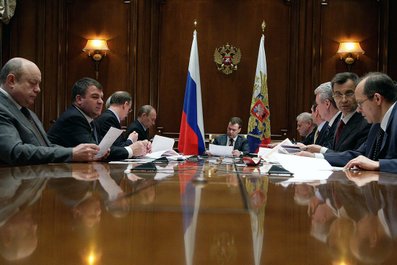
Medvedev and Security Council

Medvedev also told the Security Council he’s approved the “Fundamentals of State Policy in Nuclear Deterrence to 2020.”  But only the Military Doctrine’s been posted on Kremlin.ru.