Monthly Archives: November 2011

Nyet Means “Not Yet”

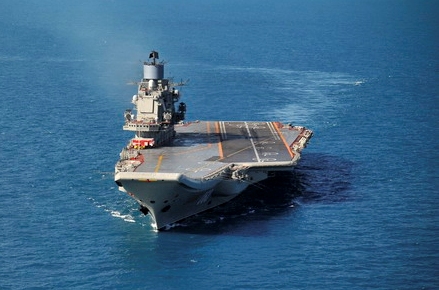
Fleet Admiral of the Soviet Union Kuznetsov (photo: Denis Abramov)

Russian aircraft carrier lobbyists — admirals and shipbuilders — define persistence.  To them, nyet means “not yet” or “keep trying.”

Izvestiya’s Denis Telmanov reported this week on future plans to build two new nuclear-powered aircraft carriers by 2027 — one for the Pacific Fleet and one for the Northern Fleet — along with 15-ship battle groups to surround them.

After years of arguing, the admirals reportedly decided they need carriers (not just nuclear subs and cruisers) to “broaden the Russian Navy’s zone of influence in the Pacific Ocean and North Atlantic.”

The Navy is reportedly completing the “technical tasks” for a new carrier, with a first design due next year, and the final one by 2017.  The first hull is supposed to be launched in 2023.  According to Izvestiya, sections and components will be built in several shipyards, but final assembly will be at Sevmash to save resources instead of building a new yard large enough to put a carrier together.

The article might be as much about where carriers would be built as if they will be.  There has been talk that the nascent New-Admiralty Wharves could get this work.

Izvestiya says land-based carrier trainers at Yeysk and Saki (NITKA) in Crimea will be used.  The paper also notes the new carriers will need new support bases because the lack of them “killed” or complicated the service lives of Soviet “heavy aircraft-carrying cruisers,” including the Kuznetsov.

One surmises that Russia’s coming experience with building, basing, and operating Mistrals will affect all this too.

But let’s rewind a bit . . . Navy CINC, Admiral Vysotskiy said in early 2010 that Russia plans to launch a carrier by 2020.  Defense Minister Serdyukov, however, has said twice in the last year that Russia has no plans to build carriers in the near future [by 2020].  On July 1, he emphasized that the Genshtab and Navy will decide on the need for an aircraft carrier after a “preliminary design” is complete.

No matter how much some say “Russia must have aircraft carriers,” it ain’t necessarily so. 

It ain’t so because (1) Russia may have more important requirements to fill with its limited resources, and (2) the people talking about carriers ain’t the same people who ultimately decide which requirements get met. 

Telmanov’s article is full of this:

“Strategists insist . . . .  The Navy has decided . . . .  The admirals have selected . . . .  In the military’s opinion . . . .  A Navy Main Staff representative explained . . . .  The military is deciding . . . .”

Not this:

“The president has decided . . . .  The government has selected . . . .  The VPK insists . . . .  The defense minister explained . . . .  In the General Staff’s opinion . . . .”

When we read that these types of people have decided to build carriers, it might really happen.
Farewell Russian Arms and Russian Army

Does it matter what old soldiers think?  It doesn’t seem to right now.  Maybe they’re just bitter old dudes whose time has passed. 

But they certainly provide interesting and frank commentary on the state of the OPK, the Armed Forces, and Serdyukov’s reforms at odds with official pronouncements from the Kremlin, White House, and Defense Ministry.

Former 58th Army Commander, retired General-Lieutenant Viktor Sobolev wrote recently for Pravda.  He reacted to a program on the army on NTV from October 9.  It apparently wasn’t posted on NTV’s site. 

Sobolev says this right up front:

“On the eve of elections, our president and Supreme Commander-in-Chief Dmitriy Medvedev and ‘national leader’ Vladimir Putin have been worried in turn by the condition of the country’s army and military-industrial complex and are assuring gullible Russian citizens that they will do everything so that our Armed Forces meet modern requirements and receive new types of armaments and military equipment in a timely manner.”

“The Russian mass media [SMI] under the government’s and president’s control have been actively used in making these assurances.”

The ex-general-lieutenant is critical of just about everyone:  Serdyukov and his “effective” managers, people who haven’t served in the army, former First Deputy Defense Minister Popovkin who wanted to buy more arms abroad, his successor Sukhorukov who dares insist that defense enterprises substantiate their prices, independent defense commentators like Litovkin and Pukhov, interest-hungry banks, corrupt middlemen.

He points only to Tactical Missile Armaments Corporation General Director Boris Obnosov in a positive light for recognizing that other countries won’t sell Russia their best weaponry. 

Still, Sobolev’s under a bit of a misimpression thinking that Moscow is really buying lots abroad.  In fact, a cynical observer might conclude the whole situation over the last year was designed to let Putin be the champion of the domestic defense sector vs. Medvedev the Westernizer.  But we digress . . . 

For Sobolev, this all sums to an OPK with a broken GOZ, that’s chronically underfinanced and losing its capability to produce modern arms and equipment. 

Again, the cynic might say this was already lost a number of years ago.

But, says Sobolev, when compared with the OPK:

“Even worse is the situation in the Armed Forces.  It’s believed we have a million-man army which Mr. Sukhorukov recalled on this program.  Let’s calculate it together.  According to TO&E, there are 150 thousand officers in the army, no warrants at all, they were liquidated.  According to civilian [but he still wears his uniform] GOMU Chief V. Smirnov, 184 thousand contractees are serving in the army and navy.  In all 334 thousand, the remaining 666 thousand are conscript servicemen.  But they simply couldn’t have called up so many.  Moreover, conscripts serve not only in the army and navy, of the number called up, up to 30% serve in the Internal Troops, Border Guards, MChS units, presidential regiment, and so forth.  This means in the army and navy huge undermanning exists, and it will only get bigger.  It’s planned to reduce the fall callup by 2 times.  More than 200 thousand citizens, according to Smirnov, are evading military service.  The spring callup stretches out to September, and the fall until March.  In the troops, they’re occupied with it constantly, in the course of the entire year, they take young soldiers into their ranks in small groups, organize individual training for them and try to man sub-units.  At the same time, the process of dismissal also goes on without interruption.  In these conditions, you can’t talk about any kind of quality manning of sub-units.  What kind of units of permanent combat readiness are these?”

“Therefore NATO’s military analysts note with satisfaction that, as a result of the reforms conducted, Russia’s Armed Forces aren’t capable of completing missions even in local conflicts, ‘The Russian Army does not have a sufficient quantity of transport resources for redeploying troops over great distances, does not have a sufficient quantity of aircraft and pilots who know how to fly in any weather, no unified information system.  There are not enough soldiers in the army . . .’”

“In NATO, they understand the Russian Army’s fallen apart, but how about our country’s leadership?”

Whoa. 

Sobolev’s no crank, and he’s not to be taken lightly.  Born and schooled in southern Russia, he probably has combat experience whereas the current General Staff Chief and Ground Troops CINC probably don’t.  Sobolev served as Deputy Commander of the OGV(s) in Chechnya in 2002, before taking over the NCMD’s 58th Army in 2003.  He ended his career as the chief military advisor in Russia’s Indian embassy in late 2010.

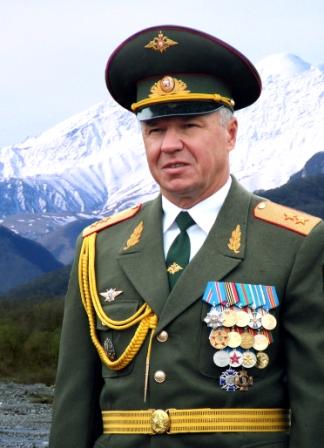
General-Lieutenant Sobolev

A more recent photo shows him looking just about as fit in retirement at age 61.

One wonders if a conservative like Sobolev realizes how much his thinking coincides with that of more liberal critics he seems to detest.

The GRU’s Smiling Face

General-Colonel Aleksandr Shlyakhturov

One would like to get off the GRU topic, but we have to follow the news to some extent.  General-Colonel Shlyakhturov not only spoke in advance of the November 5 military intelligence anniversary, but actually posed for a photo sporting a smile and his third star.

We don’t learn much here.  There are confirmations of what we’d already heard and read recently, or even long ago.  The GRU’s adapted for new missions, but keeps the old ones.  The threat from Georgia is emphasized as in previous years.  Military intelligence still falls under the Genshtab.  Shlyakhturov admits to restructuring and reducing, but insists the GRU’s still a “full-service” intelligence agency.  Spetsnaz has gone to the MDs, but the GRU still has a train and equip role.  Shlyakhturov hints that military intelligence is still very interested in foreign technology.

Interviewed in Rossiyskaya gazeta, the GRU Chief tells the paper how much times have changed, and the military intelligence agency now talks in terms of many-sided and multivector threats, rather than the “probable enemy.”

Shlyakhturov expounds on how terrorists and extremists pose the “greatest danger,” and the GRU monitors the situation in regions, like Georgia, from which this danger may emanate.  He’s quick, however, to deny that Russian special services have engaged in any subversive activity whatsoever against sovereign Georgia.  But, he says, the GRU will provide timely warning to the country’s military-political leadership if Tbilisi prepares “new military provocations against Russia and its regional allies.”  Changing tack, Shlyakhturov stresses that the GRU puts great stock in cooperating with special services of other countries to get threat information.

The GRU Chief says the agency is focused on “new” issues like economics, natural resources, and nuclear proliferation.  But it hasn’t lost focus on the disposition of foreign armies and armaments in different theaters of military operations and other issues that affect the employment and development of Russia’s Armed Forces.

Asked about reporting to the president, Shlyakhturov emphasizes that, as always, the GRU reports directly to the Defense Minister and Genshtab.  But the GRU’s most important documents still reach the president, prime minister, and Security Council, and influence Russia’s foreign and defense policies.

Shlyakhturov says the GRU has redistributed its efforts to focus on regions posing a threat to Russia’s interests and security, “hot spots” where terrorists and extremists operate, and crisis zones where international stability is threatened.

The GRU Chief admits there has been a reorganization and reduction in his agency.  As he puts it:

“Here’s the main thing you need to understand:   the changed world situation objectively required adjustments in intelligence priorities and their implementation mechanism.”

He notes, however, that the GRU still has operational, technical, information-analytical, and support sub-units as well as what he claims is a very spartan central apparatus, or headquarters staff.

Spetsnaz has, Shlyakhturov admits, gone to the MDs, fleets, and VDV, but he says they’re still part of operational intelligence, and the GRU provides their doctrine, training, and equipment.

Finally, he says the GRU remains interested in foreign technology developments, and its work here supports R&D efforts, the OPK, and the state program of armaments.

The Ayderkhanov Case (Part II)

According to Newsru.com, Aleksandr Vlasov concluded the traumas on Ayderkhanov’s body were inflicted while he was still alive, and the GVP’s statements about hitting the tree are a fiction without objective confirmation. 

Meanwhile, Ayderkhanov’s relatives organized a round-the-clock vigil at his grave to prevent anyone from stealing his body [i.e. the evidence].  Apparently, some people came looking for his grave on October 18, according to IA Rosbalt.

Ayderkhanov’s aunt told Radio Svoboda that he was full of life and not the type to commit suicide.  Nor was he likely to have conflicts with other soldiers.  She described what happened to her nephew as not just a beating,  but torture.  She said she knew the Yelan garrison had a bad record of conscript abuse.

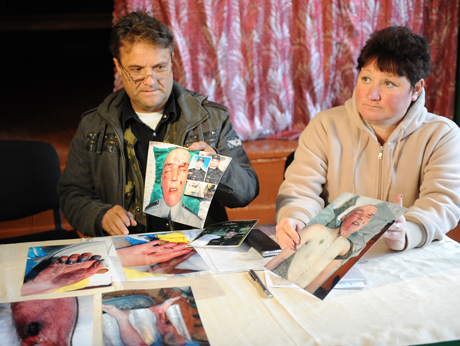
Post-Mortem Photos

Ura.ru writes that this is the third army tragedy in the last six years for Ayderkhanov’s home village Araslanovo and its 800 inhabitants.  The grandson of a local reportedly hung himself while serving in 2005, and another boy ran away from his unit and was found frozen to death in 2008.

In late September, 500 people from Araslanovo (as well as nearby Shemakha, Mezhevaya, Tashkinovo and Skaz) signed an appeal asking President Medvedev to get to bottom of Ayderkhanov’s murder, and accusing his officers of concealing it.  The appeal asks if someone can really commit suicide after such savage punishment?  It notes Ayderkhanov wanted to serve, and even considered staying in the army as a contractee. 

The appeal asks when disorder in the Armed Forces will end, and claims everyone knows such a state of affairs exists not just in Ayderkhanov’s unit but in many others as well.  Finally, the appeal says the people of these villages are stopping the fall draft until order’s established in Ayderkhanov’s unit, and those guilty of beating and killing him are punished.

Despite some sympathy with the cause, the local military commissar has warned that draft evaders will be punished.

According to Ura, some locals believe Ayderkhanov was killed because he was Tatar.  Others who previously served in V / Ch 55062 say the unit was rife with nationalism, dedovshchina, and extortion.

It’s interesting and sad (perhaps not surprising though) that no wider social or political outrage — similar to what occurred in 2006 after the Andrey Sychev case — has developed over Ayderkhanov.