Yearly Archives: 2019

Russia’s “Strategy of Limited Actions”

Army General Valeriy Gerasimov

Saturday Russia’s quasi-governmental Academy of Military Sciences conducted its annual conference on military strategy. General Staff Chief Valeriy Gerasimov made the keynote address, but only drips and drabs of his speech have been publicized thus far.

Russian news agencies focused on his remarks about an alleged Pentagon “Trojan Horse” strategy to weaken and overthrow anti-U.S. regimes around the world.

More interesting, perhaps, were Gerasimov’s comments about a new strategy for foreign intervention and limited war in defense of Russian interests.

The General Staff Chief reportedly told his audience that the experience in Syria had allowed the MOD to distinguish this new, practical area of Russian strategy.

According to Interfaks-AVN, Gerasimov said:

“This is carrying out missions to defend and advance national interests beyond the borders of Russian territory in the framework of a ‘strategy of limited action.'”

“The foundation for implementing this strategy is the creation of self-sufficient troop groupings on the base of formations from one armed service which has high mobility and is capable of making the greatest contribution to carrying out the missions set forth. In Syria such a role was given to the formations of the Aerospace Forces.”

“The most important conditions for implementing this strategy are winning and maintaining information superiority, anticipatory readiness of command and control and comprehensive support systems, and also covert deployment of the necessary grouping.”

He didn’t mention them but Russia’s invasion of Crimea and war in eastern Ukraine also qualify as examples of Russia’s new “strategy of limited action,” its new limited war doctrine if you will. Or the deployment of ChVK Vagner mercenaries and MOD trainers in Africa.

Surprise and covert deployment are what Moscow has been best at lately.

But the Russian military is not as ready for expeditionary warfare in the Third World as it was politically, diplomatically, and militarily in the 1970s or 1980s. And a one-service operation abroad goes against the grain of traditional Soviet and Russian military thinking.

With ideology (beyond opposing alleged U.S. domination of the world order) gone from the equation, which Russian interests will be supported by the “strategy of limited actions?” The interests of the Kremlin-sponsored political and financial elite? The Putin regime’s interest in distracting Russia’s attention from its domestic problems?

Big Star for Salyukov

Russian Federation President Vladimir Putin signed out his Defenders’ Day promotion list yesterday with something unexpected.

Putin handed out the four-star rank of army general for the first time in a while. To Ground Troops CINC Oleg Salyukov.

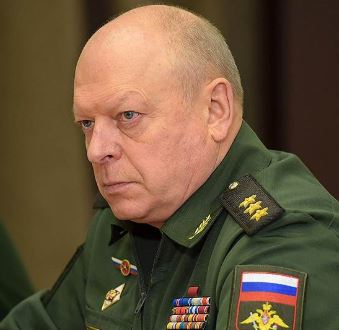
Salyukov wearing general-colonel

Salyukov wearing general-colonel

Russian media outlets say Putin gave army general to Rosgvardiya chief Viktor Zolotov and Deputy Defense Minister Pavel Popov in 2015. But we’re not talking about cronies and creatures of Putin or Defense Minister Shoygu.

We’re not talking about Shoygu himself, who got his four-star rank as a politician and bureaucrat.

And we’re not talking about Deputy Defense Minister Nikolay Pankov, FSB man and associate of former defense minister Sergey Ivanov. (Pankov’s a fascinating and separate story. He’s the longtime éminence grise of the MOD. One might bet he’s always been Putin’s reliable spy in the high command. He’s also been officially retired from military service for some time.)

So here’s the short list of current Russian Armed Forces four-stars:

  • Army General Valeriy Gerasimov obviously. He became Chief of the General Staff when Shoygu became Minister of Defense. Gerasimov got his fourth star less than four months later — February 20, 2013.
  • Deputy Defense Minister and Chief of Material-Technical Support Dmitriy Bulgakov has been at his post since 2008. He became army general on February 23, 2011.

It’s safe to conclude then that Putin’s been quite parsimonious with the “big star.”

Recall Russia’s gone back and forth on four stars. For some time, army generals actually wore four stars. Now they wear a single “big star” like marshals, but on different epaulets.

The Russian army general rank, however, is equivalent to a full U.S. General (O-10) wearing four stars.

The last Ground Troops, Air Forces, and Navy CINCs to wear four stars were Vladimir Boldyrev in 2010, Vladimir Mikhaylov in 2007, and Vladimir Masorin in 2007.

So why promote Salyukov to four-star? It doesn’t buy him more service time; by law, he still has to retire in 2020. He’ll be 65 on May 21, 2020.

We should note also that Gerasimov will be 65 on September 8, 2020 and old man Bulgakov on October 20, 2019.

But like all Russian laws, the law on military service tenure can be ignored or changed easily if Putin wants.

A little more about Salyukov. He’s a tanker. He served in the old Kiev MD as a junior officer, and then the Moscow MD. He was deputy commander of the 4th Kantemir Tank Division. After the General Staff Academy, he went to the old Far East MD in 1996, serving from division commander to commander of the district in 2010.

When the MD system was reduced to just four MDs, Salyukov returned to Moscow for a four-year stint as deputy chief of the General Staff. In May 2014, he became Ground Troops CINC. His official bio says he’s a combat veteran, but it’s unclear where he was actually under fire.

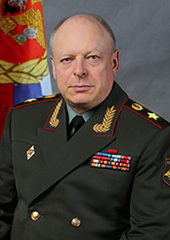
P.S. Here’s the latest official photo of Salyukov.

Salyukov sporting big star

Salyukov sporting “big star”

Death of a Conscript

Authorities are investigating the murder of a 19-year-old Russian conscript in his motorized rifle regiment near Voronezh. The Western MD at first reported he died of a heart attack, but he was apparently beaten to death.

The regiment is a troubled unit where other servicemen have been murdered, died under suspicious circumstances, or committed suicide in recent years. 

Stepan Tsymbal

Last fall Stepan Tsymbal was called up to the army from his home near Korenovsk, Krasnodar territory. He was sent to military unit 91711 — the 252nd Motorized Rifle Regiment of the 3rd MRD in Boguchar, Voronezh region.

He served in the regiment’s material-support company, possibly as a cook. The regiment was deployed to a field encampment on the Pogonovo range for training in early February.

Tsymbal was found dead on February 10. The commanding officer informed his family the next morning. They were told his heart stopped. The Western MD initially and inexplicably reported no signs of violence on Tsymbal’s body. However, the death notice from his regiment even indicated he was the victim of a violent attack.
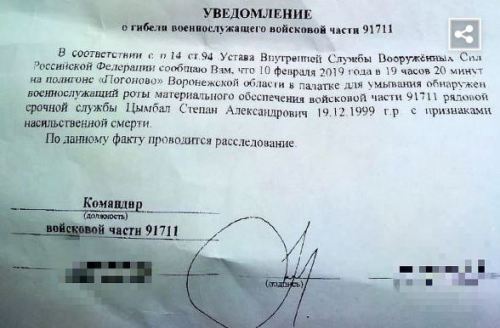
Stepan Tsymbal's death notice

According to Yuga.ru, the Investigative Department for the Voronezh garrison opened a murder investigation on February 11.

The military returned his body on February 13 but his family wasn’t allowed to view it completely. But they didn’t need to see much to see Stepan was beaten to death.

His stepfather Dmitriy told Yuga.ru:

“They didn’t show us the body fully. We saw his face a little. His mouth was all bloody, as if his teeth had been kicked in. It was also like he had no eyes, gauze was placed on them. And his entire face was wrapped [with gauze] and poured over with some kind of glue. In the temple area, we also saw a hematoma, a dent. And his hands were also very strange. Some kind of black like they hadn’t been washed.”

Dmitriy told the regional news agency that, in regular calls home, Stepan hadn’t complained about military service or mentioned any hazing or abuse.

His body came back without his documents, mobile phone, or the crucifix and glasses he wore, according to his stepfather.

His family said Stepan had no previous heart ailments. He passed through the normal  medical exams prior to entering the service and the doctors had found nothing to keep him out of the army, according to the Kuban edition of Komsomolskaya pravda.

According to KP-Kuban, Stepan’s other relatives said:

“His mouth was bloody, near the temple there was a dent and hematoma. It was like he didn’t have eyes, gauze was on them, and his entire face was simply wound with bandages poured over with some kind of glue. The impression is as if they tried to hide something.”

His hands were reportedly purple in color right up to the wrist.

KP-Kuban reported that it obtained part of an investigative report saying:

“They found Tsymbal in the dishwashing tent, on the floor. He was in a sitting position with legs and arms taped together and stretched out in front. And there was a plastic bag on his head, wrapped around his neck with adhesive tape.”

The news agency’s source said his head was beaten. There was a large abrasion on the back of the head, so it’s possible he died from a closed head injury.

Relatives said they’d heard a lot about his unit, and other guys who died there. So, they won’t let the case be hushed up and want the guilty to be found and punished to the extent of the law.

According to Lenta.ru, the Union of Committees of Soldiers’ Mothers says two servicemen have already been arrested on suspicion of involvement in his death while four others who found the body are being detained by base security.

It seems likely the law and order situation in Russia’s military has improved over the past five or six years since the armed forces have received greater funding and political attention. But the savage killing of Tsymbal shows it’s still not exactly safe for young Russians to serve in the army.

Furthermore, it’s difficult to gauge how frequently conscripts are dying today because the Kremlin and MOD have made a concerted effort to suppress bad news whenever possible. Their next step will be to lean on Tsymbal’s family or pay them off to stay quiet about what happened to him.

Today’s press said Tsymbal’s parents have created a petition addressed to the MOD, Main Military Prosecutor, and Main Military Investigative Directorate demanding punishment for the unit’s commander and the disbanding of the regiment.

Reports on the condition of the boy’s body have become more graphic and gruesome saying that half his face was gone. It certainly sounds like something more than a murder in the heat of the moment. It seems like someone was trying to send other soldiers a message.

See this old post covering Gazeta.ru’s reporting about this troubled regiment where Stepan Tsymbal served.

Officers reportedly often extorted money from conscripts for the “needs of the unit.” They also used soldiers from the material-support battalion as enforcers to keep other troops in line. The unit canteen was supposedly used as a “mobile trading post” for the financial benefit of officers. Perhaps something akin to this had some part in Tsymbal’s death. But there are likely plenty of men in the unit who know what led to this if they aren’t afraid to talk and are allowed to.

The case of Stepan Tsymbal might be galvanizing like that of Andrey Sychev. At least, it could take considerable effort for the Kremlin and military to quash it.

Return of Neustrashimyy

Russian press reported recently that project 11540 frigate Neustrashimyy (SKR 712) will  rejoin the Baltic Fleet before the end of 2019.

The 26-year-old ship’s extended capital repairs began when it arrived at Yantar in Kaliningrad in early 2014.

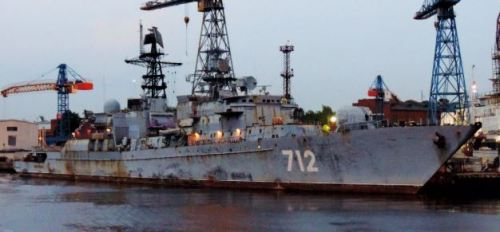
Neustrashimyy looking worse for wear some years ago

Neustrashimyy looking worse for wear some years ago

Neustrashimyy is supposed to begin moored trials in May, underway tests in August, and return to service in November.

Delivery of the refurbished ship has been postponed for various reasons, including difficulties in repairing its Ukrainian gas turbine engines after Russia’s invasion of Crimea and eastern Ukraine in 2014.

That problem has been surmounted reportedly, and Yantar will receive the renovated engines from a Russian manufacturer (probably NPO Saturn) by spring. We’ll see.

The ship suffered a minor fire due to careless welding almost exactly one year ago. That also likely contributed to the delay.

Under a “medium repair” scheduled for completion by December 2016, Yantar is repairing Neustrashimyy’s hull, screws, and shafts. The ship’s water pumps, firefighting, fuel, electrical, and control systems are also being updated. The yard is reassembling equipment and preparing to relaunch the ship at present.

According to Flotprom.ru, the original deadline was pushed to November 2017, and then to November 2019.

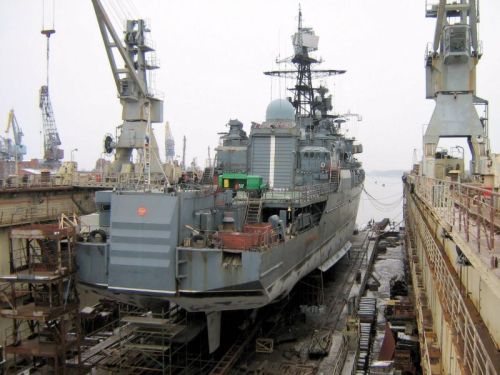
Neustrashimyy in drydock

Neustrashimyy in drydock

The 3,800-ton frigate was laid down in 1987 and commissioned in 1993. It has participated in exercises with NATO countries and anti-piracy patrols off Somalia, operated in Russia’s Mediterranean ship group, and conducted many foreign port visits.

Project 11540 stopped at unit 2 Yaroslav Mudryy, which is also part of the Baltic Fleet. Instead of project 11540, the Russian Navy opted to build project 11356 Admiral Grigorovich-class frigates.

Army Commanders

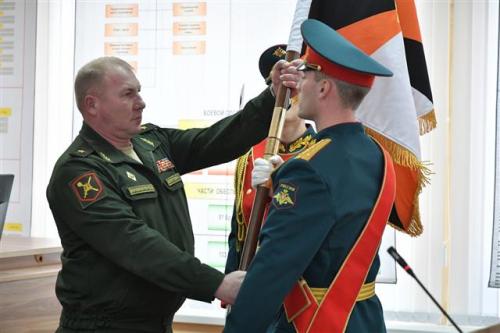
general-major andrey kolotovkin receives the 2nd caa standard

General-Major Andrey Kolotovkin receives the 2nd CAA standard

Seven new Russian combined arms (or tank) army commanders have been appointed since early 2017. Five old ones remain in place.

Eighteen months ago, only three were at post they held 18 months prior to that (i.e. in early 2016).

But two — General-Lieutenants Kuzmenko and Sevryukov — have now served in the same spot for three years or more.

The current rundown of armies, headquarters, MD/OSK, and commanders looks like this:

1st TA…Bakovka…Western…General-Major Sergey Kisel.

6th CAA…Agalatovo…Western…General-Lieutenant Andrey Kuzmenko.

20th CAA…Voronezh…Western…General-Major Andrey Ivanayev.

8th CAA…Novocherkassk…Southern…General-Lieutenant Sergey Kuzovlev.

49th CAA…Stavropol…Southern…General-Lieutenant Sergey Sevryukov.

58th CAA…Vladikavkaz…Southern…General-Lieutenant Yevgeniy Nikiforov.

2nd CAA…Samara…Central…General-Major Andrey Kolotovkin.

41st CAA…Novosibirsk…Central…General-Major Yakov Rezantsev.

36th CAA…Ulan Ude…Eastern…General-Major Mikhail Nosulev.

29th CAA…Chita…Eastern…General-Major Roman Berdnikov.

35th CAA…Belogorsk…Eastern…General-Major Sergey Chebotarev.

5th CAA…Ussuriysk…Eastern…General-Major Oleg Tsekov.

Kisel replaced General-Lieutenant Avdeyev who went to head the Combined Arms Academy. Ivanayev took the place of General-Major Peryazev who moved to the MOD’s Main Combat Training Directorate. 

There’s been considerable churn in the 2nd CAA. In early 2017, General-Major Zhidko was its commander. In less than two years, he served as chief of staff, first deputy commander for the Russian group of forces in Syria, deputy chief of the General Staff, and Commander of the Eastern MD.

General-Major Rustam Muradov replaced the meteoric Zhidko before being replaced himself by General-Major Kolotovkin. Muradov is now a deputy commander of the Southern MD.

General-Lieutenant Zavizon was relieved by Rezantsev. Zavizon is probably in Syria, or, less likely but possibly, even eastern Ukraine.

Followed by Nosulev, General-Major Kovalenko went to the unusual post of deputy commander of the Pacific Fleet for ground and coastal troops.

General-Major Poplavskiy became a deputy commander of the Central MD when Berdnikov replaced him.

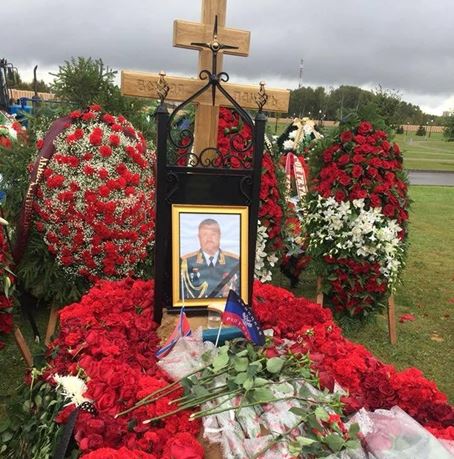
Tsekov took over the 5th CAA after General-Lieutenant Asapov died in a mortar attack in Syria in 2017.

general-lieutenant asapov's grave

General-Lieutenant Asapov’s grave

An observer has noted a flag from the so-called Donetsk People’s Republic on Asapov’s grave. According to some, he commanded the DNR’s “1st Army Corps” at one point. He reportedly also saw combat in Chechnya and Abkhazia as well.

Combat Experience

When Russian President Vladimir Putin got serious about modernizing his military in 2013, he lacked something: somewhere to flex those new muscles.

It’s a “chicken or the egg” paradox. Does a country really have military power if it doesn’t use it? Or does the process of employing the country’s military create that power?

The leaders of the world’s most bellicose nations don’t feel secure until they’ve seen their troops in combat, no matter how well manned, equipped, and trained they are. Supreme CINCs like to see the effect using their military power has on others.

The Kremlin watched while U.S. and NATO forces were used in many places around the globe in the 1990s and 2000s. There were some senior Russian officers who’d done a tour in Afghanistan during the 1980s. But Moscow’s soldiers — and precious few at that — had only Chechnya and Georgia, and the results weren’t encouraging.

So Putin’s modernized forces got their first real practice annexing Crimea and invading eastern Ukraine in 2014. And though Moscow can’t advertise, its generals and units have been fighting alongside the Russian militias in Donetsk and Lugansk ever since.

Syria served as a bigger firing range.

Russia’s intervention in the Syrian civil war in 2015 provided not just a live proving ground for the new weapons and equipment Moscow procured. It created another opportunity for Russian officers and soldiers to acquire combat experience.

There have been various Russian media summaries capturing this, but Interfaks-AVN published one recently that seems pretty comprehensive.

According to Interfaks-AVN, the Russian MOD announced that 68,000 troops, including 460 generals, have received combat experience in Syria.

It indicated that the commanders of all four Russian military districts, all combined arms army and air and air defense army commanders, all division commanders, and also 96 percent of combined arms brigade and regiment commanders have served in Syria.

The MOD said 87 percent of frontal aviation crews, 91 percent of army aviation crews, 97 percent of transport aviation crews, and 60 percent of strategic Long-Range Aviation crews have gotten combat experience over Syria.

The Russian Defense Ministry added that it’s reducing its contingent in Syria now.

These are, of course, pretty remarkable claims, but one wonders: does Russia have 460 general officers in combat command positions from which they could be sent for a tour in a war zone?

Latest Promotions

RF President Vladimir Putin signed out his latest promotion list on December 12, 2018. For the MOD, it included two new three-stars, 10 two-stars, and 11 one-stars.

Against 23 MOD promotees, the National Guard had 13 (1 three-star, 3 two-stars, and 9 one-stars).

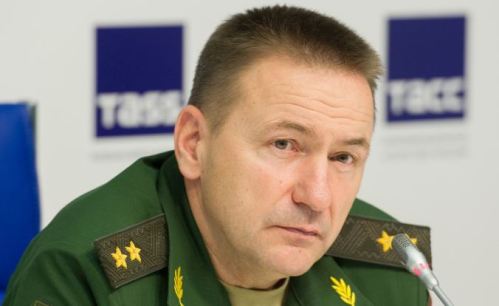
Chief of Staff and First Deputy Commander of the Central MD Yevgeniy Ustinov became a general-colonel.

yevgeniy ustinov wearing two stars

Ustinov served as a conscript in 1979-1980 before becoming a career Airborne Troops officer. He earned combat experience in his two years in Afghanistan serving as a deputy battalion commander.

After mid-career assignments and graduating MAGS, he served briefly as commander of the 106th Airborne Division in 2007. In 2009, he became deputy commander of the former Leningrad MD, and then commanded its 6th CAA.

He became deputy commander of the Central MD in 2013. He was TDY in Syria during 2016-2017 when he participated in the second operation to reclaim Palmyra. He was one of the leading contenders to replace Vladimir Shamanov as VDV commander in 2016.

He was passed over when younger General-Lieutenant Aleksandr Lapin was brought in from the Eastern MD to command the Central MD in 2017.

Ustinov has been acting MD commander since October so Lapin is likely commanding Russian forces in Syria now. But what about when Lapin returns? A two-star with a three-star first deputy? Lapin is likely to get his third star in February before he returns to the Central MD.

VDV generals who’ve traded blue for green uniforms may experience jealousy and resentment from career Ground Troops colleagues. Ustinov could be the victim of some of this.

Also getting his third star is Baltic Fleet Commander Admiral Aleksandr Nosatov who got his current post when his predecessor was dismissed for deficiencies in combat training and for distorted reports about the state of his command.

The two-star promotions include:

  • Chief of the command center of the Main Command of Ground Troops;
  • Commander of the RVSN’s 27th Missile Army;
  • Chief of Radiological, Chemical, and Biological Defense (RKhBZ) Troops;
  • Commander of the 58th CAA;
  • Chief of staff, first deputy commander of the Northern Fleet;
  • Chief of staff, first deputy commander of the Black Sea Fleet;
  • A senior air forces officer serving as a deputy chief of the General Staff’s Main Operations Directorate;
  • A duty general from the National Defense Command and Control Center;
  • Deputy commander for material-technical support, Northern Fleet;
  • Deputy chief of the material-technical support directorate, Aerospace Forces.

The one-stars include:

  • Chief of staff, first deputy commander of the Pacific Fleet’s Primorsk Flotilla;
  • Commander of the RVSN’s 7th Missile Division;
  • Commander of the 32nd Air Defense Division;
  • Commander of the 76th Air Defense Division;
  • Commander of the 8th Special Designation Aviation Division;
  • Deputy chief of the Military-Academy of Communications;
  • Chief of the Military-Orchestra Service.

Four new general-majors could not be identified in a post at present.

Airmobile Groups

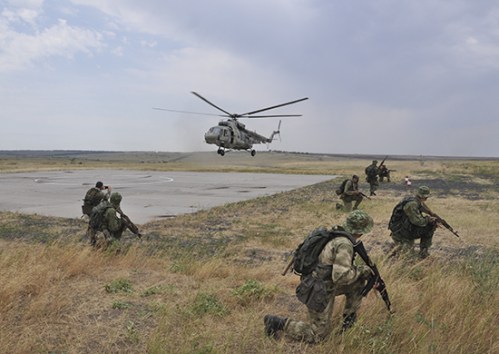
An airmobile group

The Ground Troops of Russia’s Southern MD are resurrecting airmobile groups. Recent Mil.ru press-releases have highlighted them. Though clearly still developing, they are far enough along to advertise them.

Shortly after the December 1 start of Russia’s new training year, Southern MD Commander General-Colonel Aleksandr Dvornikov declared that every battalion, regiment, brigade, and division in his AOR will establish and train airmobile groups.

He continued:

“Up to 40 helicopters of various designations — strike, combat-transport and transport — must support the completion of the combat-training missions of each company tactical group.”

Forty helos is a stiff requirement even for the Southern MD with a brigade plus two independent regiments of rotary wing air support.

Airmobile groups have been established in the Volgograd-based 20th MRB. According to Mil.ru, they have spent a month on the Prudboy range training for tactical air assaults, employing helicopter fire support, landing on different terrain day and night, and using night vision goggles.

The 150th MRD in Rostov oblast has airmobile groups. Mil.ru reported on Mi-8AMTSh Terminator helos flying in support of them. The site indicated that the groups are outfitted with the RPG-7B, AGS-17 Plamya grenade launchers, 2S12 Sani mortars, Igla (SA-18) MANPADS, and Belozer satellite comms.

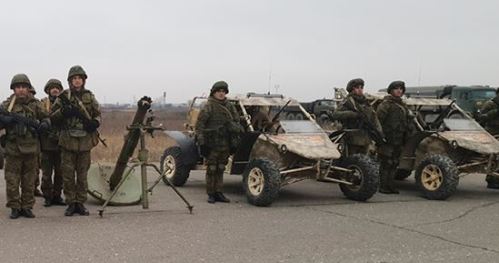
Mil.ru showed the 136th MRB’s airmobile groups with buggy-like light vehicles.

Airmobile group with ATVs

Airmobile groups sound like platoons, so several groups will probably constitute a company-sized unit for divisions or brigades.

In Soviet times, combined arms armies also had airmobile battalions.

Russian divisions and brigades won’t own helos to support airmobile groups. The MD commander, leading the joint strategic command (OSK) in his AOR, will task his air force component to support them.

Some Soviet divisions and armies had organic squadrons and regiments with Mi-8 and Mi-24 helicopters.

New Russian airmobile groups may not become named TO&E elements, but remain motorized rifle platoons or companies with training sufficient to be designated “airmobile capable” — if only parenthetically.

There’s significant history to this story. The Russian Army lost ownership of its aviation in 2002 when the General Staff gave it to the air force. But, in 2010, all theater air assets came under control of the OSK commander — a Ground Troops general. Then, in 2013, the army surrendered its three air-assault brigades to the Airborne Troops.

So the formation of airmobile groups may be, at least partially, about Russian ground pounders reclaiming some air support and airmobile missions from the other services.

Vertical envelopment wasn’t forgotten in Russia, it just became the exclusive province of the VDV, and to a lesser extent Spetsnaz and Naval Infantry, for a while. General-Colonel Dvornikov appears to be leading the charge to reinvigorate air mobility as a facet of the Russian Army’s tactical doctrine.